25
Developing of Ethylene Glycol as a New Reducing
Agent for Preparation of Pd-Ag/PSS Composite
Membrane for Hydrogen Separation
L. Samiee*, M. Dehghani Mobarake, R. Karami, and M. Ayazi,
Development and Optimization of Energy Technologies Research Division, Research Institute of Petro-leum Industry (RIPI)
Abstract
In the present work, for the first time, a palladiumsilver membrane has been prepared by electroless plating on the surface of a porous stainless steel disk by using ethylene glycol as a new reducing agent and polyol process. The reducing action of ethylene-glycol in the presence of PVP as a protecting surface agent produces a membrane with finely divided powder and nanosized pores. Furthermore, the hydrogen separation ability of the membrane confirmed that the membrane with Pd77Ag23 is highly selective towards hydrogen compared to other prepared membranes. This is mainly related to the formation of dense and homogenous microstructure of the coating. Moreover, according to Graham’s law, the tests showed that hydrogen purity rises by increasing the applying temperature.
Keywords:
Pd-Ag Membrane, Polyol Process, Ethylene Glycol, Hydrogen SeparationIntroduction
Attempts to utilize pure palladium as a hydrogen separa-tion membrane were severely hampered by the extremely high solubility of hydrogen in palladium below 300 °C, leading to the formation of a separate palladium-hydride phase, with a much larger lattice constant compared to pure Pd [1]. The subsequent distortion of the lattice is the cause of hydrogen embrittlement.
Alloying of palladium with other metals, particularly sil-ver, was investigated by Hunter and coworkers at the At-lantic Refining Company in collaboration with J. Bishop Company which later became Johnson-Matthey [2,3]. In his patent published in 1956 [4], Hunter disclosed that alloying palladium with 27 wt% Ag not only prevented hydrogen embrittlement, but also improved the hydro-gen permeability of the alloy by 70% compared to pure palladium at 450 °C.
Historically, the production of high purity hydrogen has been based on the high temperature gas phase hydrogen permeation, but the beneficial aspects of low temperature permeation of high purity hydrogen are very important. The electrolysis of aqueous alkaline hydroxide solu-tions has been one of the most popular routes for the production of hydrogen and oxygen from water. No-table recent studies concerned with the improvement of
alkaline electrolysis processes have focused on the use of advanced anode materials in electrolyzers to reduce electrode polarization and thereby improving the overall electrical efficiency [5]. It has been appreciated for many years that electrolytic hydrogen will diffuse through the walls of the tubular palladium cathode against which it is generated. This neglected possibility of simultaneous generation and purification were utilized in the design of some compact electrolytic cells which can yield pure hydrogen for laboratory or other small scale work. Better results were obtained with the silver-palladium alloy which expanded less when fully charged with hydrogen [6-7]. Several methods are available for the formation of hy-drogen separation membranes such as phase inversion, rolling, electroless-plating, chemical vapor deposition (CVD), sputtering, spray pyrolysis, coatings, metal de-position, sol-gel, and so on [8].
Among other techniques, electroless deposition provides strong advantages such as the uniformity of deposits even on very complex shapes, very simple equipment, and low cost. This technique can be discussed in three sections; surface activation, bath chemistry, and electro-less plating procedures [5].
a stabilizing agent. Electroless plating process occurs on the solid liquid interface between support and the plating solution. It involves the reduction of a metal salt on a catalytic surface.
Several reductants are available for the electroless plat-ing process such as dialkylamine-borane, borohydride, hypophosphite, formaldehyde, and hydrazine. Hypo-phosphite is commonly used, but deposits contain phos-phorus, reducing the quality of the film [5]. Formalde hyde is not a good reducing agent, especially in the case of Pd deposition since H2 gas is released during plating and cracks the membrane. Also, the reducing effect of formaldehyde is very low (Ohno et al., 1985).
Hydrazine is the most commonly used reducing agent. The disadvantages of hydrazine and related compounds mainly include toxicity and carcinogenic effects. Hydrazine is toxic if inhaled, and it is an eye and skin irritant. Besides, the de-composition of hydrazine is directly responsible for the low plating efficiency of the hydrazinebased plating bath [5]. Recently, several studies have been reported related to the fabrication of Pd-Ag alloy particles with uniform mi-crostructure by using ethylene glycol as a solvent and a reductant agent [9-12].
In the present study, we propose the preparation of Pd-Ag/PSS composite membranes by using electroless de-position and employing ethylene glycol as a reductant and polyol process.
By considering the ethylene glycol as a reducing agent, we were therefore stimulated to study the hydrogen sep-aration activity of the new prepared Pd-Ag membrane and investigate the effect of the ratio of Pd to Ag on the hydrogen separation activity.
Experimental Procedures
Membrane SupportsPorous 316L stainless steel (PSS) supports (0.2 μm grade) were purchased from Mott Metallurgical Corpo-ration. PSS plates were prepared by cutting 1 dm2 PSS-316L sheets into 53.066 cm2 circular pieces.
Cleaning of the Supports
The surface of the PSS supports was cleaned prior to electroless deposition to remove contaminants such as oil, grease, and dirt.
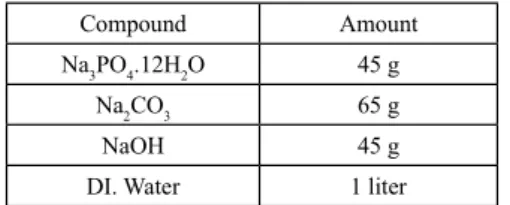
The composition of the alkaline solution used is given in Table 1. Then, the samples were thoroughly washed with high purity water (DI water) to remove the basic solution trapped in the pores of the supports. The last cleaning step involved a 10 min immersion in iso-propanol to eas-ily remove the water inside the pores. All cleaning steps were carried out in ultrasonic bath at 60 °C. Finally, the supports were dried at 120 °C for 3 hrs.
Formation of an Oxide Barrier Layer
After cleaning, the porous stainless steel supports were
oxidized in a high temperature furnace under air flowing at 550 °C for 10 hrs.
Table 1: Chemical composition of the alkaline solution
Compound Amount
Na3PO4.12H2O 45 g
Na2CO3 65 g
NaOH 45 g
DI. Water 1 liter
The rate of heating and cooling during the oxidation treatment were kept constant at 3 °C.min-1.
Activation Process of PSS Supports
The next step in membrane preparation is the surface ac-tivation for seeding the PSS surface with palladium nu-clei, which helps to achieve a better autocatalytic process of reduction of a metastable metal salt complex on the target surface during electroless plating. Solutions for the activation were prepared using tin (II) chloride di-hydrate and palladium (II) chloride. Two solutions were prepared by dissolving 1 g.l-1 SnCl
2 and 0.1 g.l-1 PdCL2 salts in 1 ml.l-1 of HCl solution. The activation process consisted of the immersion of the supports in an acidic SnCl2 solution (sensitizing) followed by an acidic PdCl2 solution at room temperature. After the immersion in the SnCl2 solution, a gentle rinsing with deionized water was used. Finally, the samples were rinsed with 0.01 M HCl and then with water. This cycle was repeated normally six to nine times.
Electroless Plating of Pd and Ag
A typical experimental procedure for electroless plating is described as follows:
First, 0.1331 gr of PdCl2 and 0.7980 gr of PVP were dis-solved in 15 ml of ethylene glycol as a solvent, and the formed suspension was mechanically stirred for 10 min to allow the dissolution of the precursors. Then, 0.1274 gr of AgNO3 and 0.8090 gr of PVP were added to the above suspension under agitation for 1 hour. The total concentration of metal ions and the ratio of PVP to the metal were kept at 0.05 M and 10 (w/w) respectively. The plating was done at 120 °C after 5 hours. Finally, the samples were rinsed in hot water and dried at 120 °C for 3 hours. The membranes were prepared for the different ratios of Pd to Ag.
The thermal treatment of asdeposited Pd–Ag films was carried out in a high temperature furnace under an N2 atmosphere. The temperature was increased at a rate of 1 °C.min-1 until it reached 550 °C and then was kept constant at this temperature for 10 hrs. After cooling the samples, they were put in a reactor and their permeation tests were carried out.
Membrane Characterization
tor. The X-ray diffraction (XRD) patterns of all the sam-ples were collected in a 2θ range between 30 ° and 60 ° by using Philips PW1840 diffractometer (Cu Kα1 radia tion, Kα1 = 1.5406Å) Micro gas chromatography(model Agilent 3000A) was used to analyze the outlet gases of the membrane.
Single Gas Permeation Test of the Membranes
A shell-and-tube apparatus shown in Figure 1 has been equipped with mass flow controllers, pressure control valves, and a temperature indicator to measure the per-meation of hydrogen and nitrogen through the present membranes. Both ends of the membrane tube were con-nected to inlet and outlet tubes and placed in the center of furnace. Hydrogen and nitrogen gases with a ratio of 50 to 50 were introduced into the membrane tube from outer shell through the mass flow controller and the gas perme ated through the membrane. Online gas chromatography was used to analyze the outlet gas of the membrane; it should be noted that the calibration of the chromatogra-phy was already performed with hydrogen gas (99.999% purity).A single point calibration was done by using the micro TCD’s linear dynamic range of 10 ppm to 100 percent. The system has a repeatability of 0.5 percent relative standard deviation and a linear detector response of ±5 percent over five orders of magnitude. Information is displayed in up to six display windows that support realtime monitoring of the defined signals of nitrogen and hydrogen compounds. Data is also sent to a CSV file for later processing in Microsoft Excel, for example. The measurements of hydrogen and nitrogen purification level were made at different temperatures (25-120 °C) and at a pressure difference of 400 kPa.
Results and Discussion
Structural Study of Pd/Ag Membrane
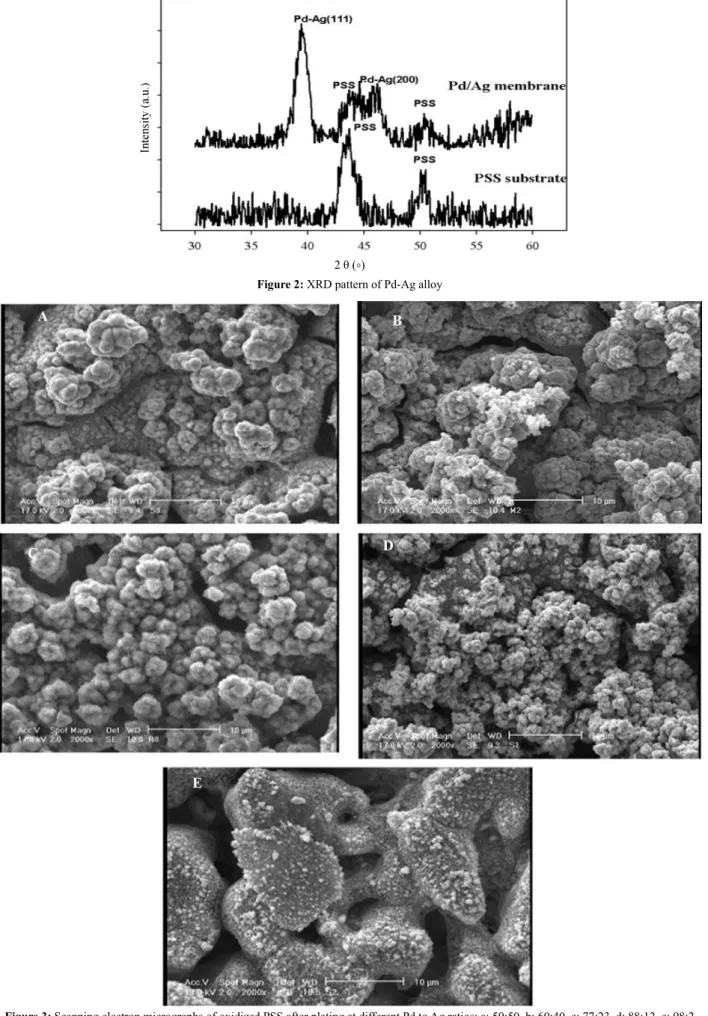
The phase properties of the Pd-Ag alloy membrane were investigated using XRD measurements. The results from XRD analysis are shown in Figure 2. The diffraction
peaks at 2θ=39.92° and 2θ=46.29° are related to PdAg alloy phase corresponding to 111 and 200 respectively. These results strongly indicate that the membrane ob-tained is an alloy of Pd and Ag [13]. The average particle size of the Pd-Ag alloy nanoparticles (d) was estimated by using Scherrer equation after background subtrac-tion from (111) peak at 2θ=39.42°. In the best sample (Pd77Ag23), the average particle size of the nanoparticles was around 11 nm. Figure 3 shows the typical scanning electron micrograph of the PSS coupons that were plated with Pd-Ag intermetallic alloy.
In the present work, the polyol process has been used for coating the PSS membrane. The polyol process has been recently proposed as a method for the preparation of fine ly divided powders of easily reducible metals [10,11]. A suitable solid inorganic compound is dissolved or sus-pended into a liquid polyol (e.g., ethylene-glycol, dieth-ylene-glycol or a mixture of both). Afterward, the system is stirred and heated to a given temperature, which can reach the boiling point of the polyol for less easily re-ducible metals. The reduction of the starting compound yields the metal as a finely divided powder. The starting compound may be a hydroxide, an oxide or a convenient salt. The main feature of the reaction mechanism is that the reduction reaction proceeds via the solution rather than the solid phase. Therefore, the metal particles are formed by nucleation and growth from solution. Accord-ing to this mechanism, the polyol acts as a solvent for the starting inorganic compound due to the rather high dielectric constant of these organic media. In particu-lar, silver nitrate and palladium chloride are soluble in ethylene-glycol to such an extent that a complete disso-lution is observed as the first step of the reaction. Nucle ation and growth must be completely separated in order to explain the fact that the obtained metal suspension is an almost homodisperse system. This condition, first ex pressed by La Mer [12, 13] in his study about sulfur sols from acidified thiosulfate solution, appears as a general condition to obtain a homodisperse system. The metal is slowly provided in solution by the progressive reduction of the dissolved species.
Figure 2: XRD pattern of Pd-Ag alloy
Figure 3: Scanning electron micrographs of oxidized PSS after plating at different Pd to Ag ratios; a: 50:50, b: 60:40, c: 77:23, d: 88:12, e: 98:2 2 θ (°)
A B
C D
In particular, the reducing action of ethylene-glycol can be monitored by analyzing the volatile compounds re-sulting from its oxidation. The formation of the main product, i.e. diacetyl, can be explained in terms of a double oxidation of acetaldehyde, previously produced by the dehydration of ethylene-glycol [11], as follows: CH2OH-CH2OH H2O CH
3-CHO (1) 2CH3CHO M+2H++CH
3-CO-CO- CH3 (2) During reaction (2), the metal concentration rises to the saturation where the nucleation can occur.
This condition results in the formation of many nuclei in a short burst. They grow rapidly and the metal concentra-tion is lowered to a point below the nucleaconcentra-tion concen-tration, but high enough to allow particle growth to occur at a rate that just consumes all the generated metal. An envelopment of the reduced metal atoms within a suit-able layer could act as a protection for the nanometric particles during their growth [14, 17]. A number of or-ganic materials are known to work as protective agents for preventing colloid sintering [18]. Among them, poly (N-vinylpyrrolidone) (PVP) exhibits the best protecting properties. The prevention of particle sintering can be achieved by adding a critical dosage of an organic pro-tective agent which covers the particles and inhibits any possibility of metal-metal particle bond formation. Such coordination interaction and the repulsion between polymer chains of PVP make the adsorption of PVP to be oriented in some definite directions, which leads to the growth of particles occurring in the preferred directions and being inhibited in other directions. This factor also contributes to particle shape and the final shape distribu tion. An increase in the concentration of the protecting agents suppresses the growth of metal particles, leading to smaller metal nanoparticles [12, 23].
Because of the relatively high temperature used in the annealing process, wide Brownian motions characterize the particles, and the atoms on their surface have an el-evated mobility. Consequently, the probability of particle collision, adhesion, and subsequent coalescence by sin-tering is enhanced.
Figure 3 shows that the deposits are a mixture of indi-vidual particles. EDS analysis (Figure 4) also proves that these particles are composed of Pd and Ag metals. With a further annealing step, these deposits make the Pd-Ag alloy.
Moreover, it can be clearly seen that a change in the metal ratio in the bath has a significant effect on the de posit concentration; an increase in the concentration of Ag in the solution results in an increase in the deposit concentration. Due to the very thin layers of Pd and Ag, the pores of the substrate can clearly be seen in Figure 3.e. As can be inferred from Figure 3, Ag shows a pref-erential deposition onto Pd. The deposits obtained are bimetallic; therefore, an increase in the Ag concentration in the deposits means relatively more surface coverage
by Ag deposits than Pd deposits. The lower catalytic activity of Ag for the ethylene glycol oxidation means that as the Ag concentration in the deposits increases, the electroless deposition potential rises too. The high over-potential associated with the Pd deposition also means that when the Ag concentration is 2 wt% in the solution, the electroless deposition potential decreases to an extent that the Pd deposition is not possible anymore [24]. Ag has a passivating effect on the Pd deposition. The Ag passivating effect was explained on the basis of the electrode potential of the metal ions in the bath. Figure 3 shows that the electrode potential of the Ag ions is less than that of Pd up to 23 wt% of Ag and the sample con-taining 77 wt% of Pd and 23 wt% of Ag (Pd77Ag23) has a uniform shaped microstructure; however, after 2 wt% Ag in the bath, covering tendency is coming down. The worst condition can be easily seen in the sample contain-ing 98 wt% of Pd and 2 wt% of Ag (Pd98Ag2).
Hydrogen Permeation Behavior of the Membrane
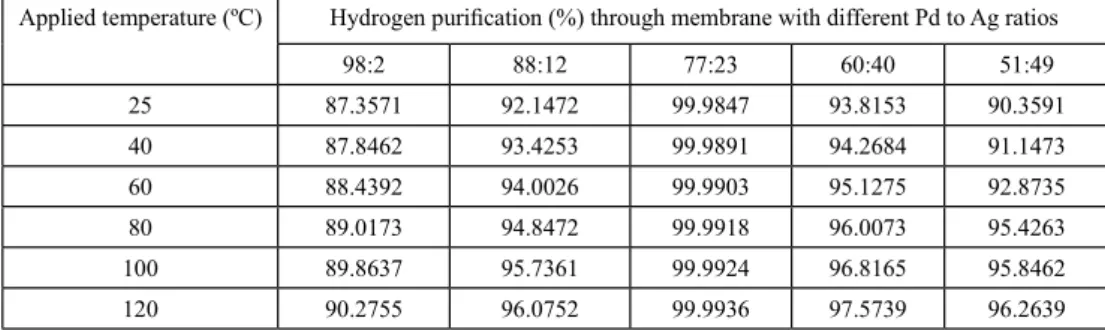
With respect to using the prepared membrane as a hydro-gen diffusion cathode in electrolyzing systems, the mem-branes were tested for H2 and N2 permeation at the range of 25-120 °C. Table 3 shows the hydrogen and nitrogen purities after passing through the membrane at the ap-plied temperatures. As can be seen in Table 3, the hydro-gen passed through the Pd77Ag23 membrane , which has a homogenous and dense alloyed layer, has a maximum purity, whereas the hydrogen passed through the Pd98Ag2 membrane (with the least coating has less purity. This problem can be possibly due to the formation of a non-homogeneous alloy with layers that contained higher Pd content than the desired composition. Also, the charac-terization of this membrane shows that the maximum H2 purity can be achieved for the membrane with reduced support porosity.diffusion (3)
In addition, since a constant volume of different gases contains the same number of particles, the number of moles per liter at a given temperature (T) and pressure (P) is constant. Therefore, the density of a gas is directly proportional to its molar mass (MM):
(4) Thus, it can be concluded that H2 diffuses more rapidly than N2 by increasing temperature [25].
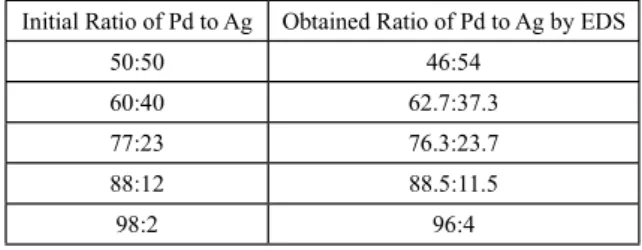
Table 2: Comparison between the initial ratio of Pd to Ag and the obtained ratio of Pd to Ag by EDS
Obtained Ratio of Pd to Ag by EDS Initial Ratio of Pd to Ag
Table 3: Hydrogen purity (%)
Hydrogen purification (%) through membrane with different Pd to Ag ratios Applied temperature (ºC)
51:49 60:40 77:23 88:12 98:2 90.3591 93.8153 99.9847 92.1472 87.3571 25 91.1473 94.2684 99.9891 93.4253 87.8462 40 92.8735 95.1275 99.9903 94.0026 88.4392 60 95.4263 96.0073 99.9918 94.8472 89.0173 80 95.8462 96.8165 99.9924 95.7361 89.8637 100 96.2639 97.5739 99.9936 96.0752 90.2755 120
The comparison results between the initial ratio of Pd to Ag and the obtained ratio of Pd to Ag by EDS also confirms the reliability of this reducing agent (Table 2).
Conclusion
A palladium-silver membrane was developed by deposit-ing Pd-Ag onto a PSS substrate by a polyol process. A smooth, flat, and dense PdAg layer is obtained at for a combination of 77 wt% Pd and 23 wt% Ag (Pd77Ag23). Due to the passivating effect the porous structure in-creases remarkably as the ratio of Pd to Ag is increased, Hydrogen purity measurements in the temperature range of 25 to 120 °C shows that the composite membrane has a high selectivity for hydrogen. The permeation tests shows that hydrogen purity level rises by increasing temperature, which represents a good reliability of the prepared membrane for using as a hydrogen diffusion cathode in the operating temperature range of electro-lyzer systems.
References
[1]. Akis B. C., Preparation of Pd-Ag/PSS
Compos-ite Membranes for Hydrogen Separation, Phd Thesis,
WORCESTER POLYTECHNIC INSTITUTE, 2004. [2]. Hunter J. B., Silver–palladium Film for Separation and Purification of Hydrogen, U.S. Patent no: 2,773,561, 1956.
[3]. Hunter J.B., “Commercial Development of
Palla-dium Alloy Diffusion Cells”, Platinum Met. Rev, Vol. 4, pp. 130–131, 1960.
[4]. Hatlevik Ф., Gade S. K., Keeling M. K., Thoen P. M., Davidson A. P. & Douglas Way J., “Palladium and Palladium Alloy Membranes for Hydrogen Separa-tion and ProducSepara-tion: History, FabricaSepara-tion Strategies,
and Current Performance”, Separation and Purification
Technology, Vol.73, pp. 59–64, 2010.
[5]. Aasberg-Petersen K., Nielsen CS. & Jørgensen SL.,
“Membrane Reforming for Hydrogen”, Catalysis Today,
Vol.46, pp. 193-201, 1998.
[6]. Borgognoni F., Tosti S., Vadrucci M. & Santucci
A., “Pure Hydrogen Production in a Pd/Ag
Multi-Mem-Branes Module by Methane Steam Reforming”, Inter
national Journal of Hydrogen Energy, Vol.36, pp. 7550-7558, 2011.
[7] Jovanovic Z., De Francesco M., Tosti S. & Pozio A.,
“Structural Modification of PdAg Alloy Induced by Elec
trolytic Hydrogen Absorption”, International Journal of
Hydrogen Energy, Vol.36, pp. 7728-7736, 2011. [8] Adhikari S. & Fernando S., “Hydrogen Membrane
Separation Techniques”, Ind. Eng. Chem. Res, Vol.45,
pp. 875-881, 2006.
[9] Wang W., Zhao B., Li P. & Xi Tan., “Fabrication and Characterization of Pd/Ag Alloy Hollow Spheres by
the Solvothermal Method”, J Nanopart Res, Vol.10, pp.
543–548, 2008.
[10] Carotenuto G., Pepe G. P. & Nicolais L., “ Prepara-tion and CharacterizaPrepara-tion of Nano-Sized Ag/PVP Com-posites for Optical Applications”, Eur. Phys. J. B, Vol.16, pp. 11-17, 2000.
[11] Patel K., Kapoor S., Purshottam dave D. &
Mukher-jee T., “Synthesis of Pt, Pd, Pt/Ag and Pd/Ag
Nanopar-ticles by Microwave-Polyol Method”, J. Chem. Sci, Vol.
117, pp. 311-316, 2005.
[12] Toshima N. & Yonezawab T., “Bimetallic Nanopar-ticles Ènovel Materials for Chemical and Physical Ap-plications”, New J. Chem, Vol. 22, pp. 11791201, 1998. [13] Yue E., Yu G., Ouyang Y., Weng B., Si W. & Ye L.,
“Electrochemical Fabrication of Pd-Ag Alloy Nanowire
Arrays in Anodic Alumina Oxide Template”, J. Mater.
Sci. Technol, Vol. 24, pp. 850-856, 2008.
[14] Fiévet F., Lagier J.P., Blin B., Beaudoin B. & Figlarz
M., “Homogeneous and Heterogeneous Nucleations in
the Polyol Process for the Preparation of Micron and Submicron Size Metal Particles”, Solid State Ionics, Vol. 32/33, pp. 198-205, (1989).
[15] Fievet F., Lagier J. P. & Figlarz M., “Preparing Monodisperse Metal Powders in Micrometer and
Sub-micrometer Sizes by the Polyol Process”, MRS Bull,
Vol.14, pp., 29-34, 1989.
[16] LaMer V. K. & Dinegar R. H., “Theory, Production and Mechanism of Formation of Monodispersed Hydro-sols”, J. Am. Chem. Soc, Vol.72, pp. 48474854, 1950.
[17] LaMer V.K., “Nucleation in Phase Transitions”,
Ind. Eng. Chem, Vol.44, pp. 1270-1277, 1952.
[18] Ducamp-Sanguesa C., Herrera-Urbina R. & Figlarz
M., “Synthesis and Characterization of Fine and
Mono-disperse Silver Particles of Uniform Shape”, J. Solid
State Chem, Vol. 100, pp. 272-280, 1992.
1—Synthesis and Characterization”, J. Mater. Chem, Vol.6, pp. 573-577, 1996.
[20]. Silvert P-Y., Herrera-Urbina R. & Tekaia-Elhsissen
K., “Preparation of Colloidal Silver Dispersions by the
Polyol Process”, J. Mater. Chem, Vol.7, pp. 293299, 1997. [21] Seshadri R. & Rao C. N. R., “Preparation of
Mono-dispersed Submicron Gold Particles”, Mater. Res. Bull,
Vol.29, pp. 795–799, 1994.
[22]. Meguro K., Nakamura Y., Hayashi Y., Torizuka M. & Esumi K., “The Preparation of Colloidal Precious
metal Particles Using Copolymers of Vinyl Alcohol–N
Vinylpyrrolidone”, Bull. Chem. Soc. Jpn, Vol.61, pp.
347-350, 1988.
[23]. Bonet F., Delmas V., Grugeon S., Herrera Urbina R., Silvert PY. & TekaiaElhsissen K., “Synthesis of Monodisperse Au, Pt, Pd, Ru AND Ir Nanoparticles in Ethylene Glycol”, NanoStructured Materials, Vol.11, pp. 1277–1284, 1999.
[24] Bhandari R., The Synthesis of Pd-Ag Composite
Membranes for H2 Separation Using Electroless
Plat-ing Method, Phd Thesis, Worcester polytechnic Institute,
2010.