R E S E A R C H
Open Access
Selective episiotomy vs. implementation of
a non-episiotomy protocol: a randomized
clinical trial
M. M. Amorim
1,2*, Isabela Cristina Coutinho
1, Inês Melo
1and Leila Katz
1Abstract
Background:Despite all the evidence corroborating the selective use of episiotomy and although routine use of the procedure is contraindicated, there are no evidences corroborating if episiotomy is necessary in any circumstance. The present clinical randomized trial was performed to compare maternal and perinatal outcomes in women submitted to a non-episiotomy protocol versus one of selective episiotomy.
Methods:An open-labelled, randomized clinical trial was carried out in a tertiary teaching hospital in Recife, Northeastern Brazil. Women in labor with a full-term live foetus, dilatation of 6 to 8 cm and cephalic presentation (vertex position) were included. Exclusion criteria consisted of bleeding disorders and an indication for a caesarean section. After signing the consent form, 241 women were randomized to a non-episiotomy protocol (the experimental group) or to a selective episiotomy group (the control group). No episiotomies were to be performed in the experimental group except under exceptional circumstances. In the control group, selective episiotomies were to be performed in accordance with the healthcare professionals’clinical judgement. Maternal and perinatal outcomes were evaluated. Ratio Risk (RR) and the 95% confidence interval (95% CI) were calculated for our outcomes.
Results:The analysis include 115 women assigned to a non-episiotomy protocol and 122 to selective episiotomy. There was no difference between the two groups with respect to maternal or perinatal outcomes. The episiotomy rate was similar (two cases in each group, about 1.7%), as was the duration of the second stage of labor, the frequency of perineal tears, severe perineal trauma, need for perineal suturing and blood loss at delivery.
Conclusions:A non-episiotomy protocol appears to be safe for mother and child, and highlights the need to investigate whether there is, in fact, any indication for this procedure.
Trial registration:This trial was registered at ClinicalTrials.gov under reference number (NCT02178111).
Keywords:Episiotomy, Vaginal delivery, Perineum, Randomized controlled trial
Plain english summary
Despite all the evidence corroborating the selective use of episiotomy and although routine use of the procedure is contraindicated, there are no evidences corroborating if episiotomy is necessary in any circumstance. The present clinical randomized trial was performed to com-pare maternal and perinatal outcomes in women submit-ted to a non-episiotomy protocol versus one of selective
episiotomy. After signing the consent form, 241 women were randomized to a non-episiotomy protocol (the ex-perimental group) or to a selective episiotomy group (the control group). No episiotomies were to be per-formed in the experimental group except under excep-tional circumstances. In the control group, selective episiotomies were to be performed in accordance with the healthcare professionals’ clinical judgement. Of the 241 women enrolled, four were excluded because of a post-randomization indication for a caesarean section. Of the remaining 237, 115 were assigned to a non-* Correspondence:[email protected]
1Instituto de Medicina Integral Prof. Fernando Figueira, Women’s Healthcare Centre, 50070-550, Recife, Pernambuco, Brazil
2Instituto Paraibano de Pesquisa Professor Joaquim Amorim Neto, Rua Neusa Borborema, 300, Santo Antônio, Campina Grande 58406-120, Brazil
episiotomy protocol and 122 to selective episiotomy. There was no difference between the two groups with respect to maternal or perinatal outcomes. The episiot-omy rate was similar with two episiotomies in each group (1.7%), as was the duration of the second stage of labor, the frequency of perineal tears, severe perineal trauma, need for perineal suturing and blood loss at de-livery. In conclusion, a non-episiotomy protocol appears to be safe for mother and child, and highlights the need to investigate whether there is, in fact, any indication for this procedure.
Background
Despite all the evidence corroborating the selective use of episiotomy and although routine use of the procedure is contraindicated, the actual indications for episiotomy in modern obstetric practice still remain to be clarified [1]. According to the American College of Obstetricians and Gynecologists (ACOG), “based on the existent evi-dence, there are no specific situation in which episiotomy is essential, and the decision to perform an episiotomy should be based on clinical considerations” [2]. The World Health Organization (WHO) recommends an episiotomy rate of 10% as “a good goal to pursue” [3], based on the previous results of a randomized clinical trial conducted in the United Kingdom and published in 1984 [4].
A Cochrane systematic review raises the question of what indeed are the real indications for episiotomy. Suggested answers have included premature delivery, breech presentation, fetal macrosomia, shoulder dys-tocia, instrumental delivery (forceps or vacuum extrac-tion), non-reassuring fetal heart rate, and rigid perineum or imminent perineal tears [5]. It has been debated, however, whether these situations do indeed represent indications for episiotomy and clearly this question merits further investigation in randomized clinical trials. Although it is obvious that routine episi-otomy should be avoided, there is no solid evidence corroborating any indication whatsoever for episiot-omy. The benefits of the use of the procedure in se-lected situations remain controversial, including in instrumental deliveries [6]. In an article proposing that the routine episiotomy era has come to an end, Scott suggests that the natural forces of labor should be allowed to gradually distend the perineum and recalls the adage already quoted by Eason and Feldman 15 years ago:“Don’t just do something, sit there!”[7, 8]. Recently, some authors suggested that episiotomy should never be performed [1, 9]. The question, how-ever, has not yet been adequately evaluated in random-ized clinical trials.
A review of the Medline, Lilacs/SciELO, EMBASE and Scopus databases and of the Cochrane Library using the
keywords “episiotomy” and “vaginal delivery” in Portu-guese, English and Spanish, with the filters“randomized clinical trials” and “systematic review”, failed to reveal any randomized clinical trials on the subject of not per-forming episiotomy during vaginal delivery. All the trials published in the literature compare selective versus rou-tine episiotomy and they were not designed to assess the need for episiotomy in any clinical setting [5]. This is an inherent limitation for its interpretation.
The present clinical trial was performed to compare maternal and perinatal outcomes in women submitted to a non-episiotomy protocol versus one of selective episiotomy.
Methods
This study was conducted at the Women’s Healthcare Centre in the Instituto de Medicina Integral Prof. Fernando Figueira (IMIP), Recife, Brazil, between July and September 2014. The protocol is registered at ClinicalTrials.gov under number NCT02178111 and was published inReproductive Health[1].
This is an open, randomized clinical trial conducted with clinically stable women in active labor with a live, full-term foetus (37 to 41 weeks of pregnancy) in ceph-alic presentation (vertex position), and with dilatation of 6 to 8 cm. Exclusion criteria consisted of pregnancy bleeding disorders (premature detachment of the placenta); indication for a caesarean section; cephalopel-vic disproportion, non-reassuring fetal heart rate, dystocia; women incapable of giving their consent and women with no responsible accompanying person. In addition, women who were submitted to a caesarean section after enrolment to the study were excluded (post-randomization exclusion).
For the experimental group, the healthcare profes-sionals were instructed to base their management on the principle that episiotomy is unnecessary even in situations in which the literature suggests that it may confer some benefit. Therefore, no episiotomy was to be performed in this group except under exceptional circumstances, i.e. those in which clinical judgement would deem the procedure absolutely necessary. For the control group, the healthcare professionals should perform episiotomy selectively according to their clin-ical judgement, i.e. in line with the routine procedure at the institute.
The primary maternal outcomes were episiotomy rate; duration of second stage; frequency of spontaneous lac-erations (degree of the laceration and the location: anter-ior or posteranter-ior); frequency of instrumental delivery; frequency of perineal trauma (any type: episiotomy or tearing); postpartum blood loss; need for perineal sutur-ing, and the number of suture threads. The primary perinatal outcomes were 1st and 5th minute Apgar scores; need for neonatal resuscitation and umbilical cord blood pH. The secondary maternal outcomes eval-uated were frequency of severe perineal trauma; compli-cations with perineal suturing (edema, ecchymosis, hyperemia, secretion, hematoma, dehiscence, perineal pain and infection) identified during postnatal consult-ation; intensity of postpartum perineal pain assessed according to a visual pain scale [10, 11], and maternal satisfaction. The secondary perinatal outcomes were neonatal morbidity (neonatal asphyxia and the duration of neonatal hospitalization) and admission of the new-born infant to the neonatal ICU. In the cases in which episiotomy was performed, the indications for the pro-cedure and the characteristics of the women submitted to it were also analyzed.
The women were accompanied during delivery accord-ing to a humanized childbirth care model based on evi-dence and on the WHO recommendations [3]. This model favors non-supine positions, non-pharmacological pain relief methods, continuous support during delivery and techniques for protecting the perineum, all in accordance with the woman’s preferences and the routine at the institute.
The duration of second stage of labor was recorded and blood loss was measured during the first hour postpartum. For this latter purpose, blood was col-lected using specially adapted plastic bags. All these bags as well as the sponges and gazes used were then weighted and the blood loss (expressed in milliliters -ml) was measured by discounting the previously de-termined dry weight. After delivery, perineal condi-tions were evaluated by visually inspecting the vulvar introitus and perineal region. Whenever present, lacer-ations were classified as first degree (involving the skin
and/or vaginal mucosa), second degree (affecting the perineal muscle), third degree (affecting the anal sphincter muscle) and fourth degree (in addition to the sphincter, the rectal mucosa is also affected) [7]. Third and fourth degree tears were classified as severe perineal damage.
The umbilical cord blood pH was measured in a sample collected from the fetal end of the cord after it was cut, with pH values≥7.2 being considered normal.
Perineal pain was evaluated between 24 and 48 h following delivery by asking the woman if she had any discomfort in the perineal region. A visual analogue scale was used to estimate pain intensity, assessed as a score that ranged from 0 to 10, with zero indicating a complete absence of pain and 10 reflecting the worst pain imaginable [10, 11]. This variable was later recoded as“any perineal pain” (scores of 1 to 10). Next, maternal satisfaction was evaluated and classified as very satisfied, satisfied, fairly satisfied, dissatisfied or very dissatisfied in accordance with the woman’s selection from a range of faces in a faces scale [9].
The presence of complications with perineal suturing (edema, ecchymosis, hyperemia, secretion, hematoma, dehiscence, perineal pain and infection) was evaluated during hospitalization (until 48 h of delivery) and at the postpartum appointment scheduled 10 days after of vaginal delivery. Women were told they could re-turn to the hospital before that date to the hospital if they felt it was necessary for suspecting any complica-tions. At these times all the women had the perineal region routinely examined by a health professional (certified nurse-midwife or an obstetrician doctor) blinded to the group assignement.
A statistician blinded to the group assignment conducted the data analysis using the public domain Epi Info statistical software program (Atlanta, GA), version 7.2. The intention-to-treat principle was applied, i.e. each woman was analysed in the group to which she had originally been allocated. Student’st-test or the Mann–Whitney test was used, as appropriate, for the numerical variables. The Pearson’s chi-square test or Fisher’s exact test (when one of the expected values was <5) was used for the categorical variables. A significance level of 5% was adopted. Allp-values were two-tailed. Risk ratios were calculated as measures of relative risk (RR), together with their 95% confidence intervals (95% CI). A standard value of 1.0 was attrib-uted to the reference category.
Ethics, consent and permissions
and they only were included if agreed voluntarily and signed an informed consent form.
Results
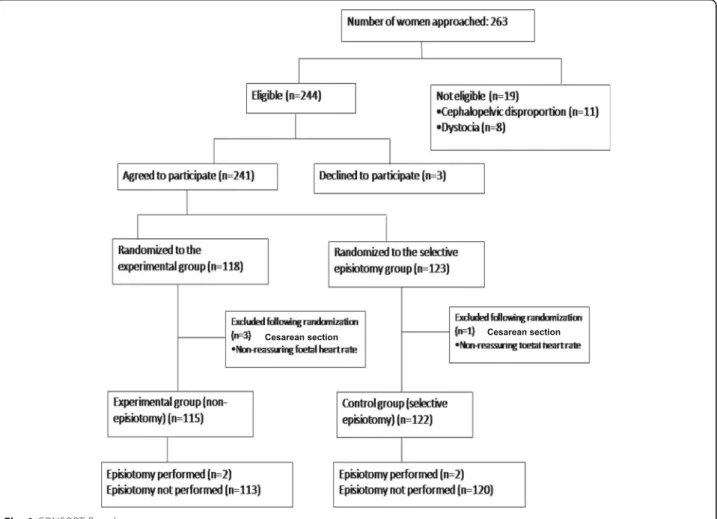
During the study period, 263 women in labor were con-sidered for inclusion. Of these, 19 women were excluded (11 because there was cephalopelvic disproportion and 8 because of dystocia) and three women declined to par-ticipate. Therefore, 241 women were randomized, 118 to the non-episiotomy group and 123 to the selective episi-otomy group. Four women were excluded following randomization because non-reassuring fetal heart rate developed and a caesarean section was indicated, leaving 115 women in the non-episiotomy group and 122 in the selective episiotomy group (Fig. 1).
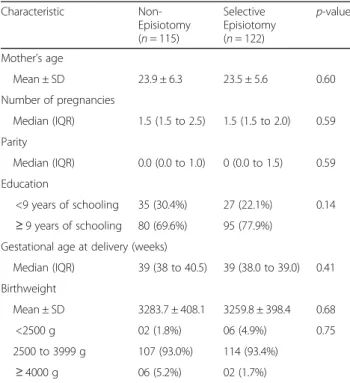
The baseline characteristics of the women in the two groups were similar. Mean age was around 23 years, with a median number of pregnancies and live births of 1.5 and zero, respectively. The percentage of primipar-ous women in the study was 59.9%, with no statistically significant difference between the groups. The majority of the participants had nine or more years of formal schooling (around 70% of those included in the
non-episiotomy group and 78% of those in the selective episi-otomy group). Median gestational age at delivery was 39 weeks in both groups. The mean birthweight was similar in the two groups (3,284 g in the experimental group vs 3,260 g in the control group) (Table 1).
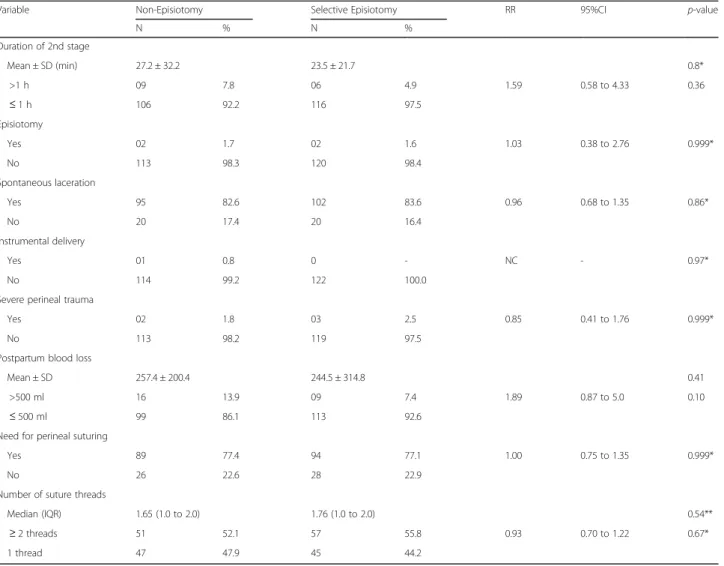
No significant differences were found in relation to the primary maternal outcomes evaluated (Table 2). The frequency of episiotomy was similar, 1.7% in the non-episiotomy group and 1.6% in the selective episiot-omy group. The two episiotomies performed in the non-episiotomy group were indicated because of a pro-longed second stage (35 and 120 min, respectively) in association with a non-reassuring fetal heart rate, while in the selective episiotomy group two episiotomies were performed exclusively due to a prolonged second stage (27 and 56 min, respectively). There was no significant difference between the experimental and control groups with respect to the duration of the second stage. The frequency of spontaneous lacerations was around 83% in both groups. There was only one case of an instru-mental delivery (forceps) in the non-episiotomy group. Severe perineal trauma occurred in 1.8% of the women in the non-episiotomy group and in 2.5% of those
randomized to the selective episiotomy group. There was also no difference in the mean postpartum blood loss between the experimental and control groups (257 ml versus 244 ml, respectively). Around 77% of the women in both groups required suturing. There was no difference in the number of suture threads re-quired, with a median of around 1.7 threads in both groups.
The groups were not significantly different insofar as any of the primary perinatal outcomes were concerned either. Apgar scores were similar, with only two cases of 5th minute Apgar scores <7 in the selective episiotomy group. Neonatal resuscitation was required in around 3% of cases in each group and there was only one case of umbilical cord blood acidosis in the selective episiot-omy group (Table 3).
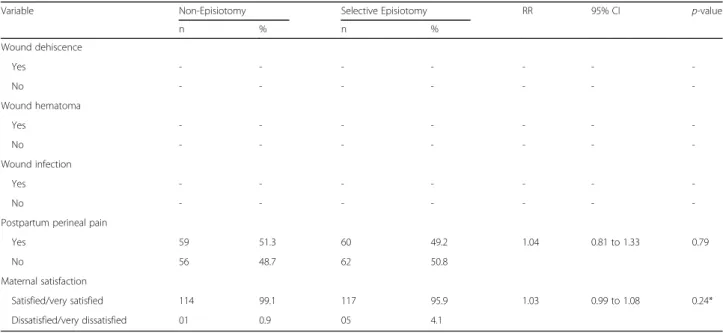
Analysis of the secondary maternal outcomes showed no significant difference between groups. The frequency of postpartum perineal pain was similar, around 50%, in both groups. There were no cases of dehiscence, hematoma or wound infection in either of the groups. Around 99% of the women in the non-episiotomy group were satisfied or very satisfied compared to 96% in the selective episiotomy group, with no significant difference between the groups (Table 4).
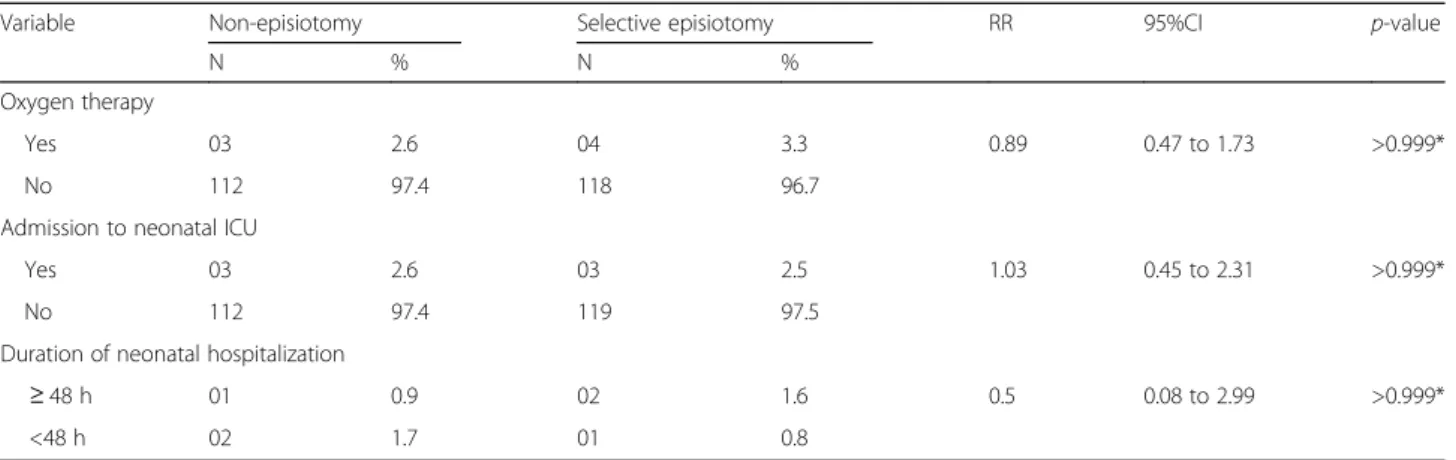
There were no significant differences between the groups with respect to the secondary perinatal outcomes either, with around 3% of the newborn infants in both groups requiring some form of oxygen therapy and 3% requiring admission to the neonatal ICU. The duration
of neonatal hospitalization was also similar in the two groups, with only 0.9% of those in the non-episiotomy group and 1.6% of those in the selective episiotomy group needing to stay in hospital for 48 h or more (Table 5).
Discussion Principal findings
In the present study-, no difference was found between the women randomized to the selective episiotomy group compared to those randomized to the non-episiotomy group. The overall rate of non-episiotomy was very low (around 1.7%), similar in the two groups, and close to the low rates already described by other authors [9, 12]. The episiotomy rate found in the present study is well below the maximum of 10% recommended by the WHO [3], and much lower than the overall episiotomy rate found in a Cochrane systematic review of around 28% in the group submitted to selective episiotomy [5].
Strengths and weaknesses
Episiotomy was introduced into obstetric practice with-out any scientific evidence corroborating any possible benefits [13]. Its use became widespread in the twenti-eth century based on the recommendation of renowned obstetricians such as Gabbe and DeLee [14]. The para-digm that existed at that time was interventionist to the extreme in that the female body was believed to be essentially defective and dependent on medical inter-ventions to enable childbirth to take place [15]. This belief, together with a change in the place of childbirth, away from the home and into the hospital environment, contributed to the popularization of the procedure in hospitals [13]. It was only in the 1970s that discordant voices began to be heard, generally from within women’s movements, demanding changes in the obstet-ric model [13].
The review published by Thacker and Banta in 1983 not only highlighted the lack of any scientific studies supporting the use of episiotomy, but also found the practice to be potentially associated with harmful con-sequences such as perineal pain, hematoma, infection, dyspareunia and healing complications [16]. In 1984, the results of the first randomized clinical trial on the subject were published. That study, conducted in the United Kingdom, reported an episiotomy rate of 10% when the proposal was to perform the procedure se-lectively [4]. Various other randomized clinical trials followed and are summarized in a Cochrane systematic review. The well-documented advantages of restricting the practice of episiotomy rather than encouraging its routine use include less risk of posterior perineal trauma and of severe perineal trauma. Other positive consequences are less blood loss, less need for sutures, Table 1Characteristics at baseline
Characteristic
Non-Episiotomy (n= 115)
Selective Episiotomy (n= 122)
p-value
Mother’s age
Mean ± SD 23.9 ± 6.3 23.5 ± 5.6 0.60
Number of pregnancies
Median (IQR) 1.5 (1.5 to 2.5) 1.5 (1.5 to 2.0) 0.59
Parity
Median (IQR) 0.0 (0.0 to 1.0) 0 (0.0 to 1.5) 0.59
Education
<9 years of schooling 35 (30.4%) 27 (22.1%) 0.14 ≥9 years of schooling 80 (69.6%) 95 (77.9%)
Gestational age at delivery (weeks)
Median (IQR) 39 (38 to 40.5) 39 (38.0 to 39.0) 0.41
Birthweight
Mean ± SD 3283.7 ± 408.1 3259.8 ± 398.4 0.68
<2500 g 02 (1.8%) 06 (4.9%) 0.75
2500 to 3999 g 107 (93.0%) 114 (93.4%)
a lower frequency of postpartum perineal pain, a lower risk of perineal suture complications (oedema, dehis-cence, infection and hematoma), fewer cases of post-partum loss of perineal muscle strength and less risk of dyspareunia [5].
A question that has recently been raised is whether there is indeed any indication for performing episiot-omy and whether the procedure, even when practiced selectively, confers any benefit at all, either immedi-ately or later [1, 6, 9]. Indications such as a pro-longed second stage, macrosomia, non-reassuring fetal heart rate, instrumental delivery, occiput posterior position, pelvic delivery and shoulder dystocia have been questioned [9]. A systematic review of the effectiveness of episiotomy for prevention and man-agement of shoulder dystocia found no evidence supporting the use of episiotomy [17]. The American College of Obstetricians and Gynecologists recognizes that there is insufficient objective evidence-based
criteria to define the indications for episiotomy – and that restrictive use of episiotomy remains the best practice [2].
Strengths and weaknesses in relation to other studies In one study that included 168,077 vaginal births at the University of Soroka Medical Centre, Israel, mediolateral episiotomy was found to be an independent risk factor for third and fourth degree perineal lacerations, even in critical situations such as shoulder dystocia, instrumen-tal deliveries, posterior presentations, feinstrumen-tal macrosomia and non-reassuring fetal heart rate. The episiotomy rates at that hospital fell from over 30% in the 1990s to less than 5% in 2010 [12].
Using a non-episiotomy protocol associated with strategies aimed at protecting the perineum, Amorim et al. reported an intact perineum rate of approxi-mately 60%, with only 23% of women requiring peri-neal suturing [9, 18]. That study, however, was not Table 2Non-episiotomy versus selective episiotomy: primary maternal outcomes
Variable Non-Episiotomy Selective Episiotomy RR 95%CI p-value
N % N %
Duration of 2nd stage
Mean ± SD (min) 27.2 ± 32.2 23.5 ± 21.7 0.8*
>1 h 09 7.8 06 4.9 1.59 0.58 to 4.33 0.36
≤1 h 106 92.2 116 97.5
Episiotomy
Yes 02 1.7 02 1.6 1.03 0.38 to 2.76 0.999*
No 113 98.3 120 98.4
Spontaneous laceration
Yes 95 82.6 102 83.6 0.96 0.68 to 1.35 0.86*
No 20 17.4 20 16.4
Instrumental delivery
Yes 01 0.8 0 - NC - 0.97*
No 114 99.2 122 100.0
Severe perineal trauma
Yes 02 1.8 03 2.5 0.85 0.41 to 1.76 0.999*
No 113 98.2 119 97.5
Postpartum blood loss
Mean ± SD 257.4 ± 200.4 244.5 ± 314.8 0.41
>500 ml 16 13.9 09 7.4 1.89 0.87 to 5.0 0.10
≤500 ml 99 86.1 113 92.6
Need for perineal suturing
Yes 89 77.4 94 77.1 1.00 0.75 to 1.35 0.999*
No 26 22.6 28 22.9
Number of suture threads
Median (IQR) 1.65 (1.0 to 2.0) 1.76 (1.0 to 2.0) 0.54**
≥2 threads 51 52.1 57 55.8 0.93 0.70 to 1.22 0.67*
1 thread 47 47.9 45 44.2
RRrelative risk,CIconfidence interval,IQRInterquartile range,NCNot calculated
controlled and was conducted with a specific sample of women, and the authors recommended that ran-domized clinical trials should be performed to com-pare a non-episiotomy policy with one of selective episiotomy. However, other observational studies cor-roborate that it is possible to avoid episiotomy and achieve a high rate of intact perineum. In other larger series of 1,176 women with natural births without episiotomy, an intact perineum rate of almost 65% was reported with 20% of perineal suture need [19]. Recently, a retrospective study conducted in Tokyo, Japan, including 1,1521 women with spontaneous births without interventions (epidural, episiotomy,
instrumental delivery) reported intact perineum rates of 49.5% in nulliparous and 69.9% in multiparous women, with only 0.1% of third-degree laceration (one case) [20].
Notwithstanding, all above mentioned studies were observational, descriptive, uncontrolled studies with the limitations inherent to the study design and until this moment we did not identify any randomized controlled trial with the objective to determine if episiotomy is necessary in any circumstance. The current recommen-dation of selective episiotomy is based on the conclu-sions of systematic reviews of clinical trials that demonstrated selective episiotomy was better than Table 3Non-episiotomy versus selective episiotomy: primary perinatal outcomes
Variable Non-Episiotomy Selective Episiotomy RR 95%CI p-value
N % N %
1st
minute Apgar score
<7 07 6.1 10 8.2 0.74 0.29 to 1.89 0.53
≥7 108 93.9 112 91.8
5th
minute Apgar score
<7 0 - 02 1.7 NE - 0.53*
≥7 115 100.0 120 91.8
Neonatal resuscitation
Yes 03 2.6 04 3.3 0.89 0.47 to 1.72 >0.999*
No 112 97.4 118 96.7
Umbilical cord blood acidosis
Yes 0 - 1 0.8 NE - >0.999*
No 115 100.0 121 99.2
RRrelative risk,CIconfidence interval *Fisher’s two-tailed exact test
Table 4Non-episiotomy versus selective episiotomy: secondary maternal outcomes
Variable Non-Episiotomy Selective Episiotomy RR 95% CI p-value
n % n %
Wound dehiscence
Yes - - -
-No - - -
-Wound hematoma
Yes - - -
-No - - -
-Wound infection
Yes - - -
-No - - -
-Postpartum perineal pain
Yes 59 51.3 60 49.2 1.04 0.81 to 1.33 0.79
No 56 48.7 62 50.8
Maternal satisfaction
Satisfied/very satisfied 114 99.1 117 95.9 1.03 0.99 to 1.08 0.24*
Dissatisfied/very dissatisfied 01 0.9 05 4.1
routine episiotomy [5, 25] and the authors of the original clinical trials did not “dare” to address the question if it is possible to never perform episiotomies for vaginal deliveries, the results and safety of definitively abolishing this procedure of the modern obstetric practice.
The present study is the first randomized clinical trial to compare the restricted use of episiotomy with a non-episiotomy protocol, thus classifying its results as representing an original contribution to the current lit-erature. The advantages of the study include its design, in which the women were randomly allocated to one of two groups, and the sample size, which was sufficient to show any possible benefits or harmful effects in ei-ther of the two groups. The analysis was performed on an intention-to-treat basis, which explains the two cases of episiotomy in the group of women randomized to the non-episiotomy group. Since the indications re-corded for these episiotomies were a“prolonged second stage” associated with non-reassuring fetal heart rate, the procedure may have been avoidable. Likewise, in the selective episiotomy group, the two episiotomies performed because of a “prolonged second stage” may have been unnecessary. The considered limits for the duration of the second stage are currently more flexible. If mother and baby are well, patience to wait without intervening could have avoided some of the procedures performed [21–23].
However, the present randomized clinical trial may have been performed too late at this hospital, where episiotomy rates have been falling for the past ten years, reaching a level below 2% within the context of selective practice in this study. This change in the paradigm could explain these results. Since this study was conducted at one single centre, further randomized clinical trials need to be carried out, preferably in places where selective episiotomy rates are higher in order to verify whether there really are any relevant differences when the pro-cedure is performed, even with restricted indications,
versus when there is no intention to ever perform the procedure. Ideally, a future systematic review could include randomized clinical trials conducted for this purpose to enable solid recommendations to be pro-posed for routine obstetric practice.
Explanations and implications for clinicians and policymakers
Until the results of such studies are available, it appears
reasonable to propose that the World Health
Organization redefine its cut-off point for the “ideal” episiotomy rate and, in an effort to reduce rates, that nurses, midwives and doctors be trained not to perform the procedure indiscriminately.
Despite the consistent evidence against its indiscrimin-ate practice [5], in some places episiotomy is still performed routinely and indeed a recent study published in Brazil showed a rate of 54% in this country [24]. This rate is more than five times the maximum rate recom-mended by the World Health Organization and means that a large number of healthcare professionals (particu-larly doctors, since in the current obstetric model in Brazil the majority of deliveries are performed by doctors) still carry out this procedure systematically. This may imply additional costs for the healthcare system, since, just in suture threads, savings between $6.50 and $12.50 could be made with each vaginal deliv-ery. Carroli and Belizan evaluated that this could repre-sent a current annual saving of US$ 15 to 30 million for Brazil [25].
Furthermore, routine episiotomy is now considered a form of obstetric violence, particularly when performed without informed consent. A relatively new legal term,
“obstetric violence” is used to describe a situation in which any form of labor in childbirth is considered pathological, when a woman is automatically trans-formed into a patient and when routine medical and pharmacological procedures are carried out without Table 5Non-episiotomy versus selective episiotomy: secondary perinatal outcomes
Variable Non-episiotomy Selective episiotomy RR 95%CI p-value
N % N %
Oxygen therapy
Yes 03 2.6 04 3.3 0.89 0.47 to 1.73 >0.999*
No 112 97.4 118 96.7
Admission to neonatal ICU
Yes 03 2.6 03 2.5 1.03 0.45 to 2.31 >0.999*
No 112 97.4 119 97.5
Duration of neonatal hospitalization
≥48 h 01 0.9 02 1.6 0.5 0.08 to 2.99 >0.999*
<48 h 02 1.7 01 0.8
giving the woman the right to make her own decisions with respect to her own body [26]. Routinely performing procedures that, in addition to being unnecessary, may be harmful, characterizes mistreatment during childbirth [27]. In this context, routine or high rates of episiotomy can be categorized as female genital mutilation [28].
Unanswered questions and future research
Within this context, it is important to define whether episiotomy is really necessary in any situation and what, if any, are its true indications. In addition to the harmful effects that may be associated with episiotomy and the costs of the procedure to the healthcare system, this question also deals with issues of reproductive rights.
It may seem curious that a procedure would be incor-porated into obstetric practice without a shred of evidence of its beneficial effects and our task now is to generate evidence to determine whether its use is in fact necessary at any childbirth. This evidence should have been sought in the past. As Cochrane said: “One should…always assume that a treatment is ineffective unless there is evidence to the contrary” [29]. Unfortu-nately, the randomized clinical trials that were published following publication of the paper by Thacker and Banta did not compare the non-performance of episiotomy with the routine practice of this procedure [30, 31].
It is hoped that this study may contribute towards significantly reducing episiotomy rates in Brazil and in other places where routine episiotomy is still performed. According to a recent study comparing rates of episiot-omy in 20 European countries found important differ-ences, varying from 3,7% in Denmark to 75% in Cyprus [32]. In other institutes and in other countries in which episiotomy is practiced selectively, the present results are expected to encourage further studies to find answers to the more decisive questions: Is it time to stop performing episiotomies? Have we actually reached the point of proposing to abolish episiotomy? It is our belief that, yes, this is the end of the cut.
Conclusions
An overall episiotomy rate of less than 2% was found in the two groups evaluated in the present study, showing that it is possible to implement a non-episiotomy proto-col for a group of women with full-term pregnancies and foetuses in the cephalic position without any statisti-cally significant differences in relation to the selective practice of the procedure. This is the first randomized clinical trial comparing the intention to never perform episiotomy to the current recommended practice of selective episiotomy. Further studies should be conducted, particularly in institutions and regions in which episiotomy rates remain high (although under the concept of “restrictive”use), in an attempt to determine
whether there really is any indication for episiotomy in modern obstetrics. Until the results of these studies are available, much lower episiotomy rates should be achieved in this country and in other countries, and the end of episiotomy is a goal that should be pursued within a humanized childbirth care model.
Acknowledgments
to Instituto Materno-Infantil Prof. Fernando Figueira where the study was conducted and to all women who agreed to participate. To CNPq for partial financial support.
Funding
CNPq(National Counsel of Technological and Scientific Development)–Grant by Universal Edital Number 482010/2012-6 for elaboration of the protocol.
Availability of data and materials
All data are available for consultation under the responsibility of Melania M Amorim, MD, PhD, and can be requested if necessary. Database is available in the format.mdb.
Authors’contributions
MA had the initial idea and drafted the initial version of protocol with LK. IM revised the final protocol and conducted data collection. MA and LK conducted the statistical analysis and drafted the manuscript. All authors contributed for the final version. All authors had full access to the whole set of data in the study and can take responsibility for the integrity of the data and the accuracy of the data analysis. All authors read and approved the final manuscript.
Competing interests
No financial interests that may be relevant to the submitted work are declared. Dr. Melania Amorim and Dr. Leila Katz are feminists and activists against obstetric violence. Dr. Melania Amorim is the owner of the Facebook page“Brazilian Women Against Routine Episiotomy”and the blog“Estuda, Melania, Estuda”where claims against unnecessary episiotomies in Brazil. Both Dr. Melania Amorim and Dr. Leila Katz believe episiotomy is never necessary and do not perform the procedure in their personal practice.
Ethics approval and consent to participate
The institution’s internal review board approved the study protocol under reference number 06561712.8.00005201. The protocol is registered at ClinicalTrials.gov under number NCT02178111 and was published in
Reproductive Health[1].All included women agreed to participate and signed a consent form.
Guarantor of the study Melania Amorim, MD, PhD.
Transparency declaration
The manuscript’s guarantor affirms that the manuscript is an honest, accurate, and transparent account of the study being reported; that no important aspects of the study have been omitted; and that were no discrepancies from the study as planned and registered.
Publisher’s Note
Springer Nature remains neutral with regard to jurisdictional claims in published maps and institutional affiliations.
Received: 25 November 2016 Accepted: 8 April 2017
References
1. Melo I, Katz L, Coutinho I, Amorim MM. Selective episiotomy vs. implementation of a non episiotomy protocol: a randomized clinical trial. Reprod Health. 2014;11:66.
3. World Health Organization Division of Family Health Maternal Health and Safe Motherhood. Care in normal birth: a practical guide. Report of a technical working group. World Health Organisation, 1996. http://apps.who. int/iris/bitstream/10665/63167/1/WHO_FRH_MSM_96.24.pdf.
4. Sleep J, Grant A, Garcia J, Elbourne D, Spencer J, Chalmers I. West Berkshire perineal management trial. Br Med J. 1984;289:587–90.
5. Carroli G, Mignini L. Episiotomy for vaginal birth. Cochrane Database Syst Rev. 2009;(1):CD000081.
6. Lappen JR, Gosset DR. Changes in episiotomy practice: evidence-based medicine in action. Expert Rev Obstet Gynecol. 2010;5:301–9. 7. Scott JR. Episiotomy and vaginal trauma. Obstet Gynecol Clin North Am.
2005;32:307–21.
8. Eason E, Feldman P. Much ado about a little cut: is episiotomy worthwhile? Obstet Gynecol. 2000;95:616–8.
9. Amorim MM, Franca-Neto A, Leal NV, Melo FO, Maia SB, Alves JN. Is it possible to never perform episiotomy during vaginal delivery? Obstet Gynecol. 2014;123 Suppl 1:38S.
10. Chapman CR, Syrjala KL. In: Bonica JJ, editor. Pain. Lea & Febiger. 1990. p. 580–94. Measurement of pain.
11. Hicks CL, von Baeyer CL, Spafford PA, van Korlaar I, Goodenough B. The Faces Pain Scale-Revised: toward a common metric in pediatric pain measurement. Pain. 2001;93:173–83.
12. Steiner N, Weintraub AY, Wiznitzer A, Sergienko R, Sheiner E. Episiotomy: the final cut? Arch Gynecol Obstet. 2012;286:1369–73.
13. Myers-Helfgott MG, Helfgott AW. Routine use of episiotomy in modern obstetrics. Should it be performed? Obstet Gynecol Clin North Am. 1999;26:305–25. 14. Gabbe SG, DeLee JB. The prophylactic forceps operation. 1920. Am J Obstet
Gynecol. 2002;187:254. discussion 255.
15. Davis-Floyd R. Birth as an American rite of passage. Berkeley: University of California Press; 1993:382.
16. Thacker SB, Banta HD. Benefits and risks of episiotomy: an interpretative review of the English language literature, 1860–1980. Obstet Gynecol Surv. 1983;38:322–38.
17. Sagi-Dain L, Sagi S. The role of episiotomy in prevention and management of shoulder dystocia: a systematic review. Obstet Gynecol Surv. 2015;70:354–62. 18. Leal NV, Amorim MM, Franca-Neto AH, Leite DF, Melo FO, Alves JN. Factors
associated with perineal lacerations requiring suture in vaginal births without episiotomy. Obstet Gynecol. 2014;123 Suppl 1:63S–4S.
19. Albers LL, Sedler KD, Bedrick EJ, Teaf D, Peralta P. Factors related to genital tract trauma in normal spontaneous vaginal births. Birth. 2006;33:94–100. 20. Suto M, Takehara K, Misago C, Matsui M. Prevalence of Perineal Lacerations in
Women Giving Birth at Midwife-Led Birth Centers in Japan: A Retrospective Descriptive Study. J Midwifery Womens Health. 2015;60:419–27.
21. Zhang J, Landy HJ, Branch DW, Burkman R, Haberman S, Gregory KD, et al. Consortium on Safe Labor. Contemporary patterns of spontaneous labor with normal neonatal outcomes. Obstet Gynecol. 2010;116:1281–7. 22. El-Sayed YY. Diagnosis and management of arrest disorders: duration to
wait. Semin Perinatol. 2012;36:374–8.
23. American College of Obstetricians and Gynecologists (College), Society for Maternal-Fetal Medicine, Caughey AB, Cahill AG, Guise JM, Rouse DJ. Safe prevention of the primary cesarean section. Am J Obstet Gynecol. 2014;210:179–93.
24. Carmo Leal M, Pereira AP, Domingues RM, et al. Obstetric interventions during labor and childbirth in Brazilian low-risk women. Cad Saude Publica. 2014;30 Suppl 1:S1–16.
25. Carroli G, Belizan J. Episiotomy for vaginal birth. Cochrane Database Syst Rev. 2000;2:CD000081.
26. Pérez D’Gregorio R. Obstetric violence: a new legal term introduced in Venezuela. Int J Gynaecol Obstet. 2010;111:201–2.
27. Bohren MA, Vogel JP, Hunter EC, Lutsiv O, Makh SH, Souza JP, et al. The mistreatment of women during childbirth in health facilities globally: a mixed-methods systematic review. PLoS Med. 2015;12:e1001847. 28. Belizán JM, Miller S, Salaria N. We need to stop female genital mutilation!
Reprod Health. 2016;13:43.
29. Cochrane AL. Effectiveness and efficiency: random reflections on health services. London: Nuffield Provincial Hospitals Trust; 1972.
30. Routine vs selective episiotomy: a randomised controlled trial. Argentine Episiotomy Trial Collaborative Group. Lancet. 1993;342:1517–8. 31. Thorp Jr JM, Bowes Jr WA, Brame RG, Cefalo R. Selected use of midline
episiotomy: effect on perineal trauma. Obstet Gynecol. 1987;70:260–2.
32. Blondel B, Alexander S, Bjarnadóttir RI, Gissler M, Langhoff-Roos J, Novak-Antolič Ž, Prunet C, Zhang WH, Hindori-Mohangoo AD, Zeitlin J, Euro-Peristat Scientific Committee. Variations in rates of severe perineal tears and episiotomies in 20 European countries: a study based on routine national data in Euro-Peristat Project. Acta Obstet Gynecol Scand. 2016;95:746–54.
• We accept pre-submission inquiries
• Our selector tool helps you to find the most relevant journal • We provide round the clock customer support
• Convenient online submission • Thorough peer review
• Inclusion in PubMed and all major indexing services • Maximum visibility for your research
Submit your manuscript at www.biomedcentral.com/submit