ORIGINAL ARTICLE
Quorum sensing of microalgae
associated marine
Ponticoccus
sp. PD-2 and its
algicidal function regulation
Wendan Chi
1, Li Zheng
1,2*, Changfei He
1, Bin Han
1, Minggang Zheng
1, Wei Gao
1, Chengjun Sun
1,2, Gefei Zhou
3and Xiangxing Gao
4Abstract
Quorum sensing (QS) systems play important roles in regulating many physiological functions of microorganisms, such as biofilm formation, bioluminescence, and antibiotic production. One marine algicidal bacterium, Ponticoc-cus sp. PD-2, was isolated from the microalga Prorocentrum donghaiense, and its N-acyl-homoserine lactone (AHL)-mediated QS system was verified. In this study, we analyzed the AHLs profile of strain PD-2. Two AHLs, 3-oxo-C8-HSL and 3-oxo-C10-HSL, were detected using a biosensor overlay assay and GC–MS methods. Two complete AHL-QS systems (designated zlaI/R and zlbI/R) were identified in the genome of strain PD-2. When expressed in Escherichia coli, both zlaI and zlbI genes could each produce 3-oxo-C8-HSL and 3-oxo-C10-HSL. Algicidal activity was investigated by evaluating the inhibitory rate (IR) of microalgae growth by measuring the fluorescence of viable cells. We found that the metabolites of strain PD-2 had algicidal activity against its host P. donghaiense (IR 84.81%) and two other red tide microalgae, Phaeocystis globosa (IR 78.91%) and Alexandrium tamarense (IR 67.14%). β-cyclodextrin which binds to AHLs and inhibits the QS system reduced the algicidal activity more than 50%. This indicates that inhibiting the QS system may affect the algicidal metabolites production of strain PD-2. Our study indicated that a QS-regulated algicidal system may play a potential role in the process of red tides disintegration. QS might be a potential way to control red tides.
Keywords: AHLs, Algicidal activity, β-Cyclodextrin, Microalgae-associated bacteria, Quorum sensing
© The Author(s) 2017. This article is distributed under the terms of the Creative Commons Attribution 4.0 International License (http://creativecommons.org/licenses/by/4.0/), which permits unrestricted use, distribution, and reproduction in any medium, provided you give appropriate credit to the original author(s) and the source, provide a link to the Creative Commons license, and indicate if changes were made.
Introduction
Quorum sensing (QS) is a cell density-dependent sys-tem for information transfer among bacteria. It ena-bles the bacterial cells to sense changes in cell density through the concentration of signal molecules called autoinducers (AI) released by bacteria themselves (Guo et al. 2011). When the bacteria grow to a high cell den-sity, the concentration of AI could reach a threshold and bind specifically to a receptor protein. Then, the com-plex will activate the transcription of target genes and regulate specific functions including biofilm formation,
bioluminescence, the secretion of virulence factors, and sporulation (Davies et al. 1998; Greenberg et al. 1979; Nealson et al. 1970). In addition to directly affecting gene regulation, increasing evidences show that cross-king-dom QS signaling between associated bacteria and their hosts also confers other ecological functions indirectly, such as growth-retarding effect of the rotifer (Gambello and Iglewski 1991), the settlement of seaweed zoospores (Joint et al. 2007), and carospore liberation of red mac-roalgae (Singh et al. 2015). Therefore, QS systems and their regulation functions in bacteria have become hot topics in the fields of marine environment, aquaculture, medicine, and bioengineering.
To date, the most studied intercellular AI molecules are N-acyl-homoserine lactones (AHLs), which can be detected by biosensors, gas chromatography–mass spectrometer (GC–MS), and high-performance liquid
Open Access
*Correspondence: [email protected]
1 Key Laboratory for Marine Bioactive Substances and Modern Analytical Technology of the First Institute of Oceanography, State Oceanic Administration, No. 6 Xianxialing Road, Qingdao 266061, Shandong, People’s Republic of China
chromatography-mass spectrometer (HPLC-MS) (Li et al. 2015). These AHLs are generated by an autoinducer synthase, the product of a luxI type gene, and the recep-tor is a cognate luxR type protein. Though there is an increasing number of AHL synthetase genes with some conserved regions in the genomic databases,the overall similarity between luxI homologs from different genera is rather low (Fuqua et al. 1996). Therefore, it is necessary to determine the profiles of AHLs produced by different
luxI homologs to better understand the QS system. Red tides are natural phenomena that are caused by the explosive proliferation of microalgae (Guzmán et al. 2016). Most red tides result in serious environmen-tal problems that are harmful or toxic to humans, fish, shellfish, marine mammals, and birds (Hu et al. 2016). The algicidal bacteria that are associated with red tide algae play an important role in controlling their host’s biomass. In the initial and developmental stages of red tides, algicidal bacteria show no algicidal activity. In the alage blooming stage, the growth of algicidal bacteria was promoted by the nutrients that are organic materi-als released by the algae. Subsequently, the bacteria begin to produce algicidal compounds that kill their host cells. It is interesting to find that some algicidal bacteria such as Cytophaga strains J18/M01 (Mirsutani et al. 1992) and A5Y (Imai et al. 1993), Flavobacterium strain 5N-3 (Imai et al. 1992), and Flavobacteriaceae strain S03 (Roth et al. 2007) must reach a cell density of at least 106 cells mL−1 before they show any algicidal activity. Li et al. (2014) found that Shewanella sp. Lzh-2 must reach a bacterial cell density threshold of at least 108 cells mL−1 before any algicidal compound can be detected. There are also reports that some microalgae could inhibit bacterial quo-rum sensing activity (Castang et al. 2004). Because algi-cidal activity is density-dependent, we hypothesize that the algicidal activity of the microalgae associated bacte-ria may be regulated by QS system and the interaction between microalgae and their associated algicidal bac-teria could be mutually restrictive. This probably is an important factor for maintaining the dynamic balance of phycosphere.
It has been proven that QS systems in some bacteria can regulate the production of secondary metabolites, such as antibiotics, including algicidal compounds. One marine bacterium, MS-02-063, belonging to the γ-proteobacteria, produces a red, algicidal pig-ment (Nakashima et al. 2006). It is interesting to note that pigment production was also inhibited by add-ing β-cyclodextrin (β-CD), which forms a complex with AHLs in media, as a QS-quenching substance (Morohoshi et al. 2013). Although it was suggested that the algicidal pigment production was controlled by AHLs-mediated QS, this study neither confirmed the
presence of a QS system at the genetic level nor did it find any AHLs molecules. In a subsequent research, Guo et al. (2016) found a bacterium Aeromonas sp.GLY-2107 which could produce two algicidal compounds against
Microcystis aeruginosa. They proved that the produc-tion of the two algicidal compounds was controlled by QS system. However, this bacterium was screened from freshwater and was not associated with microalgae M. aeruginosa. To date, there has been no report on the QS regulated algicidal activity investigated through the interaction between microalgae and their associated bacteria.
In this work, The QS systems of Ponticoccus sp. PD-2, which is a marine microalgae-associated bacterium with algicidal activity, were confirmed by detecting AHL mol-ecules and annotating luxI type autoinducer synthase and luxR type receptor genes. We analyzed the AHL synthetase functions by introducing LuxI homologes into Escherichia coli. The algicidal activity of strain PD-2 was evaluated and compared after adding β-CD into the culture medium. The purpose of this study was to under-stand AHL-based QS systems in Ponticoccus sp. PD-2, and to prove the hypothesis that the microalgae associ-ated bacterium may kill the host through QS system. We expect to find a novel way to control red tides by biologi-cal treatment via enhancing QS activities.
Materials and methods Strains and growth conditions
Ponticoccus sp. PD-2 used in this study was obtained from China General Microbiological Culture Collec-tion Center (CGMCC 1.16027). It was isolated from
Prorocentrum donghaiense. Strain PD-2 was grown in marine broth 2216E (Xu et al. 2012) at 27 °C with shak-ing at 150 rpm, unless otherwise indicated. E. coli BL21 (DE3) was used to propagate recombinant plasmids and to overexpress zlaI and zlbI proteins. For E. coli strains, the bacteria were grown in Luria–Bertani (LB) medium (Britstein et al. 2016) at 37 °C, with shaking at 150 rpm. Transformed cells were grown in LB broth supplemented with 100 μg mL−1 ampicillin (Sigma-Aldrich, St. Louis, MO, USA). The microalgae strains included red tide species P. donghaiense CCMM1007, Phaeocystis globosa
photons m−2 s−1) with a 12:12 light/dark cycle, with shaking three times per day.
The biosensor Agrobacterium tumefaciens KYC55 (pJZ372) (pJZ384, pJZ410), which was provided by Pro-fessor Hill at the Institute of Marine and Environmental Technology, University of Maryland, USA. The reporter strain KYC55 (Karina et al. 2013) was prepared by grow-ing it in 1× ATGN minimal medium (Tempé et al. 1977) with 100 μg mL−1 spectinomycin dihydrochloride pen-tahydrate, 4.5 μg mL−1 tetracycline, and 100 μg mL−1 gentamicin at 30 °C, with shaking at 180 rpm. A subcul-ture was made in the same medium with an initial 1:500 dilution of the cells. The subculture was grown under the same conditions and harvested when an optical density at 630 nm (OD630) reached 0.35. The cells were harvested by centrifugation at 15,000×g for 10 min. The cell pellet was suspended in sterile 30% glycerol to a calculated OD630 of 12. One-milliliter aliquots of the cells were stored at
−80 °C.
Chemicals
AHL standards (C6-HSL, 3-oxo-C6-HSL, C8-HSL, 3-oxo-C8-HSL and 3-oxo-C10-HSL) were purchased from the Cayman Chemical Company (Ann Arbor, Mich-igan, USA). Chromatographic-grade methanol and 99.9% ethyl acetate were purchased from Sigma-Aldrich (Buchs, Switzerland). The standards were dissolved in methanol at a concentration of 1 mM and stored at −20 °C.
Extraction of metabolites of strain PD‑2
Bacterial cell suspensions were centrifuged at 12,000 rpm for 5 min. One hundred and fifty milliliters of the cell-free supernatant solution was adjusted to pH 7 with 6 M HCl solution, preserved overnight at 4 °C, and then extracted according to the procedure described previously (Cataldi et al. 2004, 2007). Briefly, 150 mL of the cell-free super-natant solution was extracted twice with 150 mL of ethyl acetate each. The combined organic phases were evapo-rated by rotary evaporators at 37 °C. The residue was redissolved in 200 μL of ethyl acetate and stored at 4 °C.
Analysis of the AHL profile Bioautography analysis
All AHLs produced by strain PD-2 were screened using the A. tumefaciens KYC555-based biosensor system developed by Zhu et al. (2003). The reporter overlay was prepared by cooling 90 mL of 0.6% agar to 40 °C and add-ing 5 mL of 20× AT salts (15 mM (NH4)2SO4, 0.6 mM MgSO4·7H2O, 0.06 mM CaCl2·2H2O, and 0.0071 mM MnSO4·H2O), 5 mL of 20× AT buffer (79 mM KH2PO4, pH 7.0), 1 mL of 50% (w/w) glucose, 200 μL of 20 mg mL−1 X-gal, and 1 mL of the prepared the KYC55 cells. Extracts were spotted onto C18 reverse-phase
thin-layer chromatography (TLC) plates (Mallinckrodt Baker, Philipsburg, NJ, USA) and developed with 60% methanol as the mobile phase. The TLC plates were dried, sterilized with ultraviolet light, and placed in an autoclaved Petri dish. The AHLs reporter overlay was poured on top of the plate. The plate was incubated at 30 °C overnight to allow the developing of blue colonies that indicate the existence of AHLs.
GC–MS analysis
The GC–MS analysis was performed according to Cataldi et al. (2007). The analysis of AHLs in the extracts from bacterial cultures was performed by a GC system that was interfaced to a single-quadrupole mass spectrom-eter (7980A/5975C, Agilent Technologies, Santa Clara, CA, USA). Samples were injected with the split mode (5:1) into an HP-5 MS capillary column, 30 m × 250 μm internal diameter and 0.25-μm-thick film coated with 5% PhMe siloxane. High-purity helium was used as carrier gas at a flow rate of 1 mL min−1. The GC injector tem-perature was set at 200 °C. The oven temtem-perature pro-gram was optimized to hold at 150 °C for 3 min and then increase by 28 °C min−1 up to 280 °C. The transfer line temperature was adjusted to 280 °C. Mass spectrometry conditions were as follows: the electron ionization source was set to 70 eV; the emission current was 500 μA; the MS quad was set to 150 °C; and the MS source was set to 230 °C. The mass spectrometer was run both in full-scan mode (m/z 15–800) and the chromatography analysis performed in SIM mode (m/z = 143).
Analysis of AHL synthases in strain PD‑2
The genome sequence of strain PD-2 was sequenced and analyzed by Majorbio Co., Ltd. (Shanghai, China). The whole genome of strain PD-2 was submitted to GenBank (AWRV02000000) (Zheng et al. 2015). From the anno-tated sequences of Ponticoccus sp. PD-2, two clusters of
luxI and luxR homologues were identified. After analyz-ing the candidate genes related to AHL production we found two AHL-sythase genes. The first AHL-sythase gene named zlaI is located in contig 600 with a length of 870 bp. The second AHL-synthase gene named zlbI
is located in contig 616 with a length of 639 bp. The two AHL-related genes (luxR family transcriptional regula-tor), zlaR and zlbR, were located in the upstream position of zlaI and zlbI, respectively. Each cluster of the luxI and
Search Tool (BLASTP). Sequences were aligned using DNASTAR.Lasergene.v7.1 software. A phylogenetic tree was constructed with MEGA 7.0 software (Kumar et al. 2016), using the neighbor-joining algorithm with 1000 permutations.
DNA manipulations
The complete sequences of the zlaI and zlbI genes were amplified by polymerase chain reaction (PCR). Primers with the following sequences were used: zlaI-F (5′-CGGG ATCCATGAATGGAGTGGTCAAAAT-3′), zlaI-R (5′-C CCTCGAGTCAGGCCCGCTTTGCCTTCA-3′), zlbI-F (5′-CGGGATCCATGATCCGCTACATCTACGG-3′), and zlb-R (5′-CCCTCGAGTCAGGCGGCAACCATCTG CT-3′). The 5′-end primer included a BamHI restriction site, and the 3′-end primer included an XhoI restric-tion site. PCR was performed by incubarestric-tion for 2 min at 95 °C, followed by 30 cycles of 30 s at 95 °C, 30 s at 60 °C, and 1 min at 72 °C, with a final elongation step of 10 min at 72 °C.
Function determination
The amplified zlaI and zlbI genes were cloned into pGEX-6P-1, and the resulting recombinant plasmids were labeled as pGEX-zlaI and pGEX-zlbI, respec-tively. These two plasmids were transformed into E. coli
BL21 (DE3). The sequence of zlaI and zlbI cloned into pGEX-6P-1 plasmid were verified by PCR with prim-ers (F:5′-GGGCTGGCAAGCCACGTTTGGTG-3′; R:5′-CCGGGAGCTGCATGTGTCAGAGG-3′). Then, the transformants were grown on LB plate containing ampicillin (100 μg mL−1) at 37 °C for 24 h with shaking at 150 rpm. The AHLs production profiles of these two transformants were analyzed as described in the bioau-tography analysis section.
Effects of β‑CD on the growth of strain PD‑2
The effects of β-CD on the growth of strain PD-2 were tested before determining the effects of β-CD on auto-inducer activities. Strain PD-2 was inoculated into 2216E medium and incubated at 27 °C, with shaking at 150 rpm for 20 h. Then, the bacterial cultures were mixed with various concentrations of β-CD solutions (final concentrations of β-CD were 1, 2, and 5 mg mL−1 respectively) and continued incubation at 27 °C for another 64 h with shanking 150 rpm. Growth curves of the bacteria were plotted according to the periodically measured OD630. β-CD at a 1 mg mL−1 concentration, which had the smallest effects on growth, was selected for the subsequent algae-inhibition experiments to minimize the effects resulting from the addition of β-CD.
Assessment of algicidal activity
The algicidal effect of strain PD-2 was assessed as described by Xu et al. (2012). The target species included
P. donghaiense, P. globosa, and A. tamarense. The final concentrations of P. donghaiense, P. globosa, and A. tamarense were adjusted to 1.4 × 10⁵, 1.1 × 10⁶ and 2.3 × 10⁴ cells mL−1 at the exponential phase
respec-tively. Strain PD-2 was grown for 20 and 84 h at 27 °C, with shaking at 150 rpm. Metabolites were extracted as described previously. The extracts of the culture were redissolved in dimethyl sulfoxide to a final concentration of 20 mg mL−1. Subsequently, 5 μL of the extracts was added to a 10 mL glass tube containing 5 mL of the algae cultures and incubated at 25 °C. Meanwhile, as a control, 5 μL of an extract of 22l6E medium was added to 5 mL of the algae cultures after 5 day of cocultivation. The algicidal activities were measured by the fluorescence method under the conditions of EX (excitation spec-trum) = 463 nm/EM (emission spectrum) = 640 nm.
The inhibition rate (IR, %) was calculated based on the following equation:
where Ftreatment and Fcontrol represent the fluores-cence values in the treatment and control, respectively.
Investigation of the QS‑mediated regulation of the algicidal activity of strain PD‑2
To investigate whether QS regulates algicidal activity, strain PD-2 was initially grown for 20 h at 27 °C. Then β-CD was added to the culture and the culture was incu-bated for 64 h at 27 °C, with shaking at 150 rpm. Then, the metabolites were extracted to analyze changes in AHLs production and algicidal activity. The method of detecting the production of AHLs and algicidal activity based on bioautography analysis and assessment of algi-cidal activity respectively.
Results
Analysis of the AHL profile Bioautography analysis
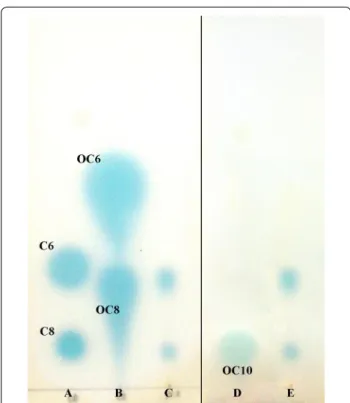
TLC overlay assay with the biosensor KYC55 suggested that strain PD-2 produced two AHLs (Fig. 1). The retarda-tion factor (RF) values of lower spot and upper spot were 0.12 and 0.31 respectively. Five standards (C6, OC6, C8, OC8 and OC10) were shown in Fig. 1. According to the RF values of the AHLs, two AHLs matched standards, which were synthetic N-3-oxo-octanoyl-L-homoserine lactone (3-oxo-C8-HSL) and N-(3-oxodecanoyl)-L-homoserine lactone (3-oxo-C10-HSL). GC–MS experiments were per-formed subsequently to confirm the AHLs of strain PD-2.
IR= Fcontrol−Ftreatment
GC‑MS analysis
A chromatography analysis was performed in SIM mode using an ion with m/z = 143 as a marker fragment. The
chromatography of the AHL standards were shown in Fig. 2b and c. Through analyzing the MS information, two peaks in PD-2 extracts showed in Fig. 2a of the retention times (RT) were consistent with the standard of 3-oxo-C8-HSL and 3-oxo-C10-HSL at 7.111 and 8.033 min.
Comparative genomics and phylogenetic tree
Web-based similarity searches using the GenBank data-base were used to determine the homologous degrees of zlaI and zlbI protein sequences to those of other AHL synthases. The most similar homolog of zlaI, identified using a BLASTP search, was an autoinducer synthase from Sulfitobacter pseuddonitzssschiae (GenBank acces-sion no. WP 037926640.1) with a 77% identity; the most similar homologs of zlbI were autoinducer synthases from Tropicibacter naphthalenivorans and Ponticoccus
sp. SJ5A-1(GenBank accession nos. WP 058247237.1 and WP 058863594.1, respectively), with 81% identity. In fact, the multiple sequence alignments revealed that zlaI and zlbI share low homology, but both shared 10 conserved amino acids with other reported autoinducer proteins of
Rhodobacterales bacteria as shown in Additional file 1: Figures S1A, B, respectively. Moreover, the phylogenetic tree constructed based on amino acid alignment (Fig. 3a, b) illustrated that zlaI clustered closely with an autoin-ducer synthase protein from Salipiger mucosus with a bootstrap value of 88% and zlbI was the least phyloge-netically related to autoinducer synthase proteins from
T. naphthalenivorans and Sagittula stellate with a boot-strap value of 52%. The Fig. 3c showed that zlaR clustered closely to an luxR family transcriptional regulator protein from Salipiger mucosus. Figure 3d showed zlbR clustered closely to luxR family transcriptional regulator proteins from Pelagibaca abyssi and Thiobacimonas profunda
with a bootstrap value of 53%.
Identification of the zlaI and zlbI genes responsible for AHL production
To identify what kinds of AHLs are produced by the
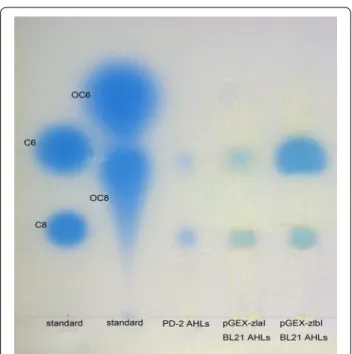
zlaI and zlbI genes, the expression of zlaI and zlbI was examined in an E. coli strain that does not produce AHL. The presence of the 870 bp zlaI and 639 bp zlbI genes in the transformants were confirmed by PCR amplifica-tion. In bioautography, the KYC55 biosensor detected AHLs from recombinant E. coli culture extracts. In Fig. 4, AHLs signals are observed as blue spots on the plat. This demonstrates zlaI and zlbI encode AHL synthetases in
E. coli BL21. The profile of AHLs produced by
pGEX-zlaI E. coli BL21 and pGEX-zlbI E. coli BL21 indicate that the zlaI and zlbI genes produced the same AHLs of
Fig. 1 Profiles of AHLs produced by strain PD-2 based on
bioautog-raphy assay. The biosensor is Agrobacterium tumefaciens KYC55. Lane A mixture of synthetic HSL standards: C6 (C6-HSL); C8 (C8-HSL). Lane B mixture of synthetic 3-oxo-HSL standards: 3-oxo-C6 (3-oxo-C6-HSL); 3-oxo-C8 (3-oxo-C8-HSL). Lane D OC10 (3-oxo-C10-HSL) standard. Lane C and E extracts of strain PD-2.There are two blue spots on the plate. This indicate two AHLs existed in strain PD-2. The upper spot matched 3-oxo-C8-HSL standard and the lower spot matched 3-oxo-C10-HSL standard
a
b
c
Fig. 2 GC-MS chromatogram in SIM mode at m/z143. a Extract of
3-oxo-C8-HSL and 3-oxo-C10-HSL (Fig. 4). Although this method cannot determine an absolute quantifica-tion, the size of a spot on TLC plate may also reflect the
concentrations of AHLs to some degree (Deepa et al. 2012). From the size of each blue spot, the zlbI gene pro-duced obviously greater amounts of 3-oxo-C8-HSL than
zlaI, thereby demonstrating that 3-oxo-C8-HSL is the main product of the zlbI gene.
The effect of β‑CD on the growth of strain PD‑2
Growth curves with different concentrations of β-CD are shown in Additional file 1: Figure S2. No significant differences were found in the initial 40 h of growth; all the strains entered the logarithmic phase at 10 h and the plateau phase at 40 h. The OD630 values declined after 40 h of incubation with β-CD. The levels of growth inhi-bition were proportional to the β-CD concentrations. At 84 h, the OD630 values were 0.67, 0.51, and 0.42 at β-CD concentrations of 1, 2, and 5 mg mL−1, respectively. The curve of the control was much more stable (OD630 of 0.7) from 40 to 84 h. The results suggested that the addition of 1 mg mL−1 β-CD had the lowest impact on growth with a growth of inhibition of only 4%, which we considered appropriate for the following experiments.
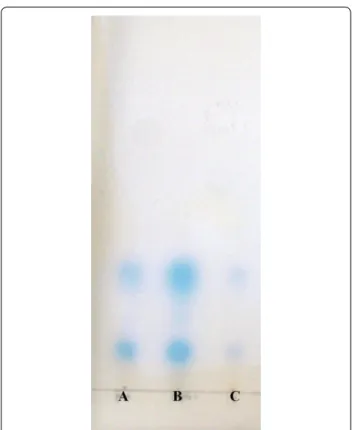
After the addition of β-CD, the concentrations of the AHLs were detected by bioautography assay (Fig. 5). The spots of samples A (PD-2 cultured for 20 h at low den-sity) and B (PD-2 cultured for 84 h at high denden-sity), which did not contain β-CD, were much larger and were deeper blue than C (A adding β-CD, then cultured for 84 h) which was dim blue. This indicates strain PD-2 at low density just produce a small amount of AHLs. When the 100
51 100 64
81
57 54
55
0.2
99 99 96 89
54 52
66
0.2
100 51
81 100
77
0.2
100
100
87 100 69
53
0.2
a b
c d
Fig. 3 Phylogenetic tree showed the phylogenetic position of AHL synthases and transcriptional regulator of strain PD-2. The tree is drawn to scale,
with branch lengths in the same units as those of the evolutionary distances used to infer from the phylogenetic tree. The horizontal talbar at the bottom represents evolutionary distance as 0.2 change pernucleotide position. The numbers at the nodes indicate the bootstrap values as percent-age of 1000 replications. Glucose dehydrogenase enzyme (GI:729809030) from Escherichia coli was chosen as the out group for comparison. a The phylogenetic position of zlaI protein. b The phylogenetic position of zlbI protein. c The phylogenetic position of zlar protein. d The phylogenetic position of zlbr protein
Fig. 4 Profiles of AHLs produced by PD-2 and recombinants based
bacterium continuously grows to high cell density, the AHLs accumulate to high concentration. But after adding QS-quenching β-CD in the low cell density, the concen-tration of AHLs do not increase. Because β-CD can form complexes with the AHLs that PD-2 produced at high cell density (Morohoshi et al. 2013).
The algicidal effect of Ponticoccus sp. PD‑2 on red tide species
Algicidal activities of strain PD-2 were obtained after 5 days of co-cultivation with target microalgae. The date presented were the mean values of IR from triplicates. (a)
The microalgae which was co-cultured with the extracts of strain PD-2 cultured for 84 h. (b) the microalgae which was co-cultured with the extracts of strain PD-2 cultured for 20 h. (c) the microalgae which was co-cultured with extracts of strain PD-2 co-cultured with 1 mg mL−1 β-CD on 20 h and continuously cultured for 64 h.
Strain PD-2 shows algicidal effects on all red tide spe-cies after 84 h of culturing (Table 1). From the IR value, PD-2 had the strongest algicidal effect (IR 84.81%) on its host, P. donghaiense. Besides its host microalgae, strain PD-2 also had algicidal effects on P. globosa (IR 79.91%) and a small effect on A. tamarense (IR 67.14%). After cul-turing for 20 h, PD-2 had very little algicidal effects on
P. donghaiense and A. tamarense with IR of 20.27 and 18.38% respectively and no effect on P. globosa. The same results were observed when PD-2 was continuously co-cultured with 1 mg mL−1 β-CD for 64 h. Then, the algi-cidal activities of PD-2 co-cultured with β-CD decreased to IR of 19.45% against P. donghaiense and 16.09% against
A. tamarense. Compared to PD-2 without β-CD added, the algicidal activities decrease by more than 50%. In this research, the addition of β-CD reduced the concentration of the AHLs. Thus, the results suggest that the algicidal activities of strain PD-2 are regulated by a QS system.
Discussion
In this study, a Ponticoccus sp. PD-2 strain was isolated from the harmful algal bloom-associated microalga
P. donghaiense. Its metabolites had growth inhibition effects not only on its host (P. donghaiense), but also on two other red tide microalgae, P. globosa and A. tama-rense. Ponticoccus was first isolated from the coastal sea-waters of Korea and has been identified as a new genus belonging to Rosebacter clade (Hwang and Cho 2008). The Rosebacter clade is one of the major marine groups and has members across diverse marine habitats (Buchan et al. 2005). Bacteria of Rosebacter clade also appear in the symbiotic systems of microalgae and may often regu-late the algal community (Kodama et al. 2006; Tan et al. 2015).
To our knowledge, this is the first report demonstrat-ing that Ponticoccus sp. has QS functions. In our previ-ous research, we found strain PD-2 could produce AHLs QS signals. Of the diverse AHLs produced by marine bacteria, the most common types are C4-HSL, C6-HSL,
Fig. 5 Profiles of AHLs produced by strain PD-2 under different
culture condition. The biosensor is Agrobacterium tumefaciens KYC55. Lane A extracts of strain PD-2 cultured for 20 h. Lane B extracts of strain PD-2 cultured for 84 h. Lane C extracts of strain PD-2 co-cultured with 1 mg mL−1 β-CD at 20 h and continuously cultured for
64 h. After overnight incubation, the AHLs production was visually observed as blue spots. There was a positive correlation between the size of the blue spots and the concentration of AHLs
Table 1 Algicidal effect of strain PD-2 against various red tides microalgae species
Inhibition rate (%) Prorocentrum donghaiense Phaeocystis globosa Alexandrium tamarense
A 84.81 ± 2.8 78.91 ± 1.6 67.14 ± 3.5
B 20.27 ± 3.6 −3.61 ± 3.1 18.38 ± 3.3
3-hydroxy-C6-HSL, 3-oxo-C6-HSL, C8-HSL, 3-oxo-C8-HSL, 3-oxo-C10-3-oxo-C8-HSL, 3-oxo-c12-HSL and C14-HSL (Berger et al. 2012; Swift et al. 1997; Tang et al. 2013; Zan et al. 2013). The various signal molecules produced by its synthetases (luxI homolog genes) can be inves-tigated by heterologous expression (Gao et al. 2014; How et al. 2015; Morohoshi et al. 2016). To determine which kinds of AHLs are produced by zlaI and zlbI, we expressed zlaI and zlbI in E. coli. 3-oxo-C8-HSL and 3-oxo-C10-HSL were identified in a PD-2 extract and in
E. coli overexpressing zlaI and zlbI, suggesting that both
zlaI and zlbI can each produce two kinds of AHLs. How-ever, it is rare that two homologous luxI genes can gen-erate identical signal molecules in one strain. Thus, we speculate that the two kinds of signal molecule are syn-thesized from the same metabolic pathway. In this study, the multiple sequence alignment and the phylogenetic tree (Additional file 1: Figure S1; Fig. 3a, b) illustrated that although there was only a low degree of homology, both of PD-2 and other Rhodobacterales bacteria had conserved regions among AHL synthases. Thus, the zlaI
gene and zlbI gene should be new AHL synthetase genes. All the strains shared the 10 invariant amino acids that are characteristic of luxI homologs (Parsek et al. 1997). This strongly indicates a low rate of random mutation for this autoinducer. It also shows that these proteobacteria share a similar QS mechanism and a similar mechanism for regulating the synthesis of AHLs, although the corre-sponding AHLs regulate different target genes. Through comparing zlaR and zlbR protein sequences with those of other LuxR family transcriptional regulator on NCBI and constructing phylogenetic tree (Fig. 3c, d), we found that there was also a low degree of homology among tran-scriptional regulator from other bacteria. Thus, the zlaR
gene and zlbR gene might also be new transcriptional regulator genes.
Many studies have shown that marine organism-asso-ciated bacteria play very important roles when interact-ing with their hosts. In recent years, a high percentage of marine organism-associated bacteria have been shown to produce QS signals, including bacteria associated with microalgae, sponges, corals, and fish (Britstein et al. 2016; Wagner-Döbler et al. 2005). Thus, studying the QS-medi-ated interactions between marine bacterial with their hosts has profound theoretical and practical significance regarding the ecological functions of marine bacteria. In fact, many investigations have proven that QS regulates such interactions. The luminous bacterium Vibrio fis-cheri is the specific light organ symbiont of Euprymna scolopes (Boettcher and Ruby 1990) E. scolopes is a small sepiolid squid (average adult length, 40 mm) that is indig-enous to the Hawaiian archipelago, where it lives in shal-low sand flats that are associated with coral reefs (Ruby
and McFallngai 1992). The squid buries itself in the sand during the day to escape predators, but it comes out to forage in the water column at night (Summers 1983). Additionally, sponges and their associated microorgan-isms have developed a variety of chemical defense path-ways. The production of chemicals which are regulated via QS systems are employed to defend sponges against potentially pathogenic bacteria and fish predators, deter fouling organisms, and degrade surfactants (Guo et al. 2011; Huang and Li 2006).
Cyclodextrins are a family of compounds comprising sugar molecules that are bound together in a ring. Cyclo-dextrins are well known cyclic oligosaccharides that form complexes with a wide range of organic compounds. Tsu-kasa proved that α,β-CD could form a complex with an autoinducer in a bacterial culture medium (Ikeda et al. 2002). He found that the addition of β-CD decreased the abundance of AHLs signal molecules by 75%, with-out inhibiting bacterial growth. But our results indicate that 1 mg mL−1 β-CD had little influence on the growth of strain PD-2, and β-CD could form a complex with AHLs produced by strain PD-2 in the culture medium (Morohoshi et al. 2013). The algicidal activities of strain PD-2 decreased more than 50% due to its QS system was inhibited, this is the first evidence that the QS systems of microalgae-associated bacteria can regulate algicidal activity.
Existing evidence proves that production of algicidal substances can be regulated by QS (Guo et al. 2016; Nakashima et al. 2006), although there is no direct evi-dence to suggest that the algicidal activities of micro-algae-associated bacteria is regulated by QS systems. Consequently, investigations of the effects of QS on the regulation of algicidal functions are needed to increase our understanding of the relationship between bacteria and algae, and QS inhibitors can be used to study QS regulation.
Abbreviations
QS: quorum sensing; AI: autoinducer; AHL: N-acyl-homoserine lactone; β-CD: β-cyclodextrin; GC–MS: gas chromatography–mass spectrometer; HPLC–MS: high-performance liquid chromatography-mass spectrometer; LB: Luria-Bertani; TLC: thin-layer chromatography; IR: inhibition rate; RF: retardation factor; 3-oxo-C8-HSL: N-3-oxo-octanoyl-L-homoserine lactone; 3-oxo-C10-HSL: N-(3-oxodecanoyl)-L-homoserine lactone; RT: retention times; PCR: polymer-ase chain reaction; CCMM: culture collection of marine microalgae.
Authors’ contributions
WC and LZ designed the whole experiment; CH, BH and MZ helped to carry the experiment; WG, CS and GZ helped to analyze the raw data; WC wrote the article and XG helpd on the paperwork. All authors read and approved the final manuscript.
Additional file
Author details
1 Key Laboratory for Marine Bioactive Substances and Modern Analytical Technology of the First Institute of Oceanography, State Oceanic Administra-tion, No. 6 Xianxialing Road, Qingdao 266061, Shandong, People’s Republic of China. 2 Laboratory for Marine Ecology and Environmental Science, Qing-dao National Laboratory for Marine Science and Technology, QingQing-dao 266071, People’s Republic of China. 3 School of Life Science of Yantai University, Yantai 264000, People’s Republic of China. 4 National Deep Sea Center, State Oceanic Administration of China, Qingdao 266237, People’s Republic of China.
Acknowledgements
We thank Professor Hill from The Institute of Marine and Environmental Technology, University of Maryland, USA, for providing the biosensor Agrobac-terium tumefaciens KYC55 (pJZ372) (pJZ384, pJZ410). We thank the Institute of Oceanography, Chinese Academy of Science, for providing the indicator microalgae strains.
Competing interests
The authors declare that they have no competing interests.
Availability of data and materials
All datasets on which the conclusions of the manuscript rely are presented in the main paper.
Funding
This work was supported by The National Natural Science Foundation of China-Shandong Joint Funded Project (U1406404), the National Natural Sci-ence Foundation of China (41076108), Basic Scientific Fund for National public Reserch Institute of China (2015T05), Marine science and technology project of Huangdao district of Qingdao city (2014-4-20), Natural Science Foundation of Shandong Province (ZR2014DL011), and the 2012 Taishan Scholar Award. All of these funds have been used for purchasing reagents and data analysis.
Received: 23 February 2017 Accepted: 27 February 2017
References
Berger M, Brock NL, Liesegang H, Dogs M, Preuth I, Simon M, Dickschat JS, Brinkhoff T (2012) Genetic analysis of the upper phenylacetate catabolic pathway in the production of tropodithietic acid by Phaeobacter gal-laeciensis. Appl Environ Microbiol 78(10):3539–3551
Boettcher K, Ruby E (1990) Depressed light emission by symbiotic Vibrio fischeri of the sepiolid squid Euprymna scolopes. J Bacteriol 172(7):3701–3706 Britstein M, Devescovi G, Handley KM, Malik A, Haber M, Saurav K, Teta R,
Cos-tantino V, Burgsdorf I, Gilbert JA (2016) A new N-Acyl homoserine lactone synthase in an uncultured symbiont of the Red Sea sponge Theonella swinhoei. Appl Environ Microbiol 82(4):1274–1285
Buchan A, Gonzalez JM, Moran MA (2005) Overview of the marine Rosebacter lineage. Appl Environ Microb 71:5665–5677
Castang S, Chantegrel B, Deshayes C, Dolmazon R, Gouet P, Haser R, Reverchon S, Nasser W, Hugouvieux-Cotte-Pattat N, Doutheau A (2004) N-Sulfonyl homoserine lactones as antagonists of bacterial quorum sensing. Bioorg Med Chem Lett 14(20):5145–5149
Cataldi T, Bianco G, Frommberger M, Schmitt-Kopplin P (2004) Direct analysis of selected N-acyl-L-homoserine lactones by gas chromatography/mass spectrometry. Rapid Commun Mass Spectrom 18(12):1341–1344 Cataldi TR, Bianco G, Palazzo L, Quaranta V (2007) Occurrence of N
-acyl-L-homoserine lactones in extracts of some Gram-negative bacteria evaluated by gas chromatography–mass spectrometry. Anal Biochem 361(2):226–235
Davies DG, Parsek MR, Pearson JP, Iglewski BH, Costerton JW, Greenberg EP (1998) The involvement of cell-to-cell signals in the development of a bacterial biofilm. Science 280(5361):295–298
Deepa A, Marzida M, Yan GOS, Yusof MYM, Hassan H, Sekaran SD (2012) Detection of quorum sensing signal molecules and identification of an autoinducer synthase gene among biofilm forming clinical isolates of Acinetobacter spp. PLoS ONE 7(7):e36696
Fuqua C, Winans SC, Greenberg EP (1996) Census and consensus in bacterial ecosystems: the LuxR–LuxI family of quorum-sensing transcriptional regulators. Annu Rev Microbiol 50(1):727–751
Gambello MJ, Iglewski BH (1991) Cloning and characterization of the Pseu-domonas aeruginosa lasR gene, a transcriptional activator of elastase expression. J Bacteriol 173(9):3000–3009
Gao J, Ma A, Zhuang X, Zhuang G (2014) An N-acyl homoserine lactone syn-thase in the ammonia-oxidizing bacterium Nitrosospira multiformis. Appl Environ Microbiol 80(3):951–958
Greenberg EP, Hastings J, Ulitzur S (1979) Induction of luciferase synthesis in Beneckea harveyi by other marine bacteria. Arch Microbiol 120(2):87–91 Guillard RR, Ryther JH (1962) Studies of marine planktonic diatoms: I. Cyclotella
Nana Hustedt, and Detonula Confervacea (CLEVE) Gran. Can J Microbiol 8(2):229–239
Guo X, Zheng L, Zhou W, Cui Z, Han P, Tian L, Wang X (2011) A case study on chemical defense based on quorum sensing: antibacterial activity of sponge-associated bacterium Pseudoalteromonas sp. NJ6-3-1 induced by quorum sensing mechanisms. Ann Microbiol 61(2):247–255
Guo X, Liu X, Wu L, Pan J, Yang H (2016) The algicidal activity of Aeromonas sp. strain GLY-2107 against bloom-forming Microcystis aeruginosa is regu-lated by N-acyl homoserine lactone-mediated quorum sensing. Environ Microbiol 18(11):3867–3883
Guzmán L, Varela R, Muller-Karger F, Lorenzoni L (2016) Bio-optical character-istics of a red tide induced by Mesodinium rubrum in the Cariaco Basin, Venezuela. J Mar Syst 160:17–25
How KY, Hong KW, Sam CK, Koh CL, Yin WF, Chan KG (2015) Unravelling the genome of long chain N-acylhomoserine lactone-producing Acinetobac-ter sp. strain GG2 and identification of its quorum sensing synthase gene. Front Microbiol 6:240
Hu X, Wang Y, Yu Y, Wang D, Tian Y (2016) Research on the concentration pre-diction of nitrogen in red tide based on an optimal grey Verhulst model. Math Probl Eng 2:1–9
Huang Y, Li Z (2006) Chemical defense and active compounds of sponge and sponge-associated microorganisms. Biotechnol Bull 25(1):13–17 Hwang CY, Cho BC (2008) Ponticoccus litoralis gen. nov., sp nov., a marine
bacterium in the family Rhodobacteraceae. Int J Syst Evol Microbiol 58:1332–1338
Ikeda T, Inoue Y, Suehiro A, Ikeshoji H, Ishida T, Takiguchi N, Kuroda A, Kato J, Ohtake H (2002) The effects of cyclodextrins on autoinducer activities of quorum sensing in Pseudomonas aeruginosa. J Incl Phenom Macrocycl Chem 44(1–4):381–382
Imai I, Ishida Y, Hata Y (1992) Isolation and properties of a bacterium inhibiting the growth of Gymnodinium nagasakiense. Nippon Suisan Gakkaishi 58(6):1073–1077
Imai I, Ishida Y, Hata Y (1993) Killing of marine phytoplankton by a gliding bacterium Cytophaga sp., isolated from the coastal sea of Japan. Mar Biol 116(4):527–532
Joint I, Tait K, Wheeler G (2007) Cross-kingdom signalling: exploitation of bac-terial quorum sensing molecules by the green seaweed Ulva. Philos Trans R Soc Lond B Biol Sci 362(1483):1223–1233
Karina G, Valentina P, Robert SM, Ariel K (2013) Coral-associated bacteria, quorum sensing disrupters, and the regulation of biofouling. Biofouling 29(6):669–682
Kodama M, Doucette GJ, Green DH (2006) Relationships between bacteria and harmful algae. Ecology of harmful algae. Springer, Berlin, pp 243–255
Kumar S, Stecher G, Tamura K (2016) MEGA7: molecular evolutionary genetics analysis version 7.0 for bigger datasets. Mol Biol Evol 33(7):1870–1874 Li Z, Lin S, Liu X, Tan J, Pan J, Yang H (2014) A freshwater bacterial strain,
Shewanella sp. Lzh-2, isolated from Lake Taihu and its two algicidal active substances, hexahydropyrrolo [1, 2-a] pyrazine-1, 4-dione and 2, 3-indo-linedione. Appl Microbiol Biotechnol 98(10):4737–4748
Li J, Nedwell DB, Beddow J, Dumbrell AJ, McKew BA, Thorpe EL, Whitby C (2015) amoA gene abundances and nitrification potential rates suggest that benthic ammonia-oxidizing bacteria and not archaea dominate N cycling in the Colne Estuary, United Kingdom. Appl Environ Microbiol 81(1):159–165
Morohoshi T, Tokita K, Ito S, Saito Y, Maeda S, Kato N, Ikeda T (2013) Inhibition of quorum sensing in gram-negative bacteria by alkylamine-modified cyclodextrins. J Biosci Bioeng 116(2):175
Morohoshi T, Okutsu N, Xie X, Ikeda T (2016) Identification of Quorum-Sensing Signal Molecules and a Biosynthetic Gene in Alicycliphilus sp. isolated from activated sludge. Sensors 16(8):1218
Nakashima T, Miyazaki Y, Matsuyama Y, Muraoka W, Yamaguchi K, Oda T (2006) Producing mechanism of an algicidal compound against red tide phytoplaonkton in a marine bacterium γ-proteobacterium. Appl Microbiol Biotechnol 73(3):684–690
Nealson KH, Platt T, Hastings JW (1970) Cellular control of the synthesis and activity of the bacterial luminescent system. J Bacteriol 104(1):313–322 Parsek MR, Schaefer AL, Greenberg E (1997) Analysis of random and
site-directed mutations in rhlI, a Pseudomonas aeruginosa gene encoding an acylhomoserine lactone synthase. Mol Microbiol 26(2):301–310 Roth PB, Twiner MJ, Wang Z, Dechraoui MYB, Doucette GJ (2007) Fate and
distribution of brevetoxin (PbTx) following lysis of Karenia brevis by algicidal bacteria, including analysis of open A-ring derivatives. Toxicon 50(8):1175–1191
Ruby EG, McFallngai MJ (1992) A squid that glows in the night: development of an animal-bacterial mutualism. J Biotechnol 174(15):4865–4870 Singh RP, Baghel RS, Reddy CRK, Jha B (2015) Effect of quorum sensing signals
produced by seaweed-associated bacteria on carpospore liberation from Gracilaria dura. Front Plant Sci 6:117
Summers W (1983) Cephalopod life cycles, Vol. I: species accounts. Academic Press, London, pp 75–91
Swift S, Karlyshev AV, Fish L, Durant EL, Winson MK, Chhabra SR, Williams P, Macintyre S, Stewart G (1997) Quorum sensing in Aeromonas hydrophila and Aeromonas salmonicida: identification of the LuxRI homologs AhyRI and AsaRI and their cognate N-acylhomoserine lactone signal molecules. J Bacteriol 179(17):5271–5281
Tan S, Zhou J, Zhu X, Yu S, Zhan W, Wang B, Cai Z (2015) An association net-work analysis among microeukaryotes and bacterioplankton reveals algal bloom dynamics. J Phycol 51(1):120–132
Tang K, Zhang Y, Yu M, Shi X, Coenye T, Bossier P, Zhang XH (2013) Evaluation of a new high-throughput method for identifying quorum quenching bacteria. Scientific Rep 3:2935
Tempé J, Petit A, Holsters M, Van Montagu M, Schell J (1977) Thermosensi-tive step associated with transfer of the Ti plasmid during conjugation: possible relation to transformation in crown gall. Proc Natl Acad Sci 74(7):2848–2849
Wagner-Döbler I, Thiel V, Eberl L, Allgaier M, Bodor A, Meyer S, Ebner S, Hennig A, Pukall R, Schulz S (2005) Discovery of complex mixtures of novel long-chain quorum sensing signals in free-living and host-associated marine alphaproteobacteria. ChemBioChem 6(12):2195–2206
Xu LY, Zheng L, Han XP, Cui ZS, Guo XC, Li XZ (2012) Screening of microalgae associated bacteria with quorum sensing system and their algicidal activ-ity. Oceanologia ET Limnologia Sinica 43(6):1149–1155
Zan J, Heindl JE, Liu Y, Fuqua C, Hill RT (2013) The CckA-ChpT-CtrA phos-phorelay system is regulated by quorum sensing and controls flagellar motility in the marine sponge symbiont Ruegeria sp. KLH11. PLoS ONE 8(6):e66346
Zheng L, Cui Z, Xu L, Sun C, Powell RJ, Hill RT (2015) Draft genome sequence of Rhodobacteraceae strain PD-2, an algicidal bacterium with a quorum-sensing system, isolated from the marine microalga Prorocentrum donghaiense. Genome Announc 3(1):e01549