Comparison of nursing students’ and clinical nurses’
attitude toward the nursing profession
Ali Noruzi Koushali, Zahra Hajiamini, Abbas Ebadi
A
bstrActBackground: To develop nursing education and promote nursing strategies, there is a need for a staff with positive attitude. The present study was conducted to compare the attitudes among clinical nurses and nursing students toward the nursing profession. Materials and Methods: In this descriptive- analytical study 313 clinical nurses and 81 nursing students (total n = 394) of Tehran, Iran, were selected through a systematic sampling method and their viewpoints were investigated using a nursing professional attitude questionnaire.
Results: The findings of this study showed that 72.6% of nurses and 65.4% of students had positive attitude toward their profession, and despite the high percentage of the clinical nurses’ positive outlook, the difference was not statistically significant (P > 0.05). Conclusion: The results showed that approximately one-third of the students and nursing practitioners had neutral or negative attitude toward their occupation. Due to the serious effect of one’s professional attitude and commitment of service, it is necessary to have further studies about the current situation to eliminate such negative factors.
Key words: Attitude, nurses, nursing students, occupation
Nursing Faculty and Behavioral Sciences Research Center, Baqiyatallah University of Medical Sciences, Tehran, Iran
Address for correspondence: Mrs. Zahra Hajiamini, Behavioral
Sciences Research Center and Nursing Faculty, Baqiyatallah University of Medical Sciences, Tehran, Iran.
E-mail: [email protected]
Access this article online Quick Response Code:
Website:
www.ijnmr.ir
DOI:
***
Article
I
ntroductIonA
t present, health care systems are encountering enormous challenges in our country; among them is the poor quality of services considered to be the most important. One of the significant factors for poor quality of health care services is human agents. Human force plays a substantial role in the evolution and progression of health care issues and is enumerated as one of the main components of each organization, which has always been emphasized by human resources development experts. It seems that achieving the objectives of organizations is highly dependent on the capacity of human resources.[1] Nurses are the key members and play the major part ofservice-providing system in almost all countries.[2,3] Nursing is also the largest group of health system, possessing considerable potential power that could be influential on the quality of health care services system.[2]
Given the nursing group the therapeutic-educational centers of the country, attending to their views and demands is actually figuring out the whole community health. Job satisfaction is an overriding factor in the quality of performance and services provided by hospital staff, including nurses. It is indeed one of the parameters in the nursing group having a direct impact on the quality of nursing services. Job satisfaction level represents a positive or negative attitude toward the profession.[4] Attitude plays a
principal role in guiding human behavior toward achieving goals, awareness of its consequences and effective processing of complex information about living environment.[5] In reality, knowledge, skill, and positive outlook are the characteristics recommended to develop nursing education and new nursing strategies today.[6] In the past, there has been a lot of negative attitude toward the nursing profession among the students due to unpleasant hard work in the hospital, working on holidays, lack of respect for work, and low salary. [7] Loss of nurses’ interest in what they do not only leads to work quality decline and irreparable damage to patients and help-seekers but also contributes to demoralization.[8] Mental and occupational burnout syndrome along with feelings of helplessness and frustrations come from negative attitude toward their career.[9]
Low morale of the nursing students results in the lack of motivation and eventually dropping out of school in this field, thus, the associated rate has been reported to be approximately 7.6% in different studies.[10] Even in several investigations, incomprehension of the nurse’s role has been accounted as the main cause of students’ low spirit[11] and familiarizing them with the nursing profession and modifying negative attitude before entering this field has been emphasized to boost their morale, especially the male students.[12] Improved job performance followed by a positive outlook and job satisfaction will enhance the quality of patients’ care and increased productivity,[4]
hence as reported in different studies, the internal factors are far more than external factors in job motivation among nurses.[1] In a study by Katsuki et al. on 189 nurses working in a psychiatric hospital in Japan, a positive correlation has been observed between the nursing attitude and the occupational burnout.[13] Although different studies have been implemented inside and outside the country in terms of nurses’ views toward various issues, such as AIDS, mental disorders, spirituality, and moral care, and taking care of the elderly, investigations on nurses’ attitude toward nursing profession have been mostly emphasized particularly in the field of nursing, especially psychiatric nursing or working in psychiatric departments, where Evangelou et al.’s, Surgenor et al.’s, and Namdar et al.’s studies are mentioned.[5,14,15] However, a few researches have been
reported associated with general attitude of nurses toward the nursing profession; for instance, in Banaderakhshan et al. survey, aiming to compare knowledge, viewpoints, and performance of nursing practitioners and senior students of
nursing, conducted a study on 54 students of Nursing and
Midwifery Faculty of Shahid Beheshti University of Medical
Sciences and 54 graduate nurses of the same university, working in teaching hospitals for 4–6 years, were evaluated and the results revealed that 52%, 46.3%, and 1.7% of
students and practitioners, respectively, had positive, neutral, and negative attitudes toward their profession,[2] whereas in the study by Iravani et al. to compare the attitude of medical students in basic and clinical courses, it has shown that students’ attitudes became more negative toward the basic training courses after entering the clinical training course.[16]
In a similar study by Taghi-Zuqi, to examine and compare the attitudes of the midwifery students from different Midwifery Faculties of Tehran universities in different academic years (182 midwifery students), a significant difference was found between the students’ views in different years of education, their positive outlook in the first year of university changed toward neutrality over the academic years, but the attitude alteration was not as much as to be considered negative. [17] To determine the viewpoints
of the nursing students of Tehran University of Medical Sciences on nursing profession and the reasons for leaving the job, Joulaee et al. conducted a research in which only 18% of the nursing students had positive view toward their career,[18] but Zhang et al.’s survey claimed that more than half (53.5%) of the nursing students had positive attitude toward their occupation.[19]
The findings of Toth et al. also revealed no significant difference between the nurses’ and nursing students’ attitude toward their occupation[20] and considering the comparative study by Brewer et al., no significant difference has been found in terms of professional attitude and willingness to change the course, if possible, between nurses and engineering specialists.[21]
Regarding a close relationship that has been established by experts between nursing attitude and job satisfaction, and even Bowers and Lutz, have reported that positive outlook determines 53% of job satisfaction,[22] and considering the beneficial effect of occupational viewpoints on professional performance of nurses as the largest group of health care providers, and the impact of working years passing their opinions, this study was carried out to compare the nurses’ and the nursing students’ attitude toward the nursing profession.
M
AterIAls AndM
ethodsIn this descriptive–analytical study, a total of 394
participants, including 313 nurses of selected hospitals with a mean age of 37.82 ± 7.17 years and 81 nursing students with a mean age of 25.65 ± 6.12 years, of Baqiyatallah University of Medical Sciences, Tehran, Iran, were selected using a systematic random sampling method. Consent for the study participation for both groups, entering the clinical environment and passing of at least two terms in nursing courses for students, and at least 1 year of official work experience or having associate degree in nursing for clinical nurses were considered as inclusion criteria. Data collecting instrument was a two-part questionnaire in which one was related to demographic information and the other was associated to attitude toward the nursing profession. Demographic components included age, gender, marital status, level of education, work experience, employment status, level of satisfaction with income, number of children, overtime and source of income, each designed separately for the study groups (nurses and nursing students). Attitude-related questionnaire consisted of 12 questions for the evaluation of nurses’ outlook toward the nursing profession; the questionnaire’s scientific validity was approved by Banaderakhshan et al., using content validity,[2] and its reliability by test–retest (r
item analysis. The questionnaire as the basis for preliminary work was re-examined for its validity and three questions were added according to experts’ points of view, so the total number of questions was 15. To collect information, different wards of mentioned hospitals were first randomly
selected using cluster sampling method, and 340 nurses
were then sampled through random allocation from those selected wards based on the study inclusion criteria that included willingness to cooperate in the study for both groups, having clinical experience, spending at least two semesters of nursing courses for students and at least 1 year of employment for nurses, and having at least associate diploma degree in nursing.
In addition, the nursing student participants were asked to complete the questionnaires on demographic information and attitude toward the nursing profession. Finally, after assuming 27 cases as sample loss due to inadequate
responses or lack of timely delivery, 394 questionnaires
submitted by 313 nurses and 81 nursing students were collected for finial analysis. Data were analyzed by SPSS15 statistical software using descriptive statistics and Chi-square test. However, it should be noted that in spite of informed consent for the study participation, the questionnaires were anonymously completed, and the results were kept confidentially.
r
esultsThe study findings showed that the mean age of nurses was 37.82 ± 7.17 ranging from 22 to 55 years. In regard to marital status, 83.1% of nurses were married, and in terms
of level of education, 5.4%, 82.2%, and 5.4% had associate,
bachelors, and masters’ degrees. The results also revealed that 33% of nurses were satisfied with their income, 23.9% were dissatisfied, and almost half of the nurses had partial satisfaction with their income [Table 1].
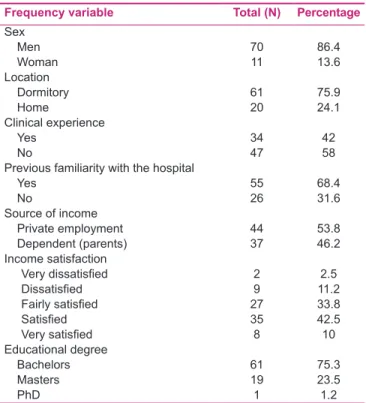
Among the 81 nursing students with the mean age of 25.65
± 6.12 years, 86.4% were males and 13.6% were females;
75.9% were living in dormitories. In terms of educational status, 75.5%, 23.5%, and 1.2% were undergraduate, masters, and PhD students [Table 2].
In this regard, the findings also represented that 72.6%, 26.7%, and 0.7% of clinical nurses, respectively, had positive, neutral, and negative outlook toward their
occupation. However, 65.4% of nursing students had positive and 34.6% had neutral views on nursing profession
[Table 3].
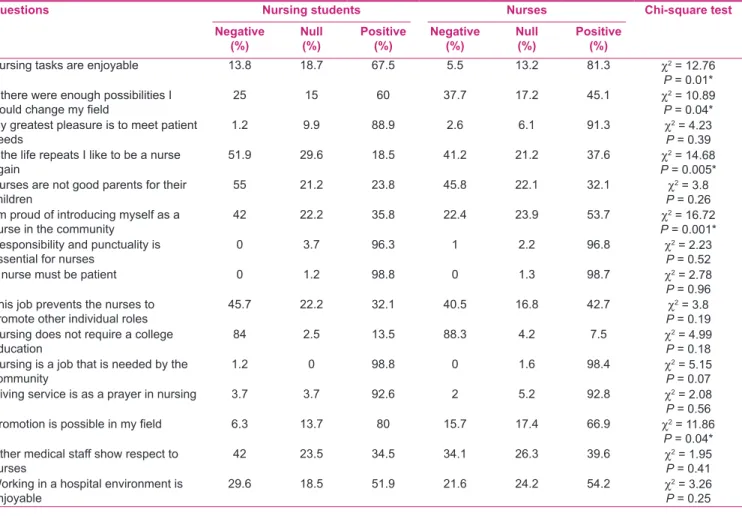
Despite that, questions 1, 2, 4, and 6 the nurses’ attitude
is more positive than the students’ (P < 0.05) but the
Table 1: Frequency of demographic profile of clinical nurses
Variable Total (N) Percentage
Sex
Men 177 56.5
Woman 136 43.5
Marital status
Single 53 16.9
Married 260 83.1
Children
Without children 47 18.1
One 64 24.6
Two 97 37.3
Three or more 52 20
Educational degree
Associates 17 5.4
Bachelors 279 89.2
Masters 17 5.4
Clinical experience (yr)
<6 80 25.4
7–12 93 29.6
13–18 64 20.5
19–24 39 12.6
>25 37 11.9
Income satisfaction
Very dissatisfied 25 7.9
Dissatisfied 51 16.2
Fairly satisfied 134 42.9
Satisfied 97 31
Very satisfied 6 2
Employment status
Hired 183 58.4
Hired over time 25 7.9
Redundancy 105 33.7
Table 2: Frequency of demographic profile of nursing students
Frequency variable Total (N) Percentage Sex
Men 70 86.4
Woman 11 13.6
Location
Dormitory 61 75.9
Home 20 24.1
Clinical experience
Yes 34 42
No 47 58
Previous familiarity with the hospital
Yes 55 68.4
No 26 31.6
Source of income
Private employment 44 53.8
Dependent (parents) 37 46.2
Income satisfaction
Very dissatisfied 2 2.5
Dissatisfied 9 11.2
Fairly satisfied 27 33.8
Satisfied 35 42.5
Very satisfied 8 10
Educational degree
Bachelors 61 75.3
Masters 19 23.5
students in question 13 that is “the possibility of promotion in the field” showed more positive attitude than the nurses (P < 0.05). But generally in comparison of the nurses’ and nursing students’ attitudes, Chi-square test exhibited no significant difference between the two groups (P > 0.05)
[Table 4].
d
IscussIonThe results of the study demonstrated that more than 69%
of the nurses had positive, 30.6% neutral, and about 0.4%
had negative attitude toward their profession; this finding is in concordance with Banaderakhshan’s study in which 1.7% of nurses have been reported to have negative attitude in their occupation,[2] but it is not in accordance with the results achieved by Joulaee et al., reporting 18.3% negative attitude toward the nursing profession[18]; the reason behind
such a contradiction may be owing to the instruments applied. Nonetheless, the level of positive attitude in this study is inconsistent with Zhang et al.’s survey, reporting 53.3% of nursing students with positive attitude toward their occupation[19] and the discrepancy might be due to the population studied, the questionnaires used and the specific conditions of the nurses investigated.
It has also been clear in the study that there is no significant difference between the two groups in their attitudes toward their nursing career, which is in agreement with Banaderakhshan et al.’ssurvey, who reported the same number of nurses and nursing students with positive outlook, and also with Toth’s study in which no meaningful difference was observed between the nurses’ and the nursing students’ viewpoints on this profession.[2,20] However, despite the lack of significant difference, the number of students with positive views is less compared with nursing practitioners. In this regard, it can be stated that working nurses’ more satisfaction and positive attitude toward their profession could be due to their involvement with their duties and responsibilities and their sense of usefulness, as Herzberg’s theory of work motivation enumerates that job nature and responsibility are the intrinsic motivating factors influencing one’s professional attitude. [23]
Table 3: Comparison of the nurses’ and nursing students’ total attitude
Subject Attitude Chi-square
test Negative
N (%) N (%)Null Positive N (%)
Nursing students 0 (0.0) 27 (34.6) 51 (65.4) χ2= 1.98 Nurses 2 (0.07) 74 (26.7) 201 (72.6) P = 0.31
Table 4: Comparison of the nurses’ and nursing students’ attitudes per questions
Questions Nursing students Nurses Chi-square test
Negative
(%) Null (%) Positive (%) Negative (%) Null (%) Positive (%)
Nursing tasks are enjoyable 13.8 18.7 67.5 5.5 13.2 81.3 χ2 = 12.76
P = 0.01* If there were enough possibilities I
would change my field 25 15 60 37.7 17.2 45.1 χ
2 = 10.89
P = 0.04* My greatest pleasure is to meet patient
needs 1.2 9.9 88.9 2.6 6.1 91.3 χ
2 = 4.23
P = 0.39 If the life repeats I like to be a nurse
again 51.9 29.6 18.5 41.2 21.2 37.6 χ
2 = 14.68
P = 0.005* Nurses are not good parents for their
children 55 21.2 23.8 45.8 22.1 32.1 χ
2 = 3.8
P = 0.26 I’m proud of introducing myself as a
nurse in the community 42 22.2 35.8 22.4 23.9 53.7 χ
2 = 16.72
P = 0.001* Responsibility and punctuality is
essential for nurses 0 3.7 96.3 1 2.2 96.8 χ
2 = 2.23
P = 0.52
A nurse must be patient 0 1.2 98.8 0 1.3 98.7 χ2 = 2.78
P = 0.96 This job prevents the nurses to
promote other individual roles 45.7 22.2 32.1 40.5 16.8 42.7 χ
2 = 3.8
P = 0.19 Nursing does not require a college
education 84 2.5 13.5 88.3 4.2 7.5 χ
2 = 4.99
P = 0.18 Nursing is a job that is needed by the
community 1.2 0 98.8 0 1.6 98.4 χ
2 = 5.15
P = 0.07
Giving service is as a prayer in nursing 3.7 3.7 92.6 2 5.2 92.8 χ2 = 2.08
P = 0.56
Promotion is possible in my field 6.3 13.7 80 15.7 17.4 66.9 χ2 = 11.86
P = 0.04* Other medical staff show respect to
nurses 42 23.5 34.5 34.1 26.3 39.6 χ
2 = 1.95
P = 0.41 Working in a hospital environment is
enjoyable 29.6 18.5 51.9 21.6 24.2 54.2 χ
2 = 3.26
Today’s nursing students and future nurses make up the backbone of the health care forces in every country, whose attitudes are influential on other health care providers, clinical environment in providing medical services.[5] It appears that the community’s points of view on nursing can positively or negatively affect this profession.[24] In this line, Saberian
ascribes society’s attitude and erroneous and undesirable public opinion as the reasons for students’ disappointment in nursing occupation and subsequent adverse effects on the quality of their education and function.[25] The results of the study also revealed that the students’ tendency to change their university major is more than the working nurses, which is in accordance with similar investigations, such as in Flinkman et al.’s research, indicating younger nurses’ more willingness to leave the nursing profession.[26] Moreover, in a research by Joulaee et al., inappropriateness of clinical working environment has been mentioned as the priority reason for leaving the nursing field.[18]
Likewise, Glossop has pointed at the importance of students’ satisfaction with teaching methods and clinical environment as a preventive factor against dropping out of education[27] and even O’Brien et al. have recommended the interview implementation, full explanation on the nature of the profession, and modification of previous negative attitude to inspire and motivate, especially in male students.[12] Therefore, according to the recommendations by the studies reported, informing nursing students on the profession’s essence and spiritual role of nursing as well as providing an appropriate and admirable clinical environment seem to be necessary for creating a positive attitude among the nurses and the nursing students. Lack of possibility in generalizing these findings to the whole population of nurses and nursing students was among the limitations of the study, and the comparison between the nurses’ attitude based on years of service and that of the nursing students’ based on levels of education are recommended in larger communities.
c
onclusIonA higher percentage of positive views on nursing profession among clinical nurses reflect their more stable attitude toward this occupation; this should be considered by health administrators to take a major step toward creating a positive outlook and increasing job satisfaction to enhance the quality of patients’ care and improve productivity in the nursing group.
A
cknowledgMentThe authors gratefully thank the nursing department and Behavioral Sciences Research Center of Baqiyatallah University
of Medical Sciences as well as nurses and administrators of the selected hospitals for their sincere cooperation.
r
eferences1. Fayzi F, Sadeghi M, Mahmoudi H, Ebrahimian A, Solymani M, Ebadi A, et al. The study of job motivation factors in critical care nurses. J Behav Sci 2007;1:171-8.
2. Banaderakhshan H, Mehrabi ,yazdani Sh, Mortazavi F, Saedi N. Comparing knowledge, attitude and practice of senior nursing students and graduates of Shahid Beheshti University of Medical Sciences. Pejouhesh 2005;29:37-43.
3. Mirzabeigi G, Salemi S, Sanjari M, Shirazi F, Heidari S, Maleki S. Job satisfaction among Iranian Nurses. Hayat 2009;15:49-59. 4. Monjamed Z, Ghorbani T, Mostofian F, Oveissipour R,
Mahmoudi M. A nationwide study of level of job satisfaction of nursing personnel in Iran. Hayat 2004;10:39-48.
5. Namdar H, Arshadi Mohammad EH, Sahebi HM. Nursing student’s attitude toward mental illnesses. Iran J Nurs Res 2008;3:15-21.
6. Cronenwett L, Sherwood G, Pohl J, Barnsteiner J, Moore S, Sullivan DT, et al. Quality and safety education for advanced nursing practice. Nurs Outlook 2009;57:338-48.
7. Neilson GR, Lauder W. What do high academic achieving school pupils really think about a career in nursing: Analysis of the narrative from paradigmatic case interviews. Nurse Educ Today 2008;28:680-90.
8. Hossaini MA, Kakooyee H, Shah ZS, Dibaei M. Determining the effect of training the continuous quality improvement on knowledge, attitude, performance and the level of occupational satisfaction of the nurses. Iran J Nurs Res 2006;1:29-34. 9. Gui L, Barriball KL, While AE. Job satisfaction of nurse teachers:
A literature review. Part II: Effects and related factors. Nurse Educ Today 2009;29:477-87.
10. Kantek F. Why do student nurses leave? Procedia Soc Behav Sci 2010;9:1922-5.
11. Cameron J. Why students leave in the UK: An integrative review of the international research literature. J Clin Nurs 2011;20:1086-96.
12. O’Brien F, Mooney M, Glacken M. Impressions of nursing before exposure to the field. J Clin Nurs 2008;17:1843-50.
13. Katsuki F, Goto M, Someya T. A study of emotional attitude of psychiatric nurses: Reliability and validity of the Nurse Attitude Scale. Int J Ment Health Nurs 2005;14:265-70.
14. Evangelou H, Adali E, Koukia F, Katostaras M, Toulia G. The Influence of education of nursing students on the formation of attitudes toward psychiatric illness. Icus Nurs Web J 2005; 23:1-8.
15. Surgenor LJ, Dunn J, Horn J. Nursing student attitudes to psychiatric nursing and psychiatric disorders in New Zealand. Int J Ment Health Nurs 2005;14:103-8.
16. Iravani K, Amini M, Doostkam A, A survey of medical students’ attitude toward medicine and its future in Jahrom Medical University (basic and clinical stages) Iranian J Med Educ 2002;2:28-9.
17. Taqi Nuqy Z. Comparison of midwifery student’s attitude in Different academic years to professional midwifery at the University of Medical Sciences, Thesis of M.Sc. Iran University of Medical Sciences 1994.
18. Joolaee S, Mehrdad N, Bohrani N. A survey on nursing student’s opinion toward nursing and reasons for giving it up. Iran J Nurs
How to cite this article: ???
Source of Support: Behavioral Sciences Research Center
Conflict of Interest: None.
Res 2006;1:21-8.
19. Zhang MF, Petrini MA. Factors influencing Chinese undergraduate nursing students’ perceptions of the nursing profession. Int Nurs Rev 2008;55:274-80.
20. Toth JC, Dobratz MA, Boni MS. Attitude toward nursing of students earning a second degree and traditional baccalaureate students: Are they different? Nurs Outlook 1998;46:273-8. 21. Brewer CS, Pooornima S, Kim H, Fairchild S, Djukic M. A
comparison of second- degree baccalaureate and traditional- baccalaureate new graduate RNS: Implications for the workforce. J Prof Nurs 2009;25:5-14.
22. Lutz BJ, Bowers BJ. Patient-centered care: Understanding its interpretation and implementation in health care. Sch Inq Nurs Pract 2000;14:165.
23. Gawel JE. Herzberg’s theory of motivation and Maslow’s hierarchy of needs. Pract Assess Res Eval 1997;5:11. Retrieved June 9, 2011 from http://PAREonline.net/getvn.asp?v=5&n=11.
24. Miers ME, Rickaby CE, Pollard KC. Career choices in health care: Is nursing a special case? A content analysis of survey data. Int J Nurs Stud 2007;44:1196-209.
25. Saberian M. The curriculum of nursing BSc course in the viewpoints of the. J Med Educ 2003;3:65-70.
26. Flinkman M, Laine M, Leino-Kilpi H, Hasselhorn HM, Salanter OS. Explaining young registered Finnish nurses’ intention to leave the profession: A questionnaire survey. Int J Nurs Stud 2008;45:727-39.
27. Glossop C. Student nurse attrition from pre-registration courses: Investigating methodological issues. Nurse Educ Today 2001;21:170-80.