By
Marcie Fisher PUSH 392 May4, 2003
Introduction
The following paper will review a community-led movement that not
only tangibly addresses core health concerns, but also tap into a larger community consciousness to create more systemic and comprehensive
change within the population it serves. John Friedmann labels this
genesis the "third system" which marks the collective potential we have as
people to move towards and embrace "the humanization of man"
(Friedmann, 1998). A review of the literature reveals that there little effort
to address with skill such questions as, "What does the humanization of man, or women, really look like? Or, " How is there truly power in the people?" Global food and water shortages as well as a grossly unequal distribution of resources, causes one to wonder if individuals have any real power at all. Nevertheless, if indeed there is a "third system," a space that
is "not a party or an organization," which serves as a framework for "human flourishing," where citizens are successfully changing social
infrastructures; we need to see it alive and working. The following project, though not without flaws, will serve as an avenue to explore
"human flourishing" in motion, and perhaps, offer us insight into how we as
professionals can be part of the process.
Jamkhed International Foundation
For the last year, I have had the opportunity to work with Jamkhed
mission is to support the work of community-based primary care projects worldwide, and specifically the Comprehensive Rural Health Project
(CRHP) in Jamkhed, India. My work with JIF primarily involved organizational development tasks such as drafting JIF's tax-exempt
paperwork and exploring funding options. What originally attracted me to
JIF however, was their connection to the Comprehensive Rural Health Project. With a long history of community work in India, an international
reputation in the field of comprehensive community health organizing, and as a self-supporting infrastructure, the implications of CRHP's ability to
work on a grassroots level and replicate its process was of great interest.
For the purposes of this paper I will explore CRHP's methodology
and work as a community health movement. I will begin by suggesting a
theoretical framework we can see exhibited through the work of Jamkhed. Specifically, an explanation of popular education principles will help elucidate the values underlying some of the specific elements of CRHP I
will discuss later in the paper. I will then focus on the project's
background, its comprehensive approach to health, organizing strategies,
and inclusion of low-caste people and women as leaders of the project. Finally, I will discuss the implications for our work as public health
professionals and explore if there are applications for CRHP's process in more developed countries.
L
Popular Education Theory
Educator and activist, Paulo Freire, originated the non-formal or
popular education philosophy. Freire's approach to education and
development work greatly contrasts the traditional didactic model of health
education and prevention that still exists today. The traditional "banking
system" of education positions individuals as "empty vessels" to be filled with knowledge by the teacher or expert. (1970). "In the banking concept
of education, knowledge is a gift bestowed by those who consider themselves knowledgeable upon those who they consider to know
nothing." In contrast to the traditional student/teacher relationship, Freire offers a "co-learner'' approach, which sets an equal relationship between
the learner and the teacher. Freire's concepts of "teacher-learner" and
"learner-teacher" reflect the flow of knowledge and information as traveling both ways-the teacher learns from the student as the student learns from
the teacher (1970).
Freire illustrates that the traditional didactic educational model
described above mirrors the inequalities in our society. As public health
professionals, we are often working in opposition to these inequalities. The principles of popular education offer strategies to analyze these
inequalities. Popular education "involves people in group efforts identify[ing) their own problems, critically analyz[ing) the cultural and socioeconomic roots of the problems, and develop[ing] strategies to effect
1994). Table one contrasts Freire's problem-posing strategy to the
traditional banking model of education and community organizing.
Table 1. Banking Vs. Problem-Posing Model (Based on Freire, 1970)
THE BANKING MODEL THE PROBLEM-POSING MODEL
Conceptualizes education and Conceptualizes education as a
development as a process by process where "experts" and the
which "experts" impart their community create knowledge together knowledge and skill into the empty in a variety of contexts, and generate mind or "accounts" of the individual themes to address critical questions or given community. about the community's growth
Is characterized by:
• Expert-centered strategies • Information dissemination • Quantitative data on "what
the community needs" • Experts as authority and
change medium • Didactic pedagogical
approaches
• "Right" answers and strategies
• The status quo
Is characterized by:
• Participant-centered problem solving
• Developing connections
between beliefs, questions, and facts
• Encouraging critical reflection of community needs and development
• An emphasis on the process of exploration and application • Pedagogical approaches which
include discussion, group work, alternative assessment
• Challenging the status quo
The tenets of popular education Wallerstein describes offer a framework for the "problem posing" approach of popular education, and are evident in the organizational strategies of CRHP which invited villagers
to identify strengths and problems for themselves. Through informal
acknowledge and explore some of the root issues such as caste, extreme
poverty, and sexism that had a negative affect on village development. Another major part of popular education theory seen within CRHP involved the adult learning cycle. The adult learning cycle emphasizes
beginning with participants' knowledge and skills, providing a collective
framework, introducing new information and skills, and applying those new
skills and information in practice (Arnold et al, 1998). This is
demonstrated in the development process of the farmers groups and in the mahila mandals, or women's groups, discussed later in the paper.
This model offers a technique for moving group processing and discussion toward group action. The experience of individual participants
is an integral aspect of popular education and adult learning theory; adults
learn better when the content to be learned relates to their experience. "Popular education techniques challenge trainers and facilitators to design
projects in which the experience and expertise of the participants is just as valid as that of the trainers" (Vella, 1994). Jack Rothman situates the
Freirian approach within a development/action social model. Beyond
offering a framing for training or formal education, Rothman suggests that the techniques offered by Freire assist in wedding the work of "locality development and social action" to create community transformation
(Rothman, 1996 p. 80). It is this precise joining of grassroots community work and village development with social change that is expressed in the
Comprehensive Rural Health Project (CRHPl
The Comprehensive Rural Health Project is a community-based health care movement in India founded on the principle that, with a limited amount of training and support, people can harness their collective
potential and create lasting social, economic, and personal change. Drs.
Raj and Mabelle Arole started the CRHP n Maharashtra, India, in 1970.
They realized that the usual way of providing medical care- mainly curative and based on a western medical model -was not improving the health of individuals or communities and was instead creating a system of
dependency that was ill-equipped to address the deeply rooted social and
economic disparities that contributed to disease and poor health. The
mission of CHRP was simple: Enable and empower people and communities to take health into their own hands (Arole M & Arole R, 1994). From the beginning of the project, the different village communities
were involved and participated as full partners with the project staff in setting and directing the development goals of the village. Now in 2003,
500,000 persons in 400 villages in the Ahmednagar, Seed and
Osmanabad Districts of India have been involved in transforming their
lives and communities through CRHP (Arole M. 2002).
CRHP, Health, and Community Social and Economic Development
While the gateway into the village community for the Arole's in 1970 was their role as physicians, they knew that the real work Jay in
L
r
f--addressing the deep caste, gender, and economic disparities that created and perpetuated ill health. For this reason, CRHP, as an organization, could be describe as a community social and economic development
(CSED) organization as outlined by Wei I and Gamble (Weil and Gamble,
1995). CHRP targeted primarily women and low caste farmers and created opportunities within these low-income and "oppressed"
communities (Weil and Gamble) on the premise that, "starvation and under-nutrition resulted more from rigid social attitudes toward women and children than from an actual shortage of food" (Arole M. & Arole R. 2002).
As the CSED model outlines, capacity building and specifically "technical and management skills" are important components of locality-driven social
and economic development. These elements are apparent within the
CRHP project, which has taken a multi-sector approach to healthcare and prevention. Before discussing in more detail the specific strategies and
scope of the project, it is necessary to first give some geographical
background.
India and the CHRP Villages
With a population that surpassed one billion in 2000, an annual
export crop requiring an inordinate amount of irrigation (an obvious problem is an area with limited water resources). Lack of food security, extreme poverty, and caste and gender discrimination permeate the
culture.
Health problems are largely due to lack of access to safe water, food, and sanitation. Poverty and inadequate medical help or facilities
complicate matters. Caste distinctions and gender discrimination often ensure that limited resources are kept in the hands of the middle to upper
class and largely controlled by area bureaucrats, all men. This is
particularly true in the rural areas. What state and government programs do exist generally offer 'selective' medical care and vertical programs that
only address specific high-risk groups (Daniel, 1994). A common example is the issue of iron deficiency in women. The typical state approach to this
problem is to provide supplementation. This strategy fails to address the real issue of poverty and the second- class citizenship of women that
results in women often choosing and being expected to feed their
husbands and children before themselves. While "empowerment-based" and "capacity-building" programs are certainly not revolutionary concepts
today there is still a significant gap between theory and practice. Thus, in 1970, in India, what the Arole's were building was truly groundbreaking.
CRHP's Approach
It soon became evident that poor people were not interested in health. They were interested in relief from
unbearable pain. Other illnesses were mere irritations. "You ask us to wash hands, to use soap. Where is the water? Do you now the cost of soap?" they challenged us. It was we who had to change first. Their questions forced us to think about poverty (Arole
M.
1999).Early on it was clear that this project must be different. The Arole's came to the area to begin a community-driven health care movement with
a focus on prevention. The location was chosen primarily on the basis of
need. The Jamkhed block (the largest village in the district) lacked government health services, had no nongovernmental organizations
(NGOs) working in the area, and had expressed community interest. While the village leaders from the area invited the young doctors to come
and begin their project, the leaders did not want what the team originally
had planned. The "elite" decision-makers in the community wanted a speciality hospital. They perceived the Arole's prevention-focus
enthusiasm as a lack of medical competency. This meant that, for the first
year, the program took a short detour into medical care. This initial decision had positive results: "We soon gained the confidence of the
people, and the curative services became the spring board through which
we could carry out various health activities" (Arole, M.1999).
Like the World Health Organization, CRHP defined health as not only the absence of disease but also social, economic, spiritual, physical
and mental well being (WHO website). With this comprehensive
understanding of health, the project moved quickly from curative services to improving the socio-economic well being of the people as well as other
L
·-aspects of health. It was clear that health did not exist in isolation, but in relation to education, environment, sanitation, socio-economic status and agriculture. Why would someone who could not afford enough food for his
or her family buy a bar of soap? Through working within the community the project staffed realized that is was so action, and not medical
technology that could reduce infant mortality and improve the health of the
villagers.
Community Organizing
Gathering community "buy-in" was not simple. Deep religious,
political, and caste lines divided the community. Key leaders within the ;
I
different factions were identified and relationships began to develop.
CRHP knew that the real work would entail gaining the trust of the poor
who were suspicious of outsiders and were historically absent from village
decision- making (Raj Arole, 1994).
One of the major needs of the area was for safe drinking water. A governmental grant was written by CRHP and enough money was given
for 200 tube-wells. The village leaders had very specific ideas as to where
these wells should be constructed--in front of their homes. Project leaders
knew that the people needing water the most were of low caste and would not be allowed by custom to use the wells of the upper caste. To solve this problem, the Arole's hired a geologist who was also a water "diviner" to identify the most plentiful spots in the village for digging. As this was an
instructed to ultimately choose the locations for the wells in the lower
caste sections of the village-this would ensure they would have the safe drinking water they needed. The plan worked, and in the process laid the
foundation for the project's acceptance by the poorest segments of the community. Because water was a commodity that was needed by all
villagers, the upper caste residents had no choice but to go to the slum areas to retrieve water. This process began to break down caste lines
(Arole R. & Arole M. 2002).
As trust was slowly built with the low caste villagers, the next task
was to bring the larger community together. Village volleyball games were organized. Men began to come together, talk, and socialize in ways that
they had not before. These informal sport events eventually became
Farmer's Clubs. As droughts, food supply, and farming techniques were issues for all men regardless of class, there was a vested interest in
meeting. CRHP leadership arranged for "experts" to share information on modern farming methods and animal husbandry. Soon, these groups
began to also address larger community issues such as long-term
improvements of land, need for community jobs, and sustainable farming. Group farming practices taught men of all castes to work together to plan
and carry out programs of benefit to the community as a whole.
These informal farming meetings made way for larger health issues to be addressed. Community kitchens were developed, underground
beginning to understand the important role women played in caring for
their children and creating healthy homes. After initiating a community-wide survey that looked at basic health issues, the men realized that many of their wives and children were sick and malnourished. The Farmer's
Clubs decided that women should be "taught" to care for their children.
While their sentiment was perhaps a little misguided, the result was that
women were beginning to begin to organize themselves in ways that are still discouraged in rural India. The role of women in the CRHP process and their role in decision making is one of the unique hallmarks of the
project.
Before discussing women's participation in the development of
CRHP and various health initiatives, it is important to first discuss some of the theoretical approaches that are present within the project. From the first initial men's meetings, to the extensive training offered to volunteers,
one of CRHP's core values is achieving equity among people by using
non-formal or "popular education" approaches. This means not only involving all villagers in the decision-making process, but also actually
utilizing citizens to generate their own ideas, and "trusting that the village people know what it is that they need and have the ability to achieve it"
(Arole M. and Arole R. 1994).
Women and CRHP
L
L
Women have initiated many of the changes that have resulted in
the villages of CRHP with participation spanning across caste lines. Like
many places in the world, women are of low status, and only understood
in relation to men and their role as mothers and caretakers. The next
section of my paper will focus on the tremendous role of women in
CRHP's success. Denied education, a voice, or opportunities to connect
with others, women, particularly in the rural villages surrounding Jamkhed,
were sceptical of involvement and afraid to speak.
By receiving support, education, and a space to share, the women
became more active and accountable for creating change within the
village and the health of their families. As one outside evaluator noted,
"The women in the villages of the project area have come out of their timid
shells and have become vibrant individuals" (Encon Evaluation Report,
3).
Village Health Workers
Demystifying health knowledge was essential to CRHP's mission
and so the project leaders decided to recruit female nurse midwives to
work within the village women to diversify the program. Three test villages
were selected and the nurse midwives went to the live in the villages for
one year. For their medical knowledge, the nurse midwives were
embraced. Yet, mothers were not coming forward for assistance with
The "childless' midwives were "outsiders" who the women did not trust. They would ask, "What does this unmarried young girl know about
women, pregnancy, and deliveries?" (Arole M. & Arole R, 1994) Village meetings were held and CRHP staff also went to farmers meetings to inquire why the services were not being fully utilized. Villagers suggested
that women within the communities should be trained to provide health
services, as the village did not easily trust people from outside the village who did not understand the rules of the village.
While the health team was originally skeptical, particularly of
!
I
training illiterate women medical skills, they agreed to work with thevillages to identify there own health workers. It was not initially easy to
recruit volunteers. Women were not generally welcome at public meetings
r
and to go from house to house could be looked upon strangely as most
women were confined to their house. The honorarium was small which was also a deterrent. Finally after a number of community meetings, eight
women from eight villages were selected. All the women were of low caste and illiterate. They were to be the first Village Health Workers
(VHW), and the first of a long line of skilled, respected community health
providers. Within sixth months of weekly trainings, the VHWs were
L
providing immunizations, nutrition information, and meeting regularly withthe farmer's group to discuss the health needs of the village. Before long,
Now, the center of the CRHP project is the Village Health Worker (VHW). Village Health Workers are still selected voluntarily by the community and with help from a monthly medical team from the main
Jamkhed village and ongoing training, are revered in their community for their expertise (Arole M. 1996). The process of adopting a prominent role
in community change, led the Village Health Workers to want to share
their discoveries and roles with other women. As villages became more self-sustaining in their health process, VHWs began to travel to other
villages to share what they had learned. When asked why they went alone without program staff into a very poor, tribal area to replicate the
rural development strategies in CRHP villages, some women shared
(Daniel, 6):
"Development depends upon psychological transformation of the people."
"Development is restoration of human dignity."
"Human development has a close bearing on values such as love, forgiveness, sympathy, and kindness."
Because the development process was so personal and powerful, VHWs
wanted to utilize it for deep, lasting village change. This desire also led to
organizing women's groups within area villages.
Mahila Mandals
We had to get the women one by one. The village health worker would be able to convince just seven or eight women to get together. In the beginning, just these eight women would sit together and share each other's problems. All that we did was
'
L
listen. This was a new experience for them. The average woman is a complete slave in her family, and the beck and call of her elders ... but in these meeting she was experiencing something new.
Ratna Kemble, CRHP Social Worker (Arole M. & Arole R., 1994 p. 184)
One of the most important organizational developments to evolve
through CRHP was the Women's Clubs, which now exists in most of the
four hundred project villages. Since the low status of women is still a
major challenge in India today, the primary objective of the Women's
Clubs was to bring about social changes, especially those which will
improve the lives of the women and children. At the beginning of the
project, women from various castes were not permitted to socialize. Just
as the men of the village originally gathered around a leisure opportunity
(volleyball), women originally met to sing traditional songs and socialize.
Slowly, as the groups became more known and trusted, women from
different caste groups came together. The groups were called mahila mandals, or women's development associations.
Eventually they began to talk about childcare, food, health, and
share frustrations over lack of money and power. It was decided that each
member (that could) would contribute a small amount of money to the
group each week. The money collected was then given to the woman with
the most need to start an income-generating activity such as selling
vegetables or buying a hen. In this way the women's clubs began to grow
empowerment, and a space for work on other health issues. As the groups became more confident, they began to organize to talk with bank
officials, government health works, and others about their needs and the needs of the village. Now, in a number of villages, the Women's Clubs are more active than the Farmers' Clubs as the prime movers on such things
as nutrition, health and hygiene, safe drinking water, kitchen gardens, and
credit banking.
Health Outcomes and CRHP
While much of the strength of CRHP is in the process, amazing and
i
I
outward changes have occurred in the last thirty years within the Jamkhedvillages. As the area is drought prone, farmers have learned new farming
strategies and have focused less on the production of export crops such as sugarcane which require a great deal of water (Daniel, 1994). Group
farming practices have led to greater food security and less nutrition related diseases (Arole M. & Arole R. 1994, p 11 0).
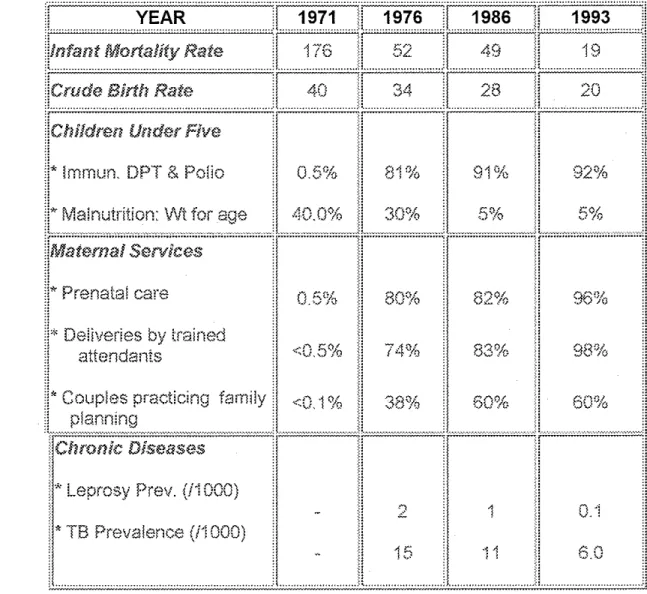
Attitudes concerning family planning have shifted and as seen in the table below, by the early 1990's 70% of villagers were using some
family planning method. One of the greatest outcomes from the project
these changes. Other important development in terms of quality of life
related to increase immunizations, an increase in prenatal care, and complete irradiation of tetanus in the village (Arole M. & Arole
R.
1994, Ch 16).Table 2. CRHP Health Indicators (Jamkhed Website)
:Chronic Diseases
i'
Leprosy Prev. (i"! 000)•. * TB Prevalence (ii 000)
ii
~:
H
H
ll
H
II
<: :< •...•...•..•..•...•..•...•... ·< ... ... !~
1
15
.... :!
·:: ·'
:::
::I
::
::l
d
..•.•. i
96Yo
0 ·j
6.0
Not all changes that have resulted from CRHP's work are
specifically health related. In 1983 the non-medical components of the project were evaluated. Representatives from the women's groups,
village health workers, and farmers groups came together to determine an
evaluation strategy. Being familiar with house-to-house surveys, the
group decided to utilize this method along with focus groups to determine villagers' ideas and beliefs about larger community change. The village
leadership wanted to specifically hear about changing perceptions of caste and gender (Arole M. & Arole R., 1994, p. 217-223).
Almost 6000 families and 60 villages were surveyed. The surveys
L
'
did show changes in attitudes specifically around working with people across caste lines and seeing increased female leadership within the
villages. However the survey also revealed that villages with an
established women's group (a minimum of five years), were more likely to show changes in the social structure that was more inclusive of
marginalized groups (Arole M. &Arole R., 1994, p. 221).
A point worth mentioning is that for CRHP data collection is
completely driven by the community and the need to inform the community about where change needs to happen. Their process is not data
collection for the sake of data collection, but instead a well-planned
"report card" type process in developing countries. Often times this
information is collected and kept by medical professionals never to benefit the people being measured. This is not the case with CRHP. From "road
to health" cards that monitor children's growth, to whole village surveys, the data is given to the people and utilized to organize change (Arole M. &
Arole R., 1994, p. 210).
Implications for Public Health
As demonstrated by CRHP, real change is incredibly personal. It involves time, listening, and most of all, people. There is an element of
hope that is fundamental to the community process. This hope is not necessarily tied to a particular doctrine or ideology, but rests on what
McKnight labels a "capacity-focused approach" which identifies and
mobilizes community strengths (McKnight 1997, 158). The typical medical model of prevention tends to concentrate not on what is present,
but on what is missing. As John McKnight notes:
The medical model, for all its utility, bears a hidden negative assumption that what is important a about a person is his or her injury, disease, deficiency, problem, need, empty half. The able, gifted, skilled, capable, and full part of a person is not the focus of the medical model. And yet communities are built upon the
capacities of people, not their deficiencies. Communities are built by one-legged carpenters. Medical systems are built on the missing leg (McKnight 1997, 24).
I
1
r
.
t---What CRHP offers is a framework that moves beyond the "top
down" or "expert-driven" approach that often typify public health interventions. While there are numerous intricacies and levels of
organizing that could be explored through CRHP, the preceding overview
is intended to highlight a few fundamental strengths that shift the project from a mere health intervention project to a community-driven
development movement.
Given that much of the ill health in the world is due to poverty and lack of social and economic resources, we as professionals are taught to
be advocates for the "underdogs." To recognize "social ills" and to work
on behalf of"marginalized" groups. Yet working on behalf of a group is to assume that they are not able to act for themselves. To work with a group
is to partner with people, to see "their issues" as your own. This is a strategy that is not limited by locality or by problem, and can be utilized
regardless of the population involved.
CRHP brings us back to the basics of community, organizing, to a
process in which communities are challenged, respected, and
transformed. From the very beginning, thirty years ago, until now, there
has been a continual exchange of learning and understanding occurring
between project team members and members and community members, with a focus on addressing the root causes of disease and illness. The Frierian model of promoting active-listening and dialogue within the
adapt to the real needs of the poor, to listen, to provide technical support when needed (i.e., writing grants), and help people created their own
change from the ground up. Their organizing strategies and process has gained worldwide attention and since 1995, Jamkhed has served as a
training center for groups and organizations worldwide to learn how
"capacity-building" and "empowerment" can become realities within a community.
CRHP offers practical, accessible, and necessary skills for
conceptualizing and implementing community change strategies.
Fundamentally, CRHP realized that while some specific skills are needed for community development, given a space to speak and be heard, most people could be their own agents of change. As one village woman
expressed, "People are like wick lamps, simple inexpensive, and
unattractive. But unlike the expensive chandeliers (which professionals
References
Arnold, R., Burke, B., James, C., Martin, D., and Tomas, B. (1999) Educating for a Change. Toronto: Between the Lines. Arole, M. (1999, revised) "Primary Health Care-A movement,"
Presentation at American Health Association annual conference. New York, Nov.1996.
Arole, R. and Arole M. (1994) Jamkhed. Bombay: Archana Art Printers, 1994.
Arole M. and Arole, R. (2002). Comprehensive Rural Health Care Project: Jamkhed, India: The Evolution of a World Training Center. Taylor-Ide, D. and Taylor C (Eds.), Just and Lasting Change. Ch 12. Johns Hopkins Univ. Press.
Arole M. (2002) The Comprehensive Rural Health Project in Jamkhed India. Rohde, J and Wyon J. (Eds.) Ch 3, p 47. Community-Based Health Care: Lessons from Bangladesh to Boston. Management Sciences for Health. Boston and Harvard School of Public Health.
Daniel, A (1994) "Peoples Movement for Rural Development," Encon, Maharashtra, India.
Encon. (2001 ). Internal Evaluation Report for CRHP. No author. Women and Development.
Friedmann, J. (1998). Empowerment: The Politics of Alternative Development. Blackwell Publishers.
Freire, Paulo. (1970). Pedaqoqy of the Oppressed. New York: The Seabury Press.
Jamhed International Foundation. Health Indicators Chart. No Date. Available at: http://www.jamkhed.org/health status.htm Accessed on: November 3, 2002.
~--Kretzman J. McKnight J. (1999). Mapping Community Capacity. Minkler, M. (Ed.), Community Organizing and Community Building for Health. Rutgers, The State University.
McKnight J. (1999). Two Tools for Well-Being: Health Systems and Communities. Minkler, M. (Ed.), Community Organizing and Community Building for Health. Rutgers, The State University.
Rothman, J. (1996). The Interweaving of Community Intervention Approaches. Weil, M. (Ed.), Community Practice. New York: Haworth Press.
Vella, Jane. (1989). Learning to Teach: Training of Trainers for
Community Development. Washington, DC: OEF International.
Wallerstein, N. (1994). "Empowerment Education Applied to youth." The Multicultural Challenge in Health Education. P. 153-76. Santa Cruz, California, ETR Associates Publishers.
Weil, M. and Gamble, D. "Community Practice Models," Encyclopedia of Social Work, 19th Ed, pp. 577-594.
World Bank. The Crisis of Malnutrition in India: New World Bank Report Addresses Food Program Shortcomings. No Date. Available at: http:l/wbln1 018. worldbank.org/sar/sa. nsf/2991 b676f98842f0852567 d7005d2cba/9c8acc61f. Accessed on: November 3, 2002.
World Health Organization. Preamble to the Constitution of the World Health Organization as adopted by the International Health
Conference, New York, 19-22 June, 1946; signed on 22 July 1946 by the representatives of 61 States (Official Records of the World Health Organization, no. 2, p. 1 00) and entered into force on 7 April 1948.
L
;:__