International Journal of Advanced Research in Computer Science and Electronics Engineering Volume 1, Issue 3, May 2012
Abstract— Mobile Ad Hoc Network (MANET) routing is highly dynamic network & power and bandwidth constrained as well as frequent topology changes are the challenges to which it must adapt to and converge quickly. As we know that it is not possible to give a continuous significant amount of power to mobile devices of MANET so that it could be active for long time. So many MANET nodes will be powered by batteries with limited lifetime. Some of the most exciting application for MANETs is in this energy constrained category to increase the time between recharging. It is possible if and only if energy consumption in communication or data packet transmission is less without interruption or packet loss. In This paper, we proposed an energy efficient Destination Sequenced Distance Vector (EEDSDV) routing protocol is proposed for MANETs. The EEDSDV overcomes the problem of more energy consumption in existing DSDV protocol. EEDSDV controls the transmission energy by variant transmission power mechanism and gives a power control approach for an energy efficient routing.
Index Terms— EEDSDV, DSDV, Efficient Energy Approach, Ad hoc Network.
I. INTRODUCTION
Wireless Mobile Ad Hoc network (MANET) which do not require infrastructure to operate. in MANET nodes are act as an autonomous body and nodes itself and act as both end system and system and intermediate system. Many routing protocol for MANET have proposed however these are most prominent in research community. DSDV [1], AODV [2], and DSR [3]due to their emergence and its varied characteristics. The operation and performance of these protocols provide an important baseline to which new protocol should be devised. Here we consider the DSDV protocol as baseline protocol and consider the baseline evaluation as well as comparison of energy efficient routing protocol (EEDSDV) in which we consider a strategy through which we control the transmission energy of node and provide a energy efficient routing EEDSDV for existing DSDV.
Manuscript received 15 May, 2012.
Dheeraj Kumar Anand, M.Tech - Research Scholar, Computer Science & Engg. Department, Madan Mohan Malaviya Engineering College Gorakhpur, affiliated to UP Tchnical Universit, Lucknow, India,
Shiva Prakash, Assistant Professor, Computer Science & Engg. Department, Madan Mohan Malviya Engineering College Gorakhpur, affiliated to UP Tchnical University, Lucknow, INDIA.
1.1 Protocol Overview and Activities
The destination sequenced distance vector (DSDV) routing protocol is a proactive routing protocol which is a modification of conventional Bellman-Ford routing algorithm, which solves the problem of routing loop forwarding packets and loss reduction is based on count to infinity by associating each route entry with a sequence number indicating its freshness [4].This new attribute, sequence number, to each route table entry at each node. Routing table is maintained at each node and with this table; node transmits the packets to other nodes in the network. This protocol was motivated for the use of data exchange along changing and arbitrary paths of interconnection which may not be close to any base station. In DSDV, a sequence number is linked to a destination node, and usually is originated by that node. A non owner is node updates a sequence number of a route is done when it detects a link break on that route.
A. DSDV Protocol
Each node in the network maintains routing table for the transmission of the packets and also for the connectivity to different stations in the network. These stations list for all the available destinations, and the number of hops required to reach each destination in the routing table. The routing entry is tagged with a sequence number which is originated by the destination station. In order to maintain the consistency, each station transmits and updates its routing table periodically. The packets being broadcasted between stations indicate which stations are accessible and how many hops are required to reach that particular station. The packets may be transmitted containing the MAC layer or Network layer addresses. Routing information is advertised by broadcasting the packets which are transmitted periodically as when the nodes move within the network. The DSDV protocol requires that each mobile node in the network must constantly; advertise to each of its neighbours, its own routing table. Since, the entries in the table may change very quickly; the advertisement should be made frequently to ensure that every node can locate its neighbours in the network. This agreement is placed, to ensure the shortest number of hops for a route to a destination; in this way the node can exchange its data even if there is no direct communication link. The data broadcast by each node will contain its new sequence number and the following information for each new route:
1. The destination address,
Energy Efficient DSDV (EEDSDV) Routing
Protocol for Mobile Ad hoc Wireless Network
destination and
3. The new sequence number, originally stamped by the destination.
The transmitted routing tables will also contain the hardware address, network address of the mobile host transmitting them. The routing tables will contain the sequence number created by the transmitter and hence the most new destination sequence number is preferred as the basis for making forwarding decisions. This new sequence number is also updated to all the hosts in the network which may decide on how to maintain the routing entry for that originating mobile host. After receiving the route information, receiving node increments the metric and transmits information by broadcasting. Incrementing metric is done before transmission because, incoming packet will have to travel one more hop to reach its destination. Time between broadcasting the routing information packets is the other important factor to be considered. When the new information is received by the mobile host it will be retransmitted soon effecting the most rapid possible dissemination of routing information among all the cooperating mobile hosts. The mobile host cause broken links as they move from place to place within the network. The broken link may be detected by the MAC layer protocol, which may be described as infinity. When the route is broken in a network, then immediately that metric is assigned an infinity metric there by determining that there is no hop and the sequence number is updated. Sequence numbers originating from the mobile hosts are defined to be even number and the sequence numbers generated to indicate infinity metrics are odd numbers. With the addition of sequence numbers, routes for the same destination are selected based on the following rules:
1. A route with a newer sequence no is preferred; 2. In the case that two routes have same sequence
number, the one with better cost metric is preferred on energy efficient.
Rest of the paper is organized as in section 2 we will go through details survey based on the previous related research papers, section 3 consider about proposed work and then energy management in section 4 and after that conclusion and future scope in section 5 and 6.
II. ABOUT WORK
Over the time, various nodes which has a limited energy, will deplete their energy supplies and drop out from network. Unless nodes are replaced or recharged, the network will eventually become partitioned. In a large network, relatively few nodes may be able to communicate directly with their intended destinations. Instead, most nodes must rely on other radios to forward their packets. Some radios may be especially critical for forwarding these packets because they provide the only path between certain pairs of radios. Some radios may be especially critical for forwarding these packets because they provide the only path between certain pairs of radios. Associated with each radio that depletes its battery and stop operating, there may be a number of other radios that can no longer communicate [5]. For this reason a
communication protocols that preserve energy so as to network failures for as long as possible.
In the paper [2] author presents an innovative energy aware routing protocol for wireless ad hoc network called Energy Efficient, protocol presents the advantage of achieving faster and efficient recovery from node failures as the energy consumed by AOMDV routing protocol is not less so author gives mechanism of EA for better performance and surplus energy consumption lesser. But still If we consider another on demand routing protocol multipath routing with bellman ford algorithm and we compare it with EEAOMDV routing protocol there may be the performance matrices like packet delivery ratio .transmission time and network lifetime show the better performing routing protocol in terms of battery power saving in a relatively high nos. of nodes network with high traffic load.
In the paper [6] author proposed a novel routing tree, as the Quality of service routing is challenged as in the normal routing strategy having problem of link breakage, congestion and energy consumption and namely gives an Energy-Efficient Traffic-Aware Detour Tree, which is constructed completely in a bottom-up fashion, with the consideration of traffic pattern and residual energy and routing shows higher throughput than other detour trees, leading to a better routing performance. But there still exist some mechanism like if we apply both the tree construction method such as top down & bottom up considering traffic pattern & residual energy of network through which the routing will be fast and topology of the network will be constant which leads to better performance.
In the paper [7] analyzing the energy consumption aspect for emergency ad hoc network for the fluctuations and rapid mobility in forming the network topology is still a current research area. If we use detour tree method which uses BFS (Breadth First Search) & DFS (Depth First Search) algorithm for the route discovery and compare the protocol performance with the matrices like packet delivery ratio end to end delay, route length average transmitted power it will show better performance for routing protocol which leads to save more battery power as compared to the existing protocol.
DSDV was one of the early algorithms available. It is quite suitable for creating ad hoc with small number of nodes. Many improved form of this algorithm have been suggested due to following limitations:
1. Wastage of bandwidth due to unnecessary advertising of routing information even if there is no change in the network topology.
2. DSDV doesn‟t support Multi path Routing. 3. It is difficult to determine a time delay for the
advertisement of routes.
International Journal of Advanced Research in Computer Science and Electronics Engineering Volume 1, Issue 3, May 2012
A. Problem Statement
The basic routing problem is that of finding an ordered series of intermediate nodes that can transport a packet across a network from its source to its destination by forwarding the packet along this series of intermediate nodes. In traditional hop-by-hop solutions to the routing problem, each node in the network maintains a routing table: for each known destination, the routing table lists the next node to which a packet for that destination should be sent. The routing protocol must perform efficiently in environments in which nodes are stationary and bandwidth is not a limiting factor. Yet, the same protocol must still function efficiently when the bandwidth available between nodes is low[8] and the level of mobility and topology change is high. Because it is often impossible to know a priori what environment the protocol will find itself in, and because the environment can change unpredictably, the routing protocol must be able to adapt automatically. From a brief literature review we have found that there are following problem lie in existing DSDV protocol -
In the existing DSDV, the large number of route replies in DSDV because route reply is sent through all the available routes leading to unnecessary congestion & waste of energy (battery power).
In existing DSDV, each node uses constant power to forward the packet or to transmit the packet. Irrespective of the distance between adjacent nodes, each node transmits with a constant power which takes more battery power.
III. PROPOSEDWORK
Here in the paper we consider the energy a constraint in MANET by variant transmission energy approach. First we stat from the and give an efficient energy management in EEDSDV. From the baseline evaluation of arguably the most prominent protocol of MANET we consider DSDV which is having the problems like-
In the existing DSDV, the large number of route replies in DSDV because route reply is sent through all the available routes leading to unnecessary congestion & waste of energy (battery power).
In existing DSDV, each node uses constant power to forward the packet or to transmit the packet. Irrespective of the distance between adjacent nodes, each node transmits with a constant power which takes more battery power.
A. Energy Efficient DSDV Routing (EEDSDV)
As our main concern on EER so initially we consider about Efficient routing then energy approach after that we proposed a combined solution as energy efficient routing. The main drawback in DSDV protocol is the large number of unwanted
Route Replies, because a Route Reply is sent through all the available routes leading to unnecessary congestion and waste of energy (battery power). It is found through observations that it is sufficient if the destination node sends the Route Reply through one selected route rather than through all the routes. Hence it is proposed to limit the number of Route Replies to only one. This is sent via the route through which the destination received the first Route Request, because it is the most active route for the particular source-destination pair at the moment of sending the request. Moreover this is the route through which the data packets can be transmitted fastest. Hence the same is chosen as the route for the data transmission, which can reduce the propagation delay to a great extant. Furthermore it leads to the decrease in control packets generated in the network and the increase in packet delivery ratio. Thus these modifications make the data transmission optimum. As consideration energy constrained in existing DSDV, each node uses constant power to forward the packet or to transmit the packet. Irrespective of the distance between adjacent nodes, each node transmits with a constant power which takes more battery power. So to tackle this problem we consider Transmission power control approach in which a routing algorithm essentially involves finding an optimal route on a given network graph where a vertex represents a mobile node and an edge represents a wireless link between two end nodes that are within each other‟s radio transmission range. When a node‟s radio transmission power is controllable, their direct communication ranges as well as the number of its immediate neighbors are also adjustable. While stronger transmission power increases the transmission range and reduces the hop count to the destination, weaker transmission power makes the topology sparse which may result in network partitioning and high end-to-end delay due to a larger hop count. There has been active research on topology control of a MANET via transmission power adjustment [9-12] in which the active communication energy can be reduced by adjusting each node‟s power just enough to reach the receiving node not more than that. So the transmission power control model can be extended to determine the optimal routing that minimizes the total transmission energy which is required to deliver the data packets to the destination.
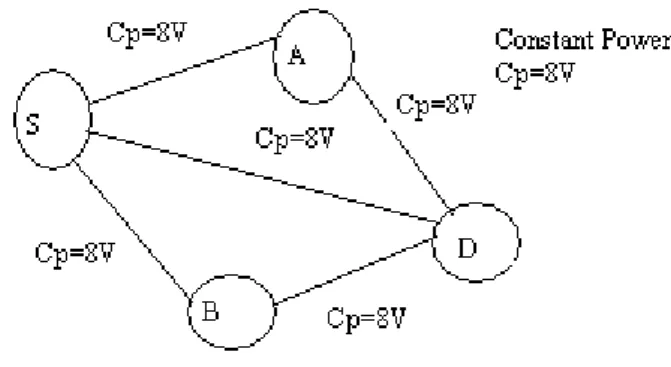
i. Constant Transmission Power Approach
Figure 2.3: Constant Transmission Power Approach p (|SD|) < p (|SA|) + p (|AD|) e.g. 8V<8V+8V.
ii. Variant Transmission power Approach
On
the other hand, if the transmission power is controllable, it may be more energy efficient to transmit packets using intermediate nodes [13 because the required transmission power, p, to communicate between two nodes has super-linear dependence on distance, d, i.e., p (d) α d2 [14, 15], e.g. if we consider an example suppose p (|SD|) =10V, p (|SA|) =5V and p (|AD|) =4V as the link cost depends on the distance. Here we see that the routing path S→A→D is more energy efficient than the route S→D sinceFigure 2.4: Variant Transmission Power Approach
p (|SD|) > p (|SA|) + p (|AD|) e.g. 10v>5v + 4v. Here node S makes energy efficient communication by lowering its transmission energy just enough to reach node Abut not enough to reach node D.
IV. DESIGN AN ALGORITHMS FOR ENERGY
EFFICIENT DSDV ROUTING PROTOCOL
Variant transmitted energy is determined using the following algorithm:
Step1:Once the route request process is over and the route is established, by the destination, unicast the Route Reply packet.
Step2:The immediately previous node from the destination in the selected path determines the distance between itself and the destination, through the time taken by the hop and store in their cache.
Step3: All the nodes in the selected path follow the same procedure and the distance between the two nodes is
node.
Step4: The transmitted power is determined using the following formula
Transmitted Power = (a x d^4) +c (1) Where„d‟ is the distance between two adjacent nodes „a‟ and „c‟ are arbitrary constants
a=Pr*k (2) Pr=Minimum Received Energy = -91dbm=7.94e-10mW k =8 then
a = 6.35e-9 mW and c = 30e-13 mW. From (1) & (2)
Transmitted Power α d.
Step5: Transmitted power is varied in accordance with the distance d.
V. CONCLUSION
A mobile ad hoc network (MANET) consists of self-organizing, autonomous and self-operating nodes, each of which communicates directly with the nodes within its wireless range or indirectly with other nodes via a dynamically computed, multi-hop route. Due to a lot advantages and different application areas, the field of MANET is rapidly growing and changing. While still there are many challenges that need to be met. To facilitate communication within MANET, an energy efficient routing protocol is required to discover routes between mobile nodes as well as to transmit data packets in energy efficient way so that it can consume less energy and battery life of the node increases. Energy efficiency is one of the main problems in a MANET, especially in designing a routing protocol. In this paper, we consider and discuss different energy aware routing schemes and provide an energy efficient routing algorithm. From theoretical aspects it is observed that the modification brought about in the existing DSDV by using energy efficient routing algorithm reduces the end to end delay and the number of control packets which is the sum of Route Request, Route Reply and Route Error packets. The average percentage energy saved per node is found to be 32 %.
vi.
Future work
Here in this paper we our main concern is to proposed an energy efficient routing algorithm which can contribute in design and implementation of a energy efficient routing protocol for MANET and we have come to the conclusion that there is an enhancement of energy management in the DSDV protocol due to the modifications made and hence it can be considered an energy efficient protocol. So in future our goal is to design and implement as well as verified the given algorithm by performance evaluations metrics like packet delivery ratio and end to end delay metrics check for the result.
References
International Journal of Advanced Research in Computer Science and Electronics Engineering Volume 1, Issue 3, May 2012
[2] Getsy S Sara, Neelavathy Pari.S, Sridharan.D “Energy Efficient Ad Hoc On Demand Multipath Distance Vector Routing Protocol” International Journal Of Recent Trends In Engineering, Vol 2, No. 3, November 2009.
[3] D.Johnson, “The Dynamic Source Routing Protocol (DSR)”,RFC4728, Feb 2007.
[4]DSDV Routing Protocol implementation in NS-3H Narra,Y Cheng, ICST,ISBN March 2011.
[5] C.E. Perkins and P.Bhagwat. Highly Dynamic Destination-sequence Distance vector Routing (DSDV)for mobile computers” .In Proceedings of the ACM Conference on Communication Architecture Protocols and Applications(SIGCOMM),pages 234-244,1994.
[6] Lei Zhang, Deying Li and Alvin Lim “energy-efficient traffic-aware detour trees for geographical routing” International Journal of Computer Networks & Communications (IJCNC), Vol.2, No.1, January 2010. [7]“energy efficient approach for emergency readiness communications in wireless ad-hoc networks”. Sandip Vijay, S.C.Sharma, Parmanand3,Vishal GuptaInternational Journal of Recent Trends in Engineering, Vol 1, No. 1, May 2009. [8] C.K. Tohi, H.Cobb and D.scott,”Performance Evaluation Of Battery Life Aware Routing Scheme for wireless ad hoc networks”ICC‟01,JUNE 2001.
[9] Rudolph V, Meng TH. Minimum energy mobile wireless networks. IEEE Journal of Selected Areas in Communications 1999; 17(8).], and the primary objective is to maintain a connected topology,
[10] Sanchez M, Manzoni P, Haas ZH. Determination of Critical Transmission Range in Ad-Hoc Networks. Proceedings of Multiaccess, Mobility and Teletraffic for Wireles Communications (MMT’99) 1999.
[11] Ramanathan R, Rosales-Hain R. Topology Control of Multihop Wireless Networks using Transmit Power Adjustment. Proceedings of The Conference on Computer Communications (IEEE Infocom 2000) 2000; 404-413. [12] Wattenhofer R, Li L, Bahl P, Wang Y-M. Distributed Topology Control for Power Efficient Operation in Multihop Wireless Ad Hoc Networks. Proceedings of the Conference on Computer Communications (IEEE Infocom 2001) [13] Dheeraj Kumar Anand, Shiva Prakash” A Short Survey of Energy-Efficient Routing Protocols for Mobile Ad-Hoc Networks”IEEE 2010, Oct 2010.
[14] Chansu Yu, Ben Lee, Hee Yong Youn,“Energy Efficient Routing Protocols for Mobile Ad Hoc Networks” , research was supported in part by the Cleveland State University, EFFRD Grant No. 0210-0630-10.
[15] Stojmenovic I, Lin X. Power-Aware Localized Routing in Wireless Networks. IEEE Trans.Parallel and Distributed Systems 2001; 12(11):1122-1133.
AUTHORS PROFILE
Dheeraj Anand going to submit his disssertation for the award of M.Tech in Computer Science in Engineering branch in Madan Mohan Malaviya Engineering College Gorakhpur UP Affiliated to GB Technical University Lucknow, UP. He has publised papers in National and International Journal and Conferences in the field of Wireless Ad-hoc Network.he has completed his B. Tech. in Computer Science & Engineering From UP Technical University Lucknow University lucknow UP.
Shiva Prakash received his M. Tech. in Computer Science & Engineering, Motilal Nehru National Institute of Technology, Allahanad, India in 2006 & B. Tech. in Computer Science & Engineering From K.E.C., Dwarahat, India in 1997. He started his career from teaching profession as Lecturer in 1998 in K.E.C., Dwarahat, India, then joined as Assistant Professor in M.M.M. Engineering. College, Gorakhpur, India in 2009 and continuing till date. He is member
of ISTE Life Member (LM 57242), CSI, Member, IJCI, Packeteer, Bitpipe, and IETF as Online Member. Convener, Board of Studies, Faculty of Engineering & Technology, Kumaun University, Nainital from August, 2004 to September, 2009 and also worked more than three years as Head of Department. He has supervised more than 30 projects/ dissertation of M. Tech. & B. Tech. Students. He has published eighteen research papers in