Data Possession Schemes with Reviving Authenticated Security in
Cloud Computing
R. Raakesh Kumar1, U. Lova Raju2
#1 M.Tech Scholar (CSE), Department of Computer Science Engineering,
#2 Assistant Professor, Department of Computer Science and Engineering, Kakinada Institute of Engineering and Technology, Korangi, AP, India.
Abstract—
Cloud computing gives adaptable data to the administrators and ever-present data annoy. Be that as it may, the vault services gave by cloud server isn't trusted by clients. The data's given by cloud server can be effectively taken by interlopers. Accessible encryption could give the elements of confidentiality insurance and protection safeguarding data recovery, which is a significant instrument for secure storage. In this paper, we propose a productive huge universe normal language look plot for the cloud storage, which protection is saving and secure against the disconnected watchword speculating assault (KGA). An outstanding feature of the proposition over other existing schemes is that it bolsters the customary language encryption and deterministic limited automata (DFA) based data recovery. The huge universe development guarantees the extendibility of the framework, wherein the image set shouldn't be predefined. Different clients are bolstered in the framework, and the client could produce a DFA token utilizing his own private key without connecting with the key age focus. Moreover, the solid plan is productive and officially demonstrated secure in standard model. Broad correlation and reenactment show that this plan has capacity and execution prevalent than different schemes.
Keywords - Cloud computing, Integrity Verification, Storage-as-a-Service, Privacy Preserving, Access control, data security.
I. Introduction
Cloud computing assets can be immediately separated with every one of the procedures, services and applications provisioned on request service regardless of the results of the client area or gadget.
Revised Manuscript received on November 17th, 2019 *Corresponding Author
R. Raakesh Kumar
mail id- [email protected]
Numerous little scale organizations and association can set up its framework without the requirement for actualizing real equipment and programming that are expected to manufacture whole structure as it can completely depend on the cloud services and utilize its assets on pay per use premise. The utilization of cloud computing service gives quick access the Applications and diminishes service costs. Cloud computing is in effect famous and to a great extent isolated particularly with the expansion use of web connectively and virtualization methods. Each cloud clients need to maintain a strategic distance from untreated cloud supplier for individual and significant archives, for example, charge/MasterCard’s subtleties
II. Related Work
Customers can remotely store their information and welcome the on-demand extraordinary applications and administrations from a typical pool of configurable registering resources, without the heaviness of close by information stockpiling and backing. Regardless, the way that customers never again have physical responsibility for re-appropriated information makes the information uprightness protection in Cloud Computing a forcing undertaking, especially for customers with obliged figuring resources. Also, customers should have the choice to just use the distributed storage as if it is close by, without struggling with the need to affirm its decency. As needs be, engaging open auditability for distributed storage is of essential hugeness with the objective that customers can rely upon an untouchable monitor (TPA) to check the genuineness of re-appropriated information and be clear. To securely introduce a ground-breaking TPA, the reviewing method should get no new vulnerabilities towards customer information assurance, and familiarize no extra online load with customer. In this paper, we propose a sheltered distributed storage structure supporting security sparing open looking into. We further loosen up our result to enable the TPA to perform surveys for various customers simultaneously and capably. Wide security and execution assessment show the proposed plans are provably secure and uncommonly capable. B. Certificateless open assessing for information decency in the cloud Due to the nearness of security risks in the cloud, various parts have been proposed to empower a customer to survey information genuineness with general society key of the information owner before utilizing cloud information. The rightness of picking the right open key in past instruments depends upon the security of Public Key Infrastructure (PKI) and announcements. Though regular PKI has been commonly used in the improvement of open key cryptography, notwithstanding all that it faces various security perils, especially in the piece of managing confirmations. In this paper, we structure a certificateless open assessing framework to take out the security threats exhibited by PKI in past courses of action. Specifically, with our segment, an open verifier doesn't need to manage confirmations to pick the right open key for the examining. Or maybe, the assessing can be worked with the assistance of the
information owner's personality, for instance, her name or email address, which can ensure the right open key is used. Meanwhile, this open verifier is up 'til now prepared to audit information trustworthiness without recouping the entire information from the cloud as past game plans. To the extent we might know, it is the fundamental certificateless open assessing framework for checking information trustworthiness in the cloud. Our speculative assessments exhibit that our instrument is correct and secure, and our preliminary results show that our part can survey the uprightness of information in the cloud adequately. C. Information Storage Auditing Service in Cloud Computing: Challenges, Methods And Opportunities Cloud figuring is a promising registering model that engages invaluable and on-demand sort out access to a typical pool of configurable processing resources. The first offered cloud administration is moving information into the cloud: information owners let cloud administration providers have their information on cloud servers and information clients can get to the information from the cloud servers. This new perspective of information stockpiling administration similarly exhibits new security challenges, since information owners and information servers have different characters and various business interests. Along these lines, a free reviewing administration is required to guarantee that the information is precisely encouraged in the Cloud. In this paper, we inspect this kind of issue and give an expansive investigation of capacity assessing methodologies in the composition. In any case, we give a great deal of necessities of the assessing show for information stockpiling in distributed computing. By then, we present some current looking into plans and research them to the extent security and execution. Finally, some difficult issues are displayed in the structure of capable assessing show for information stockpiling in distributed computing
III. ACCESS CONTROL
Access control is commonly an arrangement that permits denies or limits access to frameworks. It is an instrument that is particularly significant for assurance in PC security. Old style Access control models full in to three kinds [11]:
1. Macintosh: required Access control
3. RBAC: Role Based Access Control
These entrance control models known as Identity put together access control wish based with respect to the way that the server is in the confided in space, So in the cloud these methodologies are exceptionally restricted and not appropriate, as there is a need of decentralization, versatility and adaptability for get to control information situated in the cloud. Because of this issue, different examinations demonstrate that the encryption of information is the most effective strategy for get to control [4]. However the standard encryption is wasteful when specifically offering information to numerous clients. Since information should be re-encoded utilizing each open key [4]. To conquer this new issue, about the constrained of customary encryption, sahai and al [4], present another open key crude called ABE (Attribute Based Encryption), which has critical focal points over conventional PKC (Public key Cryptography) natives. Hence it's imagined as a significant devices for tending to the issue of secure fine-grained get to control.
ATTRIBUTE BASED ACCESS CONTROL ABAC
With the improvement of huge appropriated frameworks trait based access control (ABAC) has gotten progressively significant. As indicated by the NIST "ABAC is An entrance control technique where subject solicitations to perform tasks on objects are conceded or denied dependent on appointed characteristics of the subject, allocated properties of the item, condition conditions, and a lot of strategies that are determined as far as those qualities and conditions "[11].Attribute Based Encryption (ABE) is classification of ABAC. ABE proposed to help fine-grained get to control ABE can be seen as an augmentation of Identity Based Encryption framework IBE [5]. IBE has settling the issue open key partaking in which a subjective string can be utilized as an open key (email, IP Address, telephone number telephon).
Fig.1: Identity Based Encryption system
Contrasted and IBE in which, encoded information is focused for decoding by single known client, inABE framework, the client's character is summed up to a lot of elucidating properties rather than a solitary string indicating the personality of the client. Contrasted and the personality based encryption, ABE has a significant preferred position since it makes a progressively adaptable encryption rather than one-on-one; it is viewed as a promising apparatus to take care of the protected information sharing issue grained and decentralized access control. ABE is utilized in different applications, as Electronic Health records the executives (HER), and PHR (Personal Health Records). In the ABE framework the decoding key ought to bematched with the traits of figure content and the key will unscramble the figure content. The private keys are built by the Access tree as in ABE framework root hub [6].
Fig.2: ABE scheme
each user and all access rights, to address this problem for single authority ABE, the multi ABE system is introduced [9]. Due to this requirement the ABE system has been divided into two classes of multi authority ABE system: KP-ABE and CP-ABE.
IV. Security Issues Associated With the Cloud
• Distributed computing is a noticeable and quickly developing innovation has caught a few proficient considerations that enable numerous to store their information safely and the equivalent can be gotten to productively. Cloud specialist co-op gives a wide range of administration models, for example, Software-as-a Service, Platform-as-a-Service, Infrastructure-as-a-Service and arrangement models as Private, Public, Hybrid, and Community. These days numerous experts have begun to utilize cloud condition as it gives the client a capacity ability to store and process their information. In any case, the difficulties like information security and access control framework are the fundamental worry of Cloud Service supplier.
• Security concerns related with distributed computing condition fall into two general classes: security issues looked by Cloud Service Providers (CSP) (associations giving programming, stage, or foundation as-an administration through the cloud) and security issues experienced by their shoppers (organizations or associations who have applications or store information on the cloud). Be that as it may, the duty is shared. The Cloud Service Provider must guarantee that their framework is secure and that their customers' information and applications are ensured with well-characterized cryptographic instruments, while the client must procure measures to strengthen their application and apply solid passwords and confirmation course.
• At the point when an association chooses for store information or host applications on people in general cloud, it loses its capacity to have physical access to the servers facilitating its data. Subsequently, conceivably delicate information is in danger from insider assaults. As indicated by an ongoing Cloud Security Alliance Report, insider assaults are the 6th greatest danger to distributed computing. Hence, Cloud Service suppliers must guarantee that careful record verifications are led for workers who have physical access to the servers in
the server farm. Moreover, server farms must be over and over observed for suspicious development.
• So as to monitor assets, cut expenses, and look after proficiency, Cloud Service Providers may utilize Encryption methods to ensure information in the Cloud. The security direction of Cloud Security Alliance (CSA) suggests information is ensured very still, moving and being used [10]. Scrambling information maintains a strategic distance from unlawful getting to of information in Cloud, however it may involve new issues identified with get to control the board [11]. The most three significant information security highlights are information secrecy, accessibility, and trustworthiness which averts information loss].
Data Confidentiality is a property of information, ordinarily coming about because of authoritative measures, which keeps it from unapproved revelation.
Data honesty is the general fulfillment, exactness, and consistency of information. This can be indicated by the nonappearance of adjustment between two occasions or between two updates of an information record, which means information is whole and unaffected.Data availability is primarily used to create service level agreements (SLA) and similar service contracts, which define and guarantee the service provided by third-party IT service providers.
b) Reasons to Use Secure Cloud Storage and Access Control:
When it comes to storing data in the cloud, it is important to deploy cost-effective technologies and solutions that protect, preserve and manage data to ensure that it is secure, available and accessible when needed.
The cloud, of course, can be a valuable tool in helping IT achieve this objective, but it is important to understand how, where and when cloud services should be used and when they shouldn’t. Cloud
works best and most cost-effectively when it is part of an overall data management strategy. Because data
lifecycles evolve as an organization’s data mix changes, you don’t want to be locked into using the
Nowadays most of the organizations have started to use public clouds such as Google App Engine (GAE), Amazon Web Services (AWS), IBM Blue Cloud and Windows Azure for storing, managing, processing and accessing their valuable data. The Cloud computing environment proposes diverse services to the user; however, data access service combined with enhanced security mechanism from the cloud plays a vital role. As per the 2017–State of Cloud Adoption and Security studies, it is observed the following important insights,
(i) In another 15 months, 80% of all IT budgets will be committed to Cloud apps and solutions.
(ii) There is a tremendous growth in Hybrid cloud adoption, increasing from 19% to 57%.
(iii) Public cloud adoption percentage has been improved.
(iv) Many organizations today completely trust public clouds to keep their data secure. Public cloud platforms started to invest more for the development and resources in security features and support. To provide better storing and accessing the data in Cloud computing requires advanced data access control techniques and security solutions.
From the survey, the access control model must provide a well strongly controlled data access facility to users and resources with enhanced security mechanism. It must also provide additional
capabilities like access control manages user’s files
and other resources. From the point of access control, (i) cloud computing environment should provide Controlled data access to the various service of the cloud, based on the appropriate access control policies and the level of service requested (or) purchased by the user. (ii) Facilitate proper data
access control policy and updated user’s information.
(iii) Cloud computing supports multitenant environment hence accessing data from one to another requires controlled data access policy. (iv)To ensure better and secure data access service within the cloud environment, there must be a strong relationship between trust and reputation in the data access control models. (v) Providing controlled access to both standard user files and privileged organizational functions. Major stumbling block in cloud computing data access control is a different set of users with diverse sets of enhanced security
mechanisms such as storing, managing, processing and accessing of physical resources.
The issues related to data access control in Cloud computing environment can be solved with properly implemented data access control techniques with state-of the-art security solution and today’s
implementers can avoid such a issues made by the predecessors.
V. Proposed Methodology
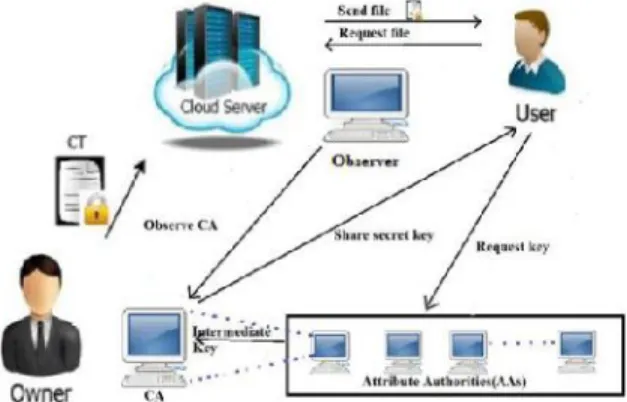
In this paper, we initially propose a revocable multi-authority CP-ABE conspire, where a productive and secure renouncement technique is proposed to tackle the quality repudiation issue in the framework. Our property disavowal strategy is productive as in it causes less correspondence cost and calculation cost, and is secure as in it can accomplish both in reverse security (The renounced client can't decode any new figure message that requires the denied credit to unscramble) and forward security (The recently joined client can likewise decode the recently distributed ciphertexts1, on the off chance that it has adequate properties). Our plan doesn't require the server to be completely trusted, in light of the fact that the key update is upheld by each characteristic power not the server. Regardless of whether the server isn't semi confided in certain situations, our plan can at present ensure the regressive security. At that point, we apply our proposed revocable multi-authority CP-ABE conspire as the basic strategies to develop the expressive and secure information get to control plot for multi-authority distributed storage frameworks.
Fig 3. Proposed Architecture diagram
Distributed computing can be even a transformation in the registering scene, by given every one of the sorts of figuring assets as administration (Software, stage, framework), however security stays a significant snag for the movement to the distributed computing. Relocating into the "Cloud" isn't that simple yet in the event that painstakingly arranged and conveyed it will get points of interest numerous territories like diminishing expense and assets. In this papers we have displayed a productive framework that give verify and fine-grained information get to control in distributed computing framework dependent on KP-ABE and another PRE framework with CCA security, agreement opposition, and secrecy in the arbitrary prophet model . One challenge in this setting is to accomplish fine-grained get to control, information secrecy, information honesty, adaptability and framework impervious to CCAs (Chosen Cipher content Attacks), which isn't given by current work. In addition, our proposed plan can empower the information proprietor to appoint a large portion of calculation overhead to incredible cloud servers. In future work, we would applied our proposed plan to guarantee fine-grained get to control of Personal Health Records (PHR) enabling the specialists and patients to encode their PHRs and store them on semi-confided in cloud servers with the end goal that servers don't approach delicate PHR settings.
References
[1] Sanjeet Kumar Nayak, Student Member, IEEE, and Somanath Tripathy, Senior Member, IEEE,
“SEPDP: Secure and Efficient Privacy Preserving Provable Data Possession in Cloud Storage”, IEEE
Transactions on Services Computing, 2018.
[2] A.B. Lewko and B. Waters, ‘‘Decentralizing
Attribute-Based Encryption,’’ in Proc. Advances in
Cryptology-EUROCRYPT’11, 2011, pp. 568-588.
[3] S. Yu, C. Wang, K. Ren, and W. Lou, ‘‘Attribute Based Data Sharing with Attribute Revocation,’’ in
Proc. 5th ACM Symp. Information, Computer and Comm. Security (ASIACCS’10), 2010, pp. 261- 270.
[4] M. Li, S. Yu, Y. Zheng, K. Ren, andW. Lou,
‘‘Scalable and Secure Sharing of Personal Health
Records in Cloud Computing Using Attribute-Based
Encryption,’’ IEEE Trans. Parallel Distributed
Systems, vol. 24, no. 1, pp. 131-143, Jan. 2013.
[5] J. Hur and D.K. Noh, ‘‘Attribute-Based Access
Control with Efficient Revocation in Data
Outsourcing Systems,’’ IEEE Trans. Parallel
Distributed Systems, vol. 22, no. 7, pp. 1214-1221, July 2011.
[6] S. Jahid, P. Mittal, and N. Borisov, ‘‘Easier:
Encryption-Based Access Control in Social Networks
with Efficient Revocation,’’ in Proc. 6th ACM Symp.
Information, Computer and Comm. Security
(ASIACCS’11), 2011, pp. 411- 415.
[7] S. Ruj, A. Nayak, and I. Stojmenovic, ‘‘DACC:
Distributed Access Control in Clouds,’’ in Proc. 10th
IEEE Int’l Conf. TrustCom, 2011, pp. 91-98.
[8] K. Yang and X. Jia, ‘‘Attribute-Based Access
Control for Multi-Authority Systems in Cloud
Storage,’’ in Proc. 32th IEEE Int’l Conf. Distributed
Computing Systems(ICDCS’12), 2012, pp. 1-10.
[9] Boneh and M.K. Franklin, ‘‘Identity Based
Encryption from the Weil Pairing,’’ in Proc. 21st Ann. Int’l Cryptology Conf.: Advances in Cryptology
-CRYPTO’01, 2001, pp. 213-229.
[10]B. Dilip Kumar Reddy, K. SaiMouni Sri, ”A
Survey on Multi Authority Access Control System in
Cloud Storage”, in proc. International Journal of
Scientific Engineering and Technology Research, April-2017, Pages: 2635-2637
[11] Dilip Reddy. B, DrN.Kasiviswanath,
DrS.ZahoorUlqHuq, “Peer to Peer Distributed Data
Storage with Security in Cloud Computing”, in proc.
R. Raakesh Kumar is presently perusing MTech [Computer Science] from KIET and received MCA from Bharathidasan University, Tiruchirappalli, Tamilnadu in the year 2002. His area of interests includes Networking, Databases, Data Mining, Java Programming and in all current trends and technologies.