FUTURETRACK: PART-TIME STUDENTS
CAREER DECISION-MAKING AND CAREER
DEVELOPMENT OF PART-TIME HIGHER
EDUCATION STUDENTS
A Report to the
Higher Education Careers Services Unit
(HECSU)
Claire Callender
Birkbeck, London University
Rebecca Hopkin
David Wilkinson
National Institute of Economic and
Social Research
ACKNOWLEDGEMENTS
Our thanks go to a range of people and organisations who have helped with this study. First, to Pearl Mok and Jane Artess at HECSU who have been supportive throughout the duration of the study and to Charles Ritchie of the Department for Business, Innovation and Skills. Next, we would like to thank the IFF, and in particular Jan Shury who conducted the survey of students on our behalf. Finally, we thank the students who participated in the study – without their help this study could not have happened.
All the views expressed in this report are solely those of the authors.
Professor Claire Callender Birkbeck, University of London 03/12/2009
CONTENTS
EXECUTIVE SUMMARY 11
1 INTRODUCTION... 23
1.1 Background ... 23
1.2 Aims and objectives of the research... 28
1.3 Methodology ... 28
1.4 Outline of the report... 29
1.5 The characteristics of the students surveyed... 30
1.6 About the course ... 32
2 REASONS FOR STUDYING... 36
2.1 Introduction... 36
2.2 Initial triggers to study ... 38
2.3 Why students chose to study part-time ... 44
2.4 Why students chose their course of study ... 47
2.5 Benefits hoped for... 49
2.6 Conclusions and summary ... 50
3 CAREER RELATED STUDY AND CAREER AIMS ... 53
3.1 Introduction... 53
3.2 Career related study ... 53
3.3 Career plans ... 62
3.4 Conclusions and summary ... 64
4 USE OF CAREERS SERVICES... 66
4.1 Introduction... 66
4.2 Careers information, advice and guidance before studying ... 67
4.3 Careers information, advice and guidance whilst studying... 76
4.4 Conclusions and summary ... 89
5 THE COSTS OF STUDY – WHO PAYS?... 92
5.1 Introduction... 92
5.2 Information on financial support before studying... 93
5.3 Tuition or course fees... 97
5.5 Government financial support... 114
5.6 Conclusions and summary ... 121
6 EMPLOYER SUPPORT ... 124
6.1 Introduction... 124
6.2 Employer awareness of part-time study... 124
6.3 Whether study a requirement of the job... 126
6.4 Other forms of employer support... 128
6.5 Student views on employer support ... 132
6.6 Conclusions and summary ... 135
7 THE BENEFITS OF PART-TIME STUDY ... 137
7.1 Introduction... 137
7.2 Changes in employment... 137
7.3 Conclusions and summary ... 143
REFERENCES... 145
APPENDIX TABLES ... 148
TABLES
Table 1.1 Student characteristics by whether a starter or completer ... 31
Table 1.2 Course and institution characteristics by starter or completer... 33
Table 1.3 Current economic status and subject of study by gender ... 34
Table 1.4 Qualification aim and family type by household income... 35
Table 2.1 The most commonly reported triggers by key student and course characteristics .. 41
Table 2.2 Employment related triggers which made students first think about starting their current course by whether employed full-time or part-time... 42
Table 2.3 Children related triggers which made students first think about starting their current course by whether have dependent children and age of dependent children and by gender ... 43
Table 2.4 Percentage reporting reason why decided to study part-time was very or fairly important by key student and course characteristics ... 46
Table 2.5 Percentage reporting reason why decided to take particular course was very or fairly important by key student and course characteristics ... 49
Table 3.1 Factors associated with whether students’ decision to study was related to their career aims... 55
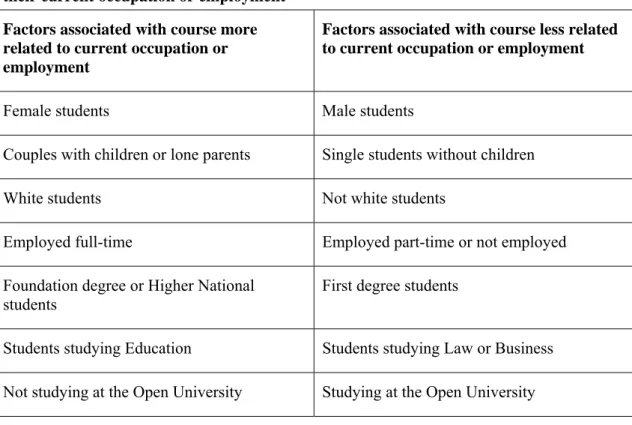
Table 3.2 Factors associated with whether students’ courses were a great deal related to their current occupation or employment... 60
Table 3.3 Factors associated with students’ having a much clearer idea about their career since they started their course... 63
Table 3.4 Factors associated with students’ having a clear idea about what they want to do in terms of career planning ... 64
Table 4.1 Factors associated with first year students’ having sought careers information, advice and/or guidance before starting their course ... 68
Table 4.2 Factors associated with agreement or disagreement that the student needed more help and advice in choosing course to study ... 75
Table 4.3 Factors associated with whether students’ had any contact with their university or college career services... 76
Table 4.4 Factors associated with students’ reporting no contact with their university or college career services because they knew what they wanted to do or that they already have the experience and knowledge to decide on my career options... 79
Table 4.5 Factors associated with students’ reporting no contact with their university or college career services because they were unaware of the service... 80
Table 4.6 Key reasons why students had not used their university’s/college’s Career Service in the 2007/08 academic year (multi-code), by starter/completer, current economic status, qualification aim and subject... 81
Table 4.7 Percentage of students reporting the most helpful source of careers information, advice and/or guidance used by students in the 2007/08 academic year by whether a starter or
completer ... 85
Table 5.1 Factors associated with students’ reporting they sought information about financial support for students studying part-time before they started their course... 94
Table 5.2 Tuition or course fees payable in the 2007/08 academic year, by qualification aim and subject... 98
Table 5.3 Factors associated with employers contributing to tuition or course fees ... 100
Table 5.4 Factors associated with students who pay some of their own tuition or course fees ... 106
Table 5.5 Factors associated with students who receive help via a fee waiver or financial assistance scheme ... 107
Table 5.6 Reporting of expenditure by mode of interview... 110
Table 5.7 Expected total course-related expenditure in the 2007/08 academic year, by mode of interview and by whether reported a breakdown of expenditure or just total expenditure ... 111
Table 5.8 Factors associated with higher total course-related expenditure in the 2007/08 academic year ... 112
Table 5.9 Expected total course-related expenditure in the 2007/08 academic year, by current economic status, qualification aim and subject ... 113
Table 5.10 Expected total course-related expenditure in the 2007/08 academic year, by item of expenditure... 114
Table 5.11 Factors associated with students who receive help via a government course grant ... 118
Table 5.12 Value and adequacy of government support ... 120
Table 6.1 Factors associated with whether current course of study was a job requirement.. 126
Table 6.2 Factors associated with non-fee support... 129
Table 6.3 Other forms of employer support by current economic status, qualification aim and subject... 130
Table 6.4 Factors associated with having a very or quite supportive employer... 132
Table 7.1 Factors associated with completers changing employers since they started their course... 138
Table 7.2 Factors associated with completers changing employers and jobs since they started their course ... 139
Table A1.1 Students characteristics by mode of interview ... 148
Table A1.2 Course and institution characteristics by mode of interview... 150
Table A1.3 Full multivariate specifications from Chapter 3 ... 151
Table A1.5a Full multivariate specifications from Chapter 5 (part one)... 159
Table A1.5b Full multivariate specifications from Chapter 5 (part two) ... 163
Table A1.6 Full multivariate specifications from Chapter 6 ... 167
Table A1.7 Full multivariate specifications from Chapter 7 ... 170
Table A2.1: Overall online outcomes... 176
Table A2.2: Online outcomes by year... 177
Table A2.3: Online outcomes by HEI ... 178
FIGURES
Figure 2.1 Triggers which made students first think about starting their current course ... 39
Figure 2.2 Reasons why students decided to study part-time rather than full-time... 45
Figure 2.3 Reasons why students chose their particular course of study ... 48
Figure 2.4 Personal or professional benefits students hoped to gain from study ... 50
Figure 3.1 Percentage of students’ who reported their decision to study was related to their career aims, by key student characteristics... 56
Figure 3.2 Percentage of students’ who reported their subject of study was related to their career aims, by key student characteristics... 58
Figure 3.3 Percentage of students’ reported the extent to which their course is related to their current occupation or employment by whether starter or completer... 59
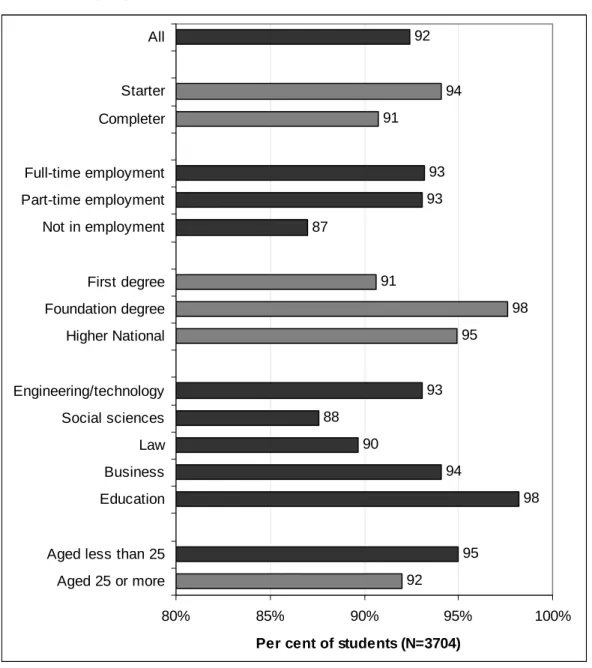
Figure 3.4 Percentage of students’ reporting that their course was a great deal related to their current occupation or employment by key student and course characteristics... 61
Figure 3.5 How student’s ideas about their career plans had changed since starting their course... 62
Figure 3.6 How students rated the clarity of their long-term career planning... 63
Figure 4.1 Percentage of first year students who sought careers information, advice and/or guidance before starting their course by subject ... 69
Figure 4.2 Sources of careers information, advice and/or guidance used by first year students before starting their course ... 70
Figure 4.3 The most helpful source of careers information, advice and/or guidance used by first year students before starting their course... 71
Figure 4.4 Whether careers information, advice and/or guidance received by first year students before starting their course was sufficient? ... 72
Figure 4.5 Reasons why students had not sought careers information, advice, and/or guidance before starting their course ... 73
Figure 4.6 Percentage of students using career services by how clear they are about long-term career planning ... 74
Figure 4.7 Percentage of students reporting agreement / disagreement with whether they needed more help and advice in choosing which course to study by whether starter or completer ... 75
Figure 4.8 Percentage of students who had made contact with their university’s/college’s Career Service in the 2007/08 academic year, by starter/completer, current economic status, qualification aim and subject... 77
Figure 4.9 Reasons why students had not used their university’s/college’s Career Service in the 2007/08 academic year (multi-code) ... 78
Figure 4.10 Sources of careers information, advice and/or guidance used by students in the 2007/08 academic year... 82
Figure 4.11 Sources of careers information, advice and/or guidance used by students in the 2007/08 academic year, by current economic status ... 84 Figure 4.12 Percentage of the students who had used each source of careers information, advice and/or guidance who thought that the source was the most helpful... 86 Figure 4.13 Student’s views of the Career Service at their university/college... 88 Figure 5.1 Students who sought information about financial support for students studying part-time before starting their course, by starter/completer, by economic status immediately before starting course, qualification aim and subject ... 95 Figure 5.2 Sources of information about financial support for students studying part-time used by students before starting their course ... 96 Figure 5.3 Sources used to pay for tuition or course fees... 99 Figure 5.4 Percentage of students receiving employer contribution to tuition or course fees102 Figure 5.5 Student knowledge of employer tuition or course fee support before starting their course, by key characteristics ... 104 Figure 5.6 Student knowledge of employer tuition or course fee support before starting their course, by level of employer fee support received ... 105 Figure 5.7 Percentage of students making own contribution to tuition or course fees... 108 Figure 5.8 Percentage of students who receive a few waiver or financial assistance for tuition or course fees... 109 Figure 5.9 Percentage of students receiving government fee grant by key characteristics ... 117 Figure 5.10 Percentage of students receiving government course grant by key characteristics
... 119 Figure 6.1 Reasons why students had not told their employers that they were studying part-time... 125 Figure 6.2 Percentage of employed students whose course of study was a job requirement by key characteristics ... 127 Figure 6.3 Other forms of employer support... 128 Figure 6.4 Other forms of employer support, by level of employer tuition or course fee support... 131 Figure 6.5 How supportive students rated their current employer, by current economic status, qualification aim and subject... 133 Figure 6.6 How supportive students rated their current employer, by level of employer fee support received ... 134 Figure 6.7 How supportive students rated their current employer, by whether other forms of employer support were received and the type of other forms of employer support ... 135 Figure 7.1 Whether students changed employers since the beginning of their course... 138 Figure 7.2 Percentage of completer students who changed employers and employers and jobs since the beginning of their course by key characteristics ... 140
Figure 7.3 Whether students’ paid hours of work have changed since the beginning of their course... 141 Figure 7.4 Expected (starters) and realised (completers) changes for students as a direct result of taking their course... 142 Figure 7.5 Percentage of students definitely or mostly agreeing with specified statements . 143
EXECUTIVE SUMMARY
This report is based on the findings of a survey of 3,704 part-time undergraduate UK domiciled students conducted in 2007/08. This survey forms part of a larger longitudinal study that will track these students over time through a series of surveys. It is the first study of its kind involving a nationally representative sample of part-time undergraduates from across the UK. The initial survey reported here, aimed to explore students’ career intentions and ambitions and to collect data on their career development and decision making – issues that have tended to be ignored in other research on part-time students. The study was conducted for HECSU and BIS and was undertaken by Prof Claire Callender of Birkbeck, University of London and David Wilkinson and Rebecca Hopkin of the National Institute of Economic and Social Research.
The students surveyed were drawn from 29 Higher Education Institutions from across the UK who were aiming for a First Degree, Foundation Degree, or Higher National. They were studying one of the following subjects: Engineering/technology; Social Sciences; Law; Business and Education. Two groups of students were surveyed – students in their first year of study – referred to as starters in this report, and students in their final year of study – referred to as completers. In this way, students’ progress at different points of time in their study careers can be charted and followed over time.
KEY FINDINGS
Part-time students’ reasons for studying
• The part-time student population is extremely heterogeneous and this is reflected in their wide range of reasons for studying. The initial factors triggering their decision to study, influencing their choice of course, and shaping their aspirations were primarily instrumental. They were employment and career driven. They were manifest in their desire for an higher education qualification to get ahead and to meet their career ambitions, and to develop new or existing skills and better opportunities in the future.
• However, the students also valued the intrinsic rewards of studying in terms of wanting to do something new and different, their interest in their subject of study, and for mothers especially, acting as a role model for their children.
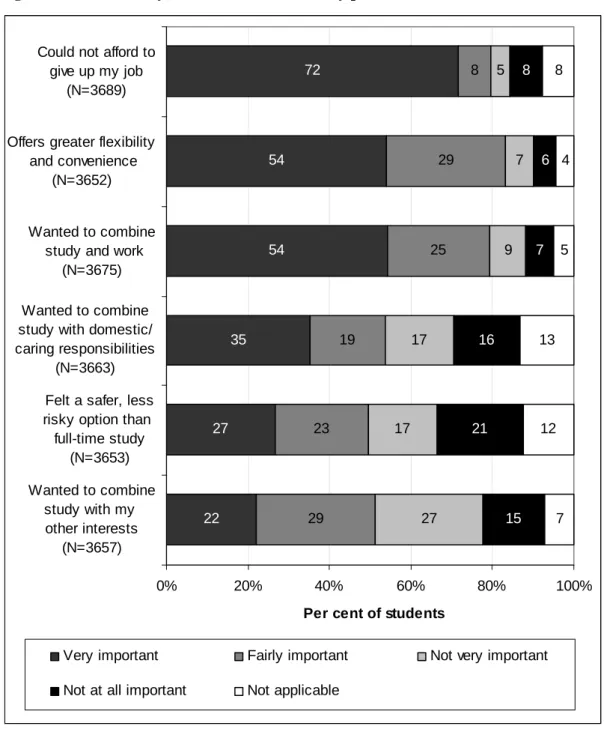
• Students’ reasons for studying part-time as against full-time were both financial and pragmatic. They could not afford to give up their job to study full-time (80%). In addition, part-time study offered them greater flexibility (83%) and they could fit their studies around their existing work (79%) and domestic commitments (54%).
• These findings confirm those of earlier studies and Kember et al’s (2001) observation that students hold ‘multiple orientations’ towards study, which inevitably influence experiences upon entry to a course and beyond.
Part-time students’ career plans and ambitions
• A unique feature of this research is its exploration of part-time students’ career plans. Well over a half of students had clear career ambitions and well-reasoned long-term career plans – they knew what they wanted to do, especially students who already had some experience of, or exposure to, higher education. For the vast majority of
students, both their decision to study (89%) and choice of subject (92%) were firmly linked to these career aims. For a sizable minority (27%), their ideas about their careers had crystallised as a direct result of taking their course, especially amongst
those nearing the end of their course and among those more vulnerable students who were not employed, entered higher education with low-level qualifications, and came from low-income households. However, for around a half of those students not taking vocational qualifications or studying education, their courses were not always directly related to their current employment or occupation. This suggests that they were using their studies as a springboard to realise their ambitions in a different job or area of work.
The careers information, advice, and guidance sought by part-time students and their use of university/college career services
• Only a third of new entrants had sought any careers information, advice, or guidance before starting their course. This was because most (71%) of them knew what they wanted to do and/or had experience to call upon to weigh up their career options. In addition, the vast majority did not think they needed more help and advice in choosing their course of study.
• It was primarily for these reasons that only a third of students had used their university/college career service once they got to university. This is an important finding given the absence of other research on part-time students’ use of university career services. Those most likely to have had some contact with their
university/college career service while at university were in their final year of study, were not employed, were without a higher education qualification at the start of their current course and came from minority ethnic groups.
• Of those part-time students who had not used their university/college careers service during the academic year, nearly three in ten (58%) knew what they wanted to do and/or had the knowledge and experience to make up their own minds about their career options. However, a further third of students who had not used their university/college’s careers service were unaware of its existence, or thought the service did not cater for people already with jobs or for those studying part-time, especially female students and those under the age of 25. This suggests that
university/college career services need to do much more both to market their facilities and to broaden their provision in order to increase student awareness of the service and to improve students’ use of the service.
• When students did seek careers information, advice, and guidance either before starting their course or during their course, those who were employed mostly relied on their employer (32%) or someone at work (30%) for such advice, which they also rated the most helpful sources of careers information, advice, and guidance. By contrast, those who were not employed depended primarily on help from family and friends (27%) which they also rated as the most helpful source
• Consequently, most part-time students do not rely on professionals for their careers information, advice and guidance. Instead, they turn to those close at hand - their informal social networks at work and at home. This means that many students may not be receiving impartial or broadly informed career advice, when compared with the advice likely to be provided by a professional career advisor.
• Although most part-time students did not use their university/college’s careers service while at university, the majority (57%) had sought some careers information, advice, and guidance from alternative sources. This demonstrates an appetite for such help and support, and potential missed opportunities for university/college career services. So, while there is a demand for careers information, advice, and guidance among part-time students, university/college career services are not fulfilling that demand. To meet that demand universities and colleges need to priorities the requirements of
part-time students and allocate more resources to them. Specifically, they need to re-orientate their services away from services preparing younger students to enter the labour market to those catering for older students already with experience of the labour market who want information, advice, and guidance on career progression and career change. A finding which confirms those of Little et al (2005), one of the very few studies that has looked generally at career development activities in HE for part-time students but within the context of effective learning for employability. Our study also found that university and college career services need to acknowledge part-time students’ preferences for a more personalised approach and for face-to-face
interaction with a careers advisors rather than delivering services for instance, via websites.
The costs of part-time study and employer support
• There were wide variations in part-time students’ total costs of study including both tuition fees and other course costs such as books, computers, travel etc. The average costs amounted to £1,730. Of this, £1,166 was spent on tuition fees, which were paid up-front, and the remaining £564 on other course costs.
• The nature of the current government-funded financial support for part-time is based on the assumption that students can afford these costs because they are working or that their employers will pay for them. However, only a minority of students received any help with their fees from their employer – around 41%.
• Employer support is discretionary rather than an entitlement, unlike statutory provision. This study, like others before (Woodley 2004, Callender et al 2006, Johnson et al 2009), confirmed that employers were very selective in terms of who they were prepared to sponsor, favouring the most advantaged in their workforce. Employer support was very unequally distributed to the detriment of those students most in need of help to improve their labour market position and human capital. Those missing out included students from ethnic minorities, from working class households with low-incomes and poorly paid part-time jobs and low qualification levels on entry. Those most likely to benefit from employer support were students least in need of such help- white students in full-time jobs, from high-income households already with a university degree studying towards a vocational qualification especially in engineering and technology.
• On top of help with fees, nearly a half of students had been given paid time off work to study by their employer, and one in six had received financial help towards their course-related costs. However, just like employers’ financial contributions towards employees’ tuition fees, employers were very selective in terms of in which
employees they were willing to invest and support both financially and in kind so that their employees could successfully complete their course of study. Those employees most likely to be given paid time off work and help with course-related costs were also the employees most likely to have had their fees paid in full by their employer. For instance, nearly three times as many students whose employer had paid their tuition fees in full as students receiving no tuition fee support at all from their employer, were also given paid time off work. Consequently, the employees most likely to receive this additional support were some of the most privileged in the labour market – individuals working full-time with high or medium household incomes studying towards vocational qualifications, especially in engineering. Conversely those missing out included some of the most vulnerable in the labour force, part-time employees or those working voluntarily from low-income households taking a First degree and studying education and the Law.
• However, such employer financial support is particularly vulnerable to cuts. Employer sponsored education and training is particularly at risk in times of fiscal constraint, especially where such spending is perceived to be discretionary and where training budgets are competing with other resources to meet more pressing targets. Consequently, it is not necessarily a reliable funding source.
• Just under a half (46%) of employed students thought their employer was very supportive in helping them do their course. Not surprisingly, the employees most appreciative of their employer, who rated them as very supportive in their studies, were those who had received financial and practical help in the form of: contributions towards their course-related expenses; paid time off work to study, and payment of their tuition fees paid in full.
Government-funded financial support for part-time students
• Part-time students are potentially eligible for two means-tested government-funded grants: a fee grant towards the costs of their tuition and a course grant for help with the costs of books, travel computing etc. However, eligibility to both grants is highly limited because of their restrictive qualifying criteria. Students have to be studying at least 50% of a full-time course, not already have a level 4 qualification or a
first/bachelor’s degree, and have very low household incomes. However, entitlement is not driven by financial need, but initially is dictated by the number of hours students study and by their qualifications on entry. As a result, the vast majority of part-time students do not receive this financial support, including some disadvantaged groups such as students from low-income families or with low levels of entry
qualifications - a finding confirmed elsewhere in earlier studies (e.g. Callender et al, 2006; Johnson et al 2009).
• Only 14% of all the students surveyed received a fee grant while 19% were awarded a course grant. This compares with 10% of all part-time undergraduates nationally. The students surveyed most likely to receive this help were those who did not receive any financial support from their employer. Therefore, the state system does help to compensate for the absence of employer support and for market failure. However, government fee grants are frequently less generous than an employer’s contribution to a student’s fees because the grants do not always cover a student’s tuition fees in full, unlike most employer support.
• Consequently, when students do qualify for these grants, the amount they receive is inadequate and does not meet their costs. Over two in five (43%) students surveyed in receipt of a government fee grant, had tuition fees higher than the fee grant they received while 68% awarded a course grant incurred course costs higher than their grant.
• Nor does the system of financial assistance for part-time students promote widening participation and fair access. This is in marked contrast to the much more generous and comprehensive financial support available to full-time undergraduates. These differences in financial support may help explain why part-time student enrolments, outside the Open University, have fallen over time while full-time enrolments have continued to grow.
The benefits of part-time study
• The few studies on the benefits of part-time study focus on the outcomes of study, and what happens to students after they graduate. This study examined changes that occurred while students were still studying. It found that students already were reaping the benefits of their course even before they had completed them. Nearly a
half of students in their final year of study had changed jobs and/or their employer since starting their course, especially younger students, from low-income households studying for a First degree, particularly in the Law or Business.
• However, some part-time students may have unrealistic expectations about the employment benefits of studying particularly in relation to getting a new job, being promoted, and getting a pay rise. While a minority of students in their final year of study had experienced these particular employment benefits as a result of their studies, much higher proportions of students in their first year of study expected these changes to occur as a consequence of their studies.
• Yet, the majority of students had seen some positive outcomes from their studies. Their productivity and job satisfaction improved, they utilised the skills learnt on their course in their jobs, and were given more responsibilities at work reflecting their improved knowledge. There were unanticipated benefits too, particularly
improvements in relations with colleagues at work and more positive employer attitudes towards them.
Detailed findings
CHAPTER 2: REASONS FOR STUDYING What triggered students’ decision to study?
• The key triggers that made students first think about taking their course of study were:
- Career and employment related:
Most students identified realising they needed a Higher Education qualification to get ahead (59%) and that their existing qualifications were inadequate to meet their career ambitions (56%), as the key triggers, especially employed students or those with taking more vocational qualifications (i.e. Foundation Degrees and Higher Nationals).
- Change related:
Just under a half (47%) of all students wanted to do something useful or different with their lives, especially students who were not employed (55%). - Family related:
Just under a half (46%) of female students with a child under the age of 11 first started to think about taking their courses because they wanted to be a role model for their children or to help with their children’s education.
• A slightly higher proportion of completers - students in their final year of study - than starters – students in their first year of study – identified these first two sets of
triggers.
Why choose to study part-time?
• Over a half of all students rated the following reasons as very important in their decision to study part-time as against full-time:
- They could not afford to give up their job (72%), especially students in full-time employment, or doing a Foundation Degree ;
- Offered greater flexibility and convenience (54%), especially students in part-time employment or taking a Foundation Degree; and
- Wanted to combine study and work (54%), especially students in part-time employment or taking a Foundation Degree;
A slightly higher proportion of starters than completers identified these three reasons. Why chose their course of study
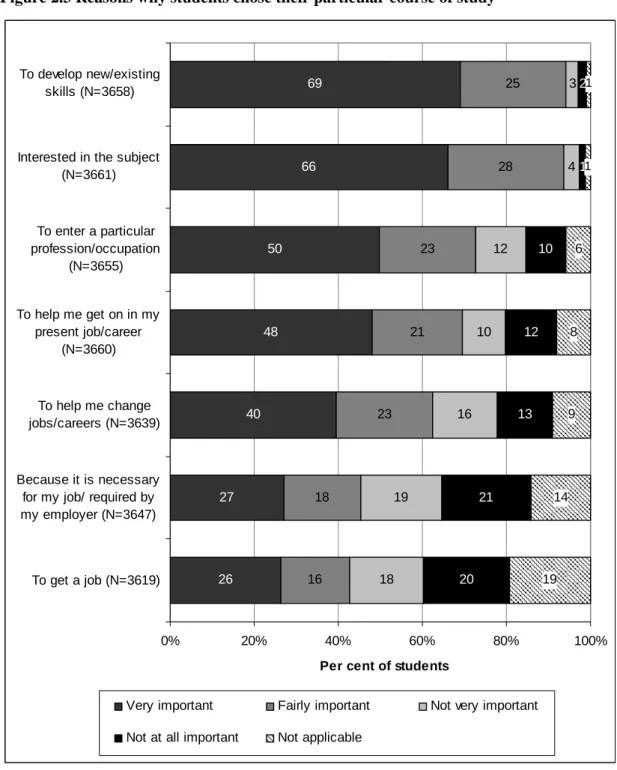
• The majority of students rated the following reasons as very important in their decision to study their particular course of study:
- To develop new and existing skills (69%), especially students studying the Law and Business or taking a Foundation Degree;
- Interest in the subject (66%), especially students studying the Law; and
- To enter a particular profession/occupation (50%), especially students studying the Law.
There were no marked differences by whether students were starters or completers. Benefits hoped for
• At least a half of students identified the following generic personal or professional benefits that they hoped to achieve from their studies:
- Better opportunities and prospects (55%); and - Improving their skills/qualification/experience (50%).
CHAPTER 3: CAREER RELATED STUDY AND CAREER AIMS
The relationship between students’ study and their career aims and current employment
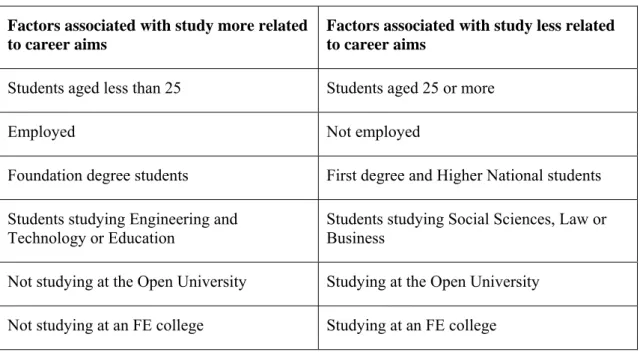
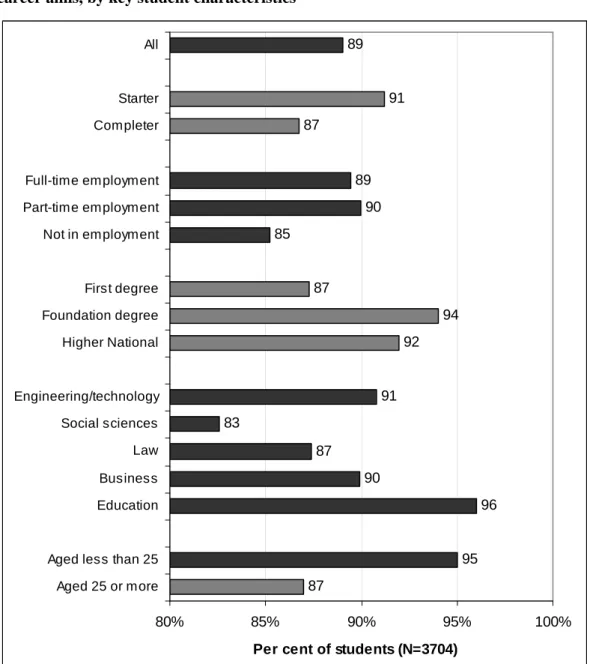
• Nearly all students’ (89%) decision to study and their subject of study (92%) was related to their career aims, particularly younger students, those who were employed, who were taking a Foundation Degree, or were studying Engineering, Technology or Education, once other characteristics were controlled for.
• Overall 55% of students said their course was related a great deal to their current occupation or employment, especially, female students, those with children, white students, those employed full-time, taking a Foundation Degree or Higher National, and studying Education, once other characteristics were controlled for.
• Only 13% reported that their course was not at all related to their current occupation or employment, a figure broadly in line with the percentage reporting that their decision to study was not related to career aims (11%) and that their subject of study was not related to career aims (8%).
Career plans
• Students had pretty set ideas about their career plans .
• Almost one-third of students had a clearer idea about their career plans since starting their course. For a further 27% of students their original career plans had been reinforced since starting their course, while for another quarter their plans remained unchanged. Only 5% had changed their ideas completely, or had a less clear idea.
• The students most likely to have a clearer idea about their career plans were in their final year of study, were not employed, from low-income households, or had a Level 3 entry qualification (i.e. A Level or equivalent).
• Most students (59%), at the time of the survey, were clear about their long-term career plans and what they wanted to do. Students who already had a level 4/5 qualification, who had a family member with an HE qualification and students studying Law or Education were more likely to report that they were clear about what they want to do, once other characteristics were controlled for. There were no
differences between starters and completers.
CHAPTER 4: USE OF CAREER SERVICE
Starters’ careers seeking behaviour before they started their course
• Only a minority of students (33%) in their first year of study had sought some careers information, advice, or guidance before starting their course. Those students most likely to seek help were younger students, those with a partner, ethnic minority students, from low household incomes, and studying Engineering, Technology and Education, once other characteristics were controlled for.
• The main reasons first year students had not sought advice were because: - they knew what they wanted to do and did not need advice (64%), and - they have the experience and knowledge to decide about their career options
(32%).
Sources of careers information, advice, and guidance used by starters before they started their course
• The most popular sources were: - their employer (32%);
- the careers service at their university/college (30%); - family and friends (26%); and
- someone at their workplace (26%). • The most helpful sources were:
- the careers service at their university/college (16%); - their employer (14%); and
- The vast majority (90%) of students in their first year of study thought there was more than enough or just enough career information, advice, and guidance. Students’ contact with their university’s career service
• Only a minority of all students – a third - had had any contact with their university career service over the academic year of 2007/08. Those most likely to have had some contact included completers, male students, ethnic minority students, students who were not employed, with a Level 3 qualification on entry, and studying Social Sciences, Law and Education, once other characteristics were controlled for.
• The main reasons students had had no contact were:
- they knew what they wanted to do and did not need advice (45%),
- they have the experience and knowledge to decide about their career options (32%); and
- they were unaware of the service (21%), especially female students and those aged under 25, once other characteristics were controlled for.
Career guidance opportunities
• Over a half of all students (57%) had accessed some careers information, advice, and guidance over the academic year from a wide variety of sources.
• Only a small minority of students had used any of the opportunities specifically offered by their university’s career service. The most popular opportunities exploited were careers advice:
- from their employer (27%);
- someone at their workplace (26%); and - family and friends (14%);
• Students employed full-time relied much more heavily on their employer and someone at their workplace for careers guidance while students employed part-time, or not at all, depended on their friends and family and the opportunities offered by their university.
• The most helpful sources of careers information, advice and guidance for those using the source were:
- one to one careers session offered by Careers Service staff at their university/college (54%);
- careers advice from their employer (53%);
- careers advice from someone at their workplace (45%);
- careers advice from a public or private careers agency (44%); and - a module to develop employment related skills (41%).
• So there was a very marked difference between the most frequently used sources of careers information and those rated the most helpful.
Students’ views about their university career service
• The university/college career services were working well for only a minority of students but there were widespread perceptions that the services are not for everybody.
• Accessing the service was not a problem with nearly half believing that it was easily accessible.
CHAPTER 5: THE COSTS OF STUDY Information on financial support
• Nearly two-fifths of students sought information about the financial support available when studying part-time before starting their course.
• Students most frequently obtained information about student financial support from their university (63%) with only a quarter using the official government website - directgov.
Tuition fees
• The mean tuition fee was £1,166 and the median £900.
• The following students had above average fees: - First degree students (£1,209);
- those studying the Law (£1,646) and Business (£1,249); - those not studying at the Open University (£1,233); and - those studying more than 60% of an full-time equivalent
• 41% of students received an employer contribution towards their fees while a similar proportion paid for some or all of their fees themselves, and a fifth gained some support from a financial assistance scheme.
• The students most likely to get help from their employers were female, white, full-time employees, from households with medium and high incomes, who already held a Level 4 or 5 qualification, were aiming for a Foundation Degree or Higher National, studying Engineering or technology, and were studying at least 50% of an FTE, after controlling for other characteristics. Thus, those students, most in need of financial help did not receive it from their employer.
• About a half of the employed students knew they would receive this help from their employer before starting their course while 30% knew they would get no help, and the remaining 22% did not know whether their employer would contribute to their tuition costs.
• The students most likely to pay for some of their tuition fees themselves were completers, male, aged 25 and over, childless, employed part-time, from households with medium and high incomes, taking a first degree, and studying the Law and at the Open University, after controlling for other characteristics.
Course costs and expenditure
• The mean amount students spent on things like books, travel to and from their place of study, computers etc was £564 and the median was £350.
• The following students had above average expenditure: - completers (£630);
- part-time employees (£674); - non-working students (£825); - first degree students (£583); and - those studying the Law (£739)
• The most costly items of expenditure for those incurring the costs were: - childcare costs incurred while studying (£884); and
- residential course costs (£723).
- The vast majority of students paid for these costs themselves with only 15% getting help from their employer.
How many, and type of students received government student financial support • The vast majority of part-time students receive no government student financial
support.
• 14% of all students received a government fee grant towards the cost of their tuition.
• Those most likely to receive such a grant were starters, female, lone parents, employed part-time or not at all, from households with low-incomes, with a Level 3 qualification or lower on entry, taking a first degree, studying education and at the Open University or an FE college, after controlling for other characteristics.
• Students receiving government financial support largely reflect those students least likely to receive employer support –so government help, in part, compensated for the absence of employer financial support.
• 19% received a course grant toward their course expenditure.
• Those most likely to receive a course grant were similar to those most likely to get a fee grant – they were aged less than 25, lone parents, employed part-time or not at all, from households with low-incomes, with a Level 3 qualification or lower on entry, without a family member who had an HE qualification, taking a first degree, studying education and at the Open University, after controlling for other characteristics.
The adequacy of government student support
• For a sizable proportion of students, the support they received from the government did not meet their costs.
• The average value of the government fee grant was £793.
• 43% of students in receipt of a fee grant had tuition fees higher than the value of their grant. The average shortfall was £576.
• The average value of the government course grant was £242.
• 68% of students in receipt of a course grant had course expenses higher than the value of their grant. The average shortfall was £729.
CHAPTER 6: EMPLOYER SUPPORT
Employer awareness of whether their employees were studying
• The vast majority (95%) of students who were working either in paid employment or voluntarily had informed their employer that they were studying part-time.
• The main reasons students had not informed their employer were because - they believed that part-time study was a personal endeavour (26%); and - their course was not relevant to their current work (21%).
Whether study was a job requirement
• For a quarter of students, their current study was a job requirement.
• Those students most likely to say this were younger students, who were male, lone parents, from an ethnic minority, employed full-time, aiming for a vocational qualification – a Foundation Degree or Higher National and studying engineering or technology, social sciences and education not at the Open University, once other characteristics were controlled for.
Other forms of employer support
• Over and above financial help with tuition fees, some employers gave their
employees other types of support. The most common form of support was paid time off to study, received by nearly a half of students (47%).
• Students whose employer paid for all their tuition fees also were most likely to be given other forms of employer support.
• The students most likely to get this additional support included full-time employees, from households with medium and high incomes, studying vocational qualification in Engineering or technology not at the Open University, after taking into account other student characteristics. These
• 41% of employees received no other forms of support. Students’ views on their employers support
• 46% of employees thought their employers were very supportive of their studies, and a further 32% thought they were quite supportive.
• Unsurprisingly, students whose employer paid for all their tuition fees were more than twice as likely as those receiving no such help to rate their employers as very supportive.
CHAPTER 7: CHANGES IN EMPLOYMENT ARSING FROM STUDY Employer and job changes
• Two-thirds of employed students had not changed jobs or employer since starting their current course.
• 20% of students had remained with their employer since starting their current course but had a different job. This figure rose to 24% for completers and fell to 16% for starters.
• 14 % of students had changed employer since starting their current course, and most of them also were doing a different sort of job. More than twice as many completers (21%) as starters (9%) had changed employers.
• The completers most likely to have changed employers since the start of their course were younger, those taking first degrees, studying the Law and Business and at the Open University.
Changes hours of work
• The vast majority of students (78%) had not changed their hours of work since starting their current course.
Changes at work arising as a direct result of their study
• This study confirms that there are many work-related benefits from participating in part-time study, apart from the more obvious change of job.
• Unsurprisingly, a higher proportion of completers than starters experienced these particular benefits because they had been studying for a longer period of time.
• The majority of starters (68%) and completers (65%) felt that their ability to do their work had improved as a direct result of having undertaken their course while most completers (58%) and nearly a half of starters (47%) had derived more job
satisfaction.
• Sizable minorities of completers had received a pay rise (41%) and promotion (39%) as a direct result of their studies – twice as many as starters.
• An unexpected consequence of studying for a sizable minority of both starters (29%) and completers (31%) was improved relationships with people at work.
• These changes at work were associated with other transformations at work associated with their studies. The majority of both starters and completers believed:
- they had made, or expected to make, good use of the skills and knowledge they have learned on their course in their current job;
- their employer’s attitude towards them was more positive because of their part-time course; and
1 INTRODUCTION
1.1 Background
Part-time students and government policy
Part-time undergraduate students have tended to be on the periphery of higher education (HE), despite the fact that in 2007/08 they made up over a third of the UK HE undergraduate population (Mason, 2010). Concern has focused on full-time students, and especially those entering higher education straight from school. Arguably, one of the most obvious
manifestations of this was the scant reference to part-time students and mature students in the government’s 2003 White Paper The Future of Higher Education (DfES, 2003) and the ensuing legislation - the 2004 Higher Education Act. The only passing references to part-time students in the White Paper were in relation to the need for more flexible provision to meet the skills gap. However, there was no discussion about what is needed to ensure greater flexibility of provision, nor any examination of the part-time student population. There was some discussion of student support for part-time students as a means of encouraging greater flexibility. This support was subsequently reformed following concerns about the impact on part-time provision of variable tuition fees for full-time students.
Nor were part-time students mentioned at all in the government’s follow up to the White Paper on “Widening Participation in Higher Education” (DfES, 2003a). It seems ironic that key government documents on the future of higher education and widening participation ignore this important and growing sector of higher education, which is essential to an economy based on lifelong learning. This did not go unnoticed by the House of Commons Education and Skills Select Committee (2002-03 HC 425-1:p49) who observed:
‘The White Paper is principally concerned with young, full-time students. The needs of those who fall outside that category must be properly taken into account if the higher education sector is to provide truly improved access’.
Neither of these two documents discussed the provision of career advice for full or part-time students, unlike the Dearing Report. However, both documents highlighted the importance of providing information to inform students’ initial choice of university and course – an area not usually covered by career services within universities.
More recently, the policy rhetoric surrounding part-time students and part-time provision has shifted. For instance, Universities UK, the main organisation representing the interests of university Vice-Chancellors, launched a programme of research on part-time students and part-time study. The research mapped the part-time student population and part-time provision (Ramsden and Brown 2006). It also explored part-time students’ attitudes and experiences of part-time study and its costs (Callender at al 2006), highlighting the inequities in the funding of part- and full-time students.
In addition, several official documents and research reports have suggested that the demand for part-time study is likely to grow in the near future, especially at the undergraduate level. For example, meeting Leitch’s (2006) 2020 target of 40 per cent or more 19-65 year olds achieving a Level 4 qualification, is predicated on part-time provision. In particular, the report argues for more flexible and responsive provision and greater employer investment in HE, especially workforce development. The report also recommends a new universal careers service for young people and adults.
Two University UK reports (Ramsden and Brown 2008a, b) on ‘The future size and shape of the HE sector in the UK’ predict that by 2027 part-time undergraduate enrolments will increase at a much faster rate than full-timers, and the mix between full and part-time students could shift substantially towards part-time primarily because of the demographic downturn in 18 year old school leavers. Similarly, a National Audit Office (2008) report called for more part-time undergraduate courses to facilitate the widening participation agenda, while another government-funded study (Pollard et al 2008) of working adults highlighted their desire for part-time study in evenings and week-ends at a university close to home.
More significantly, with the onset of the economic downturn and severe constraints on higher education expenditure, part-time provision became more prominent in the Labour
government’s discourse on higher education and its even greater emphasis on the role of higher education in meeting the high levels skill needed for a competitive economy and economic recovery. Part-time study, therefore, was seen as part of the Labour government’s wider skills strategy for re-skilling and up-skill the workforce, and as a vehicle for
encouraging greater employer involvement in the funding of higher education. The perceived value of part-time provision lay in its delivery of vocational courses and qualifications at the expense of liberal arts and continuing education provision. This was well illustrated by a series of policy changes marking this shift in policy priorities. Most recently, it is evident in the Labour government’s withdrawal of funds from universities for those students whose higher education qualification aim was equivalent or lower than their entry qualification (ELQ). The Labour government promoted the withdrawal of ELQ funding as part of their widening participation agenda. However, the main plank of its policy was to look to
employers to co-fund courses and programmes of study as a means to enable, and ensure that universities prioritised the recruitment of students within the workforce without a Level 4 qualification or Bachelor’s degree. As a House of Commons Select Committee commented, the ‘ELQ debate can be seen as a surrogate debate about the involvement of employers funding higher education’ (House of Commons 2008). The ELQ ruling, which came into force in 2008/9, has had a disproportionate impact on part-time provision.
Arguable, therefore, the Labour government was not particularly committed to part-time study and lifelong learning. Rather part-time study was perceived as just one instrument in the government’s toolbox for: creating a more flexible and diverse higher education sector with less ‘conventional’ undergraduate provision [three-year full-time degree courses]; promoting student choice; and broadening or widening higher education participation. Part-time study was also a means of reducing the higher education budget because it was considered a cheaper alternative to full-time provision.
These issues were captured in Higher Ambitions: The future of universities in a knowledge economy (Department for Business, Innovation and Skills 2009), which was the last major document on higher education the Labour government produced prior to the May 2010 election. The document, therefore, neatly encapsulates Labour’s thinking on higher education at a time of fiscal constraint, and its rhetoric is worthy of exposition because, unlike previous government documents it engages with part-time study although in a very instrumental manner. Moreover, Higher Ambitions forms the policy backdrop for the Independent Review of Higher Education Funding and Student Finance, launched at the end of 2009, to reform student financial support and an issue discussed in the current study.
The executive summary of Higher Ambitions (BIS 2009 p 8-11) pronounced that: ‘In order to attract a greater diversity of students, more part-time study, more
vocationally-based foundation degrees, more work-based study and more study whilst living at home must be made available. This is a core aim of these proposals, and our wider skills strategy (p 8)...The next phase of expansion in higher education will hinge on providing opportunities for different types of people to study in a wider range of ways than in the past. The focus will therefore be on a greater diversity of
models of learning: part-time, work-based, foundation degrees, and studying whilst at home. (p9)... We will give priority to growing a diverse range of models of higher education. These include options such as part-time and workplace-based courses aimed particularly at mature students or those from non-conventional backgrounds’ (p11).
The document, when discussing the need for more flexible routes into higher education, expanded on these points suggesting that:
‘Full-time honours degrees will continue to be a popular mode of study over the next 15 years. But we can expect part-time study to increase, and .... it is important that part-time provision is not seen by universities as something to be bolted on to a core model of full-time teaching. Part-time study can be organised around work, reducing student support costs, building practical employability skills, and fostering links between students and their employers. It is vital, therefore, that we have appropriate provision for flexible study’ (BIS 2009 para 34 p. 37).
It continued:
‘We will give priority to growing a diverse range of models of higher education most attractive to non-traditional students. These include options such as part-time and workplace-based courses aimed particularly at mature students or those from non-conventional backgrounds. Adults in the labour market who do not have higher education qualifications deserve a second chance to improve their own and their family’s economic position’ (BIS 2009 para 36 p. 37).
Wider and fairer access to higher education in Higher Ambitions was couched in terms of both social justice and economic success, but with a stronger emphasis on the latter. Thus, higher skills were deemed important because they influenced life chances and earnings potential, and consequently, ‘...wider and fairer access to higher education is a question of basic social justice’ (BIS 2009 para 1, p 24). However, Labour’s wider access agenda had another, and more prominent, rationale: ‘The need to raise skills levels in the UK
economy....[and] develop the potential of all our people’ (BIS 2009 para 4, p 25). In turn, this created challenges to develop ‘new pathways into higher education throughout professional lives and in a way that reflects the challenge of studying alongside full or part-time work’ (BIS 2009 para 4, p 25).
Specifically, Higher Ambitions advocated that:
‘We ...aim to widen participation through the expansion of the number of adults at university and by promoting a broader range of course models alongside the three year degree……In order to attract a greater diversity of students, more part-time study, more vocationally-based foundation degrees, more work-based study, more fast-track degrees, and more study at home must be available. This improved flexibility of study will help those who have previously found it difficult to access higher education, such as parents with young children, to improve their skills’ (BIS 2009 para 8 p 26).
Increasing and widening participation in higher education were not positioned at the very heart of Higher Ambitions, unlike earlier Labour government higher education policy documents and initiatives (Naidoo and Callender, 2000). Neither were the economic arguments for widening access integrated with liberal ideas of the functions of higher education and lifelong learning. Nor was wider access billed as playing a significant role in overcoming social exclusion. For part-time students in particular, Labour’s approach to widening participation and fair access in Higher Ambitions, therefore, was not driven primarily by an ideological commitment to either social justice or lifelong learning. Instead,
the drivers for change in relation to part-time students, along with the Labour government’s rhetoric about part-time study, were dictated nearly exclusively by the needs of the economy, and reducing the higher education budget. At the time of writing, it is not known whether the coalition government will adopt a different approach to part-time students and part-time higher education.
Issues concerning information, advice and guidance were also covered in Higher Ambitions. However, the discussion focused exclusively on the needs of young people in terms of encouraging progression into higher education and raising young people’s aspirations. Thus despite the importance of adult learners and part-time study within Higher Ambitions, their need for careers information, advice, and guidance was left untouched.
Career services in Higher Education
Career guidance services in HE are well developed and established compared with other OECD countries (Watts and Van Esbroeck, 1998). Unlike other career guidance provision within the education sector, there is no statutory obligation for universities to provide such services. However, the vast majority have well established services some of which are provided through dedicated Careers Services, some via academic departments, and some through integrated student services. The nature of the services provided, vary considerably. They include information provision; personal advice and guidance; access to self help techniques; career fairs; employers interviews; job placement; interview skills coaching and broader career management skills; employability skills; and curriculum-based careers education.
The most detailed review of HE’s career service was conducted by Sir Martin Harris. The report Developing Modern Higher Education Career Services (DfEE, 2001) made 41
recommendations, directed to the HE sector as a whole, institutions, career services, and other bodies. The report set out the need to deliver efficient, effective, and economical careers education, information and advice within HE. In addition, it recognised the implications for the career service of the increasing proportion of students from ‘non-traditional backgrounds’. The report highlighted the need for institutions to identify such students who were likely to require specific help and guidance.
‘Such diversity calls for imaginative responses from career education, information, and guidance services. Mature students, part-time students and students studying at a distance, as well as those with particular domestic or personal circumstances, may need different forms of help from ‘traditional students’. (DfEE, 2001:14)
Similarly, the Quality Assurance Agency recognised the expansion and diversification of higher education, and called for career education, information, and guidance that meet “the needs of students from diverse backgrounds and students engaged in different modes of study, including part-time and distance learning.” (QAA, 2001:5)
Subsequent policy and reports, however, have not been particularly concerned with part-time students and distance learners. On the whole, they have tended to focus on a narrower definition of ‘non-traditional’ students, especially on young people from lower
socio-economic backgrounds as part of a social inclusion and widening participation agenda (Rolfe and Nadeem, 2007). For example, a recent study (Morey et al, 2003), commissioned by HECSU on how careers services might enhance the employability of students from non-traditional backgrounds pays scant attention to issues specifically facing part-time and distance learning students, and demonstrates a limited understanding of the part-time student population. In the report, part-time students are conflated with mature students. Some of the concerns of these two student groups may overlap, and many of the recommendations proposed would benefit part-time students. However, part-time students may have divergent
and particular career service needs, especially those already working full-time, and in relation to access to student financial support.
The Harris Review has led to a range of changes and some progress has been made on implementing the recommendations as part of a modernising agenda (UUK, 2002). More recently, the emphasis in post-Harris provision has been on prioritising quality assurance and standards (Maguire, 2005). However, despite this recognition of a more diverse student population with differing career service needs, the model underpinning most career service provision within HE remains one informed by the ‘typical graduate’ - young and single who entered university straight after leaving school.
Existing research on part-time students’ career decision-making and career development
Part of the HECSU study included a literature view on part-time students and career making and has been published separately (Callender and Feldman, 2009). This explored existing studies on part-time students. It concluded, just as part-time students tend to be overlooked in government higher education policy, and often in CEIG services within HE – so they have been overlooked by researchers exploring the myriad of complex issues impacting on career making. Compared to full-time students, part-time students are under-researched.
The review brought together two main bodies of literature, with many works not fitting easily into either. On the one hand there is the social and education policy and sociological
literature which looks at government and institutional policies towards part-time students, and the aspirations, experiences of such students and the benefits or otherwise to them of having studied. A second body of literature was reviewed relating to careers guidance.
Within the first body of literature the review has identified an important conceptual and practical difficulty in the literature on part-time students in HE. A general neglect of the importance and diversity of part-time students, linked to a preoccupation with widening participation, has resulted in much discussion of part-time students being subsumed under other headings. Thus “part-time” is often added to descriptions of students as diverse as, non-traditional, working-class, mature, or having low entry qualifications.
This has the effect of seeing part-time students as just another disadvantaged group within the literature on widening participation. “Part-time” ceases to be seen as a mode of study, but becomes an attribute of students. However, even where part-time students are included among these groups, the specific barriers they face, and, even more, the different needs they may have, are often not specified.
In recent years, much of the careers guidance literature reflects a preoccupation with adapting careers services to new circumstances, including especially, non-traditional HE students and new labour market conditions, as well as new systems of student funding which means that many full-time as well as part-time students work during their courses. Careers Service departments have also traditionally been marginal to the main emphasis of universities, and, in response to a much stronger emphasis on employment in HE policy, part of their discussion of adaptation also involves their own repositioning within the institutions.
The literature reflects the profession’s concern to address student diversity, and many reports recognise that part-time and mature students are often not catered for. However, like the more sociological and social policy literature, with some exceptions, they also tend to subsume part-time students under other characteristics, particularly mature or disadvantaged, without addressing in detail their different needs from those of full-time students. These relate, above all, to the fact that part-time students are predominantly already in full-time employment, and therefore may have needs for advice with career advancement or career change, rather than first introductions to the labour market.
There clearly are an increasing number of studies concerned with different aspects of part-time students in HE. The complexity and variability of the students, their courses, their situations, and background can make comparison between them as difficult as between them and full-time students. The review attempted to disentangle some of the many issues that the studies in the review dealt with, drawing attention not just to the findings but to the gaps that still exist in our knowledge. In particular more needs to be known about part-time students’ experience of study in difference situations, the impact that part-time study has had on their lives, and of how career decisions are made and assisted in the course of their studies. Further studies are an important means of encouraging a more nuanced approach to part-time students in HE. We need to differentiate more clearly the varying needs and trajectories of different groups among them and use this knowledge to challenge the undifferentiated assumptions embedded in the concept of the non-traditional student, to which part-time students are too often confined.
While all the studies highlighted in the literature review, form a useful backdrop to this study, none of them systematically explore in detail the career decision-making and career
development of part-time students, nor the role of employers. It is against this background that this programme of longitudinal research aims to improve our understanding of the career learning and decision making of part-time students and graduates and the career guidance interventions required to support these.
1.2 Aims and objectives of the research The overall aims of the research are:
• to collect data on career intentions and ambitions for part-time students;
• to investigate employment and training outcomes for part-time students;
• to assess the impact of the mode of study on employment and training outcomes;
• to collect data on students’ career development/learning and decision-making; and
• to investigate the views of employers of part-time students.
At this stage of the research we have only conducted the first wave of survey data collection, hence this report focuses on career intentions and ambitions and career development/learning and decision-making.
Employers’ views on part-time students are reported separately (Mason and Hopkin Forthcoming).
1.3 Methodology
The research reported is based on analysis of data collected from online and telephone surveys of part-time learners in either their first or final year of a course of HE study, across a total of 29 Universities, conducted in 2008. For further details see the Technical Appendix. A second phase of the research will follow both cohorts of students in 2011, three years after the initial survey. The inclusion of first year and final year students means that the three-year project will yield information about student views over the duration of their course and information about how student experiences shape their career choices and progression in the three years after completion. As first degree courses, for instance, take on average five years for students to complete on a part-time basis, a model in which only first year students were