Available online throug
ISSN 2229 – 5046
International Journal of Mathematical Archive- 7(11), Nov. – 2016 32
PRIME CORDIAL AND SIGNED PRODUCT CORDIAL LABELING
FOR THE EXTENDED DUPLICATE GRAPH OF KITE GRAPH
B. SELVAM*
1, K. ANITHA
2AND K.THIRUSANGU
31,3
Department of Mathematics,
S. I. V. E. T. College, Gowrivakkam, Chennai – 600 073, India.
2
Department of Mathematics,
Sri Sairam Engineering College, Chennai – 600 044, India.
(Received On: 12-10-16; Revised & Accepted On: 11-11-16)
ABSTRACT
I
n this paper, we prove that the extended duplicate graph of kite graph is Prime cordial and signed product cordial labeling.AMS Subject Classification: 05C78.
Key words: Graph labeling, prime cordial labeling, signed product cordial labeling, Kite graph.
1. INTRODUCTION
Graph theory is well known subject in mathematics and computer science. Graph theory is now a major tool in mathematical research, marketing and so on. The concept of graph labeling was introduced by Rosa [2] in 1967. Graph labeling is an assignment of integers to the vertices or edges or both subject to certain conditions. After the introduction of graph labeling, various labeling of graphs such as graceful labeling, cordial labeling, prime cordial labeling. magic labeling, anti magic labeling etc., have been studied in over 2100 papers [1]. The concept of signed product cordial labeling was introduced by J.BaskarBabujee and he proved that many graphs admit signed product cordial labeling [5]. Sundaram, Ponraj and Somasundaram have introduced the notion of prime cordial [4]. The concept of duplicate graph was introduced by E.Sampath kumar and he proved many results [3]. K.Thirusangu, P.P. Ulaganathan and B. Selvam
have proved that the duplicate graph of a path graph 𝑃𝑃𝑚𝑚 is cordial [6].K.Thirusangu, B. Selvam and P.P. Ulaganathan
have proved that the extended duplicate graph of twig graphs is cordial and total cordial [7].
2. PRELIMINARIES
In this section, we give the basic definitions relevant to this paper. Let G=G(V, E) be a finite, simple and undirected graph with p vertices and q edges.
Definition 2.1 Kite Graph: The kite graph is obtained by attaching a path of length ’m’ with a cycle of length ’n’ and
it is denoted as Kn,m.It has m+3 vertices and m+3 edges. Kite graphs is also known as the Dragon Graphs or Canoe
Paddle Graphs.
Illustration: 1
KITE GRAPH
Fig. 1: K3,5
Corresponding Author: B. Selvam*
11
Department of Mathematics, S. I. V. E. T. College, Gowrivakkam, Chennai – 600 073, India.
•
•
•
v
3e
4v
1•
v
4•
v
5•
v
6•
v
7•
v
8e
5e
6e
7e
8e
1e
3e
2Definition 2.2 Duplicate Graph: Let G (V, E) be a simple graph and the duplicate graph of G is DG = (V1, E1), where
the vertex set V1 = V ∪ V′ and V ∩ V′ = φ and f: V → V′ is bijective (for v∈ V, we write f (v) = v′ for convenience)
and the edge set E1 of DG is defined as the edge ab is in E if and only if both ab′ and a′b are edges in E1.
Definition 2.3 Extended duplicate graph of Kite graph: Let DG = (V1, E1) be a duplicate graph of the kite graph
G(V,E). Extended duplicate graph of kite graph is obtained by adding the edge v2
v
2′
to the duplicate graph. It isdenoted by EDG (K3,m, m ≥ 1). Clearly it has 2m+6 vertices and 2m+7 edges.
Illustration: 2 EXTENDED DUPLICATE GRAPH OF KITE GRAPH
Fig. 2: EDG (K3,5)
Definition 2.4Prime Cordial labeling: A function f: V → {1, 2,.... | V|} such that each edge vivj is assigned the label
‘1’if g.c.d. (f(vi), f(vj)) = 1 and ‘0’ if g.c.d. (f(vi), f(vj)) >1 is said to be Prime cordial labeling, if the number of edges
labeled ‘0’ and the number of edges labeled ‘1’ differ by at most one.
Definition 2.5Signed productcordial labeling: A vertex labeling of graph G 𝑓𝑓: 𝑉𝑉(𝐺𝐺) → {−1, 1} with induced edge
labeling 𝑓𝑓∗: 𝐸𝐸(𝐺𝐺) → {−1, 1} defined by 𝑓𝑓∗(𝑢𝑢𝑢𝑢) = 𝑓𝑓(𝑢𝑢)𝑓𝑓(𝑢𝑢) is called a signed product cordial labeling if
�𝑢𝑢𝑓𝑓(−1) − 𝑢𝑢𝑓𝑓(1)� ≤ 1 and �𝑒𝑒𝑓𝑓(−1) − 𝑒𝑒𝑓𝑓(1)� ≤ 1, where 𝑢𝑢𝑓𝑓(−1) is the number of vertices labeled with -1, 𝑢𝑢𝑓𝑓(1) is
the number of vertices labeled with 1, 𝑒𝑒𝑓𝑓(−1) is the number of edges labeled with −1 and 𝑒𝑒𝑓𝑓(1) is the number of
edges labeled with 1.
3. MAIN RESULTS
3.1 Prime Cordial labeling
In this section, we present an algorithm and prove the existence of Prime cordial labeling for the extended duplicate graph of kite graph K3,m, m ≥ 1.
Algorithm: 3.1: procedure [PrimeCordial labeling for EDG (K3,m, m ≥ 1)]
V ← {v1, v2, … , vm+3 ,
v v
1′ ′
,
2,...,
v
m′
+3}E ← {e1, e2, …., em+4,
e e
1′ ′
,
2,...,
e
m′
+3}v1← 1; v2← 6; v3← 5
v/1← 3; v/2← 4; v/3← 2
if 0 < m < 3
for i = 1 to m do v3+i ← 7+i
v/3+i ← 4+3i
end for end if
if m = 3
vm← 11; v/m← 12
for i = 1 to 2 do v3+i ← 7+i
•
•
•
•
•
•
•
•
•
•
•
•
•
•
•
•
v
1v
2v
3v
4v
5v
6v
7v
81
v
′
2
v
′
3
v
′
4
v
′
5
v
′
6
v
′
7
v
′
8
v
′
1
e
′
2
e
′
3
e
′
4
e
′
5
e
′
6
e
′
7
e
′
8
e
′
e1
e2
e3
e4
e5
e6
e7
e8
© 2016, IJMA. All Rights Reserved 34
end for end if if m > 3
𝑓𝑓𝑓𝑓𝑓𝑓 𝑖𝑖 = 1 𝑡𝑡𝑓𝑓 �𝑚𝑚+2 3 �do v3i+1 ← 2+6i
v/3i+1 ← 1+6i
end for
𝑓𝑓𝑓𝑓𝑓𝑓 𝑖𝑖 = 1 𝑡𝑡𝑓𝑓 �𝑚𝑚+1 3 �do v3i+2 ← 3+6i
v/3i+2 ← 4+6i
end for
𝑓𝑓𝑓𝑓𝑓𝑓 𝑖𝑖 = 1 𝑡𝑡𝑓𝑓 �𝑚𝑚 3�do v3i+3 ← 5+6i
v/3i+3 ← 6+6i
end for
end if
end procedure.
Theorem 3.1: The extended duplicate graph of kite graphK3,m, m ≥ 1 is prime cordial.
Proof: Let K3,m, m ≥ 1 be a kite graph. In order to label the vertices, define a function f: V → {1, 2 ... | V|} as given
in algorithm 3.1.
If m ≥ 1, the vertices v1, v2 , v3, v/1, v/2 and v/3 receive labels 1, 6, 5, 3, 4 and 2 respectively.
Case-(i):If 0 < m < 3; for 1 ≤ i ≤ m, the vertices v3+i receive labels ‘7+i’ and v’3+i receive labels ‘3i+4’.
Case-(ii):If m =3; for 1 ≤ i ≤ 2 , the vertices v3+i receive labels ‘7+i’ and the vertices v’3+i receive labels ‘3i+4’; the
vertex vm receive label 11 and the vertex v/m receive label 12.
Case-(iii):If m >3;𝑓𝑓𝑓𝑓𝑓𝑓 1 ≤ 𝑖𝑖 ≤ �𝑚𝑚+2
3 �, the vertices v3i+1 receive labels 2+6i and the vertices v/3i+1 receive labels 1+6i;
𝑓𝑓𝑓𝑓𝑓𝑓 1 ≤ 𝑖𝑖 ≤ �𝑚𝑚+13 �, the vertices v3i+2 receive labels 3+6i and the vertices v/3i+2 receive labels 4+6 i; 𝑓𝑓𝑓𝑓𝑓𝑓 1 ≤ 𝑖𝑖 ≤ �
𝑚𝑚 3�, the
vertices v3i+3 receivelabels5+6i and the vertices v
/
3i+3 receive labels 6+6i.
Thus in all the cases, the entire 2m+6 vertices are labeled by 1, 2 ...2m+6.
The induced function f *: E → {0, 1} is defined as
f * (vi vj) = �
1 𝑖𝑖𝑓𝑓 𝑔𝑔. 𝑐𝑐. 𝑑𝑑 �f(𝑢𝑢i), f(𝑢𝑢j)� = 1 0 𝑖𝑖𝑓𝑓 𝑔𝑔. 𝑐𝑐. 𝑑𝑑 �f(𝑢𝑢i), f(𝑢𝑢j)� > 1
Case-(i): If m = 3n–2; n ∈ N, the induced function yields the label ‘1’ for the edge e2; label ‘0’ for the edges e ’
1 and
em+4; for 1 ≤ i ≤ (m+2)/3, the edges e3i and e’3i+1 receive label ‘0’; for 1 ≤ i ≤ (m+2)/3 and 1 ≤ j≤ 2 , the edges e’3i +j-2,
receive label ‘1’; for 1 ≤ i ≤ (m+5)/3, the edges e3i-2 receive label ‘1’; for 1 ≤ i ≤ (m-1)/3 and m >1 the edges e3i+2
receive label ‘0’.
Thus all the 2m +7 edges namely the edges e3, e5, e6, e8, e9,….. ,em+2 and em+4 receive label ‘0’ ; the edges e’1, e’4, e’7,
e’10, , .…,e’m+3 receive label ‘0’; the edges e1, e2, e4, e7, e10,… ,em+3 receive label ‘1’; the edges e’2, e’3, e’5, e’6, e’8, e’9,
…,e’m+2 receive label ‘1’ which differ by atmost one and satisfies the required condition.
Case-(ii): If m = 3n-1; n ∈ N, the induced function yields the label ‘1’ for the edges e2 and e’m+1; label ‘0’ for the
edges em+4 and e’1; for 1 ≤ i ≤ (m+1)/3, the edges e3i, e3i+2 and e’3i+1 receive label ‘0’; for 1 ≤ i ≤ (m+1)/3 and 1 ≤ j≤ 2
,the edges e’3i +j-2, receive label ‘1’; for 1 ≤ i ≤ (m+4)/3, the edges e3i-2 receive label ‘1’.
Thus all the 2m +7 edges namely the edges e3, e5, e6, e8, e9 ………. em+1 em+3 and em+4 receive label ‘0’; the edges e’1,
e’4, e ’
7, e
’
10, , …,e’m+2 receive label ‘0’; the edges e1, e2, e4, e7, e10 ………. em+2 receive label ‘1’; the edges e ’
2, e
’
3, e
’
5,
Case-(iii): If m = 3n; n ∈ N, the induced function yields the label ‘1’ for the edge e2; label ‘0’for the edges e ’
1 and
em+4; for 1 ≤ i ≤ (m)/3 ,the edges e3i+2 and e’3i+1 receive label ‘0’; for 1 ≤ i ≤ (m+3)/3, the edges e3i receive label ‘0’;
the edges e’3i-2 and e’3i + j-2, 1 ≤ j≤ 2 receive label ‘1’.
Thus all the 2m +7 edges namely the edges e3, e5, e6, e8, e9 ………. em+2 em+3 and em+4 receive label ‘0’ ; the edges
e’1, e’4, e’7, e’10, , …,e’m+1 receive label ‘0’; the edges e1, e2, e4, e7, e10 ………. em+1 receive label ‘1’; the edges e’2, e’3,
e’5, e’6, e’8, e’9, , …, e’m+2 e’m+3 receive label ‘1’ which differ by atmost one and satisfies the required condition.
Hence the extended duplicate graph of kite graphK3,m, m ≥ 1 is prime cordial labeling.
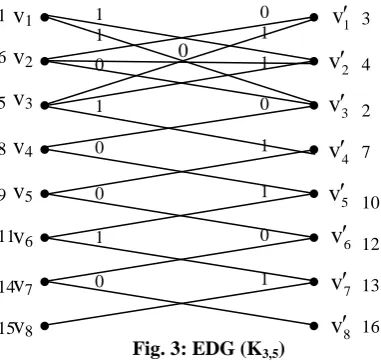
Illustration: 3 PrimeCordial labeling for the graph EDG (K3,5)
PRIME CORDIAL LABELING FOR THE EXTENDED DUPLICATE GRAPH OF KITE GRAPH
Fig. 3:EDG (K3,5)
3.2 Signed product Cordial labeling
In this section, we present an algorithm and prove the existence of signed product cordial labeling for the extended duplicate graph of kite graph K3,m , m ≥ 1.
Algorithm: 3.2: procedure (signedproductcordial labeling for EDG (K3,m, m ≥ 1)
V ← {v1, v2, … , vm+3 ,
v v
1′ ′
,
2,...,
v
m′
+3}E ← {e1, e2, …., em+4,
e e
1′ ′
,
2,...,
e
m′
+3}if m = 4n-3
for i = 0 to (m-1)/4 do
j = 0 to 1 do v1+4i+j ← -1
v3+4i+j ← 1
v’1+4i+j ← 1
v’3+4i+j ← -1 end for
else if m = 4n-2
for i=0 to (m+2)/4 do v1+4i ← -1
v’1+4i ← 1
end for
for i = 0 to (m-2)/4 do
j = 0 to 1 do v2+4i ← -1
v3+4i+j ← 1
v’2+4i ← 1
v’3+4i+j ← -1 end for
•
•
•
•
•
•
•
•
•
•
•
•
•
•
•
•
v
1v
2v
3v
4v
5v
6v
7v
81
v
′
2
v
′
3
v
′
4
v
′
5
v
′
6
v
′
7
v
′
8
v
′
1 6
5
8
9 11
14 15
3
4
2 7
10 12 13 16 1
1 0 1 0
0
1
0
0 1 1 0 1
1 0
1
© 2016, IJMA. All Rights Reserved 36
if m = 4n-1
for i = 0 to (m+1)/4 do
j = 0 to 1 do
v1+4i+j ← -1
v’1+4i+j ← 1 end for
for i = 0 to (m-3)/4 do
j = 0 to 1 do
v3+4i+j ← 1
v’3+4i+j ← -1 end for
else
if m = 4n
for i = 0 to m/4 do
j = 0 to 1 do v1+4i+j ← -1
v3+4i ← 1
v’1+4i+j ← 1
v’3+4i ← -1
end for
for i=0 to (m-4)/4 do v4+4i ← 1
v’4+4i ← -1
end for
end if
end procedure
Theorem 3.2: The extended duplicate graph of kite graphK3,m, m ≥ 1 is Signed product cordial labeling.
Proof: Let K3,m, m ≥ 1 be a kite graph. In order to label the vertices, define a function f: V → {-1, 1} as given in
algorithm 3.2.
Case-(i): If m = 4n-3; n ∈ N, for 0 ≤ i ≤ (m-1)/4 and 0 ≤ j ≤ 1, the vertices v1+4i+j and v’3+4i+j receive label ‘-1’; the
vertices v3+4i+j and v’1+4i+j receive label ‘1’. Hence all the 2m+6 vertices namely the vertices v1, v2, v5, v6,……, vm,
vm+1 receive label ‘-1’; the vertices v3, v4, v7, v8,…… ,vm+2, vm+3 receive label ‘1’; the vertices v’1, v’2, v’5, v’6,… ,v’m,
v’m+1 receive label 1; the vertices v’3, v’4, v’7, v’8,…, v’m+2 , v’m+3 receive label ‘-1’.
Case-(ii): If m = 4n-2 ; n ∈ N, for 0 ≤ i ≤ (m+2)/4, the vertices v1+4i receive label ‘-1’ and the vertices v’1+4i receive
label ‘1’; for 0 ≤ i ≤ (m-2)/4 and 0 ≤ j ≤ 1, the vertices v2+4i and v’3+4i+j receive label ‘-1’ ; the vertices v3+4i+j and
v’2+4i receive label ‘1’. Hence all the 2m+6 vertices namely the vertices v1, v2, v5, v6, v9……,vm-1 , vm , vm+3 receive
label ‘-1’; the vertices v3, v4, v7, v8, …… , vm+1 , vm+2 receive label ‘1’; the vertices v’1, v’2, v’5, v’6, v’9 ……, v’m-1,
v’m, v’m+3 receive label 1; the vertices v’3, v’4, v’7, v’8,……,v’m+1 , v’m+2 receive label ‘-1’.
Case-(iii): If m = 4n-1 ; n ∈ N, for 0 ≤ i ≤ (m+1)/4 and 0 ≤ j ≤ 1, the vertices v1+4i+j receive label ‘-1’ and the
vertices v’1+4i+j receive label ‘1’; for 0 ≤ i ≤ (m-3)/4 and 0 ≤ j ≤ 1, the vertices v3+4i+j receive label ‘1’ and the
vertices v’3+4i+j receive label ‘-1’. Hence all the 2m+6 vertices namely the vertices v1, v2, v5, v6,…… , vm+2 , vm+3
receive label ‘-1’; the vertices v3, v4, v7, v8,…… ,vm , vm+1 receive label‘1’; the vertices v’1, v’2, v’5, v’6,…… ,v’m+2,
v’m+3 receive label 1 ; the vertices v’3, v’4, v’7, v’8,……,v’m , v’m+1 receive label ‘-1’.
Case-(iv): If m = 4n ; n ∈ N, for 0 ≤ i ≤ m/4 and 0 ≤ j ≤ 1 , the vertices v1+4i+j and v’3+4i receive label ‘-1’ ; the
vertices v3+4i and v’1+4i+j receive label ‘1’. Hence all the 2m+6 vertices namely the vertices v1, v2, v5, v6,……, vm+1 ,
vm+2 receive label ‘-1’; the vertices v3, v4, v7,…. ,vm-1 , vm , vm+3 receive label ‘1’; the vertices v’1, v’2, v’5, v’6, …….
,v’m+1 , v’m+2 receive label 1; the vertices v’3, v’4, v’7,… ,v’m-1 ,v’m ,v’m+3 receive label ‘-1’.
Thus in all the cases, the entire 2m+6 vertices are labeled in such a way that the number of vertices labeled -1 and 1 differ by at most one, which satisfies the required condition.
The induced function f *: E → {-1, 1} is defined as
The induced function yields the label ‘-1’ for the edges e1, e’1 and em+4; label ‘1’ for the edges e2 and e’2; label
‘1’for the edges e2i+1 and e’2i+1 if 1 ≤ i ≤ (m+1)/2, ‘m’ is odd and if 1 ≤ i ≤ (m+2)/2, ‘m ‘ is even; label ‘-1’ for
the edges e2i+2 and e’2i+2 if 1 ≤ i ≤ (m+1)/2, ‘m’ is odd and if 1 ≤ i ≤ m/2, ‘m’ is even.
Thus the entire 2m+7 edges are labeled namely when ‘m’ is odd, m+3 edges e2, e3, e5, e7, e9, …,em+2, e
’
2, e
’
3, e
’
5, e
’
7,
e’9’ …,e’m+2 receive label ‘1’ and m+4 edges e1, e4, e6, e8, …,em+3, e’1, e’4, e’6, e’8, …,e’m+3 and the edge em+4 receive
label ‘-1’ and when ‘m’ is even, m+4 edges e2, e3, e5, e7, e9, …,em+3, e’2, e’3, e’5, e’7, e’9, …,e’m+3 receive label ‘1’ and
m+3 edges e1, e4, e6, e8, …,em+2, e’1, e’4, e’6, e’8, …,e’m+2 and the edge em+4 receive label ‘-1’ which differ by atmost
one and satisfies the required condition.
Hence the extended duplicate graph of kite graphK3, m, m ≥ 1 is signed product cordial labeling.
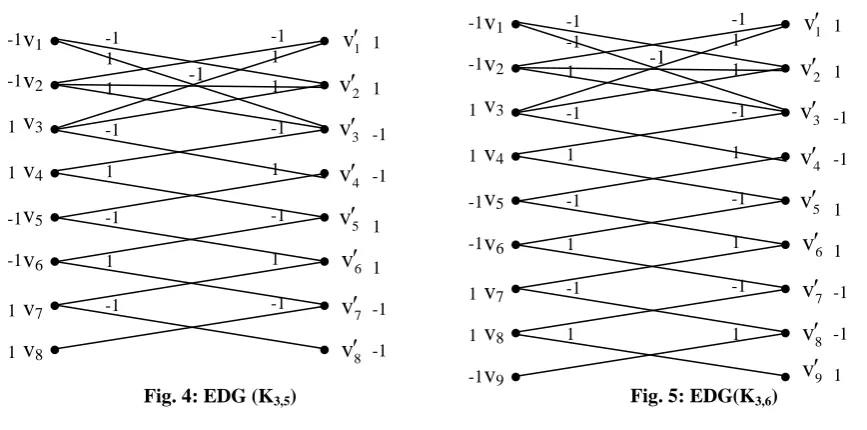
Illustration: 4 Signed product cordial labeling for the graphs EDG (K3,5) and EDG(K3,6)
SIGNED PRODUCT CORDIAL LABELING FOR THE EXTENDED DUPLICATE GRAPH OF KITE GRAPH
Fig. 4:EDG (K3,5) Fig. 5: EDG(K3,6)
4. CONCLUSION
In this paper, we presented algorithms and prove that the extended duplicate graph of kite graph K3,m, m ≥ 1 is prime
cordial and signed product cordial labeling.
5. REFERENCES
1. Gallian J.A, “A Dynamic Survey of graph labeling”, the Electronic Journal of combinatories, 19, # DS6
(2014).
2. Rosa A, On certain Valuations of the vertices of a graph, Theory of graphs (Internat).
Symposium, Rome, July 1966), Gordon and Breech, N.Y. and Dunod paris, 1967.pp. 349- 55.
3. E.Sampath kumar, “On duplicate graphs”, Journal of the Indian Math. Soc. 37 (1973), 285 – 293.
4. M. Sundaram, R.Ponraj and S.Somasundaram, Prime cordial labeling of graphs, J. Indian Acad. Math., 27(2)
(2005) 373-390.
5. J.BaskarBabujee, L.Shobana, “On Signed Product Cordial Labeling”, Applied Mathematics, 2011, 2, 1525 –
1530.
6. Thirusangu, K, Ulaganathan P.P and Selvam B. Cordial labeling in duplicate graphs, Int.J. Computer Math.
Sci. Appl. Vol. 4, Nos. (1-2) (2010) 179-186.
7. Thirusangu,K, Selvam B. and Ulaganathan P.P, Cordial labeling in extended duplicate twig graphs ,
International Journal of computer, mathematical sciences and applications, Vol.4, Nos 3-4, (2010), pp.319-328.
Source of support: Nil, Conflict of interest: None Declared
[Copy right © 2016. This is an Open Access article distributed under the terms of the International Journal of Mathematical Archive (IJMA), which permits unrestricted use, distribution, and reproduction in any medium, provided the original work is properly cited.]