August 2004
BORDER SECURITY
Consular
Identification Cards
Accepted within
United States, but
Consistent Federal
Guidance Needed
www.gao.gov/cgi-bin/getrpt?GAO-04-881. To view the full product, including the scope Several state and local government agencies and financial institutions accept consular identification (CID) cards, which are issued by foreign governments to their citizens living abroad. Mexico issued more than 2.2 million CID cards in 2002-2003 and Guatemala issued approximately 89,000 from mid-2002 to 2003. Critics of CID cards say their acceptance facilitates the unlawful stay within the United States of undocumented aliens and may provide opportunities for terrorists to remain undetected in this country.
GAO examined (1) the purpose of a CID card and how Mexican and Guatemalan CID cards are being used in the United States, (2) steps Mexico and Guatemala have taken to verify the identities of CID card applicants and incorporate security features in CID cards now used in the United States, and (3) the positions and policies of federal agencies regarding CID cards.
GAO recommends that the Homeland Security Council direct its task force to issue consistent guidance that would enable state and local
governments and other institutions to assess the authenticity of foreign-issued CID cards. The Homeland Security Council declined to comment on this report. The Department of Homeland Security generally agreed with the report but offered some suggestions for clarifying the administration’s position and practice.
Consular identification cards are issued by some governments to help identify their citizens living in a foreign country. The cards do not certify legal residence within a country; thus, cardholders may be either legal or undocumented aliens. CID cards benefit the bearers by enabling them, in some instances, to use this form of identification to obtain driver’s licenses, open bank accounts, show proof of identity to police, and gain access to other services.
Mexico and Guatemala each take multiple steps to help ensure that the process for qualifying applicants seeking to obtain CID cards verifies the applicants’ identities. After receiving criticism about the reliability of its CID card, Mexico took steps to improve identity verification procedures for its CID card issuance process. However, the Mexican issuance policy still relies on visual, rather than computer-based, verification of some documents used to obtain CID cards, including birth certificates that the Federal Bureau of Investigation (FBI) says may be fraudulently obtained. Both Mexico and Guatemala incorporate a variety of security features in their CID cards, such as holographic imagery. However, officials of the Department of Homeland Security’s (DHS) Bureau of Immigration and Customs Enforcement warn that incorporating technical security features into identification documents such as CID cards does not guarantee their authenticity.
Federal agencies hold different and, in some cases, conflicting views on the usage and acceptance of CID cards, and no executive branch guidance is yet available. A Homeland Security Council task force of executive branch agencies is reviewing identification document security but had not issued its findings at the time of GAO’s review. The Department of the Treasury adopted a regulation in 2003 that, in effect, allows CID card acceptance, while an FBI official has stated that the Mexican CID card, in particular, is not a reliable form of identification and that its acceptance could support false identities. DHS expressed security concerns as well. The State Department has publicly expressed concerns about the impact restricting CID card use might have on U.S. citizens abroad, for example, if the United States had to issue its own CID cards in an emergency.
Letter
1Results in Brief 3
Background 5 CID Cards Are Issued to Help Identify the Citizenship of Persons
Residing in a Foreign Country, and Some Institutions Accept
Mexican and Guatemalan CID Cards as Valid Identification 6
Identity Verification Procedures and Security Features Vary, and
Some CID Cards May Not Ensure Cardholder’s Identity 10
No Consistent Federal Guidance for CID Card Usage or
Acceptance Exists 20
Conclusion 23
Recommendation for Executive Action 23
Agency Comments and Our Evaluation 24
Appendix I
Objectives, Scope, and Methodology
26Appendix II
Status of Legislation Being Considered in the
European Union Related to Establishing Standards
for Secure Identification Documents
28Appendix III
References to Passports and to Consular Identification
Documents in Federal Statutes and Statutes of
Selected States
30References to Passports in Federal Statutes 30
References to Passports in Statutes of Selected States 37
Appendix IV
Comments from the Department of Homeland
Security
49GAO Contact 51
Staff Acknowledgments 51
Appendix V
GAO Contact and Staff Acknowledgments
51Tables
Table 1: Types of Required Documentation for Obtaining a Mexican
Table 2: Mexican and Guatemalan CID Card Security Features 18
Figures
Figure 1: Mexican CID Card Issuance Process, as of January 2004 13
Figure 2: The Guatemalan CID Card Issuance Process 15
Figure 3: Sample of Laminated Mexican CID card 16
Figure 4: Sample of High-Security Mexican CID Card 17
Figure 5: Sample Guatemalan CID Card 19
Abbreviations
AAMVA American Association of Motor Vehicle Administration CID consular identification card
DHS Department of Homeland Security
DMV Division of Motor Vehicles (North Carolina)
EU European Union
FBI Federal Bureau of Investigation
ICAO International Civil Aviation Organization
ICE Immigration and Customs Enforcement
IFE Federal Electoral Institute (Mexico) ITIN individual taxpayer identification number
NILC National Immigration Law Center
SSN Social Security number
US-VISIT United States Visitor and Immigrant Status Indicator Technology
VCCR Vienna Convention on Consular Relations
VWP Visa Waiver Program
This is a work of the U.S. government and is not subject to copyright protection in the United States. It may be reproduced and distributed in its entirety without further permission from GAO. However, because this work may contain copyrighted images or other material, permission from the copyright holder may be necessary if you wish to reproduce this material separately.
August 24, 2004
The Honorable F. James Sensenbrenner, Jr. Chairman
Committee on the Judiciary House of Representatives
The Honorable John N. Hostettler Chairman
Subcommittee on Immigration, Border Security, and Claims, Committee on the Judiciary
House of Representatives
In recent years, a number of state and local government agencies and financial institutions have begun accepting consular identification (CID) cards issued by certain foreign governments as a service to their citizens who, regardless of legal residence status, live in the United States. For example, Mexico issued more than 2.2 million cards from 2002 through 2003, and Guatemala issued about 89,000 CIDs from August 2002 through December 2003. Argentina has begun a program in Los Angeles to issue CID cards with new security features to its citizens, while other countries, including Peru and Bolivia, are considering issuing CID cards of their own. Critics of CID cards have argued that acceptance of these cards facilitates and promotes the continued unlawful stay within the country of
undocumented aliens. Since the terrorist attacks in 2001, some federal officials have also voiced concerns that the continued acceptance of CID cards provides opportunities to terrorists to remain undetected in the country and to transfer funds that support terrorist activities.
Our review of CID cards addresses the following issues: (1) What is the purpose of a CID card and how are Mexican and Guatemalan CID cards, in particular, being used in the United States? (2) What steps have Mexico and Guatemala taken to verify the identities of CID card applicants and to incorporate security features in CID cards now being used in the United States? (3) What are the positions and policies of key federal agencies regarding the usage and acceptance of CID cards in the United States? In addition, we reviewed other aspects of domestic and international CID card usage and related security issues, including (1) the status of new legislation under consideration by European Union members to establish standards for other types of secure identification documents and
(2) federal and state laws in selected states that refer to passports or CID cards. This information is contained in appendixes II and III, respectively. To determine the purpose of CID cards and how Mexican and Guatemalan CID cards are being used in the United States, we reviewed provisions of the Vienna Convention on Consular Relations (VCCR), which, among other things, governs consular services. We contacted the embassies of eight countries (Bolivia, El Salvador, Guatemala, Honduras, Mexico, Nicaragua, Peru, and Poland) to learn their plans for issuing CID cards, which enabled us to determine that of these countries only Mexico and Guatemala were issuing CID cards in the United States.1
We selected the countries listed because they were cited by federal, state, or local officials as countries that were considering or planning to issue CID cards or currently issuing CID cards in the United States. We interviewed officials in the Mexican and Guatemalan embassies, selected police departments, and selected elected officials to obtain their views on CID card acceptance and reviewed the positions of U.S.-based financial institutions and nonprofit advocacy and research organizations.
To determine steps Mexico and Guatemala have taken to verify the identities of CID card applicants and to incorporate security features in CID cards, we interviewed officials from the Mexican and Guatemalan embassies and consulates, analyzed related documentation, observed the Mexican consulate’s issuance of CID cards at an offsite facility, and interviewed the representatives of the company that manufactures the Guatemalan CID card. We did not perform an evaluation of the Mexican and Guatemalan CID card programs or security features.
To determine the positions and policies of key federal agencies regarding the usage and acceptance of CID cards, we interviewed officials from the Departments of the Treasury, Homeland Security (DHS), Justice, and State, and reviewed congressional testimony by the latter three agencies. We also reviewed regulations proposed and adopted by the Department of the Treasury. We conducted our review from July 2003 to June 2004 in accordance with generally accepted government auditing standards. A more detailed description of our scope and methodology is contained in appendix I.
1
We subsequently learned that Argentina has begun to issue CID cards with new security features in the United States. We did not include Argentina’s CID card program in our review.
CID cards are issued by some governments to help identify their citizens residing in a foreign country. Possession of a CID card does not certify legal residence within a country; thus, cardholders may be either legal or undocumented aliens. CID cardholders in the United States may derive benefits from the cards’ acceptance for identification purposes by financial institutions, law enforcement agencies, and state and local governments in the United States. For example, there are banks that have begun accepting CID cards for opening bank accounts, some law
enforcement agencies encourage their use for identification purposes, and some local governments accept them as identification required to obtain governmental services. In addition, some states accept CID cards as a part of required documentation for obtaining driver’s licenses.
Mexico and Guatemala each take multiple steps to help ensure that the process for qualifying applicants seeking to obtain CID cards verifies the applicants’ identities. After receiving criticism about the reliability of its CID card, Mexico took steps to improve identity verification procedures for its CID card issuance process. Prior to January 2004, Mexican consular officials relied primarily on visual, rather than computer-based,
verification of source documents, such as birth certificates or voter registration cards, submitted by CID card applicants. These documents were not compared against other sources to verify their authenticity or reliability when consular officials believed them to be authentic. Beginning in 2004, Mexican consulates can, in some instances, employ electronic verification of a CID card applicant’s identity. However, the Mexican issuance policy still relies on visual examination for some documents that are accepted in its issuance process. Guatemala’s CID issuance process is based on the country’s passport database, which includes fingerprint verification capability. The process has not been changed since it was established in 2002. Both Mexico and Guatemala incorporate a variety of security features, such as holographic images, in their CID cards.
However, officials of DHS’s Bureau of Immigration and Customs Enforcement warn that incorporating technical security features in identification documents does not guarantee their authenticity and that knowledgeable inspectors are essential for verifying documents such as CID cards.
The federal agencies we contacted hold different and, in some cases, conflicting views on the usage and acceptance of CID cards, and no executive branch guidance is yet available. A Homeland Security Council task force of executive branch agencies is examining identification document security issues including CID cards, but it had not issued its findings at the time of our review or set a date for their release. The
Results in Brief
Department of the Treasury adopted a regulation in 2003 pursuant to the USA PATRIOT Act2
(P.L. 107-56) that, in effect, allows banks to decide whether or not to accept CID cards as identification for the purposes of opening an account or making other transactions. On the other hand, a senior Federal Bureau of Investigation (FBI) official, within the
Department of Justice, has stated that the Mexican CID card is not a reliable form of identification and that its acceptance could support false identities, while a senior DHS official has also expressed security
concerns. A senior official of the State Department has publicly expressed concerns about the impact restricting CID card usage here might have on U.S. citizens abroad.
Without consistent information on the advisability of accepting CID cards, states and local governments must make their own decisions on whether to accept them, which may create uncertainty on the part of aliens
attempting to obtain services with the card, and heighten the risk of these cards being used to establish false identities. We are, therefore,
recommending to the Homeland Security Council that it direct its task force to develop and implement consistent guidance that would reconcile potential conflicts among federal agencies and complete their efforts to develop policy to enable state and local governments, financial
institutions, and others to assess the authenticity of CID cards issued by foreign governments.
We provided a draft of this report for comment to the Homeland Security Council, the Departments of State, Justice, Treasury, and Homeland Security. The Homeland Security Council, State, Justice and Treasury declined to comment on the report. DHS generally agreed with the report and the need for developing appropriate standards for identity documents and commended us for recognizing the critical security aspects of CID cards. DHS said that CID cards should not be considered of greater concern than other identity documents used in the United States and that the administration has taken a clear position that CID cards do not establish or indicate lawful U.S. immigration status. We agree with both points. DHS officials provided us with additional information on their efforts to enforce border security and verify the identity of travelers to the United States. DHS also encouraged us to provide greater context for the
2
Uniting and Strengthening America by Providing Appropriate Tools Required to Intercept and Obstruct Terrorism (USA PATRIOT) Act. The act was adopted to deter and punish terrorist acts in the United States and around the world and for other purposes.
customary and historical use of CID cards. We believe the report
sufficiently addresses this issue in its discussion of the legal basis for CID card issuance under international treaty, the history of CID card usage, as well as the accepted and legitimate uses of CID cards.
The VCCR is an agreement that governs consular relations among approximately 165 nations. Under the VCCR, countries can conduct various consular functions, such as issuing travel documents and
passports to their citizens. Consular registration—the practice by which an individual may register with his or her consulate in a foreign country— may assist consular officials in performing a variety of consular services, such as locating missing citizens and determining whether citizens are safe. According to the Department of State, issuance of CID cards falls within the general scope of permissible consular functions.
For more than 133 years, the government of Mexico has been issuing a CID card, the Matrícula Consular to citizens living abroad. 3
As of June 2004, the CID cards are issued in the United States at 45 consulate office locations in 20 states and Washington, D.C. Consulate offices may occasionally issue these cards at offsite locations, such as community centers, throughout their jurisdiction. The government of Guatemala began issuing its version of a CID card, called the Tarjeta de
Identificación Consular Guatemalteca, in the United States in August 2002.4
Guatemala maintains 8 consulate offices in 6 states and Washington, D.C., and also occasionally issues CID cards at offsite locations within the geographic area covered by the local consulate.
In October 2003, Argentina began a program to make CID cards with new security features available to its citizens in the Los Angeles, California, metropolitan area. As of May 2004, Argentina had issued approximately 2,400 cards. Several other countries have expressed interest in issuing their own identification cards to their citizens living in the United States but as of late 2003 had not yet done so. These countries include Bolivia, Peru, and El Salvador; Peru has specifically cited the acceptance of the
3
We refer to the Mexican Matrícula Consular as the Mexican CID card throughout this report.
4
We refer to the Tarjeta de Identificación Consular Guatemalteca as the Guatemalan CID card throughout this report.
Mexican CID card in the United States as a factor contributing to its interest in issuing a CID card.
CID cards are issued to help identify the citizenship of persons residing in a foreign country. While some consulates may issue CID cards, these documents have no bearing on the cardholder’s legal residence status in the host country. Thus, CID cardholders can be either undocumented aliens living in the United States or legal residents. Under the terms of the VCCR, these cardholders, regardless of their residency status, possess certain legal rights. For example, U.S. law enforcement officials and others must advise a resident alien who is arrested or otherwise detained in the United States of his or her right to request that the appropriate consular officials be notified of the detention without delay. Cardholders can, in turn, alert federal, state, and municipal law enforcement authorities of the need to notify consular officials when assistance is needed.
Austin, Texas, was one of the first areas in the country where a financial institution accepted the Mexican CID card as valid identification for opening a bank account, according to Mexican embassy representatives. An official with the Austin Police Department told us that in 2000 the department became concerned about the rate of robberies committed against the Hispanic immigrant community. Members of this community, which, according to the official, includes a large number of undocumented aliens, may not report crimes to the police for fear of deportation. After meeting with representatives of the Hispanic community and the Mexican
CID Cards Are Issued
to Help Identify the
Citizenship of Persons
Residing in a Foreign
Country, and Some
Institutions Accept
Mexican and
Guatemalan CID
Cards as Valid
Identification
Countries May Issue CID
Cards to Facilitate
Consular Notification
Some Banks, Law
Enforcement Agencies,
and Local Governments
Accept Mexican and
Guatemalan CID Cards as
Identification
consulate, the police department determined that robberies could be reduced if community members made greater use of the U.S. banking system rather than keeping large amounts of cash at home or on their person. In November 2000, the Austin Police Department began contacting area banks to determine if they would accept the Mexican CID card as identification for opening bank accounts. According to this police department official, one bank operating in Austin agreed to accept the card as valid identification in early 2001.
The Mexican embassy has reported that 160 financial institutions nationwide now accept the Mexican CID card as proof of identity for opening bank accounts. An official in the Guatemalan embassy told us that that some banks are accepting the Guatemalan CID card as well. Some reasons for financial institution acceptance of the Mexican CID, in particular, were recently stated by a state banking association. The association believes that bank acceptance of CID cards can aid law enforcement, not only for assisting immigrants who may be targeted by criminals because of their tendency to possess cash, but also for possibly combating money–laundering and terrorism. Banks, the association said, are subject to numerous layers of federal and state regulation and
oversight that can assist federal officials in monitoring international money transmissions. Also, banks accept the Mexican CID in order to better serve members of the immigrant community without bank accounts, often referred to as the “unbanked.” The association said that serving the unbanked provides a new source for deposits, loans, and wire transfers, which benefit the economy at large.
In addition, a Treasury official said that there are no laws prohibiting undocumented aliens from opening bank accounts in the United States and that banks are not required to determine whether their customers are present in the United States legally. The official also said that for purposes of fraud or money-laundering detection, the department would prefer to have as many people as possible active in the U.S. banking system, because their financial activities could be closely monitored.
Subsequent to the acceptance of the Mexican CID card by the bank in Austin, the Austin Police Department itself decided to recognize the card as a valid form of identification. In addition, the city of Austin also began accepting the card to help Mexican citizens living in the community gain access to community courts and obtain other documents, such as library cards and copies of locally maintained medical records. A representative of the Dallas, Texas, Police Department told us that the department began accepting the CID cards primarily as a means to allow officers to properly
identify all people that they came in contact with who may lack other forms of identification. According to the Mexican embassy, as of February 2004, 1,159 U.S. police departments nationwide accept the Mexican CID card as a valid identity document.
In December 2001, the Mayor of San Francisco signed a policy establishing the Mexican CID as valid identification in the city and county of San Francisco; this policy included the police and sheriff’s departments. The San Francisco Office of the Mayor, in a press release, declared that this acceptance would help members of the Mexican immigrant community, who may otherwise be jailed or deported for minor offenses if they do not possess an accepted form of identification. Use of the CID card as a recognized form of identification would, in turn, help reduce police processing time spent handling these offenses. The release also cited a benefit expressed by the Austin police, that extending official acceptance to the CID card might allow immigrants to be less fearful in reporting crimes to police, since they would now possess acceptable identification. Some cities and counties have begun accepting the Mexican CID card as valid identification for obtaining city or county services. The Mexican embassy states that 363 cities and 153 counties recognize its CID card as of February 2004. An official of one county housing and community affairs department testified before Congress that county government must
provide for public safety and health, education, and other basic services, and that accepting these CID cards helps to identify the people who need these services. Because CID cards contain a local address, the official testified, the county can determine whether applicants for services are residents of the county.
In August 2003, according to the National Immigration Law Center (NILC), 13 states accepted the Mexican CID as one form of valid ID in issuing driver’s licenses.5
Representatives of immigrant advocacy groups we contacted and whose positions we reviewed have argued that accepting CID cards for driver’s licenses helps states maximize the number of licensed and potentially insured drivers on their highways.
5
Idaho, Indiana, Michigan, Nebraska, New Mexico, North Carolina, Oregon, South Dakota, Tennessee, Texas, Utah, Washington, and Wisconsin were the states listed by NILC.
Some States Accept the
Mexican CID Card as Valid
Identification for Driver’s
License Issuance
However, we found that at least 2 states have recently rescinded their prior acceptance of CID cards in issuing driver’s licenses. For example, North Carolina (1 of the 13 states mentioned above) decided that, effective February 2004, it would no longer accept foreign-issued documents
(except passports) as proof of identity for driver’s license issuance.6
In discussing this decision, an official with the North Carolina Division of Motor Vehicles (DMV) stated that the DMV had heard concerns through the American Association of Motor Vehicle Administrators (AAMVA) that the FBI and DHS did not support public acceptance of the Mexican CID card. 7
In addition, this official informed us that some state residents had expressed concerns over and opposition to Mexican CID card acceptance to the Office of the Governor and DMV. Among these concerns, some residents felt that CID acceptance might help people not legally present in the United States to circumvent immigration laws. The DMV
Commissioner made an administrative decision that, beginning in
February 2004, the DMV would only accept documents issued by state or federal governments, or federally validated international passports, as proof of identification when issuing driver’s license or state ID cards. In addition, in December 2003, the Governor of California approved a bill that repealed the provisions of a law passed in September 2003 that would have allowed driver’s license applicants to submit a Mexican CID card as proof of identity. In September 2003, a bill passed by the California Legislature (S.B.60) and signed into law by the then Governor, provided among other things, that an applicant for a driver’s license could submit an individual taxpayer identification number (ITIN) to the Department of Motor Vehicles in lieu of a Social Security number (SSN). If submitting an ITIN, the applicant must also submit an acceptable birth certificate and one of a number of other identification documents that included the Mexican CID card. These provisions were to take effect on January 1, 2004. However, in December 2003, a new bill passed by the legislature and signed into law by the new Governor repealed S.B.60. Thus, the ITIN and the CID card as an adjunct identification document were both rendered invalid for obtaining a driver’s license in California. In calling for the repeal of S.B.60, the Governor said that the bill might “invite fraud or
6
The North Carolina Division of Motor Vehicles accepts the Mexican CID card as proof of residency.
7
The American Association of Motor Vehicle Administrators is a voluntary, nonprofit, tax-exempt, educational organization. AAMVA represents the state and provincial officials in the United States and Canada who administer and enforce motor vehicle laws.
undermine law enforcement.” He noted that the state Attorney General and California’s Sheriff’s Association had expressed security concerns over the measure. In addition, a bill analysis presented to a State Assembly committee noted that the Internal Revenue Service had informed the state that ITINs were not valid for identification outside of the tax system and that ITIN applicants were not subject to the same document verification standards as SSN applicants.
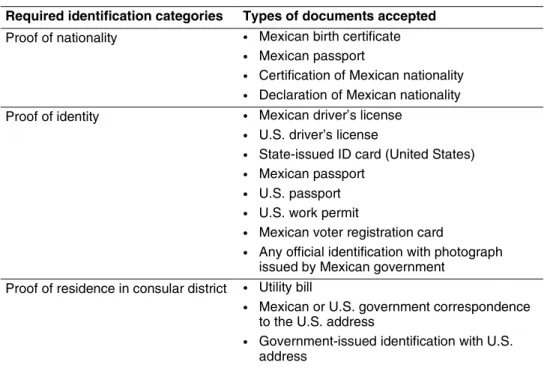
A Mexican citizen residing in the United States who seeks to obtain a Mexican CID card is required to present to the Mexican consular field office, in person, three types of documents: proof of Mexican nationality, proof of identity, and proof of local address (see table 1 for types of required documentation). The consulate office then determines if the documents presented are authentic. Prior to January 2004, nationality, identity, and residency documents were examined—that is, visually inspected—by a consular official. Mexican officials reported that
documents used to obtain CID cards were only verified with authorities in Mexico when the documents’ authenticity was in question. This process raised concerns for the FBI, which stated in congressional testimony in June 2003 that the Mexican CID card was not a reliable form of
identification.8
An FBI agent cited Mexico’s lack of a centralized database to prevent multiple cards being issued to one individual and the inability of consular field offices in the United States to share information about an applicant’s identity through a database. The FBI agent cited the Mexican
8
Hearings before the Subcommittee on Immigration, Border Security, and Claims, House Committee on the Judiciary, June 26, 2003.
Identity Verification
Procedures and
Security Features
Vary, and Some CID
Cards May Not
Ensure Cardholder’s
Identity
Mexico Has Taken Steps to
Improve Identity
Verification Procedures for
Its CID Card Issuance
Process, but Risks Remain
birth certificate, in particular, as a document that could easily be fraudulently obtained and used as proof of identity. In addition, the FBI agent said some Mexican consulates issued CID cards to individuals lacking any proof of identification, as long as they fill out a questionnaire and satisfy the consular official that they are who they claim to be.
Table 1: Types of Required Documentation for Obtaining a Mexican CID Card Required identification categories Types of documents accepted
Proof of nationality • Mexican birth certificate • Mexican passport
• Certification of Mexican nationality
• Declaration of Mexican nationality
Proof of identity • Mexican driver’s license
• U.S. driver’s license
• State-issued ID card (United States)
• Mexican passport • U.S. passport
• U.S. work permit
• Mexican voter registration card
• Any official identification with photograph
issued by Mexican government Proof of residence in consular district • Utility bill
• Mexican or U.S. government correspondence
to the U.S. address
• Government-issued identification with U.S.
address Source: Mexican government.
AAMVA also expressed concerns about the Mexican CID card and its issuance procedures. Specifically, members of AAMVA were concerned about the lack of (1) standardized issuance procedures, (2) uniform security features on all valid CID cards, and (3) access to a secure database to verify documents. In May 2003, AAMVA issued a resolution stating that it was premature to recommend the use of foreign-issued CID cards for identification purposes and that more information was needed to assess the verifiability of the documents.
Mexican consular officials told us they wanted to strengthen the CID card issuance process, in part to provide more assurance to institutions
accepting the card and to federal law enforcement agencies that the cardholder’s identity was valid. As a result, in January 2004, new issuance procedures were implemented (see fig. 1). Mexican consulates can now
search a centralized CID card database containing the records of approximately 2.6 million persons registered with the 45 Mexican consulates in the United States. Mexican passport information is also maintained on this system. In addition, consulates can verify the identity of an applicant who uses a Mexican voter registration card by checking it electronically against a voter registration database in Mexico. A Mexican official in the Dallas consulate office estimated that about 50 percent of applicants seeking Mexican CID cards in the Dallas office use their voter registration cards to prove their identity. As of April 2004, this database held approximately 67 million records—representing about 94 percent of eligible Mexican voters. The new process also checks the applicant’s identity against a Mexican government “stop list”—a database containing records of persons who are not allowed to obtain documents issued by the Mexican government, including fugitives or persons who have tried to use counterfeit documents in Mexico or at consulate offices in the past. A Mexican official estimated that this database contains about 20,000 records. In January and February 2004, Mexican consulate offices issued over 63,000 CID cards under the new issuance process.
Figure 1: Mexican CID Card Issuance Process, as of January 2004
However, despite these new procedures, Mexican consulate officials told us that they still rely primarily on a visual inspection—not database verification—of all applicant documents except the passports and voter registration cards. Thus, there are no safeguards to prevent some
Application request Photograph and signature CID card delivery Document verification Data entry CID card printing Verification of CID duplicates and stop list
database New issuance procedure (January 2004) ●CID card application explains the requirements regarding nationality and identification ● ● Visual document examination Document verification process ●Digital photograph and signature taken for CID card ●Applicant data input to CID databases at consulate office ●CID cards delivered to applicant at consulate office Consular ID card system . . 45 . . Consulates: CID cards verification process Central databases (3) maintained in Mexico
CID card application data input from (45) Mexican consulate offices in the United States IFE (voter registration database) Consular ID database Stop list database
Stop list data base system
Source: Mexican government.
Application data verified: Against central consular ID database Against stop list database Against Federal Electoral Institute (IFE): voter registration database ● ● ● ●
documents, such as birth certificates, from being fraudulently obtained and used as proof of nationality or identity in order to obtain a CID card. According to the FBI, the Mexican birth certificate is a component used in the fraudulent documents trade within the United States and worldwide. The Seattle, Washington, office of DHS’s Immigration and Customs Enforcement (ICE) said that in its experience, there has been an increase in both the number of counterfeit Mexican CID cards and legitimate Mexican CID cards issued with false biographical information. According to agents, almost all of those suspects apprehended with legitimate CID cards containing false biographical data had obtained the cards by getting a counterfeit Mexican birth certificate and using it to get a legitimate CID card from the Mexican consulate in Seattle. They then used this card in applying for a legitimate Washington State driver’s license or identity card. The office said that most of these individuals have done so in order to establish a new identity to conceal a previous arrest or deportation. For example, in November 2003, counterfeit Mexican CID cards were among the evidence seized by ICE agents during an authorized search at two apartments near Seattle. In addition to seizing the CID cards, agents seized a number of finished or partially finished counterfeit documents, including Mexican birth certificates and driver’s licenses; U.S. driver’s licenses from several states; U.S. immigration documents, such as resident alien and permanent resident cards; and U.S. Social Security cards. The agents also confiscated counterfeit document production materials that included computers, CD-ROMs, floppy disks, and many other supplies. As a result of this investigation, four Mexican citizens were arrested. One of the four was deported to Mexico with no criminal charges. Two of the perpetrators pled guilty to violating Section 1546 of Title 18 of the United States Code (Possession, Making, Selling Fraudulent Immigration
Documents) and were sentenced on March 12, 2004, to 17 and 14 months, respectively, in federal prison. The remaining perpetrator pled guilty to violating Section 1325 (a)(2) of Title 8 of the United States Code (Eluding Examination at Entry) and was sentenced on December 19, 2003, to 5 months in federal prison. All three are to be deported following their prison sentences.
According to a DHS agent, the production of these fraudulent ID
documents did not involve highly sophisticated processes or equipment. Rather, the agent said that most of the equipment used could be obtained off the shelf from retail computer supply stores at an estimated cost of under $1,000. The only exceptions to this availability were counterfeit working copies of documents and counterfeit government holographic
seals and stamps. These items were apparently produced elsewhere and shipped to the fraudulent ID document operation.
To obtain a Guatemalan CID card, an applicant must appear in person at a consulate office and present a CID application form and a valid
Guatemalan passport. An official from the Guatemalan embassy told us that the passport requires an applicant to provide, among other
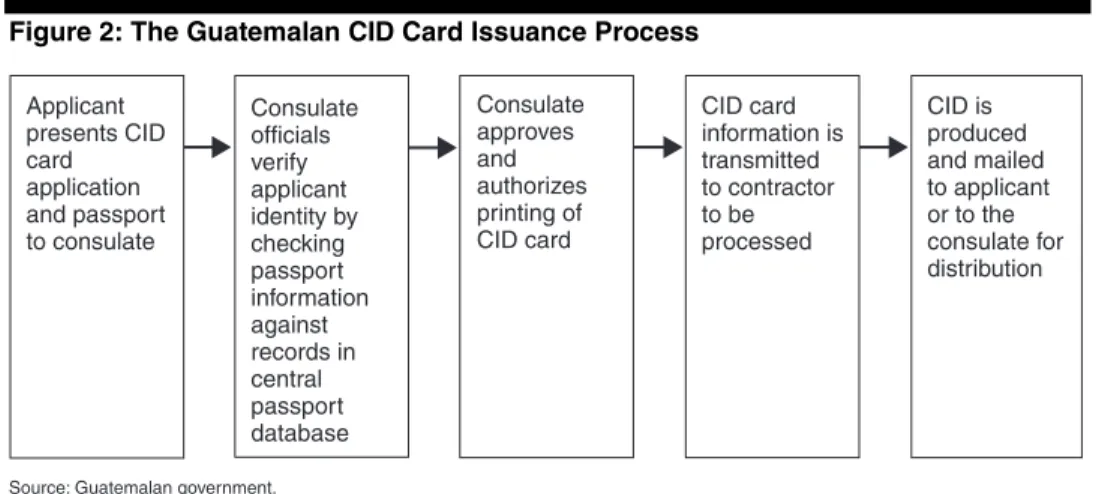
information, two fingerprints and a photograph and signature. During the CID card issuance procedure, an applicant’s passport number and other information are checked against records maintained in Guatemala’s central passport database system. In December 2003, over 1.3 million passport records were maintained in this system. After consular officials verify the applicant’s passport information, including the photograph and signature, by checking it against the central passport database records, the consulate approves the production and issuance of the CID card. Figure 2 illustrates the Guatemalan issuance process. The Guatemalan CID cards are produced centrally at a U.S. contractor’s facility and then mailed to the applicant or distributed to them at the consulate offices.
Figure 2: The Guatemalan CID Card Issuance Process
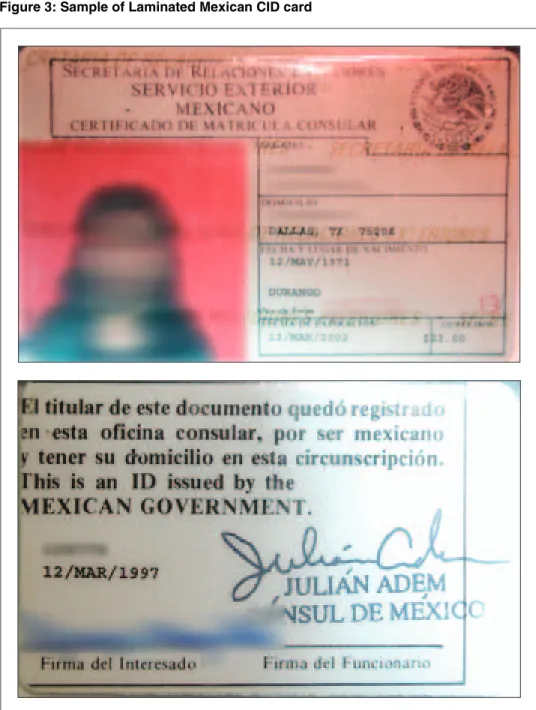
Through December 2003, Mexico issued a laminated CID card that was valid for up to 5 years (See fig. 3.) These cards contained a unique
numerical identifier, a photograph, and the signature of the cardholder. No other document security features were included in these cards. Mexican officials estimate that approximately 1.1 million of these cards were issued between 2001 and 2003, and as of June 2004, about 1 million of these CID cards remain valid and in circulation. As of June 2003, the FBI estimated that this version of the card comprised the majority of Mexican CID cards
Guatemala’s CID Issuance
Process Employs Passport
Data to Verify Identity
Security Features Not
Consistent among Mexican
CID Cards in Circulation
Applicant presents CID card application and passport to consulate Consulate approves and authorizes printing of CID card Consulate officials verify applicant identity by checking passport information against records in central passport database CID card information is transmitted to contractor to be processed CID is produced and mailed to applicant or to the consulate for distribution
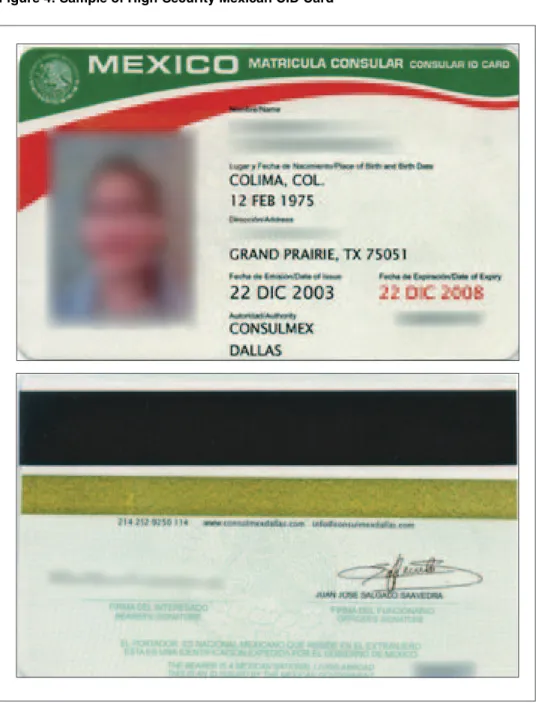
now in circulation. Prior to that assessment, in March 2002, Mexico began phasing in a new CID card that incorporates various technical security features not contained in the older version of the card (See fig. 4.) This newer card is considered by Mexican officials to be a high-security CID card, compared with the low-security CID card issued earlier.
Figure 4: Sample of High-Security Mexican CID Card
The high-security version of the Mexican CID card contains at least eight identifiable security features. (See table 2 for a list of security features.) Among other things, the new cards require a special decoder device in Source: Mexican government.
order to see certain data, such as the cardholder’s name and date of birth, printed on the card. A Mexican official told us that between 2002 and 2003, consulate offices distributed nearly 649,000 of these decoders to U.S. banks, police departments, airlines, and ICE. Mexican officials told us that as of April 2004, about 2 million high-security Mexican CID cards were issued to Mexican citizens in the United States.
Table 2: Mexican and Guatemalan CID Card Security Features
CID card security features Description of security featuresa
Mexican low-security card Mexican high-security card Guatemalan CID card
Unique identification number A unique number assigned to each CID card Yes Yes Yes
Optically variable feature (e.g., hologram, color-shifting inks)
An image or feature whose appearance changes based on the angle of viewing or illumination
No Yes Yes
Ultraviolet image Image emits visible color under exposure to ultraviolet light
No Yes Yes
Encoded information Information requires decoder device to unscramble No Yes No
Machine readable technology (e.g., bar code or magnetic stripe)
A device used to verify the authenticity of the document, the data, or the person presenting the card by use of a reader
No Yes Yes
Microprinting Miniature lettering visible under magnification No Yes Yes
Secure laminate Transparent layers or films with an integrated security feature(s) applied to card with an adhesive or fused by heat
No Yes Yes
Deliberate errors/known flaws An intentional mistake known only to the manufacturer or inspecting officials
No No Yes
Integrated photograph and signature
Photograph and signature are sealed under laminate
Yes Yes Yes
Source: Governments of Mexico and Guatemala.
a
These descriptions were provided by the American Association of Motor Vehicle Administrators and the International Civil Aviation Organization.
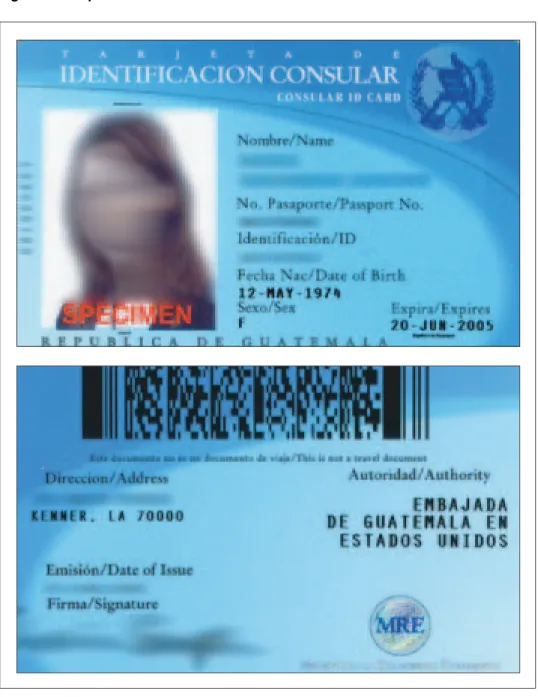
The Guatemalan CID card is produced by a U.S. contractor and has been issued in the United States since August 2002 (see fig. 5). The Guatemalan CID card contains approximately eight distinct security features (see table 2). As of April 2004, about 104,000 Guatemalan CID cards had been issued in the United States.
Figure 5: Sample Guatemalan CID Card
Officials with the Forensic Document Laboratory, a division of ICE that provides forensic assistance to law enforcement agencies, told us that incorporating technologically advanced security features into an
identification document does not guarantee any document’s authenticity.
Much of a document’s level of security, they said, depends upon the knowledge and training of the person examining the document. Thus, if a document examiner, such as a bank official or a police officer, is not familiar with the security features contained in a document, such as microprinting, then the presence—or absence—of those features does not necessarily ensure that the examiner will be able to recognize an authentic document.
Although acceptance of CID cards has grown in the United States over the past few years, a consistent federal policy regarding use and acceptance of foreign-issued CID cards has not been established. The Homeland Security Council is leading a task force of executive branch agencies examining this issue. As of June 2004, it had not issued its findings or set a date for their release. Agencies involved in this task force included the
Departments of Homeland Security, State, Justice, the Treasury,
Transportation, Education, and Health and Human Services and the Office of the Vice President and the General Services Administration.
Participating agency officials told us the task force’s emphasis has shifted from usage and acceptance of CID cards to broader concerns about identification document security in general, with CID cards being one element of concern. The task force has not set a timetable for releasing its recommendations.
Some federal agencies have expressed independent positions on the use of foreign-issued identity documents. For example, Treasury has adopted regulations that allow financial institutions to accept CID cards as valid identification. On October 26, 2001, the USA PATRIOT Act (P.L. 107-56) was adopted. Section 326 of the act required the Secretary of the Treasury to issue regulations requiring financial institutions to implement
procedures for verifying the identities of possible customers, maintaining records for customers’ identities, and consulting government lists of known or suspected terrorists to ensure that customers are not on that list. The act also required the department to issue a report to Congress with recommendations for, among other things, determining the most effective way for financial institutions to require identifying information from foreign nationals. In this report, issued in October 2002, the
department said that its proposed regulations would allow financial institutions to accept any foreign-issued document that provided evidence of nationality or residence and bearing a photograph. A footnote to this
No Consistent Federal
Guidance for CID
Card Usage or
Acceptance Exists
statement specifically declared that the proposed regulations would not discourage acceptance of the Mexican CID card.9
The final rule for implementing the provisions of Section 326 of the USA PATRIOT Act declared, among other things, that banks must implement a customer identification program containing risk-based procedures for verifying the identity of customers to the extent reasonable and practicable.10
While neither endorsing nor prohibiting acceptance of any particular foreign-issued identification, the rule reaffirmed that financial institutions could accept any such documents that they deemed reliable for establishing reasonable belief of a customer’s true identity. Then, on July 1, 2003, the department issued a notice of inquiry related to this rule, seeking additional comments on whether there may be any instance in which a financial institution should not be allowed to accept certain foreign-issued identification documents.11
The department received approximately 24,000 comments on this issue and after reviewing them, determined that no changes to the rule were necessary.12
While Treasury does not prohibit or endorse the acceptance of CID cards, an FBI official testified before Congress in June 2003 that the Mexican CID card is not a reliable form of identification.13
Concerns over the issuance process led the FBI to conclude that the document was unreliable and could pose criminal and even terrorist threats. First, the official testified, the Mexican CID card could be used as a breeder document, that is, a document that would allow access to other forms of legitimate
identification, for establishing a false identity. For example, if a card were fraudulently obtained under a false identity, it could be then used to get a driver’s license in some states. A criminal, according to the FBI, could then establish several false identities that would greatly facilitate such crimes as money laundering or check fraud. Second, CID card unreliability can
9
A Report to Congress in Accordance with Section 326(b) of the USA PATRIOT Act, October 21, 2002.
10
Customer Identification Programs for Banks, Savings Associations, Credit Unions, and Certain Non-Federally Regulated Banks, 68 Fed. Reg. 25090, 25109 (May 9, 2003).
11
Customer Identification Programs for Financial Institutions, 68 Fed. Reg. 39039, 39041 (Notice of Inquiry, July 1, 2003).
12
Customer Identification Programs for Financial Institutions, 68 Fed. Reg. 55335, 55336 (September 25, 2003).
13
Hearings before the Subcommittee on Immigration, Border Security, and Claims, House Committee on the Judiciary, June 26, 2003.
make alien smuggling easier. The FBI official testified that federal officials have arrested alien smugglers with several CID cards in their possession. The FBI has said that these would not only help conceal the smugglers’ identities, but also further entice aliens to entrust their transport to these smugglers.
The FBI has also cited the threat of falsely obtained CID cards being used by terrorists to move about in the United States. The FBI official testified that individuals of various national origins have been discovered in possession of CID cards. If foreign nationals were able to create fictitious identities in the United States, they could move about the country without triggering identification from any name-based terrorist watch lists. The FBI official said that one individual from Iran was arrested in Texas in February 2003 in possession of a Mexican CID card. He obtained the card in California by using a counterfeit Mexican birth certificate and was able to obtain a California State ID card.
In testimony given during the same hearing, an official from DHS’s Border and Transportation Security Directorate said that in light of the increased demand for CID cards and heightened security concerns in a
post-September 11 environment, it also had concerns about the use and
acceptance of CID cards. DHS believed that some individuals had obtained multiple cards under different identities. DHS also echoed the FBI’s
concerns over use of a CID card as a breeder document for obtaining other forms of identification, which in turn may be used for criminal purposes. The State Department has not adopted a policy on foreign-issued
identification documents or CID cards. However, in June 2003, a State Department official testified during the same hearing about the
department’s involvement and interests in any CID card acceptance policy being developed. The official said that any policy developed must consider the impact on the department’s ability to carry out its responsibilities regarding consular affairs, both domestically and abroad. According to the department, under the VCCR, a foreign national arrested or detained in the United States must be advised of his or her right to request that the
appropriate consular officials be notified of the detention without delay. Because a foreign CID may serve to identify an individual as a foreign national, an individual in possession of this card can alert federal, state, and municipal law enforcement authorities of the need to provide consular notification to contact consular officials from his or her nation for
assistance. The State Department views CID cards as a tool that law enforcement officials may use to help facilitate observance of this obligation under the VCCR.
In addition, the State Department believes that any policy developed that prohibits foreign-issued CID card acceptance within the United States could foreclose U.S. options to assist Americans overseas. The State Department may occasionally issue nonpassport identity cards or travel documents to U.S. citizens abroad in times of emergency and under other special circumstances. A State Department official told us that the United States should keep its options open for any future document issuance needs that may arise. This official said that the department has discussed the possibility of issuing special ID cards for U.S. citizens who live near the borders of Mexico or Canada and cross these borders often. It would be difficult to ask these nations to accept such a form of identification if the United States refused to accept CID cards, the official said.
Under international treaty, foreign governments are allowed to issue identification documents to their citizens living in the United States, but federal agencies, state and local governments, and financial institutions must determine the advisability of accepting such documents as a basis for providing services to the document holder. Thus, for all of these
institutions, acceptance of CID cards is discretionary; there is no federal guidance in place to assist state and local governments and others in determining whether a CID card presented for identification purpose is authentic; that is, that it belongs to the individual presenting the document or that it has not been fraudulently obtained.14
Consistent federal guidance could provide state and local governments and other entities with a basis for assessing the authenticity of CID cards, which in turn would assist them in determining whether, for what purpose, and for what duration they should accept these cards. The absence of consistent federal guidance could result in inconsistent acceptance of these cards by such institutions and consequent uncertainty on the part of aliens trying to use the cards to obtain services, as well as a heightened risk that CID cards be used to support false identities.
We are recommending that the Homeland Security Council direct its task force, in consultation with key federal agencies, to complete its efforts to develop policies and implement consistent guidance that would reconcile
14
While, as noted earlier, the Department of the Treasury has issued guidance to financial institutions on accepting foreign-issued documents, it has left the determination of their acceptability to the institutions themselves.
Conclusion
Recommendation for
Executive Action
potential conflicts among federal agencies and enable state and local governments, financial institutions, and others to assess the authenticity of CID cards issued by foreign governments.
We provided a draft of this report to the Homeland Security Council, the Departments of State, Treasury, Justice, and Homeland Security for their review and comment. The Homeland Security Council and the
Departments of State, Treasury, and Justice declined to comment. DHS generally agreed with the report and commended us for recognizing the critical aspects of identity document security. DHS said that
developing appropriate standards for identity documents is a critical next step to reducing security vulnerabilities associated with such documents. DHS also noted that the department does not recognize CID cards as valid travel documents and does not accept them for entry into this country. DHS also said that CID cards should not be considered of greater concern than other identity documents used in the United States and that the administration’s position on CID cards is clear: they are not acceptable as proof of legal presence in the United States. We agree on both points. We focused our review on CID cards and made no judgment on the relative susceptibility to misuse of other identification documents. However, in discussing the results of a DHS investigation, we listed a number of other counterfeit documents that DHS agents had recovered, including driver’s licenses, U.S. immigration documents, and social security cards—all of which could be used to help establish a fraudulent identity.
We also agree that the position of the United States, as well as that of the other nations whose officials we interviewed, is clear and consistent that CID cards issued by foreign countries do not establish or indicate lawful U.S. immigration status. Our report prominently states this position. However, the position of the United States on what constitutes prudent acceptance of CID cards for other than immigration purposes by federal, state, local, and private institutions does not appear to be so clear and consistent. Officials of some federal agencies support the continued acceptance of CID cards for some purposes, while others have expressed serious concerns about the dangers of accepting them. Individual states and local jurisdictions have developed conflicting policies regarding the acceptance of CID cards. As officials of DHS and other agencies told us, the Homeland Security Council has formed a working group to review the status and acceptable uses of CIDs in the United States, but has not yet issued its findings. For this reason, we have recommended that, as part of
Agency Comments
its review, the working group develop consistent guidance to help public and private institutions assess the authenticity of CID cards.
DHS also suggested that we provide greater context for the customary and historical use of CID cards. We believe that our discussion of the legal basis for CID card issuance under international treaty; the history of CID card use, particularly Mexico’s 133-year history of CID card issuance; and the accepted and legitimate uses of CID cards sufficiently addresses this issue. See appendix IV for DHS’s comments.
As agreed with your offices, unless you publicly announce its contents earlier, we plan no further distribution of this report until 30 days after its issue date. At that time, we will send copies of the report to relevant congressional committees and subcommittees, the Secretary of the Treasury, the Secretary of State, the Secretary of Homeland Security, the Attorney General, the White House Office of Homeland Security, and other interested parties. In addition, the report will be available at no charge on GAO’s Web site at http://www.gao.gov.
If you have any questions, please contact me at (202) 512-8777. Key contributors to this report are acknowledged in appendix V.
Laurie E. Ekstrand
Director, Homeland Security and Justice Issues
To determine the purpose of consular identification (CID) cards in the United States, and how Mexican and Guatemalan CID cards are being used in the United States, we reviewed provisions of the Vienna Convention on Consular Relations (VCCR), 1
which, among other things, governs consular services. We contacted the embassies of eight countries (Bolivia, El Salvador, Guatemala, Honduras, Mexico, Nicaragua, Peru, and Poland) to learn their plans for issuing CID cards and determined that Mexico and Guatemala were issuing CID cards in the United States.2
We selected these countries because they were among those cited as currently issuing CID cards in the United States, or considering doing so, by federal, state, or local officials we interviewed, or who testified on the subject at
congressional hearings in June 2003.3
We interviewed Mexican and Guatemalan embassy officials and obtained documents regarding their CID card program. We also interviewed officials from police departments in Austin and Dallas, Texas, and reviewed documents from the city of San Francisco. We contacted officials at the Office of the Mayor in the city of Lake Worth, Florida; the American Bankers Association; the American Association of Motor Vehicle Administrators; the Department of Housing and Community Affairs in Montgomery County, Maryland; and six
independent advocacy and research groups to discuss their views on CID acceptance. 4
Additionally, we reviewed testimony by the Texas Bankers Association before the Texas Legislature regarding their position on financial institutions’ acceptance of CID cards. To identify states that have recently rescinded acceptance of CID cards for driver’s license issuance or other state services, we researched the Lexis Nexis database for state legislation from 2002 through 2003 that has been passed or proposed concerning CID acceptance. From this information, we noted any states that had repealed CID acceptance. We interviewed officials in North Carolina regarding their administrative decision to revoke CID acceptance as proof of identification in driver’s license issuance.
1
Vienna Convention on Consular Relations, Apr. 24, 1963, 21 U.S.T. 77.
2
We subsequently learned that Argentina has begun issuing CID cards with new security features in the United States but did not include Argentina’s CID card program in our review
3
Hearings before the House Committee on the Judiciary, Subcommittee on Immigration, Border Security, and Claims, June 19, 2003, and June 26, 2003.
4
The American Immigration Lawyers Association, the Center for Immigration Studies, Friends of Immigration Law Enforcement, Migration Policy Institute, National Council of La Raza, and the National Immigration Law Center.
To determine steps Mexico and Guatemala have taken to verify the identities of CID card applicants and incorporate security features in CID cards, we interviewed officials from the Mexican and Guatemalan
embassies and consulate offices to obtain information and documentation about their CID card programs. We also observed the Mexican consulate’s issuance of CID cards at an off–site facility. Additionally, we interviewed and obtained documentation related to issuance procedures and security features from the company that manufactures and maintains the
Guatemalan CID card, passport, and consular registry programs. We did not perform an evaluation of the Mexican and Guatemalan CID card programs. We relied exclusively on information and data provided by embassy and consulate officials in describing the issuance systems and card security features utilized in their CID card programs. We also interviewed Department of Homeland Security (DHS) agents responsible for investigating the production of fraudulent identity documents,
including Mexican CID cards, in Lynnwood, Washington. We interviewed officials with DHS’s Forensic Document Laboratory regarding general security standards for identity documents. To determine the positions and policies of federal agencies regarding the usage and acceptance of CID cards, we interviewed officials from the Department of the Treasury, DHS, the Department of Justice, and the Department of State, and reviewed testimony by the latter three agencies. We also reviewed regulations proposed and adopted by Treasury. We also contacted officials of the Homeland Security Council to discuss its examination of foreign-issued CID cards. As of June 2004, the Homeland Security Council had not issued its findings.
We researched European Union (EU) law to determine the status of new legislation being considered by European Union members, regarding standards for secure identification documents. Through electronic searches of EU legislative databases and review of EU publications, we found that EU members proposed regulations for improving document security for visas, residence permits, and EU citizen passports.
Additionally, we reviewed information from the Department of State’s Bureau of Consular Affairs and DHS related to the current status of the U.S. Visa Waiver Program. We conducted our review from July 2003 to June 2004 in accordance with generally accepted government auditing standards.
European Union (EU) members are considering proposals that will require a photograph and fingerprints on visas and residence permits. In
September 2001, EU member states took steps to improve the security of travel visas and residence permits for third-country nationals.1
Two regulations were developed and adopted in 2002, requiring member states to integrate a photograph into travel visas by June 2007 and into residence permits by August 2007. 2
A proposal to modify the visa and residence permit regulations was introduced in September 2003. The new proposal requires (1) moving the dates for integrating photographs into visas and residence permits forward to June and August 2005, respectively, and (2) that biometric identifiers, namely a facial image and two fingerprints, be incorporated into all such documents.
Members also recognized the need to incorporate biometrics into EU citizen passports. In February 2004, a proposal to establish minimum standards for biometrics and other security features was adopted by the Commission of the European Communities and sent to the Council of the European Union and European Parliament. The aim of the proposal was to enhance the security of EU passports and to reliably link the passport to its holder through biometric identifiers. The commission proposed that all passports issued by EU member states contain a facial image and that the inclusion of fingerprints be an option left to the discretion of the member states.
1
A residence permit is an authorization issued by authorities of member states that allow a third-country national to legally stay on its territory. Any person who is not a citizen of the European Union is a third-country national.
2
Council Regulation (EC) No 334/2002, February18, 2002 (amending Regulation (EC) No 1683/95 laying down a uniform format for visas), Council Regulation (EC) No 1030/2002, June 13, 2002, laying down a uniform format for residence permits for third-country nationals.
The proposed integration of biometrics will allow EU passports to also meet the requirements of the Visa Waiver Program (VWP). To comply with these requirements, passports issued by EU member states will need to be machine-readable and comply with biometric standards established by the International Civil Aviation Organization. The VWP deadline for passports to become compliant had been October 26, 2004, but was extended for 1 year by (P.L. 108-299), which was signed into law on August 9, 2004.
As part of our review of consular identification cards, we were asked to identify instances where the terms “passport” and “consular identification document” are used in federal statutes and in the statutes of selected states.
Using electronic databases, we conducted a search of current federal statutes and the statutes of the seven states we selected.1
We found over 70 references to passport in federal statutes and a number of references in statutes of the selected states as well. Most of the statutory references we found are to what is generally considered the traditional meaning of passport—that is a document issued by the competent officer of a national state permitting the person named to travel. A passport is usually a formal document establishing the holder’s identity and citizenship, permitting that person to leave and reenter the state, and requesting protection for him or her abroad. A U.S. passport, for example, requests, in the name of the Secretary of State, that the holder be permitted “safely and freely to pass” and in case of need be given “all lawful aid and protection.”
In addition, we also found statutes that ascribe other meanings to
passport. For example, the U.S. Department of the Interior and the states of Virginia and Indiana initiated passport programs for admission to national and state parks, respectively. Also, California has created a health and education passport system in Los Angeles County, and Indiana has created a medical passport system in that state.
We found no references to matricula or consular identification card in either federal statutes or in the statutes of the selected states. Matricula or consular identification cards are a form of identification for foreign
nationals who are present in the United States. These cards certify the nationality of the cardholder but not his or her legal residency status in the United States.
• 8 U.S.C. § 1101(a)(30)
Passport defined in the Immigration Nationality Act as “any travel document issued by competent authority showing the bearer’s origin, identity, and nationality if any, which is valid for the admission of the bearer into a foreign country.”
1
We chose the states of Arizona, California, Indiana, New York, Virginia, Washington, and Wisconsin in consultation with the requester.
States
References to
Passports in Federal
Statutes
• 8 U.S.C. § 1102
Diplomats required to show passports as a means of documentation and identification necessary to establish their qualifications.
• 8 U.S.C. § 1104(c)
Powers and duties of Secretary of State; establishment of a passport office within the Department of State
• 8 U.S.C. § 1181
Valid unexpired passport may be required for admission of immigrants into the United States, except for refugees. Attorney General has
discretion not to require valid unexpired passport for returning resident immigrants.
• 8 U.S.C. § 1182(a)(7)(A)
Any immigrant who is not in possession of a valid entry document and a valid unexpired passport or other suitable travel document is inadmissible. • 8 U.S.C. § 1185(b)
Travel control of citizens and aliens; citizen generally required to bear valid U.S. passport for departure and entry into United States.
• 8 U.S.C. § 1187(a)(3)
Visa waiver program for certain visitors; valid unexpired machine-readable passport may be required.
• 8 U.S.C. § 1201(f)
Issuance of visas; surrender of documents; alien crewman not in possession of any individual documents other than a passport may be admitted under certain circumstances.
• 8 U.S.C. § 1202(b)
Application for visas; required documentary evidence for immigrant visa may include valid unexpired passport.
• 8 U.S.C. § 1221(c)
Lists of alien and citizen passengers arriving and departing to include passport number and country of issuance of each person listed.