COMPLEX SYSTEMS: AN INNOVATIVE APPROACH TO IMPROVE DRUG-RESISTANT TUBERCULOSIS TREATMENT ADHERENCE
Kei L. Alegria-Flores
A dissertation submitted to the faculty at the University of North Carolina at Chapel Hill in partial fulfillment of the requirements for the degree of Doctor of Philosophy in the Department
of Health Policy and Management in the Gillings School of Global Public Health.
Chapel Hill 2017
Approved by: Bryan J. Weiner
Kristen L. Hassmiller Lich John E. Paul
Annelies Van Rie Christopher A. Wiesen
iii
ABSTRACT
Kei L. Alegria-Flores: Complex systems: An innovative approach to improve drug-resistant tuberculosis treatment adherence
(Under the direction of Bryan J. Weiner)
The burden of multidrug-resistant tuberculosis (MDR-TB) poses a serious challenge to
global TB control and elimination; MDR-TB is far deadlier and more difficult and expensive to
treat than drug-susceptible TB. Among the factors that influence MDR-TB treatment outcomes,
adherence plays a very important role. Missing medication doses could result in poor treatment
outcomes, further transmission of MDR-TB, and further resistance to drugs. The project
investigated the key determinants of MDR-TB treatment adherence and develop specific
recommendations to improve it in Lima, Peru. The project’s main objective was to develop, test,
and apply a model that describes how treatment adherence, and consequently, treatment
outcomes, could be improved.
The specific aims of this dissertation were to 1) estimate the effects of the
information-motivation-behavioral skills model on MDR-TB treatment adherence; 2) develop an integrated
system dynamics (SD) model of the interactions most substantially affecting patient adherence to
treatment over time, and based on a structured review of the literature as well as interviews and
focused group discussions with key stakeholders; and 3) parameterize, calibrate, and test the SD
model built in Aim 2 to simulate the effects of various intervention implementation scenarios on
treatment outcomes. Implementation science and SD approaches were combined to inform the
iv
The analyses showed that adherence is a complex behavior and we need interventions
that are designed to improve the patients’ information, motivation, and behavioral skills with
implementation strategies that are intentionally chosen and measured. Implementation strategies – what, when, how, who – must be evidence-based and have a long-term sustainability plan.
Adherence, and LTFU, should be monitored during treatment, while interventions are finetuned
to fit the context and maximize its impact prior to scaling-up. Though LTFU is an extension of
adherence (LTFU is defined as zero adherence for a month of more), its determinants are not
identical and we should consider interventions accordingly. The application of implementation
science and SD methodology could facilitate and fast-track the process of improving these
strategies, close the gap between knowledge and practice, and inform the allocation of resources
v
vi
ACKNOWLEDGEMENTS
This study was possible thanks to the logistical and technical support from the team at
Innovation for Health and Development, with a special thanks to Dr. Carlton Evans, Dr. Marco
Tovar, Lic. Nataly Becerra, and Lic. Ariana Huamani. Data entry and analysis was completed
with contributions from Ashutosh Mishra. This dissertation would not have been possible
without the approval and participation from the Estrategia Sanitaria Nacional de Prevención y
Control de la Tuberculosis (National TB Program), local TB coordinators, health center
personnel, and the patients who contributed to this study, and the continued guidance and support
from my dissertation committee, Bryan J. Weiner, Kristen L. Hassmiller Lich, John E. Paul,
Annelies Van Rie, and Christopher A. Wiesen. A special thank you to Dr. Morris Weinberger for
his wisdom on academics and life.
Data Research reported in this publication was supported by the Fogarty International
Center of the National Institutes of Health (NIH) under Award Number R25TW009340. The
content is solely the responsibility of the authors and does not necessarily represent the official
vii
TABLE OF CONTENTS
LIST OF TABLES ...x
LIST OF FIGURES ... xi
LIST OF ABBREVIATIONS ... xii
CHAPTER I: INTRODUCTION ...1
Background ...1
Specific aims ...3
Study setting...4
Sample size and power calculations ...5
Institutional review board approvals ...6
Funding ...6
Structure of the dissertation ...7
References ...8
CHAPTER II: AN INNOVATIVE APPROACH TO DESIGN AND EVALUATE DRUG-RESISTANT TUBERCULOSIS TREATMENT ADHERENCE INTERVENTIONS (AIM 1) ...11
Overview ...11
Introduction ...12
Study population and methods ...13
Results ...17
Discussion ...22
Conclusion ...24
References ...25
viii
Overview ...28
Introduction ...29
Methods...30
Results ...37
Discussion ...47
Limitations ...50
Future Directions ...51
Conclusion ...51
References ...52
CHAPTER IV: MERGING SYSTEM DYNAMICS AND IMPLEMENTATION SCIENCE TO IMPROVE PUBLIC HEALTH STRATEGIES(AIM 3) ...55
Overview ...55
Background ...56
Methods...57
Results ...68
Discussion ...72
Conclusion ...76
References ...78
CHAPTER V: CONCLUSION...82
References ...87
APPENDIX A. FIRST MODEL DRAFT ...88
APPENDIX B: LITERATURE REVIEW SEARCH STRATEGIES ...90
APPENDIX C. REFERENCES FOR NUMBERED LINKS IN THE MODEL ...92
APPENDIX D. SECOND MODEL DRAFT ...94
APPENDIX E. FEEDBACK LOOPS BY TREATMENT PHASE ...97
APPENDIX F. RESULTS FOR TESTS UNDER EXTREME VALUE CONDITIONS ...104
APPENDIX G. RESULTS FOR GOAL-SEEKING ANALYSES ...105
APPENDIX H. KEY VARIABLE LIST ...107
ix
APPENDIX J. PROVIDERS QUESTIONNAIRE ...122
APPENDIX K. ADMINISTRATIVE DATA...127
APPENDIX L. SEMI-STRUCTURED INTERVIEW GRUIDE ...130
APPENDIX M. FOCUSED GROUP DISCUSSION GUIDE ...131
x
LIST OF TABLES
Table 2.1 - Description of patient participants...18 Table 2.2 - Description of healthcare service providers and health centers ...19 Table 2.3 - Relative effects on treatment adherence and behavioral skills when
patients’ adherence information, motivation, and provider’s work
engagement are varied ...21 Table 3.1a - Titles screened from the initial PubMed search results for factors
associated with TB ...36 Table 3.1b - Literature review evidence for prioritized links in the system
xi
LIST OF FIGURES
Figure 2.1 - Model of MDR-TB treatment adherence, adapted from the
IMB model by Fisher et al. (2016)...15 Figure 2.2 - Factors predicting MDR-TB treatment adherence with
standardized SEM path coefficients...20 Figure 2.3 - Mediation analyses: Standardized regression coefficients
for the mediated pathways from the model of drug-resistant
tuberculosis treatment adherence ...20 Figure 3.1 - Model building process ...32 Figure 3.2 - Preferred Reporting Items for Systematic Reviews and Meta-
Analyses (PRISMA) diagram for literature review search results
on TB and adherence ...35 Figure 3.3 - Percentage of MDR-TB patients in each phase by month of their treatment ...37 Figure 3.4 - Stock-and-flow diagram of the treatment progress for MDR-TB patients ...38 Figure 3.5 - Selected factors in stock-and-flow, and causal loop diagrams of
the treatment progress for MDR-TB patients ...41 Figure 3.6a - Intensive phase CLD of factors associated with MDR-TB
treatment adherence ...43 Figure 3.6b - Continuation phase CLD of factors associated with MDR-TB
treatment adherence ...45
Figure 3.6c - Maintenance phase CLD of factors associated with MDR-TB
treatment adherence ...47
Figure 4.1 - Patient treatment adherence rate and LTFU by month ...60 Figure 4.2 - System dynamic’s stock-and-flow diagram of the treatment
trajectory for MDR-TB patients...61 Figure 4.3 - MDR-TB treatment outcomes calibrated to data from Peru (2012) ...65 Figure 4.4 - Changes in adherence rates and LTFU daily probability needed in
each phase of treatment to increase treatment completion by 1% and 5% ...69 Figure 4.5 - Six policy scenarios and their effects on treatment outcomes ...70 Figure 4.6 - Policy goal-seeking scenarios Plan X and Plan Z and their effects
xii
LIST OF ABBREVIATIONS
CLD Causal loop diagram
CHW Community health worker
CFI Comparative Fit Index
DOT Directly observed therapy
FGD Focused group discussion
HIV Human immunodeficiency virus
IMB Information-motivation-behavioral skills
INEI National Institute of Statistics and Informatics (abbreviation from its original name in Spanish)
LTFU Lost-to-follow-up
MDR-TB Multidrug-resistant tuberculosis
NIH National Institutes of Health
NTP National tuberculosis program
RMSEA Root mean square error of approximation
STDSIM Sexually transmitted disease stochastic microsimulation models
SEM Structural equation modeling
SD System dynamics
TB Tuberculosis
TB MAC Tuberculosis Modelling and Analysis Consortium
TLI Tucker-Lewis Index
US United States
xiii
WHO World Health Organization
1
CHAPTER I: INTRODUCTION
Background
In 2015, tuberculosis (TB) became the world’s leading infectious disease killer again.1
Peru accounts for 3.2% of the population of the Region of the Americas, but has 13.3% of the
region's TB and 29% of the multidrug-resistant tuberculosis (MDR-TB) cases.2 MDR-TB is
defined as resistance to at least two of the most powerful TB drugs, isoniazid and rifampicin. It is
far deadlier and more difficult and expensive to treat than drug-susceptible TB. It results from
inconsistent or incorrect TB treatments, or from direct person-to-person transmission.3 Directly observed therapy (DOT) –trained individuals observing patients take their medications– has been
widely adopted as a method to deliver treatment.4 DOT was adapted for MDR-TB patients for
the first time in the late 1990s in Peru, with 83% treatment completion, 8% lost-to-follow-up
(LTFU), and 8% death rates.5 Twenty years later, Lima’s MDR-TB treatment outcomes have
worsened: completion rates have dropped to 60% and the rate of LTFU is at an alarming 30%.6
Global statistics are equally shocking. Less than half of the estimated cases of MDR-TB
are diagnosed, and only 70% of the diagnosed cases initiated second-line medication treatment.3
Furthermore, out of all the MDR-TB diagnosed patients in the 2011 cohort, only 48% completed
treatment, 24% were LTFU or did not have a documented outcome, 16% died, and 12% were not
cured despite treatment. Today, we are far from the 83% treatment completion observed in the
1990s study. The majority of the world population lives in urban areas where the risk of TB and
2
as in many other cities around the world, MDR-TB treatment is free and accessible in public
health facilities.8 Several factors beyond cost and accessibility have amplified the gap between knowledge and practice, with devastating consequences for MDR-TB patients.
Among the factors that influence MDR-TB treatment outcomes, adherence plays a very
important role. Missing medication doses could result in poor treatment outcomes, further
transmission of MDR-TB, and further resistance to drugs.9,10,11 Health complications, and
additional treatment days to make up for missed doses, increase the workload for healthcare
service providers and costs for the health system. Adherence is a complex behavior determined
by numerous factors that needs to be repeated daily.12 Unlike other treatment outcomes, the
documentation of daily adherence can be found in patients’ treatment logs. One of the pillars of
DOT was ensuring patients’ daily medication intake for the 18 months of MDR-TB treatment,
and it was globally adopted in the 1990s.4 However, DOT’s advantage over self-administered treatment has no scientific basis.13,14 Moreover, failure in its implementation may have
contributed to the emergence of global drug resistance over the past two decades, which have
resulted in MDR-TB, extremely drug-resistant TB, and totally drug-resistant TB.15
MDR-TB poses a serious challenge to TB control and elimination.16 Nonetheless,
investment in TB diagnostics, drugs, and technologies have not kept up with global needs.
Recent innovations in MDR-TB are minimum, including two new drugs (bedaquiline and
delamanid) and a shorter ‘Bangladesh regimen’.17,18 However, the new regimen is still long (9-12
months), includes the use of the new drugs and older ones at higher doses, has strict eligibility
criteria, and does not exclude injectable drugs.19 With the current levels of investment in research
and development for MDR-TB, it is likely that short, patient-friendly treatment regimens are still
3
strategies that help us replicate the 83% treatment completion and low LTFU and death rates that
were possible 20 years ago.
Specific aims
This dissertation project applied innovative approaches to investigate the key
determinants of MDR-TB treatment adherence and develop specific recommendations to
improve it. Lima was chosen as the setting for this dissertation project due to its high burden of
MDR-TB and because it was the site for the successful study in the 1990s. The project’s
long-term goal was to decrease the global burden of MDR-TB and its objective was to develop, test,
and apply a model that describes how treatment adherence, and consequently, treatment
outcomes, could be improved. The global hypothesis of this dissertation is that how we
implement strategies that target adherence to improve MDR-TB treatment outcomes is the key to
understanding and solving this complex public health problem.
To accomplish this dissertation’s objective and test its global hypothesis, the project was
grounded in theory and the published literature, and system dynamics (SD) methodology was
applied as a tool to test implementation science principles. As will be explained in later chapters,
SD is a modeling technique that uses feedback loops and stock-and-flow diagrams to illustrate
and simulate complex systems.20 Implementation science is an interdisciplinary study of the methods to promote the integration of research findings and evidence into healthcare policy and
practice.21 Three specific aims were designed to improve MDR-TB treatment adherence through
the application of these innovative approaches:
Aim 1: Estimate the effects of the information-motivation-behavioral skills (IMB) model on
4
using structural equation modeling. Structured questionnaires were applied to collect
cross-sectional quantitative and qualitative data between April and December, 2015, in
Lima, Peru.
Aim 2: Develop an integrated SD model of the interactions most substantially affecting patient
adherence to MDR-TB treatment over time. This diagram extends prior attempts to
describe adherence, and was developed based on a structured review of the literature as
well as interviews and focused group discussions (FGDs) with key stakeholders in Lima.
Aim 3: The SD model built in Aim 2 was parameterized, calibrated, and validated to simulate the
effects of various intervention implementation scenarios on MDR-TB treatment
outcomes. Implementation science and SD approaches were combined to inform the
design of implementation strategies that improve treatment outcomes most effectively in
the context of Lima.
Study setting
Peru’s capital, Lima, and the adjacent constitutional province of Callao combined have
54% of the TB cases, 76% of the MDR-TB cases, and 89% of the extremely drug-resistant
tuberculosis (XDR-TB) cases in the country.6 Lima is also a site for continuous research in
TB/MDR-TB for over 20 years. Its population has grown to 10 million, a third of the total
population in Peru. The massive immigration from rural parts of the country into the capital of
people looking for job opportunities, or escaping from terrorism, started in the 1950s with
government-assisted shantytowns.22 Today, these shantytowns cover the hills surrounding Lima and continue to grow along the peripheries of the city.
Each of the public health centers that provide treatment for MDR-TB patients have a TB
5
covering approximately 80% of the MDR-TB population in need of services.23 Generally, TB
units are staffed by a small number of healthcare service providers including a specialized
physician, nurses, and a lab technician. Occasionally, psychiatrists and nutritionists trained in TB
care are available. Health centers’ MDR-TB caseloads vary widely, usually in the range of 1-50,
depending on their catchment areas. Most of the clinics are within walking, or a short bus ride distance away from patients’ homes and located in Lima’s shantytowns.
According to Peru’s MDR-TB guidelines, treatment lasts for at least 18 calendar months at health centers ran by the Ministry of Health and following the World Health Organization’s
DOT strategy.24,25 This means that a typical patient must go to the health center
Monday-Saturday, excluding national holidays, to take their medications so they can be supervised as they
swallow their pills. An MDR-TB patient is expected to be on injectable medications for
approximately six months (or until obtaining four consecutive negative cultures, tested monthly)
unless otherwise specified by their physician; and an LTFU case is defined as a patient who
missed doses for 30 continuous days or more.
Sample size and power calculations
Sample size and power calculations guided the design, and data collection and analysis in
Aim 1. The sample of health centers and adult MDR-TB patients was determined using cluster
sampling given the restrictions in resources for data collection. I planned for data collection in 35
health centers with some of the highest MDR-TB prevalence in Lima. Then, I randomly sampled
7-10 patients from each of these health centers. High-prevalence health centers have anywhere
between 5 and 50 patients. Based on 2013 data from Peru’s Ministry of Health, 350 patients
6
For the sample size calculations, I assumed an intra-class correlation of 0.1 and a design
effect size of 1.4, which is a constant that quantifies the extent to which the expected sampling
error in a survey departs from the sampling error that can be expected under simple random
sampling. I calculated the sample size based on a statistical significance = 0.05, power = 0.8, and
an effect size of 0.5 using the one-sample Z-test formula. I calculated the sample size for the
outcome variable measured as adherence rate, and then as a categorical variable.
Outcome as adherence rate: due to the lack of MDR-TB studies on adherence rate, I used
data from a recent HIV systematic review with a pooled proportion of 70% (95% CI: 59-81),27 and an approximated standard deviation of 25.28 The calculated sample size to capture the
desired effect size, adjusted by design effect, was 276 patients. The closest MDR-TB data
available for the categorical outcome I proposed in this study was that of LTFU rates. For a
hypothetical dichotomous outcome variable (LTFU vs. no LTFU), with a mean of 18% default,29 the design effect adjusted sample size was 225 patients. Based on sample size calculations, I
expected to have an adequate sample size (35 clinics, ~350 patients) for the purposes of this
study, even with the limited resources that were available for data collection.
Institutional review board approvals
The study was approved by the institutional review boards of the University of North
Carolina at Chapel Hill (US), Asociación Benéfica PRISMA (Peru), the Dirección Regional de
Salud Callao, Dirección de Salud IV Lima Este, and Dirección de Salud II Lima Sur.
Funding
The dissertation project was possible with funding from the National Institute of Health’s
7
University of North Carolina at Chapel Hill (UNC-CH), UNC-CH’s Summer Graduate Research
Fellowship, and UNC-CH’s Dissertation Completion Fellowship.
Structure of the dissertation
This dissertation was written in five chapters: the introduction chapter (Chapter 1), the
Aim 1 manuscript (Chapter 2), Aim 2 manuscript (Chapter 3), Aim 3 manuscript (Chapter 4),
8
REFERENCES
1. TB is now the World’s Leading Infectious Killer | TB Alliance. Available from: https://www.tballiance.org/news/tb-now-worlds-leading-infectious-killer
2. Organización Panamericana de la Salud (2015). Tuberculosis in the Americas, Regional Report 2015, Epidemiology Control and Financing. Washington D.C., 2015. Available from: file:///C:/Users/Kei/Desktop/June%202016/Dissertation/PAHO%20TB%20Report%202015. pdf
3. World Health Organization (2014). Drug-resistant TB: surveillance and response. Supplement Global Tuberculosis Report 2014. Available from:
http://www.who.int/tb/publications/global_report/gtbr14_supplement_web_v3.pdf
4. Volmink J, Garner P. Directly observed therapy for treating tuberculosis. Cochrane Database Syst Rev. 2007;(4):CD003343.
5. Mitnick C, Bayona J, Palacios E, Shin S, Furin J, Alcantara F, et al. Community-Based Therapy for Multidrug-Resistant Tuberculosis in Lima, Peru. New England Journal of Medicine, 2003, 348:119.
6. Ministerio de Salud, Dirección General de Intervenciones Estratégicas en Salud Pública, Estrategia Sanitaria Nacional de Prevención y Control de la Tuberculosis. 4ta Jornada Científica de la Tuberculosis. Lima, Perú, March 16-17, 2016. Presentación PowerPoint by Dr. Valentina Antonieta Alarcón Guizado (National Coordinator, ESNPCT/DGSP – MINSA)
7. Prasad A, Ross A, Rosenberg P, Dye C. A world of cities and the end of TB. Trans R Soc Trop Med Hyg. 2016 Mar;110(3):151–2.
8. Otero L, De Orbegoso A, Navarro AF, Ríos J, Párraga T, Gotuzzo E, et al. Time to initiation of multidrug-resistant tuberculosis treatment and its relation with outcome in a high
incidence district in Lima, Peru. Trop Med Int Health. 2015 Mar;20(3):322–5.
9. Cadosch D, Abel Zur Wiesch P, Kouyos R, Bonhoeffer S. The Role of Adherence and Retreatment in De Novo Emergence of MDR-TB. PLoS Comput Biol. 2016
Mar;12(3):e1004749.
10.Podewils LJ, Gler MTS, Quelapio MI, Chen MP. Patterns of treatment interruption among patients with multidrug-resistant TB (MDR TB) and association with interim and final treatment outcomes. PLoS ONE. 2013;8(7):e70064.
11.Bastard M, Sanchez-Padilla E, Hewison C, Hayrapetyan A, Khurkhumal S, Varaine F, et al. Effects of treatment interruption patterns on treatment success among patients with
9
12.Alegria-Flores K, Hassmiller Lich KL, Van Rie A, Weiner BJ, Becerra Herrera N: Complex systems: Visualizing multidrug-resistant tuberculosis treatment adherence in a causal loop diagram. In the 21st Annual Conference of The Union-North American Region. Vancouver: The Union-NAR; 2017: 11.
13.Yin J, Yuan J, Hu Y, Wei X. Association between Directly Observed Therapy and
Treatment Outcomes in Multidrug-Resistant Tuberculosis: A Systematic Review and Meta-Analysis. PLoS ONE. 2016;11:e0150511.
14.Pasipanodya JG, Gumbo T. A meta-analysis of self-administered vs directly observed therapy effect on microbiologic failure, relapse, and acquired drug resistance in tuberculosis patients. Clin Infect Dis. 2013;57:21–31.
15.Keshavjee S, Farmer PE. Tuberculosis, Drug Resistance, and the History of Modern Medicine. New England Journal of Medicine. 2012 Sep 6;367(10):931–6.
16.Sotgiu G, D’Ambrosio L, Centis R, Mura I, Castiglia P, Spanevello A, et al. The multidrug-resistant tuberculosis threat: old problems and new solutions. J Thorac Dis. 2015
Sep;7(9):E354–60.
17.Bonnet M, Bastard M, du Cros P, Khamraev A, Kimenye K, Khurkhumal S, et al. Identification of patients who could benefit from bedaquiline or delamanid: a multisite MDR-TB cohort study. Int J Tuberc Lung Dis. 2016;20:177–86.
18.Sotgiu G, Tiberi S, Centis R, D’Ambrosio L, Fuentes Z, Zumla A, et al. Applicability of the shorter “Bangladesh regimen” in high multidrug-resistant tuberculosis settings. Int J Infect Dis. 2017;56:190–3.
19.Khan F: Meta-analysis of Short-Course MDR-TB Treatment Regimens. 21st Annual Conference The Union-North America Region; Vancouver, 2017.
20.Meadows DH. Thinking in Systems: A Primer. White River Junction, Vt: Chelsea Green Publishing; 2008.
21.Eccles MP, Armstrong D, Baker R, Cleary K, Davies H, Davies S, et al. An implementation research agenda. Implementation Science. 2009 Apr 7;4(1):18.
22.Fernandez Maldonado, A.M., TU Delft. Las barriadas de Lima como estímulo a la reflexión urbana sobre la vivienda. Revisitando a Turner y de Soto. Available from:
http://resolver.tudelft.nl/uuid:53578ab9-d734-4d1c-b257-cbc81248cc4c
23.Ministerio de Salud (2013). Estrategia Sanitaria Nacional de Prevención y Control de la Tuberculosis. Available from: http://www.tuberculosis.minsa.gob.pe/
24.Ministerio de Salud, Perú. Norma Técnica de Salud para la Atención Integral de las Personas afectadas por Tuberculosis. 2013. Available from:
10
25.WHO | Pursue high-quality DOTS expansion and enhancement. WHO. Available from: http://www.who.int/tb/dots/en/
26.Casos de tuberculosis disminuyeron en el Perú en el 2013. EL COMERCIO. 2014. Available from: http://elcomercio.pe/lima/ciudad/casos-tuberculosis-disminuyeron-peru-2013-noticia-1718107
27.Kumar A, Alandikar V, Mhaskar R, Emmanuel P, Djulbegovic B, Patel S, et al. Adherence to antiretroviral therapy in India: A systematic review and meta-analysis. Indian Journal of Community Medicine. 2013;38(2):74.
28.Wagner GJ, Ryan GW. Relationship between routinization of daily behaviors and medication adherence in HIV-positive drug users. AIDS Patient Care STDS. 2004 Jul;18(7):385–93.
29.World Health Organization. Global tuberculosis report 2013. Geneva: World Health Organization; 2013. Available from:
11
CHAPTER II: AN INNOVATIVE APPROACH TO DESIGN AND EVALUATE DRUG-RESISTANT TUBERCULOSIS TREATMENT ADHERENCE INTERVENTIONS
(AIM 1)
OVERVIEW
Objective. Multidrug-resistant tuberculosis (MDR-TB) treatment is expensive, lengthy,
and can cause severe side effects. Patients face socio-economic, psychosocial, and systemic
barriers to adherence; poor adherence results in poor treatment outcomes. This study estimates
the effects of the Information-Motivation-Behavioral skills model components on MDR-TB
treatment adherence.
Design. We interviewed 326 adults receiving MDR-TB treatment and 86 of their
healthcare service providers from 40 health centers in Lima, Peru. The main outcome was
adherence – the proportion of prescribed dosages taken by a patient. Exposure measures were
adherence information, motivation, and behavioral skills; lost-to-follow-up during previous TB treatment(s); providers’ work engagement; and patient-perceived support from his/her social
network.
Results. Structural equation modeling revealed that adherence information and
motivation had positive effects on adherence, but only when mediated through behavioral skills (β=0.02, p<0.01 and β=0.07, p<0.001, respectively). Behavioral skills had a direct positive effect
12
negative effect, providers’ work engagement had a direct positive effect, and perceived support
had indirect positive effects on adherence. The model’s overall R-squared was 0.76.
Conclusion. The Information-Motivation-Behavioral skills model components were
associated with adherence and could be used to design, monitor, and evaluate interventions
targeting MDR-TB treatment adherence.
INTRODUCTION
Multidrug-resistant tuberculosis (MDR-TB) threatens TB control worldwide; it results
from inconsistent or incorrect TB treatment or direct person-to-person transmission.1 Compared to drug-susceptible TB, MDR-TB is far deadlier and current treatments are expensive, lengthy,
and often cause severe side-effects.2 Many patients face biological, financial, psychosocial, and systemic barriers to treatment adherence, which often lead to poor outcomes and amplification of
drug-resistance.3,4,5 Directly observed therapy (DOT) –where trained individuals observe patients taking their medication– has been widely adopted as a method to deliver treatment;6,7 however, its effectiveness has been disputed.8,9 Effective and supportive interventions are thus needed to
improve MDR-TB treatment adherence.4,10
In recent years, there has been a surge in publications about interventions that target
adherence.11,12,13 While some studies show promising results, there is a lack of theoretical frameworks to guide intervention design, implementation, and evaluation. Implementation
processes and strategies (such as the duration, content, and provider of an intervention) are also
poorly documented.14,15 These limitations make it difficult to evaluate their effectiveness at improving adherence and applicability in different settings.
The main aim of our study was to estimate the effects of the
13
was first developed for the field of HIV to conceptually and empirically link adherence to
personal and socioeconomic factors. The IMB model has also been used as the theoretical basis
to design behavioral interventions across a variety of clinical applications.17,18 We adapted the IMB model to the context of MDR-TB and evaluated whether it could inform the design,
monitoring, and evaluation of interventions that target treatment adherence.
STUDY POPULATION AND METHODS
Our study population resided in Peru’s capital, Lima, where approximately 80% of the
MDR-TB population in need of services access treatment.19 In the late 1990s, Lima was the first place to adopt DOT for MDR-TB patients in a few clinics, a project which also included
psychosocial support and resulted in 83% cure and 8% loss to follow-up (LTFU) rates.20,21 After that project ended, interventions that target adherence were never widely implemented. In 2015,
the rate of MDR-TB LTFU in Lima reached 30%.22 Participants and procedures
Participants (patients and their health care providers) were recruited at 40 of the 80
TB-units at public health centers with the highest number of MDR-TB cases. Most of the health centers were in shantytowns, within walking distance or a short bus ride away from patients’
homes. At each health center’s TB-unit, 1-3 providers were recruited. Providers were defined as
nurses, nurse technicians, and physicians who had daily contact with MDR-TB patients. All adult
(ages 18-65) TB patients registered in 2013-2014 who had been on treatment for ≥ 12 days, had
microbiological evidence of any drug resistance, and/or were prescribed a treatment scheme for
drug-resistant TB at the 40 TB-units were identified.
Based on power analysis, the sampling goal was eight patients per health center. When
14
without replacement to select patients within each category of provider-reported adherence
(90-100%, 70-89%, 50-69%, 1-49%, LTFU) over the past two months. Among those selected, 10
patients were excluded because they were not found at the health center, home, or workplace;
and one was unable to participate due to cognitive impairments. Three patients and two providers
declined to participate.
We used structured questionnaires to collect cross-sectional data between April and
December, 2015. Questionnaires were administered in Spanish using iPads and Magpi software
(www.magpi.com) by two trained research assistants from Peru. The interviews lasted 30-60
minutes including the time to obtain informed consent. All data collection tools were piloted and
adjusted for contextual fit.
Measures
We adapted the IMB model to identify the key determinants of MDR-TB treatment
adherence and their corresponding relationships (Figure 2.1). The main outcome was treatment
adherence, measured as the proportion (rate) of prescribed dosages taken by a patient during the
two calendar months prior to data collection. In Peru, patients take doses Monday-Saturday. One
dose was considered taken if all medications prescribed for that day were marked by their
providers as taken in the patient treatment attendance logs.
Our main exposure measures were the three core constructs in the IMB model: adherence
information, adherence motivation, and adherence behavioral skills.16Adherence information
measures whether the patient’s knowledge regarding the disease, medications, potential side
effects, and the consequences of treatment interruption or LTFU is correct. Adherence motivation
15
of the sequence of behaviors that result in adherence. IMB model constructs were measured
using a validated questionnaire consisting of 30 questions on a 5-point scale (“strongly disagree” to “strongly agree”) to react to statements such as “skipping a few of my medications from time
to time would not really hurt my health”.23
Figure 2.1 Model of MDR-TB treatment adherence, adapted from the IMB model by Fisher et al. (2016)
We also measured provider’s work engagement because under DOT, providers interact
daily with patients. In the field of organizational behavior, provider’s work engagement is
defined as an active, positive work-related state that is characterized by vigor, dedication, and
absorption.24Providers’ work engagement was measured using the Utrecht Work Engagement Scale, which has 17 questions on a 7-point scale ranging from “never” to “always/every day” for
questions such as “I am proud of the work that I do”.25 Because patients can be treated by
different providers on different days, the average providers’ score per health center was used in
the analysis.
The analytic model also included measures for previous LTFU (as a continuous variable),
and patient-perceived financial and/or emotional support from specific members of their social
16
measure the constructof personal support network with support from family, friends, and at
work, as indicator variables. Support from the psychologist was measured with responses to the statement “talking with the psychologist helped me feel better about having MDR-TB” on a
3-point scale. Support from community health workers (CHWs) was measured with responses to the statement “when I see my CHW, s/he motivates me to adhere to treatment” on a 5-point
scale. For all scales, a higher score was preferred.
Data analysis
We used structural equation modeling (SEM) with maximum likelihood estimation to
understand the strength of association of hypothesized determinants with treatment adherence.26
SEM is a statistical technique composed of multivariable regression models for building and
testing statistical models and their structural assumptions.27 With confirmatory SEM, we tested
the fit between our model and the data collected.
The model fit was evaluated using the Comparative Fit Index (CFI), the Tucker-Lewis
Index (TLI), the root mean square error of approximation (RMSEA), and the coefficient of determination. CFI and TLI values range from 0 to 1, with values ≥ 0.90 representing adequate
fit. RMSEA values < 0.06 and an upper bound of the confidence interval < 0.1 are considered
acceptable. The coefficient of determination – overall model R-squared – ranges from 0 to 1,
with higher values representing more variance accounted for.26 In SEM, fit is improved through an iterative process of re-specification by using theory and modification indices either to adjust
pathways between variables or to allow them to co-vary. We evaluated the correlations and
significance levels of the standardized estimates after a well-fitting SEM model was attained.
17
(US), Asociación Benéfica PRISMA (Peru), the Dirección Regional de Salud Callao, Dirección
de Salud IV Lima Este, and Dirección de Salud II Lima Sur.
RESULTS
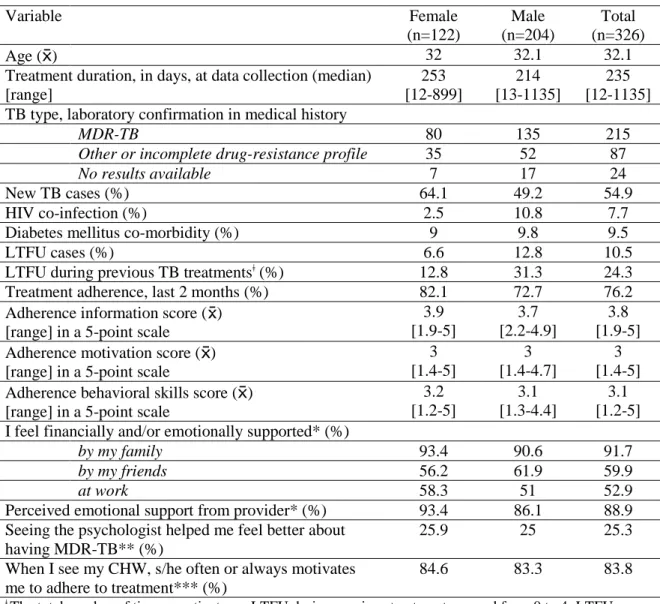
Of the 326 patients interviewed, 215 (66%) had laboratory-confirmed MDR-TB, 204
(63%) were male, and 34 (11%) had been LTFU during treatment (Table 2.1). The mean
treatment adherence rate was 76%. Means scores for adherence information, motivation, and
behavioral skills were 3.8, 3, and 3.1, respectively. Over 90% of patients reported feeling
supported by family members, and 25% said that visiting the psychologist was helpful. Most
(85%) healthcare service providers were women (Table 2.2). Their average work engagement score was 5.3. TB services were available for ≤6 hours per day in 55% of the health centers. Less
than half (45%) of the health centers counted with CHWs. Fidelity to DOT was low; 58% of
patients were never or almost never observed when they took their medications.
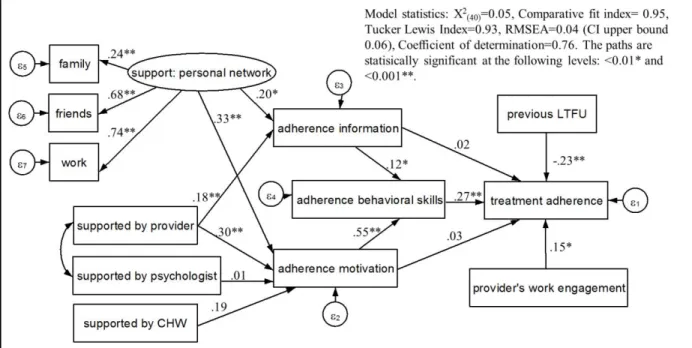
Modifications made to the original model (Figure 2.1) to improve fit were repositioning provider’s work engagement and previous LTFU as factors directly affecting treatment
adherence; and allowing a co-variance between patient-perceived support from their provider and the health center’s psychologist. Figure 2.2 displays the final model of MDR-TB treatment
adherence. Model fit was excellent with CFI=0.947, TLI=0.926, RMSEA=0.035 (90% CI,
0.005-0.055), and coefficient of determination=0.76.
SEM analysis revealed that adherence information (β=0.02, p<0.01) and motivation
(β=0.07, p<0.001) had a positive effect on treatment adherence, but only through behavioral
skills (Figure 2.3). The indirect effects of adherence information and motivation on treatment adherence were β=0.02 (p<0.01) and β=0.07 (p<0.001), respectively. Behavioral skills had a
18
LTFU had a direct negative effect (β=-0.23, p<0.001), whereas providers’ work engagement had
a direct positive effect (β=0.15, p<0.01) on adherence.
Table 2.1 Description of patient participants
Variable Female
(n=122)
Male (n=204)
Total (n=326)
Age ( ) 32 32.1 32.1
Treatment duration, in days, at data collection (median) [range] 253 [12-899] 214 [13-1135] 235 [12-1135] TB type, laboratory confirmation in medical history
MDR-TB 80 135 215
Other or incomplete drug-resistance profile 35 52 87
No results available 7 17 24
New TB cases (%) 64.1 49.2 54.9
HIV co-infection (%) 2.5 10.8 7.7
Diabetes mellitus co-morbidity (%) 9 9.8 9.5
LTFU cases (%) 6.6 12.8 10.5
LTFU during previous TB treatmentsǂ (%) 12.8 31.3 24.3
Treatment adherence, last 2 months (%) 82.1 72.7 76.2
Adherence information score ( ) [range] in a 5-point scale
3.9 [1.9-5] 3.7 [2.2-4.9] 3.8 [1.9-5] Adherence motivation score ( )
[range] in a 5-point scale
3 [1.4-5] 3 [1.4-4.7] 3 [1.4-5] Adherence behavioral skills score ( )
[range] in a 5-point scale
3.2 [1.2-5] 3.1 [1.3-4.4] 3.1 [1.2-5] I feel financially and/or emotionally supported* (%)
by my family 93.4 90.6 91.7
by my friends 56.2 61.9 59.9
at work 58.3 51 52.9
Perceived emotional support from provider* (%) 93.4 86.1 88.9 Seeing the psychologist helped me feel better about
having MDR-TB** (%)
25.9 25 25.3
When I see my CHW, s/he often or always motivates me to adhere to treatment*** (%)
84.6 83.3 83.8
ǂ The total number of times a patient was LTFU during previous treatments ranged from 0 to 4; LTFU once=15%, LTFU twice=5%, LTFU three times or more=5%. *Answer options were yes/no. **Answer options were “not at all”, “somewhat better”, and “a lot better”. ***Answer options were “never”, “rarely”, “sometimes”, “often”, “always”.
Perceived financial/emotional support from patients’ social networks, and providers had
indirect positive effects on treatment adherence. Patient-perceived support from their providers had positive direct effects on adherence information (β=0.18, p<0.001) and motivation (β=0.3,
19
networks also affected adherence information (β=0.2, p<0.01) and motivation (β=0.33, p<0.001)
directly, which in turn affected adherence. Perceived support from the psychologist or CHW had
no effect on adherence motivation.
Table 2.2 Description of healthcare service providers and health centers HEALTHCARE SERVICE PROVIDERS
Variable Total (n=86)
Age ( ) [range]
42.8 [25-65]
Female (%) 84.9
Work engagement score ( ) [range] in a 7-point scale
5.3 [3.2-6] >12 months of experience with TB (%) 73.2
Nurse 36.1
Nurse Technician 51.2
Physician 11.6
TB training in the last 12 months (%)
0 times 62.4
≥1 times 37.6
HEALTH CENTERS
Variable Total (n=40)
Hours of operation with TB providers: ≤ 6 per day (%)
54.6
≤ 4 providers in TB team (%) 87.5
Nutritionist available* (%) 80.0
Nutritionist TB trained in the past 12 months (%) 15.6
Psychologist available* (%) 87.5
Psychologist TB trained in the past 12 months (%) 37.1
Social worker available* (%) 92.5
Social worker TB trained in the past 12 months (%) 21.6 CHWs working with DR-TB patients available* (%) 45.0 DOT is implemented as intended** (%)
Never or almost never 58.3
Sometimes 21.5
20
21
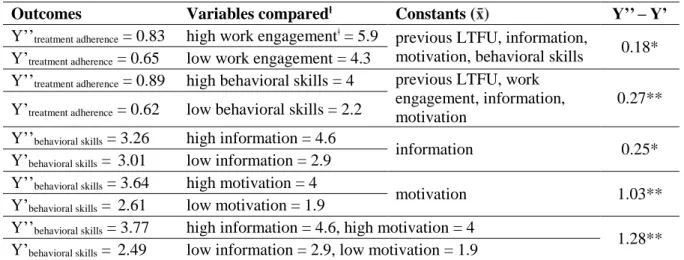
We compared the relative effects of varying scores to their lower and upper 95th
percentiles (Table 2.3). The estimated treatment adherence rate was 89% for a patient with a
behavioral skills score of 4 and 62% for someone with a score of 2.2 (diff=27%). This 27%
difference in treatment adherence rate due to behavioral skills was larger than the 18% estimated difference due to providers’ work engagement scores: 83% with high (5.9) vs. 65% with low
(4.3) work engagement. Greater positive differences in behavioral skills were observed in higher
motivation scores (diff=1.03 or a 21% increase), than in higher information scores (diff=0.25 or
a 5% increase). When motivation and information scores were both high, behavioral skills scores
were 1.28 (26%) higher than when the two scores were low.
Table 2.3 Relative effects on treatment adherence and behavioral skills when patients’ adherence information, motivation, and provider’s work engagement are varied
SEM equations:
treatment adherence: [rate: 0-1]
Ytreatment adherence = β0 + β1*(previous LTFU) + β2*(provider’s work
engagement) + β3*(adherence information) + β4*(adherence
motivation) + β5*(adherence behavioral skills)
adherence behavioral
skills: [scale: 1-5] Ybehavioral skills = β6 + β7*(adherence information) + β8*(adherence motivation)
Outcomes Variables comparedƚ Constants (x̄) Y’’– Y’
Y’’treatment adherence = 0.83 high work engagementǂ = 5.9 previous LTFU, information,
motivation, behavioral skills 0.18* Y’treatment adherence = 0.65 low work engagement = 4.3
Y’’treatment adherence = 0.89 high behavioral skills = 4 previous LTFU, work
engagement, information, motivation
0.27** Y’treatment adherence = 0.62 low behavioral skills = 2.2
Y’’behavioral skills = 3.26 high information = 4.6
information 0.25*
Y’behavioral skills = 3.01 low information = 2.9
Y’’behavioral skills = 3.64 high motivation = 4
motivation 1.03**
Y’behavioral skills = 2.61 low motivation = 1.9
Y’’behavioral skills = 3.77 high information = 4.6, high motivation = 4
1.28** Y’behavioral skills = 2.49 low information = 2.9, low motivation = 1.9
22 DISCUSSION
The IMB model produced a well-fit model describing adherence to MDR-TB treatment
and its key determinants. Adherence information and motivation were found to be predictors of
adherence through behavioral skills. Furthermore, patients’ perceived support from their social network and providers improved adherence through information and motivation. Providers’ work
engagement also improved adherence directly, emphasizing the importance of patient-provider
interactions. Finally, the model showed that patients with prior LTFU to TB treatment were less
likely to adhere.
Most prior research on adherence to TB treatment has focused on drug-sensitive TB and
found that social support, previous LTFU, and knowledge about TB are associated with
adherence.4,29,30 Research on the determinants of adherence to MDR-TB patients (e.g. side
effects, financial difficulties) has mainly consisted of qualitative studies.15 Our findings of the value of the IMB model were similar to adherence studies in the fields of human
immunodeficiency virus (HIV), reproductive health, diabetes, and heart disease.17,18
For patient-centered interventions the IMB model could be used to measure the progress,
and evaluate the effectiveness of interventions aimed at improving adherence. Adherence
information, motivation, and behavioral skills could be the intermediate targets for intervention
activities, which would have the goal to improve one, or a combination of these targets.
Checking the progress of interventions over time using these targets also allows practitioners to
finetune activities in real-time. The common approach to interventions is to implement at time
zero and then report results at the end of the study. Therefore, practitioners would have the
opportunity to maintain intervention activities on target during implementation and improve the
23
Our study also suggests examples for intervention activities. We observed an additive
effect from patient-perceived support by providers and social networks. Greater improvement in
adherence information and motivation were observed if the support was perceived to come just
from both rather than one or the other. This may be a reflection of the psychosocial barriers
patients face, which have been documented in the literature.4,21 The direct positive effect of providers’ work engagement, on the other hand, highlights the importance of addressing
provider-level barriers to improve adherence. Some of these include high-risk work
environments, understaffing, and difficulties coordinating care with supporting services (e.g.
psychologists).31,32
We did not find an association between patient-perceived support by psychologists or
CHWs in our model. This may be because patients only had an average of two psychology
appointments throughout treatment and most of the few CHWs were involved in MDR-TB care
as former TB-CHWs had either retired or were supporting other public health campaigns (e.g.
dengue and chikungunya).
Limitations
Our study was a cross-sectional observational study, limiting any causal interpretation. It
is possible that some of our participants responded to questions even when they did not
remember the answers well. We reduced potential recall biases limiting adherence data to 2
months prior to data collection. To focus on the IMB model and social networks, we did not
include covariates such as sex and income. Such omission could have affected model parameter
24 CONCLUSIONS
While there is a growing consensus that patient-centered care is essential for optimal
adherence, a complex human behavior, global and national treatment guidelines are based on
limited evidence on how to implement patient-centered care.33,34 Our results suggest that
comprehensive interventions should include adherence information, motivation, and behavioral
skills. The IMB model could be used to design adherence interventions and measure their
effectiveness. Future studies should follow patients over time to understand how adherence
barriers change, and which interventions are most effective at different stages of treatment.
Acknowledgements
This study was possible thanks to the contributions from the team at Innovation for
Health and Development, a special thanks to Dr. Carlton Evans, Lic. Nataly Becerra, and Lic.
Ariana Huamani for their technical support and help with field work, the Estrategia Sanitaria
Nacional de Prevención y Control de la Tuberculosis, local TB coordinators, health center
personnel, and the patients who contributed to this study. Research reported in this publication
was supported by the Fogarty International Center of the National Institutes of Health (NIH)
under Award Number R25TW009340. The content is solely the responsibility of the authors and
25
REFERENCES
1. World Health Organization. Global tuberculosis report 2015. 2015. Available from: http://apps.who.int/iris/bitstream/10665/191102/1/9789241565059_eng.pdf?ua=1
2. Abubakar I, Zignol M, Falzon D, Raviglione M, Ditiu L, Masham S, et al. Drug-resistant tuberculosis: time for visionary political leadership. Lancet Infect Dis. 2013 Jun;13(6):529– 39.
3. Bastard M, Sanchez-Padilla E, Hewison C, Hayrapetyan A, Khurkhumal S, Varaine F, et al. Effects of Treatment Interruption Patterns on Treatment Success Among Patients With Multidrug-Resistant Tuberculosis in Armenia and Abkhazia. J Infect Dis. 2015 May 15;211(10):1607–15.
4. Thomas BE, Shanmugam P, Malaisamy M, Ovung S, Suresh C, Subbaraman R, et al. Psycho-Socio-Economic Issues Challenging Multidrug Resistant Tuberculosis Patients: A Systematic Review. PLoS ONE. 2016;11(1):e0147397.
5. Deshmukh RD, Dhande DJ, Sachdeva KS, Sreenivas A, Kumar AMV, Satyanarayana S, et al. Patient and Provider Reported Reasons for Lost to Follow Up in MDRTB Treatment: A Qualitative Study from a Drug Resistant TB Centre in India. PLoS ONE.
2015;10(8):e0135802.
6. Volmink J, Garner P. Directly observed therapy for treating tuberculosis. Cochrane Database Syst Rev. 2007;(4):CD003343.
7. JN Newell, SC Baral, SB Pande, DS Bam, P Malla. Family-member DOTS and community DOTS for tuberculosis control in Nepal: cluster-randomised controlled trial. Lancet, 2006; 367: 903-9.
8. Yin J, Yuan J, Hu Y, Wei X. Association between Directly Observed Therapy and Treatment Outcomes in Multidrug-Resistant Tuberculosis: A Systematic Review and Meta-Analysis. PLoS ONE. 2016;11(3):e0150511.
9. Pasipanodya JG, Gumbo T. A meta-analysis of self-administered vs directly observed therapy effect on microbiologic failure, relapse, and acquired drug resistance in tuberculosis patients. Clin Infect Dis. 2013 Jul;57(1):21–31.
10.Frick M, Zhang A. Patient-Centered TB Treatment Will Require Modernizing Directly-Observed Therapy. Speaking of Medicine. Available from:
http://blogs.plos.org/speakingofmedicine/2013/10/30/patient-centered-tb-treatment-will-require-modernizing-directly-observed-therapy/
26
for a cluster randomized controlled trial. Trials. 2015 Jun 22;16. Available from: http://www.ncbi.nlm.nih.gov/pmc/articles/PMC4479352/
12.Sripad A, Castedo J, Danford N, Zaha R, Freile C. Effects of Ecuador’s national monetary incentive program on adherence to treatment for drug-resistant tuberculosis. The
International Journal of Tuberculosis and Lung Disease. 2014 Jan 1;18(1):44–8.
13.Gelmanova IY, Taran DV, Mishustin SP, Golubkov AA, Solovyova AV, Keshavjee S. “Sputnik”: a programmatic approach to improve tuberculosis treatment adherence and outcome among defaulters. The International Journal of Tuberculosis and Lung Disease. 2011 Oct 1;15(10):1373–9.
14.Munro S, Lewin S, Swart T, Volmink J. A review of health behaviour theories: how useful are these for developing interventions to promote long-term medication adherence for TB and HIV/AIDS? BMC Public Health. 2007 Jun 11;7:104.
15.Toczek A, Cox H, du Cros P, Cooke G, Ford N. Strategies for reducing treatment default in drug-resistant tuberculosis: systematic review and meta-analysis. The International Journal of Tuberculosis and Lung Disease. 2013 Mar 1;17(3):299–307.
16.Fisher JD, Fisher WA, Amico KR, Harman JJ. An information-motivation-behavioral skills model of adherence to antiretroviral therapy. Health Psychol. 2006 Jul;25(4):462–73.
17.Chang SJ, Choi S, Kim S-A, Song M. Intervention Strategies Based on Information-Motivation-Behavioral Skills Model for Health Behavior Change: A Systematic Review. Asian Nursing Research. 2014 Sep 1;8(3):172–81.
18.Mayberry LS, Osborn CY. Empirical validation of the information-motivation-behavioral skills model of diabetes medication adherence: a framework for intervention. Diabetes Care. 2014;37(5):1246–53.
19.Ministerio de Salud (2013). Estrategia Sanitaria Nacional de Prevención y Control de la Tuberculosis. Available from: http://www.tuberculosis.minsa.gob.pe/
20.Mitnick C, Bayona J, Palacios E, Shin S, Furin J, Alcantara F, et al. Community-Based Therapy for Multidrug-Resistant Tuberculosis in Lima, Peru. New England Journal of Medicine, 2003, 348:119.
21.Acha J, Sweetland A, Guerra D, Chalco K, Castillo H, Palacios E. Psychosocial support groups for patients with multidrug-resistant tuberculosis: Five years of experience. Global Public Health. 2007 Oct 1;2(4):404–17.
27
23.The LifeWindows Project Team. The LifeWindows Information Motivation Behavioral Skills ART Adherence Questionnaire (LW-IMB-AAQ). 2006. Center for Health, Intervention, and Prevention. University of Connecticut.
24.Bakker AB. An Evidence-Based Model of Work Engagement. Current Directions in Psychological Science. 2011 Aug 1;20(4):265–9.
25.Schaufeli WB, Bakker AB, Salanova M. The Measurement of Work Engagement With a Short Questionnaire A Cross-National Study. Educational and Psychological Measurement. 2006 Aug 1;66(4):701–16.
26.Kline RB. Principles and Practice of Structural Equation Modeling. 3rd ed. New York, NY: The Guidlford Press; 2011.
27.Bollen KA. Structural Equations with Latent Variables. United States of America: John Wiley & Sons, Inc.; 1989.
28.StataCorp. 2013. Stata Statistical Software: Release 13. College Station, TX: StataCorp LP.
29.Volmink J, Garner P. Systematic review of randomised controlled trials of strategies to promote adherence to tuberculosis treatment. BMJ. 1997 Nov 29;315(7120):1403–6.
30.Tola HH, Tol A, Shojaeizadeh D, Garmaroudi G. Tuberculosis Treatment Non-Adherence and Lost to Follow Up among TB Patients with or without HIV in Developing Countries: A Systematic Review. Iran J Public Health. 2015 Jan;44(1):1–11.
31.Nansera D, Bajunirwe F, Kabakyenga J, Asiimwe PKJ, Mayanja-Kizza H. Opportunities and barriers for implementation of integrated TB and HIV care in lower level health units: experiences from a rural western Ugandan district. Afr Health Sci. 2010 Dec;10(4):312–9.
32.Wannheden C, Westling K, Savage C, Sandahl C, Ellenius J. HIV and tuberculosis
coinfection: a qualitative study of treatment challenges faced by care providers. Int J Tuberc Lung Dis. 2013 Aug;17(8):1029–35.
33.Ministerio de Salud, Perú. Norma Técnica de Salud para la Atención Integral de las Personas afectadas por Tuberculosis. 2013. Available from:
http://www.minsa.gob.pe/dgsp/observatorio/documentos/infecciones/RM715-2013_MINSA_TB.pdf
34.WHO | Companion handbook to the WHO guidelines for the programmatic management of drug-resistant tuberculosis. WHO. Available from:
28
CHAPTER III: COMPLEX SYSTEMS: VISUALIZING MULTIDRUG-RESISTANT TUBERCULOSIS TREATMENT ADHERENCE WITH CAUSAL LOOP DIAGRAMS
(AIM 2)
OVERVIEW
Background. Multidrug-resistant tuberculosis (MDR-TB) treatment adherence poses a
complex public health challenge, due to the many important facilitators and barriers at multiple
levels affecting each other over time. Interventions designed based on an incomplete
understanding of this complexity are likely to fail. This paper extends prior attempts to describe
adherence behaviors by presenting a broad, integrated systems diagram depicting the interactions
most substantially affecting patient adherence to MDR-TB treatment.
Methods. We engaged mixed stakeholder groups in urban Peru using system dynamics
qualitative methods to diagram the most important cause-and-effect connections determining
MDR-TB treatment adherence over time. These causal loop diagrams were then validated and
expanded based on a review of the scientific literature. Finally, expanded diagrams were
reviewed with local stakeholders to ensure final versions continued to reflect local reality.
Results. Adherence was affected by adverse reactions to medications, psychosocial
factors, and health care system barriers, among others. These factors vary in importance across
three phases of treatment – intensive, continuation, and maintenance – as defined by patients. In
stakeholder-29
diagrammed relationships were substantiated in the scientific literature. Additional relationships
were added based on the literature, including financial difficulties, substance abuse, and gender
effects. The final diagram had high face validity with stakeholders.
Conclusion and recommendations. Future research is needed to validate and expand
upon our initial model. However, the many feedback loops are important in shaping outcomes,
and should be considered when designing intervention.
INTRODUCTION
In 2014, Tuberculosis (TB) surpassed human immunodeficiency virus (HIV) as the
leading cause of death from infectious disease worldwide.[1] Multidrug-resistant TB (MDR-TB)
is defined as resistance to at least two of the most powerful TB drugs, isoniazid and rifampicin.
Compared to drug-sensitive TB, MDR-TB treatment is longer (≥18 months) and side effects are
often more severe.[2] Missing doses could result in poor treatment outcomes, further
transmission of MDR-TB, and amplified resistance to drugs.[3–5] Barriers and facilitators at
multiple levels (e.g. patient, healthcare provider, health system) affect patient adherence and
loss-to-follow-up (LTFU) during treatment.[6,7]
Barriers and facilitators to MDR-TB treatment adherence are part of a system that
includes biomedical,[8] cognitive,[6] socioeconomic,[9] and operational factors.[10]
Relationships among these barriers and facilitators are complex because they likely differ in
direction and magnitude over the period of treatment.[7,11] Interventions designed based on an
incomplete understanding of this complexity may not have the desired impact or cause negative
unintended consequences. Recent efforts to study similar complex systems include sexually
transmitted disease stochastic microsimulation models (STDSIM), which evaluate behavioral
30
Consortium (TB MAC), which has been modelling the natural history and epidemiology of
TB.[13]
A simulation platform like the STDSIM could accelerate our ability to evaluate and
scale-up interventions in the field of TB. System dynamics (SD) is a modeling technique that
uses feedback loops and stock-and-flow diagrams to illustrate and simulate complex
systems.[14] In this paper, we present an integrated system dynamics diagram of the interactions
most substantially affecting patient adherence to MDR-TB treatment over time. This diagram
extends prior attempts to describe adherence, and was developed based on a structured review of
the literature as well as interviews and focused group discussions (FGDs) with key stakeholders.
This diagram is the first step to a simulation platform that decision-makers could use to evaluate
the effects of different interventions on MDR-TB treatment outcomes for their specific contexts.
METHODS
Utility of system dynamics using feedback loops and stock variables
SD is a methodology and mathematical modeling technique for mapping and modeling
the forces of change in complex systems to identify critical points for change.[15] SD models are
composed of stocks, flows, internal feedback loops, and time delays, put together through a
participatory approach to model-building. Simulations using SD can be used to model and
compare complex interventions over time to aid in policy decision-making.[16] SD has been
used extensively in the fields of business, engineering, economics, environmental science, and
most recently in public health (operations, diabetes care, substance abuse, heart disease).[17]
In the United States (US), the Centers of Disease Control and Prevention has sponsored
the development of SD models for diabetes, obesity, and non-communicable diseases broadly.
31
Caribbean.[18] In our study we used SD methodology – including the engagement of mixed
stakeholder groups in urban Peru – to diagram the disease trajectory of MDR-TB, and the most
important cause-and-effect connections determining treatment adherence over time. Analyses
were conducted in Microsoft Excel (2010) and Vensim DSS (2016) software.[18,19]
Study setting
We used data from a previous study in Lima, Peru,[20] to aid us in setting the model’s
boundary between MDR-TB treatment initiation and treatment completion or LTFU during
treatment. Peru accounts for 3.1% of the population of Latin America and the Caribbean region,
but has 11.6% of the region's TB and 35.3% of the MDR-TB cases.[21] Peru’s capital, Lima, and
the constitutional province of Callao combined have 54% of the TB cases, 76% of the MDR-TB
cases, and 89% of the extremely drug-resistant tuberculosis (XDR-TB) cases in the country. The model we developed illustrates the disease trajectory in the context of Peru’s national guidelines
for MDR-TB treatment.[22]
Under Peru’s TB guidelines, treatment is provided Monday-Saturday for at least 18
months at health centers ran by the Ministry of Health and following the World Health Organization’s Directly Observed Therapy (DOT) strategy.[22,23] An MDR-TB patient is
expected to be on injectable medications a maximum of six to eight months (or after four
consecutive negative cultures, tested monthly) unless otherwise specified by their physician;
second-line drugs should be administered in one daily dose except for ethionamide, PAS, and
cycloserine, which should be administered in two doses each day, eight hours apart, to avoid
adverse reactions; and a LTFU case is defined as a patient who missed doses for 30 continuous
32
Developing a qualitative model of MDR-TB treatment adherence
The development of our model was an iterative process grounded on an extensive
literature review, structured interviews, and FGDs with patients, healthcare service providers,
decision-makers, and community health workers (CHWs) in Lima, Peru. These findings were
incorporated in three stages – model development, refinement, and face validation – to develop a
model that represented the MDR-TB disease trajectory and determinants of treatment adherence
(Figure 3.1).
Model development
In the model development stage, we used structured questionnaires to conduct structured
interviews with 212 patients and 86 of their providers, and conducted two FGDs with patients
(n=8), one with CHWs (n=4) and one with providers (n=3). Participants were recruited from the
40 health centers with the highest 2013-2014 MDR-TB prevalence in Lima, Peru. We included
adults (ages 18-65) diagnosed with MDR-TB who had been in treatment for at least 12 days. In
each health center seven to 10 patients and up to three of their providers (physicians, nurses,
33
of Lima, and patients lived or worked less than 20 min away walking or using public
transportation.
The patient questionnaire included questions about demographics, medical history,
socio-economic and psychosocial states, and patient-perceived barriers and facilitators for treatment
adherence. The provider questionnaire focused on provider-perceived operational and
programmatic barriers and facilitators to treatment adherence, as well as their own capacity to
facilitate adherent behavior among patients. We also accessed patients’ medical histories and
daily patient treatment logs. A detailed description of the data can be found elsewhere.[20]
We recruited FGD participants at the health centers visited, from the same pool of
interviewed participants. In health centers where CHWs assisted with MDR-TB patient care, we
also recruited CHWs for FGDs. FGD questions focused on describing the stages of treatment and
comparing the impact of patient- and provider-reported barriers and facilitators on treatment
adherence over time. During the FGDs, labeled notecards were used to help participants
visualize the direction and relative impact each barrier and facilitator had on adherence. Using
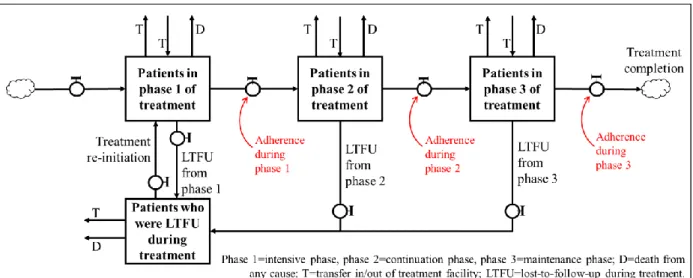
the data gathered in this stage, we drafted the stock-and-flow diagram for MDR-TB disease
trajectory shown in the results section, and the first draft of causal loop diagrams (CLD) that
reflect changes over the period of treatment (Appendix A).
The study was approved by the institutional review boards of the University of North
Carolina at Chapel Hill (US), Asociación Benéfica PRISMA (Peru), the Dirección Regional de
Salud Callao, Dirección de Salud IV Lima Este, and Dirección de Salud II Lima Sur.
Model refinement
The model refinement stage was guided by the results in the model development stage.
34
within the field of TB that studied factors associated with adherence. Selection of the number
and terms for the search strategies was determined from the model develop during the first stage
and in consultation with a librarian. Minor adjustments and additions made to the search
strategies were guided by the reviewed literature. We also searched through the reference lists
from systematic reviews for additional articles.
The initial search produced 22,643 results (Figure 3.2); we reviewed their titles for
relevance. Our inclusion criteria were TB studies that quantified associations between factors in
the context of treatment adherence research. After excluding 22,540 articles based on relevance
and duplication, we reviewed 103 abstracts. Among the abstracts, we found 13 systematic
reviews and 79 non-systematic reviews for full-text assessment. A total of 17 relevant articles,
four from the systematic reviews and 13 from non-systematic reviews, were used for context and
content validation of the model.[24]
During the initial search, larger number of articles were found for searches that only
included terms for TB and one additional factor. When search terms were combined, the number
of results decreased significantly. For example, searching for TB and adherence terms resulted in
3225 article titles, whereas searching for TB, adherence, and financial difficulties returned 26
results. Some combination of searches returned zero results. An example of this is pain from
injections. Numerous qualitative studies and our data have shown that pain from injections is a
strong determinant for non-adherence and LTFU, yet few related search results were found.
The search strategies (Appendix B) included terms for TB and 16 terms that were
identified during interviews, FGDs, and the literature review as relevant and searchable. The
matrices below show the count of articles found in the initial search per link (Table 3.1a) and the
35
for 30 links, including the 10 links originally identified as relevant to adherence during the
interviews and FGDs from step 1. In addition to the 17 articles from the literature review,
empirical evidence included analyzed data from a previous study.[20] The initial model draft was
adjusted and expanded based on the findings from the model refinement stage.
Figure 3.2 Preferred Reporting Items for Systematic Reviews and Meta-Analyses (PRISMA) diagram for literature review search results on TB and adherence
Model face validation
In the last stage of the model building process, we conducted additional interviews and FGDs with key stakeholders to maximize the model’s face validity. These interviews and FGDs
were guided by a collaborative planning tool developed by Hovmand et al., which is a script used