PROBABILISTIC KNOWLEDGE BASE SYSTEM FOR
FORENSIC EVIDENCE ANALYSIS
1
NOOR MAIZURA MOHAMAD NOOR, 2SALWANA MOHAMAD @ ASMARA, 3MD YAZID
MOHD SAMAN, 4MUHAMMAD SUZURI HITAM
School of Informatics and Applied Mathematics, Universiti Malaysia Terengganu, Malaysia
E-mail: [email protected] , [email protected] , [email protected] , [email protected]
ABSTRACT
Crime investigation is a complex task involving huge amounts of information and requiring many different types of expert knowledge. To improve policies and developing effective crime investigation strategies, it is important to understand the processes behind crime. Besides, uncertainty is a common problem in crime investigation. Uncertainties of knowledge in forensic investigation gives a great impact to the decision making process entirely. This paper discusses on representing and calculating probabilistic knowledge for forensic evidence analysis in assisting crime scene investigation. In order to facilitate forensic evidence analysis, a knowledge base system and Bayesian networks have been developed. It describes the process of calculating the probabilities for forensic evidence analysis. In conclusion from the obtained results, it shows that the developed knowledge base can support decision making for uncertainties knowledge in forensic evidence analysis.
Keywords: Knowledge Base System, Probabilistic, Crime Investigation, Forensic Evidence Analysis.
1. INTRODUCTION
Crime scene investigation is the application of forensic science within the context of the crime scene to the court [1]. It is the process of establishing the scientific facts of a case. A crime scene is any space or item that may contains physical evidence that a crime has been committed [2]. It is about relating something or someone to that crime. This definition covers everything from a small item to an extensive area. The goal of crime scene investigation is to provide information for scientific crime reconstruction and crime scene analysis tasks. Forensic scientists have to analyze physical evidence found at the scene. Also, they should provide expert testimony in a court of law. They analyze evidence using science, math, and problem solving methods. The process applies complex instruments and techniques of a crime investigation.
Decision making skill is needed among forensic and crime investigator because they should interpret the data and develop valuable knowledge that can help the investigation. Forensic and crime investigator would therefore gain advantage from the application of a knowledge based system (KBS) and visualization to handle the forensic and crime
investigation. It provides knowledge to solve more complex problems
The skill to hypothesize possible crime scene by crime investigator will determine the efficiency in crime investigation [3]. Formulation of
theoretical crime scenarios will develop
methodologies for analyzing physical evidence and
determining effective strategies in crime
investigation. The hypothesis-driven investigation of specific forensic problem using computers will achieve the primary goal of discovery and advancement of forensic knowledge.
The investigation process in forensic and crime scene can be replaced by a KBS with emerging artificial intelligence (AI) tools. KBS is a computer programs which capture and preserve expertise [4]. It also makes use of knowledge obtained from other knowledge sources. A separation also has been made in a KBS between application-independent
inference rules and application-dependent
knowledge [5]. A KBS can be used as an aid tool to solve very complicated knowledge which may not be statically and mathematically defined [6].
real-time decision making. Therefore, a knowledge base is required to store the expertise knowledge in a formal system. Also, the knowledge can be retrieved and manipulated efficiently.
Knowledge is derived by analyzing
information in intelligent system. A right
information is required to make an accurate decision [7]. Knowledge is one of the various information necessarilly to support intelligent reasoning [8, 9]. The elicitated knowledge must be formalized and changed into a symbolic form that can be recorded in knowledge base system and
infered [10]. Mostly applied knowledge
representation scheme in many expert system development is in production rules [11]. The reasoning process in production rules is based on rules that fulfill the condition by given set of facts [12]. Domain professionals are able to deliver input for the rule base system better than low level staff [13]. This is because their expertise is the main element in the system.
However, logic becomes the most popular method because of its solid mathematical condition [14]. The language of classical logic [15]that is widely used in the theory of knowledge representation is the language of first-order-logic formulas [16]. Validity is concerned in logic instead the truth of statements [17]. Therefore, traditional logic is unable to deal with uncertainty. Different types of logic such as modal logics, probabilistic methods and fuzzy logic could provide some ability to reason about possibilities and more accurate ways to reason in uncertain situations [18]. It can be used in situation where regularly knowledge addition and incomplete knowledge to infer is occurred. Besides incomplete knowledge, inconsistencies are also occurs in knowledge reasoning.
Uncertainty is a main problem that has been faced by decision makers. Decision theory is a framework for representing and reasoning about uncertainty within domain decision making. Computational techniques within the context of this framework has been developed by AI researchers in uncertainty field [19].
Forensic scientist usually deals with
uncertainty element because of incomplete
scientific evidence. All evidence needs to be clarified based on the knowledge of the case and statements that expresses a judgment [20]. On purpose to handle the formal analysis of decision
making, forensic scientists have to understand all of the dependency among evidence. In expert system, rules that are meant to be applied to existing facts are assumed to be certain. However, uncertainties from real-world applications are dealt with during the modelling stage [21].
Probabilistic theory has been raised as the solution by many researchers. The most popular formalism for defining probabilities in possible worlds is Bayesian networks. Bayesian probability theory is one of methods that can deal with uncertainty in knowledge representation and reasoning [22]. It is a reasoning formalism for a clear representation of uncertain relationship among parameters in a domain. Reasoning about uncertain information is important in many application of reasoning about knowledge and belief [23]. Bayesian network modeling has features such as enabling the handling of missing data, avoiding the over-fitting of data, assisting learning about causal relationships between variables and allowing a combination of data with domain knowledge. These reliable features are useful in data analysis and management within a real world context [24]. Bayesian network can be viewed as a direct graphical representation of possible stories related to a scenario that evolved [20].
Particularly, this research tackles two problems in building knowledge base for crime investigation and evidence evaluation:
1) Dealing with the evidence tracing and
hypotheses of crime scenario.
2) Estimating the probability of crime scenario
hypotheses by given evidences. In dealing with these challenges, this paper presents probable scenarios within a Bayesian Network (BN).
This paper is divided into eight sections. Section 1 discussed the introduction. Section 2 describes the background literature. Section 3 briefly explains about probability method. Section 4 and 5 is a detail about representing knowledge and probabilistic knowledge for forensic evidence analysis. Section 6 and 7 explains about results and discussion and future works. Finally, section 8 concludes the research findings.
2. BACKGROUND LITERATURE
to the law [25]. Franke and Srihari [26] have defined computational forensic as an emerging interdisciplinary research domain. It is understood as the hypothesis-driven investigation of specific forensic problem using computers with the primary goal of discovery and advancement of forensic knowledge.
It is practical to sort domain knowledge in larger part whereas a related set of variables often
considered together by knowledge experts.
Knowledge elicitation and knowledge base
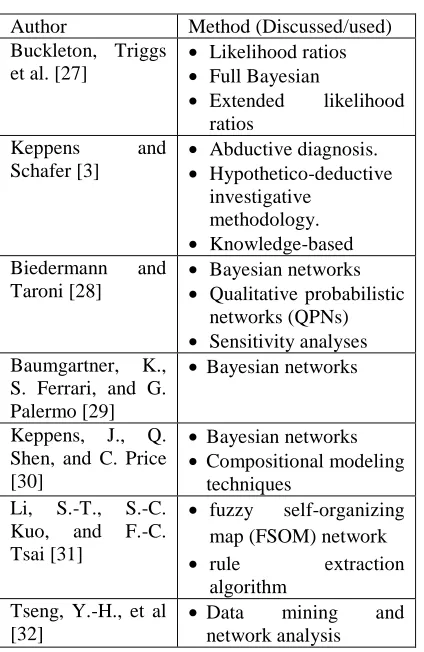
[image:3.612.85.297.311.637.2]maintenance can be handled by the groupings of variables and their relationships [19]. Some related works of forensic science and crime investigation that apply artificial intelligent method in their works has been studied (see table 1):
Table 1: Related Works
Forensic scientists are commonly faced with the problems of making decisions under situation of uncertainty. For example, they are always involved in situations of more than one item of evidence is found. Or else, two or more traces may be found, for example, at different locations where crimes have been committed.
Uncertainty can be defined as the lack of the exact knowledge that would enable us to reach a perfectly reliable conclusion. The sources of uncertain knowledge are [33] :
i. Weak implications: Domain experts and
knowledge engineers have the difficulty to form a solid correlation between IF -THEN parts of the rules.
ii. Imprecise language: Naturally, we
describe facts with such terms as often and sometimes, frequently and hardly ever. As a result, it can be difficult to knowledge in the precise IF-THEN form of production rules.
iii. Unknown data: When the data is
incomplete or missing, the only solution is to accept the value ’unknown’ and proceed to an approximate reasoning with this value.
iv. Difficulty of combining the views of
different experts: Huge expert systems usually combine the knowledge and expertise of multiple experts. Therefore, experts have conflicting opinions and construct conflicting rules.
3. PROBABILITY METHOD
Cao [23] has defined the term of probabilistic in their context as probabilistic representations and reasoning mechanisms by applying probability theory, such as Bayesian networks, hidden Markov models and stochastic grammars. Probable also means a personal degree of belief that a proposition of natural language, describing that fact is true [34]. General theory of “beliefs” must always have numerical probabilities associated with them. The numerical probabilities are said to measure the degree of justification of the belief [35].
Expressive probabilistic logic can deal with the application of probability to complex and variety problems. A well-defined and unique probability distribution can resolve problems in probabilistic reasoning for expressive probabilistic logics [36]. In forensic science, uncertainties evaluation usually based on forensic evidence that described inferences. Forensic scientists have to consult in the evaluation of uncertainties within their state of knowledge.
Therefore, probability theory can be applied in forensic science to do the reasoning process [34].
Author Method (Discussed/used)
Buckleton, Triggs et al. [27]
• Likelihood ratios
• Full Bayesian
• Extended likelihood
ratios
Keppens and
Schafer [3]
• Abductive diagnosis.
• Hypothetico-deductive
investigative methodology.
• Knowledge-based
Biedermann and
Taroni [28]
• Bayesian networks
• Qualitative probabilistic
networks (QPNs)
• Sensitivity analyses
Baumgartner, K., S. Ferrari, and G. Palermo [29]
• Bayesian networks
Keppens, J., Q. Shen, and C. Price [30]
• Bayesian networks
• Compositional modeling
techniques
Li, S.-T., S.-C.
Kuo, and F.-C.
Tsai [31]
• fuzzy self-organizing
map (FSOM) network
• rule extraction
algorithm Tseng, Y.-H., et al
[32]
• Data mining and
The most popular formalism for defining probabilities on possible worlds is Bayesian networks. Bayesian network modeling has features such as enable to handle missing data, avoid over fitting of data, assist learning about causal
relationships between variables and allow
combination of data with domain knowledge. These reliable features are useful in data analysis and management within real world context [24].
Bayesian networks use graphical and numerical
representations to model knowledge about
propositions in uncertain domains. It is a directed acyclic graph, where each node represents a variable. A factorization of a joint probability distribution into a set of conditional distributions at the numerical level are consists in each variable of the network. The graph represents conditional independence relations among the variables [37].
For any propositions A and B, numerical degrees of belief must follow the laws of the mathematical theory of probability whereas [20]:
1) Degrees of belief are real numbers between
zero and one: 0 ≤ Pr(A) ≤ 1.
2) Proposition of A and B cannot be both true at
the same time they are equally restricted propositions. The degree of belief that one of them is true is given by the sum of their degrees of belief:
Pr(A or B) = Pr(A) + Pr(B).
A Bayesian networks specify the following conditional independency assumption:
Each node Xi in the graph is conditionally
independent of any subset A of nodes that are not descendants of Xi given a joint state of Pa(Xi),
P(Xi | A, Pa(Xi)) = P(Xi|Pa(Xi)).
P(B|A) P(A) = P(A,B) (1)
It follows by Bayes rule:
| |
2
By assuming numerical independence, Bayesian networks can assemble subset of probabilities that cannot be derived from each other. It has efficient inference mechanism for improving probabilities that can be obtained from them [38]. The framework of Bayesian networks offers a coherent, expressive, and flexible formalism for the representation and manipulation of uncertain
knowledge compared to the earlier uncertainty models [39]. Biedermann and Taroni [20] have summarized that the use of Bayesian networks has some main advantages as follows:
1) Enable to structure inferential processes,
permitting the consideration of problems in a logical and sequential fashion;
2) Requirement to evaluate all possible
narratives;
3) It is possible to calculate the effect of
knowing the truth of one proposition or piece of evidence on the plausibility of others.
4) Allow communication of the processes
involved in the inferential problems to others in a concise manner by illustrating the assumptions made.
5) Enable to focus the discussion on
probability and underlying assumptions.
By using Bayes’s theorem, Bayesian network is considered as useful because of the ability to calculate the probability distributions of children given the values of their parents and vice versa. This situation also enables the user to infer the probabilities of different causes given the consequences [24].
4. REPRESENTING KNOWLEDGE FOR FORENSIC EVIDENCE ANALYSIS (FEA)
The application of knowledge representation for crimes has been demonstrated by Keppens [3]. They used symbolic rules of propositional logic. Meanwhile, a state-based knowledge representation approach has been applied in [40]. Frames is used in representing knowledge in [41] whereby it provides a natural way of clustering and distributed knowledge. Semantic networks is applied in [42] while it provide better support for acquisition of more complex and integrated knowledge structures
at all levels of conceptual facilitation
restrictiveness. Several researchers added fuzzy approach in their works such as in [43], [44]. By applying fuzzy logic approach, uncertainties environment in domain task can be solved. Approach integrating rules, neural networks and cases for knowledge representation and reasoning in expert system have shows effective result in knowledge representation and reasoning as in [45].
To develop the model, a crime scene is required to be specified. For this work, it was chosen to use a fictional scene from several research articles. There are no legal consequences in using a fictional scenario to develop a prototype. Real data can be used once the model is completely developed. In this example, the test crime scene is adapted from Keppens [3] are considered based on a crime scene scenario. A simple crime case is described as below:
A dead body of a man named Johndoe is found in his house. His dead body is hanging and some evidences are found at the scene:
i. Johndoe’s hanging dead body => evidence
1
ii. Signs of petechiae on Johndoe’s eyes =>
evidence 2
iii. Johndoe’s cause of death was asphyxiation
cause by hanging => evidence 3.
iv. Cutting instrument was found near
Johndoe => evidence 4.
v. Johndoe’s body has defensive injuries =>
evidence 5.
vi. Johndoe has a severe injury on the head
=> evidence 6.
The question now is to find the cause of death of Johndoe whether it is suicide or not.
These hypotheses may have three causes of death:
1) Suicide
2) Homicide
3) Accident
In Prolog, the facts related to the cause of death and their rules are represented as in Fig. 1:
1) Evidences are declared as ‘evidence’
predicate with arguments of evidence, En and
cause of death, Cn as follows: evidence (E, C).
2) Causes of deaths are declared as ‘cod’
predicate with arguments of suicide,
accident and homicide. For accident
hypothesis, it may be supported by evidences of hanging dead body, cutting instrument found and failed attempt of knot on rope.
3) Rule of hypothesis uses a recursive search
strategy:
hypothesis(X,Y) :- evidence(Y,X), cod(X).
Figure 1: Knowledge Representation For Forensic Evidence Analysis
5. PROBABILISTIC KNOWLEDGE FOR FEA
Many literatures have discussed about
representation and reasoning of probabilistic information such as probabilistic belief logic [23] and [46], probabilistic in forensic investigation [47] and [34], probabilities with rule base reasoning
[39], probabilistic induction method [48],
probabilistic assumption based reasoning [37], probabilistic approach for argument interpretation [49] and many more.
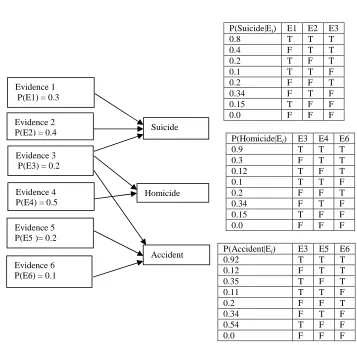
By using Bayes’ theorem, a Bayesian network is considered as useful because of its ability to calculate the probability distributions of children given the values of their parents and vice versa. This situation also enables the user to infer the probabilities of different causes given the results [24]. In this work, we focus on a probabilistic knowledge base for a crime scene scenario as our case study. Based on the crime scene scenario, a model of a Bayesian network graph is developed as in Figure 2.
/*facts of evidences*/
evidence(hanging_dead_body,homicide). evidence(has_defensive_injuries,homicide). evidence(traces_of_anaesthatic,homicide). evidence(severe_injuries,homicide).
evidence(hanging_dead_body,accident). evidence(cutting_instrument_found,accident). evidence(failed_attempt_of_knot_on_rope,acci dent)
evidence(hanging_dead_body,suicide). evidence(signs_petechiea_on_eyes,suicide). evidence(medical_report_of_asphyxiation,suic ide).
/*Facts of cause of death*/ cod(homicide).
cod(suicide). cod(accident).
/*rule*/
Every hypothesis of the cause of death is supported by forensic evidence. Forensic evidence is defined as variables of evidence. Each node represents variables of evidence and hypotheses of the cause of death. Each variable of evidence has a conditional distribution in numerical form which represents the degrees of belief that support the three hypotheses. Domain experts have to define degrees of belief based on their expertise. This degree of belief is represented in numerical form as conditional probabilities. When the evidence exists, the value of the evidence is ‘True’ (T), and ‘False’ (F) when the evidence does not exist. In a real situation, a problem may arise when the same forensic evidence can support two different hypotheses.
In probability reasoning, a decision maker can get a result in numerical probability that support the most probable hypothesis of a crime case. Decision maker can make several decision making scenario by choosing the range of evidence that exist in one scenario based on their findings and experience (see Figure 3).
Given the crime scene scenario, the hypotheses of cause of death can be suicide, homicide and accident:
H1=suicide
H2=homicide
H3=accident
H={H1,….Hn}
List of evidence which are related to those hypotheses are evidence 1, evidence 2, evidence 3, evidence 4, evidence 5, evidence 6.
En={E1, E2, E3, E4, E5, E6}
If we calculate the probability of hypothesis suicide given evidence 1 and evidence 2:
Pr H1 | E1, E2 Pr Pr| Pr | Pr ,
In Prolog, belief network is represented by relations:
1) parent( ParentNode, Node) defines
ParentNode is a parent of Node.
2) p( Node, ParentStates, Prob) defines Prob
is conditional probability of Node given values of parent variables ParentStates.
Example: p(suicide, [evidence1,
evidence2,evidence3], 0.8)
3) p( Node, Prob) defines a probability of
node without parents.
4) prob( Event, Condition, P) defines a
probability of Event, given Cond, is P; Event is a variable, its negation, or a list of
simple events representing their
conjunction.
The method for probabilistic analysis of inference networks discussed in this work using applications of Bayes’ rule. Bayes rule is used if condition involves a descendant. For example, if user wants to know the probability of suicide given evidence 1 and 2:
1 ?- prob(suicide,[evidence1,evidence2], P).
P = 0.32.
The calculation of probability by given evidences is:
Psuicide|evidence1, evidence2
Pevidence1, evidence2|suicidePsuicide Pevidence1, evidence2
= 0.32
P is the answer that explains the probability of suicide given evidence1 and evidence2 is 0.32. Therefore, this probability values can support decision making process in FEA. Different combination of forensic evidence analysis will calculate the probability of cause of death hypothesis. Based on the evidence, a user can make a variety of combinations of evidence that can be defined as a scenario. For example, table 2 shows three scenarios of different evidence combinations made by a user.
6. RESULT AND DISCUSSION
The experiment shows that the calculation of the probability value for forensic evidence in a crime scene can be done by developing Bayesian networks with conditional probabilities. Every given piece of evidence will calculate the probability using Bayes rule in the Prolog program. Thus, the numerical probability can be referred to as a supportive element in decision-making among experts, especially in uncertain conditions when one piece of evidence could lead to many hypothetical conclusions. The ‘what-if’ element in the knowledge base will allow the expert to
construct multiple scenarios of evidence
7. FUTURE WORKS
In future, we will improve the reasoning process by integrating the whole process with the probabilistic reasoning. Furthermore, some added features such as visualization technology can improve the system for reconstruction task. To
accomplish those tasks efficiently, a new
framework for the system should be developed.
8. CONCLUSION
This paper has discussed about representation of knowledge and Bayesian networks model for FEA in a KBS form. It uses Prolog as a knowledge base development language. A small set of knowledge of crime scene forensic analysis as case study is developed. The knowledge is categorizes based on evidence type in every hypothesis as facts and rules. Then, a Bayesian network of forensic evidence analysis is developed by defining conditional probabilities.
Overall, the result shows that the decision maker in forensic unit can calculate the probability hypothesis of cause of death by entering evidences. The calculated probability will assist decision making process among forensic scientist by suggesting the most probable situation that might be happen in the crime scene. However, future works is needed to improve the overall system that can be applied in real world.
ACKNOWLEDGEMENT
The authors would like to thank for continuous supports given by Datuk Seri Mohd Bakri bin Mohd
Zinin, Director of Criminal Investigation
Department, Royal Police Malaysia (RPM).
REFERENCES:
[1] Chisum, W.J., B.E. Turvey, and J. Freeman,
"Chapter 7 - Crime Scene Investigation",
Crime Reconstruction (Second Edition).
2011, Academic Press: San Diego. pp. 147-177.
[2] Jamieson, A., "A rational approach to the
principles and practice of crime scene investigation: I. Principles", Science &
Justice, Vol. 44, No. 1, 2004, pp. 3-7.
[3] Keppens, J. and B. Schafer, "Knowledge
based crime scenario modelling", Expert
Systems with Applications, Vol. 30, No. 2,
2006, pp. 203-222.
[4] Santos, E. and G. Johnson, "Towards
Detecting Deception in Intelligent Systems",
Proceeding of the SPIE: Defense & Security Symposium, Orlando, FL, 2004, pp.
[5] Dearnley, P.A. and D.J. Smith, "On the use
of dynamic feedback in knowledge base system design", Information and Software
Technology, Vol. 37, No. 12, 1995, pp.
659-664.
[6] Marcus, A., L. Feng, and J.I. Maletic, "3D
representations for software visualization", in Proceedings of the 2003 ACM symposium
on Software visualization. 2003, ACM: San
Diego, California. pp. 27-ff.
[7] Noor, N.M.M., A. Retnowardhani, N.
Mohamad, M.Y.M. Saman, et al., "A Framework of Decision Support for Crime Forecasting in Malaysia", WSEAS 2nd
European Conference for the Applied Mathematics and Informatics, Montreux,
Switzerland, WSEAS,2011, pp. 31-35.
[8] Partridge, D., "Representation of
Knowledge", Artificial Intelligence. 1996, Academic Press. pp. 55-87.
[9] Davis, R., H. Shrobe, and P. Szolovits.,
"What is a Knowledge Representation?", in
AI Magazine. 1993. pp. 17-33.
[10] Matsatsinis, N.F., M. Doumpos, and C. Zopounidis, "Knowledge acquisition and representation for expert systems in the field of financial analysis", Expert Systems with
Applications, Vol. 12, No. 2, 1997, pp.
247-262.
[11] Hatzilygeroudis, I. and J. Prentzas,
"Integrating (rules, neural networks) and cases for knowledge representation and reasoning in expert systems", Expert Systems
with Applications, Vol. 72, No. 2004, pp.
63-75.
[12] Radwan, A.A., H.M. El-Bakry, and H.M.E. Hadad, "A New Expert System for Pediatric Respiratory Diseases by Using Neural
Networks", WSEAS 2nd International
Conference on Applied Informatics and Computing Theory (AICT '11), Prague,
Czech Republic, WSEAS Press,2011, pp. 296-305.
[13] Din, R. and A. Samsudin, "Digital
steganalysis: Computational intelligence
approach", International Journal of
Computers, Vol. 3, No. 1, 2009, pp.
161-170.
knowledge representation methodology",
Expert Systems with Applications, Vol. 27,
No. 4, 2004, pp. 501-519.
[15] McCarthy, J., "Programs with common sense", Teddington Conference on the
Mechanization of Thought Processes, Her
Majesty’s Stationery Office, London, 1959, pp. 75-91.
[16] Lifschitz, V., L. Morgenstern, and D.
Plaisted, "Chapter 1 Knowledge
Representation and Classical Logic",
Foundations of Artificial Intelligence, V.L.
Frank van Harmelen and P. Bruce, Editors. 2008, Elsevier. pp. 3-88.
[17] Jones, M.T., "Knowledge Representation", in
Artificial Intelligence: A Systems Approach.
2008, Infinity Science Press.
[18] Coppin, B., "Chapter 7-Propositional and Predicate Logic", in Artificial Intelligence
Illuminated. 2004, Jones and Bartlett
Publishers.
[19] Xiang, Y. and K.-L. Poh, "Constructing Bayesian network in a changing world",
American Association for Artificial
Intelligence, Vol. No. 2005, pp.
[20] Taroni, F., C. Aitken, P. Garbolino, and A.
Biedermann, "Bayesian network and
probabilistic inference in forensic science". 2006, England: John Wiley & Sons Ltd. [21] Braz, R.d.S., E. Amir, and D. Roth, "A
survey of first-order probabilistic models",
Innovations in Bayesian Networks, SCI 156,
Vol. No. 2008, pp. 289-317.
[22] Wang, J., J. Byrnes, M. Valtorta, and M. Huhns, "On the combination of logical and
probabilistic models for information
analysis", Applied Intelligence, Vol. No. 1-26.
[23] Cao, Z., "A Complete Probabilistic Belief Logic Computational Logic in Multi-Agent Systems", K. Inoue, K. Satoh, and F. Toni, Editors. 2007, Springer Berlin / Heidelberg. pp. 80-94.
[24] Uusitalo, L., "Advantages and challenges of
Bayesian networks in environmental
modelling", Ecological Modelling, Vol. 203, No. 3-4, 2007, pp. 312-318.
[25] Ribaux, O., A. Baylon, C. Roux, O. Delémont, et al., "Intelligence-led crime
scene processing. Part I: Forensic
intelligence", Forensic Science
International, Vol. 195, No. 1-3, 2010, pp.
10-16.
[26] Pomerol, J.-C., "Artificial intelligence and human decision making", European Journal
of Operational Research, Vol. 99, No. 1,
1997, pp. 3-25.
[27] Buckleton, J.S., C.M. Triggs, and C. Champod, "An extended likelihood ratio
framework for interpreting evidence",
Science & Justice, Vol. 46, No. 2, 2006, pp.
69-78.
[28] Biedermann, A. and F. Taroni, "Bayesian networks and probabilistic reasoning about scientific evidence when there is lack of data", Forensic Science International, Vol. 157, No. 2006, pp. 163-167.
[29] Baumgartner, K., S. Ferrari, and G. Palermo,
"Constructing Bayesian networks for
criminal profiling from limited data",
Knowledge-Based Systems, Vol. 21, No. 7,
2008, pp. 563-572.
[30] Keppens, J., Q. Shen, and C. Price, "Compositional Bayesian modelling for
computation of evidence collection
strategies", Applied Intelligence, Vol. No. 2010, pp. 1-28.
[31] Li, S.-T., S.-C. Kuo, and F.-C. Tsai, "An intelligent decision-support model using FSOM and rule extraction for crime
prevention", Expert Systems with
Applications, Vol. 37, No. 10, 2010, pp.
7108-7119.
[32] Tseng, Y.-H., Z.-P. Ho, K.-S. Yang, and C.-C. Chen, "Mining term networks from text collections for crime investigation", Expert
Systems with Applications, Vol. 39, No. 11,
2012, pp. 10082-10090.
[33] Negnevitsky, M., "Artificial Intelligence: A guide to intelligent system". 2002, Harlow, England: Pearson Education.
[34] Biedermann, A. and F. Taroni, "Bayesian networks and probabilistic reasoning about scientific evidence when there is a lack of data", Forensic Science International, Vol. 157, No. 2-3, 2006, pp. 163-167.
[35] Pollock, J.L., "How to use probabilities in reasoning", Philosophical Studies, Vol. 64, No. 1, 1991, pp. 65-85.
[36] Laskey, K.B., "MEBN: A language for first-order Bayesian knowledge bases", Artificial
Intelligence, Vol. 172, No. 2-3, 2008, pp.
140-178.
[37] Cobb, B.R. and P.P. Shenoy, "A Comparison of Bayesian and Belief Function Reasoning",
Information Systems Frontiers, Vol. 5, No.
4, 2003, pp. 345-358.
[39] Lucas, P., "Certainty-factor-like Structures in Bayesian Networks AI*IA 99: Advances in Artificial Intelligence", E. Lamma and P. Mello, Editors. 2000, Springer Berlin / Heidelberg. pp. 25-36.
[40] Ma, J., G. Zhang, and J. Lu, "A state-based knowledge representation approach for information logical inconsistency detection in warning systems", Knowledge-Based
Systems, Vol. 23, No. 2, 2010, pp. 125-131.
[41] Marinov, M., "Using frames for knowledge
representation in a CORBA-based
distributed environment", Knowledge-Based
Systems, Vol. 21, No. 5, 2008, pp. 391-397.
[42] Khalifa, M. and V. Liu, "Semantic network
representation of computer-mediated
discussions: Conceptual facilitation form and knowledge acquisition", Omega, Vol. 36, No. 2, 2008, pp. 252-266.
[43] Boegl, K., K.-P. Adlassnig, Y. Hayashi, T.E. Rothenfluh, et al., "Knowledge acquisition in
the fuzzy knowledge representation
framework of a medical consultation system", Artificial Intelligence in Medicine, Vol. 30, No. 1, 2004, pp. 1-26.
[44] Wu, S.J. and S.L. Lin, "Intelligent web-based fuzzy and grey models for hourly wind speed forecast", International Journal of
Computers, Vol. 4, No. 4, 2010, pp.
235-242.
[45] Hatzilygeroudis, I. and J. Prentzas,
"Integrating (rules, neural networks) and cases for knowledge representation and reasoning in expert systems", Expert Systems
with Applications, Vol. 27, No. 1, 2004, pp.
63-75.
[46] Ng, K.S. and J.W. Lloyd, "Probabilistic reasoning in a classical logic", Journal of
Applied Logic, Vol. 7, No. 2, 2009, pp.
218-238.
[47] Keppens, J., Q. Shen, and B. Schafer, "Probabilistic abductive computation of evidence collection strategies in crime investigation", International Conference on
Artificial Intelligence and Law, Bologna,
Italy, 2005, pp.
[48] Binaghi, E., L. Luzi, P. Madella, F. Pergalani, et al., "Slope Instability Zonation: a Comparison Between Certainty Factor and
Fuzzy Dempster–Shafer Approaches",
Natural Hazards, Vol. 17, No. 1, 1998, pp.
77-97.
[49] Zukerman, I. and S. George, "A Probabilistic Approach for Argument Interpretation",
User Modeling and User-Adapted
Figure 2: Bayesian Belief Networks Of Forensic Evidence Analysis
Figure 3: Multiple Decision Making Scenarios Of Evidence Options
P(Suicide|Ei) E1 E2 E3
0.8 T T T
0.4 F T T
0.2 T F T
0.1 T T F
0.2 F F T
0.34 F T F
0.15 T F F
0.0 F F F
P(Homicide|Ei) E3 E4 E6
0.9 T T T
0.3 F T T
0.12 T F T
0.1 T T F
0.2 F F T
0.34 F T F
0.15 T F F
0.0 F F F
P(Accident|Ei) E3 E5 E6
0.92 T T T
0.12 F T T
0.35 T F T
0.11 T T F
0.2 F F T
0.34 F T F
0.54 T F F
0.0 F F F
Evidence 1 P(E1) = 0.3
Evidence 2 P(E2) = 0.4
Evidence 4 P(E4) = 0.5
Evidence 5 P(E5 )= 0.2
Evidence 6 P(E6) = 0.1
Suicide
Homicide
Accident Evidence 3
P(E3) = 0.2
Decision making 1
Decision making 2
Decision making 3
Decision making n
Evidence 3 Evidence 4 Evidence 1
Evidence 6 Evidence 4 Evidence 2
Evidence 5 Evidence 6 Evidence 2
Evidence 3
Evidence 4
Evidence 5
Evidence 6
Evidence 1 Evidence 1
Evidence 3
Probability
Suicide= 0.8
Not suicide= 0.2
Probability Suicide= 0.7 Not suicide= 0.3
Probability Suicide= 0.4 Not suicide= 0.6
[image:10.612.100.501.519.660.2]