Embodied Emotion Concepts and Aging:
Interoceptive Differences in Older versus Younger Adults’ Emotion Concepts1 Brian Davis
University of North Carolina at Chapel Hill
Spring 2015
A thesis presented to the faculty of The University of North Carolina at Chapel Hill in partial fulfillment of the requirements for the Bachelor of Arts degree with Honors in Psychology.
Advisor ___________________
Reader ___________________
Reader & Graduate Advisor ___________________
Acknowledgements
Firstly, I would like to acknowledge and thank all the participants that took part in my studies. Psychological research is a social science in all aspects, and we as researchers are
dependent on the willingness of everyday people to take part in the various tasks that we develop with the purpose of advancing the field further. Without their sincere participation there would be no psychological science.
Secondly, I wish to express my utmost gratitude to my committee members. I especially want to thank my advisor Dr. Kristen Lindquist and my graduate mentor Jennifer MacCormack for their unwavering support and superlative guidance. Their willingness to provide me with mentorship despite the fact that I had limited experience in the lab attests to their kindness and commitment to the undergraduate population here at UNC-CH. I also thank Dr. Paschal Sheeran for offering valuable feedback during my defense. Dr. Beth Kurtz-Costes and Dr. Peter Ornstein also provided me helpful guidance throughout this process and made themselves available above and beyond to lend their assistance. Additionally, I thank all the members of the Carolina
Affective Science Laboratory for their feedback when I practiced my defense as well as their overall support of the project.
Finally, I would like to acknowledge the support for my thesis from the Department of Psychology Undergraduate Research (DoPUR) program supported by the Lindquist
Abstract
Two studies examine the hypothesis that older adults experience a decrement in interoceptive information when representing emotion concepts. To test this hypothesis, adults aged 18-75 completed property verification tasks in an online study to validate emotion property words as describing one of three conceptual modalities (interoceptive, behavioral, or situational). Participants then rated property words across all three modalities as representing discrete
The body is a fundamental element of emotion. Philosophers have long known this intuitively—the etymology of the word “emotion” is “to stir up; to move around”. However,
contemporary research demonstrates that physiological states and the experience of emotion are in fact linked. For example, individuals who are better at detecting their own heartbeats are also more likely to experience emotions as highly arousing states (e.g., more likely to report
experiencing “anger,” “disgust,” “fear,” and “excitement” than “sadness,” “depression,” and “contentment”; Barrett, Quigley, Bliss-Moreau, & Aronson, 2004; Dunn et al., 2010).
Individuals with greater chronic coherence in the brain network that represents bodily changes (including the ventral anterior insula, ventral anterior cingulate cortex, amygdala, and
orbitofrontal cortex) also experience emotions as more arousing (Touroutoglou, Hollenbeck, Dickerson, & Barrett, 2012).
These findings, which suggest that changes in internal bodily feedback lead to changes in emotion experience (for review, see Critchley, 2009), are consistent with a psychological
constructionist theory of emotion (and more specifically with the Conceptual Act Theory; CAT), which states that emotions emerge when sensory feedback from internal bodily changes and from the external environment are made meaningful in light of the current situation (Barrett, 2014; Lindquist, 2013). A major advantage of the CAT is that it conceives of emotions as consisting of more basic psychological components. Alterations to any one of those components (either via experimental manipulation, pathology, or normative developmental changes) should alter the resulting emotional experience. Following the predictions of the CAT, I hypothesize that declines in physiological sensitivity due to aging cause older adults to draw less on internal bodily feedback when conceptualizing their emotions.
Psychological constructionism posits that emotions emerge as a result of more basic psychological processes (Barrett, 2006; Lindquist, 2013). This viewpoint runs counter to the basic theory of emotion, which states that each discrete emotion category such as “fear” or “sadness” has its own distinctive and universal neural, physiological, and behavioral properties rooted in causal neural and psychological mechanisms across persons (Ekman & Cordaro, 2011; Panksepp, 1998; Sprengelmeyer et al., 1996; for discussion, see Barrett, 2006). In other words, this commonsense view of emotion assumes that the characteristics of English emotion
categories such as “fear,” “anger,” “disgust,” and “happiness” are generated and experienced the same way across all people.
By contrast, growing evidence suggests that emotions are not biologically basic
categories. For instance, evidence suggests that emotions are not triggered from specific neural structures that produce consistent physiological and behavioral outcomes (Kober et al. 2008; Lindquist, Wager, Kober, Bliss-Moreau, & Barrett, 2012; Touroutoglou, Lindquist, Dickerson, Barrett, 2015). Rather, many neural and psychological processes are involved in emotion construction (e.g., language, internal bodily feedback, external sensory feedback, and executive functioning) (Lindquist et al. 2012). These psychological processes are supported by multiple distributed networks in the brain, which interact together to produce the experience of emotion (e.g., Oosterwijk et al. 2012; Wilson-Mendenhall, Barrett, Simmons, Barsalou, 2011; for a review see Lindquist & Barrett, 2012).
in the context of the current situation is called “situated conceptualization” (cf.,
Wilson-Mendenhall et al. 2011). Emotions emerge when a priori conceptual knowledge acquired from prior experiences is used to integrate and make sense of bodily and situational information (Barrett, 2014; Barrett, & Lindquist, 2008; Wilson-Mendenhall et al. 2011). For instance, prior evidence has shown that individuals experience the emotion fear when they make meaning of unpleasant feelings using knowledge about the concept “fear” (Lindquist & Barrett, 2008).
The CAT thus captures the ideographic and situated variations underlying emotion experience between-persons and between-situations: a difference in core affect, conceptual knowledge, or the current situation shifts the resultant emotion experience. Aging serves as an avenue to examine how natural shifts in one ingredient of emotion—core affect—have
downstream consequences for emotion and provides a means of testing the conceptual act theory. Emotion & Aging
In the psychological literature, it is well known that aging is associated with changes in cognition (e.g., slower cognitive processing; Salthouse, 1994), sensory processing (e.g.,
adults experience less heart rate and finger temperature detection than younger when they are induced to experience anger, fear, sadness, happiness, disgust, and surprise.
Mendes (2010) recently reviewed these age-related changes in interoception and peripheral physiology and proposed that, due to declines in interoception and physiological sensitivity, older adults may be likely to experience maturational dualism, that is—changes in emotional experience due to the weakening of the mind-body connection. In this view, older adults receive less input from the body during emotion and become less aware of that input compared to younger adults; as a result, older adults may even become “less emotional.”
However, despite these domain-specific declines, older adults tend to adapt to age-related changes and are able to compensate for the loss of one function by recruiting from other
behavioral cues (when compared with younger adults), then this would be an important step towards addressing how older adults’ ways of conceptualizing their emotions may change in response to, and even to compensate for, physiological declines relevant to emotion experience. These differences in emotion experience and regulation could be a result of decreased peripheral physiological activity (or a less accurate interoceptive representation of physiology).
However, none of these studies address how emotion conceptualization may differ with age. Thus, the present studies are a first step towards understanding the nature of older adults’ emotion conceptualization. To do so we compare older and younger adults’ interoceptive, behavioral, and situational conceptualizations of discrete emotion to determine if older adults do indeed rely less on interoceptive emotion properties than younger adults do, and if older adults rely more or similarly on behavioral and situational emotion properties compared with younger adults.
Measuring Emotion Conceptualization
Growing evidence suggests that conceptual knowledge is embodied, or represented by the sensorimotor modalities responsible for creating experiences in the first place (Glenberg & Gallese, 2012; for review, see Kiefer & Barsalou, 2013). For example, when people think about their favorite candy they actively represent what that candy tastes and looks like in the gustatory and visual systems of the brain (Kiefer & Barsalou, 2013). This model of cognition proposes that concepts are “grounded” in modality-specific systems such as interoceptive bodily
feedback from the situation (e.g., visual stimuli, auditory stimuli, tactile stimuli, etc.; for discussions, see Barsalou, 2008; Barsalou, 2012; Berlucchi & Aglioti, 2010; Stapleton, 2013).
Likewise, the CAT extends the predictions of embodied cognition to suggest that emotion concepts—what someone knows about different emotion categories such as anger, disgust, fear, etc.—are grounded in different modalities of experience (for empirical evidence and a full discussion of emotion-relevant modalities, see Barrett & Lindquist, 2008; Wilson-Mendenhall et al., 2011). For example, conceptual knowledge about “anger” is acquired through both direct experience (e.g., your own experiences of anger or observing someone else being angry) and transmission (e.g., what others tell you about the nature of anger, what metaphors your language has for anger, etc.) but this acquisition of the category “anger” is also rooted in multiple
modalities of experience (see Lindquist, MacCormack, & Shablack, 2015 for discussion). The English category “anger” may include what situations precede anger, co-occur with anger, or happen after anger, and also what interoceptive bodily sensations as well as nonverbal behaviors and actions are associated with anger in these different situations. All of these dimensions of “what it means to be angry” are rooted in the modalities of experience. Even transmitted knowledge about anger like a language’s metaphors for anger are primarily rooted in concrete, embodied ways (e.g., “he boiled with anger”, “she was seething”, “she’s hot-headed”, or “he went purple with rage”; see Kovecses, 2003 for a comprehensive review of emotion metaphors). Thus, the outcome of situated conceptualization will differ depending on variation in the current content of the interoceptive, behavioral, and situational modalities.
The Present Studies
conceptual knowledge of emotion. As the CAT suggests that emotions are the emergent product of core affective changes, exteroceptive feedback, and conceptual knowledge, we proposed that emotion concept knowledge may included three primary modalities: (1) the interoceptive
component of emotion experience (e.g., feeling “butterflies” in the stomach; racing heart), (2) the behavioral component, related to our own and others’ behaviors (e.g., clenched fists; frowning; running away), and finally (3) the situational component, rooted in inferences about what the situation means (e.g., loss, injustice, immorality). Specifically, we hypothesize that older adults will, due to maturational dualism, rely less on the interoceptive modality when conceptualizing emotions and focus more on the behavioral aspects of emotion (e.g., emotion-relevant behaviors like smiling or frowning) and situational aspects of emotions (e.g., appraisals that a situation is unjust, or that harm is being done) when conceptualizing emotions. Drawing on cognitive paradigms from the embodied concept knowledge literature (e.g., Kan, Barsalou, Solomon, Minor, & Thompson-Schill, 2003), we tested this hypothesis in two studies.
measure the availability of interoceptive vs. behavioral vs. situational information in older vs. younger adults’ emotion concepts.
Study 1
The goal of Study 1 was twofold. First, we assessed the hypothesis that older adults would be less likely to associate emotion property words (e.g., “hot”) with the interoceptive modality and with discrete emotion concepts (anger, sadness, fear, disgust, and boredom) as compared to younger adults. Second, we used ratings from Study 1 to validate the suitability of interoceptive, behavioral, and situational properties for use in subsequent studies.
Methods Participants
169 participants (61.2% female) were recruited using Amazon’s Mechanical Turk
(MTurk). Forty-three out of the full sample of 169 participants did not wish to disclose their age, however their data was not excluded because the main focus of this study was to evaluate the properties of words. Age calculations with the remaining 126 participants revealed a range of 18-72 with 74% of participants falling between the ages of 18-40, 9% between 41-50, and 17% between 51-72. Ethnicity and race were representative of typical American-wide demographics (66.4% European American, 11.2% African American, 3.0% Asian American, 1.4% Native American, and 6.0m% Latin American. Total annual income ranged from $0 to $400,000 per year (Mincome = $60,158.76, SD= $50,281.34).
Measures
Stimulus development. In pilot testing, we developed 180 emotion property words based
“frowning,” “moaning,” and “looking away”; situational properties included “cheated,” “uncertainty,” and “abandoned”.
Procedures
Participants first read about the study on Mechanical Turk. They were told that this was an “emotion knowledge survey” and then were asked to participate for $0.60 monetary
compensation. Participants were directed to Qualtrics via Mechanical Turk and gave their consent to participate.
Emotion modality ratings. Next, participants read the following instructions: “For this
first task, you will rate 60 words based on their emotional properties. All words are related to experiences you might have when feeling an emotion. When reading a word, try to imagine yourself in relation to that word. How does it feel in your body? What actions or behaviors might you take as a result? What situation would you be in to experience that word? These three
questions will help guide you in rating how much the 60 words fit into bodily, behavioral, or situational categories. Remember: please answer these questions using your knowledge of your own and other people's emotions.”
emotional?” and (3) “How much does this describe a situation in which you’d feel emotional?” Given our sample size (N=131), the range of people that rated each emotion property by modality was 39-48.
Discrete emotion ratings. After rating the extent to which each of the 60 properties were
deemed to be interoceptive, behavioral, or situational, participants then read instructions for the second task. The instructions were as follows: “Next, we will ask you about how much you associate 30 words randomly selected from the previous task with 5 different emotion categories (anger, sadness, fear, disgust, and boredom). You may see new words that are different from the words you saw on the previous task.” To control for the impact of valence dimensions on emotion judgments, we confined our emotion categories to the negative portion of affective space. Based on normative ratings (Russell, 1980), anger, fear, and disgust are rated to be high arousal emotions whereas sadness and boredom are deemed to be low arousal emotions.
In the second task, participants rated on a Likert scale from 1 to 5 (1 = Not at all to 5 = Completely) how strongly they associated 30 emotion properties with each of the five discrete emotion categories (anger, sadness, fear, disgust, and boredom). Because participants were rating each property five times (once for each emotion), we only presented 30 emotion properties to reduce participant burden. However, these 30 emotion properties were randomly selected from the previous task and evenly presented (so that all 180 items were represented). These questions were split in two blocks of 15 questions. The order of these questions was randomized across participants to avoid order effects. Given our sample size (N=131), the range of people that rated each emotion property for discrete emotion associations was 39-48.
Demographics. Following the second task, participants reported their age, gender,
Results
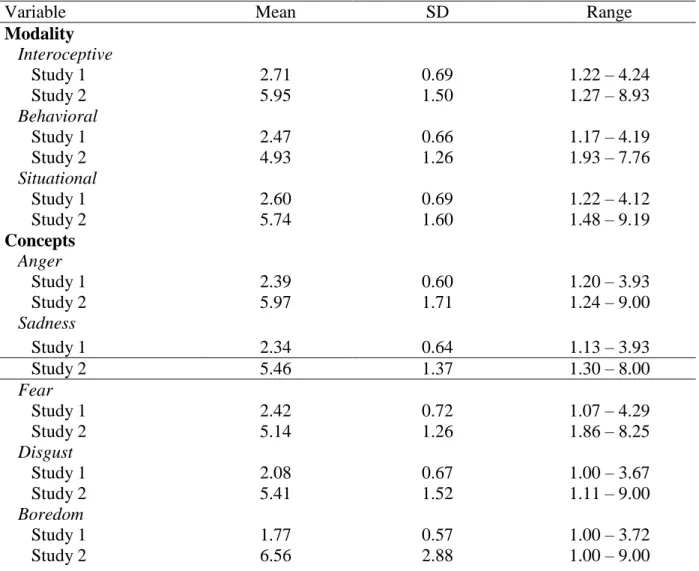
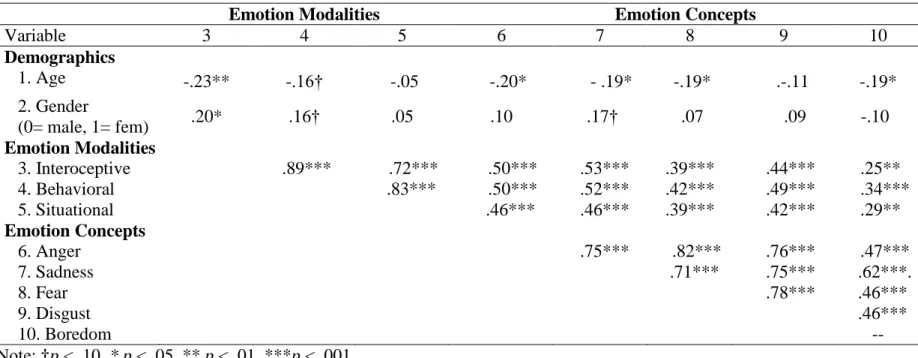
To assess differences in emotion modality associations, we calculated a mean score for all three modalities (an interoceptive mean, behavioral mean, and situational mean) based on participants’ likert scale ratings (i.e., “How much does this describe a bodily feeling you would have when experiencing an emotion?”). To assess differences in emotion concept associations, we calculated a mean score for each discrete emotion concept, resulting in five discrete emotion means (anger, sadness, fear, disgust, and boredom). All variables demonstrated univariate and multivariate normality (see Table 1 for means, standard deviations, and ranges for the modality and emotion concept means). Bivariate correlations between all modality and emotion means, age, and gender are presented in Table 2.
Validating Suitability. Based on the modality and discrete emotion category ratings for
total mean score = 2.82, interoceptive mean score = 3.41, behavioral mean score = 2.32, and situational mean score = 2.73).
To clarify which discrete emotion concept participants had most strongly associated with each emotion property, we calculated mean scores for each property word according to the five emotion concepts (anger mean, sadness mean, disgust mean, fear mean, boredom mean) based on how participants responded to the concept specific questions (i.e., “How much does this describe anger/sadness/disgust/fear/boredom?”).We then calculated a total across-emotions mean score for each property word by averaging across the five emotion concepts for that particular emotion property ([anger mean + sadness mean + disgust mean + fear mean + boredom mean] ÷ 5) Each property’s concept mean score was then compared to its total across-emotions mean score to determine if participants were more likely to report it as being an attribute of one
concept more so than the others. If one of the concept means of a property word was >.1 than the total concept mean score of that property word, and the other two modality means were <0.0 than the total mean score, I assigned that property word to the corresponding concept (e.g., “hot”
concept total mean score = 1.99, for anger mean score = 3.11, sadness mean score = 1.53, disgust mean score = 1.95, fear mean score= 1.84, and boredom mean score = 1.53). The final list of 100 emotion properties included 40 interoceptive properties, 29 behavioral properties, and 31
situational properties. Each property was linked to its most strongly associated discrete emotion to then formed a concept-property item (for example, “ANGER-hot” where “anger” is the emotion concept and “hot” is the interoceptive property; see Appendix for a full list of the final 100 concept-property items).
Determining Age Differences. To test our prediction that older adults would be
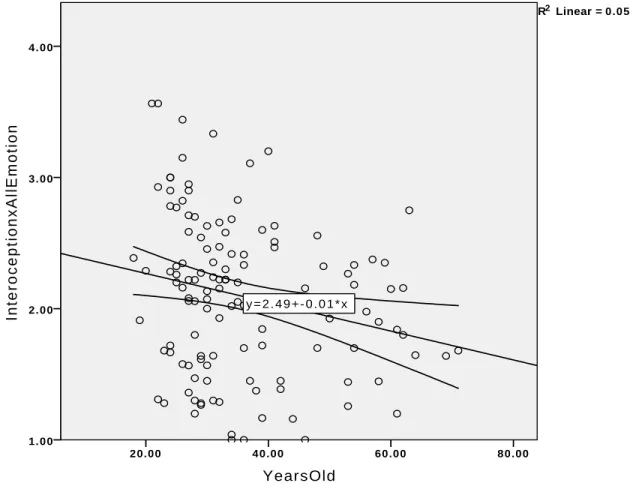
age (i.e., years old) as a continuous predictor. Age was a significant predictor of interoceptive ratings (β = -.01, p = .009), suggesting that older adults are less likely to rate emotion properties in general as interoceptive compared to younger adults. Age only marginally predicted
behavioral ratings (β = -.01, p = .077), suggesting that older adults may be less likely to rate emotion properties as behavioral compared to younger adults. However, age was not a
significant predictor of situational ratings (β = -.003, p = .572), suggesting that older and younger adults are equally likely to rate properties of emotions as situational. See Figures 1, 2, and 3 for scatterplots of each regression.
We also tested whether age predicted any significant modality differences across all discrete emotion categories. After computing a mean score for all Interoceptive properties across all discrete emotion ratings, a mean score for all behavioral properties across all discrete emotion ratings, and a mean score for all situational properties across all discrete emotion ratings, we used multiple linear regressions with age as the predictor. We found that age was a significant predictor of interoceptive ratings across all emotion categories ((β = -.011, p = .011), such that older adults were less likely to indicate that interoceptive phenomena (e.g., “hot”) were a
property of specific discrete emotion categories. Age was also a marginally significant predictor for behavioral ratings across all emotion categories (β = -.007, p = .084), but was not a
significant predictor for situational ratings across all emotion categories (β = -.003, p = .573), See Figures 1, 2, and 3 for scatterplots of each regression.
Study 2
deemed to be the best examples of interoceptive, behavioral and situational properties, as well as the properties that were most indicative of each of the five emotion categories. To assess whether age changes older adults’ embodied representations of emotion categories, we used a property verification task (Kan et al. 2003) in which participants rated how much each property came to mind when thinking about a specific emotion concept (e.g., how much does ABANDONED come to mind when thinking about SAD?). We predicted that older adults would be less likely to describe interoceptive properties as representing discrete emotions.
Participants
151 (57.3% female) participants were recruited using Amazon’s Mechanical Turk (MTurk). Age calculations reveal a range of 18-75 with 56.6% falling between 18-40, 17.2% between 41-49, and 26.2% between 50-75. Ethnicity and race were representative of typical American-wide demographics (78.7% European American, 5.3% African American, 6.0% Asian American, and 6.0% Latin American). Total annual income ranged from $0.00 to $167000.00per year (Mincome = $48292.25, SD= 35384.98).
Measures
In Study 1, we developed 100 emotion property words based on each of the three modalities of emotion experience that were validated in Study 1 (see appendix).
Procedures
Association ratings and reaction times. Next, participants read the following
instructions: “In this task, you will rate how much a word comes to mind when thinking about a specific emotion. This task is timed, so please work as quickly and accurately as you can.” Participants then rated how much they thought an emotion property word comes to mind when thinking about a discrete emotion concept. Participants were shown an emotion concept (e.g., ANGER) and asked a question about a corresponding emotion property that was either interoceptive, behavioral, or situational in nature (e.g., “How much does HOT come to mind when you think about anger?”). Participants answered using a 9-point Likert scale (0 = Did not come to mind at all to 9 = Immediately came to mind). Participants rated all100 concept-property pairs, which were randomized across participants. Additionally, we used Qualtrics’ built-in reaction time measure, which measures the time it takes for participants to click on their answer. These provided us with 100 reaction time measures, provided in seconds and
milliseconds.
Demographics. Following the association task, participants reported their age, gender,
ethnicity, level of education, and total annual income. Data Preparation
participants’ reaction times across all items, it was clear that most participants responded within the first 30 seconds, and that outliers emerged after one minute.
Results
To test our prediction that older adults would be significantly less likely to rate interoceptive emotion properties as coming to mind when thinking about discrete emotion concepts, we ran a multilevel linear model. The outcome of interest was participants’ likert ratings for each individual concept property item. As participants rated multiple items in the study, this leads to a multi-level design, with item nested within person. Adding in random effects to the model also allowed every individual to have their own unique mean tendency for interoceptive, behavioral, and situational ratings.
To ensure that the effects were interpretable, age was centered at the lowest age in the sample, 18 years old—so that all positive values would indicate an increase in ratings compared to ratings at age 18 (the intercept) and all negative values would indicate a decrease in ratings compared to ratings at age 18. Age was a continuous variable. Additionally, an age2 term was calculated to address potential curvilinear effects of age.
Level 1 and Level 2 equations are presented below:
Level 1: 𝐿𝑖𝑘𝑒𝑟𝑡𝑖𝑘 = 𝜋0 + 𝜋1∗ 𝑀𝑜𝑑𝑎𝑙𝑖𝑡𝑦𝐼𝑛𝑡+ 𝜋2∗ 𝑀𝑜𝑑𝑎𝑙𝑖𝑡𝑦𝐵𝑒ℎ+ 𝜋3∗ 𝑅𝑒𝑎𝑐𝑡𝑖𝑜𝑛𝑇𝑖𝑚𝑒 +
𝜖𝑖𝑘
Level 2: 𝜋0 = 𝛽00+ 𝛽01∗ 𝐴𝑔𝑒𝑐𝑒𝑛+ 𝛽02∗ 𝐴𝑔𝑒𝑐𝑒𝑛2 + 𝛾00𝑘
𝜋1 = 𝛽10+ 𝛽11∗ 𝐴𝑔𝑒𝑐𝑒𝑛+ 𝛽12∗ 𝐴𝑔𝑒𝑐𝑒𝑛2 + 𝛾 10𝑘
𝜋2 = 𝛽20+ 𝛽21∗ 𝐴𝑔𝑒𝑐𝑒𝑛+ 𝛽22∗ 𝐴𝑔𝑒𝑐𝑒𝑛2 + 𝛾 20𝑘
And the reduced form equation was:
𝐿𝑖𝑘𝑒𝑟𝑡𝑖𝑘 = 𝛽00+ 𝛽01∗ 𝐴𝑔𝑒𝑐𝑒𝑛+ 𝛽02∗ 𝐴𝑔𝑒𝑐𝑒𝑛2 + 𝛽
10∗ 𝑀𝑜𝑑𝑎𝑙𝑖𝑡𝑦𝑖𝑛𝑡 + 𝛽11∗ 𝐴𝑔𝑒𝑐𝑒𝑛∗
𝑀𝑜𝑑𝑎𝑙𝑖𝑡𝑦𝑖𝑛𝑡+ 𝛽12∗ 𝐴𝑔𝑒𝑐𝑒𝑛2 ∗ 𝑀𝑜𝑑𝑎𝑙𝑖𝑡𝑦𝑖𝑛𝑡 + 𝛽20∗ 𝑀𝑜𝑑𝑎𝑙𝑖𝑡𝑦𝑏𝑒ℎ+ 𝛽21∗ 𝐴𝑔𝑒𝑐𝑒𝑛∗
𝑀𝑜𝑑𝑎𝑙𝑖𝑡𝑦𝑏𝑒ℎ+ 𝛽22∗ 𝐴𝑔𝑒𝑐𝑒𝑛2 ∗ 𝑀𝑜𝑑𝑎𝑙𝑖𝑡𝑦
𝑏𝑒ℎ+ 𝛽30∗ 𝑅𝑒𝑎𝑐𝑡𝑖𝑜𝑛𝑇𝑖𝑚𝑒 + 𝛾00𝑘 + 𝛾10𝑘+
𝛾20𝑘 + 𝜖𝑖𝑘
Or more simply, the condensed statistical model was:
Likert Ratings = Intercept + Age(cen) + Age(cen)2 + Modality + (Age × Modality) +
(Age2 × Modality) + RT + Random Effects + Error
Here, the 𝛽s are the fixed effects for the main effect and interaction terms in the model, and the 𝛾s are the random intercepts for each individual on each of the modalities. Each modality was coded 0-1 and situational items served as the reference group so as to allow parsing apart how behavioral and interoceptive items might differ with age in comparison to situational items. Therefore the 𝛽0∗ coefficients represent the intercept and effects of age (at 18 years old) on the situational items, and the other effects represent the difference for interoceptive and behavioral items in the intercept and effects of ages from the effects of the situational items. Reaction time for each item was included in the model to control for potential age effects on reaction time (in case older adults might be slower than younger adults). Additionally, the random intercepts allow each individual to have their own unique mean score on interoceptive, behavioral and situational items. All random intercepts were allowed to correlate freely with one another (thus having an unstructured covariance matrix).
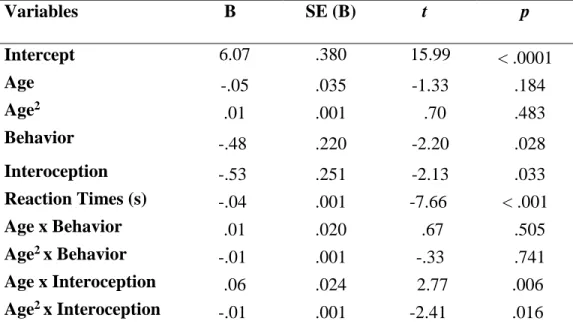
There were several significant fixed effects. The intercepts for behavioral and
B= -.53, p= .033), suggesting that on average, participants aged 18 tended to endorse behavioral and interoceptive items less than situational items. There were no main effects of age nor age squared (B= -.05, p= .184; B= .01, p= .483), meaning that age did not significantly predict individual’s responses for situational modalities. Nor were there age x modality or age-squared x modality interactions for behavioral items (B= .01, p= .505; B= -.01, p= .741), suggesting that age does not significantly predict individual’s responses for behavior modalities of emotion concepts. However, there were significant interactions between age x modality and age-squared x modality for interoceptive items (B= .06, p= .006; B= -.01, p=.016), suggesting a general trend of increasing responses for interoceptive items as age increases into late adulthood (the linear Age effect), and then a decreasing rate of responses on interoceptive items into old age (the Age-squared curvilinear effect). These age effects for situational, behavioral, and interoceptive modalities are plotted in Figure 4.
Discussion
In two studies, I tested whether older adults conceptualize their emotions differently than younger adults. Across both studies, I found that older adults do indeed experience an
interoceptive-general decrement in their representation of emotion concepts. For example, in Study 1, older adults are less likely to see an emotion property word (e.g., hot) as representing an internal feeling that you would have when experiencing an emotion. Furthermore, older adults are less likely to think of interoceptive property words as describing specific discrete emotions (e.g., hot describes anger). In Study 2, I again found that older adults are less likely to associate interoceptive property words with specific discrete emotions. Additionally, Study 2 suggests that the influence of interoceptive information in informing a person’s emotion concepts is
With regards to non-interoceptive properties, I found in Study 1 that older adults are marginally less likely to see a behavioral emotion property word (e.g., clenched fists) as representing a behavior that is linked to emotional experience in general or specific discrete emotions in particular (e.g., that clenched fists describes anger). However, in Study 2, I found that older adults are not less likely to associate behavioral property words with the domain of emotion or particular discrete emotions than younger adults. In both Studies 1 and 2, age was not a significant predictor of participants’ situational ratings, suggesting that older adults do not conceptualize the situational nature of emotions differently from younger adults.
These findings suggest that emotion concepts vary as a result of age. Overall, older adults are less likely to rate interoceptive emotion properties as describing an emotional experience, which may support the maturational dualism hypothesis. Older adults are perhaps also less likely to associate behavioral properties with discrete emotions (see Table 2), but these findings were marginal in Study 1 and not present in Study 2, suggesting that the simulation of behavior properties in the brain may be weakened by aging because it involves an aspect of the body, however not to the same extent as interoception. Future studies should investigate the possible links between modalities, and especially the one between behavior and interoception. It is likely the case that, because all concepts are embodied (see Kiefer & Barsalou, 2013), behavioral and situational modalities are in some way embodied, but may draw less on embodied processes that are impacted with age (e.g., peripheral physiology, interoceptive abilities).
interoceptive merely due to generational effects in emotion concept knowledge. For instance, older adults, who developed their emotion knowledge during a different period of history than younger adults, might merely know and emphasize different aspects of emotions than younger adults. Regardless of the cause, the fact that older adults’ concepts are informed less by
interoceptive information could create a difference in emotional experience if concepts are used to make meaning of one’s affective state in the moment. Psychological constructionism predicts that concept knowledge about emotion categories is used in the moment when individuals make meaning of their core affective states (e.g., Lindquist & Barrett, 2008). If older adults’ concepts involve less interoceptive information, then an older adult might be less likely to make meaning of a beating heart as an experience of fear than a younger adult.
nervous system starts to change in middle age and beyond. Future research should address this question by assessing whether embodied concept knowledge tracks with individuals’ actual interoceptive abilities (e.g., in a heartbeat detection task).
Limitations and Future Directions
There are several limitations to the present studies. First, as mentioned previously, these studies did not measure actual experiences of emotion—they instead measured individuals’ emotion concepts. Emotion concepts are likely informed via experience (Lindquist et al. 2015), and might in turn shape experiences (Lindquist & Barrett, 2008; see Lindquist, Satpute, & Gendron, 2015 for a review), but are not the same as actual momentary experiences of emotion. To address this question, future studies should see if physiological responses to tasks that are meant to elicit an emotional response vary with age. A fear induction task may cause a quicker and more rapid heartbeat in younger adults, and it may take less stimulation for them to self-report experiencing fear. Finding this “stimulation threshold” is another direction for future studies. Additionally, neuroimaging might provide insight into the biological differences that may be occurring when individuals experience an instance of fear.
Another limitation is that these studies were cross-sectional. It could be that older adults’ access to interoceptive language differs from younger adults. Older adults might use other words to describe their bodily states because of generational differences in language use or conceptual knowledge. Given that semantic knowledge is grounded in modality specific systems in the brain (Kiefer, & Barsalou, 2013), future researchers may consider using reaction time and property switching tasks to investigate whether or not simulation is occurring differently as a function of age (see Pecher, Zeelenberg, & Barsalou, 2003). Longitudinal study designs may look to
nature of a person’s emotion self-reports across several decades to see if the descriptions use less interoceptive words.
Implications
The aging process is characterized by change. Mental and physical capacities vary depending on age and lifestyle. Aging brings with it modality-specific declines—for example, decreased memory (Buckner, 2004), poorer executive function (Buckner, 2004), and less
sensitive physiological feedback (Khalsa et al., 2009; Mendes, 2010). Because of the constructed nature of emotions, one should expect the emotional experience of older adults to also change. This study provides insight into what the change in older adults’ emotional experience might be – a decline in overall interoceptive accessibility. Future research on aging and emotion should be mindful of these discrepancies in interoceptive awareness that accompany aging.
In order to maintain a high level of functioning, research suggests that aging individuals selectively optimize their lives, behaviors, and experiences in efforts to compensate for these modality-specific declines – as well as relying on overcompensation in brain (Baltes et al., 1999; Reuter-Lorenz, & Cappell, 2008). Future research should thus investigate how one might
References
Baltes, P. B., Staudinger, U. M., & Lindenberger, U. (1999). Lifespan psychology: theory and application to intellectual functioning. Annual Review of Psychology, 50, 471–507. Barrett, L. F. (2014). The conceptual act theory: A précis. Emotion Review, 6(4), 292–297. Barrett, L. F. (2006). Are emotions natural kinds? Perspectives on Psychological Science, 1(1),
28–58.
Barrett, L. F., & Lindquist, K. A. (2008). The embodiment of emotion. In G. Semin & E. Smith (Eds.), Embodied grounding: Social, cognitive, affective, and neuroscientific approaches
(pp. 237–262). New York, NY: Cambridge University Press.
Barrett, L. F., Quigley, K. S., Bliss-Moreau, E., & Aronson, K. R. (2004). Interoceptive sensitivity and self-reports of emotional experience. Journal of Personality and Social Psychology, 87(5), 684–697.
Barsalou, L. W. (2012). The human conceptual system. The Cambridge Handbook of Psycholinguistics, 240–257.
Barsalou, L. W. (2009). Simulation, situated conceptualization, and prediction. Philosophical Transactions of the Royal Society of London. Series B, Biological Sciences, 364(1521), 1281–9. doi:10.1098/rstb.2008.0319
Barsalou, L. W. (2008). Grounded cognition. Annual Review of Psychology, 59, 617–45. Berlucchi, G., & Aglioti, S. M. (2010). The body in the brain revisited. Experimental Brain
Research, 200(1), 25–35.
Buckner, R. L. (2004). Memory and executive function in aging and AD. Neuron, 44(1), 195– 208.
Cabeza, R., Anderson, N. D., Locantore, J. K., & McIntosh, A. R. (2002). Aging gracefully: Compensatory brain activity in high-performing older adults. Neuroimage, 17, 1394–1402. Carstensen, L. L., Mayr, U., & Nesselroade, J. R. (2000). Emotional experience in everyday life
across the adult life span. Journal of Personality and Social Psychology,79(4), 644–655. Critchley, H. D. (2009). Psychophysiology of neural, cognitive and affective integration: fMRI
and autonomic indicants. International Journal of Psychophysiology, 73(2), 88–94. Dunn, B., Galton, H., Morgan, R., Evans, D., Oliver, C., Meyer, M., Dalgleish, T. (2010).
Ekman, P., & Cordaro, D. (2011). What is meant by calling emotions basic. Emotion Review,
3(4), 364–370.
Glenberg, A. M., & Gallese, V. (2012). Action-based language: A theory of language acquisition, comprehension, and production. Cortex, 48(7), 905–922.
Goodpaster, B., Park, S., Harris, T., Kritchevsky, S., Nevitt, M., Schwartz, A., Simonsick, E., Tylavsky, F., Visser, M., Newman, A. (2006). The loss of skeletal muscle strength, mass, and quality in older adults: The health, aging and body composition study. The Journals of Gerontology Series A: Biological Sciences and Medical Sciences, 61(10), 1059–1064. Kan, I. P., Barsalou, L. W., Solomon, K. O., Minor, J. K., & Thompson-Schill, S. L. (2003).
Role of mental imagery in a property verification task: FMRI evidence for perceptual representations of conceptual knowledge. Cognitive Neuropsychology, 20(3), 525–540. Khalsa, S., Rudrauf, D., & Tranel, D. (2009). Interoceptive awareness declines with age.
Psychophysiology, 46(6), 1130–1136.
Kiefer, M., & Barsalou, L. (2013). Grounding the human conceptual system in perception, action, and internal states. Grounding the Human Conceptual System (pp. 381–407). Kober, H., Barrett, F., Joseph, J., Bliss-Moreau, E., Lindquist, K., & Wager, T. D. (2008).
Functional grouping and cortical – subcortical interactions in emotion : A meta-analysis of neuroimaging studies. NeuroImage,42, 998–1031.
Kövecses, Z. (2003). Metaphor and emotion: Language, culture, and body in human feeling. Cambridge, UK: Cambridge University Press.
Labouvie-Vief, G., DeVoe, M., & Bulka, D. (1989). Speaking about feelings: conceptions of emotion across the life span. Psychology and Aging, 4(4), 425–437.
Levenson, R., Carstensen, L., Friesen, W., & Ekman, P. (1991). Emotion, physiology, and expression in old age. Psychology and Aging, 6(1), 28–35.
Lindquist, K. (2013). Emotions emerge from more basic psychological ingredients: A modern psychological constructionist model. Emotion Review, 5(4), 356–368.
Lindquist, K. A., & Barrett, L. F. (2012). A functional architecture of the human brain: Insights from emotion. Trends in Cognitive Sciences, 16, 533–554.
Lindquist, K. A., & Barrett, L. F. (2008). Constructing emotion: The experience of fear as a conceptual act. Psychological Science, 19(9), 898–903.
Lindquist, K., MacCormack, J.,& Shablack, H. (2015). The role of language in emotion:
Lindquist, K.A., Satpute, A.B., & Gendron, M. (2015). Does language do more than communicate emotion? Current Directions in Psychological Science, 24, 99-108.
Mendes, W. B. (2010). Weakened links between mind and body in older age: The case for maturational dualism in the experience of emotion. Emotion Review, 2(3), 240–244. Ong, A., & Bergeman, C. (2004). The complexity of emotions in later life. The Journals of
Gerontology. Series B, Psychological Sciences and Social Sciences, 59(3), 117–122. Oosterwijk, S., Lindquist, K. A., Anderson, E., Dautoff, R., Moriguchi, Y., & Barrett, L. F.
(2012). States of mind: emotions, body feelings, and thoughts share distributed neural networks. NeuroImage, 62(3), 2110–28.
Panksepp, J. (1998). The periconscious substrates of consciousness: Affective states and the evolutionary origins of the self. Journal of Consciousness Studies, 5(5-6), 566–582. Pecher, D., Zeelenberg, R., & Barsalou, L. (2003). Verifying different-modality properties for
concepts produces switching costs. Psychological Science, 14(2), 119–24.
Ready, R., Carvalho, J., & Weinberger, M. (2008). Emotional complexity in younger, midlife, and older adults. Psychology and Aging, 23(4), 928–933.
Reuter-Lorenz, P., & Cappell, K. (2008). Neurocognitive aging and the compensation hypothesis. Current Directions in Psychological Science, 17(3), 177–182.
Russel, J. (1980). A circumplex model of affect. Journal of Personality and Social Psychology, 39(6), 1161-1178.
Salthouse, T. (1994). The aging of working memory. Neuropsychology, 8(4), 535–543. Somerville, L., Fani, N., & MaClure-Tone, E. (2011). Behavioral and neural representation of
emotional facial expressions across the lifespan. Developmental Neuropsychology, 36(4), 408–428.
Sprengelmeyer, R., Young, A., Calder, A., Karnat, A., Lange, H., Homberg, Perrett, D., Rowland, D. (1996). Perception of faces and emotions in Huntington’s disease. Brain, (119), 1647–1665.
Stapleton, M. (2013). Steps to a “properly embodied” cognitive science. Cognitive Systems Research, 22-23, 1–11.
Touroutoglou, A., Lindquist, K. A., Dickerson B. C., & Barrett, L. F. (2015). Intrinsic connectivity in the human brain does not reveal networks for "basic" emotions. Social Cognitive and Affective Neuroscience.
Truett, A., Hume, A., Wood, C., & Goff, W. (1984). Developmental and aging changes in
somatosensory, auditory and visual evoked potentials. Electroencephalography and Clinical Neurophysiology, 58, 14–24.
Whelan, R. (2008). Effective analysis of reaction time data. The Psychological Record, 58, 475– 482.
Table 1. Summary of Means, Standard Deviations, and Ranges for the Emotion Modality means and Emotion Concept means for Studies 1 and 2.
Variable Mean SD Range
Modality
Interoceptive
Study 1 2.71 0.69 1.22 – 4.24
Study 2 5.95 1.50 1.27 – 8.93
Behavioral
Study 1 2.47 0.66 1.17 – 4.19
Study 2 4.93 1.26 1.93 – 7.76
Situational
Study 1 2.60 0.69 1.22 – 4.12
Study 2 5.74 1.60 1.48 – 9.19
Concepts
Anger
Study 1 2.39 0.60 1.20 – 3.93
Study 2 5.97 1.71 1.24 – 9.00
Sadness
Study 1 2.34 0.64 1.13 – 3.93
Study 2 5.46 1.37 1.30 – 8.00
Fear
Study 1 2.42 0.72 1.07 – 4.29
Study 2 5.14 1.26 1.86 – 8.25
Disgust
Study 1 2.08 0.67 1.00 – 3.67
Study 2 5.41 1.52 1.11 – 9.00
Boredom
Study 1 1.77 0.57 1.00 – 3.72
Table 2. Correlations between Demographics, Emotion Modalities, & Emotion Concepts in Study 1.
Emotion Modalities Emotion Concepts
Variable 3 4 5 6 7 8 9 10
Demographics
1. Age -.23** -.16† -.05 -.20* - .19* -.19* .-.11 -.19* 2. Gender
(0= male, 1= fem) .20* .16† .05 .10 .17† .07 .09 -.10 Emotion Modalities
3. Interoceptive .89*** .72*** .50*** .53*** .39*** .44*** .25** 4. Behavioral .83*** .50*** .52*** .42*** .49*** .34***
5. Situational .46*** .46*** .39*** .42*** .29**
Emotion Concepts
6. Anger .75*** .82*** .76*** .47***
7. Sadness .71*** .75*** .62***.
8. Fear .78*** .46***
9. Disgust .46***
10. Boredom --
Table 3. Fixed Effects for Study 2 Multilevel Model With Age as a Continuous Predictor.
Variables B SE (B) t p
Intercept 6.07 .380 15.99 < .0001
Age -.05 .035 -1.33 .184
Age2
.01 .001 .70 .483
Behavior -.48 .220 -2.20 .028
Interoception -.53 .251 -2.13 .033
Reaction Times (s) -.04 .001 -7.66 < .001
Age x Behavior .01 .020 .67 .505
Age2 x Behavior
-.01 .001 -.33 .741
Age x Interoception .06 .024 2.77 .006 Age2 x Interoception
Figure 1. Linear Regression Scatterplot of Interoceptive Ratings Across All Emotion Categories in Study 1.
YearsOld
80.00 60.00
40.00 20.00
In
te
ro
c
e
p
ti
o
n
x
A
ll
E
m
o
ti
o
n
4. 00
3. 00
2. 00
1. 00
y = 2 . 4 9 + - 0 . 0 1 * x
R2 Linear = 0.051
Figure 2. Linear Regression Scatterplot of Behavioral Ratings Across All Emotion Categories in Study 1.
YearsOld
80.00 60.00
40.00 20.00
B
e
h
a
v
io
rx
A
ll
E
m
o
ti
o
n
4.00
3.00
2.00
1.00
y = 2 . 4 2 + - 7 . 2 1 E - 3 *x
R2 Linear = 0.024
Figure 3. Linear Regression Scatterplot of Situational Ratings Across All Emotion Categories in Study 1.
YearsOld
80.00 60.00
40.00 20.00
S
it
u
a
ti
o
n
x
A
ll
E
m
o
ti
o
n
4.00
3.00
2.00
1.00
y = 2 . 4 + - 2 . 8 2 E - 3 * x
R2 Linear = 0.003
Figure 4. Scatterplot of Interoceptive, Behavioral, and Situational Likert Ratings Controlling for Reaction Times, With Age as a Continuous Predictor in Study 2.
Likert ratings (1-9) controlling for RT
Ag
e
in
Y
e
ar
s I
n
cr
e
as
in
Appendix. Final List of 100 Emotion Concept-Property Items.
Interoceptive Situational Behavioral
ANGER Blood Pumping Cheated Careless
Flushed Cruel Fixed Gaze
Head Rush Disgraced Growling
Hot Explosive Loud
Red-Faced Incompetent Pushing Away
Tightness Injustice Sarcastic
Juiced Insulted Screaming
Mistreated Staring Persecuted Willful Thwarted
Violent Oppressed Harm
SADNESS Aching Abandoned Frowning
Drained Defeated Moaning
Exhausted Degraded Mumbling
Fatigued Failure Seeking Comfort
Numb Inferior Silence
Pain Intolerable Withdrawing
Weak Lonely
Weary Loss
Worn Out Rejection
Vulnerable Wistful
FEAR Breathless Danger Approach
Butterflies in Stomach Uncertain Avoidant
Dizzy Unprotected Careful
Faint Cautious
Goosebumps Protective
Heartbeat Resistant
Jittery Retreated
Knots Running
Wide Awake White-Faced
DISGUST Ill Despicable Looking Away
Nauseas Immorality Lurching
Sick Squint
Turned Stomach
BOREDOM Drowsy Ambiguity Contemplative
Sleepy Sighing
Sluggish Sitting