ESSAYS ON MICROECONOMICS
Sam Flanders
A dissertation submitted to the faculty of the University of North Carolina at Chapel Hill in partial fulllment of the requirements for the degree of Doctor of Philosophy in the Department of Economics.
Chapel Hill 2016
Approved by: Gary Biglaiser Fei Li
Peter Norman Ju Hyun Kim Brian McManus Ju Hyun Kim
c
2016
Sam Flanders
ABSTRACT
SAM FLANDERS: Essays on Microeconomics (Under the direction of Gary Biglaiser.)
This dissertation consists of three essays on applied microeconomic theory, focusing on matching markets. The rst two essays focus on nding closed form solutions to matching problems. Both generalize Gary Becker's well-known assortative matching results to more general environments. Becker studied a frictionless one-to-one matching environment with vertical or quality-based univariate preferences and found that, the higher one's type, the higher the type of their match will be, an implication that has been extremely inuential in empirical work. The rst paper generalizes this analysis to an environment where agents care about many traits instead of just one and have more general preferences, rather than restrict-ing attention to vertical preferences. The latter generalizes it to a univariate environment where agents can have any ideal type and preference is decoupled from type, such that dier-ent agdier-ents of the same type can have dierdier-ent preferences. Both papers provide closed-form matching functions and make empirical predictions about the structure of matching. Theo-retical and empirical interest in matching is currently shifting to richer settings where agents have varied preferences and must make tradeos between various traits they care about, so foundational work on the qualitative structure of sorting in these settings is necessary to provide intuition for researchers and to direct empirical questions, and closed-form matching functions can make theoretical models with embedded matching problems tractable.
ACKNOWLEDGMENTS
There are countless individuals who have helped me along the way, most of whom will not be mentioned by name here. Needless to say, I am grateful to every single person who has aided me. Thank you from the bottom of my heart.
I would like to rst and foremost thank my advisor Gary Biglaiser, whose help and guidance throughout the years have been invaluable. I could not have asked for a better mentor. I would also like to thank my dissertation committee members, Peter Norman, Fei Li, Ju Hyun Kim, Brian McManus, and Atila Abdulkadiroglu, for their tutelage. They have aided me from start to nish, from drafts to presentations, and from ideas to realizations. Thank you also to all of the members of the UNC Microeconomic Theory Workshop, namely Matthew Horne, Yiyi Liu, and Ben Labe, for their insightful comments that have helped shape the essays in this dissertation. I would also like to thank the Royster Society of Fellows for supporting my nal year of research and the UNC Childcare Scholarship for enabling the graduate student parents of a feisty little boy, Erhan, to actually get work done during the day.
TABLE OF CONTENTS
LIST OF TABLES . . . ix
LIST OF FIGURES . . . x
1 Catsh: Lying in Matching Markets with Cheap Talk . . . 1
1.1 Introduction . . . 1
1.2 Related Literature . . . 6
1.3 Model . . . 7
1.3.1 Preliminaries . . . 7
1.3.2 The Set of Equilibria . . . 12
1.3.3 Steady State in the Limited Pooling Equilibrium. . . 22
1.4 Strategic Platforms . . . 26
1.4.1 Per-Date Costs as Frictions . . . 26
1.4.2 Additively Separable Match Utility and Per-Date Prices . . . 31
1.5 Conclusions . . . 33
1.6 Appendix . . . 34
1.6.1 Extensions . . . 34
1.6.2 Proofs . . . 41
2 Matching with Single Peaked Preferences . . . 53
2.1 Introduction . . . 53
2.2 Model with homophilic preferences . . . 56
2.2.1 Baseline Model . . . 56
2.2.2 Extensions to the Baseline Model . . . 59
2.3 Generalization to arbitrary single peaked preferences . . . 61
2.3.2 Extensions to the Baseline Model . . . 69
2.4 Relationship to the Literature . . . 74
2.5 Interpretation and Empirical Implications . . . 75
2.5.1 Interpretation . . . 75
2.5.2 Empirical Implications . . . 77
2.6 Conclusions . . . 77
2.7 Appendix . . . 78
2.7.1 Uniqueness of the Stable Matching . . . 78
3 Matching Markets with N-Dimensional Preferences . . . 82
3.1 Introduction . . . 82
3.2 Theoretical Preliminaries . . . 86
3.2.1 The Model . . . 86
3.2.2 Modeling Various Preference Types in a Horizontal Framework . . . . 88
3.2.3 Aggregation to a Single Dimension . . . 89
3.3 Theoretical Results for Symmetric Distributions . . . 91
3.3.1 Nontransferable Utility Matching with Symmetric Distributions . . . 91
3.3.2 Transferable Utility Matching with Symmetric Distributions . . . 95
3.3.3 Matching with Asymmetric Distributions . . . 97
3.4 Simulation Framework . . . 99
3.4.1 Simulation Setup . . . 99
3.4.2 Simulation Model Specications . . . 99
3.5 Results . . . 101
3.6 Conclusions . . . 108
3.7 Appendix . . . 110
3.7.1 Proofs . . . 110
3.7.2 Monte Carlo Simulations . . . 114
LIST OF TABLES
LIST OF FIGURES
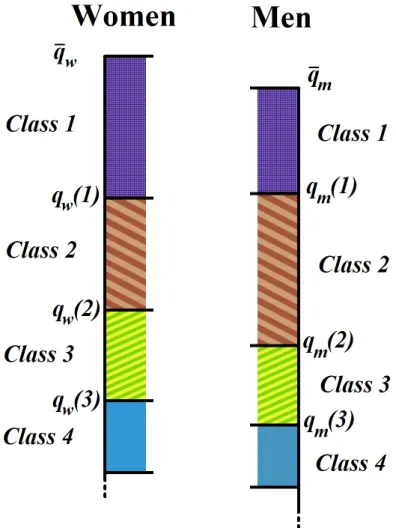
1.3.1 The class structure of an equilibrium. . . 14
1.3.2 This diagram shows inter-class pooling, as in Proposition 2. . . 15
1.3.3 The pooling structure of an LPPE. . . 19
1.4.1 The trade-o induced by q(2) shifting due to an increase in c. . . 30
1.6.1 Cost per-date 1 . . . 39
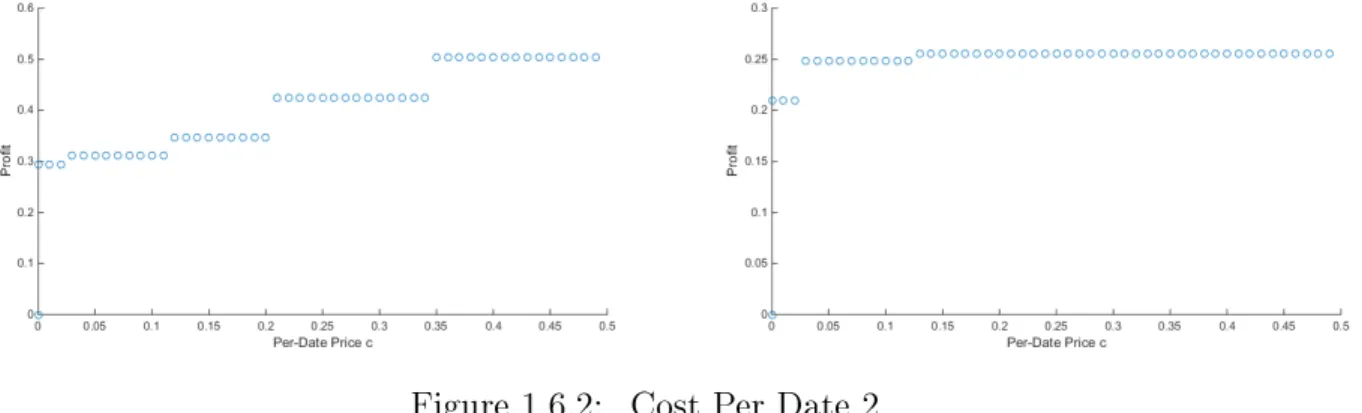
1.6.2 Cost Per Date 2 . . . 40
1.6.3 Cost Per Date 3 . . . 40
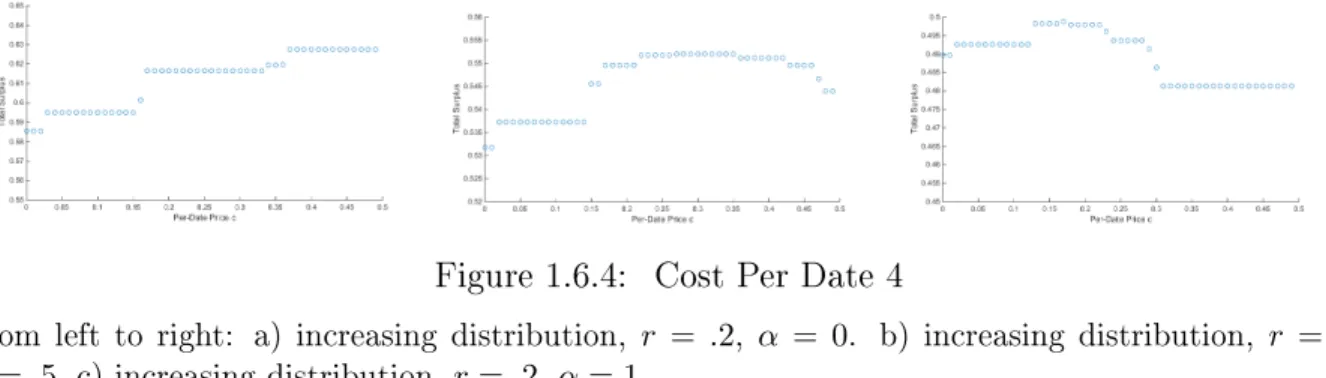
1.6.4 Cost Per Date 4 . . . 41
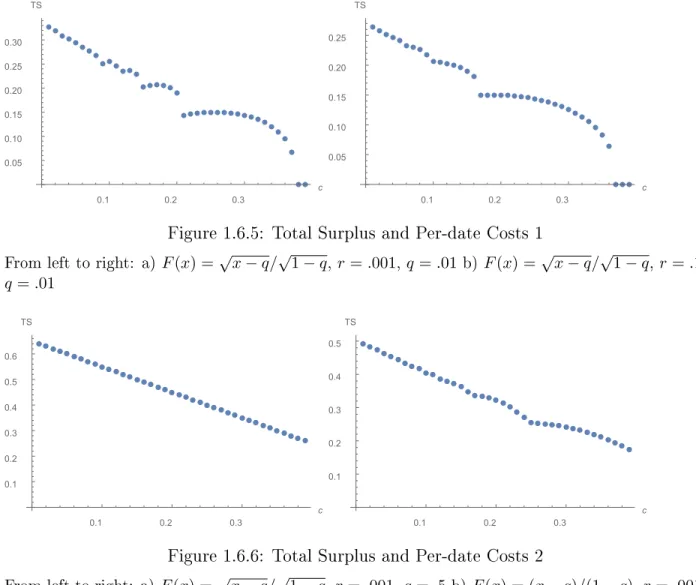
1.6.5 Total Surplus and Per-date Costs 1 . . . 51
1.6.6 Total Surplus and Per-date Costs 2 . . . 51
1.6.7 Total Surplus and Per-date Costs 2 . . . 52
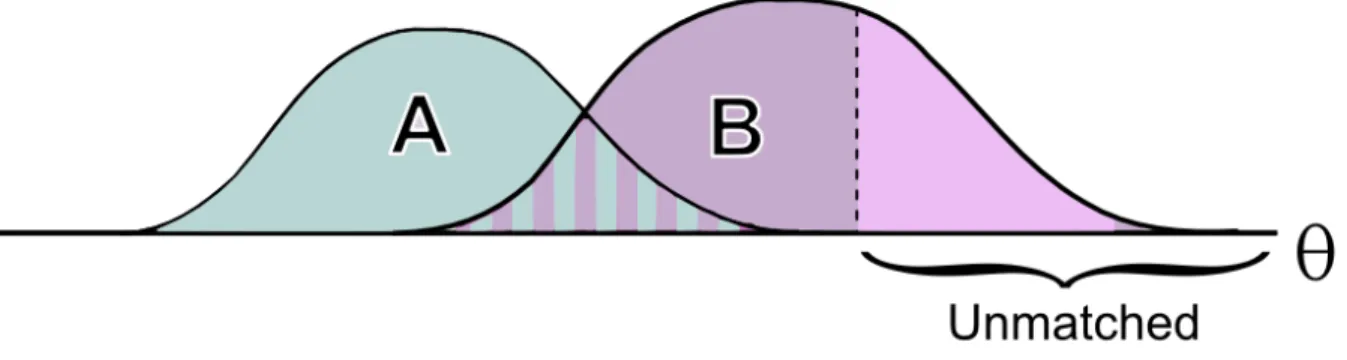
2.2.1 Initial distributions A and B of agents over type θ. . . 57
2.2.2 Remainder distributions A0 and B0. . . 57
2.2.3 Inside-Out Matching. . . 59
2.2.4 Matching with unbalanced distributions. . . 60
2.2.5 Matching without the single crossing property. . . 61
2.2.6 Matching when agents have the option to refuse. . . 62
2.3.1 Contour plot of the trait/preference distribution A. . . 63
2.3.2 Overlaid contour plots of distributions A (teal) and B (purple). . . 63
2.3.3 Comparing matches graphically using the overlay. As shown above, the . . . 64
2.3.4 Matching from the southwest to northeast on the remainder distributions. . . 65
2.3.5 Matching with unequal marginal distributions. . . 71
2.3.6 Proposition 18, Case 1 Example. . . 72
2.3.7 Proposition 18, Case 2 Example. . . 73
2.4.1 Horizontal preferences in the single peaked preference framework. . . 74
2.4.2 Horizontal matching in the single peaked preference framework . . . 75
2.4.3 Vertical preferences in the single peaked preference framework. . . 76
3.2.1 Mapping vertical preferences to a horizontal model. . . 88
3.3.1 Failure of the symmetry assumption. . . 98
3.4.1 Rotation example . . . 100
3.5.1 NTU with baseline specications 1. . . 104
3.5.2 NTU with baseline specications 2. . . 105
3.5.3 NTU with baseline specications 3. . . 106
3.7.1 Horizontal deviations have small utility eects relative to vertical deviations. 116 3.7.2 TU and NTU stable assignments dier when the symmetry assumption fails. 119 3.7.3 NTU with baseline specications 4. . . 120
3.7.4 NTU with baseline specications 5. . . 121
3.7.5 TU with baseline specications 1. . . 122
3.7.6 TU with baseline specications 2. . . 123
3.7.7 TU with baseline specications 3. . . 123
3.7.8 TU with baseline specications 4. . . 124
CHAPTER 1
CATFISH: LYING IN MATCHING MARKETS WITH CHEAP TALK
1.1 Introduction
This paper studies matching markets with catsh, a neologism for someone who attempts to attract matches on an online dating platform by lying about themselves. Online dating has become a common component of dating and partnership formation, and is a fast growing market, taking in $1.08 billion in revenue for dating sites and $572 million for dating apps in 2014.1 Lying is an important factor in search on these platforms; the distributions of reported types for traits like income and male height tend to be shifted right on online dating platforms relative to the broader population, suggesting misreporting,2 and one industry study found that 20% of women and 33% of men admit to lying on their online dating proles.3 This report also oers advice on how to account for such misreporting, advising women to assume the men you meet might not be quite as tall, as successful or as connected as they say they are, and then decide whether you'd still consider dating them regardless, suggesting that misreporting is an important factor in agent search strategies. We study a stylized model motivated by this issue, with a two sided (men and women) platform allowing agents to search for matches on the other side4 where agents can misreport their type.
Specically, we model a one-to-one nontransferable utility (NTU) matching market with
1http://www.wsj.com/articles/the-dating-business-love-on-the-rocks-1433980637
2http://blog.okcupid.com/index.php/the-biggest-lies-in-online-dating/ 3http://www.ayi.com/dating-blog/ayi-top-online-dating-prole-lies/
random search5 and time discounting where agents pursue long term (permanent) matches. Agents are vertically dierentiated,6 are distributed over a continuum of types, and self-report type. When agents meet, they see one another's self-reports and choose whether to enter a type verication phase (date) or to part and return to search. If they go on a date, they see each other's true type. They then decide whether or not to match permanently.
Going on a date is costly, allowing some agents to protably lie. Before a date, agents weigh the expected payo from continued searching against the benet of matching today less the cost of the date, accepting a match if the latter is higher. However, after the date this per-date cost is sunk and drops from the agent's decision, making them less selective. That is, once you've already made the eort to meet and learn about someone you should be less picky, since if you start your search over again you'll have to make a costly investment in learning about the next person. Thus, some agents will be rejected for a date if they truthfully report their type, but, if they get a date by pooling with more attractive peers, they will be accepted after the date when standards are lower.
We focus on an equilibrium with a minimal amount of pooling, which we term the Lim-ited Pooling equilibrium. In this equilibrium, agents self partition into classes, where each agent only matches within their class. Classes will typically be largerand thus agents less choosywhen per-date costs are higher, since these costs allow lower quality agents to pool with and match to higher types who would like to reject them ex-ante.
We study how a strategic platform charging a single xed fee7 can utilize per-date costs to improve rm prots or maximize surplus as a social planner. We rst consider the case where per-date costs are prices (for example, a price to communicate with an individual you're interested in). Externalities endemic to NTU search markets make agents too picky. In particular, agents don't care about their match's payo, or the payo of other agents in the market, only their own. Without transfers, other agents have no way of making them
5Over time, agents receive random draws from the set of agents on the other side of the market.
6Each type is characterized by a level of quality, and all agents prefer higher quality matches to lower quality matches.
internalize these costs. Thus agents will chase after high quality matches, ignoring the fact that if they get a high quality match, someone else must get a low quality match, so their gain is another's loss. Thus the social planner will want agents to be less picky, since choosy behavior results in surplus loss due to time discounting and benets the social planner much less than it does the individual. Thus, per-date costs can counter this excessive pickiness, and we nd that a social planner will utilize positive per-date prices to make agents less picky and increase total surplus.
A prot seeking monopolist 8platform will also charge positive per-date prices.9 In this environment, the platform fully extracts surplus from the lowest quality agent who joins, while leaving rents to all higher class agents due to the lack of price discrimination. By forcing higher types to match to lower types they'd like to reject, per-date costs can be interpreted as inducing a transfer from high types to low types, which allows the platform to extract more surplus from agents by making the indierent agent better o (and willing to pay more) at a cost to the rents of high type agents, which the platform does not value.
We also consider the case where per-date costs are frictions, and a platform has access to technology that can lower per-date frictions at a cost to the platform. Some online dating platforms in fact oer technologies such as video-chat and ID verication to lower informational frictions. Even in this case, we nd that a monopolist platform often prefers high per-date costs, despite their great cost to agents. Per-date costs can again be interpreted as inducing a transfer from high types to low types, increasing the xed fee the platform can charge. With appropriately chosen per-date costs, this benet osets the direct surplus losses due to per-date frictions. Thus, in this environment platforms often do not have an incentive to induce truth-telling or informative reporting, and in fact may benet from inducing lying if lowering frictions is even slightly costly. A social planner will generally prefer to lower
8A platform with signicant market power may be a reasonable approximation of the online dating market as the market is fairly concentrated and the fact and much of the market outside of the two largest rms, IAC and eHarmony, is highly dierentiated niche platforms like JDate and ChristianMingle.
per-date frictions to zero if the cost to the platform of this technology is suciently low, but there are special cases where even a social planner will prefer higher per-date frictions.
In the broader set of equilibria, the ability to freely report type allows for many forms of pooling, including highly non-monotonic reporting where, for example, agents in a high type class and a low type class make the same report while agents in an intermediate quality class make reports that uniquely identify their class. However, we nd that, regardless of reporting strategies, equilibria are characterized by a class partition where, after going on a date, agents will only match to draws whose true type is within their class. Hence, this paper contributes to the literature by extending the coarse, class based form of positively assortative matching (PAM)10 found previously in NTU search models like Macnamara and Collins (1990) and Burdett and Coles (1997) to an environment with cheap talk and costly type verication.
It also contributes to the literature on two-sided platformsspecically, the literature on strategic matching platforms. In particular, we show how informational frictions can be protably used by a strategic platform to counteract externalities in matching markets. A recent survey of the search and matching literature by Chade, Eeckhout, and Smith (2015) identied the nature and implications of externalities in matching markets as one of the major open questions in the eld, so this analysis addresses an important hole in the literature.
We'll now describe some additional salient features of the online dating market. It features signicant concentration, with eHarmony taking in $310 million in revenue in 2014 and platforms owned by the IAC (Match, Tinder, OkCupid, etc.) taking in $601 million, almost all of which was from dating websites, where total dating site revenue was $1.08 billion. 11. Membership is slightly less concentrated, with IAC platforms serving 21% of users in 2014 and eHarmony serving 13%12. The remainder of the market is composed of small platforms, many of which are niche dating sites, and recent dating app entries. Platforms typically either
10Higher types match with higher types, lower types match with lower types.
11 http://www.washingtonpost.com/news/business/wp/2015/04/06/online-datings-age-wars-inside-tinder-and-eharmonys-ght-for-our-love-lives/
oer a single service at a positive price, or a free, ad-supported service and a premium paid service with additional amenities, such as unlimited messaging, better search options, and video chat. Many platforms engage in second degree price discrimination, oering signicant discounts for longer contracts. Typical contract lengths are 1, 3, 6, or 12 months. Few major platforms engage in overt demographic based price discrimination, although Tinder prices based on age.
While this paper focuses on an application to online dating markets, matching markets with search and costly type vericationand thus an incentive for lower quality agents to pool with higher quality agentsappear in a variety of contexts, notably in job search. While the NTU assumption is less palatable for job search, as wages are often bargained over and can be set exibly by the employer, there are also often limits to the degree of transferability. Among other things, rms may have their wage setting abilities constrained by regulations like minimum wages, and progressive taxation makes larger transfers more costly. Hence, the eciency and protability of positive per-date frictions we nd assuming NTU may extendperhaps with some attenuationto partially transferable utility (PTU) environments that may more credibly model applications like job search. Additionally, in some job search applications like the market for medical residents, wage oers are extremely compressed due to the market structure, making NTU a reasonable assumption. While the National Resident Matching Program ends with a one-shot assignment game based on rankings reported by each side, hospitals and students meet in time consuming and costly interviews before reporting their preferences, suggesting a search model like the present may capture some stylized characteristics of such markets.
1.2 Related Literature
This paper follows a rich literature on search and matching. In particular, it ts within the literature on search and matching with NTU. McNamara and Collins (1990) rst studied the NTU search environment with a continuum of types and found the distinctive partition or class equilibrium common in this literature, where agents in each class only match within their class. Burdett and Coles (1997) extended this analysis to a steady state environment with exogenous inows of agents and endogenous outows. The present paper is closely related to this strand of the literature. In particular, the constant returns to matching model can be interpreted as Burdett and Coles with an additional reporting stage. Eeckhout (1999) extends this result to multiplicatively separable preferences, and Chade (2001) extends it to xed search costs. Smith (2006) looks at even more general preferences, situating the partition result in a larger class of equilibria where partitioning does not necessarily hold. There is a parallel literature for the transferable utility (TU) assumption, with Shimer and Smith (2000) studying equilibria in the analogous TU environment. Generally, TU makes characterizing equilibria, payos and agent behavior more dicult.
There is also a small literature on strategic matching platforms with search. Bloch and Ryder (2000) study a monopolist platform environment that can oer frictionless NTU matches for a xed fee or a xed proportion of match surplus, with an outside option of NTU search. Damiano and Li (2007) study vertically dierentiated agents and a monopolist that creates a continuum of platforms and sets prices to induce agents to join their assigned platform and match with identical agents. Given the simplicity of observed contracts in this market and the potential frictional costs of partitioning agents into many small platforms, our paper instead considers what a less ambitious platform can do in an environment where draw rates proportional to the mass of agents on a platform make innite partition of the space into measure zero platforms inecient. Damiano and Li (2008) study competition between matching markets.
Hopkins (2012), who study matching with signaling. Bilancini and Boncinelli (2013) address a similar NTU environment but assume only one side has unobservable types and consider a binary choice between type certication and full information matching and hiding one's type and matching randomly. The present paper diers from these works by focusing on a cheap talk environment. Ko and Konishi (2010) study a prot-maximizing platform matching rms and workers in a many-to-one environment, where rms and workers report match-specic wage oers and desired wages, respectively. They nd that manipulating reporting by curtailing the message space can improve prots. A current working paper, Hagenbach et al. (2015), studies an environment very similar to ours, with an initial reporting stage and a costly type verication stage before permanent matching in a search environment with vertical dierentiation and NTU. However, they consider a two point type distribution, while our analysis focuses on the class structure that only appears non-degenerately in a model with a continuum of types. We also study strategic platforms, while they focus on a nonstrategic platform.
This paper also relates to the literature on two-sided platforms, pioneered in Rochet and Tirole (2003, 2006) and Armstrong (2006). More recent work includes Weyl (2010), Bedre-Defolie and Calvano (2013), and Lee (2013). In contrast to the majority of this literature, which takes advantage of simple, exogenous specications for network externalities, this paper explicitly models the special case of network eects induced by a search model of matching.
1.3 Model
1.3.1 Preliminaries
We model a heterosexual market on an online dating platform and denote the two sides men (m) and women (w). Agents are characterized by a single vertical characteristic representing quality or attractiveness, where every agent strictly prefers higher quality matches. Quality for side j is distributed over [q
j, qj], qj >0.
13 When agents join the platform, the platform
solicits a report on their true typeqˆ∈[q
j, qj], representing their online dating prole. On the platform, agents engage in bilateral search for partners in continuous time, with a discount rate of r ∈ (0,∞). Agents receive random draws from from the endogenous distribution of agents on the other side Gj(q, t) according to a Poisson process with arrival rate α, where Gj is continuous14
When they meet, each agent observes the other's report, and they make an ex-ante decision whether or not to propose a date. If both propose a date, they pay a per-date cost,15 learn each other's true type, and make an ex-post decision whether to propose a match. If both propose a match they marry forever. If either rejects in the rst stage they part costlessly, while if either rejects after the date they part having paid the per date cost. Inow into the platform is exogenous and time invariant, with the cumulative distribution given by Fj(q), where Fj is twice dierentiable and has full support on [qj, qj]. The corresponding density is given by fj(q). The total mass of inow is equal for both sides and normalized to 1. Outow is determined endogenously by the rate of acceptances and the mass on the platform. The mass of agents on the platform is given by N.
Total match surplus is given by a function u(qm, qw) ≡ ψm(qm)φm(qw) +ψw(qw)φw(qm), where each agent's payo is multiplicatively separable into an own type component ψ and a match's type componentφ. Both are weakly increasing twice dierentiable positive functions, withφ is strictly increasing. We assume non-transferable utility (NTU), whereuw(qm, qw)≡ ψw(qw)φw(qm) and um(qm, qw) ≡ ψm(qm)φm(qw). This means that agents cannot bargain over the apportionment of surplus, perhaps due to social norms, which may be plausible in some matching markets such as dating markets. NTU, along with the multiplicative separability of each agent's own type and match type in their payo, ensures the very simple and tractable class structure common to this literature. Per-date cost for an agent of type qj on side j is ψj(qj)c. This is a strong assumption, but it is also necessary to preserve the
14We'll prove this later.
class structure of the equilibrium.16 When ψ = 1, as in the commonly assumed case where utility is simply match's type, per-date costs can be thought of as either a price imposed by the platform or the opportunity or eort cost of going on a date. Whenψ 6= 1, per date costs should be thought of as opportunity costs that are increasing in type. 17 Unless otherwise noted, agents have an outside option of zero, such that every possible match is preferable to remaining unmatched.
We'll focus on stationary equilibria where
• Assumption 1 (STN) : Each agent believes Gj(q, t) =Gj(q).
Further assume stationary agent strategies, where a strategy is an agent's ex-ante date decision for each reported type and ex-post match decision for each true type. Let µi(ˆq) be agent i's belief about the distribution of q given a report qˆ. Following Burdett and Coles (1997) and extending the denition to a game of incomplete information, we utilize the following denition:
Denition 1 Given (Gm, Gw), a Bayesian perfect partial equilibrium (BPPE) is a strategy prole and beliefsµwhere STN is satised, agents maximize utility subject to their belief about other agents' types and actions and follow sequential rationality, and beliefs are consistent with Bayes rule wherever possible.18
This denition identies a set of candidates for a steady state equilibrium, which we will later winnow down by requiring that inows equal outows.
We can now establish several useful properties of the agents' strategies and payos. First, we'll establish that agents follow cuto strategies:
16We'll relax this assumption in numerical simulations in Appendix 1.6.1. 17Note that, if φ
w = φm, we can dene a new trait x0 = φ(x) and nd a distribution H such that
F(φ−1(x0)) =H(x0). Thus, when we assume symmetric payos it will suce to considerφ(x) =x. However,
when we make distributional assumptions we must note that they will change when types are mapped back into the original distribution.
Lemma 1 In a BPPE each agent x accepts all draws above some cutoq
x ex-post and rejects all draws below. Each agent x accepts all draws with expected discounted match quality above a cuto ex-ante and rejects all draws below. Each agent accepts a strictly positive measure of ex-post matches in equilibrium.
Proof. After true type is revealed, an agent chooses between a continuation value indepen-dent of current draw and the value of the draw. Accepting is costless, so they must accept if the utility of the draw exceeds the continuation value and reject otherwise. Before true type is revealed, agents choose between a continuation value independent of the current report and the expected discounted match quality associated with that report.
Accepting a zero measure of dates or matches yields a continuation value of zero. Ac-cepting any agent yields a strictly positive payo ex-post, thus agents must have a cuto below the maximal type on the other side.
Let Uw(q|qˆ) denote woman q0s expected discounted lifetime utility when reporting qˆ. qwE(q|qˆ)≡Uw(q|qˆ)/ψw(q) is then the expected discounted match quality. Given symmetric denitions for men, we can easily show that higher type agents get matches of weakly better discounted quality (and thus higher utility) and that agents with higher quality matches must have weakly higher types:
Lemma 2 If an agent is of type x > x0, qjE(x|qˆx)≥ qjE(x0|qˆx0). If qjE(x|qˆx)> qjE(x0|qˆx0),
x > x0.
Proof. Given Lemma 1, any agent that will accept x' ex-post must accept x and x can always mimic the x' strategy. Thus an x agent can always obtain at least as high expected match quality as an x' agent.
We will make one of two assumptions about the rate of draws agents face. Specically, we'll assume they face linear returns to matching (LRM) in the main body of the paper, and consider the case of constant returns to matching (CRM)
19 in Appendix 1.6.2.
• Assumption 2A (LRM) : Agents receive a rate of drawsα proportional to the mass of agents on the platform, normalized toN.
• Assumption 2B (CRM) : Agents receive a constant rate of draws α, normalized to 1.
Linear returns to matching means that the frequency of draws is proportional to the mass of agents on the platform and that thick markets make search faster. Most past work on search with NTU has focused on the constant returns to matching environment, and this may be more appropriate for traditional forms of partner search where nding potential matches is time consuming and these frictions put an upper bound on the number of draws an agent can consider, regardless of the size of the market. However, on an online dating platform, we'll argue that linear returns may be more realistic. With easy search, ltering, and detailed information available with a single click, it's plausible that more agents on the platform means more draws, since one may quickly exhaust a small list of potential matches by paring it down to a handful of likely matches.
In fact, the linear returns environment is signicantly more tractable than the constant returns one: since there are no per-draw costs in this model, having to eliminate more agents outside of your acceptance region imposes no cost, and thus changes in the mass of agents outside your class has no eect on your optimization problem. This can be motivated by the nearly costless ltering out of undesired matches that may be achieved on a search platform. With CRM, by contrast, more agents in other classes means it will take longer to get a draw from your class, making behavior in each class dependent on behavior in every other class.
Dene λ≡P r[match|q,qˆ] and γ ≡P r[date|q,qˆ]. Given that the continuation value of a woman of type q reporting qˆ(and the case for men is symmetric) is their lifetime expected utility, Uw(q|qˆ), and is also equal to the ex-post cuto draw qwl(q,qˆ), the dynamic program for this environment gives us the following optimization condition ex-post for a small time period dt:
Uw(q|qˆ) =
Uw(q|qˆ)(1−λαdt) +λαdtE[φw(q0)ψw(q)|q,q,matchˆ ]−γαdtψw(q)c
Where c does not appear on the left-hand side (LHS) because the per-date cost has already been paid when the ex-post match decision is being made. Taking the limit as dt→0, we have
Uw(q|qˆ) =
(αλE[φw(q0)|q,q,matchˆ ]−αγc)ψw(q)
λα+r (1.3.2)
and applying the equality between continuation and cuto acceptance utility,
φw(qwl(q,qˆ))ψw(q) =
(αλE[φw(q0)|q,q,matchˆ ]−αγc)ψw(q)
λα+r (1.3.3)
Notice that this specication for the cuto means that the way one's own type enters the utility function doesn't aect agent behavior, and thus only matters when one considers welfare or adds prices to the model.
Because the continuation value is the same for both the ex-post and ex-ante decisions, but ex-ante the per-date cost is not sunk, the ex-ante cuto is simply φ−w1(φw(qwl(q,qˆ)) +c) if type is certain or expected discounted match quality equal to the same.
Lemma 3 Ex-post cutos and optimal strategies are independent of ψj. Proof. Direct inspection of 1.3.3.
1.3.2 The Set of Equilibria
Ex-Post matching structure
We can now analyze ex-post matching behavior. While the structure of reporting can be quite complex, ex-post matching behavior is simple and highly consistent with previous research on NTU search models with observable types. In particular, Proposition 1 shows that agents will partition themselves into classes in equilibrium. First, we'll formally dene the terminology:
Note that this is a condition on the second stage where type has been revealed. Agents in a given class may reject agents within their class ex-ante, and accept dates from agents outside their class depending on the reporting structure.
Proposition 1 The distribution of agents on each side is partitioned by intervals (or classes) of agents where, for each class n, men(women) in class n will accept any woman(man) in their corresponding class n ex-post, will reject any woman(man) below class n, and will be rejected by any woman(man) above class n.
Proof. Consider aqm man. qm men are accepted by every woman ex-post and must accept women above a cuto strictly below qw by Lemma 1. Thus, there is a nontrivial interval over which every qm man accepts matches ex-post. Denote the lower bound qw(1) for the highest type man's cuto type (in the distribution of women) and qm(1) for women. Then by Lemmas 1 and 2, every agent must accept this interval ex-post as they have lower types. Since women will accept men above qm(1) ex-post, a man above that type can mimic any man's strategy. Thus, every man above qm(1) will get the same payo in expectation and thus the same cuto qw(1). We'll call the interval of women (qw(1), qw] class 1 of side w and denote the nth class class n. A symmetric analysis yields(qm(1), qm], class 1 of sidem. We can proceed inductively from here. Given that every woman aboveqw(n)rejects any man at or below qm(n), qm(n) type agents face a problem analogous to qm men, and accept every woman in an interval whose lower limit is dened as qw(n+ 1). Similarly, every lower type man accepts all women in (qw(n+ 1), qw(n)]. Thus every woman in classn+ 1is accepted by the same set of men and must have the same payo in expectation and thus the same cuto qm(n+ 1). A symmetric analysis shows that every man in (qm(n+ 1), qm(n)] only accepts women above qw(n+ 1).
Figure 1.3.2: This diagram shows inter-class pooling, as in Proposition 2.
each class must have a higher payo than agents receive in any lower class.
Lemma 4 Suppose type q is in class m and type q0 is in class n. If m>n, qjE(q)> qjE(q0). Proof. Suppose not. Then the q and q0 agents receive the same payo and thus must have the same ex-post cuto. But then they are in the same class. Contradiction.
Reporting Structure
We can now address the reporting stage of the game. While the ex-post class structure was simple, there are a wide range of possible reporting structures, including pooling over multiple classes. Because of the bilateral nature of the signaling, it's important to note the possibility of asymmetric reporting where, for example, every woman pools and every man reports their class. The redundancy of the two sided reporting and acceptance decisions means that, so long as one side reports their class and accepts everyone ex-ante, the other side can simply accept only the the class they will match to ex-post.
that is accepted by the same set of agents ex-ante.
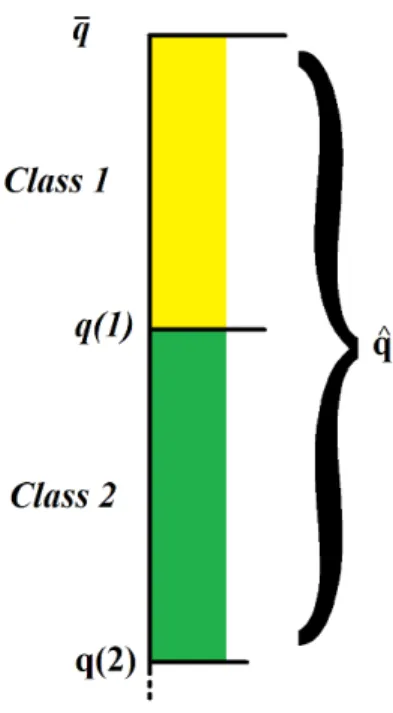
Pools, then, are dened based on reporting and the ex-ante dating stage. This is in contrast to classes, which are dened based on ex-post acceptance decisions. The following proposition shows that, for any any contiguous set of classesnthrough n+k, an equilibrium exists where all agents in each of these classes pool on a single report qˆ. That is, any pooling structure that nests contiguous sets of classes within pools can be supported in equilibrium. Figure 1.3.2 shows an example with two classes pooling on a single report: all agents in classes 1 and 2 make the same report qˆ. Note that the cutos for these classes are endogenous in the reporting structure.
Proposition 2 Any contiguous pool (qj(n+k), qj(n−1)] can be supported in a BPPE. Proof. Suppose that, for each side j, all agents in classes n through n+k pool on a single reportqˆj, no agent outside(qj(n+k), qj(n−1)] reportsqˆj and every agent rejects any report made only by agents outside of their class. Then if a pooling agent makes any report other than qˆj they will never receive a match, yielding a non-positive payo. Thus there is no protable deviation for pooling agents. If each other class i forms a pool where all agents report qˆij, this is an equilibrium, so a BPPE exists.
We will now provide a lemma that establishes the range of characteristics pools can have in equilibrium. In particular, it shows that pool cutos can coincide with class cutos as above or appear within classes, with the possibility of multiple pools within a class and mutual rejection by agents within the same class but in dierent pools, even though they would like to match ex-post.
Lemma 5 For any contiguous pool in a BPPE, on at least one side of the market, one of the following holds for the lower(upper) bound of the pool:
i) The lower(upper) bound is also the lower(upper) cuto of the lowest(highest) class with reports in the pool.
by an agent in the lowest pooling class with a dierent payo than some other report made by an agent outside pool but in the class. Then agents in that class have a strict incentive to give the higher payo report and the assumed reporting is not optimal. Contradiction.
The above lemma could be presented more tersely by giving a more general form of ii., but this formulation provides more intuition about the range of possible reporting strategies. It suggests several dierent sorts of equilibria, and we will describe examples for both cases. If reports satisfy i) for both bounds, classes are nested within pools and agents can't protably leave the pool by reporting above, where they'll get rejected, or reporting below, where they'll get a lower payo. If reports satisfy ii) for both bounds, agents will reject one another ex-ante even though they are in the same class. For example, suppose a report qˆm is made by some men in class n and some outside of it, and qˆw is made by some women in class n and some outside. If men reporting qˆm always reject women reporting qˆw and vice versa, deviating to accepting may yield a costly date with no match and will never yield a match, so it is strictly better to reject. This can be supported if the payo for each report on a given side in class n is equal, e.g. half of n men of each type in the class report qˆm1 and only accept qˆw1 and
the other half reportqˆm2 and only accept qˆw2 , and women behave symmetrically. Note that
reports need not satisfy the same case for both the top and the bottom bounds the upper bound could satisfy i) while the lower bound satises ii)
This can analysis can trivially be extended to pools that are discontiguous but can be represented as a nite union of contiguous pools. In fact, we can quite easily nd equilibria where, for example, classes 1 and 3 pool on a single report despite rejecting one another ex-post while class 2 agents make a report that uniquely identies their class.
Corollary 1 Suppose the support of a pool can be expressed as the union of a nite set of intervals. Then each interval must satisfy Lemma 5.
The Limited Pooling Equilibrium
Having established some characteristics of the set of possible equilibria, we will now introduce the equilibrium20 of interest for the remainder of this paper. Unlike many other equilibria in this environment, this equilibrium looks very similar to those found in Macnamara and Collins (1990) and Burdett and Coles (1997), with agents only dating within their class. The primary dierence from equilibria with observable types is that there is a region between the ex-ante and ex-post (class) cutos for each class that, with observable types, would be rejected by the agents in the class. However, since per-date costs induce a lower ex-post cuto, agents in this interval can pool with those above them and get accepted due to the laxer ex-post standards.
Denition 4 (Limited Pooling Partial Equilibrium (LPPE)) We'll call a BPPE an LPPE if each agent makes a report only made by agents in their class and accepts every report made by agents in their class.21
We can now easily characterize the equilibrium pooling structure and the relationship between the ex-ante and ex-post acceptance decisions:
Lemma 6 (1) In any LPPE, agents between the ex-ante and ex-post cutos must pool with agents above the ex-ante cuto such that the expected quality of that report exceeds the ex-ante cuto.
(2) In any LPPE, agents will always accept after a date.
Proof. Consider an agentm(w)in classn. Suppose a reportqˆis never made by women(men) above the ex-ante cuto in class n. Then m(w)'s continuation value is higher than the expected payo of dating and matching to the qˆ woman(man) and he must reject. Thus women(men) below the ex-ante cuto must pool with agents above it to gain acceptance in their class. It is immediate that any agent with a type below the ex-ante cuto must pool
20Formally, a set of equilibria with reporting strategies that lead to equivalent payos for all agents.
Figure 1.3.3: The pooling structure of an LPPE.
with an agent of a type above the ex-ante cuto for the average quality of an agent in that pool to exceed the ex-ante cuto. Finally, since agents only accept dates within their class, they always accept a match after a date.
Figure 1.3.3 shows the pooling structure of an LPPE. For women(men) in each class, agents the region from qw(n)+c to qw(n) are below the ex-ante class cuto but above the ex-post class cuto, and thus will be rejected ex-ante if they reveal their true type, but will be accepted ex-post. Thus, they must pool with agents above the ex-ante cuto (classes will always have length greater than c, so this is always possible). Note that, in this example, q
w > qw(4) +c, so the fourth class ends before the ex-ante cuto. While the rst J-1 classes must end with the class's endogenous ex-post cuto, the last class J may end with the lower limit of the support of G, which may be above qw(J)or even above qw(J) +c.
dates with others within that class due to coordination failures.
The lack of a complex reporting structure independent of ex-post classes make LPPE very tractable, and thus very attractive. There are reasons beyond convenience to focus on LPPE, though. Given linear returns to matching (LRM) and a steady-state assumption these equilibria must exhibit the nest class partition in the set of steady-state equilibria in terms of the number of classes.22
Additionally, in any other equilibrium some agents must pool and accept dates they will later reject, or reject dates they'd like to accept. This means that every such agent would strictly prefer to leave the pool and report their true class, and they are only prevented from doing so by the absence of messages that can reveal their class.23 In particular, any man(woman) who goes on dates outside their class or rejects dates inside their class would prefer to unilaterally reveal their true class and commit to accepting agents in their class ex-post, since this would allow them to match to every good draw and to reject every bad date. This does not imply a simple equilibrium dominance argument, unfortunatelyeveryone switching to truthful reporting of class creates higher expected payos, which induces higher class cutos. Thus, agents between the old and new cutos could be made worse o by being bumped from classn to classn+ 1.
However, given LRM, consider a non-LPPE equilibrium. There must be some class where men(women) reject dates within the class or accept dates outside the class. For the rst such class, n, class n men(women) who would remain in the class under the limited pooling class cuto would all strictly prefer to form a coalition and report their true class, if that were possible. Importantly, if they did, no man(woman) outside their class would have an incentive to re-pool with their new report, since they would simply be rejected ex-post, and any coalition attempting to repool would necessarily include agents who would be worse o under the coalitional deviation. Thus, non-LPPE seem fragile in the sense that all agents will deviate from the multi-class pools that dene them if they can nd a way to report their
22Depending on the parameterization, there may be other equilibria with the same number of classes, but none will have fewer.
true type, and when agents deviate from these pools there is no incentive for the agents in their former pool to unilaterally follow them to a new report.
Could this same argument also exclude the LPPE, where pooling also occurs? We'll provide a heuristic argument to the contrary. In an LPPE, high type agents in a class would like to reveal their true types and thus escape pooling with agents between the ex-ante and ex-post cutos. However, all of these low type agents strictly prefer to pool with higher type agents in the class. If we assume that agents can change reports at intervals and coalitional deviations are signicantly more costly than unilateral deviations due to coordination costs, we'd expect to generally see pooling as in the LPPE since it will be too costly for high types to repeatedly coordinate on new reports only to have low types unilaterally follow them. The nest partition and equilibrium preference arguments are formalized in Section 1.3.3.
We can now write down the explicit form of the agents optimization problem. We'll focus on the case where the distributions of men and women and their utility functions are symmetric for tractability. Dene the number of classes as J, the proportion of agents in class n λn ≡G(q(n−1))−G(q(n)), and deneql and qu as the lower and upper cutos for a class, respectively. Given that agents accept any agent in their class and reject all others ex-ante, every date results in a match and the probability of accepting a draw is λn. Then equation 1.3.3 can be rewritten as
ql= αλ λα+r
Z qu
ql
(x−c)g(x)
λ dx (1.3.4)
Rearranging and applying integration by parts, we have:
ql = α
r(
Z qu
ql
G(qu)−G(x)dx−λc) (1.3.5) We can now characterize the class structure explicitly:
Proposition 3 Given G, a LPPE implies sequence of cutos for men and women{q(n)}J n=0
It also follows that agents accepting measure zero masses of agents outside their class or rejecting measure zero masses of agents inside their class generates the same cutos and payos.
1.3.3 Steady State in the Limited Pooling Equilibrium.
Linear Returns to Matching
The linear returns to matching equilibrium analysis closely follows Burdett and Coles (1997). Some proofs go through nearly unchanged, but others must be amended to account for per-date costs and the diering assumptions on returns to matching. Dene the distribution of agents leaving the platform as H(q) and the mass of agents leaving the platform by O. We can now dene our complete equilibrium concept by combining the partial equilibrium of the LPPE, which ensures all behavior and beliefs are rational and assumes steady-state, with a balanced ow condition that ensures steady-state holds by equating the endogenous outows with the exogenous inows, closing the model.
Denition 5 (LPPE Steady-State Equilibrium (LSSE)): given exogenous inows (F), a steady state equilibrium is pair (G, N) satisfying LPPE and balanced ow: for every interval [q1, q2)∈[q, q], O(H(q2)−H(q1)) =F(q2)−F(q1).
The cuto equation is now
q(n) = N r (
Z q(n−1)
q(n)
G(q(n−1))−G(x)dx−λnc) (1.3.6) Within a given class, we can get a simple characterization of outow. Outow in a class is given by the number of agents on the platform, N, times the proportion of agents in the class, λn, times the rate of draws of an agent in that class N λn. Then outow from class n is λ2nN2. Then, in an LSSE,
λn =
p
(F(q(n−1))−F(q(n)))/N (1.3.7) We also have that, for any [q1, q2) in class n,λn(G(q2)−G(q1))N2 =F(q2)−F(q1) and
g(q) = f(q) λnN2
(1.3.8) Thus the density of agents on the platform in a given class is inow density times a scalar. Combining (1.3.6) and balanced ow, we can get eliminate G terms, yielding class cutos solely in terms of inows and c.
q(n) = 1 r(
Z q(n−1)
q(n)
F(q(n−1))−F(x)
F(q(n−1))−F(q(n))dx−c)
p
(F(q(n−1))−F(q(n))) (1.3.9)
Note that in the linear returns environment, the N's cancel out, and we have cutos that depend on the previous cuto. We can now explicitly characterize the LSSE in this environment:
Proposition 4 Given F, then (G, N) denes a LSSE if and only if G satises (1.3.8) and λn satises (1.3.6), (1.3.7), q(0) =q, q(J)≤q, and
P
nλn= 1. Proof. P
nλn = 1,the boundary conditions, and (1.3.6)-(1.3.8) are necessary in an LSSE by construction. Conversely, the assumptions guarantee G(q) = 1, G(q) = 0 and G increasing, so G is a well dened steady state distribution and any G and N satisfying them form a valid LSSE.
Thus, equilibrium requires that each class cuto is the solution to the agents' optimal stopping problem and the density on the platform is consistent with balanced ow. P
nλn= 1 ensures thatg is well dened.
To ensure existence of an LSSE, we'll need to make some distributional assumptions. An increasing hazard function will ensure that the class structure is unique. Note that, while Burdett and Coles need this assumption to deal with a multiplicity of cutos due to N, that channel is shut down in the linear returns environment. However, this assumption also constrains multiplicity induced by per-date costs, so it is still necessary in this environment.
Proof. See Appendix 1.6.2.
The intuition for this proposition is that the RHS of (1.3.9) is decreasing in q(n), while the LHS q(n)is obviously increasing, yielding a single crossing. The RHS can be interpreted as the expected surplus quality of an accepted match over the cuto quality, multiplied by the probability of acceptance. Generally, we'd expect this to be decreasing in cuto type q(n), since a higher cuto lowers the surplus over cuto for any given draw, and, were G exogenous, a higher cuto would lower the probability of accepting a draw. However, due to the endogenous nature of G, it's possible for the density to rise asq(n)increases, swamping the aforementioned eects. The hazard rate assumption ensures that the density can't rise too fast, excluding this possibility.
In this environment, existence and uniqueness of the equilibrium follow directly. The class cutos are unique and these cutos imply a unique steady-state mass on the platform, N. This in turn ensures a unique density g(q) = √ f(q)
(F(q(n−1))−F(q(n)))N and thus a unique distribution on the platform G.
Proposition 6 A unique LSSE exists.
Proof. The class summation condition and (1.3.7) yield
N =X
n
p
(F(q(n−1))−F(q(n))) (1.3.10)
and N does not enter the cuto equation so q(n) is not a function of N and uniqueness is ensured. Existence is similarly direct.
We can also show that the cutos are decreasing in cthat is, increasing per-date costs generally makes classes coarser, and for suciently high c the class structure completely unravels as every man(woman) accepts every woman(man) due to the high costs of continuing their search and paying the per-date cost again.
Proposition 7 Given LRM, q(n) is decreasing and continuous in c in an LSSE for all n and q(n)→0 for csuciently high.
must be compensated with a lowerq(1)for equality to hold. We can now proceed inductively. Supposeq(n−1)is decreasing inc. Lemma 11 also shows that the RHS increasing inq(n−1), so to maintain equality, q(n) must increase in q(n−1). Additionally the argument in the base case ensures that, xing q(n−1), q(n) is decreasing in c. Thus, q(n) is increasing in the argument that decreases,q(n−1), and decreasing in the argument that increases,c, and must decrease on net. Direct inspection shows continuity given the continuity of F. Lemma 11 shows that, for suciently high per-date costs, the RHS goes to zero and thus the cuto goes to zero.
The intuition for this result is that per-date costs lower expected match utility, and in the optimal stopping problem cuto utility must be equal to expected match utility, so higher per-date costs should yield lower cutos.
We're now ready to formalize the justications for our equilibrium selection. Lemma 7 shows that LPPE classes with the same upper bound generate higher payos for agents within the class and thus that the classes are smaller. Lemma 8 shows that the top agents in a pool prefer revealing their class and matching to one another to remaining in the pool. Corollary 2 shows that an LPPE induces the nest partition of the type-space in terms of classes. Recall that q(n−1) is the upper bound of a class n and dene q(LP P E, q(n−1)) as the cuto induced byq(n−1)if everyone in the class accepts one another ex-ante and no one else, as in an LPPE and nLP P E as the corresponding class starting at q(n−1)with no cross-class pooling or within-class rejection and where balanced ow is satised. Also dene nLP P E,q(n) as the class with upper bound q(n−1), lower bound q(n), limited pooling and
balanced ow and dene q(LP P E, n) as the nth cuto given an LPPE. Dene Mn as the mass of agents in class n.
Lemma 7 Given LRM, a class n starting at q(n−1)where the probability of an agent in n accepting a date outside the class or rejecting a date inside the class is strictly positive must have a cuto q(n)<q(LP P E, q(n−1)). Additionally, q(n)< q(LP P E, n).
Proof. See Appendix 1.6.2.
n accepting a date outside the class or rejecting a date inside the class is strictly posi-tive. Further, dene n as the rst class where this is true. Then agents in class n above q(LP P E, q(n−1)) all strictly prefer an equilibrium with class nLP P E to the one with class n, and if they could coordinate to reveal their true class and accept only others in their class, no agent outside their class would have an incentive to pool with them.
Proof. A class with a lower cuto ofq(n)must have an expected match qualityqE(n) =q(n) and one with q(LP P E, q(n−1))must haveqE(nLP P E) =q(LP P E, q(n−1)). By Lemma 7, q(n)< q(LP P E, q(n−1)), so agents must prefer thenLP P E. Additionally, any agent outside the class that pools with them will be rejected ex-post, and thus has no incentive to pool.
Corollary 2 In any LSSE with LRM, the nth class cuto is maximal in the set of steady-state equilibria, and the number of classes is also maximal.
Proof. By Lemma 7, q(n) < q(LP P E, n) and if q(k) exceeds the lower bound of the distribution, q(LP P E, k) must as well.
1.4 Strategic Platforms
1.4.1 Per-Date Costs as Frictions
Monopolist Platform
joining agent. Formally, amend the game to include a rst stage where the platform chooses p and c and consider the equilibrium where the maximal mass of agents join the platform. As before, agents have an outside option of zero24. Deneq
n(c)as thenth endogenous cuto given c. Dene p∗(c) as the optimal price given a per-date cost c. Then it will generally be optimal for the platform to set a price such that the lowest type joining the platform is also the cuto type for the last class joining the platform. Specically,
Lemma 9 Suppose LRM and c suciently high. Either: i) a positive c is optimal for the monopolist platform, or
ii) choosing a price that yields a cuto q(p, c) that does not coincide with the lowest joining class' endogenous cuto is suboptimal for the platform if q(p, c)< q1(0).
Proof. Suppose the optimal contract yields a cuto q(p, c) such that q(p, c) > q1(c) and
q(p, c)< q1(0). Then a positivecis optimal. Now suppose the platform induces an individual
rationality (IR) cuto q(p, c)< q1(c), and q(p, c) 6=qn(c) for any n. For suciently high c,
there must be a c0 such thatc≥c0 > c and q(p, c) = q1(c0) since q1 is continuous, decreasing
in c, and goes to zero as c increases. Note that the cuto type is equal to discounted expected utility. Thus, any class with the same lower cuto yields the same expected match quality for agents in that class. Then if the rm chooses c0 and a p0 to induce the same cuto, the quantity of agents on the platform is identical, but the cuto agent is willing to pay φ(q(p, c))ψ(q(p, c)), while under the original regime the cuto agent is willing to pay φ(qn(c))ψ(q(p, c)). q(p, c) > qn(c) implies p0 > p, and since cutos are decreasing in c, τ(c0)< τ(c). Thus the rm will increase prot by inducing q(p0, c0) =q1(c0).
We can use this to result to show that the platform generally will not have an incentive to lower per-date costs to zero:
Proposition 8 Suppose LRM. Ifcis suciently high andq(p∗(0),0)< q1(0),the monopolist
platform never has an incentive to lower per-date costs to zero.
Proof. q(p∗(0),0) < q1(0), so since q(1, c) → 0 as c increases and q(1,c) is continuous
in c, the intermediate value theorem (IVT) ensures that there will be a c∗ > 0 such that q(1, c∗) = q(p∗(0),0), p∗(c∗) ≥ p∗(0), and τ(c∗) < τ(0). Thus prot will be higher with a per-date cost c∗ than with a zero per-date cost.
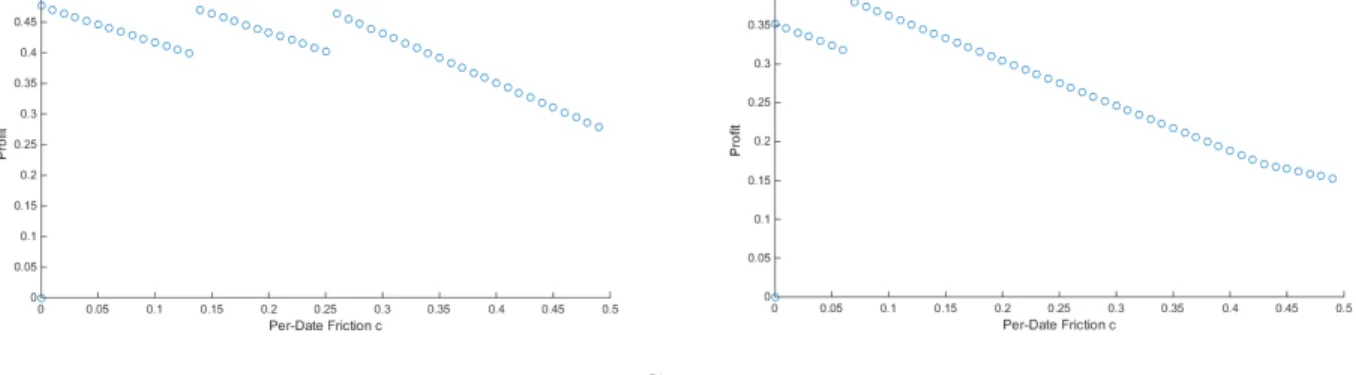
Thus, even when per-date costs are frictions, a monopolist platform can protably with-hold higher eciency search technologies, even when the cost of implementing such tech-nologies is minimal. Lemma 9 shows that inducing endogenous class cutos equal to the IR cuto is typically optimal, since that is the highest class cuto that indierent agent can have and the higher a cuto is, the higher the utility agents in the class receive due to the equality of the cuto and the continuation value. Then, given that prices and per-date costs are chosen to induce this coincidence between the platform and last class cuto, higher per date costs have a direct eect of decreasing total surplus via eort spent on dates, but at the same time transfer surplus from high types to low types. Generally, the net eect of these countervailing forces would be ambiguous, but because the cuto is held constant they must cancel out exactly, again due to the equality between cutos and continuation values. Thus, in terms of revenue, the platform is indierent between any per-date costs that induce the appropriate cuto, and strictly prefers higher per-date costs in terms of its own cost τ.
Social Planner
extremely high. In addition to directly lowering payos through frictions, c can thus speed up matching and change the size of this last rump class, potentially avoiding ineciently sized nal classes. Note that the ow of total surplus can be expressed as
T S≡
J
X
n=1
qjE(n)
Z q(n−1)
q(n)
ψ(q)f(q)dq (1.4.1)
That is, for each class n, the rate of total surplus generation is the expected match utility for each agent integrated over the distribution of inow in class n, where expected match quality for the class qjE(n) is constant across agents and can be pulled out of the integral. Total surplus is the sum over these classes. For ease of exposition, suppose for now that ψ(q) = 1. As shown in Appendix 1.6.2, we can express ∂T S∂c as the sum of the eects of the change in each class cuto ∂q(n)
∂c on the surpluses generated in the classes above and below it. In particular, the net eect of a change in cuto q(n) is proportional to
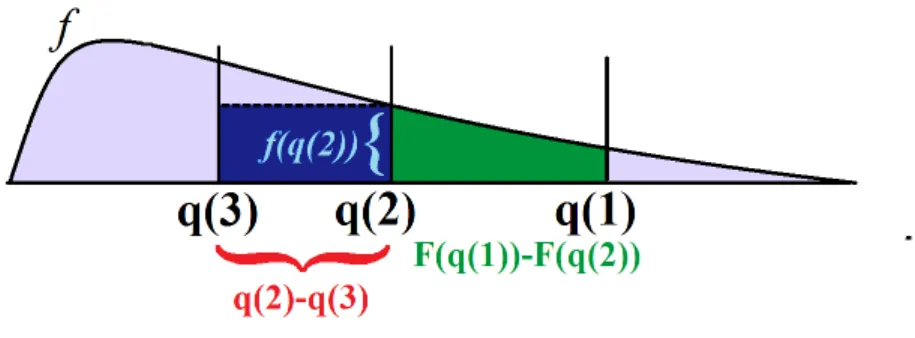
F(q(n−1))−F(q(n))−f(q(n))·(q(n)−q(n+ 1)) (1.4.2)
as shown in Figure 1.4.1. IfF(q(n−1))−F(q(n))> f(q(n))·(q(n)−q(n+1))for alln(with a caveat for the last class discussed in the Appendix), TS decreases in c, and if the inequality is reversed the opposite holds. While the condition itself is simple, the class cutos are determined by a highly non-homogeneous recurrence relation, so nding conditions for either case is quite dicult in general. Below, we treat the case when utility is highly supermodular, which ensures Equation 1.4.2 is positive because the trade-o is between utility for class n, F(q(n−1))−F(q(n)),and utility for classn+ 1,f(q(n))·(q(n)−q(n+ 1)). Supermodularity ensures that higher classes generate more surplus since they are populated by higher type agents, so for sucient supermodularity the eect on class n dominates the eect on class n-1.
Proposition 9 Suppose LRM,ψ(q) = qα, and τ(c) = 0. If α is suciently high, total surplus is decreasing in c.
Figure 1.4.1: The trade-o induced byq(2) shifting due to an increase in c.
Class 2 surplus decreases proportionally to its mass (in green) due to the class cutoq(2) shifting
down and thus lowering expected match quality, which is equal to the class cuto. Lowering q(2)
also bumps top class 3 agents up to class 2. The surplus increase induced by this is proportional to the change in payoq(2)−q(3)(red) multiplied by the density of agents at the cutof(q(2))(blue).
Geometrically, this is the blue rectangle in Class 3. If the former decrease (green area) exceeds the latter increase (blue area) for each class, increasingc will lower total surplus.
In the Appendix 1.6.2 we run numerical simulations for the modular utility case, and nd that increasing c typically decreases total surplus, and must decrease it above a certain point (if c gets suciently high no one can get positive utility from joining the platform). The primary reason for this is that lower type classes tend to be smaller, since agents choose their reservation types based on a trade-o between quality and discounting, which causes a proportional decrease in match utility. Thus, agents who get high expected payos must be less selective, as waiting is more costly for them. Since ∂T S
∂c is negative when the surplus loss for higher classes of shifting a cuto down outweighs the gain to lower classes, lower classes having less mass and thus generating less surplus makes ∂T S
is limited by the support of the distribution, and then to a large class again as the last class cuto passes the bottom of the support of the distribution and the next class becomes the last class. Thus, for friction reduction costs where small decreases in frictions are asymptotically costless likeτ(c) = (¯c−c)2, we can nd cases where there is no incentive to decrease per-date
frictions even a little bit, since total surplus is locally increasing in c.
1.4.2 Additively Separable Match Utility and Per-Date Prices
Monopolist Platform
Corollary 3 Suppose LRM. If q(p∗(0),0) < q1(0), the monopolist platform never has an
incentive to lower per-date prices to zero.
Proof. Note that the proofs of Lemma 9 and Proposition 8 go through with the removal of
−τ(c) in the prot function and the inclusion of w(p, c)c(F(q)−F(q(p, c)).
Social Planner
As discussed above, the social planner prefers agents to leave as quickly as possible to minimize time discounting, since assignment doesn't matter. We can prove this result very directly for constant returns to matching (CRM):
Proposition 10 Suppose CRM. If c is a price, ψ(q) = 1, f(x) is increasing or xf(x) is increasing and c is suciently small, and there is more than one class when c is zero, a positive c maximizes social surplus.
Proof. A suciently high c will ensure a single class, and we have multiple classes with zero per-date costs.ψ(q) = 1, so, given the inow distribution F, social surplus is given by SS = 2Rqqφ(q)f(q)E[e−rt|q]dq. This is maximized when E[e−rt|q] is maximized for all q. A single class maximizes the exit rate, maximizing E[e−rt|q]. Thus a single class maximizes social surplus and a positive c is necessary to induce a single class. Platforms can choose an appropriate xed fee (possibly negative) to satisfy agent IR constraints.
to induce this partially negatively assortative matching25 so inducing a single class will still be optimal given the instruments available, but we'll need to amend the proof to take into account the endogenous draw rate.
Proposition 11 If c is a price, ψ(q) = 1, LRM holds, and there is more than one class when c is zero, a positive c maximizes social surplus.
Proof. A suciently highcwill ensure a single class, and we have multiple classes with zero per-date costs.ψ(q) = 1, so, given the inow distribution F, mass on the platform will be 1 by (1.3.10) and every agent will leave upon a draw, which they get at rate 1. Suppose there is more than one class. Mass on the platform is P
n
p
(F(q(n−1))−F(q(n))) by (1.3.10), and the probability an agent in class n gets a draw they will accept is
√
(F(q(n−1))−F(q(n))) P
n
√
(F(q(n−1))−F(q(n))).
Then the rate of accepted draws is p
(F(q(n−1))−F(q(n))) < 1 and all agents have a longer expected wait on the platform, getting lower utility in expectation. Platforms can choose an appropriate xed fee (possibly negative) to satisfy agent IR constraints.
1.5 Conclusions
In this paper, we extended the NTU search literature to an environment with a cheap talk stage and costly type verication. We found that the partition or class based equilibria that have characterized this literature extend to this environment with informational frictions, with agents only matching to one another within their respective disjoint classes. When per-date costs are endogenously chosen by a strategic platform, positive per-per-date costs may be optimal, despite being distortionary, and, in the case of per-date frictions, having a negative direct eect on surplus. A social planner can take advantage of these per-date costs by using them to counter externalities that make agents too picky by allowing low type agents to pool with high type agents, preventing those high type agents from ineciently rejecting them. A monopolist can use per-date costs to induce eective transfers from high to low types by forcing high types to match to low types, attening the demand curve and allowing a monopolist that charges a xed fee to extract more surplus from consumers.
Future avenues for study include analysis of more complex contracts in this environment to see how much prot the simple contracts commonly in use leave on the table, to see how more complex contracts interact with the externalities in these markets, and to more precisely capture the second degree price discrimination common to the menu of contracts in these markets. This is briey studied in Appendix 1.6.1.
Studying an analogous model with transferable utility would be extremely useful, yielding results more applicable to job search, where cheap talk on both sides of the market can also be important. A two-type TU model is studied in Appendix 1.6.1, and we discuss how, under TU with linear returns to matching, agents are generally not picky enough since spending more time on the platform increases the mass of agents and thus increases the frequency of draws, a benet agents do not internalize even with transfers known as the thick market externality. This is in contrast to the NTU case where agents are too picky, and thus yields opposite implications for per-date pricing, making negative per-date prices that incentivize an agent to stay on the platform longer optimal.
Including competition would be an obvious extension of this research program, though an even greater multiplicity of equilibria must be contended with due to the coordination issues with multiple platforms and network eects. Including exogenous exit and match dissolution would allow for more realistic modeling of matching behavior, especially on platforms that focus on short term matching like Tinder. This is not likely to substantively change the qualitative characteristics of the equilibrium, though.
1.6 Appendix
1.6.1 Extensions
More Complex Contracts
per-date cost. Optimal menus of per-date costs will be highly dependent on the distribution F, and aren't amenable to a simple analysis.
Given the IR cuto induced by a single xed fee contract, if it's possible to include multiple classes above that cuto, the original IR cuto can be maintained with additional higher price cutos for higher types, allowing more surplus extraction. Under modular utility it's optimal to set contract intervals coinciding with endogenous class cutos (everyone reporting in class n must pay pn) for reasons analogous to those in Lemma 9. If utility is supermodular it could be possible to nd cases where this is not true, due to higher utility for higher types, but we'll assume one and only one contract per class, noting that, for supermodular utility, this must be weakly worse than the optimal contract structure.
For the lowest class k, the IR binds as is standard, yielding pk = q(k)ψ(q(k)) For class k−1, note that lower class agents cannot deviate to higher classes due to rejection, even if the contract is more favorable. Thus we only need to worry about deviations by higher type agents to lower reports. The incentive compatability (IC) constraint ICk−1,k requires q(k −1)ψ(q(k −1))−pk−1≥q(k)ψ(q(k −1))−pk, based on the bottom agent k −126 so
(q(k −1)−q(k))ψ(q(k −1)) ≥ pk−1 −pk and so on, with each following price pn−1 rising
based on the dierence in class utilitiesq(n−1)−q(n)scaled by the supermodular component ψ(q(n−1))and with rentsq(n−1)(ψ(q)−ψ(q(n−1)))accruing to classn−1agents based on ψ increasing in q over the class interval. This strategy maintains the same total surplus but allows the platform to extract more from users, and is a lower bound for maximal revenue with multiple contracts. Some rents are still left the to users if utility is supermodular.
In the modular case, however, the monopolist has full extraction and is essentially a social planner, and thus the earlier analysis of the social planner's problem in Section 1.4 applies: increasing per-date frictions is less costly in terms of revenue than the direct eect of frictions on utility would imply, just like the social planner case, and, generally, smallerτ's can rationalize high per-date costs than one woud expect based on the direct eect of frictions (in particular, a sucient τ would be τ(c) =c−c), especially under certain distributional