PALLADIUM AND NICKEL CATALYZED OLEFIN ISOMERIZATION AND POLYMERIZATION
Alexandra H. Farquhar
A dissertation submitted to the faculty at the University of North Carolina at Chapel Hill in partial fulfillment of the requirements for the degree of Doctor of Philosophy in the Department
of Chemistry.
Chapel Hill 2019
Approved by:
© 2019
ABSTRACT
Alexandra H. Farquhar: Palladium and Nickel Catalyzed Olefin Isomerization and Polymerization
(Under the direction of Alexander J. M. Miller)
This work describes the preparation of palladium complexes supported by
aminophosphinite pincer ligands and their reactivity in the presence of electrophilic reagents and olefins, respectively. An additional study into the oligomerization and polymerization of 5-ethylidene-2-norbornene (ENB) by cationic allyl Ni and Pd catalysts is also described.
Chapter 2 investigates the challenges particular to palladium in the metalation of
aminophosphinite pincer ligands. Three aminophosphinte ligands with a methoxy blocking group installed ortho to the phosphinite were prepared of varying amine substitution: a macrocycle-containing 15-aza-crown-5 ether (15c5NMeOCOP-H), an acyclic bis(methoxy)diethylamine
(MeOEtNMeOCOP-H), and a diethylamine analogue containing no ether donor ligands (EtNMeO COP-H). Neutral and cationic complexes of palladium based on these three different ligand scaffolds were prepared. Attempts to access PdIV complexes based on the macrocycle-containing
macrocycle-containing [(15c5NMeOCOP)Pd]+ and dialkylamine-containing [(EtNMeOCOP)Pd]+ is described. This work provided the first comparative reactivity studies of macrocycle-containing aminophosphinite pincer catalysts and a dialkylamine-containing analogue with no hemilabile ether donors.
ACKNOWLEDGMENTS
I am forever grateful to my mentors, friends, and family for their incredible support both before my time at Carolina and during this wild adventure.
I would first like to thank my advisor, Alex, for mentoring me these last five years. Thank you for always supporting my academic and career endeavors—from making it possible for me to research in Israel prior matriculating into Carolina, to encouraging me to branch out into polymer chemistry in a collaboration with Eastman, and for cheering me on in my goal to pursue patent law. I will always remember your thoughtfulness, from the delicious challah and macaroons that you would share with me on Rosh Hashana and Passover, to lending an ear for challenging and unexpected hurdles in life. Thank you for always being there and for your mentorship.
Thank you to Brook, for being the best (and only) “consultant” I have ever had the privilege to work with. I am so thankful to you for taking the time to mentor me. Working on the polymer project together is one of my best memories in graduate school. Thank you for always lending a kind ear and thought—I will always be grateful for your mentorship, candor, patience, and encouragement.
I am incredibly grateful to my committee members: Joe, Cindy, and Frank. Thank you, Joe, for always taking a genuine interest in my progress, and for sharing your sense of humor— running into you in Kenan and talking with you always brightens my day. Thank you to Cindy, for mentoring me while I was a teaching assistant for inorganic synthesis lab—I am so grateful to you for always welcoming me into your office and helping me when I needed it. Thank you, Frank, for always lending a hand in my polymer project, your insight, and for letting me use your lab’s instruments (and more importantly, for hiring an incredible group of people who always assisted me in countless ways).
Thank you to Brandie Ehrmann and Marc ter Horst for all of your guidance throughout the years. We are all so lucky to have you both at UNC, and I am so appreciative of all of the trouble-shooting, training, and mentorship you give to all of us. Carolina Chemistry also would not run without Randy Simmons, Fred Young, Donnyell Batts, Jill Fallin, and Karen Gilliam— thank you all for your hard work and friendship—each one of you never hesitated to lend a hand, and I am so grateful to have known you.
Thank you to all of my lab mates: Brian, Sergio, Scott, Changho, Tianfei, Andrew, Quinton, Bethany, Henry, Eric, Sebastian, and Noah. I am so grateful for your friendship over the years. I am especially grateful for Kristen—thank you for sticking it out with me for three years, and being one of the best humans I know. I am excited to see where your talents, compassion, and courage take you.
Barnes. Teaching at a small public high school in Nevada with few resources isn’t always easy, but you both were an inspiration to me.
Finally, thank you to my family. I love you all so much, and could never have made it through without you. Thank you, Mom, for always listening to me, for your love, and patience. Thank you to my Dad, for teaching me the value of hard work, to have confidence in my ability to learn, and to have the humility to keep trying. Thank you to Uncle Raymond, Aunt Diane, and Adam, for giving me a home when I first moved to North Carolina, and for your love and
TABLE OF CONTENTS
LIST OF TABLES... x
LIST OF SCHEMES ... xi
LIST OF FIGURES ... xiii
LIST OF ABBREVIATIONS AND SYMBOLS ... xxi
CHAPTER 1 - INTRODUCTION ... 1
Introduction to Hemilabile Ligands ... 1
Hemilabile Ligands Stabilizing High-Valent Metal Centers ... 6
Hemilability and Internal Bases ... 11
Pincer Crown Ether Complexes ... 13
This Work... 14
CHAPTER 2 – SYNTHESIS OF PALLADIUM PINCER COMPLEXES SUPPORTED BY AN AMINOPHOSPHINITE LIGAND SCAFFOLD ... 18
Introduction ... 18
Synthesis of Neutral (NCOP)PdIIX Complexes ... 20
Synthetically Blocking Ancillary Ligand Reactivity ... 28
Diversifying the N-donor on the Aminophosphinite Pincer Ligand Scaffold ... 32
Synthesis of Cationic (NCOP)PdII Complexes ... 33
CHAPTER 3 – POSITIONAL OLEFIN ISOMERIZATION BY CATIONIC
PALLADIUM PINCER COMPLEXES ... 87
Introduction ... 87
Results and Discussion ... 92
Preliminary Reactivity Studies ... 92
Isomerization of 1-hexene with [(15c5NMeOCOP)Pd][B(C6F5)4] ... 96
Isomerization of 1-hexene with [(EtNMeOCOP)Pd][B(C6F5)4] ... 100
Summary and Outlook ... 106
Experimental ... 108
CHAPTER 4 – OLIGOMERIZATION AND POLYMERIZATON OF ETHYLIDENE NORBORNENE BY CATIONIC PALLADIUM AND NICKEL ALLYL CATALYSTS ... 114
Introduction ... 114
Results and Discussion ... 119
Homopolymerization of Ethylidene Norbornene by Cationic Palladium Catalysts ... 119
Controlling Molecular Weight in Palladium-Catalyzed Ethylidene Norbornene Enchainment ... 125
Homopolymerization of Ethylidene Norbornene by [(mes)Ni(Me-allyl)][BArF4] ... 128
Controlling Molecular Weight in Nickel-Catalyzed Ethylidene Norbornene Enchainment .. 131
Comparing Catalytic Reactivity Trends of the Nickel and Palladium Systems ... 138
Physical properties of ENB-derived materials ... 139
Conclusions ... 142
Experimental Section ... 143
LIST OF TABLES
Table 4.1. Influence of PR3 identity and concentration of ENB homopolymer Mn. Conditions: 250 mM ENB, 1 mM [(mes)Ni(Me-allyl)][BArF4] and
PR3 (1 or 2 mM) mixture in CH2Cl2 at 25 oC ± 1 oC for two hours ... 130 Table 4.2. Concentration of dimer increases with increasing PR3 cone angle. ... 136 Table 4.3. GPC characterization of ENB homopolymers obtained using [(mes)Pd(allyl)]+ ... 147 Table 4.4. GPC characterization of polymer obtained via chain transfer with
C2H4 using [(mes)Pd(allyl)]+ catalyst ... 150 Table 4.5. GPC characterization of homopolymerizations of ENB by
[(mes)Pd(allyl)]+ and PR3 ... 152 Table 4.6.GPC characterization of ENB homopolymers obtained using
different initial ENB concentrations. ... 154 Table 4.7 GPC characterization of ENB homopolymers obtained at different
reaction times ... 156 Table 4.8. GPC characterization of hexene-terminated ENB polymers
(Mn 10,500 – 21,000 Da) ... 159 Table 4.9.GPC characterization of ENB homopolymers obtained using
[(mes)Ni(Me-Allyl)]+ ... 166 Table 4.10.GPC characterization of ENB homopolymers obtained using
[(mes)Ni(Me-allyl)]+ ... 169 Table 4.11.GPC Characterization of hexene-terminated ENB oligomers
LIST OF SCHEMES
Scheme 2.1. Synthesis of (15c5NCOP)Pd(Br). ... 21
Scheme 2.2. Synthesis of (15c5NCOP)Pd(Cl). ... 23
Scheme 2.3. Salt metathesis of (15c5NCOP)Pd(Br) with AgOAc. ... 27
Scheme 2.4. Modified preparation of (15c5NCOP)Pd(OAc). ... 27
Scheme 2.5. Preparation of methoxy-blocked aminophosphinite pincer ligands. HNR2 = aza-15-crown-5, HNEt2, HN(CH2CH2OCH3)2 ... 28
Scheme 2.6. Synthesis of (15c5NMeOCOP)Pd(OAc) and (15c5NMeOCOP)Pd(Br). ... 28
Scheme 2.7. The synthesis of (15c5NMeOCOP)Pd(Cl). ... 31
Scheme 2.8. Synthesis of (15c5NMeOCOP)Pd(CF3). ... 31
Scheme 2.9. The synthesis of (EtNMeOCOP)Pd(Cl) and (EtMeONMeOCOP)Pd(Cl) ... 32
Scheme 2.10. Synthesis of [(15c5NMeOCOP)Pd][B C6F5)4]. ... 33
Scheme 2.11. Synthesis of [(MeOEtNMeOCOP)Pd][B(C6F5)4]. ... 35
Scheme 2.12. Halide abstraction of (EtNMeOCOP)Pd(Cl) with silylium cation generated in situ. 36 Scheme 3.1. Distinct mechanisms of olefin isomerization ... 88
Scheme 3.2. Proposed internal base-assisted isomerization by [(15c5NMeOCOP)Pd][B(C6F5)4].. 107
Scheme 4.1. Three different mechanisms produce three distinct ENB polymer structures. Only coordination/insertion polymerizaiton maintains both the bicyclic structure and vinylic functionality ... 116
Scheme 4.2. Chain transfer of a-olefins clips growing polyNB chain via chain transfer. ... 118
Scheme 4.3.Homopolymerization of ENB catalyzed by [(mes)Pd(allyl)][PF6] (1 mM) in CH2Cl2 at 25 oC ± 1 oC for two hours, and quenched with methanol ... 119
Scheme 4.5. Ethylene as a chain transfer reagent leads to low ENB conversion. Conditions: 250 mM ENB, 1 mM (PtBu3)PdMeCl/NaBArF4, and 1 atm C2H4,
two hours at 25 oC ± 1 oC ... 127 Scheme 4.6. Quantitative production of oligomers (Mn 900) in the presence of 1 atm
C2H4. Conditions: 250 mM ENB, 1 mM [(mes)Ni(Me-Allyl)][BArF4], 1 atm C2H4,
stirred for two hours at 25 oC ± 1 oC ... 132 Scheme 4.7. Increased C2H4 pressure decreases ENB oligomer chain length.
Conditions: 250 mM ENB, 1 mM [(mes)Ni(Me-allyl)][BArF4], 200 psi C2H4,
LIST OF FIGURES
Figure 1.1. Ligand dissociation from metal complexes with and without hemilabile donors. ... 2 Figure 1.2. Hemilabile ligand scaffolds with substitutionally inert (red)
donors and substitutionally labile ether (blue) donors. ... 3 Figure 1.3. Hemilabile ligands as substrate gates and cooperative actors
through complex stabilization or substrate activation... 5 Figure 1.4. Reversible binding of bidentate P—N hemilabile ligands stabilizes AuI and AuIII
intermediates in catalysis ... 7 Figure 1.5. A bidentate carbene hemilabile ligands stabilizes AuI and AuIII intermediates in
catalysis. ... 8 Figure 1.6. Hemilabile ether donation proposed to increase rates of oxidative addition. ... 8 Figure 1.7. Hemilabile k2 Tp’ promotes aryl migration and k3 Tp’ stabilizes PtIV. ... 10 Figure 1.8. A macrocyclic hemilabile cyclic thioether stabilizes PdIV oxidation
state upon the oxidative addition of methyl iodide to the PdII precursor. ... 10 Figure 1.9. Hemilabile ligand cooperation of a bridging phosphinoamine ligand
assists hydrogen activation at Fe. ... 11 Figure 1.10. Hemilabile ligand scaffold stabilizing intermediates and acting as internal base. ... 12 Figure 1.11. Allosteric control of hemilabile macrocycle binding. HD exchange
promoted in the presence of Lewis acidic cations. ... 13 Figure 1.12. Hemilability of pincer crown ether ligand scaffold to stabilize
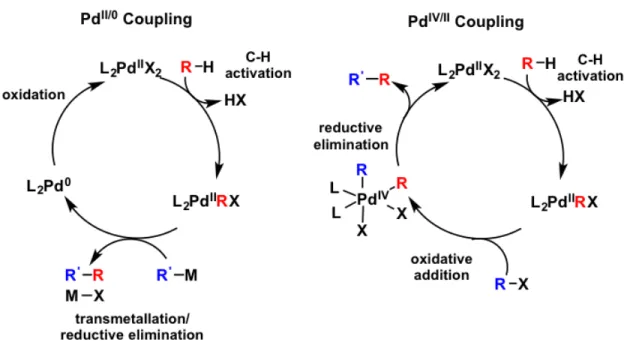
high valent intermediates and serve as an internal base. ... 14 Figure 2.1. PdII/0 and PdIV/II cross coupling ... 19 Figure 2.2. Palladium pincer complexes supported by three distinct
aminophosphinite pincer ligands of different hemilability ... 20 Figure 2.3. The diagnostic 1H NMR resonances of (15c5NCOP)PdII(Br)
that is Cs symmetric in solution, showing the aryl backbone protons
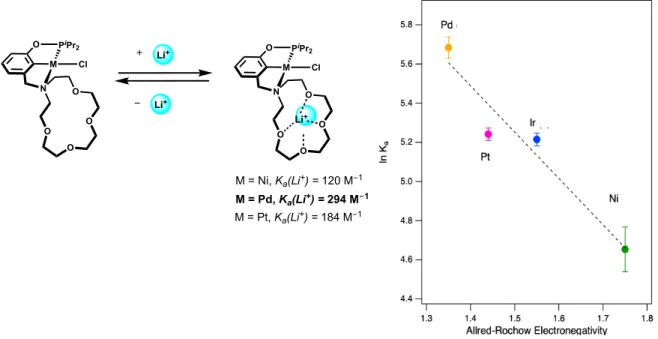
(purple), isopropyl methine protons (red) and isopropyl methyl protons (blue). ... 22 Figure 2.4 Natural log of LiOTf binding affinity of group 10 chloride
isoelectronic (15c5NCOP)Ir(CO) vs. metal Allred-Rochow electronegativity parameter... 24
Figure 2.5. Attempted preparation of (15c5NCOP)Pd(OAc) and 1H NMR spectrum of the aromatic region of the product ... 26
Figure 2.6. Structure of (15c5NMeOCOP)Pd(OAc)•HOAc is presented with thermal ellipsoids shown at 50% probability density. Hydrogen atoms are omitted for clarity ... 29
Figure 2.7. Structure of (15c5NMeOCOP)Pd(Br) is presented with thermal ellipsoids shown at 50% probability density. Hydrogen atoms are omitted for clarity ... 30
Figure 2.8. Proposed formation of bridging [PdII-Cl-PdII]+ species ... 35
Figure 2.9. Reactivity of (15c5NMeOCOP)Pd(X) complexes with alkyl electrophiles. ... 40
Figure 2.10. Proposed F- abstraction to form (15c5NMeOCOP)Pd(CO) complex. ... 42
Figure 2.11. 1H NMR spectrum of (15c5NCOP)Pd(Br) in CD2Cl2. ... 45
Figure 2.12. 31P{1H} NMR spectrum of (15c5NCOP)Pd(Br) in CDCl3. ... 46
Figure 2.13. 1H NMR spectrum of 15c5NMeOCOP-H in C6D6. ... 48
Figure 2.14. 31P{1H} NMR spectrum of 15c5NMeOCOP-H in C6D6. ... 48
Figure 2.15. 1H NMR spectrum of EtNMeOCOH in CDCl3. ... 49
Figure 2.16. 1H NMR spectrum of EtNMeOCOP-H in CD2Cl2. ... 50
Figure 2.17. 31P{1H} NMR spectrum of EtNMeOCOP-H in CD2Cl2. ... 51
Figure 2.18. 1H NMR spectrum of MeOEtNMeOCOH in CD3Cl... 52
Figure 2.19. 13C{1H} NMR spectrum of MeOEtNMeOCOH in CD2Cl2. ... 53
Figure 2.20. 1H NMR spectrum of MeOEtNMeOCOP-H in CD2Cl2. ... 54
Figure 2.21. 31P{1H} NMR spectrum of MeOEtNMeOCOP-H in CD2Cl2. ... 55
Figure 2.25. 31P{1H} NMR spectrum of (15c5NMeOCOP)Pd(Br) in C6D6. ... 59
Figure 2.26. 1H NMR spectrum of (15c5NMeOCOP)Pd(Cl) in CD2Cl2. ... 61
Figure 2.27. 13C{1H} NMR spectrum of (15c5NMeOCOP)Pd(Cl) in CD2Cl2. ... 61
Figure 2.28. 31P{1H} NMR spectrum of (15c5NMeOCOP)Pd(Cl) in CD2Cl2. ... 62
Figure 2.29. 1H NMR spectrum of (EtNMeOCOP)Pd(Cl) in CD2Cl2. ... 64
Figure 2.30. 13C{1H} NMR spectrum of (EtNMeOCOP)Pd(Cl) in CD2Cl2... 64
Figure 2.31. 31P{1H} NMR spectrum of (EtNMeOCOP)PdCl in CD2Cl2... 65
Figure 2.32. 1H NMR spectrum of (MeOEtNMeOCOP)Pd(Cl) in CD2Cl2. ... 66
Figure 2.33. 13C{1H} NMR spectrum of (MeOEtNMeOCOP)Pd(Cl) in CD2Cl2. ... 67
Figure 2.34. 31P{1H} NMR spectrum of (MeOEtNMeOCOP)Pd(Cl) in CD2Cl2. ... 67
Figure 2.35. 1H NMR spectrum of (15c5NMeOCOP)Pd(CF3) in CD2Cl2. ... 69
Figure 2.36. 13C{1H} NMR spectrum of (15c5NMeOCOP)Pd(CF3) in CD2Cl2. ... 69
Figure 2.37. 31P{1H} NMR spectrum of (15c5NMeOCOP)Pd(CF3) in CD2Cl2. ... 70
Figure 2.38. 19F{1H} NMR spectrum of (15c5NMeOCOP)Pd(CF3) in CD2Cl2. ... 70
Figure 2.39. 1H NMR spectrum of [(15c5NMeOCOP)Pd][B(C6F5)4] in CD2Cl2. ... 72
Figure 2.40. 13C{1H} NMR spectrum of [(15c5NMeOCOP)Pd][B(C6F5)4] in CD2Cl2. ... 72
Figure 2.41. 31P{1H} NMR spectrum of [(15c5NMeOCOP)Pd][B(C6F5)4] in CD2Cl2. ... 73
Figure 2.42. Mass spectrum of [(15c5NMeOCOP)Pd][B(C6F5)4] in positive mode. ... 74
Figure 2.43. 1H NMR spectra of a 1:1 mixture of (15c5NMeOCOP)Pd(Cl) and [(15c5NMeOCOP)Pd][B(C6F5)4 ... 76
Figure 2.44. 1H NMR spectrum of [(EtNMeOCOP)Pd][B(C6F5)4] species in CD2Cl2. ... 78
Figure 2.45. 31P{1H} NMR spectrum of [(EtNMeOCOP)Pd][B(C6F5)4] species in CD2Cl2. ... 78
Figure 2.46. Mass spectrum of [(EtNMeOCOP)Pd][B(C6F5)4] species in positive mode ... 79
Figure 2.48. 13C{1H} NMR spectrum of [(MeOEtNMeOCOP)Pd][B(C6F5)4] in CD2Cl2. ... 81 Figure 2.49. 31P{1H} NMR spectrum of [(MeOEtNMeOCOP)Pd][B(C6F5)4] in CD2Cl2. ... 82 Figure 2.50. Mass spectrum of [(MeOEtNMeOCOP)Pd][B(C6F5)4] in positive mode. ... 83 Figure 2.51. 1H NMR spectrum of the products from the addition of
[Me3O][BF4] to (15c5NMeOCOP)Pd(Cl). ... 86 Figure 3.1. Hemilabile “pincer crown ether” ligand controls binding of allylbenzene. ... 89 Figure 3.2. Cationic Pd complexes in this study and expected olefin binding reactivity. ... 91 Figure 3.3. The consumption of allylbenzene red dots) and b-methylstyrene
(blue squares) in the presence of [(15c5NMeOCOP)Pd][PF6] (5 mM) and
LiBArF4 (10 mM). ... 94 Figure 3.4. Isomerization of 2,3-dimethylbutene. ... 95 Figure 3.5. Isomerization of 1-hexene in the presence of [(15c5NMeOCOP)Pd][B(C6F5)4]. ... 97 Figure 3.6. Time-adjusted overlay of the isomerization of 1-hexene by
[(15c5NMeOCOP)Pd][B(C6F5)4] (5 mM) and LiBArF4 (5 mM) shows
catalyst robustness and lack of product inhibition. ... 98 Figure 3.7. VTNA treatment to determine order in 1-hexene by
[(15c5NMeOCOP)Pd][B(C6F5)4] (5 mM) and LiBArF244 (5 mM) ... 99 Figure 3.8. VTNA normalization to determine the order in
[(15c5NMeOCOP)Pd][B(C6F5)4] catalyst, assuming first order in Li+ ... 100 Figure 3.9. Time-adjusted overlay of the isomerization of 1-hexene by
[(EtNMeOCOP)Pd][B(C6F5)4] (5 mM) shows catalyst robustness and lack of
product inhibition ... 101 Figure 3.10. VTNA treatment of the isomerization of 1-hexene by
[(EtNMeOCOP)Pd][B(C6F5)4] to determine the order in 1-hexene ... 102 Figure 3.11. Time-adjusted overlay of the isomerization of 1-hexene by
[(EtNMeOCOP)Pd][B(C6F5)4] (5 mM) and LiBArF4 (5 mM) shows catalyst
Figure 3.13. Classic treatment to determine the order of 1-hexene in the presence
of [(EtNMeOCOP)Pd][B(C6F5)4] and one equivalent LiBArF4 ... 104 Figure 3.14. A representative 1H NMR in CD2Cl2 stack of the isomerization
of allylbenzene by [(15c5NMeOCOP)Pd][PF6] and LiBArF244 (top), and the
1H NMR spectrum of two isolated indans in CDCl3 (bottom) ... 110 Figure 3.15. Mass spectrum of dimers and trimers of 2,3-dimethyl-1-butene
obtained in the presence of [(15c5NMeOCOP)Pd][B(C6F5)4] and LiB(C6F5)4 ... 111 Figure 3.16. Representative 1H NMR spectra monitoring in situ the
isomerization of 1-hexene. ... 113 Figure 4.1. Number-averaged molecular weight (Mn) as a function of ENB
concentration in the homopolymerization of ENB by (PtBu3)PdMeCl/NaBArF4.
Conditions: 250 – 1000 mM ENB, 1 mM (PtBu3)PdMeCl/NaBArF4, two hours at 25 oC ± 1 oC under nitrogen ... 123 Figure 4.2. Polymer Mn values increase linearly with conversion.Red circles
denote the relationship of Mn as a function of % conversion, and blue circles show the relationship between PDI and % conversion. Conditions: 250 mM
ENB, 1 mM (PtBu3)PdMeCl/NaBArF4, two hours at 25 oC ± 1 oC under nitrogen ... 124 Figure 4.3. Mn increases with decreasing [1-hexene]. Red circles denote the
relationship of Mn as a function of initial concentration of 1-hexene, and blue circles show the relationship between PDI and the initial concentration of 1-hexene. Conditions: 250 mM ENB, 1 mM (PtBu3)PdMeCl/NaBArF4, and
30, 50, 80, or 250 mM 1-hexene, two hours at 25 oC ± 1 oC under nitrogen ... 126 Figure 4.4. Mn decreases with increasing [1-hexene]. (red circles), and shorter
oligomers are obtained in the presence of a PPh3 co-ligand (blue circles). Conditions: 250 mM ENB, 1 mM [(mes)Ni(Me-allyl)][BArF4] and 0 or 1 mM PPh3. 30, 50, 80, or 250 mM 1-hexene in CH2Cl2, stirred for two
hours at 25 oC ± 1 oC ... 135 Figure 4.5. The Tg of ENB oligomers increases with increasing chain
length. Ethylene-terminated oligomers (blue circles), hexene-terminated oligomers (orange circles), and ENB homopolymer (grey circles) were
(Mn ranging from 400 to 25,000 Da). See Experimental Section for details ... 141 Figure 4.6. Representative 1H NMR spectrum to determine the conversion ... 145 Figure 4.7. GPC trace overlay of ENB homopolymerizations by
Figure 4.9. GPC overlay of ENB homopolymers obtained using by [(mes)Pd(allyl)]+ and 1 equiv. PEt3 (yellow), 1 equiv. PPh3 (green),
1 equiv. PtBu3 (blue), and 2 equiv. PtBu3 (red) ... 152 Figure 4.10. GPC overlay of ENB homopolymers produced from
different initial ENB concentrations: 1000 mM (yellow), 750 mM (green),
500 mM (red), and 250 mM (blue) ... 154 Figure 4.11. 13C{1H} NMR spectrum of ENB homopolymer (Mn 23,000) from
(PtBu3)PdMeCl/NaBArF4 system in CDCl3 ... 155 Figure 4.12. 1H NMR spectrum of ENB homopolymer (Mn 23,000) from
(PtBu3)PdMeCl/NaBArF4 system in CDCl3 ... 155 Figure 4.13. GPC overlay of ENB homopolymers obtained at varying reaction
times: yellow (0.5 min), green (1 min), red (5 min), blue (10 min) ... 157 Figure 4.14. GPC overlay of hexene-terminated ENB polymers produced from
different initial concentrations of 1-hexene... 159 Figure 4.15. 1H NMR spectrum to determine concentration of ethylene in CD2Cl2 at 25 oC. ... 160 Figure 4.16. GPC trace of ENB polymer obtained via chain transfer with C2H4 in
(PtBu3)PdMeCl/NaBArF4 system ... 162 Figure 4.17. 1H NMR spectrum of the addition of C2H4 to (PtBu3)PdMeCl and
NaBArF4 in CD2Cl2 ... 163 Figure 4.18. 31P{1H} NMR spectrum of the addition of C2H4 to (PtBu3)PdMeCl
and NaBArF4 in CD2Cl2 ... 164 Figure 4.19. GPC overlay of ENB homopolymers obtained using [(mes)Ni(Me-Allyl)]+... 166 Figure 4.20. GPC overlay of ENB homopolymers obtained using
[(mes)Ni(Me-Allyl)]+ and PR3: blue (1 equiv. PtBu3), red (2 equiv. PtBu3),
green (1 equiv. PPh3), yellow (2 equiv. PPh3) ... 169 Figure 4.21. GPC overlay of ENB oligomers obtained via chain transfer with
varying concentrations of 1-hexene using [(mes)Ni(Me-Allyl)]+: blue
Figure 4.23. 1H NMR spectrum of polymer obtained via chain transfer with
1-hexene by cationic allyl Niin CDCl3 ... 172
Figure 4.24. GPC overlay of ENB oligomers obtained via chain transfer with varying initial concentrations of 1-hexene using [(mes)Ni(Me-allyl)]+ and PPh3: blue (250 mM), red (80 mM), green (50 mM) yellow (30 mM) ... 174
Figure 4.25. Mass spectrum of 1-hexene terminated ENB oligomer (Mn 270Da by GPC) ... 175
Figure 4.26.Mass spectrum of 1-hexene terminated ENB oligomer (Mn 460Da by GPC). ... 176
Figure 4.27.Mass spectrum of 1-hexene terminated ENB oligomer (Mn 660Da by GPC). ... 177
Figure 4.28.Mass spectrum of 1-hexene terminated ENB oligomer (Mn 750Da by GPC). ... 178
Figure 4.29. 1H NMR spectrum of 1-hexene terminated ENB with an Mn of 660 Da in CDCl3 179 Figure 4.30. 13C{1H} NMR spectrum of 1-hexene terminated ENB with an Mn of 660 Da in CDCl3 ... 179
Figure 4.31. GPC trace overlay of ENB oligomer obtained via chain transfer by C2H4 using [(mes)Ni(Me-allyl)]+ ... 181
Figure 4.32. 1H NMR of ethylene-terminated ENB oligomer (Mn 890 Da) in CDCl3 ... 182
Figure 4.33. 13C{1H} NMR of ethylene-terminated ENB oligomer (Mn 890 Da) in CDCl3 ... 182
Figure 4.34. Mass spectrum of Mn 890 Da ethylene-terminated ENB oligomer. ... 183
Figure 4.35. Mass spectrum of ethylene-terminated ENB oligomer using [(mes)Ni(Me-allyl)]+ and PPh3 ... 186
Figure 4.36. Mass spectrum of ethylene-terminated ENB oligomer using [(mes)Ni(Me-allyl)]+ and PMePh2 ... 187
Figure 4.37. Mass spectrum of ethylene-terminated ENB oligomer using [(mes)Ni(Me-allyl)]+ and PEt3 ... 188
Figure 4.38. 1H NMR spectrum of ENB oligomer obtained using [(mes)Ni(Me-Allyl)]+at 200 psi C2H4 ... 190
Figure 4.39. 13C{1H} NMR spectrum of ENB oligomer obtained using [(mes)Ni(Me-Allyl)]+at 200 psi C2H4 ... 190
Figure 4.41. 1H NMR spectrum of hydrogenated ENB oligomer (Mn 400 Da). ... 193 Figure 4.42. 13C{1H} NMR spectrum of hydrogenated ENB oligomer (Mn 400 Da). ... 193 Figure 4.43. ENB homopolymer (Mn 25,000 Da) before (bottom) and
LIST OF ABBREVIATIONS AND SYMBOLS
° degree(s)
a Greek alpha: first carbon attached to a functional group b Greek beta: second carbon attached to a functional group d Greek delta: denotes chemical shift reference scale
η Greek eta: ligand hapticity
k Greek kappa: denotes coordination to metal by x atoms p Greek pi: denotes bond
q Greek theta: general angle
s Greek sigma: denotes coordination to a metal via a single atom
D Greek capital delta: denotes separation between values or applied heat Å angstrom(s)
atm Atmosphere Ar general aromatic
BArF4 tetrakis(3,5-trifluoromethylphenyl)borate 13C Carbon NMR
C Celsius D Deuterium d doublet
DFT Density Functional Theory
DSC Differential Scanning Calorimetry DG° standard Gibbs energy
equiv. equivalents Et ethyl, -CH2CH3 19F Fluorine NMR g gram
GPC Gel Permiation Chromatography h hour(s)
1H Proton NMR Hz Hertz
PF6- hexafluorophosphate Ir-H Iridium-hydrogen bond Ir-O Iridium-oxygen bond
XJYZ magnetic coupluing between atoms Y and Z through a distance of x bonds K Kelvin
kcal kilocalorie L general ligand m multiplet M molar
M general metal atom
mmol millimole min minutes
Mn number-average molecular weight Mw weight-average molecular weight mol mole
NMR Nuclear Magnetic Resonance OAc Acetate
oligo oligomer OTf Triflate
31P Phosphorous NMR Pd Palladium
Pd-O oxygen bond to palladium Pd-X halide bond to palladium PDI Polydispersity Index Ph Phenyl
ppm parts per million poly polymer
R general alkyl group s singlet (NMR spectrum) s seconds
t triplet (NMR spectrum) tBu tertiary-butyl
CHAPTER 1 - INTRODUCTION
Introduction to Hemilabile Ligands
Hemilabile ligands are chelating ligand scaffolds that contain at least one strongly
binding ligand that does not freely dissociate from the metal center, and one or more ligands that can reversibly coordinate to the metal center.1–4 The concept of hemilability in coordination complexes was first introduced by Jefferey and Rauchfuss in 1979, with their investigation of ruthenium complexes supported by phosphinoanisole chelating ligands.5 Jefferey and Rauchfuss found that these phosphinoanisole chelating ligands imparted both thermal and oxygen stability to the ruthenium complexes, but that the weak ether donor of the phosphinoanisole backbone was readily displaced by a variety of ligands, including strong donor ligands such as carbon monoxide. While dissociation of strong donor ligands in metal complexes lacking hemilabile ligands is often triggered thermally or photolytically,6,7 a key feature of many catalysts
Figure 1.1. Ligand dissociation from metal complexes with and without hemilabile donors.
Hemilabile scaffolds incorporate a host of substitutionally inert and labile ligands, and vary in donor number from bidentate chelates, to multidentate scaffolds of three or more donors.1,2,8 Geometries of these scaffolds vary widely, from rigid planar structures, to flexible scorpionate morphologies. Substitutionally inert counterparts of these scaffolds can be carbon-based, including alkyl sigma bonds, cyclopentadienyl rings, arenes, and even an alkene in some examples.9,10 Other common substitutionally inert moieties on hemilabile ligand backbones are nitrogen or phosphorus-containing. Substitutionally labile counterparts within hemilabile scaffolds are often harder ligands with respect to hard-soft acid base theory than their substitutionally inert counterparts, and are usually oxygen, sulfur, or nitrogen containing.11
As observed by Rauchfuss and Jefferey,5 one advantage and often invoked motivation to
M L L L L L L
hν M
L L L L L M L L L L L Δ
Thermal dissociation Photolytic dissociation
cationic metal center upon halide abstraction of the neutral species by filling the empty coordination site through coordination of the pendent and substitutionally labile ligand of the scaffold.12 Reversibly coordinated moieties of hemilabile ligands also protect active sites on metal centers,13,14 where their reversible coordination to the metal center enables more facile displacement in favor of incoming substrate.8 One such example is the Grubbs ruthenium metathesis catalyst,15 which employs an ether chelate that is much more readily displaced than the PR3 in the parent complex,16 increasing the rate of olefin metathesis and enabling milder reaction conditions. Many such complexes utilize this aspect of hemilability, shown in Figure 1.2, where substitutionally inert ligands of the depicted hemilabile scaffolds are shown in red, and the substitutionally labile ligands shown in blue.
Figure 1.2. Hemilabile ligand scaffolds with substitutionally inert (red) donors and substitutionally labile ether (blue) donors.
While hemilabile ligands are often utilized for protecting active sites on metal centers through chelation of the weak donor ligand, these weak donors of hemilabile ligands are not solely limited to acting as spectators when de-coordinated from the metal center, Figure 1.3.17
Ru O N N Mes Mes Ru Cl Cl Ph2 P O Me Ph2 P O Me Me O O Me Pd Ru HO CO PPh2 PPh2 OC OC +
Substitutionally labile ligands of hemilabile scaffolds are typically Lewis basic sites that can also act cooperatively in catalysis. Some of these functions include stabilizing reactive
Figure 1.3. Hemilabile ligands as substrate gates and cooperative actors through complex stabilization or substrate activation.
A central goal in this thesis work was to leverage our own hemilabile aminophosphinite pincer scaffold towards stabilizing highly reactive intermediates in catalysis, as well as to activate substrates in chemical steps. The scope of this introduction aims to note previously reported examples demonstrating the specific utility of hemilabile ligands as cooperative actors in catalysis and chemical steps, via substrate activation or reactive intermediate stabilization, as
well as to explore our own ligand scaffold for its potential in this type of cooperative hemilability.
Hemilabile Ligands Stabilizing High-Valent Metal Centers
Besides reversibly coordinating to the metal center to provide open active sites, the substitutionally labile moieties of hemilabile ligands can also participate in chemical
transformations by stabilizing reactive intermediates in a catalytic cycle. For example, a pendent reversibly binding ligand may dissociate from the metal center when it is low valent, or bind to the metal center to stabilize high valent species. In this way, preferred geometries of metal complexes can be mediated between oxidation states, allowing one multidentate hemilabile ligand to accommodate changes in the oxidation state of the metal center.
This type of behavior is beautifully displayed in the gold-catalyzed arylation of arenes with aryl halides in an AuI/AuIII cycle supported by a P-N chelating ligand, Me-Dalphos (Figure 1.4).23 In this case, the hemilabile Me-Dalphos ligand plays a seminal role in the stabilization of both the AuI and AuIII species, as shown in Figure 1.4. While AuI typically shows a strong preference for linear geometries, AuIII species are often unstable unless four-coordinate. In this example, the low valent AuI complex is stabilized in a two-coordinate linear geometry with the substitutionally inert phosphine of the P-N chelate bound to the metal center. Upon oxidative addition of the aryl halide, the resultant AuIII species is stabilized by the coordination of the pendent amine of the P-N chelate to achieve a preferred four-coordinate geometry. Direct arylation of aryl halides and arenes in the presence of (Me-Dalphos)AuCl and AgSbF6 is
Figure 1.4. Reversible binding of bidentate P—N hemilabile ligands stabilizes AuI and AuIII intermediates in catalysis.
Another similar AuI/III example that utilizes hemilabile ligands to toggle between stable two-coordinate AuI and four-coordinate AuIII states involves the hydroarylation of styrenes with anilines, Figure 1.5.22 These transformations are achieved in the presence of a gold catalyst supported by a hemilabile cyclic(alkyl)(amino)carbene with a pendent imine. As with the case with the phosphine Me-Dalphos, the strong carbene donor stabilizes the two-coordinate AuI, whereas coordination of the pendent imine stabilizes AuIII intermediates during hydroarylation.
P
NMe2 Au Cl +
I AgSbF6
-AgCl P
NMe2 Au I Ad
Ad Ph
SbF6
Hemilabile P-N Chelate Stabilizes AuI and AuIII
AuI / AuIII Catalysis towards Direct Arylation of Arenes
I 2 eq. AgSbF
6
-AgCl +
OMe
MeO OMe
1 eq. (Me-Dalphos)AuCl
-AgI CH2Cl2, 12 h, 25 oC
MeO
MeO
Figure 1.5. A bidentate carbene hemilabile ligands stabilizes AuI and AuIII intermediates in catalysis.
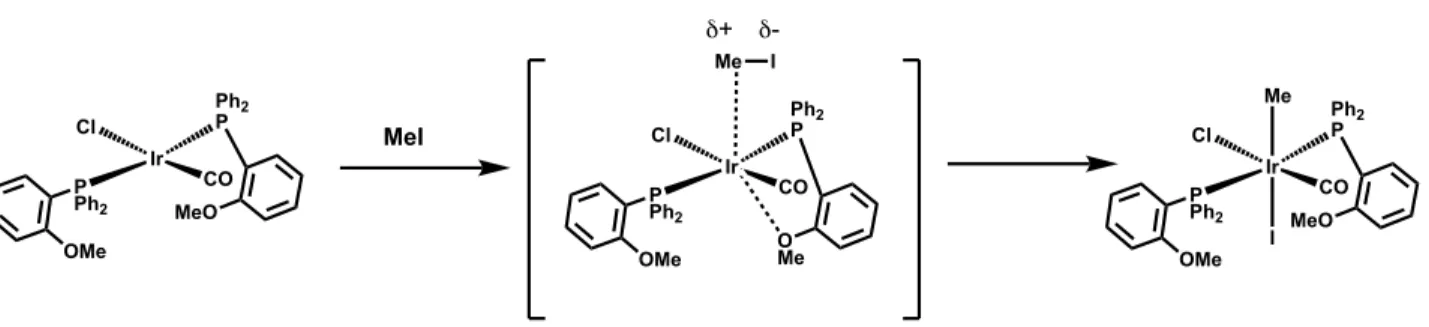
Even the phosphinoanisole hemilabile ligand scaffold described by Jefferey and Rauchfuss, which was touted for the thermal and oxidative stability it imparted to their
ruthenium complexes, was also reported by Shaw and coworkers to have a direct impact on the rate of oxidative addition of methyl iodide to phosphinoanisole-supported iridium complexes, Figure 1.6.32
Figure 1.6. Hemilabile ether donation proposed to increase rates of oxidative addition.
They found that methyl iodide oxidatively added to the iridium complexes supported by phosphinoanisole much faster than complexes supported by more basic monodentate tertiary phosphines. If only considering the phosphine donor, one might expect the more basic and
Au Cl N Dipp tBu N Dipp KB(ArF20 4)
CH2Cl2 25 oC, 12 h
-KCl Au N Dipp tBu N Dipp Ir Ph2 P MeO Cl P Ph2 OMe CO Ir Ph2 P O Me Cl P Ph2 OMe CO Me I δ+ δ
-Ir Ph2 P MeO Cl P Ph2 OMe CO Me I MeI
electron-poor phosphinoanisole. However, it was proposed that the pendent ether on the phosphinoanisole coordinates to Ir prior to oxidative addition, thereby imparting more electron density to the metal center than the more basic monodentate phosphine ligands.
Stabilization of reactive or high valent intermediates is not limited to bidentate scaffolds, however. Several metal complexes featuring tridentate scorpionate ligand scaffolds are also stabilized in a similar fashion, particularly palladium and platinum complexes, with some of the classic platinum examples from the Templeton lab featuring hydridotris(3,5-dimethylpyrazolyl)- borate) ligands (Tp’), Figure 1.7.33–35 These hemilabile Tp’Pt systems can toggle between k2 and k3 binding modes, where the k3 binding mode stabilizes the high valent Tp’PtIV species.35
Thermolysis or the presence of Lewis acidic boranes is proposed to weaken the PtIV-N bonds, allowing the dissociation of one of the pyrazolyl rings of the Tp’ ligand. From this coordinatively unsaturated k2 species, aryl migration to the bound olefin is proposed. Re-coordination of the pyrazolyl ring to bring the Tp’ ligand back to its k3 state then stabilizes the final Tp’PtIV hydride.
Figure 1.7. Hemilabile k2 Tp’ promotes aryl migration and k3 Tp’ stabilizes PtIV.
Cyclic ethers and thioethers can also provide excellent stability to metal complexes changing oxidation state by interconverting through k2 and k3 coordination modes. An excellent example of a hemilabile thioether ligand stablilizing high-valent PdIV comes from a report by Willis et. al. presented in Figure 1.8.36 Upon the oxidative addition of methyl iodide, this
six-coordinate thioether-supported complex was resistant to both reductive coupling of the methyl
ligands to form ethane and to iodide coordination.
Figure 1.8. A macrocyclic hemilabile cyclic thioether stabilizes PdIV oxidation state upon the oxidative addition of methyl iodide to the PdII precursor.
Pt N N
N
HB
B(C6F5)3
Benzene Pt
N N
N
HB
Pt
H N N
N
HB
κ2 Tp’ promotes
aryl migration κ
Hemilability and Internal Bases
Hemilabile ligands are not limited to only mediating oxidation states in metal complexes. They can also participate cooperatively in chemical steps by activating substrates, such as serving as an internal base towards substrate deprotonation.
For example, in octahedral iron complexes supported by three chelating and hemilabile bis(diphenylphosphino)amine ligands, the bridging phosphinoamines promote H2 activation by accepting a proton of hydrogen, while the iron center formally accepts a hydride. Under higher pressures of hydrogen, two molecules of dihydrogen are activated at the iron center, assisted by deprotonation at the pendent amines to form the iron dihydride, resulting in the dissociation of an equivalent of the protonated phosphinoamine and the iron dihydride supported by two chelating and protonated phosphinoamines, Figure 1.9.31
Figure 1.9. Hemilabile ligand cooperation of a bridging phosphinoamine ligand assists hydrogen activation at Fe.
Hemilabile ligands can act as an internal base and also provide stability to catalytic intermediates through coordination of its substitutionally labile ligands. One such example is a palladium catalyst supported by a 1,1’-bis(tert-butyl(pyridine-2-yl)phosphanyl)ferrocene ligand
Fe Ph2P
Ph2P
PPh2 P Ph2 PPh2 Ph2 P N N HN
1 bar H2
toluene 25 oC
Fe Ph2P
H PHPh2 P Ph2 PPh2 Ph2 P N HN HN PPh2
8 bar H2
toluene 60 oC
Fe H H P Ph2 P Ph2 Ph2 P Ph2 P
HN NH
+ NH
Ph2P
Ph2P
Fe Ph2P
Ph2P
for the methoxycarbonylation of alkenes, Figure 1.10.28,37 In this study, Dong and coworkers showed experimentally and computationally that the pendent pyridyl moieties of the Pd catalyst both reversibly bind to stabilize the catalytic intermediate Pd acyl species, and also act as an internal base to deprotonate methanol prior to the methanolysis of the Pd-acyl, which was determined to be the rate determining step. Notably, this work utilizes a hemilabile ligand as both a stabilizer of highly reactive intermediates, and as an internal base to facilitate
methanolysis of the Pd-acyl.
Fe P P N N Pd
+ CO
0.04 mol% [Pd]
MeOH CO2Me
R
Net Reaction
Pd catalyst supported by hemilabile pyridines
Pd P P N N H Pd P P NH N + + Pd P P N N H + R Pd P P N N + CO R Pd P P N + N O R Pd P P N N + O R O Me H R CO MeOH R OMe O
Stabilization by pyridine Pyridine
Pincer Crown Ether Complexes
Inspired by the wide utility of hemilabile ligands within organometallic transformations, we sought to explore this utility within our own pincer crown ether hemilabile scaffold, shown in Figure 1.11. Macrocycles containing weak donor ligands, such as crown ethers, are suitable targets to incorporate into ligand scaffolds and impart hemilability, where their denticity to the metal center can be modulated through non-covalent interactions with the addition Lewis acidic cations.38–40 Prior to the work reported herein, our group had reported the synthesis of this
macrocycle-containing hemilabile scaffold on iridium, shown in Figure 1.11. It was found that in the binding of the pendent macrocycle to the Ir center could be modulated between k3 to k5 coordination modes. This phenomenon was found to impart the ability to tune the rates of catalysis of isomerization41 and hydrogen activation in the presence of Lewis acidic cations (Figure 1.11),38 as well as trigger substrate binding39 and influence activity towards methanol carbonylation.42
Figure 1.11. Allosteric control of hemilabile macrocycle binding. HD exchange promoted in the presence of Lewis acidic cations.
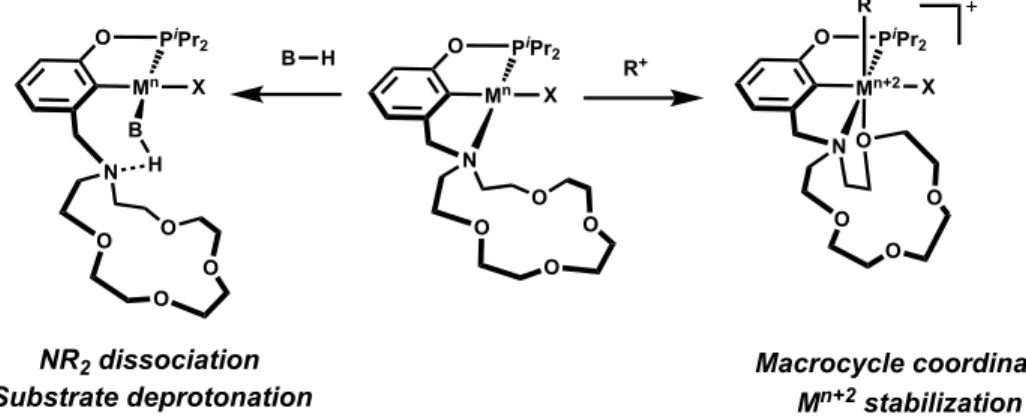
our pincer ligand scaffold’s controllable denticity in a similar manner. One could imagine both the stabilization of high valent and highly reactive metal centers through donation of the pendent macrocycle upon oxidation, as well as possibly leveraging the potential hemilability of the pendent amine arm itself as an internal base in catalytic transformations. Since the denticity of our pincer ligand scaffold on Ir and Ni complexes had been shown to be modulated in the presence of cations in solution, one could also imagine utilizing the “switchability” of our catalyst systems to study fundamental reactions such as reductive elimination, by stabilizing the products of oxidative addition through macrocycle ether donation, and triggering reductive elimination through the addition of cations in solution, Figure 1.12.
Figure 1.12. Hemilability of pincer crown ether ligand scaffold to stabilize high valent intermediates and serve as an internal base.
This Work
We chose to focus our study on the preparation of new macrocycle-containing pincer complexes based on palladium to explore our ligand scaffold’s potential in reactive intermediate stabilization, and in internal base-assisted catalysis. A rich history of high-value palladium catalyzed reactions,43–45 along with a growing field in the study of high valent PdIV intermediates
O PiPr 2 Mn O N O O O X R+
O PiPr 2
Mn+2 X
O N O O O R O PiPr
2 Mn O N O O O X B H B H
Mn+2 stabilization
Substrate deprotonation
+
complexes,49 along with precedence of intramolecular base-assisted Pd catalyzed reactions,27,50– 53 added further applications that we could envision with tunable Pd pincer crown ether catalysts.
Chapter 2 describes the synthesis of these novel aminophosphinite pincer palladium complexes, detailing the challenges and considerations in their preparation, as well as their preliminary reactivity with oxidants. Palladium pincer complexes of three different
aminophosphinte ligand scaffolds of the form (NCOP)Pd(X) (where X = Cl, Br, I, OAc, and CF3) were prepared, along with their cationic analogues.
The three different aminophsophinite ligand scaffolds varied in their amine substitution, where the aza-15-crown-5 ether, bis(methoxy)diethylamine, and diethylamine analogs were prepared. Of note, preparation of the diethylamine analogue of the [k3-(15c5NCOP)Ir(H)]+ complex was inaccessible prior to this work. It was found that the installation of a methoxy group on the phenyl backbone of the aminophosphinite pincer ligand was essential for ensuring tridentate NCOP pincer Pd metalation, as well as to prevent activation of the phenyl backbone of the pincer ortho to the phosphinite. A screen of preliminary reactivity of (15c5NMeOCOP)Pd(X) complexes with electrophilic R+ reagents did not generate PdIV species. Either no reactivity is observed, or partial halide abstraction towards the formation of a mono-halide bridging Pd dimers is observed.
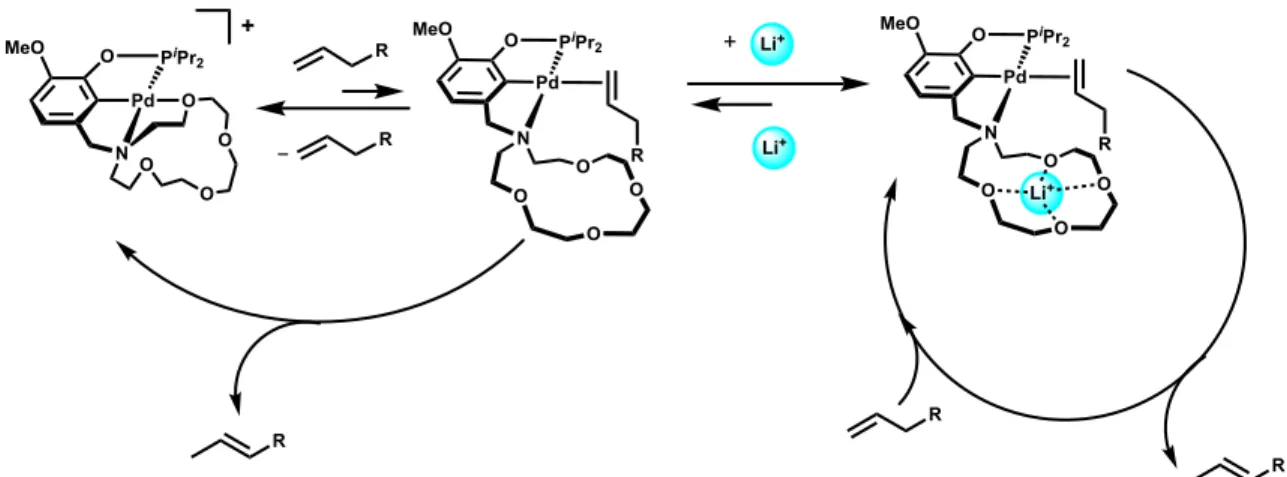
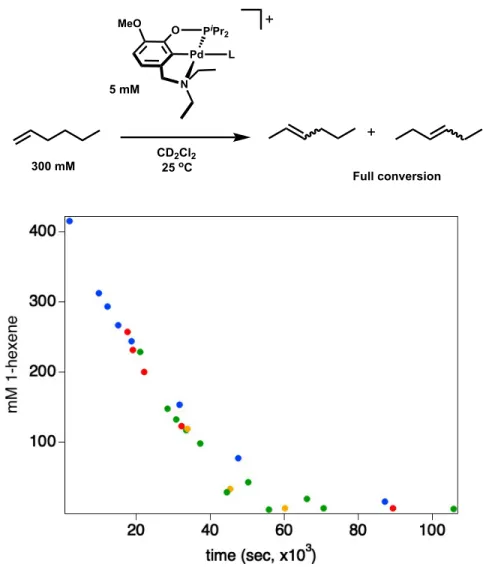
are highly substituted or contain acidic allylic protons is observed, while clean isomerization without subsequent dimerization is observed in the presence of linear 1-hexene.
Interestingly, the activity of [(15c5NMeOCOP)Pd]+ towards isomerization is increased in the presence of Li+, whereas the activity of [(EtNMeOCOP)Pd]+ is hindered in the presence of Li+. We propose that this chemistry is proceeding through a p-allyl mechanism, necessitating the
dissociation of the pendent amine to deprotonate substrate and form the Pd-allyl.
Chapter 4 diverges from the chemistry of pincer crown ether palladium complexes and hemilability altogether for a detailed study on the polymerization and oligomerization of 5-ethylidene2-norbornene (ENB) by “activatorless” Pd and Ni catalysts. These catalysts are capped with labile mesitylene ligands that are readily displaced in solution by monomer or phosphine co-ligands.54,55 Polymerizations in the presence of terminal olefin chain transfer agents are explored with and without added phosphine co-ligands. Both the activity of these catalysts and their product distribution are determined by the added phosphine co-ligand and chain transfer agent in solution.
CHAPTER 2 – SYNTHESIS OF PALLADIUM PINCER COMPLEXES SUPPORTED BY AN AMINOPHOSPHINITE LIGAND SCAFFOLD
Introduction
Palladium catalysis has become a ubiquitous tool in chemical synthesis. Cross-coupling reactions catalyzed by palladium were recognized with a Nobel Prize in 2010 and have been applied in ton-scale syntheses of pharmaceuticals.44,56 The centerpiece of palladium catalysis is a two-electron chemical redox transformation, where oxidative addition of a substrate increases the Pd formal oxidation state by two, while reductive coupling often releases product while
Figure 2.1. PdII/0 and PdIV/II cross coupling requires different metal complex geometries.
While palladium catalytic cycles most commonly utilize Pd0 and PdII oxidation states, catalytic cycles that move between PdII and PdIV have increasingly been proposed in some cross-coupling mechanisms.58,59 Proposed PdIV catalytic intermediates are increasingly prevalent in the literature, and ligand scaffolds capable of supporting high valent Pd are desired to further
understand these transformations.46,48,59,60 Catalysis involving relatively high-valent intermediates could offer improved air and moisture tolerance and perhaps facilitate rapid chemical steps along coupling process.57 A key feature of the PdII/IV cycle is an oxidative addition to reach PdIV prior to the reductive elimination of the coupled product (Figure 2.1).
The aminophosphinite pincer ligand developed by our group,38,61 abbreviated as
15c5NCOP-H, combines a rigid and strongly donating pincer ligand with several weak and
potentially hemilabile donors of the pendent 15-aza-crown-5 ether macrocycle, which would be
explored in the context of cation-modulated oxidative addition and reductive elimination. When
this work began, however, relatively few NCOP palladium pincer complexes had been
prepared,62–72 and no pincer-crown ether palladium complexes were known.
Figure 2.2. Palladium pincer complexes supported by three distinct aminophosphinite pincer ligands of different hemilability.
This chapter describes the preparation of PdII complexes of C
s symmetry supported by
three different aminophosphinite pincer ligands, Figure 2.2. Non-equivalent axial ligands on Pd would break the symmetry of complex, and be indicative of PdIV formation under oxidative conditions. A reactivity screen of these novel neutral PdII complexes with electrophilic alkyl and halide reagents will also be discussed.
Synthesis of Neutral (NCOP)PdIIX Complexes
Synthesis of (15c5NCOP)PdIIBr
Synthesis of 15c5NCOP-H ligand was performed following the literature procedure
O PiPr 2 Pd X O N O O O R
X = Cl, Br, OAc, CF3
R = H, OMe
O PiPr 2 Pd X N O O R
O PiPr 2
Pd X
N R
X = Cl, Br, OAc X = Cl, Br, OAc
in the presence of base, affording (15c5NCOP)Pd(Br)asa yellow-orange solid in 60% yield (Scheme 2.1).
Scheme 2.1. Synthesis of (15c5NCOP)Pd(Br).
Diagnostic 1H NMR resonances indicated Cs symmetry in solution. These proposed cyclometalated complexes have convenient 1H and 31P NMR handles to probe cyclometalation, axial-ligand coordination, and oxidation state of the metal (Figure 2.3). The free ligand
15c5NCOP-H has a 31P{1H} NMR resonance at δ 147. In analogous NiII systems,
(15c5NCOP)NiII(Br),61 the 31P{1H} NMR resonance shifts approximately 50 ppm downfield from the free ligand upon cyclometalation (δ 200). The aromatic region in the 1H NMR spectrum is also diagnostic, where two doublets and one triplet corresponding to the ligand-backbone are expected. The isopropyl methyl and methine resonances in the 1H NMR spectrum are indicative of the symmetry of the molecule, where a square-planar (NCOP)PdII(X) or a (NCOP)PdIV(X)3 complex with equivalent axial ligands should be Cs symmetric in solution.
O PiPr 2 Pd Br O N O O O O O N O O O P
1.1 eq PdBr2 1.1 eq NEt3
C6H6
12 h, 25 oC
Figure 2.3. The diagnostic 1H NMR resonances of (15c5NCOP)PdII(Br) that is Cs symmetric in solution, showing the aryl backbone protons (purple), isopropyl methine protons (red) and isopropyl methyl protons (blue).
Synthesis of (15c5NCOP)Pd(Cl)
Scheme 2.2. Synthesis of (15c5NCOP)Pd(Cl).
The complex (15c5NCOP)Pd(Cl) is prepared by refluxing the ligand 15c5NCOP-H in toluene for two hours (Scheme 2.2). The crude light yellow to colorless oil can be extracted into toluene, layered with pentane, and crystallized at -30 oC to afford colorless crystals in 55% yield. Diagnostic aryl backbone resonances of two doublets (6.58 J = 7.5 Hz, and 6.72 J = 7.9 Hz), as well as one triplet of doublets 6.87 (J = 7.8, 1.0 Hz) in the 1H NMR spectrum and a singlet in the 31P{1H} NMR spectrum ( d 201) confirm a cyclometalated structure, and a Cs symmetry in solution, like the bromide analogue (15c5NCOP)Pd(Br).
Since our goal in utilizing these complexes was to leverage allosteric tuning of the pendent hemilabile macrocycle with cations in solution, we wanted to quantify the binding affinity of the neutral chloride complex to Li+ cations in acetonitirile. The binding affinity of (15c5NCOP)Pd(Cl) to Li+ was measured in CD3CN according to previous methods. 39 The Ka was determined to be 294±16 M-1, the strongest interactions with cations of group 10 pincer crown ether complexes synthesized. Figure 2.4 shows the relationship of the natural log of the binding affinity to Li+ versus the Allred-Rochow electronegativity parameter74 of each metal center. The observed linear correlation shows that the complex with the least electronegative
O PiPr
2
Toluene Reflux, 2 hrs
Pd(cod)Cl2
- HCl
metal center, (15c5NCOP)Pd(Cl), has the strongest interactions with Li+, and suggests that complexes with more electronegative metal centers, such as the nickel analogue
(15c5NCOP)Ni(Cl) have lower binding affinities to Li+ because the organometallic fragment withdraws more electron density from the pendent amine and the ether oxygen atoms.39,75 Encouraged by the strong binding affinity of the palladium complex to Li+, we pursued other palladium analogues to further expand our library of pincer crown ether palladium complexes.
Figure 2.4. Natural log of LiOTf binding affinity of group 10 chloride complexes
(15c5NCOP)Ni(Cl), (15c5NCOP)Pt(Cl), and (15c5NCOP)Pd(Cl) along with the isoelectronic (15c5NCOP)Ir(CO) vs. metal Allred-Rochow electronegativity parameter.
O PiPr
2 M Cl O N O O O Li+ Li+ +
-O PiPr
2 M Cl O N O O O Li+
Synthesis of (15c5NCOP)Pd(OAc)
The reaction of 15c5NCOP-H and Pd(OAc)2 in acetonitrile was undertaken in an attempt to prepare (15c5NCOP)Pd(OAc) (Figure 2.5). While base was required to achieve
cyclometalation of 15c5NCOP-H with PdBr2, an acetate group could act as an internal base (the pKa of acetic acid in acetonitrile is 23.5),76 so no additional base was employed.
Figure 2.5. Attempted preparation of (15c5NCOP)Pd(OAc) and 1H NMR spectrum of the aromatic region of the product.
An alternative route to (15c5NCOP)Pd(OAc) was sought via salt metathesis of
(15c5NCOP)Pd(Br) with AgOAc,71 where acetate coordination would be driven by precipitation of insoluble AgBr (Scheme 2.3). Surprisingly, the expected product of salt metathesis,
Scheme 2.3. Salt metathesis of (15c5NCOP)Pd(Br) with AgOAc.
Suspicious that adventitious protons may be facilitating remetalation chemistry on the pincer ligand backbone under the salt metathesis conditions with AgOAc, we employed the use of excess base in the reaction (Scheme 2.4). After adding excess triethylamine (7 equivalents) to a solution of (15c5NCOP)Pd(Br), one equivalent of AgOAc was added to achieve full conversion to the expected cyclometalated (15c5NCOP)Pd(OAc) by 1H NMR and 31P{1H} NMR
spectroscopy (δ 198). A triplet (δ 6.94, J = 7.8 Hz, 1H) and two doublets (δ 6.68, J = 8.4 Hz, 1H, and δ 6.58, J = 8.0 Hz, 1H) were observed in the aromatic region of the 1H NMR spectrum, consistent with the expected cyclometalated product (15c5NCOP)PdII(OAc).
Scheme 2.4. Modified preparation of (15c5NCOP)Pd(OAc).
Full conversion by 1H NMR
O PiPr
2 Pd Br O N O O O THF
25 oC, 2 hrs
AgOAc
- AgBr
7 equiv. NEt3
O PiPr
Synthetically Blocking Ancillary Ligand Reactivity
Scheme 2.5. Preparation of methoxy-blocked aminophosphinite pincer ligands. HNR2 = aza-15-crown-5, HNEt2, HN(CH2CH2OCH3)2.
The observation of undesired ligand reactivity at the aromatic C–H bond para to the aza-crown ether highlighted the need to redesign the ligand scaffold for its further implementation in synthesis and catalysis. In order to protect the reactive aromatic position, we prepared a new methoxy-blocked aminophosphinite ligand 15c5NMeOCOP-H in hopes that the installation of the methoxy blocking group would prevent unwanted cyclometallation to form bidentate chelates and any other potential backbone activation. The methoxy-blocked aminophosphinite ligand, 15c5NMeOCOP-H (31P{1H} NMR δ 153), was prepared in a two-step synthesis from 3-hydroxy-4-methoxybenzaldehyde (Scheme 2.5).61
Synthesis of (15c5NMeOCOP)PdII(OAc) and (15c5NMeOCOP)PdII(Br)
Scheme 2.6. Synthesis of (15c5NMeOCOP)Pd(OAc) and (15c5NMeOCOP)Pd(Br).
O PiPr 2 Pd Br O N O O O MeO
O PiPr 2 Pd OAc O N O O O MeO O O N O O O
MeO P 1.1 eq PdBr
2
1.1 eq NEt3
C6H6
12 h, 25 oC
1 eq PdOAc2
CH3CN
12 h, 25 oC
The cyclometallated acetate complex (15c5NMeOCOP)Pd(OAc) was obtained in 92% yield after allowing the 15c5NMeOCOP-H ligand to stir in acetonitrile in the presence of Pd(OAc)2 at room temperature for twelve hours (31P{1H} NMR δ 199) (Scheme 2.6). Two doublets (δ 6.65, J = 8.1 Hz, 1H; δ 6.60, J = 8.0 Hz, 1H) corresponding to the aryl backbone were observed in the aromatic region of the 1H NMR spectrum, and are slightly upfield of the aromatic resonances of the unblocked complex as might be expected from a more electron rich arene backbone. Notably, no base was required to achieve the desired metalation product, unlike the synthesis of
(15c5NCOP)Pd(OAc) with the unblocked ligand. Light yellow crystals of (15c5NMeOCOP)Pd(OAc) suitable for X-ray diffraction were grown from the slow evaporation of pentane (Figure 2.6). (15c5NMeOCOP)Pd(OAc)co-crystallized with acetic acid that interacted via hydrogen bonding to the acetate ligand on Pd . This result led to employing an aqueous treatment to remove any excess acetic acid by washing the product with deionized water, and extracting into
dichloromethane. The absence of acetic acid was confirmed by 1H NMR spectroscopy post-aqueous workup.
Figure 2.6. Structure of (15c5NMeOCOP)Pd(OAc)•HOAc is presented with thermal ellipsoids shown at 50% probability density. Hydrogen atoms are omitted for clarity.
mixture was allowed to stir for twelve hours, after which it was dried in vacuo and washed with pentane to afford a yellow solid in 53% yield (Figure 2.7). Two doublets (δ 6.71, J = 8.2 Hz, 1H, and δ 6.63, J = 8.2 Hz, 1H) corresponding to the aryl backbone were observed in the aromatic region of the 1H NMR spectrum. Two doublet of doublets (δ 1.43, J = 19.1, 7.2 Hz, 6H, and
δ1.32, J = 16.0, 7.0 Hz, 6H) corresponding to the isopropyl methyl protons, consistent with a square-planar cyclometalated species, were observed. Amber-orange crystals of
(15c5NMeOCOP)Pd(Br) that were suitable for X-ray diffraction were grown by layering a concentrated solution of (15c5NMeOCOP)Pd(Br) in toluene with pentane (Figure 2.7).
Synthesis of (15c5NMeOCOP)PdII(Cl)
Scheme 2.7. The synthesis of (15c5NMeOCOP)Pd(Cl).
A palladium chloride complex of the methoxy-blocked pincer-crown ether ligand was prepared in 60% yield by refluxing of (cod)Pd(Cl)2 in the presence of 1.1 equivalents of 15c5NMeOCOP-H ligand in toluene for 48 hours (Scheme 2.7). The 1H NMR spectrum features two doublets δ 6.66 and d 6.58 in the aromatic region, as well as a heptet and two sets of doublets of doublets in the aliphatic region, consistent with a cyclometalated pincer complex of Cs symmetry in solution. The 31P{1H} NMR spectrum contains a singlet d 203.
Synthesis of (15c5NMeOCOP)Pd(CF3)
Scheme 2.8. Synthesis of (15c5NMeOCOP)Pd(CF3).
The trifluoromethyl complex (15c5NMeOCOP)Pd(CF3) was synthesized by salt metathesis of (15c5NMeOCOP)Pd(Cl) with AgCF3 (generated in situ from AgF and TMSCF3)79 in acetonitrile
O PiPr
2 Pd O N O O O MeO Cl 1 eq. Pd(COD)Cl2
Reflux, 48 hrs Toluene
- 1 eq HCl O O O N O O P MeO 1.1 eq 60% yield
O PiPr 2 Pd O N O O O MeO Cl AgF/TMSCF3
CH3CN 25 oC, 2 hours
- TMSF
- AgCl
(Scheme 2.8). Two doublets (d 6.70, J = 7.9 Hz, d 6.59, J = 8.2 Hz) corresponding to the aromatic backbone, as well as a septet (d 2.37, J = 6.9) corresponding to the isopropyl methines can be observed in the 1H NMR spectrum, consistent with Cs symmetry in solution. A quartet (d 200.7, J = 9.1 Hz)is observed in the 31P NMR spectrum, consistent with fluorine-phosphorus coupling due to incorporation of the trifluoromethyl group in the primary coordination sphere. In the 19F NMR spectrum, a resonance at d-21.51 (JP-F = 7.5 Hz) corresponds to the Pd—CF3, similar to previously reported POCOP Ni and Pd trifluoromethyl complexes.79
Diversifying the N-donor on the Aminophosphinite Pincer Ligand Scaffold
Synthesis of (MeOEtNMeOCOP)Pd(Cl) and of (EtNMeOCOP)Pd(Cl)
Scheme 2.9. The synthesis of (EtNMeOCOP)Pd(Cl) and (EtMeONMeOCOP)Pd(Cl).
The amine substituents are expected to play a critical role in catalysis, so a series varying the structure of the amine donor was developed. To complement the complexes with ligands containing a 15-aza-crown-5 ether macrocycle, a diethylamine analogue lacking ether
functionality and a bis(methoxy)diethylamine analogue with non-cyclic ethers were prepared
O PiPr
2 Pd N O O MeO Cl
1 eq. Pd(COD)Cl2
Reflux, 48 hrs Toluene
- 1 eq HCl
NR2 O
P
MeO
1.1 eq 1 eq. Pd(COD)Cl2
Reflux, 48 hrs Toluene
- 1 eq HCl
O PiPr
2
Pd
N MeO
Cl
NR2 = NEt2
NR2 = N(CH2CH2OCH3)2
Two chloride complexes supported by these aminophosphinite ligands were prepared according to the same procedure as the macrocycle-containing analogue, Scheme 2.9. Both complexes displayed Cs symmetry in solution, consistent with cyclometalated species and the macrocycle-containing analogues. X-ray quality crystals of (MeOEtNCOP)Pd(Cl) were grown in hexane at -35 oC.
Synthesis of Cationic (NCOP)PdII Complexes
Synthesis of [(15c5NMeOCOP)Pd]+
Scheme 2.10. Synthesis of [(15c5NMeOCOP)Pd][B(C6F5)4].
Halide abstraction from the chloride, bromide, or acetate complexes (15c5NMeOCOP)Pd(X) proved challenging. Attempts with salts of sodium, potassium, thallium, and trityl cation resulted in either partial conversion of simple salt interaction with the crown ether macrocycle without halide abstraction. Halide abstraction obtained using AgPF6, however, leads to the formation of a cationic Pd(II) species, determined by high-resolution mass spectrometry and NMR
spectroscopy. The presence of persistent silver impurities was confirmed by ICP-MS
(inductively-coupled mass spectrometry) to a Pd:Ag ratio of 2.4:1, hampering utilization of this procedure.
The only method discovered for clean halide abstraction from (15c5NMeOCOP)Pd(Cl) relied on in situ generated [Et3Si]+, Scheme 2.10.80–82 Silylium cation is generated via the
Chlorobenzene -35 oC to 25oC, 1 hr
[Ph3C][B(C6F5)4]
- Ph3CH
-Et3SiCl
Et3SiH
O PiPr 2 Pd Cl O N O O O MeO
O PiPr 2 N Pd O O O O
MeO B(C6F5)4



![Figure 2.52. 1 H NMR spectrum of product from the addition of [Me 3 O][BF 4 ] to ( 15c5 N MeO COP)Pd(CF 3 )](https://thumb-us.123doks.com/thumbv2/123dok_us/8324787.2207185/109.918.209.718.360.746/figure-nmr-spectrum-product-addition-bf-meo-cop.webp)