Impact of Vector-Current Interactions on the QCD Phase
Diagram
Thomas Hell1,2, Kouji Kashiwa3, Wolfram Weise1,2 1Physik Department, Technische Universität München, Garching, Germany
2ECT*, Strada delle Tabarelle 286, Villazzano, Trento, Italy
3RIKEN/BNL Research Center, Brookhaven National Laboratory, Upton, USA Email: [email protected], [email protected]
Received January 22, 2013; revised February 25, 2013; accepted March 31,2013
Copyright © 2013 Thomas Hell et al. This is an open access article distributed under the Creative Commons Attribution License, which permits unrestricted use, distribution, and reproduction in any medium, provided the original work is properly cited.
ABSTRACT
Using a nonlocal version of the Polyakov-loop-extended Nambu-Jona-Lasinio model, we investigate effects of a non- derivative vector-current interaction (relating to the quark-number density) at both real and imaginary chemical po- tentials. This repulsive vector interaction between quarks has the following impact on the chiral first-order phase transition: at imaginary chemical potential it sharpens the transition at the Roberge-Weiss (RW) end point and moves this critical point toward lower temperatures; at real chemical potential, the critical end point moves on a trajectory towards larger chemical potentials and lower temperatures with increasing vector coupling strength. The conditions are discussed at which the first-order phase transition disappears and turns into a smooth crossover.
Keywords: QCD Phase Diagram; PNJL Model
1. Introduction
Exploring the phase diagram of quantum chromo-dyna- mics (QCD) at finite temperature and real chemical po- tential is one of the most interesting and important sub- jects in particle and nuclear physics. Lattice-QCD (L- QCD) simulations are a powerful method to investigate the QCD thermodynamics at zero chemical potential. At finite chemical potential, however, LQCD suffers from the so-called sign problem which restricts the applicabil- ity of LQCD to the region of small real chemical poten- tial
R and high temperatures (see Ref. [1]). There- fore, model calculations (admittedly with substantial am- biguities [2]) are used to investigate the phase structure at moderate and large R.A promising strategy for studying the QCD phase dia- gram at finite R is the imaginary-chemical-potential matching approach [3]. It is similar to the usual imaginary chemical potential approach for LQCD [4-7]: LQCD data at finite imaginary chemical potential
I are extra- polated to the R region by using an analytic function. In the imaginary-chemical-potential matching approach we extract some important restrictions for the model de- sign from the I region. This allows us to extend the model to the real-chemical-potential region more realisti- cally (cf. Ref. [8]). The important point is that the Iregion encodes almost all information of the R region. This fact can be understood through a Fourier transform- ation of the grand-canonical partition function, , in terms of
I T
in the case that the baryon number is a good quantum number:
π i
π1 d e 2π
q
N C Nq
.
(1)
Here, C Nq
is the canonical partition functionwith real quark numbers (Nq). Moreover, QCD possesses
the so-called Roberge-Weiss (RW) periodicity [9]: ther- modynamical quantities have a periodicity of 2π3
along the -axis. This periodicity is described by in- variance under the extended 3 symmetry [10]
2π 3 2π 3
2πk 3, e k , e k ,
k
(2) with integer , where is the Polyakov loop and
its conjugate. The RW periodicity enables us to deter- mine which interactions are relevant and how strong the couplings are by comparing model results with LQCD data at finite I. Note, that I can be absorbed in the boundary angle of the temporal direction of the quark field. From this viewpoint, quarks are fermions at
2πk Nc and these become boson-like at
π 2k 1 Nc
was proposed [11] as an order parameter for the chiral
and the deconfinement phase transition.
int
, ,
a a v v v
x G j x j x J x J x
G j x j x
At π3
another characteristic property of QCD, the so-called RW transition, arises: this RW transition can be related to charge-conjugation or 3 sym- metry breaking [12]. 3 symmetry is explicitly bro- ken at finite
R
, but it is not explicitly broken at π 3
because of RW periodicity (see, e. g., Ref. [13]). On the RW transition line, -odd quantities can have a finite value, but they vanish for temperatures below the RW end point [9]. Therefore, we can interpret -odd quantities as order parameters of spontaneous -sym- metry breaking.
The Polyakov-loop-extended Nambu-Jona-Lasinio (PN- JL) model is a promising approach as it preserves the RW periodicity in the same way as QCD. In the present study we extend the nonlocal version of the two-flavor PNJL model from Refs. [14,15] by introducing a non- derivative vector-current interaction between quarks both at imaginary and real chemical potentials.
This paper is organized as follows: In Section 2 we introduce the nonlocal PNJL model that is used in our calculations. In particular, we describe in detail the treat- ment of the vector-type interaction in the nonlocal frame- work. We show how this approach can be extended to imaginary chemical potentials. Section 3 presents the re- sults of our calculations. Section 4 closes this work with a discussion and a summary.
2. Framework and Formalism
2.1. Lagrangian Density and Nonlocality Distribution Functions
The generic Euclidean action of the two-flavor PNJL model is
3 0d d i
, ;
x q x D m
V A A T
0 int ,q x
q x m0
(3)
where is the two-flavor quark field, denotes the current quark mass, and
4, 4
i i a 2
a
A
D A is the color gauge-
covariant derivative with SU
3 c Gell-Mann matricesa
. The gauge coupling g is understood to be absorbed
in the definition of 4,a
A .
The last term in Equation (3) is the Polyakov-loop-ef- fective potential , multiplied by volume V and in-
verse temperature 1, and to be specified later.
T
and are the Polyakov loop and its conjugate, respec- tively.
The nonlocal generalization of the PNJL model is cha- racterized by an interaction featuring nonlocal quark cur- rents and densities, as follows [14-18]:
(4)
d4
2
2 ,
a a
j x
z z q xz q xz (5)
d4
2
2 ,
v
j x
z z q xz q xz
(6)
4 i
d 2 2
2
J x z z q x z q x z
. (7)
The chiral (scalar and pseudoscalar) densities ja x
0,1, 2,3a
with involve the operators a
1,i 5
. The overall coupling strength G of dimension [length]2 ischosen sufficiently large so that spontaneous chiral sym- metry breaking and pions as Goldstone bosons emerge properly. The term involving the nonlocal quark vector currents jv
has a coupling strength
v, again of di-
mension [length]2. This
v is treated as a parameter in
the present work. For orientation, the Fierz transforma- tion of a color-octet current-current interaction (induced, e.g., by gluon exchange) gives
G G
1 2
v
G G (see, e.g.,
Ref. [8]).
J
The term involving x is an additional vector-type
derivative coupling with
:
q x q x q x q x q x q x
together with a scale so that the effective strength of this term in int is
2
G
. In the following, we refer to the interaction induced by J x
simply as a derivative coupling in order to avoid confusion with the nonderi- vative vector interaction which is called vector-current interaction from here on.The currents Equations (5)-(7) include nonlocality dis- tributions
z and
z
. These distributions govern the momentum dependences of the quark mass function and of the renormalization factor that appears in the quark quasi-particle propagator,
12 2
Z p p M p
[8,15,17]. The Fourier trans-
2p
of
z is related to the quasi-particleform
2M p determined by the self-consis-
mass function tent gap equation,
2 2
20 ,
M p Z p m p (8)
where is the scalar mean field basically representing the chiral condensate qq . The Fourier transform
2p
z
is, in turn, related to the Z factor of
of
quark wave-function renormalization,
12 1 v 2 ,
Z p p
(9)
v J x
[19].The following four-dimensional momentum-space
forms of the distribution functions are used in this study:
2 2 2
i i
E p M p
2 2 2 2 i ,p z z p
p
2 2 2
2 4
2
2
d exp
e p dC
s p z p p
(10)
2 2
i
2 . F
p z z
2s p
d
2 d exp4
exp
p z
p d
(11)The running QCD coupling determines the asymptotic form of
2 while its infrared behaviorp
is given by a Gaussian parameterization with a cha- racteristic length scale C. The matching of these high-
and low-momentum representations at an intermediate scale determines the constant . Parameters in both distribution functions are fitted to LQCD data as described in Ref. [15].
2.2. Thermodynamical Potential
Consider now the (grand-canonical) thermodynamical potential,
ln ,
T V
(12)
where
e
q q
(13)
is the grand-canonical partition function determined by the path integral over the action (3). In the mean-field approximation the fields are replaced by their (thermal) expectation values. After bosonization, the mean-field thermodynamical potential, MF of the nonlocal PNJL
model, including quark wave-function-renormalization corrections, but in the absence of the the vector-current interaction reads
, ;
, U T 1 MF (14)
where
2 2 2
, 2 2
n n i i i E p Z p 3 1 3 ,0 2 2 d 4 l 2π . 4 i n p T v G
(15) Here (16)with dynamically generated masses,
2
2 2 2
,
i n i
M p M p p
,
n i
, determined self-con- sistently at each shifted Matsubara frequency with
,0i :
and are the mean fields associated with the scalar density 0 and the derivative vector current
v
j
J, respectively. The first term on the right-hand side of
Equation (15) involves the quark quasi-particle energies
3 8
4 4
, i ,
2 2 3
n n
A A
8 4
,0 i .
3 n n A (17) 3,8 4
A are the gauge fields forming the Polyakov loop
given in Equation (22). Likewise, the Z factors are under-
2 2 2 2
,
i n i
Z p Z p p . More explicitly:
stood as
2
2
2 2 2
0 , ,
i i n i
M p Z p m p p
(18)
12 2 2 2
,
1 .
i n i
v
Z p p
p
(19)
At finite temperature T , the Lorentz invariance is
broken by the thermal medium and the inverse quark quasi-particle propagator becomes
1 4
4 4
i i
p p p p p p
with
4
. Here we assume for simplicity that the diffe- rence between 4 and is sufficiently small so that it can be neglected, given that the overall influence of wave-function renormalization on thermodynamical quan- tities is not very significant.
The introduction of the vector-current interaction leads to the following modifications of the thermodynamical potential (14): first, from the bosonization of Equation (6) a quadratic term involving the vector mean field ,
2
, 4Gv
(20)
is added to the thermodynamical potential (15); second, the chemical potential is shifted according to
2 2 2
,
n i
p
p . The vector mean field 0
v
j
basically represents the baryon density, , in the
form . One important remark is in order: the
2Gv
-dependence does not appear in the distribution func- tions because these functions are introduced in the La- grangian density before taking the mean-field approxi- mation.
2.3. Polyakov-Loop Potential
23 ,
4 2 3 3 4 , ; 1 2
ln 1 6 4
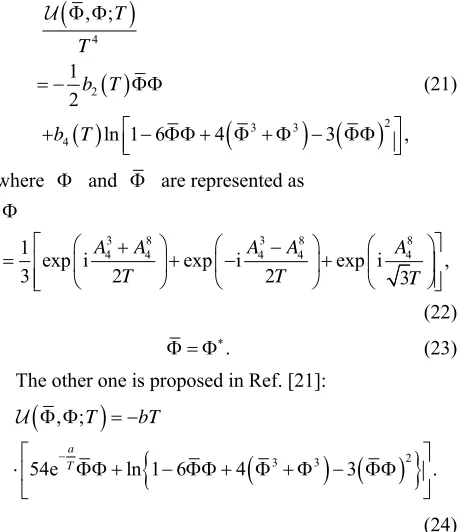
T T b T b T (21)
where and are represented as
3 8 3 8
4 4 4 4
1
exp i exp i
3 2 2
A A A A
T T 8 4
exp i ,
3 A T (22) .
(23) The other one is proposed in Ref. [21]:
2
3 .
3 3, ;
54e ln 1 6 4
a T T bT (24) This latter form is obtained from the knowledge of the strong-coupling limit of QCD. Recently the details have been investigated in Ref. [22,23]. The nonlocal PNJL model with potential (21) is henceforth denoted as model A and that with potential (24) as model B.
It is convenient to introduce a modified Polyakov-loop and its conjugate as
i i
e , e,
Im
(25) as these are RW-periodic quantities. The real and ima- ginary parts of serve as order parameters of the de- confinement transition and spontaneous -symmetry breaking because is a -odd quantity, just like the quark number density. We use as the order parameter of -symmetry breaking. As mentioned in the introduction, this
Im
-odd quantity serves as an exact order parameter at π3 because there -symmetry is not explicitly broken.
2.4. Parameter Setting
In the PNJL model the pion mass and its decay constant are used to fix parameters in the NJL sector of the Lagrangian. These parameters are taken from Ref. [15]. The vector-current interaction, at mean-field level, has no influence on the thermodynamics at 0. An estimate of the coupling constant v can therefore only be pro- vided by comparison with (restricted) LQCD information at nonzero chemical potential. For guidance, we can use the LQCD value for the ratio
G
1.05
TRW Tc [4], where
RW is the critical temperature of the Roberge-Weiss
end point (at
T
π3
) and is the crossover tem-
perature at c T 0 .
The coefficient functions 2 and b4 in (24) are parameterized such as to reproduce pure-gauge- LQCD results (Refs. [15,16]). When we use T0 = 270 MeV for the confinement-deconfinement transition tem- perature in the pure-gauge case, the resulting crossover transition temperature when including quarks in the PNJL model is slightly higher than the LQCD prediction. Alternatively, we also use T0 in order to
reproduce
b T
T240 MeV
190 MeV
Tc , as suggested in Ref. [24].
The parameter a in (24) is fitted to reproduce the
critical temperature in the pure gauge limit and its value is a = 664 MeV. The remaining parameter is defined
to reproduce the pseudo-critical temperature with dy- namical quarks. To reproduce T from the
two-flavor LQCD data, we take .
b
190 MeV c
3 0.01 GeV
b
T
0 240
T 270 MeV
0.01
b
[image:4.595.59.291.87.353.2]3. Numerical Results
Figure 1 displays the -dependence of the chiral order parameter and the real part of . Here we show the results of model A with and and that of model B with and 0.02 at 0, in both cases with Gv0.In all cases the transitions are
crossovers. The transition temperatures for the chiral and deconfinement crossovers almost coincide. This property comes from the entanglement of the chiral and decon- finement transitions through the nonlocality distribution functions.
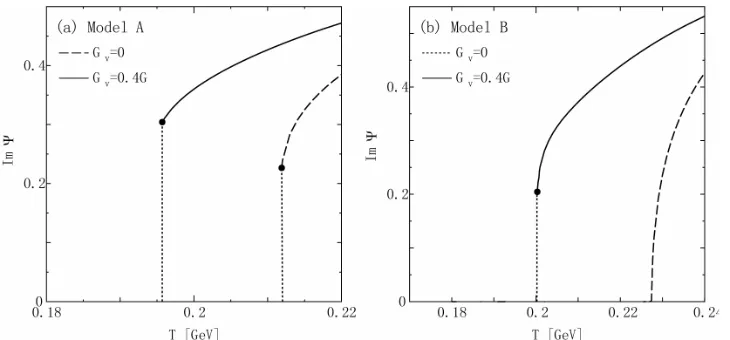
Figure 2 shows the T-dependence of Im at
3
. From the right figure we see that there is a first-order RW end point in the case of which turns into second-order for b . The LQCD data
[25,26] suggest that the order of the RW end point is first-order at sufficiently small 0. From this perspec- tive, 0.02 b 0.01 m 0.01
b is not a suitable choice, but this situation
can be modified as shown below.
In the previous figures we have ignored the vector- current interaction. As a consequence, the ratio RW c
exceeds the LQCD prediction [4,7]. Choosing Gv = 0.4 G
in model A with T0 = 240 MeV, this ratio becomes
T T
1.04
TRW Tc [8]. Model B with Gv = 0.4 G and b =
0.01 leads to TRW Tc1.05. These values are close to
the LQCD result. Figure 3 shows again the T-depend-
ence of the imaginary part of the modified Polyakov loop
Im
. One observes that the transition at TRW be-comes first-order when introducing the vector-current in- teraction in model B with . Henceforth, we only refer to the results of model A as both models lead to almost identical results.
0.01
b
G
-T
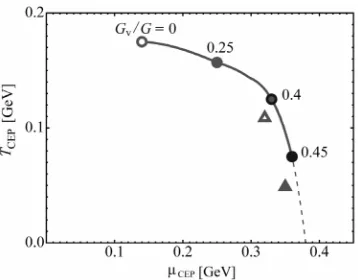
Finally, we study the v-dependence of the position
Figure 1. T-dependence of the chiral order parameter and the real part of Ψ at μ = 0 with Gv = 0. The solid and dotted lines
[image:5.595.125.475.313.489.2]denote the result of model A with T0 = 240 and 270 MeV, respectively. The left figure shows the result of model B with b = 0.01 and 0.02.
Figure 2. Left (right) figure: T0-dependence ( -dependence) of ImΨ as function of temperature T at θ = π/3 with Gv = 0. In
the left figure, the solid and dotted lines denote the result of model A with T0 = 240 and 270 MeV, respectively. In the right figure, the solid and dotted lines denote the result of model B with b = 0.01 and 0.02, respectively.
b
Figure 3. T-dependence of ImΨ at θ = π/3 for Gv = 0 and 0.4 G. The solid and dotted lines denote the result with Gv = 0.4 G
[image:5.595.117.482.537.707.2]Figure 4. Phase diagram in the μR-T plane. The circles and
triangles represent the position of the critical end point for the nonlocal and the local PNJL models, respectively. The white, blue, black blue and black symbols correspond to results with Gv/G = 0, 0.25, 0.4 and 0.45, respectively.
0, .4
G G 0.25,0
T
v and 0.45, respectively. In the local
PNJL model, the critical end point disappears or shifts to very small when considering a realistic range
0.25G G1
G
v for the vector coupling strength. In the
nonlocal PNJL model, the location of the critical point has a less pronounced dependence on temperature, at least for small v. This behavior can be traced to the
weakening of the NJL interaction by the nonlocality dis- tribution. The downward trajectory of the critical point becomes very steep, however, once v reaches val-
ues of 0.4 and beyond (see Figure 4). Around
G G
0.5
G G
G
v , the canonical ratio corresponding to an
effective quark-quark interaction induced by color-octet (gluon-exchange) currents, the critical points tends to disappear altogether and the first-order phase transition turns into a continuous crossover.
4. Summary
In this study we have investigated the impact of a (non- derivative) vector-current interaction in the nonlocal PNJL model at real and imaginary chemical potentials. The presence of the vector-current interaction makes the transition at the Roberge-Weiss end point more pro- nounced. The RW end point becomes first-order, con- sistent with recent LQCD simulations.
The location of the critical point in the phase diagram for real chemical potentials is highly sensitive to the vector coupling strength v. In the nonlocal PNJL mo-
del used here, the critical point tends to be eliminated in favor of a continuous crossover once the ratio of vector- to-scalar couplings is increased toward and beyond
1
G G
2 1
2
v , the value characteristic of an effective
gluon-exchange interaction between quarks. Qualita- tively similar tendencies are found in recent related work [27] and in a -flavor study using the local PNJL model [28] in which the disappearance of the chiral
first-order transition turning to a crossover is indicated already at values G Gv 1 2.
5. Acknowledgements
K. K. thanks H. Kouno and M. Yahiro for fruitful dis- cussions. K. K. is supported by RIKEN Special Post- doctoral Researchers Program. T. H. acknowledges the kind hospitality at Brookhaven National Laboratory dur- ing his stay. This work is supported in part by BMBF, by the Excellence Cluster “Origin and Structure of the Uni- verse”, and by DFG and NSFC through CRC 110.
REFERENCES
[1] P. de Forcrand, PoS (LAT2009), Vol. 010, 2009.
[2] K. Kashiwa, H. Kouno, T. Sakaguchi, M. Matsuzaki and M. Yahiro, Physics Letters B, Vol. 647, 2007, p. 446 [3] K. Kashiwa, M. Matsuzaki, H. Kouno, Y. Sakai and M.
Yahiro, Physical Review D, Vol. 79, 2009, Article ID: 076008. doi:10.1103/PhysRevD.79.076008
[4] P. de Forcrand and O. Philipsen, Nuclear Physics B, Vol. 642, 2002, p. 290.
[5] M. D’Elia and M.-P. Lombardo, Physical Review D, Vol. 67, 2003, Article ID: 014505.
[6] H. S. Chen and X. Q. Luo, Physical Review D, Vol. 72, 2005, Article ID: 034504.
doi:10.1103/PhysRevD.72.034504
[7] K. L. Wu, X. Q. Luo and H. S. Chen, Physical Review D, Vol. 76, 2005, Article ID: 034505.
doi:10.1103/PhysRevD.76.034505
[8] K. Kashiwa, T. Hell and W. Weise, Physical Review D, Vol. 84, 2011, Article ID: 056010.
doi:10.1103/PhysRevD.84.056010
[9] A. Roberge and N. Weiss, Nuclear Physics B, Vol. 275, 1986, p. 734. doi:10.1016/0550-3213(86)90582-1 [10] Y. Sakai, K. Kashiwa, H. Kouno and M. Yahiro, Physical
Review D, Vol. 77, 2008, Article ID: 051901. doi:10.1103/PhysRevD.77.051901
[11] E. Bilgici, F. Bruckmann, C. Gattringer and C. Hagen, Physical Review D, Vol. 77, 2005, Article ID: 094007. doi:10.1103/PhysRevD.77.094007
[12] K. Kashiwa, T. Sasaki, H. Kouno and M. Yahiro, 2012. arXiv:1208.2283
[13] H. Kouno, Y. Sakai, K. Kashiwa and M. Yahiro, Journal of Physics G, Vol. 36, 2009, p. 1150.
doi:10.1088/0954-3899/36/11/115010
[14] T. Hell, S. Roessner and W. Weise, Physical Review D, Vol. 79, 2009, Article ID: 014022.
doi:10.1103/PhysRevD.79.014022
[15] T. Hell, K. Kashiwa and W. Weise, Physical Review D, Vol. 83, 2011, Article ID: 114008.
doi:10.1103/PhysRevD.83.114008
doi:10.1103/PhysRevD.81.074034
[17] G. A. Contrera, M. Orsaria and N. N. Scoccola, Physical Review D, Vol. 82, 2010, Article ID: 054026.
doi:10.1103/PhysRevD.82.054026
[18] V. Pagura, D. Gomez Dumm and N. N. Scoccola, 2011. arXiv:1105.1739
[19] S. Noguera and N. N. Scoccola, Physical Review D, Vol. 78, 2008, Article ID: 114002.
doi:10.1103/PhysRevD.78.114002
[20] C. Ratti, S. Roessner, M. Thaler and W. Weise, European Physical Journal, Vol. C49, 2007, p. 213.
doi:10.1140/epjc/s10052-006-0065-x
[21] K. Fukushima, Physics Letters B, Vol. 591, 2004, p. 277. [22] C. Sasaki and K. Redlich, 2012. arXiv:1204.4330
[23] M. Ruggieri, P. Alba, P. Castorina, S. Plumari, C. Ratti and V. Greco, 2012. arXiv:1204.5995
[24] B.-J. Schaefer, J. M. Pawlowski and J. Wambach, Physi- cal Review D, Vol. 76, 2007, Article ID: 074023. doi:10.1103/PhysRevD.76.074023
[25] C. Bonati, G. Cossu, M. D’Elia and F. San_lippo, Physi- cal Review D, Vol. 83, 2011, Article ID: 054505. doi:10.1103/PhysRevD.83.054505
[26] C. Bonati, P. de Forcrand, G. Cossu, M. D’Elia, O. Phil- ipsen and F. San_lippo, 2012. arXiv:1201.2769
[27] G. Contrera, A. Grunfeld and D. Blaschke, 2012. arXiv:1207.4890