Estimating Money Demand Function by
a Smooth Transition Regression Model:
An Evidence for Turkey
Sahin, Afsin
Department of Banking, School of Banking and Insurance, Gazi
University
29 April 2013
Estimating Money Demand Function by a Smooth Transition Regression Model: An Evidence for Turkey
Afsin Sahin, Associate Professor of Economics, Department of Banking, Gazi University, Ankara, Turkey
Email: [email protected], Phone: +90-312-2162116
Abstract
The money supply process is assumed to be fixed in economic literature or at least there is a central bank trying to control the liquidity in the economy. On the other hand, the demand side is more volatile and more uncertain. This situation hinders the homogenous and symmetric information assumptions of the monetary models. The amount of money demanded is a dynamic process and changes depending on the transition variable in concern. The money demand increases in the boom periods of the economy but may diminish in the recessions gradually. Therefore the money demand function indicates an asymmetric behavior and nonlinearity. This paper estimates the money demand function by including the inflation uncertainty, that is assumed to be a transition variable for a small-open economy, Turkey by using the monthly data spanning from January, 1990 to May, 2012. The parameters of the money demand function are estimated by the Smooth Transition Regression (STR) models. While modelling the nonlinearity, an appropriate logistic function is determined. The dependent variables that are used to estimate the money function are gold, interest rate, inflation uncertainty, share prices, exchange rate and income. The inflation uncertainty data is gathered from the conditional variances of a specified EGARCH model. The results of the paper have several policy implications for the monetary authorities. First, the behavior of the money demand and its determinants are crucial at the times of adopting the inflation targeting regime. The stability of money demand is also related to the stability of inflation. So the results of the paper may be beneficial for the policy makers and monetary authorities during their decision making process.
Key Words: Money Demand; Inflation Uncertainty; Smooth Transition Regression; Nonlinearity.
Acknowledgment: This paper is based on the project entitled by “Estimating Money Demand Function by a Smooth Transition Regression Model: An Evidence for Turkey” that is supported by Gazi University Research Programme, Project No. 53/2012-01. Part of the paper was written while the author was a Visiting Research Scholar in the Department of Economics, Andrew Young School of Policy Studies, Georgia State University, USA.
I. Introduction
It is assumed in economic theory that money demand motives of agents are classified under transaction, precautionary and speculative purposes, and analyzing its determinants are crucial for monetary policy (Lovell, 2006, p. 471). Some of these determinants are well known and widely discussed in books on macroeconomics and monetary economics. There are well known facts about the signs of some elasticities. Transaction and precautionary motives increase by income and speculative motive and diminish by an increase in interest rate. Some papers also include other assets such as gold prices and share prices. These attempts are for representing the substitutes for money and elaborating their other possible positive wealth effects.
On the other hand, the discussion continues on the magnitudes of the elasticities, specifications of the models and estimation methods. In an empirical sense, there are two main category of methodology for measuring the determinants of money demand. These are linear and nonlinear methods. Gujarati (1968) for India; Goldfeld (1973), Buscher and Frowen (1993) for England; US, Germany and Japan; Boughton (1981) for Canada; Hetzel and Mehra (1989, p. 459), Friedman (1994, p. 118-119), Dreger and Wolters (2010), Ball (2001) for the US; Yashiv (1994) for Israel; Wang (2011), Hasan (2011), Slavova (2003) for Bulgaria were some of the past attempts for estimating the linear money demand functions.
The recent literature focuses more on the nonlinear methods to estimate the money demand function. Wolters, Terasvirta and Lütkepohl (1998), Granger and Terasvirta (1993, chp. 7), Lin and Terasvirta (1994), Lütkepohl, Terasvirta and Wolters (1999) for Germany; Sarno (1999) for Italy; Chen and Wu (2005), Ordonez (2003) for Spain; Austin and Ward (2007) for China are some of these studies using nonlinear methods to estimate money demand functions.
There are also plentiful of papers for Turkey trying to estimate the money demand function. Dönmez (2007) by using monthly Turkish data for the 1986-2003 period constructs a VECM model. He benefits from M1 and finds a negative effect of inflation. Korap and Yıldırım (2012) by using quarterly narrow money data for the years 1998-2010 include the share price index and the exchange rate to the equation. They use a correction term, a first lagged interest rate and lagged share prices index as transition variables and fail to reject the nonlinearity for money demand function and benefit from a linear error correction model. Tunay (2001) uses a parametric nonlinear method for the years 1987-2000. According to Keyder (2008, p. 378), inflation expectations are effecting the money demand negatively. Altıntaş (2008), by using quarterly M2 data for the period 1985-2006 benefits from the ARDL cointegration method and finds a positive exchange rate elasticity of money demand. Özdemir (2011) uses the M2Y definition and benefits from an economic uncertainty variable.
Second section provides the data and methodology. Third section presents the results and the fourth section is for the discussion. The last section is for the conclusion.
2. Data and Methodology
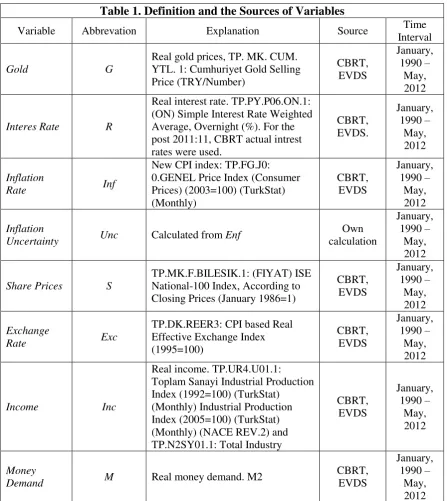
Index (Inc), Inflation Uncertainty (Unc) and Money Demand (M). The natural logarithm of the variables is taken except for the interest rate. Following Skalin and Terasvirta (1999, p. 210), the variables are not seasonally adjusted. The sources and explanations of the variables used in the text are presented in Table 1.
According to Keyder and Ertunga (2012, p. 327), M2 monetary aggregate definition is more appropriate if the scope inherits both transaction and wealth dimension of the money. M2 has interest bearing assets and this may affect the money demand elasticity of interest rates (Boefing, 2001, p. 23). Wu and Hu (2009, p. 1636) suggest including exchange rate to money demand equation for small open economies to increase the stability of the system. Following Enders (2010, p. 131), the inflation uncertainty is measured by the conditional heteroscedasiticy model. The appropriate model is chosen as ARCH (1,3,Thr=1, GED, EGARCH, Backcast=0.7, Deriv=AA, Lags=12).
In this paper, Smooth Transition Regression (STR) model is used to explore the determinants of money demand function. When a STAR model is estimated by an exogenous regressor, STR is obtained (Pavlidis, 2009). There are logistic and exponential versions of the models. Skalin and Terasvirta (1999), Sensier et al. (2002), Deschamps (2008) can be analysed for the LSTR models. Exponential transition version can also be estimated.- See Luukkonen, et al. (1998), Terasvirta (1994), Escribano and Jorda (1999), Kapetanios, Shin and Snell (2003) and Terasvirta (2004).
The transition function in STR models is widely used in economics. It indicates a degree of mean reversion and is a probability function of transition variable, threshold variable and smoothing parameter. If the process is asymmetric then the logistic version of the model is used (see Granger and Terasvirta, 1993 and Escribano and Jorda, 2001). The gamma that is the smoothing parameter strengths the nonlinearity if it is significant.
In this paper, following Lütkepohl, Terasvirta and Wolters (1999), the money demand function is estimated by the STR model given in equation (1). JMulti is used to estimate parameters and the systematic detailed application of the methodology can be found in literature. Terasvirta (1998) can be analyzed for the technical details of the model. Kratzig (2005) explains in detail how to apply the STR models by Jmulti. Below, the STR model is briefly provided following Terasvirta (2004) and Kratzig (2005).
JMulti allows using the two different types of logistic transition functions. See also Lundbergh and Terasvirta (2002, pp. 486-509), Dijk, Terasvirta and Franses (2002). One type of them is the LSTR1 and the other is the LSTR2.
,
(
, ,
t t t t t
y w x G c s u ; 2
~ (0, )
t
u iid t = 1, ..., T (1)
1
1 , ,
1 t
t s c
G c s
e
, 0 (2)
The transition function that is provided in the equation (2) is written for LSTR1. The
explanatory variables are given by wt
1,yt1,...,yt7
and xt
x1t,x2t,...,x7t
. The and parameters are linear and nonlinear parts of the model respectively where0 1 7
( , ,..., )
and ( , ,..., 0 1 7). If K = 1 then it is assumed that the specification allows to capture the asymmetry and the parameter change increases by the transition parameter monotonically from zero to one (Lundbergh and Terasvirta, 2002, p. 487).
7 lags. The estimation is also repeated for the nominal and the real variables and the seven monetary measures.
The specifications that reject the linearity for inflation uncertainty are considered. During the specification phase, several linearity tests are applied and the most appropriate transition variable and LSTR model are determined. The linearity is rejected for most of these models. These selected models also gave the lowest p-value for the specified inflation uncertainty variable and suggested as the strongest transition variable by the linearity tests. The unit root hypothesis is rejected by the ADF tests. The best model is selected by analyzing the significance and selection criteria. The model with the M2 monetary aggregate is selected as the best model. Unct7 is perceived as the transition variable. The suggested model is selected by the F (0.0140), F4 (0.6639), F3 (0.0451) and
F2 (0.0000) statistics. Conditional maximum likelihood method is made use for the parameter estimations.
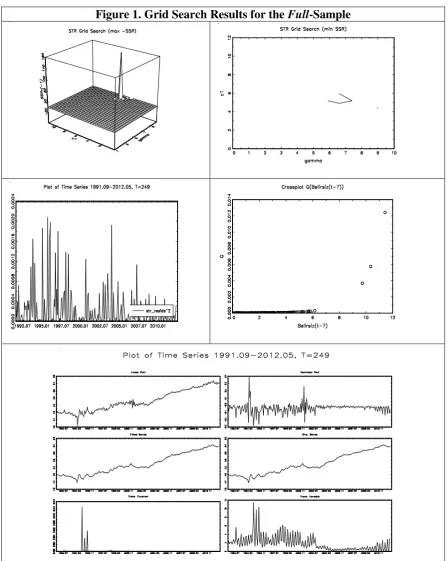
The estimated starting values for the gamma and the location parameters are 7.3352 and 5.5732 respectively and determined by the nonlinear optimization algorithm provided by Jmulti, which is called the grid search (Franses and Dijk, 2003, p. 108). The sum of squared residual is -171.0368 and it is used for the grid search to account for thresholds (Martens, Kofman and Vorst, 1998, p. 252). According to Enders (2010, p. 446), the sum of squared residuals is minimized when it approximates to the true value. Figure 2, Panel A indicates that the transition variable gives the minimum SSR. The graph is for the sum of squared residuals as a function of c and .
When the linear and nonlinear sections are graphed, we can gather interesting information. The nonlinear part can be drawn if the transition function is different than zero and can be interpreted as adjustment values for the high inflation uncertainty periods. When we control the values of transition function, its high values also match with the high inflation uncertainty and inflation values. The sum of linear and nonlinear parts of money demand is equal to the values of fitted series. Although the linear part is positive, nonlinear part is negative when the transition function is above zero. Besides during the
post-2002: 07, the transition function’s value is zero. This also increases the possibility that during the post-2002: 07, the money demand is linear.
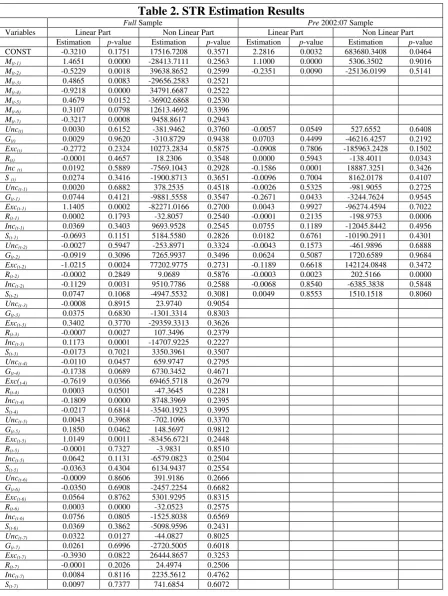
The estimation results are provided in Table 2 for the full sample. Gamma coefficient that is related by the transition between regimes is 1.2210 with the p-value 0.0001. The transition value is 17.5218 with p-value 0.0000 and that is inflation uncertainty indicating that if the monthly inflation uncertainty exceeds seven month’s lagged inflation than the economy transits from one regime to another. The regime is called as low if it is under this value and high if it is over. The value of the transition function in Turkey during the post-2002: 07 is zero and can be interpreted as low inflation uncertainty years.
The AIC criteria with -7.4717 and adjusted R2 with 0.9993 determines one of the best fitting models as suggested by Franses and Dijk (2003, p. 39). Test of parameter constancy rejects for H1 with p-value of 0.0725. ARCH-LM test with 8 lags rejects the null with the p-value of 0.0113. Jarque Bera statistics rejects the null with the p-value of 0.0422.
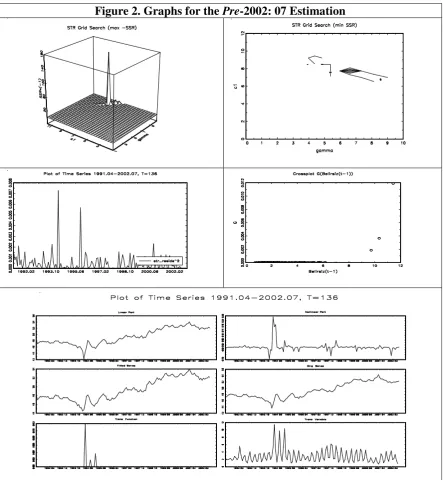
2012: 05: When the parameters are estimated by M2 for the pre-2002: 07 Unct-1 is chosen
as a transition variable with F (0.0000), F4 (0.0000), F3 (0.4004) and F2 (0.0000) statistics and suggests the LSTR1 type model. Gamma variable is 1.9091 (0.0005) and location parameter is 15.4510 (0.0000). The AIC and adjusted R2 statistics are -6.9274 and 0.9915 respectively. SSR, gamma and c are -156.4819, 6.6153 and 7.7398 respectively. p-values of the ARCH-LM test with 8 lags and Jarque-Bera statistics are 0.7710 and 0.0000. The suggested models for the post-2007: 07 are all linear.
3. Discussion
There are varieties of possible reasons concerning the nonlinear behavior in the money demand. For instance, Weintraub (1970, p. 251) and Chen and Wu (2005) claim that the money demand is not linear because of the transaction costs such as brokage fee. Michael et al. (1999) stress the role of non-convex costs for the rigidity in adjustment mechanism in money demand.
In this paper the possible effects of inflation uncertainty in terms of creating nonlinearity in money demand function is analyzed. According to Belke and Polleit (2009, p. 1), the reason of individuals using money is because of the uncertainty. They claim that if the future is certain, then the individuals would not hold money. The uncertainty may increase money demand, interest rates may increase and the bond prices may diminish (Bocutoğlu, 2011, p. 69). There are also several past theoretical and empirical considerations on the role of uncertainty. For instance Poole (1970, p. 485) stresses the role of uncertainty on the money demand and income relationship. Klein (1977) uses standard deviation to measure the inflation uncertainty and finds a positive effect for US economy. According to Klein (1977, p. 713), an increase in inflation uncertainty increases the money demand of the individuals. Khan (1982) uses inflation variability to measure the uncertainty for Pakistan economy and claims that the precautionary motive increases by the uncertainty. However according to him, the portfolio composition changes by the uncertainty and diminishes the money demand. Besides he claims that the latter channel is more dominant than the first. Asilis and Honohan (1993) explore a negative effect of inflation uncertainty that is measured by GARCH model for Bolivia. Mizrach and Santomero (1990) find a negative effect of inflationist risk measured by ARCH model on money demand for the US economy. Blejer (1979) tells that inflation uncertainty affects the money demand in two ways. Money demand may increase because of the precautionary motive and diminish because of the asset risks. According to him, high inflation increases inflation uncertainty for Argentina, Brazil and Chile and diminishes the money demand. Inflation may increase the level of inflation uncertainty therefore effects the money demand.
The effects of inflation expectation are also considered by several authors. Rao and Singh (2006), by using Indian M1 data, suggest to use nominal interest rate rather than the real interest rate and claim that the expected inflation should have a negative effect on money demand. According to Blanchard (2011, p. 499-500) money demand may diminish by the diminish in expected inflation.
An increase in interest rate diminishes the money demand. This is consistent with Demiralp and Carpenter (2008, p. 15) whom are claiming that when the central bank increases the interest rates in Turkey, the demand deposit diminish and the time deposits increase. Consequently, when the interest rate increases money demand diminishes.
The exchange rate is also an other variable affecting the money demand function. Calvo and Reinhart (2000) claim that an increase in exchange rate in developing countries pushes the inflation up through the import channel and increases the inflation. Consequently, an increase in the exchange rate may increase the transaction motive of the money demand. On the other hand, the investment decision of the firms may be detorated and the net effect would depend on the dominance.
The coefficients for the gold are not significant but they are positive. The positive coefficient for gold is meaningful since it is one of the wealth determinants of the Turkish households. Ingbank (2012) survey that is supervised by Alpay Filiztekin and Şengül Dağdeviren tries to determine the saving behaviors in Turkey. According to their study, Turkish Lira, time deposit account, gold, (demand deposit, foreign currency or cash) are the most important saving tools in Turkey. The gold is the second most important saving tool and this results supports why the banking sector is highly interested in gold funds in Turkey. Equity shares, individual pension fund, funds, treasury bonds are the least used ones for saving purposes in Turkey. According to the survey, the ratio of individuals’ saving is nearly 10%. Nearly 60% of the survey participants answered that the reason of their not doing saving was because of their low income levels. Nearly half of the individuals claimed that they increase their savings as an assurance in terms of unexpected situations. The ratio of the ones whom are increasing their savings to earn interest rate is nearly 5%.
A possible structural change is also considered in the paper. An economic structure may change and develop by the time being. For instance, it is apparent that the financial system of 1990s is much more complicated than the years 1970s as claimed by Mayer (1993, p. 43). Following these new developments, the dynamics of monetary aggregates and their behavior may also change.1 The changing dynamics in the economy may also create an uncertainty.2 Therefore it is meaningful to claim that for the post-2002 period, the suggested models are linear.
4. Conclusion
Money demand is the tendencency of the economic actors for holding their welfare as cash and bank deposit. Precautionary motive part of this tendency increases during the periods where the inflation uncertainty goes up. During the high inflation uncertainty levels individuals may tend to save more and this may affect the long-run
1For example according to Bofinger (2001, p. 23), velocity of money diminished in the countries such as United States
and Germany.
2
adjustment of the money demand to its equilibrium level. Inflation uncertainty creates an asymmetry in money demand function. It is a dynamic process and it’s case sensitive. The sensitivity of money demand is asymmetric and has a nonlinear structure.
The money demand function indicates a nonlinear behavior between high and low inflation uncertainty periods. During the high inflation uncertainty period, precautionary motive of money demand increases. Considering this nonlinearity may give several advantages to the policy makers during the decision making process. When the inflation uncertainty increases the central bank generally prefers a tight monetary policy. In times like these diminishing liquidity phases of the economy, the net liquidity would be determined by the net money supply. Since the money demand may increase by the lagged inflation uncertainty, central bank may also bethink this lag and its effect while taking decisions for the liquidity adjustment.
Sources
Altıntaş, H. (2008). 'The stability of money demand in Turkey and predicting with nound testing approach: 1985-2006.' Erciyes Üniversitesi İktisadi ve İdari Bilimler Fakültesi
Dergisi 30(Jan.): 15-46. [In Turkish.]
Asilis, C.M., P. Honohan & P.D. Mcnelis (1993). 'Money demand during hyperinflation and stabilization: Bolivia, 1980-88.' Economic Inquiry 31(2): 262-273.
Austin, D., B. Ward & P. Dalziel (2007). 'The demand for money in China, 1987-2004: A nonlinear modelling approach.' China Economic Review 18(2): 190-204.
Bailey, M. J. (1956). 'The welfare cost of inflationary finance.' Journal of Political Economy 64(2): 93-110.
Ball, L. (2001). 'Another look at long-run money demand.' Journal of Monetary Economics 47(1): 31-44.
Belke, A. & T. Polleit (2009). Monetary economics in globalized financial markets. New York: Springer.
Blanchard, O. (2011). Macroeconomics. Updated Fifth Edition, UK: Pearson Education. Blejer, M. I. (1979). 'The demand for money and the variability of the rate of inflation: Some empirical results.' International Economic Review 20(2): 545-549.
Bocutoğlu, E. (2011). Comparative macroeconomics: Theories and policies. Extended 4th Edition, Trabzon: Murathan Publication House. [In Turkish].
Bofinger, P. (2001). Monetary policy goals, institutions, strategies, and instruments. New York: Oxford University Press.
Boughton, J. M. (1981). 'Recent instability of the demand for money: An international perspective.' Southern Economic Journal 47(3): 579-97.
Buscher, H. & S.F. Frowen (1993). 'The demand for money in Japan, the United Kingdom, West Germany and the USA: An empirical study of the evidence since 1973.' In: S.F. Frowen (ed.), Monetary theory and monetary policy, new tracks for the 1990s, 123-165. New York: St. Martin’s Press.
Calvo, G. & C. Reinhart (2000). 'Fear of floating.' NBER Working Paper, No. 7993, November.
Calza, A. & A. Zaghini (2011). 'Sectoral money demand and the great disinflation in the US.' Banca D'Italia Working Paper, No. 785: 1-32.
Demiralp, S. & Carpenter, S. (2008). The role of money in the transmission mechanism.
TÜBİTAK Project No. 106K226. [In Turkish].
Deschamps, P.J. (2008). 'Comparing smooth transition and markov switching autoregressive models of US unemployment.' Journal of Applied Econometrics 23(4): 435-462.
Dijk, D., Terasvirta, T. & Franses, P.H. (2002). 'Smooth transition autoregressive models: A survey of recent developments.' Econometric Reviews 21(1): 1-47.
Dönmez, O. (2007). 'The Fisher equation examined: Implications for the money demand in Turkey.' Central European University, Department of Economics Masters Thesis, Hungary.
Dreger, C. & J. Wolters (2010). 'Investigating M3 money demand in the Euro area.'
Journal of Intenational Money and Finance 29(1): 111-122.
Enders, W. (2010). Applied Econometric Time Series. USA: John Wiley.
Escribano, A. & O. Jorda (2001). 'Testing non-linearity: decision rules for selecting between logistic and exponential STAR models.' Spanish Economic Review 3(3): 193– 209.
Escribano, A. & O. Jorda (1999). 'Improved testing and specification of smooth transition regression models.' In: P. Rothman & P. Dordrecht (eds.), Nonlinear time series analysis of economic and financial data, 289-320. USA: Kluwer Academic Publishers.
Friedman, M.B. (1994). 'Intermediate targets versus information variables as operating guides for monetary policy.' In: J.A.H. Wijnholds, S.C.W. Eiffinger and L.H. Hoogduin (Eds.), A framework for monetary stability, 109-133. USA: Kluwer Academic Publishers. Franses, P.H. & D. Dijk (2003). Non - linear time series models in empirical finance.
New York: Cambridge University Press, Cambridge, 69-132.
Goldfeld, S. (1973). 'The demand for money revisited.' Brookings Papers on Economic Activity 4(3): 577-638.
Granger, C.W.J. & T. Terasvirta (1993). Modeling non-linear economic relationships.
Oxford: Oxford University Press.
Gujarati, D. (1968). 'The demand for money in India.' Journal of Development Studies
5(1): 59-64.
Hasan, M. S. (2011). 'Seasonal cointegration and long - run neutrality of money in the USA.' Review of Banking, Finance and Monetary Economics 40(3): 93-105.
Hetzel, R. & Y. Mehra (1989). 'The behaviour of money in the 1980s.' Journal of Money, Credit and Banking 21(4): 45-463.
Ingbank (2012). 'Research on saving tendencies of Turkey: Comparative results for the 2011 4th quarter and 2012 first quarter.' ING BANK. [In Turkish].
Inguva, S. (1978). 'The demand for money and inflationary process: An econometric model.' Ph.D. diss., Georgia State University, Department of Economics.
Issing, O., V. Gaspar, O. Tristani & D. Vestin (2005). Imperfect knowledge and monetary policy. Cambridge: Cambridge University Press.
Kapetanios, G., Y. Shin & A. Snell (2003). 'Testing for a unit root in the nonlinear STAR framework.' Journal of Econometrics 112(2): 359-379.
Keyder, N. & E.İ. Ertunga (2012). Money, theory, policy and application. 12th edition, Ankara. [In Turkish].
Keyder, N. (2008). Money, Theory, Policy, Application, Ankara. [In Turkish].
Khan, A.H. (1982). 'The demand for money and the variability of the rate of inflation.'
Klein, B. (1977). 'The demand for quality-adjusted cash balances: Price uncertainty in the U.S. demand for money function.' Journal of Political Economy 85(4): 691-715.
Korap, L. & M. Yıldırım (2012). 'Testing the Lucas Critique for the money demand function.' İktisat, İşletme ve Finans27(318): 57-82.
Kratzig, M. (2004). 'STR Analysis in JMulti.', March, 1-17.
Lin, C.F.J & T. Terasvirta (1994). 'Testing the constancy of regression parameters againist continous structural change.' Journal of Econometrics 62(2): 211-228.
Lovell, M.C. (2006). Economics with calculus. USA: World Scientific, pp. 465-486. Lundbergh, S. & T. Terasvirta (2002). 'Forecasting with smooth transition autoregressive models.' In: M.P. Clements and D.F. Hendry (eds.), A Companion to Economic Forecasting, 485-509. USA: Blackwell Publishing.
Luukkonen, R., P. Saikkonen & T. Terasvirta (1988). 'Testing linearity againist smooth transition autoregressive model.' Biometrika 75(3): 491-499.
Martens, M., P. Kofman & T.C.F. Vorst (1998). 'A threshold error-correction model for intraday futures and index returns.' Journal of Applied Econometrics 13(3): 245-263. Mayer, T. (1993). 'Monetarism in a world without money.' In: S.F. Frowen (ed.),
Monetary theory and monetary policy, new tracks for the 1990s, 43-79. USA: Martin’s Press.
Mizrach, B. & A.M. Santomero (1990). 'A liquidity in advance model of the demand for money under price uncertainy.' Journal of Monetary Economics 26(1): 143-159.
Slavova, S. (2003). 'Money demand during hyperinflation and stabilization: Bulgaria, 1991-2000.' Applied Economics 35(11): 1303-1316.
Lütkepohl, H., T. Terasvirta & J. Wolters (1999). 'Investigating stability and linearity of a German M1 money demand function.' Journal of Applied Econometrics 14(5): 511-525. Michael, P., Nobay, R.A. & D.A. Peel (1999). 'Nonlinear adjustment towards long-run money demand.' In: P. Rothman (ed.), Nonlinear time series analysis of economic and financial data, 179-190. USA: Kluwer Academic Publishers.
Ordonez, J. (2003). 'Stability of non-linear dynamics in the broad demand for money in Spain.' Economics Letters 78(1): 139-146.
Özdemir, K.A. (2011). 'Overlook on the monetary analysis: An evidence for Turkey.'
Central Bank Review 11(7): 29-48. [In Turkish].
Pavlidis, E.G., I. Paya & D.A. Peel (2009). 'Specifying smooth transition regression models in the presence of conditional heteroskedasticity of unknown form.' Lancaster University Management School WP 2009/09.
Poole, W. (1970). 'Whither money demand.' Brookings Papers on Economic Activity 1(3): 485-501.
Rao, B.B. & R. Singh (2006). 'Demand for money in India: 1953-2003.' Applied Economics 38(11): 1319-1326.
Sarno, L. (1999). 'Adjustment costs and nonlinear dynamics in the demand for money: Italy, 1861-1991.' International Journal of Finance and Economics 4(2): 155-177.
Sensier, M., D.R. Osborn & N. Özal (2002). 'Asymmetric interest rate effects for the UK real economy.' Oxford Bulletin of Economics and Statistics 64(4): 315-339.
Skalin, J. & T. Terasvirta (1999). 'Another look at Swedish business cycles, 1861-1988.'
Journal of Applied Econometrics 14(4): 359-378.
Terasvirta, T. (2004). 'Smooth transition regression modelling.' In: Lütkepohl, H. and Kratzig, M. (eds.), Applied time series econometrics, Cambridge: Cambridge University Press.
Terasvirta, T. (1998). 'Modelling economic relationships with smooth transition regressions.' In: A. Ullah and D.E. Giles (eds.), Handbook of applied economic statistics, 507-552. New York: Marcel Dekker.
Terasvirta, T. (1994). 'Specification, estimation and evaluation of smooth transition autoregressive models.' Journal of the American Statistical Association 89(425): 208-218. Tunay, B.K. (2001). 'Estimation of income velocity for Turkey by MARS method.'
ODTÜ Gelişme Dergisi29(3-4): 431-434.
Tunca, Z. (2011). Macroeconomics. 5th edition, İstanbul: Geçit Publication House. [In Turkish].
Wang, Y. (2011). 'The stability of long-run money demand in the United States: A new approach.' Economics Letters 111(1): 60-63.
Weintraub, R.E. (1970). Introduction to monetary economics. New York: The Ronald Press Company.
Wolters, J., Terasvirta, T. & H. Lütkepohl (1998). 'Modelling the demand for M3 in the United Germany.' The Review of Economics and Statistics 80(3): 399-409.
Wu, J.L. & Y.H. Hu (2007). 'Currency substitution and nonlinear error correction in Taiwans’s demand for broad money.' Applied Economics 39(13): 1635-1645.
Table 1. Definition and the Sources of Variables
Variable Abbrevation Explanation Source Time
Interval
Gold G
Real gold prices, TP. MK. CUM. YTL. 1: Cumhuriyet Gold Selling Price (TRY/Number)
CBRT, EVDS
January, 1990 – May, 2012
Interes Rate R
Real interest rate. TP.PY.P06.ON.1: (ON) Simple Interest Rate Weighted Average, Overnight (%). For the post 2011:11, CBRT actual intrest rates were used.
CBRT, EVDS.
January, 1990 – May, 2012
Inflation
Rate Inf
New CPI index: TP.FG.J0: 0.GENEL Price Index (Consumer Prices) (2003=100) (TurkStat) (Monthly)
CBRT, EVDS
January, 1990 – May, 2012
Inflation
Uncertainty Unc Calculated from Enf
Own calculation
January, 1990 – May, 2012
Share Prices S
TP.MK.F.BILESIK.1: (FIYAT) ISE National-100 Index, According to Closing Prices (January 1986=1)
CBRT, EVDS
January, 1990 – May, 2012
Exchange
Rate Exc
TP.DK.REER3: CPI based Real Effective Exchange Index (1995=100)
CBRT, EVDS
January, 1990 – May, 2012
Income Inc
Real income. TP.UR4.U01.1: Toplam Sanayi Industrial Production Index (1992=100) (TurkStat)
(Monthly) Industrial Production Index (2005=100) (TurkStat) (Monthly) (NACE REV.2) and TP.N2SY01.1: Total Industry
CBRT, EVDS
January, 1990 – May, 2012
Money
Demand M Real money demand. M2
CBRT, EVDS
Table 2. STR Estimation Results
Full Sample Pre 2002:07 Sample
Variables Linear Part Non Linear Part Linear Part Non Linear Part Estimation p-value Estimation p-value Estimation p-value Estimation p-value CONST -0.3210 0.1751 17516.7208 0.3571 2.2816 0.0032 683680.3408 0.0464
M(t-1) 1.4651 0.0000 -28413.7111 0.2563 1.1000 0.0000 5306.3502 0.9016
M(t-2) -0.5229 0.0018 39638.8652 0.2599 -0.2351 0.0090 -25136.0199 0.5141
M(t-3) 0.4865 0.0083 -29656.2583 0.2521
M(t-4) -0.9218 0.0000 34791.6687 0.2522
M(t-5) 0.4679 0.0152 -36902.6868 0.2530
M(t-6) 0.3107 0.0798 12613.4692 0.3396
M(t-7) -0.3217 0.0008 9458.8617 0.2943
Unc(t) 0.0030 0.6152 -381.9462 0.3760 -0.0057 0.0549 527.6552 0.6408
G(t) 0.0029 0.9620 -310.8729 0.9438 0.0703 0.4499 -46216.4257 0.2192
Exc(t) -0.2772 0.2324 10273.2834 0.5875 -0.0908 0.7806 -185963.2428 0.1502
R(t) -0.0001 0.4657 18.2306 0.3548 0.0000 0.5943 -138.4011 0.0343
Inc (t) 0.0192 0.5889 -7569.1043 0.2928 -0.1586 0.0001 18887.3251 0.3426
S (t) 0.0274 0.3416 -1900.8713 0.3651 -0.0096 0.7004 8162.0178 0.4107
Unc(t-1) 0.0020 0.6882 378.2535 0.4518 -0.0026 0.5325 -981.9055 0.2725
G(t-1) 0.0744 0.4121 -9881.5558 0.3547 -0.2671 0.0433 -3244.7624 0.9545
Exc(t-1) 1.1405 0.0002 -82271.0166 0.2700 0.0043 0.9927 -96274.4594 0.7022
R(t-1) 0.0002 0.1793 -32.8057 0.2540 -0.0001 0.2135 -198.9753 0.0006
Inc(t-1) 0.0369 0.3403 9693.9528 0.2545 0.0755 0.1189 -12045.8442 0.4956
S(t-1) -0.0693 0.1151 5184.5580 0.2826 0.0182 0.6761 -10190.2911 0.4301
Unc(t-2) -0.0027 0.5947 -253.8971 0.3324 -0.0043 0.1573 -461.9896 0.6888
G(t-2) -0.0919 0.3096 7265.9937 0.3496 0.0624 0.5087 1720.6589 0.9684
Exc(t-2) -1.0215 0.0024 77202.9775 0.2731 -0.1189 0.6618 142124.0848 0.3472
R(t-2) -0.0002 0.2849 9.0689 0.5876 -0.0003 0.0023 202.5166 0.0000
Inc(t-2) -0.1129 0.0031 9510.7786 0.2588 -0.0068 0.8540 -6385.3838 0.5848
S(t-2) 0.0747 0.1068 -4947.5532 0.3081 0.0049 0.8553 1510.1518 0.8060
Unc(t-3) -0.0008 0.8915 23.9740 0.9054
G(t-3) 0.0375 0.6830 -1301.3314 0.8303
Exc(t-3) 0.3402 0.3770 -29359.3313 0.3626
R(t-3) -0.0007 0.0027 107.3496 0.2379
Inc(t-3) 0.1173 0.0001 -14707.9225 0.2227
S(t-3) -0.0173 0.7021 3350.3961 0.3507
Unc(t-4) -0.0110 0.0457 659.9747 0.2795
G(t-4) -0.1738 0.0689 6730.3452 0.4671
Exc(t-4) -0.7619 0.0366 69465.5718 0.2679
R(t-4) 0.0003 0.0501 -47.3645 0.2281
Inc(t-4) -0.1809 0.0000 8748.3969 0.2395
S(t-4) -0.0217 0.6814 -3540.1923 0.3995
Unc(t-5) 0.0043 0.3968 -702.1096 0.3370
G(t-5) 0.1850 0.0462 148.5697 0.9812
Exc(t-5) 1.0149 0.0011 -83456.6721 0.2448
R(t-5) -0.0001 0.7327 -3.9831 0.8510
Inc(t-5) 0.0642 0.1131 -6579.0823 0.2504
S(t-5) -0.0363 0.4304 6134.9437 0.2554
Unc(t-6) -0.0009 0.8606 391.9186 0.2666
G(t-6) -0.0350 0.6908 -2457.2254 0.6682
Exc(t-6) 0.0564 0.8762 5301.9295 0.8315
R(t-6) 0.0003 0.0000 -32.0523 0.2575
Inc(t-6) 0.0756 0.0805 -1525.8038 0.6569
S(t-6) 0.0369 0.3862 -5098.9596 0.2431
Unc(t-7) 0.0322 0.0127 -44.0827 0.8025
G(t-7) 0.0261 0.6996 -2720.5005 0.6018
Exc(t-7) -0.3930 0.0822 26444.8657 0.3253
R(t-7) -0.0001 0.2026 24.4974 0.2506
Inc(t-7) 0.0084 0.8116 2235.5612 0.4762