ISSN: 1816-949X
© Medwell Journals, 2020
Review of Steady State Visually Evoked Potential Brain-Computer Interface
Applications: Technological Analysis and Classification
1, 2
Sebastián Poveda Zavala,
1, 2José Luis Murillo López,
1, 2Kelvin Ortíz Chicaiza and
1, 2Sang Guun Yoo
1
Departamento de Informática y Ciencias de la Computación, Escuela Politécnica Nacional,
Quito, Ecuador
2
Smart Lab, Escuela Politécnica Nacional, Quito, Ecuador
Abstract: Brain-computer interface is a technology which creates a new way of communication between a person’s brain and the external world. To achieve this objective, the brainwaves of a person must be gathered by using specialized devices and then classified in different categories that are associated with specific commands. In the process of brainwave gathering, brain activities of a person can be influenced by different types of stimuli to get the desired results and one of the most important and popular stimuli used in this field is steady state visually evoked potential. Based on this background, this review seeks to show and analyze a series of articles that have been executed around the world related to brain-computer interface applications using steady state visually evoked potential. This review has been executed with the objective of identifying the advantages and limitations of utilizing steady state visually evoked potentials, its main areas of application and the future challenges. Additionally, this review analyzes the different technologies involved to the implementation of state visually evoked potential systems such as signal classification techniques, electroencephalography devices, channels, verification metrics and experimental environments used in the research projects. In summary, this review intends to guide the scientific community about the different aspects involved in conducting research on the development of brain-computer interface applications using electroencephalography devices and steady state visually evoked potential.
Key words: Brain computer interface, steady state visually evoked potentials, BCI, SSVEP, BCI applications, electroencephalography
INTRODUCTION
Brain-Computer Interface (BCI) is a technology that uses signals gathered from the brain of a person to enable communication with the external world. Although, BCI may seem like a novel concept, it was first introduced by the researcher Jacques J. Vidal in 1973 who presented the term, the vision and some ideas of what this technology could achieve Nam et al. (2018). And with almost 50 years of antiquity, the main milestones of the field were achieved even before; like the birth of the Electroencephalography (EEG) concept Berger (1929), the description of contingent negative variation Walter et al. (1964) or the beginning of neurofeedback Kamiya (1968). Despite such achievements, there were no significant advances until this century when important real-life projects began to appear Shih et al. (2012). Those projects received the attention of the scientific community and followed in new researches that allowed the progress of this field.
In order to implement a functional application, a BCI system must be able to capture the signals of the brain,
process them, i.e., extracting specific characteristics and identifying the user’s intentions and execute the functionalities selected by the user He et al. (2013). In this aspect, brainwave acquisition is indispensable for the implementation of a BCI system and for such process, a large number of techniques have been developed. Those techniques can be divided into two large categories, i.e., invasive (which uses surgical implants in the brain for signal acquisition) and non-invasive (which does not require a surgical implant for signal acquisition) Graimann et al. (2009). Invasive techniques allow getting data with higher quality, however, they are not widely used because they require surgical operations that can bring medical complications. On the other hand, non-invasive techniques are widely used since there are no health risks and they have a much easier implementation feature. Within the category of non-invasive BCI, various technologies are used to capture brain signals. Among them, the most important technologies include: functional Magnetic Resonance Imaging (fMRI) based on measuring changes in blood flow Rios-Lago (2008), Functional Near-Infrared
Spectroscopy (fNIRS) (which uses infrared light to measure characteristics of specific cortical regions) Bunce et al. (2006), Magnetoencephalography (MEG) (which is based on measuring magnetic induction in neuronal cells) Hamalainen et al. (1993) and Electroencephalography (EEG) (which yields a record of brain bioelectric activity) Zhang et al. (2017a, b). And among the mentioned technologies, EEG is considered as the most popular and accessible method for most researchers, since, there are more variety of devices that meet their needs in the market i.e., portability, ease of use, number of brainwave channels and price Thakor and Sherman (2013).
According to the International Federation of Clinical Neurophysiology, EEG is defined as “the science relating to the electrical activity of the brain and the technique of recording electroencephalograms” Steriade et al. (1990). In recent years, a large number of EEG based BCI systems have been developed thanks to the release of different low-cost devices that allows recording brain signals at a constant rate i.e., Muse headband, OpenBCI, emotiv EPOC. Additionally, the development of different technologies to analyze and use the brain signals gathered using EEG such as ERD/ERS (event-related desynchronization and event-related synchronization), P300, motor imagery and SSVEP (Steady State Visual Evoked Potentials) Bi et al. (2013), also helped the expansion of BCI systems based on EEG. In this aspect among the aforementioned technologies for analyzing and using brainwaves, one of the most important is SSVEP. SSVEP makes use of brainwaves generated by visual stimulation responses when a subject looks at a light source flickering at a specific frequency. SSVEP’s usage has grown considerably, since, it is easy to implement in real life applications, denoting more than anything benefits such as the use of few channels to get accurate results and the short training time needed by the user.
Due to the importance of EEG and SSVEP in BCI systems, this review presents a detailed study of different application researches done using the aforementioned technologies. This review has the purpose to deliver a systematic literature review of the latest BCI applications that uses EEG and SSVEP to help people understand the new trends of applications in this area and the different technologies involved in the implementation of those applications.
MATERIALS AND METHODS
To fulfill the purpose of this review, we have conducted a systematic review of different researches that focus on BCI systems based on EEG and SSVEP. For this process, we adopted the approach described by Arksey and O’Malley which is commonly used in researches
involving health. This method offers a way to examine the extent and nature of the research regardless of the quality of the study Arksey and O’Malley (2005).
Criteria of inclusion and exclusion: Scientific articles reviewed were selected based on the following criteria: C Articles published since, January, 2012
C The BCI system must use EEG and SSVEP technologies
C Since, the purpose of this review is focused on the implementation of real-world applications, researches that only focus on signal classification and modeling were excluded
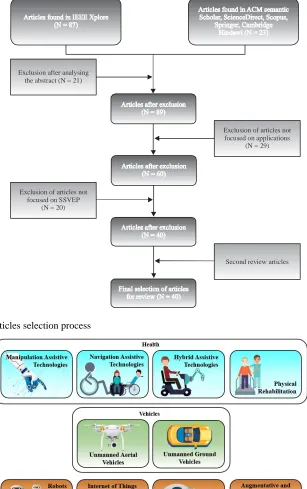
Search strategy and results: The search was performed in various scientific databases including IEEE Xplore, ACM Digital Library, ScienceDirect, SemanticScholar, Scopus, Springer and Hindawi. The words BCI, EEG, SSVEP, control and application were searched in titles, keywords and abstracts of articles. Once the search was done, 110 articles were collected. After reviewing their complete content, we proceeded to exclude those articles not focused on BCI applications and those not using SSVEP responses. After such exclusion, the whole set of articles were reduced to 40 which were selected as the target of analysis of this review. Figure 1 shows the details of the article selection process.
Review of EEG-SSVEP application: In the field of
neuro-engineering, Steady State Visually Evoked Potentials (SSVEP) is defined as a set of signals that are captured when there is a certain visual stimulation at specific frequencies called Visual Evoked Potentials (VEP). Registered VEPs are activated by sensory stimulation of a subject’s visual field and they reflect visual information processing mechanisms in the brain Wang et al. (2006). A BCI system that uses VEP can identify the object in which the user is focusing their attention, through an analysis of the EEG signals recorded in real time. To ensure reliable identification, VEPs derived from different stimulus sequences are registered and usually classified to a frequency domain Vialatte et al. (2010). SSVEPs are widely used with EEG since it delivers excellent signal-to-noise ratio and relative insusceptibility to artifacts. In this sense, the growing interest of the scientific community for BCI systems that are lightweight, easy-to-use inexpensive and non-invasive has allowed EEG-SSVEP to be applied in a variety of solutions in different areas. Based on this background, this review has analyzed the most recent research articles related to EEG-SSVEP implementations intended to be used in real life. The reviewed articles were classified in different categories as shown in Fig. 2.
Health applications: According to the World Health
Exclusion after analysing the abstract (N = 21)
Exclusion of articles not focused on applications
(N = 29)
Exclusion of articles not focused on SSVEP
(N = 20)
[image:3.612.157.464.97.586.2]Second review articles
Fig. 1: Diagram of articles selection process
Fig. 2: Categories of BCI applications based on SSVEP result in temporary or permanent disabilities Road safety (2018). Considering this statistic, health is one of most benefited fields of BCI systems based on SSVEP, since, this technology can improve the quality of life of people who suffer from Motor Neuron Diseases (MND) or other types of movement disabilities. Health
applications can be divided into manipulation assistive technologies, navigation assistive technologies, hybrid assistive technologies and physical rehabilitation tools.
Manipulation assistive technologies: Manipulation
for people who have difficulties to perform daily tasks. Some examples of this type of technologies are electric hospital bed proposed by Peng et al. (2016), an assistant arm for patient feeding Perera et al. (2016, 2017), the control of a transhumeral prosthesis Ruhunage et al. (2017) and robotic arms Yang et al. (2017); Zhang et al. (2017a, b); Pelayo et al. (2018); Zhang et al. (2012).
Among the reviewed articles, Peng et al. (2016) proposes an electric hospital bed controlled by SSVEP-P300 combination responses. SSVEP is used to turn on/off and control the bed. Different frequencies, 6.0, 6.67, 7.5 and 8.57 Hz are displayed in the corners of the screen and they are used to select one of 4 commands. Among the 4 commands, only one is used at the moment. The brain signals are filtered using a bandpass of 0.1-20 Hz and then classified using power ratios obtained by using Minimum Energy Combination (MEC) and Discrete Fourier Transform (DFT) methods. On the other hand, P300 is used to control the main functions of the bed.
Within the robotic arm control implementations we have Perera et al. (2017, 2016); Ruhunage et al. (2017a, b); Yang et al. (2017); Zhang et al. (2017); Pelayo et al. (2018); Zhang et al. (2018), several solutions are presented. According to Perera et al. (2017), the researchers developed a BCI system to control a robotic arm that aids in people’s feeding process. The system was created to help people with any type of movement limitations in their upper limbs. The frequencies used for this system were 6, 7 and 8 Hz. The system processes the brain signals by means of spatial and high-pass filters and the frequency domain is extracted and classified using a simple threshold and Fourier transform. Similarly, the research Perera et al. (2017) proposes a system for controlling a robotic food assistance arm. The system uses 6, 7 and 8 Hz to control an arm with 4 Degrees of Freedom (DOF). The signals are processed with high-pass filter and fourier transform, then, they are classified with an algorithm based on a threshold.
On the other hand, the work presented by Ruhunage et al. (2017) proposes an arm prosthesis composed of an elbow (controlled by EMG signals) and a hand (controlled by EEG-SSVEP signals). This system works with a single frequency of 6 Hz for hand control. The data is processed as follows: first, the signals are handled by an algorithm developed by the authors; then, a filter based on high-pass differentiation and fourier transform are applied; later, the frequency intervals (thresholds) that will be used for the classification are extracted; and at the end, the command is executed when 5 consecutive positive ratings are obtained.
Another manipulation assistive technology application is the one presented by Zhang et al. (2017a, b). In such research, the authors present a hybrid BCI system that uses SSVEP responses, motor imagery, computer vision and artificial intelligence. All the
technologies are applied in order to control a robotic arm to grasp objects. The operation of the system is based on detecting objects in a certain area. Once the object is detected, it is selected through SSVEP responses using a panel that generates different visual stimuli. The robotic arm approaches the selected object using artificial intelligence algorithms and sends the commands to open and close the hand by means of Electrooculography (EOG) signals.
Similarly, Zhang et al. (2017ab) shows a BCI system that uses SSVEP responses in order to control a robotic arm. The system classifies the signals into 4 categories. 4 Hz to move left, 4.615 Hz to move right, 5,455 Hz to move up and 6 Hz to move down. The operation of the system is based on amplified brain signals generated when the user looks at a screen. These signals pass through a fourth order filter in order to eliminate noises and detect the command and once the desired command is detected, it is sent to the robotic arm to perform the movement.
In the same way, Pelayo et al. (2018) presents a system that allows users to control a robotic arm through EEG signals based on SSVEP responses. The operation of the system is based on controlling 3 servomotors (servo 1: change the orientation, servo 2: change the angle, servo 3: change the claw’s opening) using signals generated by the brain of the user when he/she looks at 3 LED lights of different frequencies (servo 1: 7 Hz, servo 2: 11 Hz, servo 3: 15 Hz).
Finally, Yang et al. (2017) presents a shared control of a robotic arm which combines SSVEP and vision sensor. The operation of the system is based on the visualization of target objects using a camera integrated into the robotic arm. Each object has blinking diamonds which generate the SSVEP stimuli needed to invoke the commands that allow the user to choose the objects. On the other hand, the vision sensor technology allows detecting the positions of the objects.
electric wheelchair control system using 6-9 Hz frequencies to execute turn left, turn right, go back and go forward commands, respectively; the signals are processed and classified using a sixth order Bandpass Filter (BPF) with cutoff frequencies of 4 and 30 Hz and an Adaptive Neuro-Fuzzy Inference System (ANFIS). Turnip et al. (2015a-c) also uses an ANFIS classifier but extracts the signals characteristics by using a Nonlinear Adaptive Filter (NAF) and estimates the parameters of the signals by using a self-regressive model; the data used as input of the classifier are also pre-processed by a sixth order bandpass filter with 4 and 30 Hz cutoff frequencies. The system works with images at 6-9 Hz frequencies that are displayed in a Graphical User Interface (GUI) combined with the task of imagining the movement of the chair in the desired direction.
On the other hand, the work indicated by Mistry et al. (2018) adds proximity sensors to the wheelchair to provide a way to prevent collisions; if sensors detect an obstacle at a distance of 50 cm or less, then the movement of the wheelchair to such direction is not performed. The system processes the SSVEP signals generated by the stimuli of 4 frequencies (7 Hz turn left, 9 Hz go forward, 11 Hz turn right and 13 Hz go back) by means of Fourier transforms and SNR classification.
Additionally, systems proposed by Turnip et al. (2017) use frequencies of 7.5, 10, 15 and 20 Hz with an Adaptive Feedforward Neural Networks (AFNN) classifier to perform the control of the wheelchair. Being more specific, Turnip et al. (2017) uses the aforementioned frequencies to advance, stop, turn right and turn left, respectively and processes the signals using a bandpass filter with a Chebyshev method with cutoff frequencies of 7 and 30 Hz, to then classify them using the AFNN. Meanwhile, Turnip et al. (2017) uses the frequencies to stop, advance, turn right and turn left, respectively and processes the signals using a bandpass filter with cutoff frequencies of 7.5-20 Hz with an attenuation of -10 dB, to then pass through a stop-band filter with cutoff frequencies of 5-30 Hz and with an attenuation of -40 dB, to finally, classify them using the AFNN.
Although, many of the articles detail the frequencies they use Andronicus et al. (2015) and Turnip et al. (2016) do not. Andronicus et al. (2015) focuses on explaining the construction of a system with the minimum amount of electrodes to make more comfortable to use. This system consists of 3 parts: a pre-processing stage that uses a “centering process” to eliminate data offset, a feature extraction stage based on 4 bandpass filters with “14-order Chebyshev Type 2 IIR” and Power Spectral Density (PSD) estimation using the Welch method and a classification stage based on a “threshold and voting” system for classification into 4 patterns: forward, stop, left, right. Finally, Turnip et al. (2016) details that its
operation is based on the processing of signals through, a bandpass filter, noise elimination by Wavelet and Fourier transforms and classification of signals through ANFIS.
Hybrid assistive technologies: In the literature review, we found a solution that combines manipulation assistive and navigation assistive technologies in a single system by implementing the control of a wheelchair with a robotic arm. In such work, Achic et al. (2016) presents a BCI system that uses EMG and EEG waves to control a robotic arm that is connected to an electric wheelchair. This system uses the SSVEP responses based on 14-7 Hz frequencies for controlling the robotic arm. The SSVEP signals are processed by a fourth order Butterworth low filter with a 50 Hz cutoff frequency, Fourier transforms and frequency domain classification.
Physical rehabilitation: Systems in this category provide help to people who have difficulty to move, so that, they can restore their lost capabilities and recover the levels of mobility they previously had. Additionally in some cases, these solutions can help them to adapt to the acquired disabilities.
The work presented by Gui et al. (2015) proposes an exoskeleton system that aims to help people in lower extremities rehabilitation process. The selected SSVEP frequencies used by the system are 6.82, 7.5, 8.33 and 12.5 Hz which give the functions of decelerating, accelerating, normal walking and braking of the exoskeleton, respectively. The system processes the signals with a filter that cuts the frequencies between 0.05-60 Hz and classifies them using Linear Discriminant Analysis (LDA) and Container Strategy (CS) algorithms devised by the authors. In the end, the system makes the decision by using a central pattern generator algorithm which tells the exoskeleton the movements to perform.
On the other hand, Savic and Popovic (2016) shows 3 versions of a system for functional electrical stimulation. While the first version uses SSVEP and ERD signals, the next two versions work only with ERD signals. The frequencies used for SSVEP were between a range of 15 and 24 Hz. The system filters the SSVEP signals with six fourth order Butterworth bandpass filters with a bandwidth of 1 Hz and the filtered signals are classified using band power thresholds.
Unmanned aerial vehicles: In the field of Unmanned Aerial Vehicles (UAV), the work presented by Wang et al. (2006) shows a system that controls a quadrotor helicopter using an encephalogram system and a virtual reality device. The objective of the system is to control the pitch, yaw and roll movements of a helicopter through SSVEP responses. The system has two states, the transitional state and the stable state. To determine the state in which the system is, the data of the head position of the virtual reality device (i.e., HTC VIVE) is used during the SSVEP session.
Similarly, Khan et al. (2016) proposes the scheme for a quadcopter through the use of several signals. Four brain signals are decoded using a hybrid Electroencephalogram (EEG) -Near Infrared Spectrum (NIRS) system. The signals obtained by NIRS are used to move the quadcopter forward while the decoded EEG signals are used to increase and decrease the height; meanwhile, SSVEP is used as a security mechanism to avoid collisions by stopping the command in execution. Horizontal eye movements are used to control the rotation of the quadcopter.
Unmanned ground vehicles: In the field of unmanned
ground vehicles, article Diez et al. (2014) presents an asynchronous machine-man interface that allows the navigation of a motor vehicle and it is based on a high-frequency SSVEP. In the aforementioned system, SSVEP signals are generated by four stimulation boxes around a monitor that generate frequencies of 37-40 Hz while the monitor shows a real-time video that the vehicle perceives.
Additionally, the control of Remote Control (RC) cars using brainwaves is explored in different articles. Lee et al. (2012) presents a system that uses SSVEP responses for driving an RC car; the automotive has a camera connected to the computer in which the visual stimuli are superimposed. They use three rectangles that emit signals at 13-15 Hz. The system captures the signals using a bioamplifier, then converts the analog signals to digital ones and finally they are processed to control the RC car. Similarly, Wu et al. (2016) shows a BCI system that controls an RC car inside a labyrinth; one of the objectives of the research is to get a system that avoids obstacles. The system uses a NuAmp EEG amplifier and a remote control car that uses four types of signals i.e., 7, 8-10 Hz for its movements i.e. go forward, turn to the left, turn to the right and go backwards, respectively. The operation of the system is based on receiving signals through the NuAmp amplifier which are produced by a visual stimulus generated on a screen. These signals are passed through a fourth order bandpass filter with Low cutoff frequency (Lf1) and High cutoff frequency (Hf1) in order to remove the noise.
Persisting in the automotive control field, Farmaki et al. (2016) presents a BCI System based on SSVEP responses that control an RC car using 4 commands: move forward, turn left, turn right and brake. Commands are sent when an SSVEP response is received at different frequencies (10 Hz for “go forward”, 13,333 Hz for “turn right”, 15 Hz for “turn left”, brake when no stimulus is received). In the same way, Gonzalez-Mendoza et al. (2015) describes the development of an SSVEP system that controls a car remotely. For the control of the movements of the car, an interface of 4 visual stimuli zones was developed (15 cm 2 each zone) and each zone generates 4 different visual stimuli 9 Hz (to advance), 8 (to go back), 7 (turn left) and 6 Hz (turn right). After obtaining and processing the signal, an algorithm proposed by the researchers was used to find the peak of the power spectrum of second harmonic; if the peak is at the frequency corresponding to the visual stimulus, the interface proceeds to send the respective command to move the car via Bluetooth communication; the system makes use of an Arduino board and a full bridge controller L298N for motor controlling.
Furthermore, two SSVEP BCI systems created to control an MRC (Mobile Robotic Car) are found in our literature review. Liu et al. (2018) proposes a BCI system that uses 4 stimuli frequencies (18 Hz to turn left, 20 Hz to move forward, 22 Hz to turn right and 24 Hz to move back). The system uses a GES 300 system with a 64-channel hat, a smart Wi-Fi car that uses an Arduino microcontroller with an ultrasonic sensor and a camera that presents the environment in real time. LEDs were used to generate the stimuli. Similarly, the BCI system proposed by Stawicki et al. (2016) has live video feedback and allows to control the camera and MRC. When you are in driver mode, you have the options to go forward, turn left, turn right and change to camera mode; in camera mode, you have the possibility to look to the left, look to the right, look up and change to driver mode. The frequencies used to control these commands vary from person to person and they are selected using a wizard software which chooses the four best frequencies from a set of 14 possible frequencies (from 6-20 Hz). In the same way, article Zhang et al. (2017a, b) develops a BCI application that allows controlling a mobile unit through the Internet. The platform uses a server for EEG signal acquisition/processing and an integrated robotic arm which is controlled by an Android smartphone using the Bluetooth protocol. The SSVEP system uses 7, 11, 13, 17 and 19 Hz to represent the turn left, turn right, advance, move back, move the robotic commands, respectively.
Robot control: In 1929, Berger demonstrated the
different purposes in different areas. In this sense, one of the most active areas of brainwaves application now a days is the field of robotics, since, they can deeply transform the lifestyle and way of working of people around the world.
Within the reviewed articles, Guneysu and Akin (2013) shows a BCI system that uses SSVEP responses to control a humanoid robot NAO. The SSVEP system uses 7, 9, 11, 15 Hz lights to move left, right, down and up, mainly emitted from 4 light-emitting diodes. The mentioned articles maintain a similarity with Zhao et al. (2017) which uses a BCI system with SSVEP responses to control an NAO robot. The system uses 5 frequencies between 4.615, 6.67, 8.57, 12, 15 and 20 Hz. SSVEP to navigate through menus with the help of a graphical interface. This will allow the user to implement 14 different behaviors through the use of enhanced frequency stimuli.
On the other hand, Kang et al. presents a method to control robots using EEG-SSVEP. Although, the researchers indicate that they are controlling robots in the background, the system controls only the leading robot while the rest devices move through a “follow the leader” paradigm. To generate the stimuli, a 1020×580 screen is used to display 4 rectangles (10×8 cm each) with frequencies of 8.75, 10, 12 and 15 Hz corresponding to move back, turn clockwise, turn anticlockwise and move along commands. The system is constructed in such a way that the EEG waves are extracted using the NCC NuAmps of 24 channels at a sampling rate of 512 Hz.
Finally, Su and Li (2017) presents a BCI system based on SSVEP that control a humanoid robot moving within a space containing static and dynamic obstacles. The system uses Kinect and laser sensors to obtain a map of the space where the robot will be mobilized and such data is stored in the FastSLAM program. Subsequently, the brainwaves are captured by using the NeuroScan EEG and they are classified in different commands e.g., there is no obstacle, brake, obstacle to the right and obstacle to the left; commands to avoid obstacles use the Probability Potential Field (PPF).
Internet of things: The growing number of devices
connected to the Internet has contributed to the development and implementation of new technologies such as smart homes, smart industries and smart cities. In this situation, the scientific community has also begun to develop applications that combine Internet of Things (IoT) and BCI technologies. The first BCI solutions to control IoT devices showed up as platforms as seen by De Buyser et al. (2016); Jagadish et al. (2017) and applications by Shivappa et al. (2018). These solutions use brainwaves captured by EEGs and produced by human actions such as blinking and facial expressions. Even though blinking and facial expressions are good
options, the use of SSVEP in IoT applications are considered an important advance in the area since, the increase of the quantity of visual stimuli frequencies will generate a greater range of commands to control more variety of devices. This is the reason why several articles are focusing on the control of IoT devices based on SSVEP. Zhao et al. (2017) proposes an SSVEP solution for controlling household devices such as lights and electric curtains; this system makes use of an ADS1299 based headset to extract data generated by 8, 9, 11 and 12 Hz stimulus frequencies. The headset amplifies the signals to improve accuracy and it is designed to be portable. On the other hand, another SSVEP IoT system is presented by Virdi et al. (2017). In such solution, different IoT devices such as lights, fans, televisions and alarms of a house are controlled by 10-13 Hz stimulus frequencies. Furthermore, a platform prototype for multiple devices control has been developed by Anindya et al. (2016); the system allows to control up to three connected devices and it uses a low stimulus frequencies set (6, 6.5, 7, 7.5, 8.2, 9.3, 10, 12 Hz) and a high frequencies set (8, 14, 28 Hz).
Virtual reality: According to Alimardani et al. (2015), the development of applications in virtual reality has increased considerably due to the growing interest of users and launching of affordable devices. In this aspect, BCI systems have been used for different applications to connect the real world with a virtual one.
Among different applications, SSVEP based BCIs that allow users to explore virtual worlds also have received the attention of the research community. In Bevilacqua et al. (2014), the authors propose an avatar control system (in first person view) which uses 12, 15 and 20 Hz stimulus frequencies for executing turn left, turn right and go forward commands, respectively. Additionally by Li et al. (2017), the researcher propose a car driving system in a virtual world. The system uses 8 and 10 Hz SSVEP stimulus frequencies to brake and accelerate the car and uses motor imagery to execute turn left and turn right commands, it also includes a computer vision module to detect intersections and collisions.
Augmentative and alternative communication:
matrix, representing 26 characters, 10 digits/numbers and 4 symbols. On the other hand, Won et al. (2014) presents a 30-character speller whose peculiarity is that it uses high frequencies visual stimuli. We are saying that the system is peculiar since, SSVEP systems usually work with a low frequencies range (<20 Hz). In this research, high frequencies are used since they can reduce the fatigue of the subject and it can make the system less susceptible to external noise. For the system, an LED keyboard with a QWERTY design of 28.5×8.5 cm was used; the interface contains the 26 L of the English alphabet and some special characters such as '. ', ' <', ' _ ' and '/'. To assign frequencies, a distribution model was designed for each letter, so, the minimum difference between neighboring LEDs was 1.2 Hz in a range from 26-34.7 Hz.
RESULTS AND DISCUSSION
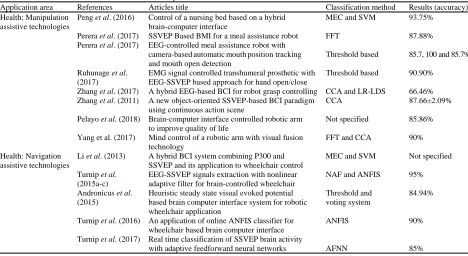
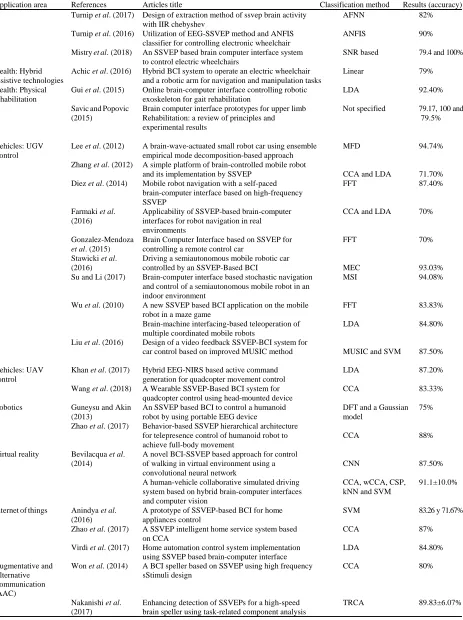
Analysis of technical specifications of previous works methods of data extraction and classification: In BCI systems, stimuli generation and data gathering are characterized and classified based on electrodes location standards. However, signal processing and classification for detecting commands of applications are not subject to any specification or standard. In fact, the effectiveness of these alternatives is one of the main focus of research in the BCI field. Methods for data processing and classification go from traditional signal analysis methods to machine learning algorithms. A summary of the classification methods used in recent researches is organized in Table 1.
Canonical Correlation Analysis (CCA) is an approach that is gaining strength in SSVEP signals detection and differentiation. As you can see in Table 1, CCA was not used a few years ago but it is used in most of the latest research works. This is because unlike other techniques, CCA has a better Signal-to-Noise Ratio (SNR), less subject dependency and allows the use of harmonic frequencies (Hakvoort et al. (2011)); in fact, it is the technique that delivered better results. Additionally, we have noticed that CCA is commonly used in conjunction with other techniques in order to improve its accuracy in non-harmonic frequencies (achieving an average of 81.5% in terms of precision). Since, traditional techniques usually have the limitation of having low precision in detecting harmonic frequencies, CCA appears as its solution. Additionally, CCA allows making use of a greater number of stimuli which can be translated into more commands for applications.
[image:8.612.72.540.470.726.2]Even though, CCA is the most used technique in recent years according to the reviewed articles, other traditional methods such as Linear Discriminant Analysis (LDA) or Fast Fourier Transform (FFT) are also widely used. LDA is a very simple linear classifier and its use has become popular due to its low computational complexity (Nicolas-Alonso and Jaime, 2012) for this reason, this technique is used to implement solutions in microcontroller boards with limited resources. In addition, LDA’s popularity is due to its acceptable results; the previous works that we have analyzed in this review had an average accuracy of 81.8%. FFT is another popular algorithm and it is used in conjunction with some filters
Table 1: Classification methods used in SSVEP BCI systems
Application area References Articles title Classification method Results (accuracy)
Health: Manipulation Peng et al. (2016) Control of a nursing bed based on a hybrid MEC and SVM 93.75%
assistive technologies brain-computer interface
Perera et al. (2017) SSVEP Based BMI for a meal assistance robot FFT 87.88%
Perera et al. (2017) EEG-controlled meal assistance robot with
camera-based automatic mouth position tracking Threshold based 85.7, 100 and 85.7% and mouth open detection
Ruhunage et al. EMG signal controlled transhumeral prosthetic with Threshold based 90.90%
(2017) EEG-SSVEP based approach for hand open/close
Zhang et al. (2017) A hybrid EEG-based BCI for robot grasp controlling CCA and LR-LDS 66.46%
Zhang et al. (2011) A new object-oriented SSVEP-based BCI paradigm CCA 87.66±2.09%
using continuous action scene
Pelayo et al. (2018) Brain-computer interface controlled robotic arm Not specified 85.86% to improve quality of life
Yang et al. (2017) Mind control of a robotic arm with visual fusion FFT and CCA 90%
technology
Health: Navigation Li et al. (2013) A hybrid BCI system combining P300 and MEC and SVM Not specified
assistive technologies SSVEP and its application to wheelchair control
Turnip et al. EEG-SSVEP signals extraction with nonlinear NAF and ANFIS 95%
(2015a-c) adaptive filter for brain-controlled wheelchair
Andronicus et al. Heuristic steady state visual evoked potential Threshold and 84.94%
(2015) based brain computer interface system for robotic voting system
wheelchair application
Turnip et al. (2016) An application of online ANFIS classifier for ANFIS 90%
wheelchair based brain computer interface Turnip et al. (2017) Real time classification of SSVEP brain activity
Table 1: Continue
Application area References Articles title Classification method Results (accuracy)
Turnip et al. (2017) Design of extraction method of ssvep brain activity AFNN 82%
with IIR chebyshev
Turnip et al. (2016) Utilization of EEG-SSVEP method and ANFIS ANFIS 90%
classifier for controlling electronic wheelchair
Mistry et al. (2018) An SSVEP based brain computer interface system SNR based 79.4 and 100%
to control electric wheelchairs
Health: Hybrid Achic et al. (2016) Hybrid BCI system to operate an electric wheelchair Linear 79%
assistive technologies and a robotic arm for navigation and manipulation tasks
Health: Physical Gui et al. (2015) Online brain-computer interface controlling robotic LDA 92.40%
rehabilitation exoskeleton for gait rehabilitation
Savic and Popovic Brain computer interface prototypes for upper limb Not specified 79.17, 100 and
(2015) Rehabilitation: a review of principles and 79.5%
experimental results
Vehicles: UGV Lee et al. (2012) A brain-wave-actuated small robot car using ensemble MFD 94.74%
Control empirical mode decomposition-based approach
Zhang et al. (2012) A simple platform of brain-controlled mobile robot
and its implementation by SSVEP CCA and LDA 71.70%
Diez et al. (2014) Mobile robot navigation with a self-paced FFT 87.40%
brain-computer interface based on high-frequency SSVEP
Farmaki et al. Applicability of SSVEP-based brain-computer CCA and LDA 70%
(2016) interfaces for robot navigation in real
environments
Gonzalez-Mendoza Brain Computer Interface based on SSVEP for FFT 70%
et al. (2015) controlling a remote control car
Stawicki et al. Driving a semiautonomous mobile robotic car
(2016) controlled by an SSVEP-Based BCI MEC 93.03%
Su and Li (2017) Brain-computer interface based stochastic navigation MSI 94.08%
and control of a semiautonomous mobile robot in an indoor environment
Wu et al. (2010) A new SSVEP based BCI application on the mobile FFT 83.83% robot in a maze game
Brain-machine interfacing-based teleoperation of LDA 84.80%
multiple coordinated mobile robots
Liu et al. (2016) Design of a video feedback SSVEP-BCI system for
car control based on improved MUSIC method MUSIC and SVM 87.50%
Vehicles: UAV Khan et al. (2017) Hybrid EEG-NIRS based active command LDA 87.20%
control generation for quadcopter movement control
Wang et al. (2018) A Wearable SSVEP-Based BCI system for CCA 83.33%
quadcopter control using head-mounted device
Robotics Guneysu and Akin An SSVEP based BCI to control a humanoid DFT and a Gaussian 75%
(2013) robot by using portable EEG device model
Zhao et al. (2017) Behavior-based SSVEP hierarchical architecture
for telepresence control of humanoid robot to CCA 88%
achieve full-body movement
Virtual reality Bevilacqua et al. A novel BCI-SSVEP based approach for control
(2014) of walking in virtual environment using a CNN 87.50%
convolutional neural network
A human-vehicle collaborative simulated driving CCA, wCCA, CSP, 91.1±10.0%
system based on hybrid brain-computer interfaces kNN and SVM
and computer vision
Internet of things Anindya et al. A prototype of SSVEP-based BCI for home SVM 83.26 y 71.67%
(2016) appliances control
Zhao et al. (2017) A SSVEP intelligent home service system based CCA 87%
on CCA
Virdi et al. (2017) Home automation control system implementation LDA 84.80%
using SSVEP based brain-computer interface
Augmentative and Won et al. (2014) A BCI speller based on SSVEP using high frequency CCA 80%
Alternative sStimuli design
Communication (AAC)
Nakanishi et al. Enhancing detection of SSVEPs for a high-speed TRCA 89.83±6.07%
in the signal pre-processing phase; the works using FFT that we analyzed in this review had an average accuracy of 82.4%.
Another important fact is that the presence of machine learning and deep learning techniques is increasing significantly. The use of Support Vector Machine (SVM) and neural networks such as Convolutional Neural Network (CNN) or Adaptive Feedforward Neural Network (AFNN) in classification tasks is increasing due to their results in terms of accuracy (average accuracy of 85.6% in reviewed articles). With this background, machine learning techniques seem to be promising options to achieve more precise results with less subject dependency in the future. However, we must consider that the implementation of these technologies requires wider knowledge to adjust its parameters and a larger amount of data/time to train and test the models.
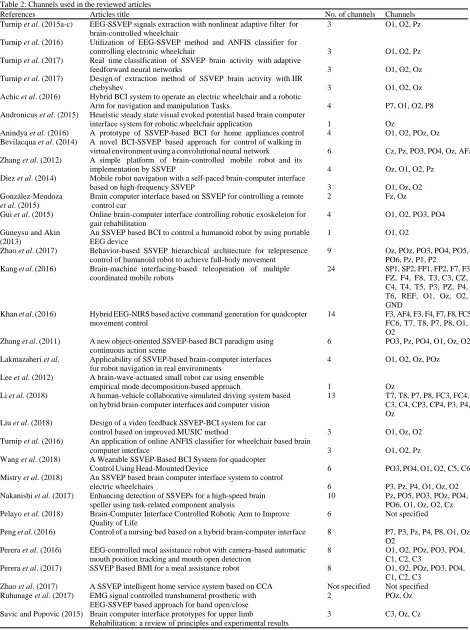
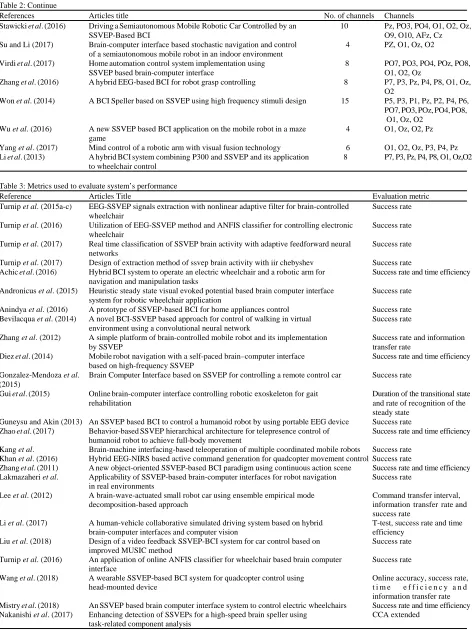
Used channels: One of the most important information in BCI applications is the channels used to gather brain signals since, they are the source of input data. Because of such importance, this review also has analyzed the different channels used in different researches. Our analysis indicated that channels O1, O2 and Oz were the most frequently used in SSVEP (Meng et al., 2011). This is because these channels are located in the occipital lobe of the brain which is involved with vision. As shown in Table 2 among 43 articles, 27 of them used the Oz channel while 30 used O1 or 2 as a solitary channel or in combination with other channels. It should also be noted that 31 of the articles used channels different from those indicated above; we assume that this was due to:
Restriction of channels: The following articles Guneysu and Akin (2013); Gui et al. (2015); Achic et al. (2016); Wang et al. (2018) make use of EMOTIV EPOC that has 14 channels that include O1 and 2 but does not have the Oz channel.
Variation of signals: SSVEP varies depending on the user Meng et al. (2011).
Hybrid solution: Some articles such as Peng et al. (2016); Zhang et al. (2017); Li et al. (2017) implements a hybrid BCI system that incorporates SSVEP in combination with other method such as motor imagery and P300.
Within the reviewed articles, 3 did not specify the used channels as seen in Yang et al. (2017); Zhao et al. (2016a, b) and Pelayo et al. (2018) specified the number of used channels.
Evaluation methods: Each system needs an evaluation process to determinate its level of accuracy. In this regard, we believe that it is important to understand which are the
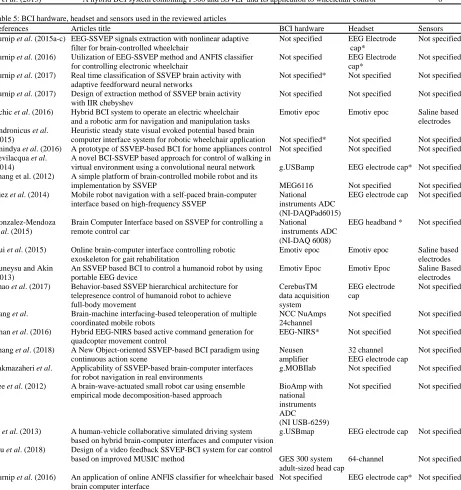
most popular methods used by different works in evaluating BCI systems, to obtain reproducible and quantifiable measurements. In this review, we have analyzed which are the most popular evaluation methods used in different articles. This analysis will help researchers to recognize the possible evaluation methods for this kind of systems. Table 3 shows that the most used metric is the success rate which presents the percentage of success with respect to the errors that existed during the tests. Another common evaluation criteria is the time efficiency.
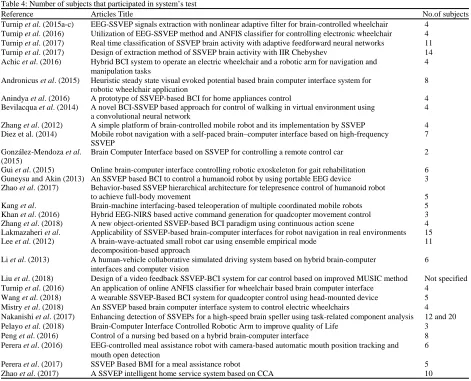
Participants: Reviewing different articles of the BCI field, we understand that the accuracy achieved by the proposed models is a very important metric (summarized in Table 1). But these results are be insufficient to determine the reliability of a system as a real-life solution if it were tested in a small number of users; this is because one of the main problems of BCI systems on detecting and classifying signals is the subject’s dependency. For this reason, an analysis of testing environments of reviewed articles was carried out in this review.
Table 4 presents the number of subjects who participated in the experimentation of previous articles. It reflects that among the 40 reviewed articles, only Liu et al. (2018) does not show concise information in this aspect. The research in which the largest number of experimental subjects has participated was in Stawicki et al. (2016) with 61 people and it was the article that obtained one of the best results (with an accuracy of 93.03%). The articles that have tested with the smallest number of subjects were in Gonzalez-Mendoza et al. (2015) and Yang et al. (2017) with 2 people each. The most common number of participants in experiments were 4 people (present in 10 of the reviewed articles) while the average number of participants was 7.95.
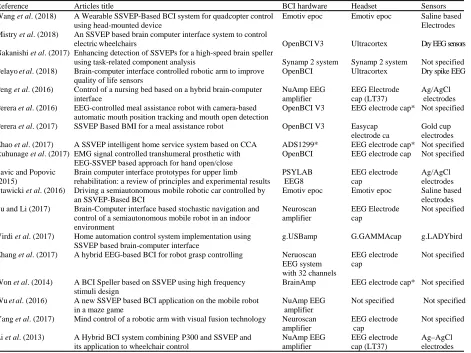
BCI equipment: In this review, we also have analyzed the equipment used by researchers in developing their experimental prototypes. The information gathered in this analysis is organized in Table 5. Such table indicates that Li et al. (2013); Peng et al. (2016); Su and Li (2017); Wu et al. (2016); Yang et al. (2017); Zhang et al. (2017a, b); Nakanishi et al. (2017) and Wang et al. (2018) have used BCI hardware made by NeuroScan (from different models). Similarly, OpenBCI and Emotiv EPOC also demonstrate to be a popular solution with 5 articles each. On the other hand, other articles such as Turnip et al. (2015a-c); Andronicus et al. (2015); Turnip et al. (2016); Anindya et al. (2016)and Turnip et al. (2017)did not specify the BCI hardware that they used.
Table 2: Channels used in the reviewed articles
References Articles title No. of channels Channels
Turnip et al. (2015a-c) EEG-SSVEP signals extraction with nonlinear adaptive filter for 3 O1, O2, Pz
brain-controlled wheelchair
Turnip et al. (2016) Utilization of EEG-SSVEP method and ANFIS classifier for
controlling electronic wheelchair 3 O1, O2, Pz
Turnip et al. (2017) Real time classification of SSVEP brain activity with adaptive
feedforward neural networks 3 O1, O2, Oz
Turnip et al. (2017) Design of extraction method of SSVEP brain activity with IIR
chebyshev 3 O1, O2, Oz
Achic et al. (2016) Hybrid BCI system to operate an electric wheelchair and a robotic
Arm for navigation and manipulation Tasks 4 P7, O1, O2, P8
Andronicus et al. (2015) Heuristic steady state visual evoked potential based brain computer
interface system for robotic wheelchair application 1 Oz
Anindya et al. (2016) A prototype of SSVEP-based BCI for home appliances control 4 O1, O2, POz, Oz
Bevilacqua et al. (2014) A novel BCI-SSVEP based approach for control of walking in
virtual environment using a convolutional neural network 6 Cz, Pz, PO3, PO4, Oz, AFz
Zhang et al. (2012) A simple platform of brain-controlled mobile robot and its
implementation by SSVEP 4 Oz, O1, O2, Pz
Diez et al. (2014) Mobile robot navigation with a self-paced brain-computer interface
based on high-frequency SSVEP 3 O1, Oz, O2
González-Mendoza Brain computer interface based on SSVEP for controlling a remote 2 Fz, Oz
et al. (2015) control car
Gui et al. (2015) Online brain-computer interface controlling robotic exoskeleton for 4 O1, O2, PO3, PO4 gait rehabilitation
Guneysu and Akin An SSVEP based BCI to control a humanoid robot by using portable 1 O1, O2
(2013) EEG device
Zhao et al. (2017) Behavior-based SSVEP hierarchical architecture for telepresence 9 Oz, POz, PO3, PO4, PO5,
control of humanoid robot to achieve full-body movement PO6, Pz, P1, P2
Kang et al. (2016) Brain-machine interfacing-based teleoperation of multiple 24 SP1, SP2, FP1, FP2, F7, F3,
coordinated mobile robots FZ, F4, F8, T3, C3, CZ,
C4, T4, T5, P3, PZ, P4, T6, REF, O1, Oz, O2, GND
Khan et al. (2016) Hybrid EEG-NIRS based active command generation for quadcopter 14 F3, AF4, F3, F4, F7, F8, FC5,
movement control FC6, T7, T8, P7, P8, O1,
O2
Zhang et al. (2011) A new object-oriented SSVEP-based BCI paradigm using 6 PO3, Pz, PO4, O1, Oz, O2
continuous action scene
Lakmazaheri et al. Applicability of SSVEP-based brain-computer interfaces 4 O1, O2, Oz, POz
for robot navigation in real environments
Lee et al. (2012) A brain-wave-actuated small robot car using ensemble
empirical mode decomposition-based approach 1 Oz
Li et al. (2018) A human-vehicle collaborative simulated driving system based 13 T7, T8, P7, P8, FC3, FC4,
on hybrid brain-computer interfaces and computer vision C3, C4, CP3, CP4, P3, P4,
Oz Liu et al. (2018) Design of a video feedback SSVEP-BCI system for car
control based on improved MUSIC method 3 O1, Oz, O2
Turnip et al. (2016) An application of online ANFIS classifier for wheelchair based brain
computer interface 3 O1, O2, Pz
Wang et al. (2018) A Wearable SSVEP-Based BCI System for quadcopter
Control Using Head-Mounted Device 6 PO3, PO4, O1, O2, C5, C6
Mistry et al. (2018) An SSVEP based brain computer interface system to control
electric wheelchairs 6 P3, Pz, P4, O1, Oz, O2
Nakanishi et al. (2017) Enhancing detection of SSVEPs for a high-speed brain 10 Pz, PO5, PO3, POz, PO4,
speller using task-related component analysis PO6, O1, Oz, O2, Cz
Pelayo et al. (2018) Brain-Computer Interface Controlled Robotic Arm to Improve 6 Not specified
Quality of Life
Peng et al. (2016) Control of a nursing bed based on a hybrid brain-computer interface 8 P7, P3, Pz, P4, P8, O1, Oz, O2
Perera et al. (2016) EEG-controlled meal assistance robot with camera-based automatic 8 O1, O2, POz, PO3, PO4,
mouth position tracking and mouth open detection C1, C2, C3
Perera et al. (2017) SSVEP Based BMI for a meal assistance robot 8 O1, O2, POz, PO3, PO4,
C1, C2, C3
Zhao et al. (2017) A SSVEP intelligent home service system based on CCA Not specified Not specified
Ruhunage et al. (2017) EMG signal controlled transhumeral prosthetic with 2 POz, Oz
EEG-SSVEP based approach for hand open/close
Savic and Popovic (2015) Brain computer interface prototypes for upper limb 3 C3, Oz, Cz
Table 2: Continue
References Articles title No. of channels Channels
Stawicki et al. (2016) Driving a Semiautonomous Mobile Robotic Car Controlled by an 10 Pz, PO3, PO4, O1, O2, Oz,
SSVEP-Based BCI O9, O10, AFz, Cz
Su and Li (2017) Brain-computer interface based stochastic navigation and control 4 PZ, O1, Oz, O2
of a semiautonomous mobile robot in an indoor environment
Virdi et al. (2017) Home automation control system implementation using 8 PO7, PO3, PO4, POz, PO8,
SSVEP based brain-computer interface O1, O2, Oz
Zhang et al. (2016) A hybrid EEG-based BCI for robot grasp controlling 8 P7, P3, Pz, P4, P8, O1, Oz,
O2
Won et al. (2014) A BCI Speller based on SSVEP using high frequency stimuli design 15 P5, P3, P1, Pz, P2, P4, P6, PO7, PO3, POz, PO4, PO8, O1, Oz, O2
Wu et al. (2016) A new SSVEP based BCI application on the mobile robot in a maze 4 O1, Oz, O2, Pz game
Yang et al. (2017) Mind control of a robotic arm with visual fusion technology 6 O1, O2, Oz, P3, P4, Pz
Li et al. (2013) A hybrid BCI system combining P300 and SSVEP and its application 8 P7, P3, Pz, P4, P8, O1, Oz,O2 to wheelchair control
Table 3: Metrics used to evaluate system’s performance
Reference Articles Title Evaluation metric
Turnip et al. (2015a-c) EEG-SSVEP signals extraction with nonlinear adaptive filter for brain-controlled Success rate wheelchair
Turnip et al. (2016) Utilization of EEG-SSVEP method and ANFIS classifier for controlling electronic Success rate wheelchair
Turnip et al. (2017) Real time classification of SSVEP brain activity with adaptive feedforward neural Success rate networks
Turnip et al. (2017) Design of extraction method of ssvep brain activity with iir chebyshev Success rate
Achic et al. (2016) Hybrid BCI system to operate an electric wheelchair and a robotic arm for Success rate and time efficiency navigation and manipulation tasks
Andronicus et al. (2015) Heuristic steady state visual evoked potential based brain computer interface Success rate system for robotic wheelchair application
Anindya et al. (2016) A prototype of SSVEP-based BCI for home appliances control Success rate
Bevilacqua et al. (2014) A novel BCI-SSVEP based approach for control of walking in virtual Success rate environment using a convolutional neural network
Zhang et al. (2012) A simple platform of brain-controlled mobile robot and its implementation Success rate and information
by SSVEP transfer rate
Diez et al. (2014) Mobile robot navigation with a self-paced brain–computer interface Success rate and time efficiency based on high-frequency SSVEP
Gonzalez-Mendoza et al. Brain Computer Interface based on SSVEP for controlling a remote control car Success rate (2015)
Gui et al. (2015) Online brain-computer interface controlling robotic exoskeleton for gait Duration of the transitional state
rehabilitation and rate of recognition of the
steady state Guneysu and Akin (2013) An SSVEP based BCI to control a humanoid robot by using portable EEG device Success rate
Zhao et al. (2017) Behavior-based SSVEP hierarchical architecture for telepresence control of Success rate and time efficiency humanoid robot to achieve full-body movement
Kang et al. Brain-machine interfacing-based teleoperation of multiple coordinated mobile robots Success rate Khan et al. (2016) Hybrid EEG-NIRS based active command generation for quadcopter movement control Success rate
Zhang et al. (2011) A new object-oriented SSVEP-based BCI paradigm using continuous action scene Success rate and time efficiency Lakmazaheri et al. Applicability of SSVEP-based brain-computer interfaces for robot navigation Success rate
in real environments
Lee et al. (2012) A brain-wave-actuated small robot car using ensemble empirical mode Command transfer interval,
decomposition-based approach information transfer rate and
success rate
Li et al. (2017) A human-vehicle collaborative simulated driving system based on hybrid T-test, success rate and time
brain-computer interfaces and computer vision efficiency
Liu et al. (2018) Design of a video feedback SSVEP-BCI system for car control based on Success rate improved MUSIC method
Turnip et al. (2016) An application of online ANFIS classifier for wheelchair based brain computer Success rate interface
Wang et al. (2018) A wearable SSVEP-based BCI system for quadcopter control using Online accuracy, success rate,
head-mounted device t i m e e f f i c i e n c y a n d
information transfer rate Mistry et al. (2018) An SSVEP based brain computer interface system to control electric wheelchairs Success rate and time efficiency
Nakanishi et al. (2017) Enhancing detection of SSVEPs for a high-speed brain speller using CCA extended
Table 3: Continue
References Articles title Evaluation metric
Pelayo et al. (2018) Brain-computer interface controlled robotic arm to improve quality of life Success rate
Peng et al. (2016) Control of a nursing bed based on a hybrid brain-computer interface Success rate, time efficiency and false-positive rate
Perera et al. (2017) EEG-controlled meal assistance robot with camera-based automatic mouth position Efficiency of time tracking and mouth open detection
Perera et al. (2017) SSVEP Based BMI for a meal assistance robot Success rate and time efficiency
Zhao et al. (2017) A SSVEP intelligent home service system based on CCA Success rate
Ruhunage et al. (2017) EMG signal controlled transhumeral prosthetic with EEG-SSVEP based Success rate and time efficiency approach for hand open/close
Savic and Popovic (2015) Brain computer interface prototypes for upper limb rehabilitation: a review of
principles and experimental results Success rate and time efficiency
Stawicki et al. (2016) Driving a semiautonomous mobile robotic car controlled by an SSVEP-Based BCI Success rate and information transfer rate
Su and Li (2017) Brain-computer interface based stochastic navigation and control of a ERA, success rate and time
semiautonomous mobile robot in an indoor environment efficiency
Virdi et al. (2017) Home automation control system implementation using SSVEP based Success rate and time efficiency brain-computer interface
Zhang et al. (2017) A hybrid EEG-based BCI for robot grasp controlling Success rate and time efficiency
Won et al. (2014) A BCI speller based on SSVEP using high frequency stimuli design Subjective fatigue and success rate Wu et al. (2016) A new SSVEP based BCI application on the mobile robot in a maze game Success rate
Yang et al. (2017) Mind control of a robotic arm with Visual fusion technology Success rate
Li et al. (2013) A hybrid BCI system combining P300 and SSVEP and Its False positives rate and true
application to wheelchair control positives rate
Table 4: Number of subjects that participated in system’s test
Reference Articles Title No.of subjects
Turnip et al. (2015a-c) EEG-SSVEP signals extraction with nonlinear adaptive filter for brain-controlled wheelchair 4 Turnip et al. (2016) Utilization of EEG-SSVEP method and ANFIS classifier for controlling electronic wheelchair 4 Turnip et al. (2017) Real time classification of SSVEP brain activity with adaptive feedforward neural networks 11
Turnip et al. (2017) Design of extraction method of SSVEP brain activity with IIR Chebyshev 14
Achic et al. (2016) Hybrid BCI system to operate an electric wheelchair and a robotic arm for navigation and 4 manipulation tasks
Andronicus et al. (2015) Heuristic steady state visual evoked potential based brain computer interface system for 8 robotic wheelchair application
Anindya et al. (2016) A prototype of SSVEP-based BCI for home appliances control 4
Bevilacqua et al. (2014) A novel BCI-SSVEP based approach for control of walking in virtual environment using 4 a convolutional neural network
Zhang et al. (2012) A simple platform of brain-controlled mobile robot and its implementation by SSVEP 4
Diez et al. (2014) Mobile robot navigation with a self-paced brain–computer interface based on high-frequency 7 SSVEP
González-Mendoza et al. Brain Computer Interface based on SSVEP for controlling a remote control car 2
(2015)
Gui et al. (2015) Online brain-computer interface controlling robotic exoskeleton for gait rehabilitation 6
Guneysu and Akin (2013) An SSVEP based BCI to control a humanoid robot by using portable EEG device 3
Zhao et al. (2017) Behavior-based SSVEP hierarchical architecture for telepresence control of humanoid robot
to achieve full-body movement 5
Kang et al. Brain-machine interfacing-based teleoperation of multiple coordinated mobile robots 5
Khan et al. (2016) Hybrid EEG-NIRS based active command generation for quadcopter movement control 3
Zhang et al. (2018) A new object-oriented SSVEP-based BCI paradigm using continuous action scene 4
Lakmazaheri et al. Applicability of SSVEP-based brain-computer interfaces for robot navigation in real environments 15 Lee et al. (2012) A brain-wave-actuated small robot car using ensemble empirical mode 11
decomposition-based approach
Li et al. (2013) A human-vehicle collaborative simulated driving system based on hybrid brain-computer 6 interfaces and computer vision
Liu et al. (2018) Design of a video feedback SSVEP-BCI system for car control based on improved MUSIC method Not specified Turnip et al. (2016) An application of online ANFIS classifier for wheelchair based brain computer interface 4
Wang et al. (2018) A wearable SSVEP-Based BCI system for quadcopter control using head-mounted device 5
Mistry et al. (2018) An SSVEP based brain computer interface system to control electric wheelchairs 4
Nakanishi et al. (2017) Enhancing detection of SSVEPs for a high-speed brain speller using task-related component analysis 12 and 20
Pelayo et al. (2018) Brain-Computer Interface Controlled Robotic Arm to improve quality of Life 3
Peng et al. (2016) Control of a nursing bed based on a hybrid brain-computer interface 8
Perera et al. (2016) EEG-controlled meal assistance robot with camera-based automatic mouth position tracking and 6 mouth open detection
Perera et al. (2017) SSVEP Based BMI for a meal assistance robot 5
[image:13.612.71.542.345.726.2]Table 4: Continue
References Articles title No.of subjects
Ruhunage et al. (2017) EMG signal controlled transhumeral prosthetic with EEG-SSVEP based approach for hand 5
open/close
Savic and Popovic (2015) Brain computer interface prototypes for upper limb rehabilitation: a review of principles and 6 experimental results
Stawicki et al. (2016) Driving a semiautonomous mobile robotic car controlled by an SSVEP-Based BCI 61
Su and Li (2017) brain-computer interface based stochastic navigation and control of a semiautonomous mobile 5
robot in an indoor environment
Virdi et al. (2017) Home Automation control system implementation using SSVEP based brain-computer interface 10
Zhang et al. (2017) A hybrid EEG-based BCI for robot grasp controlling 6
Won et al. (2014) A BCI speller based on SSVEP using high frequency stimuli design 4 Wu et al. (2016) A new SSVEP based BCI application on the mobile robot in a maze game 10
Yang et al. (2017) Mind control of a robotic arm with visual fusion technology 2
Li et al. (2013) A hybrid BCI system combining P300 and SSVEP and Its application to wheelchair control 8
Table 5: BCI hardware, headset and sensors used in the reviewed articles
References Articles title BCI hardware Headset Sensors
Turnip et al. (2015a-c) EEG-SSVEP signals extraction with nonlinear adaptive Not specified EEG Electrode Not specified
filter for brain-controlled wheelchair cap*
Turnip et al. (2016) Utilization of EEG-SSVEP method and ANFIS classifier Not specified EEG Electrode Not specified
for controlling electronic wheelchair cap*
Turnip et al. (2017) Real time classification of SSVEP brain activity with Not specified* Not specified Not specified adaptive feedforward neural networks
Turnip et al. (2017) Design of extraction method of SSVEP brain activity Not specified Not specified Not specified
with IIR chebyshev
Achic et al. (2016) Hybrid BCI system to operate an electric wheelchair Emotiv epoc Emotiv epoc Saline based
and a robotic arm for navigation and manipulation tasks electrodes
Andronicus et al. Heuristic steady state visual evoked potential based brain
(2015) computer interface system for robotic wheelchair application Not specified* Not specified Not specified
Anindya et al. (2016) A prototype of SSVEP-based BCI for home appliances control Not specified Not specified Not specified Bevilacqua et al. A novel BCI-SSVEP based approach for control of walking in
(2014) virtual environment using a convolutional neural network g.USBamp EEG electrode cap* Not specified
Zhang et al. (2012) A simple platform of brain-controlled mobile robot and its
implementation by SSVEP MEG6116 Not specified Not specified
Diez et al. (2014) Mobile robot navigation with a self-paced brain-computer National EEG electrode cap Not specified
interface based on high-frequency SSVEP instruments ADC
(NI-DAQPad6015)
Gonzalez-Mendoza Brain Computer Interface based on SSVEP for controlling a National EEG headband * Not specified
et al. (2015) remote control car instruments ADC
(NI-DAQ 6008)
Gui et al. (2015) Online brain-computer interface controlling robotic Emotiv epoc Emotiv epoc Saline based
exoskeleton for gait rehabilitation electrodes
Guneysu and Akin An SSVEP based BCI to control a humanoid robot by using Emotiv Epoc Emotiv Epoc Saline Based
(2013) portable EEG device electrodes
Zhao et al. (2017) Behavior-based SSVEP hierarchical architecture for CerebusTM EEG electrode Not specified
telepresence control of humanoid robot to achieve data acquisition cap
full-body movement system
Kang et al. Brain-machine interfacing-based teleoperation of multiple NCC NuAmps Not specified Not specified
coordinated mobile robots 24channel
Khan et al. (2016) Hybrid EEG-NIRS based active command generation for EEG-NIRS* Not specified Not specified
quadcopter movement control
Zhang et al. (2018) A New Object-oriented SSVEP-based BCI paradigm using Neusen 32 channel Not specified
continuous action scene amplifier EEG electrode cap
Lakmazaheri et al. Applicability of SSVEP-based brain-computer interfaces g.MOBIlab Not specified Not specified
for robot navigation in real environments
Lee et al. (2012) A brain-wave-actuated small robot car using ensemble BioAmp with Not specified Not specified
empirical mode decomposition-based approach national
instruments ADC (NI USB-6259)
Li et al. (2013) A human-vehicle collaborative simulated driving system g.USBmap EEG electrode cap Not specified based on hybrid brain-computer interfaces and computer vision
Liu et al. (2018) Design of a video feedback SSVEP-BCI system for car control
based on improved MUSIC method GES 300 system 64-channel Not specified
adult-sized head cap
[image:14.612.79.540.232.722.2]Table 5: BCI hardware, headset and sensors used in the reviewed articles
Reference Articles title BCI hardware Headset Sensors
Wang et al. (2018) A Wearable SSVEP-Based BCI system for quadcopter control Emotiv epoc Emotiv epoc Saline based
using head-mounted device Electrodes
Mistry et al. (2018) An SSVEP based brain computer interface system to control
electric wheelchairs OpenBCI V3 Ultracortex Dry EEG sensors
Nakanishi et al. (2017) Enhancing detection of SSVEPs for a high-speed brain speller
using task-related component analysis Synamp 2 system Synamp 2 system Not specified
Pelayo et al. (2018) Brain-computer interface controlled robotic arm to improve OpenBCI Ultracortex Dry spike EEG
quality of life sensors
Peng et al. (2016) Control of a nursing bed based on a hybrid brain-computer NuAmp EEG EEG Electrode Ag/AgCl
interface amplifier cap (LT37) electrodes
Perera et al. (2016) EEG-controlled meal assistance robot with camera-based OpenBCI V3 EEG electrode cap* Not specified automatic mouth position tracking and mouth open detection
Perera et al. (2017) SSVEP Based BMI for a meal assistance robot OpenBCI V3 Easycap Gold cup
electrode ca electrodes
Zhao et al. (2017) A SSVEP intelligent home service system based on CCA ADS1299* EEG electrode cap* Not specified
Ruhunage et al. (2017) EMG signal controlled transhumeral prosthetic with OpenBCI EEG electrode cap Not specified
EEG-SSVEP based approach for hand open/close
Savic and Popovic Brain computer interface prototypes for upper limb PSYLAB EEG electrode Ag/AgCl
(2015) rehabilitation: a review of principles and experimental results EEG8 cap electrodes
Stawicki et al. (2016) Driving a semiautonomous mobile robotic car controlled by Emotiv epoc Emotiv epoc Saline based
an SSVEP-Based BCI electrodes
Su and Li (2017) Brain-Computer interface based stochastic navigation and Neuroscan EEG Electrode Not specified
control of a semiautonomous mobile robot in an indoor amplifier cap
environment
Virdi et al. (2017) Home automation control system implementation using g.USBamp G.GAMMAcap g.LADYbird
SSVEP based brain-computer interface
Zhang et al. (2017) A hybrid EEG-based BCI for robot grasp controlling Neruoscan EEG electrode Not specified
EEG system cap
with 32 channels
Won et al. (2014) A BCI Speller based on SSVEP using high frequency BrainAmp EEG electrode cap* Not specified stimuli design
Wu et al. (2016) A new SSVEP based BCI application on the mobile robot NuAmp EEG Not specified Not specified
in a maze game amplifier
Yang et al. (2017) Mind control of a robotic arm with visual fusion technology Neuroscan EEG electrode Not specified
amplifier cap
Li et al. (2013) A Hybrid BCI system combining P300 and SSVEP and NuAmp EEG EEG electrode Ag–AgCl
its application to wheelchair control amplifier cap (LT37) electrodes
*Not mentioned by the researchers. Deduced using the figures presented in the article
figures provided in the articles. The following articles, Li et al. (2013); Peng et al. (2016) indicated that the LT37 model was used. In addition, Guneysu and Akin (2013); Gui et al. (2015); Achic et al. (2016); Stawicki et al. (2016); Wang et al. (2018) used the Emotiv EPOC headset which incorporates all the components in its equipment.
Finally, regarding the sensors, 28 of 40 reviewed articles have not specified this information. Instead, Peng et al. (2016) indicated that the research used Dry spike EEG sensors while Li et al. (2013); Peng et al. (2016); Savic and Popovic (2015) indicated the usage of Ag/AgCl electrodes.
Benefits and limitations of analyzed articles: Within the reviewed literature, many advantageous features that can improve the lifestyle of human beings were found, especially for people who have MND or other types of disabilities. Health-oriented applications offer several benefits such as support to people who have difficulty performing daily tasks (e.g., feeding), help people with movement limitations (e.g., electric wheelchair) and support for physical rehabilitation.
Additionally in the field of robotics and vehicles, there are advances that are beginning to appear, since, this area can offer a great amount of benefit for society. One of the common applications are those related to humanoid robots. Multiple BCI applications have been generated in the field since, they can offer benefits such as replacing the task of human beings in dangerous situations and to perform jobs in a more efficient and faster way. On the other hand, BCI systems applied to motorized vehicles will bring great benefits since driver reactions will be perceived by the automotive system in a rapid and transparent manner, reducing the number of accidents. In addition, research on improving driving environments using brainwaves will bring significant changes to the automotive area.