Master Thesis
Same, same but different?
A strategic framework for attraction-oriented employer
branding strategies under the consideration of employee
preference profiles
Submitted by: Henriette Brune Student number: 1979132 Date: 04.03.2019
Faculty: Behavioral, Management and Social Sciences Study Program: MSc. Business Administration
MSc. Innovation Management & Entrepreneurship
First Supervisor: Dr. E. Constantinides University of Twente Second Supervisor: Dr. S.A. de Vries
University of Twente External Supervisor: Dr. Henrike Weber
‚(People) may be said to resemble not the bricks of which a house is build, but the pieces of a picture puzzle, each differing in shape, but matching the rest, and thus bringing out the picture.‘
– Felix Adler
A
BSTRACT
T
ABLE OF
C
ONTENTS
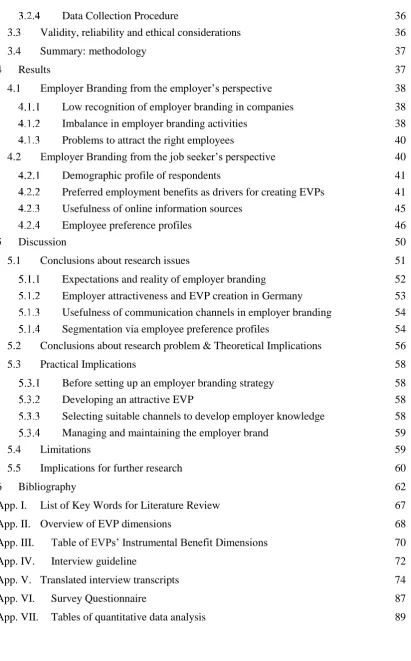
Abstract 2
Table of Contents 3
Lists of Tables & Figures 5
List of Abbreviations 6
1 Introduction 5
1.1 Significance of topic 5
1.2 Justification for the research 6
1.3 Research method 6
1.4 Definitions and key concepts 7
1.5 Delimitations 7
1.6 Outline of the report 8
2 Theoretical Framework 8
2.1 Methodology of literature review 8
Preparation and process of literature review 8
Structure of theoretical framework 9
2.2 A war for talent – the context of employer branding 9
Employees: resources of competitive advantage 9
Reasons for talent shortages 10
Talent management in the war for talent 10
Summary: context for employer branding 11
2.3 Understanding employer branding 11
Defining employer branding 12
Employer brand equity: value of employer branding 13
Summary: understanding employer branding 15
2.4 Employer branding strategies for attraction 15
Strategic frameworks for employer branding – then and now 16 Employer value propositions: foundation of employer knowledge 18 Communication channels: sources of employer knowledge 21 Success factors and influences of employer branding strategies 25
Employer branding framework for attraction 28
3 Methodology: a mixed-methods research design 30
3.1 Employer branding from the employer perspective 31
Qualitative research method: semi-structured interviews 31
Data collection and analysis 31
3.2 Employer branding from employee perspective 33
Quantitative research method: a self-administered online survey 33
Sampling Procedure 33
Data Collection Procedure 36
3.3 Validity, reliability and ethical considerations 36
3.4 Summary: methodology 37
4 Results 37
4.1 Employer Branding from the employer’s perspective 38
Low recognition of employer branding in companies 38
Imbalance in employer branding activities 38
Problems to attract the right employees 40
4.2 Employer Branding from the job seeker’s perspective 40
Demographic profile of respondents 41
Preferred employment benefits as drivers for creating EVPs 41
Usefulness of online information sources 45
Employee preference profiles 46
5 Discussion 50
5.1 Conclusions about research issues 51
Expectations and reality of employer branding 52
Employer attractiveness and EVP creation in Germany 53 Usefulness of communication channels in employer branding 54
Segmentation via employee preference profiles 54
5.2 Conclusions about research problem & Theoretical Implications 56
5.3 Practical Implications 58
Before setting up an employer branding strategy 58
Developing an attractive EVP 58
Selecting suitable channels to develop employer knowledge 58
Managing and maintaining the employer brand 59
5.4 Limitations 59
5.5 Implications for further research 60
6 Bibliography 62
App. I. List of Key Words for Literature Review 67
App. II. Overview of EVP dimensions 68
App. III. Table of EVPs’ Instrumental Benefit Dimensions 70
App. IV. Interview guideline 72
App. V. Translated interview transcripts 74
App. VI. Survey Questionnaire 87
[image:4.595.103.515.62.724.2]L
ISTS OF
T
ABLES
&
F
IGURES
List of Tables
Table 1 Overview of concept definitions for this thesis 7
Table 2 Instrumental benefits of employer brands 19
Table 3 Suggestions for combining channels based on employer knowledge situations 24
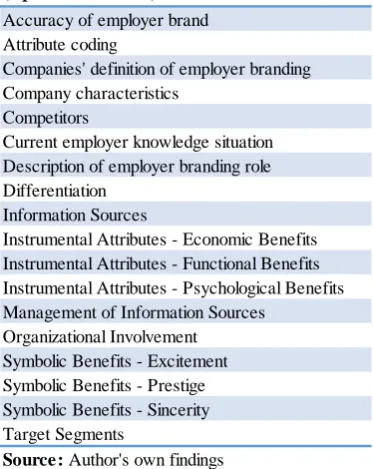
Table 4 Overview of codes in qualitative data analysis 33
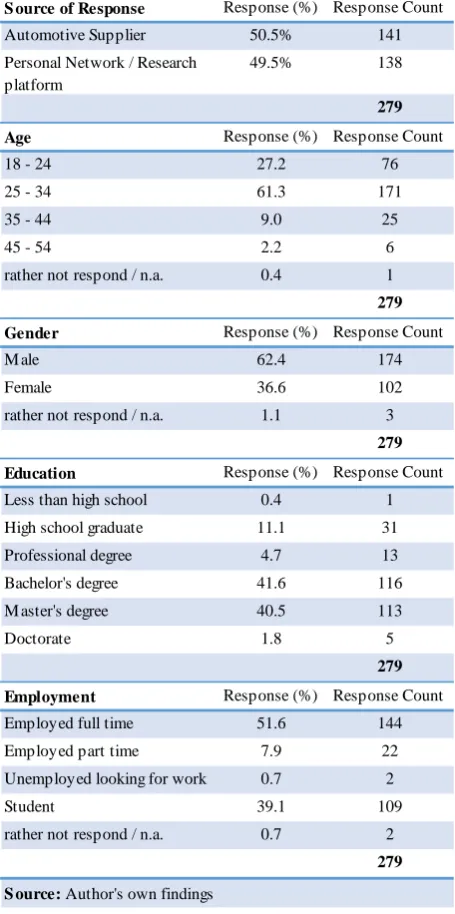
Table 5 Demographic structure of the sample 41
Table 6 Five employer attractiveness items with highest and lowest means 42 Table 7 Explanation of total variance and factor loadings of the six-component solution 44
Table 8 List of keywords for literature review 67
Table 9 Overview of dimensionality of employer attractiveness 68
Table 10 Table of EVP’s instrumental benefit dimensions 70
Table 11 Full list of item means 89
Table 12 Initial analysis of reliability, KMO & Bartlett's test with variance explained 90
Table 13 Reliability analysis of six-component solution 91
Table 14 Average ranking of information sources 92
Table 15 Group differences in age ranges regarding EVP attributes 92 Table 16 Group differences in age ranges regarding communication channels 93 Table 17 Group differences in genders regarding EVP attributes 93 Table 18 Group differences in gender regarding communication channels 93 Table 19 Group differences in education levels regarding EVP attributes 94 Table 20 Group differences in education levels regarding communication channels 94 Table 21 Group differences in employment status regarding EVP attributes 94 Table 22 Group differences in employment status regarding communication channels 94
List of Figures
Figure 1 Classification of literature streams contributing to employer branding 9
Figure 2 Talent management philosophies 10
Figure 3 Theoretical model of recruitment equity 13
Figure 4 Typology of employer brands 16
Figure 5 The Employer Branding Value Chain 18
L
IST OF
A
BBREVIATIONS
CSR – Corporate Social Responsibility e.g. – exempli gratia
EVP – Employer Value Proposition HR – Human Resources
i.e. – id est
KPI – Key Performance Indicator LQ – Leading question
5
1 I
NTRODUCTION
Employees, their expertise and social networks are valuable resources that ensure the viability of businesses (Backhaus, 2016; Backhaus & Tikoo, 2004). Reports on talent and skill shortages, in Germany for example, prospect deficits in the labor market of 1.2 to 4.9 million individuals with academic education by 2030 (German Federal Ministry of Labour and Social Affairs, 2017; Korn Ferry, 2018; Vereinigung der Bayerischen Wirtschaft e.V., 2015). But even now, more than half of German employers express having difficulties to hire new staff, especially in engineering, sales, IT and business administration (ManpowerGroup, 2018). Labor market supply is heavily influenced by demographic changes, increased global mobility and dynamic developments of technologies and professions. The term ‘war for talent’ expresses that companies have to go out of their way to keep their employees engaged and committed and is used as a buzzword in recruiting for the last 20 years (Chambers, Foulon, Handfield-Jones, Hankin, & Micheals, 1998). Hence, today’s highly-qualified and in-demand workforce uses this fight of employers over them to find companies that fit their expectations and values (Berthon, Ewing, & Hah, 2005; Chambers et al., 1998).
Therefore, companies must convince these individuals that their organization will cater to their expectations and values by providing information about the employment and create HR management that is able to do exactly that. To attract valuable workforces, impressions of attractive employment need to be advertised externally (Meyers & van Woerkom, 2014; Schuler, Jackson, & Tarique, 2011; Stahl et al., 2012). Hence, companies use employer branding to convince potential employees that their organizations are better places to work than competing organizations (Ambler & Barrow, 1996; Backhaus & Tikoo, 2004; Biswas & Suar, 2016). Employers with attractive brands access a greater pool of suitable and motivated employees at a lower price compared to companies with less favorable employer brands. So, how can employer branding be utilized the right way?
Employer branding is based on the concept of employer brand equity (Ambler & Barrow, 1996; Theurer, Tumasjan, Welpe, & Lievens, 2018). This concept describes the creation of value for employees rooted in their knowledge about employers (Cable & Turban, 2001). The main goal of employer branding efforts is to influence this knowledge by communicating desirable employment experiences and, consequently, creating perceptions of attractiveness on the side of potential employees (Backhaus & Tikoo, 2004). Therefore, firms need employer branding strategies to influence these evaluations of attractiveness. Associated research discovered several reoccurring elements for employer branding strategies. Employer branding literature extensively examined the creation of employer attractiveness through employment benefits (Arachchige & Robertson, 2011; Berthon et al., 2005; Dabirian, Kietzmann, & Diba, 2017; Deepa & Baral, 2017; Hillebrandt & Ivens, 2013; Lievens & Slaughter, 2016; Roy, 2008; Tanwar & Prasad, 2017; Zhu et al., 2014) and information channels for employer branding (Backhaus, 2004; Cable & Yu, 2006; Collins, 2007; Collins & Han, 2004; Collins & Stevens, 2002). However due to the relatively young age of the employer branding field, there are under-researched areas regarding the integration of research findings, influences on employer branding and newer media.
1.1 S
IGNIFICANCE OF TOPIC6
but fails to provide an understanding of how to acknowledge this suggestion for employer branding strategies. Therefore, the central research question (RQ) of this thesis is:
RQ: What is the role of employee preference profiles in attraction-oriented employer branding strategies?
Essentially, I argue that differences in the workforce described by employee preference profiles take a central role in employer branding strategies because they influence perceptions of potential employees. Thus, employee preference profiles can mitigate the success of companies’ efforts in employer branding if neglected by employer branding strategies and facilitate it if differences of those profiles are acknowledged. Several leading questions (LQ) help to come to this conclusion, contribute to the stated research problem as well as structure this thesis. Those are phrased as follows:
LQ1: What is the current understanding of employer branding in research?
LQ2: What aspects can describe attraction-oriented employer branding strategies?
LQ3: What are characteristics that determine employee preference profiles?
Answering the research and leading questions provides contributions that will be presented in section 5.2. This thesis advances a holistic understanding of employer branding strategies to initially attract employees to organizations. Further, it provided insights into the development of attraction-oriented employer branding strategies based on employee preference profiles. Thus, findings of this thesis contribute to the understanding of how segmentation based on employee preference profiles can be applied to attract a diverse workforce.
1.2 J
USTIFICATION FOR THE RESEARCHCurrent employer branding research mostly focusses on single aspects of employer branding activities. This focus creates a lack of recommendations for the design of coherent and effective strategies to attract a diverse workforce (Biswas & Suar, 2016; Deepa & Baral, 2017). Moreover, previous research rarely provided empirical insights regarding employee’s influence on employer branding as reviewed in section 2.4. Therefore, this thesis will advance a holistic understanding of attraction-oriented employer branding strategies and how potential employees influence it. This approach will cater to solve the disconnect for companies between the recognition of employer branding as a necessary tool to attract talent and developing concrete employer branding strategies (Maheshwari, Gunesh, Lodorfos, & Konstantopoulou, 2017). Rather than focusing on one aspect of employer branding, the integration of findings creates a strategic framework with detailed insights on the influence of potential employees as described by employee preference profiles. This framework will help practitioners to manage their employer brands and advances the current understanding of employer branding in research. Insights on employee preference profiles can help to create a more inclusive strategy for attracting a diverse workforce that fosters strategic flexibility.
1.3 R
ESEARCH METHOD7 German labor market will advance the understanding of employee preference profiles in relation to employer branding activities. The questionnaire is developed from tested scales in the employer branding field as discussed further in section 3.2.3 and is distributed to a diverse convenience sample. Descriptive statistics will be used to describe the sample composition and assessments of employer value propositions (EVPs) and information channels as employer branding activities. An exploratory factor analysis will be conducted to identify value drivers among participants. Differences in response patterns based on demographics will be analyzed with Mann-Whitney and Kruskal-Wallis tests to provide insights into employee preference profiles.
1.4 D
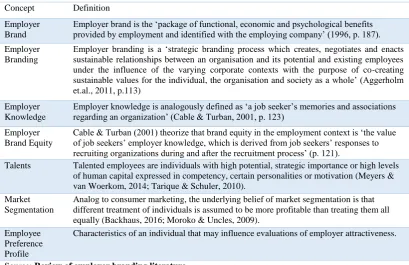
EFINITIONS AND KEY CONCEPTS [image:9.595.86.496.283.548.2]Key concepts and definitions of them are given in the following Table 1 for a common ground throughout this thesis. These concepts will be further discussed in chapter 2.
Table 1 Overview of concept definitions for this thesis
Concept Definition
Employer Brand
Employer brand is the ‘package of functional, economic and psychological benefits provided by employment and identified with the employing company’ (1996, p. 187).
Employer Branding
Employer branding is a ‘strategic branding process which creates, negotiates and enacts sustainable relationships between an organisation and its potential and existing employees under the influence of the varying corporate contexts with the purpose of co-creating sustainable values for the individual, the organisation and society as a whole’ (Aggerholm et.al., 2011, p.113)
Employer Knowledge
Employer knowledge is analogously defined as ‘a job seeker’s memories and associations regarding an organization’ (Cable & Turban, 2001, p. 123)
Employer Brand Equity
Cable & Turban (2001) theorize that brand equity in the employment context is ‘the value of job seekers’ employer knowledge, which is derived from job seekers’ responses to recruiting organizations during and after the recruitment process’ (p. 121).
Talents Talented employees are individuals with high potential, strategic importance or high levels of human capital expressed in competency, certain personalities or motivation (Meyers & van Woerkom, 2014; Tarique & Schuler, 2010).
Market Segmentation
Analog to consumer marketing, the underlying belief of market segmentation is that different treatment of individuals is assumed to be more profitable than treating them all equally (Backhaus, 2016; Moroko & Uncles, 2009).
Employee Preference Profile
Characteristics of an individual that may influence evaluations of employer attractiveness.
Source: Review of employer branding literature
1.5 D
ELIMITATIONS8
(Hillebrandt & Ivens, 2013; Rampl & Kenning, 2014; Wilden, Gudergan, & Lings, 2010). A focus on one specific country is also necessary as the cultural context is suspected to influence evaluations of employer attractiveness (Berthon et al., 2005; Sivertzen, Nilsen, & Olafsen, 2013). Lastly, differences among potential employees are examined in regard of observable characteristics as values and attitudes need tested scales that are currently not provided by employer branding research.
1.6 O
UTLINE OF THE REPORTThe previous introduction to the topic laid the foundations for this thesis. It introduced the research problem and related research issues through questions that this thesis is trying to answer. In the following, the structure of this thesis is outlined. This research is arranged in five chapters with several sections. In the beginning, a thorough literature review is conducted to establish a theoretical framework. The context of employer branding is outlined before discussing central concepts and the evolution of research in this field. Current literature on employer branding strategies is reviewed to identify reoccurring elements and create a conceptual framework for the following empiric analysis. The mixed-methods research approach will be justified, and the qualitative and quantitative designs will be discussed in consideration of reliability and validity of the research. Results will be presented and implications for research and practice as well as limitations and opportunities for further research will be pointed out.
2 T
HEORETICAL
F
RAMEWORK
The theoretical framework gives overview over current literature in relation to employer branding considering a mix of disciplines. Therefore, this chapter suggests integration of concepts to achieve a common understanding serving further analysis of the research question. The methodology of literature review is discussed before outlining sections of this chapter.
2.1 M
ETHODOLOGY OF LITERATURE REVIEWA thorough literature review was conducted to position the research question in light of literature related to employer branding (Wolfswinkel, Furtmueller, & Wilderom, 2013). The iterative stages of systematic reviewing – define, search, select, analyze and synthesize – were used to identify relevant concepts and integrate current research findings in relation to employer branding (Wolfswinkel et al., 2013).
Preparation and process of literature review
9 texts. The data was then synthesized into higher-order themes represented in the structure of the theoretical framework.
Structure of theoretical framework
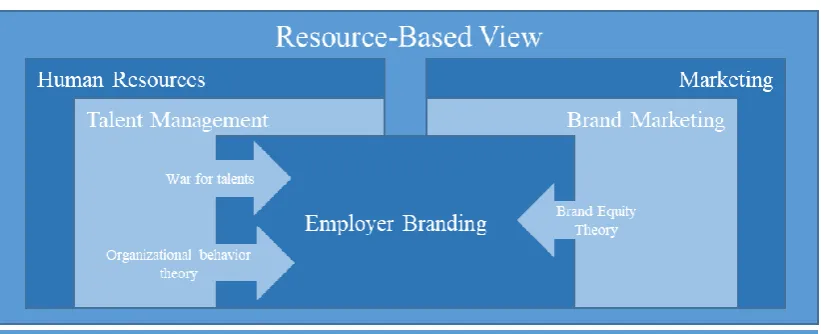
The field of employer branding is of multidisciplinary nature. Concepts and theories from human resources and recruitment literature, organizational behavior theory as well as brand marketing help to understand employer branding as a holistic concept (Edwards, 2009) as illustrated in Figure 1. First, the context of employer branding is set in the resource-based view highlighting that employees are valuable, rare, inimitable and non-substitutable resources necessary for competitive advantage. However, the struggle to attract employees described by the term ‘war for talent’ is discussed focusing on the reasons of talent shortages. After, talent management theory is shortly reviewed to explore how employer brands serve the purpose of convincing individuals to work for certain employers. Next, concepts of employer branding are defined. Then, employer branding activities are discussed by drawing analogies to consumer brand marketing. Lastly, current research is explored on how to design employer branding strategies under consideration of employee preference profiles. The literature review is used to establish a framework for attraction-oriented employer branding strategies to answer the research question in the empirical part of this thesis.
2.2 A
WAR FOR TALENT–
THE CONTEXT OF EMPLOYER BRANDINGWhen considering employees as resources, the resource-based view gives employer branding a general context and highlights the purpose of the concept for businesses. The field of talent management integrates employer branding into a set of strategies and practices to attract highly-skilled employees.
Employees: resources of competitive advantage
[image:11.595.86.497.333.500.2]The resource-based view suggests that having rare, valuable, substitutable and non-imitable resources helps to achieve a sustainable competitive advantage (Backhaus, 2016; Backhaus & Tikoo, 2004; Collings & Mellahi, 2009). A sustainable competitive advantage can be defined as a value-creating strategy that cannot be used or duplicated by competitors (Barney, 1991). Next to capital or machines necessary to develop, produce and market products or services, workforces are directly tied to the success and viability of companies (Ambler & Barrow, 1996; Collings & Mellahi, 2009). Not only acquired education and professional expertise but also their social networks make employees valuable and unique to businesses (Backhaus, 2016). Thus, if companies fail to attract and retain employees, they risk losing their competitive advantage and viability of business (Maheshwari et al., 2017; Maurya & Agarwal, 2018).
10
Reasons for talent shortages
However, employees are difficult to acquire in times of talent shortages. Chambers et al. (1998) coined the term ‘war for talent’ for the struggle to attract and retain talented employees while demand for them is increasing in labor markets. Reports on talent and skill shortages prospect deficits of employees in varying proportions. Human resource service provider Korn Ferry assumes a deficit of 4.9 million workers in Germany by 2030 (Korn Ferry, 2018). The Vereinigung der Bayerischen Wirtschaft (2015), a German institute, projects a shortage of 3.9 million employees by 2040. Regarding persons with an academic degree, a deficit of 1.2 million is expected. The German government expects a shortage of 1.4 million academics (German Federal Ministry of Labour and Social Affairs, 2017). While the future paints a picture of difficult hiring situations, 51% of German employers already face difficulty in recruiting (ManpowerGroup, 2018).
This shortage of talent has several interlocking reasons (Berthon et al., 2005; Biswas & Suar, 2016; Chambers et al., 1998). On the one side, demographic changes shrink the available workforce in developed countries (Schuler et al., 2011). Additionally, this smaller workforce is more focused on finding an employer that fits their expectations and values (Berthon et al., 2005; Chambers et al., 1998). On the other side, more globalized and dynamic markets increase job and geographic mobility. Further, demand for specific skills increases quickly as new business fields and technologies tend to grow fast while supply of employees tends to develop slower (Berthon et al., 2005; Schuler et al., 2011). It can be concluded that that job seekers tend to have more leverage in the labor market than employers as the demand is higher than supply. Consequently, employees become more particular in choosing their employers.
Talent management in the war for talent
Companies constantly risk to lose their competitive advantage if they do not attract and retain valuable employees (Chambers et al., 1998). Talent management theory is specifically focused on valuable employees (Meyers & van Woerkom, 2014). A successful talent management implies that companies have the right amount of talent at the right location and price responsive to dynamic environments (Schuler et al., 2011). In this regard, talented employees are individuals with
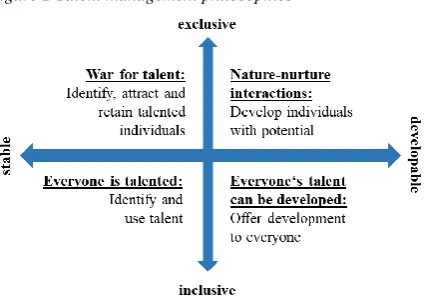
[image:12.595.295.508.415.565.2]high potential, strategic importance or high levels of human capital expressed in competency, certain personalities or motivation (Meyers & van Woerkom, 2014; Tarique & Schuler, 2010). Companies can adapt four underlying philosophies along the dimensions of exclusivity and stability that determine the respective management activities as illustrated in Figure 2. While other talent management philosophies focus on talent as a potential that needs to be developed or used in the right place, the exclusive/stable perspective considers talent as a scarce, stable characteristic that only a small proportion of individuals possess (Meyers & van Woerkom, 2014; Meyers, van Woerkom, & Dries, 2013). Practices in relation to the exclusive/stable philosophy focus on the attraction and retention of highly-competed talents (Meyers & van Woerkom, 2014). Hence, taking this perspective helps to elaborate on the purpose of employer branding and integrates the concept in a set of tools to attract talent in ‘wars for talent’.
11 To tackle talent scarcity in the labor market, it is suggested to highly prioritize talent management in general, develop existing talents through training and feedback as well as attract external talents (Chambers et al., 1998). The development of talent potentials comes with heavy investments in individuals, requires a long-term perspective and is dependent on the cooperation and intention of employees as well as the efficient allocation of training and development budgets (Meyers & van Woerkom, 2014). Only relying on development could be problematic in times of high job mobility leading to companies being unable to skim off benefits from developed talent. It might also be more efficient to acquire talent externally that already has the required qualifications instead of trying to develop internal capabilities. To attract talents to companies, employers must invoke attention of job seekers and influence decisions to apply. It is suggested that employer branding is used as a strategic tool to develop reputation and attractiveness influencing talents’ intention to apply by providing information about the expected employment experience early in the recruitment process (Baum & Kabst, 2014). When done right, employers with attractive employer brands can benefit from accessing a greater pool of employees at a lower price compared to companies with less favorable employer brands (Berthon et al., 2005; Collins & Han, 2004; Lievens & Highhouse, 2003; Theurer et al., 2018). Thus, employer branding takes a central role in the attraction of talented employees in the early stages of the recruitment process.
Summary: context for employer branding
In the following, the context of employer branding is shortly summarized. The resource-based view suggests that employees are sources of competitive sustainable advantage (Backhaus, 2016; Backhaus & Tikoo, 2004; Collings & Mellahi, 2009). In talent shortages, employees are more particular in choosing their employers and need to be convinced to accept job offers. The term ‘war for talent’ describes the struggle of organizations to attract and retain a talented workforce. As a response to this situation, companies engage in talent management to attract, retain and develop valuable employees (Meyers & van Woerkom, 2014). In this regard, employer branding helps to facilitate reputation and attractiveness of employers among individuals in the labor market influencing their decisions in early stages of recruitment processes. When done right, employers with attractive employer brands can benefit from greater talent pools at a lower price compared to companies with less favorable employer brands.
2.3 U
NDERSTANDING EMPLOYER BRANDINGDeducing from the previous considerations, firms’ employer branding efforts need to spark interest of valuable human resources. The leverage of power on the side of employees suggests that they might have an influence on employer branding strategies. However, individuals in the job market are not a homogeneous group but a conglomeration of different experiences, values and expectations. Thus, perceptions of employer brands may not be the same because of individual experiences, life stages or demographic characteristics. Therefore, the central research question of this thesis is:
RQ: What is the role of employee preference profiles in attraction-oriented employer branding strategies?
First, a common understanding of employer branding lays foundation for further considerations throughout this thesis. Thus, the first leading question is:
LQ1: What is the current understanding of employer branding in research?
12
Defining employer branding
Ambler & Barrow (1996) introduced the term ‘employer brand’ with the assumption that marketing practices can be applied in the human resource management context. In marketing, brands are defined as personalities of products or product ranges by which consumers identify and differentiate them from those of competitors (Keller, 1993). In line with these analogies, Ambler & Barrow defined ‘employer brand’ as the ‘package of functional, economic and psychological benefits provided by employment and identified with the employing company’ (1996, p. 187). This definition has been widely adapted in the employer branding field (Backhaus, 2016; Backhaus & Tikoo, 2004; Edwards, 2009; Theurer et al., 2018) and will be used for this thesis as well. Employer brands are employment-specific identities of companies where the experience of working in organizations is the product advertised (Backhaus & Tikoo, 2004). With employer brands, a promise of a certain experience is made to employees that take the role of consumers in this constellation (Backhaus, 2016; Edwards, 2009). Thus, job seekers can use the employer brand as a source of information about the quality, associated risks and trustworthiness of the expected employment experience. Therefore, employer brands can result in positive or negative brand associations and influence decisions of employees (Backhaus, 2016). Ambler & Barrow’s (1996) definition further indicates that these employment experiences have distinctive benefits which will be discussed further in section 2.4.2.
In distinction to the employer brand, ‘employer branding’ can be defined as ‘the process of building an identifiable and unique employer identity’ (Backhaus & Tikoo, 2004, p. 502) which relates to active management of the brand. Thus, employer branding can be considered as a goal-oriented, long-term strategy that tries to influence employees (Edwards, 2009). Activities in this regard relate to the development of a desired employer identity as well as the marketing of it (Backhaus, 2016; Backhaus & Tikoo, 2004; Edwards, 2009). Originally, employer branding was assumed to be a one-way communication of a stable employer brand from the organization to employees. But with advancement of the field, criticism emerged regarding the underlying belief that individuals would simply accept the brand offering in every labor market situation (Aggerholm, Andersen, & Thomsen, 2011). Not only the intent of employer branding activities on the side of companies influence employer brand associations but also how potential and current employees cognitively perceive the offered employment experience (Aggerholm et al., 2011; Backhaus, 2016). This is backed by the consideration that employers have employer brands even if they are not actively managing their image (Backhaus, 2016). Therefore, employer branding should be considered an iterative and interactive process in which employees are involved in employer branding activities of companies. Thus, an updated definition of employer branding as a
‘strategic branding process which creates, negotiates and enacts sustainable relationships between an organisation and its potential and existing employees under the influence of the varying corporate contexts with the purpose of co-creating sustainable values for the individual, the organisation and society as a whole’ (Aggerholm et.al., 2011, p.113)
13 In conclusion, employer brands are employment-specific identities of companies giving promises about experiences of employees and associated benefits. In contrast to employer branding being a one-directional communication of a stable employer identity, current definitions characterize it through activities that aim to create and negotiate relationships to potential and current employees with the aim to create value for individuals, the company and society in dynamic environments.
Employer brand equity: value of employer branding
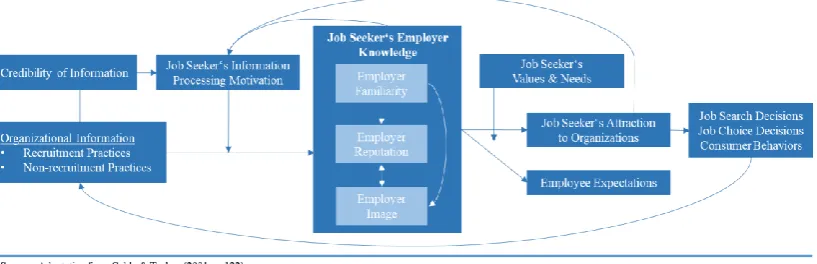
As the previous section indicated, the creation of value through employer brands is crucial to attract valuable human resources. The concept of employer brand equity describes this creation of value and is taken from the marketing field. For companies, positive brand equity can increase effectiveness of marketing and facilitate competitive advantage in comparison with an unbranded product (Keller & Lehmann, 2006). For customers it is an decisive element whether they feel attracted to the brand (Alshathry, Clarke, & Goodman, 2017). Applying these explanations from the marketing to the employment context, Cable & Turban (2001) theorize that brand equity is ‘the value of job seekers’ employer knowledge, which is derived from job seekers’ responses to recruiting organizations during and after the recruitment process’ (p. 121). Companies primarily aim to influence this knowledge of potential employees to create a favorable perception in the labor market (Ewing, Pitt, de Bussy, & Berthon, 2002). Thus, the primary goal of employer branding strategies is the development of employer knowledge and, through that, positive employer brand equity. A framework by Cable & Turban (2001) describes the creation of brand equity as depicted in Figure 3. This model serves as a foundation for the following discussion of employer branding strategies. Generally, this framework assumes that information sources affect employer knowledge and its dimensions in an ongoing feedback loop depending on credibility of information and the job seekers’ motivation for processing further information. In turn, the job seeker’s employment knowledge affects their behaviors towards organizations. The components are reviewed in detail in the following section, beginning with the dimensions of employer knowledge.
2.3.2.1 Employer knowledge: familiarity, image and reputation
To develop attractive employer brands, companies must consider that attraction to employers is the result of job seekers processing information about them. Employer knowledge is defined as ‘a job seeker’s memories and associations regarding an organization’ (Cable & Turban, 2001, p. 123). This knowledge can be described along three aspects – employer familiarity or awareness, employer image and employer reputation.
[image:15.595.89.498.577.709.2]14
positive associations are unlikely (Cable & Turban, 2001; Collins, 2007). Employer image contains general associations and attitudes of individuals towards the employer (Berthon et al., 2005; Theurer et al., 2018). Backhaus (2016) implies that ‘a well-differentiated employer image enables job seekers to understand the organization’s values and to find similarities between themselves and the organization’ (p. 194). Thus, these associations contain subjective beliefs about what it is like to work in a company and companies’ personalities (Backhaus & Tikoo, 2004; Lievens & Highhouse, 2003; Lievens, Van Hoye, & Anseel, 2007). Employer reputation refers to what job seeker’s think about public opinions of companies in comparison with competitors (Cable & Turban, 2001). This dimension serves a legitimizing function in a way that employers are validated by positive public evaluations (Cable & Turban, 2001). The previous discussion implies that employer image and reputation are based on beliefs about the organization. If companies want to create successful employer brands, they must actively try to influence these beliefs and create desirable content as a basis for employer knowledge. This can only be done when initial familiarity with employers is developed. Thus, the organization’s desired perception among job seekers needs to be considered as a strategic elements of attraction-oriented employer branding strategies and is discussed in section 2.4.2.
2.3.2.2 Information sources of employer knowledge
For the development of employer knowledge, information about organizations is crucial for employees. Therefore, organizations should consider sources of information and their influences on potential employees. Cable & Turban (2001) establish four assumptions in their discussion of information sources. First, individuals start developing employer knowledge even before they intent to apply to organizations. Second, all information sources can influence the employer knowledge of individuals regardless if they are in a recruitment context. Third, job seekers have varying motivation to process information about employers that is influenced by previous employment knowledge, their initial attraction to the employer as well as the credibility and company-dependence of information source. Lastly, motivation to process information about employers, in turn, impacts the change and development of employer knowledge. These assumptions imply that employer knowledge is dependent on several information sources with different characteristics. If companies want to create successful employer brands, they must actively try to manage information via the selection of suitable information channels. Therefore, section 2.4.3 discusses the management of information channels as a strategic element of attraction-oriented employer branding strategies.
2.3.2.3 Outcomes of employer knowledge
15 likely to perceive the employer as attractive (Backhaus, 2016). Therefore, it is very important to acknowledge the expectations and values of individuals when advertising employments. Lastly, employer knowledge influences expectations regarding experiences with their employer. Individuals possess beliefs about employment right after they are recruited and even before they start working at organizations. The concept of psychological contracts is useful to explain this circumstance. Psychological contracts are implicit beliefs about the terms and conditions of the employer-employee relationship that exist next to explicit contracts (Rousseau, 1989). Employees implicitly expect rewards, training and career opportunities, trust and fairness as well as aspirational values from their employer in exchange for their loyalty, skills and performance (Backhaus, 2016). Given these expectations, organizations should communicate accurate and realistic information (Cable & Turban, 2001) that match these expectations to actual employment experiences (Edwards, 2009) in order to avoid shock and disappointment after recruitment. In conclusion, employer knowledge can generate a motivation to process further information about employers, evaluations of attractiveness and expectations about employment experiences. In the following, implication on employer branding definitions as well as the employer brand equity framework is summarized and the structure for following discussions of employer branding strategies is determined.
Summary: understanding employer branding
Employer brands are employment-specific identities that describe experiences employees are likely going to have working in a company and expected benefits of the employment relationship. In distinction, employer branding is characterized through related activities that aim to create and negotiate relationships with potential and current employees aiming to create value for individuals, companies and society in dynamic environments. The creation of value is expressed by ‘employer brand equity’ and rooted in employer knowledge of job seekers. Companies must actively try to create desirable content as a base for job seekers’ employer knowledge with their employer branding activities. The following sections discuss the development of employer value propositions as well as the use of information channels to influence employer knowledge and, consequently, behaviors of job seekers towards organizations (Cable & Turban, 2001). Since attraction to employers is not only evaluated on employer knowledge but also on the perceived match of employment experiences with individuals’ expectations and values (Cable & Turban, 2001), their role in employer branding strategies is reviewed.
2.4 E
MPLOYER BRANDING STRATEGIES FOR ATTRACTIONFollowing, this section elaborates on aspects of attraction-oriented employer branding strategies required to create employer brand equity contributing to the following question:
LQ2: What aspects can describe attraction-oriented employer branding strategies? To create a holistic review of employer branding literature and not only rely on one framework, the first sub-section focusses on the evolution of associated research and integrates several frameworks to structure employer branding strategies. Following that, findings on employer branding activities of companies are reviewed in connection to needed capabilities, differentiation from competitors and accuracy of employer brands. Lastly, the influence of job seekers on employer branding strategies is reviewed by introducing employee preference profiles.
16
behavior that emerges as patterns. Fourth, strategies can be considered a mediating force between the environment and an organization where niche companies create returns because of their unique position. Fifth, strategy refers to common thinking and behavior. Thus, it can be assumed that strategies contain more or less planned activities towards a goal. These activities are mostly consistent over time, emerge to patterns, are supposed to optimally fit to the environment of an organization and involve individuals of an organization based on a shared understanding of the intended or emerged strategy. Thus, employer branding strategies will be individual for companies but may contain reoccurring aspects. In the following, the evolution of employer branding research is discussed before exploring these pattern-creating aspects.
Strategic frameworks for employer branding – then and now
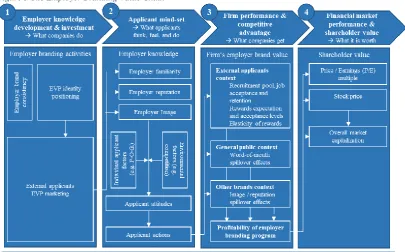
When Ambler & Barrow coined the term ‘employer brand’ in 1996 and asked practitioners how they manage theirs, no respondent explicitly did. As the popularity of the concept grew, recommendations on managing employer brands emerged as well. In 2004, Backhaus & Tikoo described the employer branding process in three steps derived from practitioner literature. In the first step, a value proposition is developed which contains information about the employer. In the second step, this information is advertised to potential employees external to the firm. In the third step, internal marketing fulfils the promises made in the recruitment process to develop a loyal and committed workforce. For the attraction of employees, Backhaus & Tikoo (2004) indicated that employer brand associations are developed from employer branding that result in employer image and, lastly, in employer attraction. This employer branding process depicts the core of employer branding from the organizational perspective but does not involve influences that might mitigate or facilitate success of employer brands.
Moroko & Uncles (2008) presented a typology of characteristics of successful employer brands involving these aspects in part.
Their research discussed marketing and human resource management strategies for four states of employer branding success. Following their argumentation, successful employer brands can create employer familiarity, provide relevant and attractive information with their value proposition, be positively different from competing employer brands and realize pre-recruitment promises because they
were accurate. The authors mapped their findings in a typology of four strategic issues along the dimensions of accuracy and attractiveness as depicted in Figure 4. In cell 1, organizations have attractive and accurate employment offerings but need to externally advertise them to improve familiarity and differentiation from competitors. In cell 2, companies develop employer knowledge via marketing but are unable to follow through with promises because of inaccurate information and, therefore, need to focus on the accuracy of employer brands. In cell 3, both the marketing and employment offering need revision to initially attract employees and make them stay. In cell 4, the desirable state of employer brands is depicted as being able to attract and retain employees well. However, success is not static and needs maintenance by measuring and readjusting employer branding strategies. Findings of Moroko & Uncles (2008) correspond with findings from Botha et al. (2011) who developed an employer brand predictive model for talent attraction and retention. The authors identified influences on employer brands which they call building blocks. In this regard, target group needs should be considered by employers to identify appropriate contents for employer brands. Companies should also ensure that brand promises are delivered and are differentiated from competitors.
17 Lastly, suitable channels distribute information to potential employees while metrics helps to control the success of the employer brand.
Moroko & Uncles (2009) further explored the application of market segmentation to employer branding. Findings suggested that companies used segmentation factors such as age, profitability of employees and preferred career benefits to tailor their employer branding strategies to specific groups of valuable employees. Moroko & Uncles (2009) hypothesized that market segmentation can not only be used to focus to recruit one potential employee group with certain characteristics – such as focusing on only graduates – but rather to create an understanding what a diversity of employees expects and demands from an employer. Following this notion, Aggerholm et al. (2011) reviewed former conceptualizations of employer branding, criticizing the static, one-directional notion of employer branding strategies where the employer is the sender and (potential) employees are the receiver as described by Backhaus & Tikoo (2004) or Ambler & Barrow (1996). As already discussed when defining employer branding in section 2.3.1, Aggerholm et al. (2011) emphasize the co-creation and relational aspect of employer brands as well as the iterative nature of employer branding approaches. These findings indicate that employers are supposed to acknowledge the influence of employee characteristics and connected expectations and values to create attractive employer branding approaches and are further discussed in section 2.4.4.4.
A framework by Deepa & Baral (2017) creates a map consisting of nine building blocks for the long-term employer branding strategy of a company. ‘Key partners’ describes the involved parties in employer branding while ‘key activities’ involves necessary activities in relation to development and marketing of employer brands. ‘Key resources’ refers to physical, financial, intellectual and human resources necessary to implement strategies in this regard. ‘Value propositions’ comprises the benefits of EVPs relative to defined target segments. ‘Channels’ contains considerations regarding information sources for employer knowledge. ‘Employee relationships’ refers to the intended nature of relationships with employees while ‘employee segments’ describes the segmentation of employees based on needs, behaviors or other attributes. Lastly, ‘cost structure’ and ‘revenue streams’ give ideas about the financial value of employer branding. These elements mostly match previously discussed conceptualizations. Again, it must be noted that (potential) employees and their relationship to employers are conceptualized to be an important part of employer branding.
18
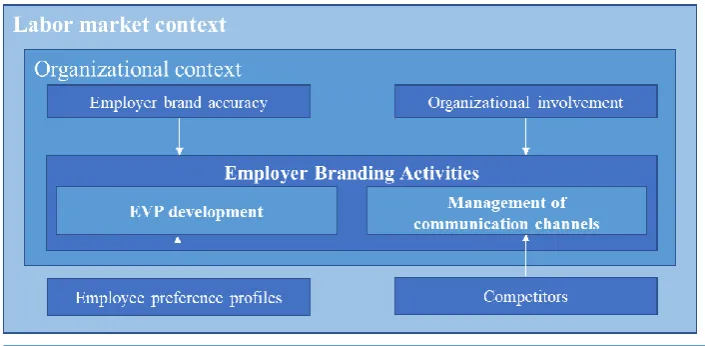
In summary, employer branding literature discovered several reoccurring aspects for employer branding strategies. The following sections are used to discuss and integrate current knowledge of employer branding in relation to these aspects. For companies, the definition of a desired employer brand through EVPs and marketing of it through information channels is at the core of employer branding activities. These topics are reviewed first in the following sections. Next, organizational partners and accuracy of employer brands as influences from within companies are examined. Then, influences external to the company such as job seekers and competitors are discussed. In this regard, the role of potential employees in employer branding strategies is extensively examined. At the end of the chapter, research issues for the empirical part of this thesis are summarized.
Employer value propositions: foundation of employer knowledge
[image:20.595.102.508.79.331.2]Crafting an attractive EVP is the basis for developing employer knowledge on the side of job seekers. The employer value proposition can be defined as ‘a desired or ideal employer identity, i.e. how the company wants to be perceived by (potential) employees as an attractive employer’ (Theurer et al., 2018, p. 166). In this regard, the symbolic-instrumental framework adapted from marketing research serves to describe benefits and information that may be included in companies’ EVPs (Lievens & Highhouse, 2003; Lievens & Slaughter, 2016). Companies need to develop their EVPs in two regards – the selection of relevant tangible benefits of the employment experience that companies want to convey to their potential employee and intangible personality traits inferred onto employers. It is important to note that the symbolic-instrumental framework rather works as a continuum. Thus, attributes can have characteristics of both ends of the continuum and, therefore, are classified differently by a variety of authors which can be illustrated by an overview in App. II(Ambler & Barrow, 1996; Arachchige & Robertson, 2011; Berthon et al., 2005; Dabirian et al., 2017; Deepa & Baral, 2017; Hillebrandt & Ivens, 2013; Lievens & Highhouse, 2003; Roy, 2008; Sutherland, Torricelli, & Karg, 2002; Tanwar & Prasad, 2017; Zhu et al., 2014).
19
2.4.2.1 Symbolic attributes of EVPs: the personality of employers
Individuals ascribe personality traits to organizations and favor employers that have personality traits similar to their own (Lievens & Highhouse, 2003; Lievens, Hoye, & Schreurs, 2005; Lievens & Slaughter, 2016; Van Hoye, Bas, Cromheecke, & Lievens, 2013). Symbolic meanings are individual associations regarding personality of employers. They help potential employees to evaluate person-organization fit to companies and influence their assumptions about employer reputations. Personality traits like sincerity, cheerfulness, innovativeness, competence, prestige and robustness contribute to developments of attractiveness if they match the self-concept of the potential employee (Lievens & Highhouse, 2003; Lievens et al., 2005; Lievens & Slaughter, 2016). Thus, symbolic meanings are related to the need of individuals to maintain their identity, express themselves or enhance their self-image. Further, innovativeness, sincerity and prestige serve as points of differentiation. Hence, especially emphasizing these personality traits may be beneficial when included in advertisements and information material (Lievens & Highhouse, 2003). In conclusion, symbolic attributes are personality traits inferred to employers and help to explain employer attractiveness for individuals. Therefore, it is suggested that companies use information in the marketing of employer brands that invoke attributions of innovativeness, sincerity and prestige. This should trigger perception of benefit for individuals to express themselves, enhance their self-image or maintain their identity.
2.4.2.2 Instrumental attributes of EVPs: organizational and job benefits
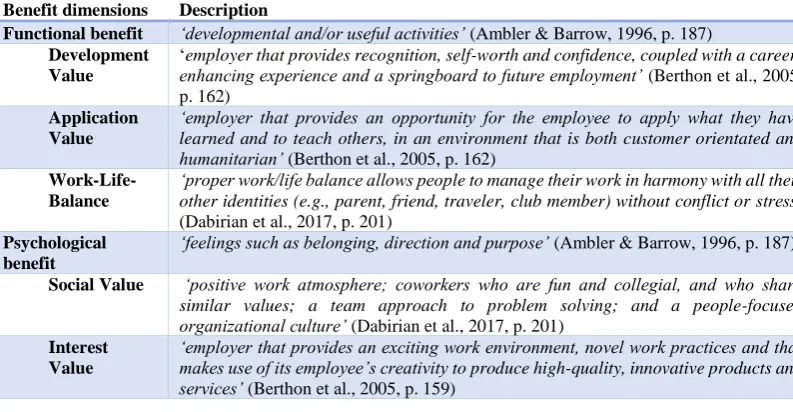
[image:21.595.89.486.564.770.2]Next to symbolic attributes, employers have to determine which tangible benefits can be offered to potential employees (Backhaus, 2016; Backhaus & Tikoo, 2004). This goes hand in hand with the integration of information about HR practices and policies into an attractive and marketable employment experience (Edwards, 2009). Instrumental attributes are specifically focused on utility in a way that (potential) employees can maximize benefits from them. Ambler & Barrow (1996) initially identified economic, functional and psychological benefits of an employer brand that provide value to employees. These dimensions served as a starting point for the identification of instrumental EVP dimensions in employer branding literature. (Arachchige & Robertson, 2011; Berthon et al., 2005; Dabirian et al., 2017; Deepa & Baral, 2017; Hillebrandt & Ivens, 2013; Roy, 2008; Tanwar & Prasad, 2017; Zhu et al., 2014). Table 2 gives an overview about benefit dimensions that are most attractive to potential employees while Appendix III contains an extended version to compare description of benefits throughout the publications. In the following, benefit dimensions are discussed and categorized along the initial conceptualization by Ambler and Barrow (1996).
Table 2 Instrumental benefits of employer brands
Benefit dimensions Description
Functional benefit ‘developmental and/or useful activities’ (Ambler & Barrow, 1996, p. 187)
Development Value
‘employer that provides recognition, self-worth and confidence, coupled with a career-enhancing experience and a springboard to future employment’ (Berthon et al., 2005, p. 162)
Application Value
‘employer that provides an opportunity for the employee to apply what they have learned and to teach others, in an environment that is both customer orientated and humanitarian’ (Berthon et al., 2005, p. 162)
Work-Life-Balance
‘proper work/life balance allows people to manage their work in harmony with all their other identities (e.g., parent, friend, traveler, club member) without conflict or stress’ (Dabirian et al., 2017, p. 201)
Psychological benefit
‘feelings such as belonging, direction and purpose’ (Ambler & Barrow, 1996, p. 187)
Social Value ‘positive work atmosphere; coworkers who are fun and collegial, and who share
similar values; a team approach to problem solving; and a people-focused organizational culture’ (Dabirian et al., 2017, p. 201)
Interest Value
20
Ethics & CSR ‘employer which is ethical, and the work culture is strong and clear’ (Roy, 2008, p.
121)
Economic benefit ‘employer that provides above-average salary, compensation package, job security and
promotional opportunities’ (Berthon et al. 2005, p. 159)
Source: Author’s own depiction derived from literature review
2.4.2.2.1 Functional benefit dimensions
Functional benefit of employer brands comprises the characteristics of the job itself including development opportunities, challenges as well as the usefulness of activities in the job (Ambler & Barrow, 1996). Frequently, development and application value are used as more detailed sub-dimensions attributed to functional benefit (Berthon et al., 2005). Development value can be offered by an employer who provides recognition for employees’ performance as well as career-enhancing possibilities (Hillebrandt & Ivens, 2013; Roy, 2008; Tanwar & Prasad, 2017). Application value is perceived when employees can apply their knowledge and transfer it to their colleagues. The importance of work-life-balance as the ability to arrange work and private life in harmony is also emphasized by current publications (Dabirian et al., 2017; Hillebrandt & Ivens, 2013; Tanwar & Prasad, 2017; Zhu et al., 2014).
2.4.2.2.2 Economic benefit dimensions
Economic benefit contains compensation and other offered rewards for performance of employees (Ambler & Barrow, 1996). Mostly, economic value is characterized by a competitive salary, an attractive compensation package, job security and opportunities for promotion (Arachchige & Robertson, 2011; Berthon et al., 2005). Additionally, pension programs are also identified in line with economic benefit (Hillebrandt & Ivens, 2013; Tanwar & Prasad, 2017).
2.4.2.2.3 Psychological benefit dimensions
Psychological benefit centers around feelings like belonging as well as purpose and concern company cultures along with its external perception (Ambler & Barrow, 1996). This type of benefit seems to have partial overlaps with the previously discussed symbolic personality traits (Lievens & Slaughter, 2016). Psychological benefit can be further categorized in interest value, social value as well as benefits arising from ethical behavior of the companies. Interest value can be provided by exciting work environments and can lead to the perception of innovativeness as an ascribed personality trait (Lievens & Slaughter, 2016). Further, interest value also comprises feelings of self-confidence resulting from working for a company with a good reputation and can be perceived as cues for the perception of prestige and in relation to employers (Arachchige & Robertson, 2011; Lievens & Slaughter, 2016; Roy, 2008). Moreover, ethics and corporate social responsibility (CSR) can also be considered as psychological benefit as employees feel good when their organizations contribute to a better society and have ideological values. This gives signals about sincerity as a trait inference (Hillebrandt & Ivens, 2013; Roy, 2008; Tanwar & Prasad, 2017). Lastly, social value is high when there are good relationships with colleagues and, generally, great team atmosphere (Arachchige & Robertson, 2011; Berthon et al., 2005; Dabirian et al., 2017).
2.4.2.3 Summary: employer brand development
21 psychological benefits describe instrumental attributes that provide value to employees and can be characterized through refined sub-dimensions (Ambler & Barrow, 1996; Arachchige & Robertson, 2011; Berthon et al., 2005; Dabirian et al., 2017; Deepa & Baral, 2017; Hillebrandt & Ivens, 2013; Roy, 2008; Sutherland et al., 2002; Tanwar & Prasad, 2017; Zhu et al., 2014). In the following, employer brand marketing through different online channels as information sources are examined.
Communication channels: sources of employer knowledge
Communication channels are used in employer branding to develop or influence employer knowledge. Messages via these information sources serve as promises and signals indicating the nature of the employment experience and help forming beliefs and expectations about employers (Rousseau, 2001). This section aims to understand how online communication channels can be used for employer branding to distribute information and increase interest to develop employer knowledge among job seekers in early stages of recruitment processes. The restriction to early recruiting stages is made since employer branding is used to ignite initial attraction before being replaced by interviews and site visits (Breaugh, 2008; Cable & Turban, 2001). Additionally, the review of communication channels will only focus on online media as most of information processing of private and business topics is increasingly done online (Dabirian et al., 2017; Mangold & Faulds, 2009) In this regard, it must be noted that any information can influence the job seeker’s employer knowledge and, therefore, recruitment-specific and general channels are considered (Cable & Turban, 2001). First, characteristics of communication channels will be reviewed before discussing concrete sources of information. Lastly, the strategic creation of marketing mixes is reviewed.
2.4.3.1 Characteristics of communication channels
Information sources can be characterized regarding their locus of control and the cognitive effort to process information by potential employees (Baum & Kabst, 2014; Collins & Han, 2004; Collins & Stevens, 2002; Lievens & Slaughter, 2016).
2.4.3.1.1 Control of communication channels
Control as a characteristic has implications on credibility and trustworthiness of the respective channel. Company-dependent communication channels are directly controlled by employers making it easy for them to distribute information (Cable & Turban, 2001; Hoye & Lievens, 2007). In contrast, company-independent information channels are published and edited by third parties and cannot be directly sanitized or sanctioned by the employer (Cable & Yu, 2006). The latter is typically considered more credible as they convey negative as well as positive information (Hoye & Lievens, 2007). Therefore, individuals may be skeptical about information from company-dependent sources and seek complementary information of company-independent channels (Sivertzen et al., 2013). However, findings indicate that job seekers can perceive company-dependent information sources as more credible than third-party ones when information is presented in a balanced manner including positive and negative aspects of employment. (Cable & Turban, 2001; Kissel & Büttgen, 2015).
2.4.3.1.2 Cognitive effort required to process information
22
cognitive effort and motivation of job seekers to identify and process detailed information about companies. These are best suited for known employers that want to influence their image by providing extensive information about the employment experience (Collins & Han, 2004; Theurer et al., 2018). Individuals with a motivation to process information about employers will rather turn to high-involvement sources to complement their employer knowledge as these provide more detailed information.
2.4.3.2 Online communication channels
The marketing of employer brands follows two main objectives: (1) increase general employer familiarity and (2) create the perception of a great place to work through positive employer image and reputation (Backhaus & Tikoo, 2004). Various online information sources such as recruitment advertising, company websites and social media as well as their respective characteristics are reviewed in connection to these two goals.
2.4.3.2.1 Online recruitment advertising
Online recruitment advertising can be defined as any form of recruitment-specific promotion online that is paid by the employer to convey a positive message to potential applicants (Jaidi, van Hooft, & Arends, 2011). Therefore, recruitment advertising is a company-dependent communication channel. These promotions can be distributed through different outlets such as job boards and social media and advertise employment easily and cheaply (Girard & Fallery, 2011). General recruitment advertisements demand low cognitive involvement on the side of potential employees and, thus, only increase employer familiarity (Collins & Han, 2004; Theurer et al., 2018). In contrast, detailed recruitment advertising can be considered high-involvement information sources that individuals have to actively search for (Collins, 2007). Detailed recruitment advertising, for example, for specific jobs can influence beliefs about employers (Lievens & Slaughter, 2016). However, this is only the case if individuals are initially aware of and interested in employment opportunities of companies. It can be assumed that after processing a detailed recruitment advertisement, potential employees seek more information to complement their initial employer image (Cable & Turban, 2001).
2.4.3.2.2 Company career websites
Companies’ career websites can include different types of media such as text, pictures and videos. Websites can contain several sections and categories customized to demographics, needs and situations of potential employees (Cable & Yu, 2006). It is suggested to provide as much information as possible about employment experiences via this channel (Allen, Mahto, & Otondo, 2007). The effectiveness of influencing employer image is dependent on familiarity and initial interest of potential employees because individuals must actively visit company websites to obtain information. Therefore, this information source can be considered a high-involvement practice (Baum & Kabst, 2014; Collins & Han, 2004). Contrary to consumer branding research, authors in the employer branding field found that job seekers perceive information on company websites as more credible than information from third parties (Kissel & Büttgen, 2015).
2.4.3.2.3 Social media
23 oriented social media also influences the employer knowledge of job seekers as well according to the conceptualization of Cable & Turban (2001).
Further, Kissel & Büttgen (2015) distinct company-dependent social media presences of employers from company-independent word-of mouth on social media. Social media provides a platform to discuss employment experiences either in interaction with employers, current or former employees of employers or other job seekers (Lievens & Slaughter, 2016). Credibility of employer social media presences is increased as they are subject to close social control by users (Kissel & Büttgen, 2015; Lievens & Slaughter, 2016). This means that wrong or inaccurate statements can be criticized and corrected endangering the credibility of employers. Company presences on social networking sites like LinkedIn, XING or Facebook allow for interactions between employers and individuals and facilitate the building of relationships between these two parties (Kissel & Büttgen, 2015).
If organizations do not actively interact, job seekers can also use company-independent discussions of employment experiences to obtain information. Word-of-mouth in the employer branding context can be defined as ‘interpersonal communication, independent of the organization’s recruitment activities, about an organization as an employer or about specific jobs’ (Hoye & Lievens, 2007, p. 373). When word-of-mouth is distributed on the Internet, it referred to as word-of-mouse and can reach thousands of people through social networking sites and communities (Mangold & Faulds, 2009). Results of earlier studies indicated that job seekers favor information about employers from university contacts as well as from current and former employees (Breaugh, 2008). The ratings of former applicants and employees on employer rating websites can enhance or undermine the credibility of employer brand and recruitment messages (Breaugh, 2008). However, fear of false information and oversharing of negative experiences can mitigate the credibility of word-of-mouth on social media and employer rating websites (Cable & Yu, 2006; Kissel & Büttgen, 2015). Individuals can search actively for discussions about certain employers or be exposed to them incidentally if the network of the individual engages in these resulting in a varying degree of cognitive involvement. Therefore, employer branding on social media reaches active and passive job seekers with varying motivation to process information (Sivertzen et al., 2013). Further, current research on social media in relation to employer branding concludes that job seekers rather complement their employer knowledge with information found on company social media presences than only relying on them to develop their employer knowledge (Bartosik-Purgat & Jankowska, 2017; Kissel & Büttgen, 2015). This might also be the reason why the importance of social media in relation to job seekers’ efforts in obtaining information is relatively low as it does not deliver a holistic picture of the employment experience on its own (Bartosik-Purgat & Jankowska, 2017). Therefore, current publications call for further research in relation to the combination of different online information sources (Nikolaou, 2014), determination of job choices (Sivertzen et al., 2013) and distinctive target groups (Kissel & Büttgen, 2015). The notion of targeting specific groups of potential employees relates to the influence of potential employees and is discussed further in section 2.4.4.4.
2.4.3.3 Combination of communication channels and employer knowledge