A Novel Framework for Automatic Chinese
Question Generation Based on Multi-Feature
Neural Network Model
Hai-Tao Zheng1, Jinxin Han1, Jinyuan Chen1, and Arun Kumar Sangaiah2
1 Graduate School at Shenzhen Tsinghua University China, Shenzhen 518055
[email protected], {hanjx16,cj-chen13}@mails.tsinghua.edu.cn
2 School of Computing Science and Engineering VIT University
India, Tamil Nadu Vellore-632014 [email protected]
Abstract. Automatic question generation from text or paragraph is a great challenging task which attracts broad attention in natural language processing. Because of the verbose texts and fragile ranking methods, the quality of top generated questions is poor. In this paper, we present a novel framework Automatic Chinese Question Generation (ACQG) to generate questions from text or paragraph. In ACQG, we use an adopted TextRank to extract key sentences and a template-based method to construct ques-tions from key sentences. Then a multi-feature neural network model is built for ranking to obtain the top questions. The automatic evaluation re-sult reveals that the proposed framework outperforms the state-of-the-art systems in terms of perplexity. In human evaluation, questions generated by ACQG rate a higher score.
Keywords:Chinese Question Generation, TextRank, Multi-Feature Neu-ral Network Model
1. Introduction
Question generation aims to create natural questions from a given text or para-graph, and there are a lot of demands in the field of natural language process-ing, such as reading comprehension [8,5,6], developing as a chatbot component to request feedback [4], and improving mental health [16]. Besides, question gen-eration systems can aid in the development of annotated datasets for question answering [19]. The existing question generation approaches can be categorized as template-based [17,10,8], semantic-based [9,13,12], and sequence-to-sequence-based [16,21,5]. The success of these approaches hinges critically on the existence of well-designed rules for declarative-to-interrogative sentence transformation or a powerful labeled dataset.
generate many unimportant questions, which are unacceptable for users. In addi-tion, the fragile ranking methods do not take enough features into account, such as then-gram score in question, answer’s location position in original sentence and so on. As a result, the key questions do not always appear in the front rank of outputs.
To address these issues, we introduce an Automatic Chinese Question Gener-ation (ACGQ) approach. Since the verbose text content is not a good input for question construction, we firstly extract key sentences from text, and locate the main points. Next, a template-based question construction model is built to gen-erate questions from declarative-to-interrogative sentence. Finally, a multi-feature neural ranking model is proposed to rank the generated questions.
The main contributions of our work are listed as follows:
1. We develop an adapted TextRank model to identify the key sentences of text and filter verbose sentences from source.
2. We design a multi-feature neural network model to rank all generated questions and obtain more acceptable questions in the front rank.
3. We conduct extensive experiments and the results show that our framework achieves a better performance compared to the state-of-the-art systems in terms of perplexity and human evaluation measurement.
The remainder of the paper is organized as follows. In section 2, we review related work on question generation. Section 3 introduces an overview of our model and a detailed description of each component. Section 4 details the experiments setup and their results. Section 5 concludes this paper and puts forward future work.
2. Related Work
The concept of question generation was presented dating back to 1976 by Wolfe [24], which has attracted attention of the natural language generation community in recent years since the work of Rus et al. [20].
answer phrases which may be targets for WH-movement and converts them into question phrases. Yao et al. [25] and Becker et al.[2] both followed this strategy. However, this kind of approaches does not work well when the input text is verbose, and the result is rough and redundant.
Another view is generating question based on semantic, the semantic role la-bels include subject, predicate verb, object, tense and so on. The semantic roles are used to determine the interrogative pronoun for the generated question [9,13,12]. Kunichika et al. [9] carried out their work in automatically generating reading com-prehension questions, the questions included both syntax and semantic questions. Mazidi and Nielsen [12] uses semantic pattern recognition to crate questions of varying depth and type for self-study. Generation patterns specify the text, verb forms and semantic arguments form the source sentence to form the question. Mazidi and Tarau [13] focused on the frequency of pattern sentence occurrences and the consistency of semantic information conveyed by the pattern to generate questions, this method could generate questions in a low dimension. Such ap-proaches generate a wider variety of questions which are not as closely bound to original text, and there are syntax errors in some questions.
Nowadays neural network with word embedding can be effectively applied to the natural language processing task with highly accurate results [7,23]. Mostafa-zadeh et al. [16] introduced visual question generation to explore the deep connec-tion between language and vision. Serban et al. [21] proposed generating simple factoid questions from logic triple (subject, relation, object). Their task tackles mapping from structured representation to natural language text, and their gen-erated questions are consistent in terms of format. Xinya Du et.al [5] built a bigger dataset for text&question based on SQuAD3, and trained a sequence to sequence network to generate questions on level on word and paragraph. These supervised methods need a large scale of labeled data and cost much time to train the net-work, which are not a good way to handle question generation problem for a rare of Chinese dataset.
To conclude, most of the existing question generation models are based on full texts, leading to generate some redundant questions. in addition, the fragile rank-ing methods do not take enough features into account and many useless questions are generated. In order to improve the performance of Chinese question genera-tion, ACQG identifies the key sentences in texts and utilizes multiple features for question ranking.
3. The Framework of Automatic Chinese Question
Generation
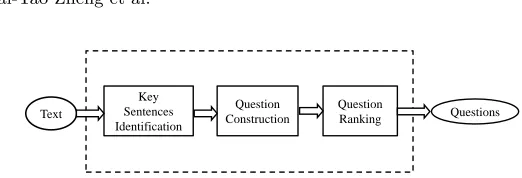
The goal of ACQG is to generate more acceptable questions from text or para-graph. The framework is shown in Fig. 1. This involves 1) identifying the key sentences of text with an adapted TextRank. 2) constructing questions according to rule-based templates. 3) ranking questions with a multi-feature neural network model.
Text Questions Key
Sentences Identification
Question Construction
Question Ranking
Fig. 1.Overview of Automatic Chinese Question Generation Framework
3.1. Key Sentences Identification
To identify the key sentences from text or paragraph, we use an adapted TextRank method. Graph-based ranking algorithm is a common measure to extract the key content in web [26,14]. A similar method called TextRank [15] can be applied to extract summary from document. In this work, we use an adapted TextRank to identify key sentences from text, which converts text to a graph and calculates the score of each sentence node. When the score of a sentence is greater than the set thresholdθ, the sentence will be selected. The original TextRank employs the BM254to compute the similarity of sequence, whereas it has many manual setting parameters leading to inefficient results. Therefore, we use the cosine similarity replaced in our method. The details are described as follows.
The input text T is divided into some sentences with different terminators (e.g. ‘ ’,‘ ’,‘ ’). T = {S0, S1, ...Si, ..., Sn}, Si represents a sentence in T, n is the total number of sentences in T. Then we segment Si into words. Si = {w0, w1, ..., wk..., wm},wk represents a word inSi,mis the total number of words in Si .
We introduce Term Frequency Inverse Document Frequency [1] to quantify each word, where T F(wk) is the frequency of wk in T, IDF(wk) = log||w||T||
k∈T|| is an inverse word frequency in total texts, ||T|| is the total number of texts in dataset. So a sentence can be represented to a word vector. The similar score is computed by Equation. 1.
simij=sim(Si, Sj) =
∑
wv∈Si∩Sj(T F(wv)IDF(wv))2 |Si||Sj|
(1)
For a given sentenceSi, In(Si)is the previous sentences,Out(Si)is the sub-sequent sentences. The score ofSi is computed using the Equation. 2.
W S(Si) = (1−d) +d∗
∑
Sj∈In(Si)
simji
∑
Sk∈Out(Sj)simjk
W S(Sj) (2)
Wheredis a parameter that is set between 0 and 1.
When the algorithm finished, a score associates with each sentence, and it expresses the importance of sentence in text. Whether the sentence is selected or not depends on this score.
3.2. Question Construction
In this section, we describe how to construct questions from sentence. In particu-lar, we focus on the structure and relation between words to construct questions. We design different rule-based templates to construct targeted questions from the parser tree.
Firstly, we design 5 general templates. If an input sentence contains location, person, noun, or time finding them by Named Entity Recognition (NER) , we constructWhere,Who,WhatorWhentype of question. If there is adjective around noun, we constructHowquestion. Then we replace a question type with the named entity to generate a question by declarative-to-interrogative. A good performance of NER is important for the type of question. To ensure the quality of tokenize and NER, we expand the annotators by getting neologisms from Wikipedia5regularly. Secondly, we design more templates aiming at generating targeted questions. Parser tree describes the relationship among verb, subject, object, and so on. We utilize it to analyze each sentence, and edit some templates learning from text to generate targeted questions. The templates are listed as follows.
1. numberquestion : (QP <CD =number<CLP) 2. rank question : (QP<OD=number)
3. if-causequestion : ((IP|PP=reason<< (because of)| (because)) ..(IP|PP|VP)|<< (IP|PP|VP<< (so)| (so that)))
4. relative-causequestion : ((( IP|PP=front<< (though)) .IP=however )|
<<(IP|PP=front(IP|PP |VP=however<< (but)| (but)))) 5. colorquestion : (QP<NP=JJ<NP)
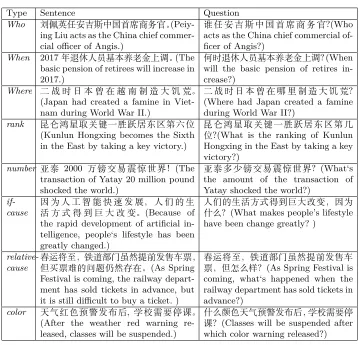
IP, PP, and VP represent different tag of words. A dot means subsequent follow and a left shaped arrow means an immediate subtree relation. These tem-plates guide to search possible answer phrases on the parser tree. Once a subtree matches any template, a question will be constructed. In order to have a better understanding of each template, we list some examples in Table. 1.
3.3. Question Ranking
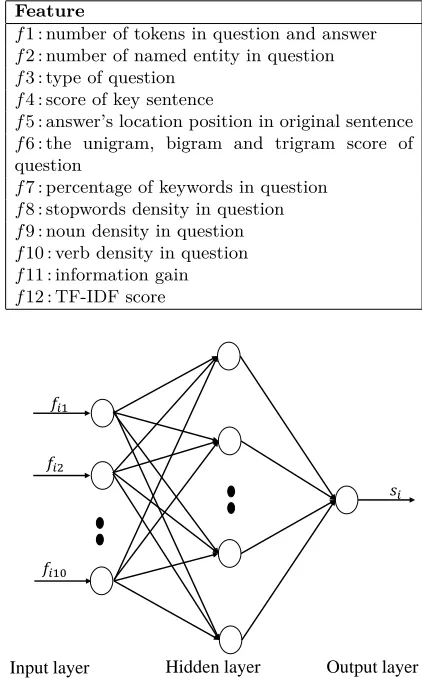
After the two processes above, we can obtain lots of questions, while these questions are sorted arbitrarily and the key questions do not always appear in the front rank of outputs. We build a multi-feature neural ranking model to select the top key questions. We import twelve features from the generated questions and text, shown in Table. 2, and design a multi-feature neural network model to rank them. This is an appropriate solution to the multiple features problem without manual intervention.
As shown in Table. 2, we select twelve features about generated questions and original text. Additionally, the features f1∼f5 are basic information of question and answer. f6 are the n-gram scores in question sequence, which provide rich contextual information.f7is used to compute the keywords percentage in question.
f8∼f10 are different tags of word distribution in question, which indicate the
Table 1.The Template Examples
Type Sentence Question
Who
(Peiy-ing Liu acts as the China chief commer-cial officer of Angis.)
?(Who acts as the China chief commercial of-ficer of Angis?)
When 2017 (The
basic pension of retirees will increase in 2017.)
(When will the basic pension of retires in-crease?)
Where
(Japan had created a famine in Viet-nam during World War II.)
? (Where had Japan created a famine during World War II?)
rank
(Kunlun Hongxing becomes the Sixth in the East by taking a key victory.)
?(What is the ranking of Kunlun Hongxing in the East by taking a key victory?)
number 2000 (The
transaction of Yatay 20 million pound shocked the world.)
(What‘s the amount of the transaction of Yatay shocked the world?)
if-cause (Because of
the rapid development of artificial in-telligence, people‘s lifestyle has been greatly changed.)
(What makes people’s lifestyle have been change greatly? )
relative-cause (As Spring
Festival is coming, the railway depart-ment has sold tickets in advance, but it is still difficult to buy a ticket. )
(As Spring Festival is coming, what‘s happened when the railway department has sold tickets in advance?)
color ,
(After the weather red warning re-leased, classes will be suspended.)
(Classes will be suspended after which color warning released?)
structure of question sequence. f11 is a probability data, which represents the uncertainty of sentence. f12 is a numerical statistic measure that is a popular sentence-weighting scheme.
We design a three layers neural network, as Fig. 2, this model is a gradient descent method designed to minimize the total error of predicted score and human rated score. The input layer is all features of each question. The middle layer is a hidden layer with K nodes, and the last layer is the predicted score. fij is jth feature ofith question. Furthermore, the multi-feature neural model is viewed as statistical model of the under form:
si=β0+ K
∑
j=1
βjΨ(wjfi) (3)
Table 2.All Features to Rank
Feature
f1: number of tokens in question and answer
f2: number of named entity in question
f3: type of question
f4: score of key sentence
f5: answer’s location position in original sentence
f6: the unigram, bigram and trigram score of question
f7: percentage of keywords in question
f8: stopwords density in question
f9: noun density in question
f10: verb density in question
f11: information gain
f12: TF-IDF score
𝑓𝑖1
𝑓𝑖2
𝑓𝑖10
𝑠𝑖
Input layer Hidden layer Output layer
Fig. 2.The Description of Multi-Feature Neural Ranking Model
squashing function like the rectified linear unit function:
Ψ(z) = 1
1 +exp(−z) (4)
And we use the mean square erroreas loss function, that is:
e= 1 2M
M
∑
i=1
(ti−pi)2 (5)
attached to questions, we can obtain the top questions which are more acceptable by users.
4. Experiments
We conduct extensive experiments to evaluate the feasibility and effectiveness of our framework, and compare it with the state-of-the-art question generation sys-tems.
4.1. Experimental Setup
We crawl ten topics of news data from Netease6and Toutiao7, which are the pop-ular Chinese media and website. The news contains ten topics, such as Economic (Ec), House, National, Military, Woman, Cars, Sports, Web, Entertainment (En), and Others. There are two hundred media news totally in the dataset8. For each news topic, 80% news are selected randomly as the training set, the rest news is used as the testing set.
There are some parameters to setup before generating. In the adopted Tex-tRank, the parameter d is usually set to 0.85 [15], and this is the value we are also using in our implementation; the threshold θ is 1.2, which is a little greater than the independent sentence score. In neural ranking model, the parameterK, ε
are set to 5, 0.01 [3] respectively. These values can ensure the model is robust. For sentences analysis, we apply the Stanford CoreNLP [11] to handle sentences including named entity recognizer and parser tree building.
We introduce three recent methods including H&S, HSKS and HSMF for com-parison to evaluate the performance of each framework. The compared methods are listed as follows:
• H&S: H&S transforms the input sentence into a simpler sentence and the simpler sentence is transformed into sets of questions by a sequence of well-defined syntactic and lexical transformations.[8]
• HSKS: HSKS extracts the key sentences from texts and then constructs ques-tions from the key sentences using templates.
• HSMF: HSMF applies a multi-feature model to rank all generated questions to make the top questions more useful.
We calculate the perplexity [18] score of generated questions, which is used to compare probability for nature language processing. Note that the lower perplexity indicates the generated questions are more likely to human writing. Besides, we also use human evaluation that is frequently adopted in recent works about question generation [5,22,10]. In human evaluation, all generated questions mixed together are evaluated by human, and each question is rated by two people. In detail, we define an evaluation criterion of question with different score values.
6http://news.163.com/ 7https://www.toutiao.com/
• Good represents the question is related to the text well without grammatical error and its score is 3.
• Borderlinerepresents the question has no problem from the view of the ques-tion but the answer does not make much sense (e.g., feature, today) and its score is 2.
• Bad represents the question is redundant or the answer is a part of other question and its score is 1.
4.2. Experimental Results
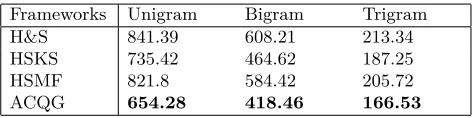
Table. 3 shows the perplexity score of n-gram in each framework. Unigram is
n= 1, Bigram is n= 2 and Trigram is n= 3. ACQG outperforms other frame-works, whose perplexity scores are 654.28 (Unigram), 418.46 (Bigram) and 166.53 (Trigram). H&S uses the over-generated questions and ranks them to get the out-put questions. The full text is used to generate questions, thereby the outout-puts are redundant and the scores are 841.39 (Unigram), 608.21 (Bigram) and 213.34 (Tri-gram). HSKS filters unmeaning sentences in texts, which is able to generate more targeted questions. Thus the scores decrease dramatically. Referring to HSMF sys-tem, HSMF is superior to H&S slightly. However the score of unigram is greater than H&S. The reason is that they both construct more absurd questions and the ranking method cannot improve this issue effectively. When we improve both key sentence extracting and question ranking, the performance of ACQG achieves best.
Table 3.The Perplexity Score of n-gram in Different Frameworks
Frameworks Unigram Bigram Trigram H&S 841.39 608.21 213.34
HSKS 735.42 464.62 187.25
HSMF 821.8 584.42 205.72
ACQG 654.28 418.46 166.53
Furthermore, we introduce human evaluation into this work. The average mark-ing scores are shown in Table. 4 , the detailed score distribution in each topic is shown in Fig. 3.
Table 4.The Average Score of Human Evaluation in Different Frameworks
Frameworks H&S HSKS HSMF ACGQ
Average Score 1.79 2.12 1.95 2.37
H&S has a poor performance, whose human evaluation score is only 1.79. For HSKS and HSMF, whose human evaluation score are 2.12 and 1.95 respectively. They both show better performance than H&S, but perform worse than ACGQ. Thus, the results of human evaluation are consistent with the above automatic evaluation.
Fig. 3.The Human Evaluation in Each Topic
Fig. 3 shows the detailed human evaluation score distribution in each topic. We can observe that all frameworks have a low satisfaction score in the topic of House. The reason is that the collected news is almost advertisements in House, which cannot generate meaningful questions. For other topics, H&S always shows a lower score in each topic, while ACQG always shows a higher score in each topic. For other frameworks, the results fluctuate within H&S and ACQG. In de-tail, the upper scores are 2.62 (Ec), 1.97(House), 2.46 (National), 2.29 (Military), 1.90 (Woman), 2.11 (Cars), 2.34 (Sports), 2.36 (Web), 2.27 (En), 2.45 (Others) respectively. HSKS pays attention to the main points of text, which filters some noisy sentences from verbose text, so the generated questions almost match texts well. HSMF takes enough features into account, which makes the ranking model effective, thus the top questions are more likely acceptable. ACGQ includes both improved components, so we can see the average score of ACQG by human evalua-tion is the highest. Therefore, ACQG works effectively by extracting key sentences instead of full text and improving ranking method.
5. Conclusion and Future Work
solve the multiple features problem. Extensive experiments are conducted on a Chinese dataset from the popular Chinese website and media, and the results show a significant improvement in terms of perplexity and human evaluation comparing with the baseline methods. We believe the proposed method will play an important role in question generation.
There still exist limitations in ACGQ. For example the types of generated questions are limited which is caused by the limited templates. In the future work, we will design more useful templates from texts to generate more meaningful questions. In addition, we will construct enough pairs of text and questions to train an end-to-end neural model to generate high-quality Chinese questions directly.
Acknowledgments This research is supported by National Natural Science Foun-dation of China (Grant No. 61773229), Natural Science FounFoun-dation of Guang-dong Province (Grant No. 2014A030313745), Basic Scientific Research Program of Shenzhen City (Grant No. JCYJ20160331184440545), and Cross fund of Grad-uate School at Shenzhen, Tsinghua University (Grant No. JC20140001).
References
1. Aizawa, A.: An information-theoretic perspective of tf–idf measures. Information Processing & Management 39(1), 45–65 (2003)
2. Becker, L., Basu, S., Vanderwende, L.: Mind the gap: learning to choose gaps for question generation. In: Proceedings of the 2012 Conference of the North American Chapter of the Association for Computational Linguistics: Human Language Tech-nologies. pp. 742–751. Association for Computational Linguistics (2012)
3. Burges, C., Shaked, T., Renshaw, E., Lazier, A., Deeds, M., Hamilton, N., Hullender, G.: Learning to rank using gradient descent. In: Proceedings of the 22nd international conference on Machine learning. pp. 89–96. ACM (2005)
4. Colby, K.M., Weber, S., Hilf, F.D.: Artificial paranoia. Artificial Intelligence 2(1), 1–25 (1971)
5. Du, X., Shao, J., Cardie, C.: Learning to ask: Neural question generation for reading comprehension. CoRR abs/1705.00106 (2017),http://arxiv.org/abs/1705.00106
6. Duke, N.K., Pearson, P.D.: Effective practices for developing reading comprehension. The Journal of Education 189(1/2), 107–122 (2008)
7. He, D., Xia, Y., Qin, T., Wang, L., Yu, N., Liu, T., Ma, W.Y.: Dual learn-ing for machine translation. In: Lee, D.D., Sugiyama, M., Luxburg, U.V., Guyon, I., Garnett, R. (eds.) Advances in Neural Information Processing Systems 29, pp. 820–828. Curran Associates, Inc. (2016), http://papers.nips.cc/paper/ 6469-dual-learning-for-machine-translation.pdf
8. Heilman, M., Smith, N.A.: Good question! statistical ranking for question genera-tion. In: Human Language Technologies: The 2010 Annual Conference of the North American Chapter of the Association for Computational Linguistics. pp. 609–617. Association for Computational Linguistics (2010)
9. Kunichika, H., Katayama, T., Hirashima, T., Takeuchi, A.: Automated question gen-eration methods for intelligent english learning systems and its evaluation (2001) 10. Lindberg, D., Popowich, F., Nesbit, J., Winne, P.: Generating natural language
11. Manning, C.D., Surdeanu, M., Bauer, J., Finkel, J.R., Bethard, S., McClosky, D.: The stanford corenlp natural language processing toolkit. In: ACL (System Demon-strations). pp. 55–60 (2014)
12. Mazidi, K., Nielsen, R.D.: Linguistic considerations in automatic question generation. In: ACL (2). pp. 321–326 (2014)
13. Mazidi, K., Tarau, P.: Infusing nlu into automatic question generation. In: INLG. pp. 51–60 (2016)
14. Mihalcea, R.: Graph-based ranking algorithms for sentence extraction, applied to text summarization. In: Proceedings of the ACL 2004 on Interactive poster and demonstration sessions. p. 20. Association for Computational Linguistics (2004) 15. Mihalcea, R., Tarau, P.: Textrank: Bringing order into text. In: EMNLP. vol. 4, pp.
404–411 (2004)
16. Mostafazadeh, N., Misra, I., Devlin, J., Mitchell, M., He, X., Vanderwende, L.: Gen-erating natural questions about an image. arXiv preprint arXiv:1603.06059 (2016) 17. Mostow, J., Chen, W.: Generating instruction automatically for the reading strategy
of self-questioning. In: AIED. pp. 465–472 (2009)
18. Popel, M., Mareček, D.: Perplexity of n-gram and dependency language models 19. Rajpurkar, P., Zhang, J., Lopyrev, K., Liang, P.: Squad: 100,000+ questions for
machine comprehension of text. arXiv preprint arXiv:1606.05250 (2016)
20. Rus, V., Wyse, B., Piwek, P., Lintean, M., Stoyanchev, S., Moldovan, C.: The first question generation shared task evaluation challenge. In: Proceedings of the 6th International Natural Language Generation Conference. pp. 251–257. Association for Computational Linguistics (2010)
21. Serban, I.V., García-Durán, A., Gulcehre, C., Ahn, S., Chandar, S., Courville, A., Bengio, Y.: Generating factoid questions with recurrent neural networks: The 30m factoid question-answer corpus. arXiv preprint arXiv:1603.06807 (2016)
22. Susanti, Y., Tokunaga, T., Nishikawa, H., Obari, H.: Evaluation of automatically gen-erated english vocabulary questions. Research and Practice in Technology Enhanced Learning 12(1), 11 (Mar 2017),https://doi.org/10.1186/s41039-017-0051-y
23. Vinyals, O., Toshev, A., Bengio, S., Erhan, D.: Show and tell: A neural image caption generator. CoRR abs/1411.4555 (2014),http://arxiv.org/abs/1411.4555
24. Wolfe, J.H.: Automatic question generation from text-an aid to independent study. ACM SIGCSE Bulletin 8(1), 104–112 (1976)
25. Yao, X., Tosch, E., Chen, G., Nouri, E., Artstein, R., Leuski, A., Sagae, K., Traum, D.: Creating conversational characters using question generation tools. Dialogue & Discourse 3(2), 125–146 (2012)
26. Zhu, H., Zhang, P., Sun, C.: Deep q-learning with prioritized sampling. In: Neural Information Processing: 23rd International Conference, ICONIP 2016, Kyoto, Japan, October 16–21, 2016, Proceedings. vol. 9947, p. 13. Springer (2016)
Jinxin Han is a master student in Department of Computer Science and Tech-nology, Tsinghua University. His research interests include natural language pro-cessing, machine learning and deep learning.
Jin-Yuan Chenis a doctoral student of Dr. Hai-Tao Zheng. He got his master degree in computer engineering, Graduate School at Shenzhen, Tsinghua Univer-sity 2013. His research interests include artificial intelligence, information retrieval and machine Learning.
Arun Kumar Sangaiah has received his Master of Engineering (ME) degree in Computer Science and Engineering from the Government College of Engineer-ing, Tirunelveli, Anna University, India. He had received his Doctor of Philoso-phy (PhD) degree in Computer Science and Engineering from the VIT Univer-sity, Vellore, India. He is presently working as an Associate Professor in School of Computer Science and Engineering, VIT University, India. His area of interest includes software engineering, computational intelligence, wireless networks, bioin-formatics, and embedded systems. He has authored more than 100 publications in different journals and conference of national and international repute. His current research work includes global software development, wireless ad hoc and sensor networks, machine learning, cognitive networks and advances in mobile comput-ing and communications. Also, he was registered a one Indian patent in the area of Computational Intelligence. Besides, Prof. Sangaiah is responsible for Editorial Board Member/Associate Editor of various international journals.