Abstract—To date, several new problems interesting for an ant colony optimization (ACO) are proposed and evaluated. However, in electronic marketplaces, there are no schemes focusing on forming a buyer coalition with bundle of items by ACO. In this paper, the new proposed approach, called GroupBuyACO scheme, applies ACO technique for forming buyer coalitions with the aim at maximizing the total discount. The solution of the algorithm is a collective outcome of the solution found by all the ants. The pheromone trail is updated after all the ants have found out their solutions. The simulation results of a proposed approach are compared with the genetic algorithm technique called GroupPackageString scheme [1]. Extensive computational experiments indicate that ACO technique performs better than GroupPackageString scheme in any environments.
Keywords— Ant algorithm, ant colony optimization, buyer
agent, group buying, buyer formation, bundle of items.
I. INTRODUCTION
n present, several companies have investigated the electronic commerce for selling their products because it is one of the fastest ways to advertize the product’s information to the huge number of customers. Tons of products can be sold rapidly in few days. So, the companies can get better profits from selling a large number of products. Ordinarily, many sellers provide some attractive products with the special prices. One of the strategies which sellers prefer to make is selling their goods in a bundle of items1 with the special prices. Moreover, several commercial websites usually offer the volume discount for customers if the number of selling is big. For buyer side, most of buyers prefer to build the corresponding purchasing strategies to minimize the purchase cost. The buyer’s strategy is becoming popular on the Internet because buyers can improve their bargaining power with sellers to purchase goods at a lower price.
There are several group buyer schemes in electronic marketplaces. The main objective of these schemes is to gather all buyers’ information for forming a buyer coalition to purchase goods at low cost. It helps to reduce the cost of communication and makes buyers comfortable in joining a coalition. In the recent years, several existing buyer coalition schemes have been developed. The work of Ito, T., Hiroyuki O., and Toramatsu S. in [3] presented an agent-mediated electronic market by group buy scheme. Buyers or sellers can sequentially enter into the market to make their decisions.
Manuscript received Feb 28, 2010. This work was supported in part by Bangkok University
A.S. Author is with the Information Technology Department, School of Science and Technology, Bangkok University, Bangkok, Thailand (e-mail:
Tsvetovat, M., Sycara, K.P., Chen, Y. and Ying, J. [4] have investigated the use of incentives to create buying group. Yamamoto, J. and Sycara, K. presented the GroupBuyAuction scheme [5] for forming buyer coalition based on item categories. Then, the paper of Masaki H., Tokuro M., and Takayuki I. [6] presented an optimal coalition formation among buyer agents based on a genetic algorithm (GA) with the purpose of distributing buyers among group-buying site optimally to get good utilities. The Combinatorial Coalition Formation scheme by Li, C., Sycara, K. [7] considers an e-marketplace where buyers place a bid on a combination of items with the reservation prices and sellers set special offers based on volume. However, there are two schemes by Anon S. [1] called GroupPackageString scheme and Laor, B., Leung, H. F., Boonjing and V.,Dickson, K. W [8] called GroupBuyPackage scheme that form a buyer coalition with bundles of items. Only the GroupPackageString scheme applied by heuristic function called genetic algorithm (GA) to form the buyer coalition with bundles of items while the other is not.
In this paper, the proposed approach applies ACO technique for forming buyer coalitions with the aim at maximizing the total discount. In ACO, several generations of artificial ants search for good solutions. The main characteristic of ACO is that every ant reads and updates pheromone value associate with good or promising solutions thought the edges of the path. The following ants of the next generation perceive the pheromone and tend to follow the paths where pheromone concentration is higher. However, there is no guarantee for convergence of ACO, but the experimental results have shown that in most cases the effciency of the proposed algorithm is acceptable. The paper is divided into six sections including this introduction section. The rest of the paper is organized as follow. Section 2 outlines group buying with bundle of itmes and the motivating problem in detail. Section 3 details the problem formulization to buyer formation with bundles of items. Secion 4 overviews the describes the approach applied in the paper using ACO technique for forming buyer coalition with bundle of items. Section 5 shows the simulation and parameter setting for the experiments including the discussion of GroupBuyACO scheme performance. The conclusions are in Section 6.
II. OUTLINE OF GROUP BUYING WITH BUNDLE OF ITEMS In electronic marketplaces, sellers have more opportunity to sell their products in a large number if their websites are very well-known among buyers. Moreover, the pricing strategy of sellers might expedite the selling volume. Some
Ant Colony Optimization for Buyer Coalition
with Bundle of Items
Anon Sukstrienwong, IAENG Member
1bundles of items refer to the practice of selling two or more goods together in a package at a price which is below the sum of the independent prices [2].
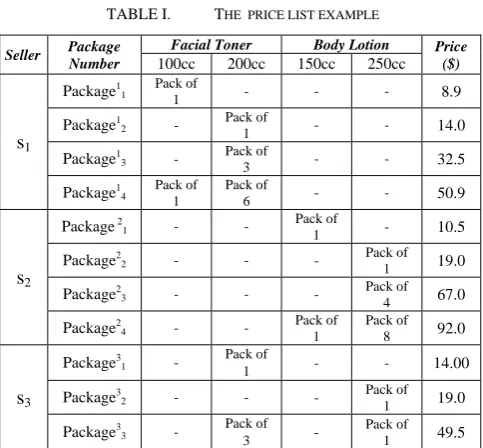
simultaneously make a single take-it-or-leave-it price offer to each unassigned buyer and to each buyer group [9]. In this paper, I assume that the buyer group is formed under one goal to maximizing aggregate buyer’s utility, the price discount received by being members of a coalition. Additionally, the definition of bundle of items is a slightly difference from [2] referring to several items together in a package of one or more goods at one price. The discount policy of sellers based on the number of items bundled in the package. If the package is pure bundling, the average price of each item will be cheaper than the price of a single-item package. Suppose that there are three competitive sellers in the e-marketplace selling some similar or the same products. These sellers prepare a large stock of goods and show the price list for each product. Then, conceptually, price watcher agent retrieves competitors' product prices from seller websites or agent sellers over the World Wide Web as shown in Fig. 1. Generally speaking, both seller agent and buyer agent are a software entity that assists its owner to achieve some delegated goals [10]. The example of three sellers’ information is shown in table 1. The first seller, called s1, is
selling two sizes of facial toner, 100 cc and 200 cc. To get attract to buyers seller s1 has made the special offers to attract
the buyers. For instance, seller s1 offers a package of number
p13 with the price of $32.0. The package p13 composes of 3
bottle of facial toner (200 cc). The average price of each facial toner (200 cc) is about 32.0/3 = 10.67 dollars/bottle which is 14.0-10.67 = 3.33 dollars/bottle cheaper than a sing-bottle of facial toner (200 cc) in package p12. At the same
time, the third seller called s3 offers package p33 which
comprises of 3 bottles of facial toner (200 cc) and 1 bottle of body lotion (250 cc) at the price of $49.5. However, a single bottle of facial toner (200 cc) and body lotion (250 cc) are set individually in the package p12 at the price of $14.0 and the
package p22 at the price of $19.0. Suppose there are some
buyers who want to purchase some products listed in the table 1. In the heterogeneous preference of buyers, some buyers do not want to purchase the whole bundle of items by their own. Some buyers need to buy few items at a cheapest price, but they do not want to buy the whole package. Suppose a buyer called b1 who wants to purchase a bottle of
facial toner (200 cc) and a bottle of body lotion (250 cc) as shown in table 2. Typically, a buyer has seen the price list provide by sellers before making orders. The problem of buyer b1 is described as follows. If buyer b1 goes straight to
purchase those products by his own, the total cost that buyer b1 needs to pay is 14.0+19.0 = 33.0 dollars which is the
highest price at that time. So, buyer b1 comes to participate in
the group buying with the aim of obtaining better prices on the purchasing. Then, buyer b1 places the orders to specific
items with the reservation prices2 of $9.0 for facial toner (200 cc) and $10.5 a bottle of body lotion (250 cc).
In common scenario in participation of group buying, the buyer agent collects buyer’s requests and joins a buyer coalition for some period of time to allow new orders to come in. At the end of specified period of time, buyer agent eases the new buyers’ requests, and buyer agent forms a coalition based the specific algorithm. Buyer agents can be loaded at the sites other than the seller websites. The algorithm
presented in this paper provides means for buyer coalition formation by ACO in an e-marketplace.
2The reservation price is the maximum price a buyer is willing to pay for a good. It varies for the buyer according to their desire for the good and their information about substitute goods.
[image:2.595.314.538.222.382.2]In particular constrains, buyers are quoted a buyer-specific price after they have seen the price list of all packages provided by sellers. The buyer coalition is formed concerning only the price attribute. And, the price per item is a monotonically decreasing function when the size of the package is increasing big. Additionally, the rule of the coalition is that each buyer is better forming a group than buying individually. The buyer coalition could be fail if there is no utility earned from forming the group buyer.
[image:2.595.305.547.418.642.2]Figure I. The outline of the GroupBuyACO scheme
TABLE I. THE PRICE LIST EXAMPLE
Seller Package Number
Facial Toner Body Lotion Price ($) 100cc 200cc 150cc 250cc
s1
Package1
1 Pack of 1 - - - 8.9 Package1
2 -
Pack of
1 - - 14.0
Package13 -
Pack of
3 - - 32.5
Package1 4
Pack of 1
Pack of
6 - - 50.9
s2
Package 2
1 - -
Pack of
1 - 10.5
Package2
2 - - -
Pack of 1 19.0 Package2
3 - - -
Pack of 4 67.0
Package24 - -
Pack of 1
Pack of 8 92.0
s3
Package31 -
Pack of
1 - - 14.00
Package32 - - -
Pack of 1 19.0 Package33 -
Pack of 3 -
Pack of 1 49.5 The symbol ‘-’ appearing in the Table 1 means that the seller does not put the product item in that package number.
TABLE II. A SAMPLE OF BUYERS’ORDER
Buyers
Buyer’s Order (Number of item (price $)) Facial Toner Body Lotion
100cc 200cc 150cc 250cc
b1 1 x (9.0) 1 x (10.5)
b2 - - - 2 (10.95)
III. PROBLEM FORMATION TO BUYER FORMATION WITH BUNDLES OF ITEMS
In the period of time, there is a set of sellers on the Internet called S = {s1,s2,…,sm} offering to sell a partial or all goods
of G = {g1,g2,…,gj}. Let B = {b1, b2,…,bn} denote the
collection of buyers. Each buyer wants to purchase several items posted by some sellers in S. The seller i has made special offers within a set of packages, denoted as Packagei = {Packagei1, Packagei2,…, Packageik}The price per item is a
monotonically decreasing function when the size of the package is increasing big, an each package is associated with the set of prices, denoted Price = {pricei1, pricei2,…, priceik},
where the priceik is an item list denoted by a vector {gik1
gik2,…, gikj}. If any goods gj is not available in the packagejk
of seller si, ,giki = 0. Each buyer bm needs to buy some items
offered by sellers, denoted as Qm = {qm1 ,qm2,…,qmj}, where
qmj refers to the quantity of items gj of buyer m. If qmj = 0, it
means that buyer bm does no request to purchase goods gj.
Also, any buyer bm places the reservation price for each
particular goods associated with Qm, denoted as Rsm = {rsm1,
rsm2,…,rsmj} where rsmh 0, 0hj. The objective of the
problem is to find best utility of the coalition; the following terms and algorithm processes are needed to define. The coalition is a temporary alliance of buyers for a purpose of obtaining best utility. The bm’s utility gained from buying qm
of gj at the pricej as (rsmj pricej)qm, so the total utility of
the group is define as follow:
B
b q Q
m j m
j
m m m
q price rs
U ( ) . (1)
IV. ANT COLONY OPTIMIZATION FOR BUYER COALITION SCHEME
A. Background
Ant colony optimization (ACO) algorithms are inspired by the behavior of real ants for finding good solutions to combinatorial optimization. The first ACO algorithm was introduced by Dorigo and Gambardella [11], [12] in 1997 which known as Ant System (AS). ACO applied to classical NP-hard combinatorial optimization problems, such as the traveling salesman problem [13], the quadratic assignment problem (QAP) [14], and the shop scheduling problem and mixed shop scheduling [15]. In nature, real ants are capable of finding the shortest path from a food source to their nest without using visual cues [16].
In ACO, each artificial ant builds a feasible solution by repeatedly applying a stochastic greedy rule. While constructing its tour, an ant deposits pheromone on the ground and follows the path by previously pheromone deposited by other ants. Once all the m ants have completed their tours, the ant which found the best solution deposits the amount of pheromone on the tour according to the pheromone trail update rule. The best solution found so far in the current iteration is used to update the pheromone information. The pheromoneij, associated with the edge joining i and j, is updated as follow:
m k k ij ij ij 1 ) 1 ( , (2)
where is the evaporation rate which (0,1]. The reason
influence on the future. And k ij
is the amount of pheromone laid on edge (i, j) by ant k:
where Q is a constant, and Lk is the length of the tour
performed by ant k.
In constructing a solution, it starts from the starting city to visit an unvisited city. When being at the city i, ant k selects the city j to visit through a stochastic mechanism with a probability
p
ijk given by:where Nik is a set of feasible neighborhood of ant k,
representing the set of cities what ant k has not been visited. and are two parameters which determine the relative influence of pheromone trail and heuristic information, and
ij
, which is given by:
ij ij
d 1
, (5)
where dij is the length of the tour performed by ant k
between cities i and j.
B. Forming buyer group with bundles of items by Ants
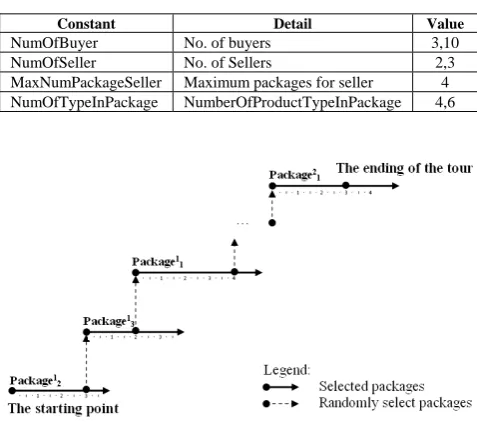
The procedure of ACO for forming buyer coalition with bundles of items is as follows. The first step is to represent the problem as graph where the optimum solution can be found in a certain way through the graph. In Fig. 2, the solid line represents a package selected by the ant k. If the selected package is picked more than one, the ant k moves longer along the solid line. Then, in this particular problem, the ant randomly chooses the other package which is represented by a dotted line. The probability of selecting i units of packages jth is
p
ijk formally defined below:
0i lD il il ij ij k ij p
where k ij
is the intensity of the pheromone trail on the solid line. For instance, at the starting point if the ant k has selected three sets (j=3) of 1
2
Package , the ant deposits its pheromone only on the 1
2
Package at the unit of 3. The result is shown in the Fig. 2. The quantity of pheromone k
ij
is defined as follow:
if j Nik
(4) otherwise,
0
k i il N c il il ij ij k ijp
If edge (i, j) is used by ant k. (3) 0 / k k ij L Q otherwise,
If j D, the set of packages offered by all sellers which have not been selected. (6) Otherwise,
where k
U is the total utility derived from the ant k. And, ij is given by:
where mij is the number of items in the selected packages which is matched to the buyer’s requests, and uij is the total number of items in the selected packages which is unmatched to the buyers’ requests.
At the beginning all of the pheromone values of each package line are initialized to the very small value c, 0 < c 1. After initializing the problem graph with a small amount of pheromones and defining each ant’s starting point, a small number of ants runs for a certain number of iterations. In each iteration, each ant determines a path through the graph from its starting point to the solid package line. The measurement of the quality of a solution found by the ACO is calculated according to the total utility of coalitions in (1).
TABLE III. DATA SETTINGS FOR GROUPBUYACO SCHEME
Constant Detail Value
NumOfBuyer No. of buyers 3,10
NumOfSeller No. of Sellers 2,3 MaxNumPackageSeller Maximum packages for seller 4 NumOfTypeInPackage NumberOfProductTypeInPackage 4,6
Figure II. Representing the formation of group buying as graph (no. of sellers = 2)
C. GroupBuyACO scheme
This section shows the implementation of ACO algorithm for forming buyer group with bundles of items called the GroupBuyACO scheme. The proposed algorithm can be described by the following procedure:
V. EXPERIMENTS AND RESULTS
This section demonstrates the simulation setup for group formation by the proposed algorithm, GroupBuyACO scheme. The algorithm has been tried several of runs with different number of artificial ants, and different value of and to find which values would steer the algorithm towards the best solution.
A. Simulation and data settings
[image:4.595.302.543.53.370.2]The simulation program for the GroupBuyACO scheme is coded in C++ programming language. In the experiment, the two examples with different characteristic are used. Each example of operates several runsto get the average results. Table 3 summarizes the data settings for GroupBuyACO scheme in the evaluation.
1) Example1
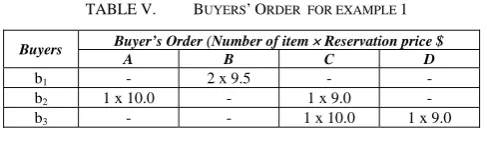
For the sake of simplicity, this example is a simple case. In the marketplace, there are two sellers selling some product as listed in Table 4. And there are three buyers who want to purchase some of those products. They have placed the orders as shown in table 5.
TABLE IV. THE PRICE LIST FOR EXAMPLE 1
Seller Package Number
Product types Price ($) A B C D
s1
Package1
1 1 1 1 1 35.0
Package1
2 1 1 - - 18.0
Package1
3 1 - - - 10.0
Package1
4 - 1 - - 10.0
s2
Package21 - - 2 1 24.0
Package2
2 - - 1 - 10.0
Package23 - - - 1 10.0
0 1
/ ij ij
ij
u m
If some of the items in the selected package are unmatched to the buyers’ requests.
If all items of the selected package (8) are totally matched to the buyers’ requests.
Otherwise,
procedure GroupBuyACO(){
Initialization of the GroupBuyACO;
Initialization all pheromone values to a small numerical constant c > 0 while not (isFinish(Iteration )){ for Ant = 1 to MaxAnt {
ManageAntsActivity(); EvaporatePheromone();
Save the best solution found so far UpdatePheromone();
} } }
ManageAntsActivity(){
while not (isAntFinish(tour)){
Select a package I to be visited and the exact j amount of package with probability k
ij
p in (4).
} }
EvaporatePheromone(){
Old pheromone should not have too strong an influence on the future. The
evaporation rate value is which is initialized to be small, (0,1]. }
UpdatePheromone(){
[image:4.595.49.288.385.596.2] [image:4.595.307.550.645.755.2]TABLE V. BUYERS’ORDER FOR EXAMPLE 1
Buyers Buyer’s Order (Number of item Reservation price $
A B C D
b1 - 2 x 9.5 - -
b2 1 x 10.0 - 1 x 9.0 -
b3 - - 1 x 10.0 1 x 9.0
2) Example 2
In order to get best experimental results, for this example, the buyers’ orders of this example are randomly chosen by the simulation to demonstrate that the proposed algorithm is possible to works in the real-world data. This example randomly chooses the requests of ten buyers form three different sellers. Each seller offers to sell various packages in which some of them are pure bundling packages and single-item packages. Table 6 shows the price list offered by individual seller, and Table 7 is the example of ten buyers who participate in the group buying.
TABLE VI. THE PRICE LIST FOR EXAMPLE 2
Seller Package Number
Product types
Price($) A B C D
s1
Package1
1 1 - - - 1000
Package1
2 - 1 - - 1000
Package1
3 - - 1 - 1000
Package1
4 - - - 1 1000
Package1
5 1 1 - - 1950
Package26 - 1 1 - 1900
s2
Package2
1 - - 1 1 1925
Package2
2 1 - 1 - 1950
Package2
3 1 - - 1 1920
Package2
4 - 1 - 1 1970
s3
Package3
1 1 1 1 - 2700
Package3
2 - 1 1 1 2690
Package33 1 - 1 1 2750
Package3
4 1 1 - 1 2700
Package3
5 1 1 1 1 3500
TABLE VII. A SAMPLE OF BUYERS’ORDER FOR EXAMPLE 2
Buyers Buyer’s Order (Number of item Reservation price $)
A B C D
b1 - 1 x 955 1 x 960 -
b2 - - - 1 x 980
b3 - - 2 x 980 -
b4 - 1 x 970 - -
b5 - - - 1 x 989
b6 1 x 965 - - -
b7 - - 1 x 970 -
b8 1 x 960 1 x 975 -
b9 - - 1x 1000 -
b10 2 x 969 - - -
B. Study of the GroupBuyACO scheme performance
Usually the main parameters of an ACO algorithm are and which are assigned fixed values during the run of the algorithm.
1) The effect of and
The first two parameters to be studied are and . As shown in previous equations of (6), these parameters are related to the probability of selecting i units of packages jth (
p
ijk ) because is the exponent of kij
and is the exponent of ij. Thus, the corresponding variations in values
of both and might play an importance role on the GroupBuyACO scheme. Let both and value rang from 0.5 to 5, and the number of iterations is 200. The resulting of corresponding variation in values of and is shown in Table 8. The best result for the problem of example 1 and example are in bold. It can be seen that average of group’s utility earned on group buying by GroupBuyACO scheme is high when is 2 and is between 0.5 and 1.
2) Number of Iterations
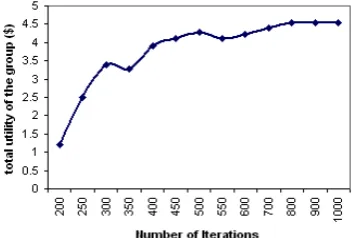
In Fig. 3 and 4, it can be observed that as the number of iterations increase, the total utility of the group derived by GroupBuyACO scheme also increases. Moreover, when the problem is huge, the number of iterations also is large. Thus the optimum number of iterations is needed to be chosen to give the stabilized solutions to the problems.
3) Evaporation rate
Evaporation rate of the pheromone is one of the most important for the GroupBuyACO scheme. From Fig. 5 and Fig. 6, it can be seen that as the value of = 0.1 the total utility earned from the group buying is the highest.
TABLE VIII. THE AVERAGE OF GROUP’S UTILITY (EXAMPLE 1) DERIVIED FROM CORRESPONDING VARIATION IN VALUES OF AND , ITERATION
NUMBER =450
0.5 1 2 3 4
0 -1.83 0.50 -1.57 -0.50 1.17
0.5 2.06 3.27 1.22 3.04 2.20
1 -0.07 1.82 3.70 3.50 0.58
2 3.73 4.10 1.85 2.30 -1.50
3 -0.77 2.73 -0.75 -2.67 0.11
[image:5.595.303.549.355.447.2]4 -1.73 0.86 0.63 -0.75 2.60
TABLE IX. THE AVERAGE OF GROUP’S UTILITY (EXAMPLE 2) DERIVIED FROM CORRESPONDING VARIATION IN VALUES OF AND , ITERATION
NUMBER =2000
0.5 1 2 3 4
0 759.06 457.22 791.33 673.21 463.67 0.5 755.25 594.23 814.71 734.72 761.39 1 623.57 757.48 698.21 542.01 654.04 2 927.24 907.09 456.98 671.45 643.21 3 554.65 657.84 569.24 459.27 598.25 4 365.98 452.11 741.37 456.89 744.25
4) Comparison of GroupBuyACO scheme with
GroupPackageString scheme in [1]
In order to evaluate the performance of GroupBuyACO, the initial parameters were set to the following values: = 2, = 1 and = 0.1. It is interesting to see that both GroupBuyACO scheme and GroupPackageString give similar result for the example 1, but GroupBuyACO outperforms GroupPackageString for the example 2.
TABLE X. THE COMPARISON OF GROUPBUYACO SCHEME WITH THE GENETIC ALGORITHM IN [1]
Example # GroupBuyACO scheme GroupPackageString [1]
1 4.52 4.51
[image:5.595.45.288.497.630.2] [image:5.595.302.550.504.591.2]Figure III. Number of iterations for example 1, where initial settings = 2 , = 1, and = 0.1.
[image:6.595.50.268.61.663.2]Figure IV. Number of iterations for examplpe 2 where initial settings = 2 , = 0.5, and = 0.1.
Figure V. Evaporation rate () for examplpe 1, where initial settings = 2 and = 1.
Figure VI. Evaporation rate () for examplpe 2, where initial setting = 2 and = 0.5
VI. CONCLUSION AND FURTHER WORK
This paper has introduced a new method for forming buyer coalition through the use of ant colony optimization technique, called GroupBuyACO scheme. The desired goal for the proposed algorithm is to form a buyer coalition in order to maximize the group’s total utility. The ants construct
the trail by depositing pheromone after moving through a path and updating pheromone value associate with good or promising solutions thought the edges of the path. From two illustrative examples, it is observed that the proposed algorithm is effective in dealing with finding best buyer coalitions with bundle of items. The solution quality of GroupBuyACO scheme is shown by comparing with the genetic algorithm technique called GroupPackageString scheme. In the experimental results, it turns out that in most cases the effciency of GroupBuyACO is acceptable. The GroupBuyACO scheme has restrictive constraints of forming a buyer coalition as follow: 1) buyers quote their reservation prices after they have seen the price list of all packages provided by sellers. 2) The buyer coalition is formed concerning only the price attribute. 3) And, the price per item is a monotonically decreasing function when the size of the package is increasing big. 4) The period of time for forming the buyer coalition is not under consideration even through it may change the results buyer coalition. These restrictions can be investigated in the future research.
REFERENCES
[1] Anon, S., Buyer Formation with Bundle of Items in E-Marketplaces by Genetic Algorithm. International Multiconference of Engineers and Computer Scientists 2010, vol. 1, pp 158-162.
[2] Gurler, U., Oztop, S. and Sen A., 2006, Optimal Bundle Formation and Pricing of two products with limited stock, J. International Journal of Production Economics (2008).
[3] Ito, T., Hiroyuki O., and Toramatsu S., A Group Buy Protocal based on Coalition Formation for Agent-mediated E-Commerce. International Journal of Computer and Information Science (IJCIS).
[4] Tsvetovat, M., Sycara, K. P., Chen, Y. and Ying, J., Customer Coalitions in Electronic Markets, Lecture Notes in Computer Science, Vol. 2003, pp. 121-138. Springer, Heidelberg (2001).
[5] Yamamoto, J. and Sycara, K., 2001, “A Stable and Efficient Buyer Coalition Formation Scheme for E-Marketplaces”, Proceedings of the 5TH International Conference on Autonomous Agents, Monttreal, Quebec, Canada, pp. 576-583.
[6] Masaki H., Tokuro M., and Takayuki I., An optional Coalition Formation among Buyer Agents based on a Genetic Algorithm. [7] Li, C., Sycara, K. Algorithm for Combinatorial Coalition Formation
and Payoff Diversion in an Electronic Marketplace. In: Proceedings of the First International Joint Conference on Autonomous Agents and Multiagent Systems, pp. 120-127 (2007).
[8] Laor, B., Leung, H. F., Boonjing, V., Dickson, K. W., “Forming Buyer Coalitions with Bundles of Items”. In: Nguyen NT, Hakansson A, Hartung R., Howlett R., Jain LC (eds.) KES-AMSTA 2009. LNAI 5559-0717 PP 121-138. Springer, Heidelberg (2009).
[9] Dana, J. (2004). ”Buyer groups as strategic commitments”, mimeo, Northwestern University.
[10] Choi, S. P. M. and Liu, J., “Optimal time-constrained trading strategies for autonomous agents”. In: International ICSC Symposium on Multi-agents and Mobile Agents in Virtual Organizations and E-commerce (MAMA 2000), Wollongong, Australia, December 2000. [11] Dorigo M. and L.M. Gambardella. “Ant Colony System: A cooperative learning approach to the traveling salesman problem,” IEEE Transactions on Evolutionary Computation, vol. 1, no. 1, pp. 53–66, 1997.
[12] M. Dorigo and G. Di Caro, “The Ant Colony Optimization metaheuristic,”in New Ideas in Optimization, D. Corne et al., Eds. McGraw Hill, London, UK, 1999, pp. 11–32.
[13] Lawler, E. L., Lenstra, J. K., Rinnooy-Kan, A. H. G. and Shmoys, D. B. (eds) (1985). The traveling salesman problem. New York, NY: Wiley. [14] V. Maniezzo, A.Colorni, M.Dorigo, “The Ant System Applied to the
QuadraticAssignment Problem”, Tech.Rep.IRIDIA/94-28, Université Libre de Bruxelles, Belgium, 1994.
[15] Yamada, T. and Reeves, C.R., 1998. “Solving the Csum permutation flowshop scheduling problem by genetic local search”. In: Proceedings of 1998 IEEE International Conference on Evolutionary Computation, pp. 230–234.
[image:6.595.82.260.64.183.2] [image:6.595.79.261.531.657.2]