Solving The Printed Circuit Board Drilling Problem
By Ant Colony Optimization Algorithm
Taisir Eldos, Aws Kanan, Abdullah Aljumah
Abstract - Printed Circuit Board (PCB) manufacturing depends on the holes drilling time, which is a function of the number of holes and the order in which they are drilled. A typical PCB may have hundreds of holes and optimizing the time to complete the drilling plays a role in the production rate. At an early stage of the manufacturing process, a numerically controlled drill has to move its bit over the holes one by one and must complete the job in minimal time. The order by which the holes are visited is of great significance in this case. Solving the TSP leads to minimizing the time to drill the holes on a PCB. Finding an optimal solution to the TSP maybe prohibitively large as the number of possibilities to evaluate in an exact search is (n-1)!/2 for n-hole PCB. There exist too many algorithms to solve the TSP in an engineering sense; semi-optimal solution, with good quality and cost tradeoff. Starting with Greedy Algorithm which delivers a fast solution at the risk of being low in quality, to the evolutionary algorithms like Genetic algorithms, Simulated Annealing Algorithms, Ant Colony, Swarm Particle Optimization, and others which promise better solutions at the price of more search time. We propose an Ant Colony Optimization (ACO) algorithm with problem-specific heuristics like making use of the dispersed locales, to guide the search for the next move. Hence, making smarter balance between the exploration and exploitation leading to better quality for the same cost or less cost for the same quality. This will also offer a better way of problem partitioning which leads to better parallelization when more processing power is to be used to deliver the solution even faster.
Keywords - Ant Colony, Optimization Algorithm, Printed Circuits Board Drilling, Traveling Salesman.
.
I. INTRODUCTION
Ant Colony Optimization (ACO) algorithm is a probabilistic technique for solving computational problems which can be reduced to finding good paths through graphs. Proposed by Marco Dorigo in 1992, the first algorithm was meant to search for an optimal path in a graph, based on the behavior of ants seeking a path between their colony and a source of food.
Manuscript received July 12th, 2013; revised August 20th, 2013. This research project was funded by the deanship of scientific research, Salman bin Abdulaziz University Grant No. 1/T/1432.
Taisir Eldos, [email protected], Department Of Computer Engineering, College of Computer Engineering and Sciences, Salman in Abdulaziz University, Al Kharj, 11942 Saudi Arabia, phone: 00966553213300.
Aws Kanan, [email protected], Department Of Computer Engineering, College of Computer Engineering and Sciences, Salman in Abdulaziz University, Al Kharj, 11942 Saudi Arabia.
Abdullah Aljumah, [email protected], Department Of Computer Engineering, College of Computer Engineering and Sciences, Salman in Abdulaziz University, Al Kharj, 11942 Saudi Arabia
ACO has since diversified to solve a wider class of numerical problems, and as a result. In nature, ants start wandering randomly, and upon finding food return to their colony while laying down pheromone trails. If other ants find such a path, they are likely to follow the trail, returning and reinforcing it if they eventually find food. Over time, however, the pheromone trail starts to evaporate, thus reducing its attractive strength. The more time it takes an ant to travel down the path and back again, the more time the pheromones have to evaporate. A short path, by comparison, gets marched over more frequently, and thus the pheromone density becomes higher on shorter paths than longer ones. Pheromone evaporation also has the advantage of avoiding the convergence to a locally optimal solution. If there were no evaporation at all, the paths chosen by the first ants would tend to be excessively attractive to the following ones. In that case, the exploration of the solution space would be constrained. Thus, when one ant finds a short path from the colony to a food source, other ants are more likely to follow that path, and positive feedback eventually leads to all the ants' following a single path. The idea of the ant colony algorithm is to mimic this behavior with "simulated ants" walking around the graph representing the problem to solve. Generally, this algorithm is convergent; capable of finding a global optimum in finite time.
The ACO has been successfully applied to many problems; scheduling problems, assignment problems, data mining, classification, multiple knapsack problem, traveling salesman problem, and many others. However, some problems have not received enough attention and while they may have attractive attributes for this search technique. In our work, we will focus on the Printed Circuits Boards Drilling problem as a special case of the Travelling Salesman problem, taking advantage of the dispersed locales property.
II. RELATED WORK
choice of the evaporation factor. A sensibility analysis to help tune the parameters of an ant colony model where ants leave a fuzzy trace of pheromone to mark their track and its neighborhood, where tests were conducted on classical problems is presented in [3]. A case study demonstrating the capability of the Ant Colony Optimization (ACO) algorithm to solve the Travelling Salesman problem is presented in [4], in order to find the best solution in terms of the shortest distance. Many tough problems have been solved by the ant colony optimization technique with great success; [5] presents an edge detection technique that is based on ACO, by establishing a pheromone matrix that represents the edge information at each pixel based on the routes formed by the ants dispatched on the image. The movement of the ants is guided by the local variation in the image’s intensity values, taking advantage of the improvements introduced in ant colony system. Experimental results show the success of the technique in extracting edges from a digital image. [6] develops a coarse-grain parallel ant colony algorithm to solve the problem develops optimization model for bus transit network based on road network and zonal OD. The model aims at achieving minimum transfers and maximum passenger flow per unit length with line length and non-linear rate as constraints. It uses a heuristic pheromone distribution rule, by which ants’ path searching activities are adjusted according to the objective value. [7] reports the analysis of using a lower pheromone trail bound and a dynamic updating rule for the heuristic parameters based on entropy to improve the efficiency of this algorithm in solving Traveling Salesman Problems (TSPs), with extremely large problem space. The experiments show that the proposed algorithm has superior search performance over traditional ant colony algorithms. [8] addresses the problem by developing a general framework of grid scheduling using dynamic information and an ant colony optimization algorithm to improve the decision of scheduling. The performance of various dispatching rules such as First Come First Served (FCFS), Earliest Due Date (EDD), Earliest Release Date (ERD), and an Ant Colony Optimization (ACO) are compared. Moreover, the benefit of using an Ant Colony Optimization for performance improvement of the grid Scheduling is also discussed. It is found that the scheduling system using an Ant Colony Optimization algorithm can efficiently and effectively allocate jobs to proper resources. [9] proposes the Omicron ACO (OA), a novel population-based ACO alternative originally designed as an analytical tool. To experimentally prove OA advantages, this work compares the behavior between the OA and the MMAS as a function of time in two well-known TSP problems. A simple study of the behavior of OA as a function of its parameters shows its robustness.
The ant colony algorithm performance has been boosted by involving other techniques in its internal workings; for example, [10] shows an ant colony and simulated annealing algorithms used to find the core of a graph, such that the total travel cost time required for the demand points to reach the closest vertex on this path is minimized. While [11] develops a new fuzzy-logic based ACO algorithm, taking
into consideration the uncertainties that can be found in both the heuristic and the pheromone factors. Where during the solution iterations the calculations are performed taking into consideration the fuzzy levels of the involved parameters. A stochastic-based technique is proposed to enable the artificial ant to choose the best oncoming step based on the values of the probabilities and their corresponding fuzzy levels. The proposed algorithm gives the optimal solution in a form of an optimal value and its corresponding fuzzy level, using benchmark Quadratic Assignment Problem (QAP) and Travelling Salesman Problem (TSP). An ant colony optimization technique for continuous domains is presented in [12], to provide improvements in computing time and robustness when compared to other optimization algorithms. The developed Modified Continuous Ant Colony (MCACO) algorithm was run for numerous classic test cases for both single and multi-objective problems. The results demonstrate that the method is robust, stable, and that the number of objective function evaluations is comparable to other optimization algorithms. In [13], the authors propose an algorithm that incorporates key features of the Tabu Search method in the development of a relatively simple but robust global ant colony optimization algorithm. Numerical results are reported to validate and demonstrate the feasibility and effectiveness of the proposed algorithm in solving electromagnetic (EM) design problems.
III. ANT BASED SEARCH
In ACO, artificial ants build solutions to the problem by traversing a construction graph, as sets denoted by cij,
towards a set of all possible solution components denoted by C. A pheromone trail value τij is associated with each
component cij, to allow the probability distribution of
different components of the solution to be modeled. The ants move from vertex to vertex along the edges of the construction graph exploiting information provided by the pheromone values to incrementally build solutions. Ants deposit pheromone on the components, whose amount Δτ is a function of both the iteration and the solution quality.
Typically, a set of m artificial ants construct solutions from elements of a finite set of available solution components C = {cij} , i=1, …, n , j = 1, …, |Di|. The
solution construction starts with an empty partial solution sp=∅ . Then, at each construction step, the current partial solution sp is extended by adding a feasible solution component from the set of feasible neighbors N(sp) ⊆
C. This process can be regarded as a path on the construction graph.
Choosing the solution component from N(sp) is is carried out probabilistically at each construction step, and the best known rule is the one of ant system:
𝑝 𝑐𝑖𝑗 𝑠𝑝 =
𝜏𝑖𝑗𝛼 ∙ 𝜂𝑖𝑗𝛽 𝜏𝑖𝑙𝛼∙ 𝜂
𝑖𝑙 𝛽 𝑐𝑖𝑗∈𝑁(𝑠𝑝)
where τij and ηij are respectively the pheromone value and
the heuristic value associated with the component cij.
α and β are positive real parameters to impose relative importance of pheromone against heuristic information.
Pheromone update is meant to increase the pheromone values associated with good solutions, and to decrease those that are associated with bad ones. Usually, this is achieved by decreasing all the pheromone values through a process called pheromone evaporation, and increasing the pheromone levels associated with a chosen set of good solutions Supd:
𝜏𝑖𝑗 ← 1 − 𝜌 ∙ 𝜏𝑖𝑗 + 𝜌 ∙ 𝐹(𝑠)
𝑠∈𝑆𝑢𝑝𝑑|𝑐𝑖𝑗∈𝑠 (2)
where Supd is the set of solutions that are used for the update, ρ∈(0,1] is a parameter called evaporation rate, and F:S→R+0 is a function such that;
f(s) < f(s′) ⇒F(s) ≥ F(s′), ∀s ≠ s ′∈S (3)
F is commonly called the fitness function.
Pheromone evaporation implements a useful form of forgetting, favoring the exploration of new areas in the search space. Instantiations of the update rule given above are obtained by different specifications of Supd; typically a
subset of Siter∪{sbs} , where Siter is the set of solutions that
were constructed in the current iteration, and sbs is the
best-so-far solution, that is, the best solution found since the first algorithm iteration.
Usually, the update rule is Supd←Siter, although Supd←arg
maxs∈Siter F(s), is more often used in practice.
IV. MAIN ACO ALGORITHMS
Several special cases of the ACO metaheuristic have been proposed in the literature.
Ant System (AS)
This variant is mostly concerned with updating the pheromone values by all the ants that have completed the tour. Solution components cij are the edges of the graph, and
the pheromone update for τij , the pheromone associated
with the edge joining nodes i and j , is performed as follows: 𝜏𝑖𝑗 ← 1 − 𝜌 ∙ 𝜏𝑖𝑗 + 𝜌 ∙ ∆𝜏𝑖𝑗𝑘
𝑚
𝑘=1 (4)
where ρ∈(0,1] is the evaporation rate, m is the number of ants, and Δτkij is the quantity of pheromone laid on
edge (i,j) by the k-th ant:
∆𝜏𝑖𝑗𝑘 = 1
𝐿𝑘 𝑖𝑓 𝑎𝑛𝑡 𝑘 𝑎𝑠 𝑒𝑑𝑔𝑒 𝑖, 𝑗 𝑖𝑛 𝑡𝑜𝑢𝑟, 𝑒𝑙𝑠𝑒 0 (5)
where Lk is the tour length of the k-th ant.
When constructing the solutions, the ants traverse the construction graph and make a probabilistic decision at each vertex. The transition probability p(cij|spk) of the k-th ant
moving from city i to city j is given by:
𝑝 𝑐𝑖𝑗 𝑠𝑝 =
𝜏𝑖𝑗𝛼 ∙ 𝜂𝑖𝑗𝛽 𝜏𝑖𝑙𝛼∙ 𝜂
𝑖𝑙 𝛽 𝑐𝑖𝑗∈𝑁(𝑠𝑝)
, 𝑖𝑓 𝑗 ∈ 𝑁 𝑠𝑘𝑝 , 𝑒𝑙𝑠𝑒 0 (6)
where N(spk) is the set of components that do not belong yet
to the partial solution spk of ant k , parameters α and β to
control relative importance of pheromone against heuristic information ηij=1/dij , where dij is the length of
component cij (i.e., of edge (i,j)).
Ant Colony System (ACS)
A major improvement over the original ant system, through the decision rule during the construction process. Here, ants use the so-called pseudorandom proportional rule, which says: the probability for an ant to move from city i to city j depends on a random variable q uniformly distributed over [0,1], and a parameter q0 ; if q≤q0 , then, among the feasible components, the component that maximizes the product τilηβil is chosen; otherwise, the same equation as in
AS is used.
This greedy rule favors exploitation of the pheromone information, and is counterbalanced by the introduction of the local pheromone update for diversification. The local pheromone update is performed by all ants after each construction step. Each ant applies it only to the last edge traversed:
τij=(1−φ)⋅τij+φ⋅τ0 (7) where φ∈(0,1] is the pheromone decay coefficient, and τ0 is the initial value of the pheromone.
The main goal of the local update is to diversify the search performed by subsequent ants during one iteration; decreasing the pheromone concentration on the edges as they are traversed during one iteration encourages subsequent ants to choose other edges and hence to produce different solutions. This makes less likely that several ants produce identical solutions during one iteration. Additionally, because of the local pheromone update in ACS, the minimum values of the pheromone are limited.
τij←(1−ρ)⋅τij+ρ⋅Δτbestij (8)
where Δτbestij=1/Lbest if the best ant used edge (i,j) in its
tour, Δτbestij=0 otherwise (Lbest can be set to either the length
of the best tour found in the current iteration -- iteration-best, Lib -- or the best solution found since the start of the
algorithm -- best-so-far, Lbs).
MAX-MIN Ant System (MMAS)
MMAS is another improvement, it differs from AS in that (i) only the best ant adds pheromone trails, and (ii) the minimum and maximum values of the pheromone are explicitly limited. The pheromone update equation takes the following form:
τij←(1−ρ)⋅τij+Δτbestij (9)
where Δτbestij=1/Lbestif the best ant used edge (i,j) in its
tour, Δτbestij=0 otherwise, where Lbest is the length of the tour
of the best ant. As in ACS, Lbest may be set (subject to the
algorithm designer decision) either to Lib or to Lbs ,or to a
combination of both.
The pheromone values are constrained between τmin and τmax by verifying, after they have been
updated by the ants, that all pheromone values are within the imposed limits.
τij is set to τmax if τij>τmax and to τmin if τij<τmin (10)
The minimum and maximum values are experimentally or analytically selected.
V. PCBDRILLING PROBLEM
PCBs contain few hundreds of holes of different diameters and depths, typically portioned for the sake of drilling time, each set of holes need to be drilled in the shortest time possible.
Table I, Performance: Tour Improvement
After 500 iterations After 1000 iterations Size Optimal Best Tour Error Best Tour Error
127 118282 146117 23.5 % 123608 4.5 % 150 6528 8546 30.9 % 6697 2.5 %
[image:4.595.307.551.48.288.2]Table I shows the performance of the algorithm on two instances with relatively small number of holes as a test drive. Error drops significantly upon doubling the number of iterations.
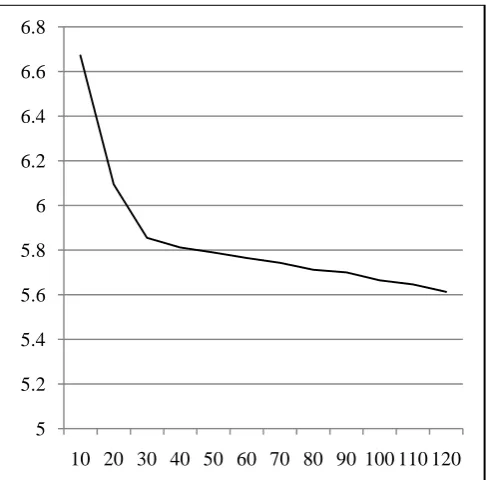
Fig. 1, Search Progress: Tour Length versus Processing Time (1000s iterations)
Fig. 1 shows the Max Min Ant System algorithm progress on the PCB442 benchmark; tour length as a function of the processing time (in msec). Clearly, the first tens of iterations have the biggest share in the tour enhancement.
[image:4.595.322.531.484.626.2]Table II shows the effect of employing more ants in the system to run for a fixed amount of time. More ants represents a computational burden, but it pays off in terms of the solution quality, although not quite linearly.
Table II: Performance versus Number of Ants
Number of Ants Best Tour Length
5 59476
10 58428
15 58172
20 58432
25 57284
30 57396
VI. CONCLUSION
Although the TSP and its derivatives have been solved by many evolutionary algorithms, the ACO algorithms seem to be a promising alternative in solving the PCB drilling problem in practically reasonable quality with practically reasonable time. The implementation shows that the problem is amenable to parallelization due to the dispersed locals, and hence may offer better performance when more computational resources is available.
5 5.2 5.4 5.6 5.8 6 6.2 6.4 6.6 6.8
VII. FUTURE WORK
We plan to compare the performance of the Ant Colony Optimization (ACO) algorithm with competitive ones like Chemical Reaction Optimization (CRO) and Gravitational Search Algorithm (GSA) on several PCB benchmarks. We are analyzing few benchmarks to design few daemon actions towards better performance in certain identified locales.
ACKNOWLEDGMENT
This research was conducted at Salman bin Abdulaziz University, Al Kharj, Saudi Arabia during the academic year 2012/2013. Lead by the first author, who was on a sabbatical leave as a tenured associate professor at Jordan University of Science and Technology.
REFERENCES
[1] Marco Dorigo, Luca Maria Gambardella, “Ant colonies for the travelling salesman problem,” Eslevier, BioSystems, Vol. (43), pp 73–81, 1997. [2] Frank Neumann Dagstuhl, “Runtime Analysis of a
Simple Ant Colony Optimization Algorithm,” Seminar Proceedings: Theory of Evolutionary Algorithms.
[3] Louis Gacogne, Sandra Sandri, “A study on ant colony systems with fuzzy pheromone dispersion,” Proceedings of IPMU'08, pp. 812, 2008.
[4] Helmi Md Rais, Zulaiha Ali Othman, Abdul Razak Hamdan, “Improved Dynamic Ant Colony System (DACS) on symmetric Traveling Salesman Problem,” International Conference on Intelligent and advanced systems, pp43-48, 2007.
[5] Anna Veronica Baterina, Carlos Oppus, “Image Edge Detection Using Ant Colony Optimization,” International Journal of Circuits, Systems and Signal Processing, Issue 2, Vol. (4), 2010.
[6] Bin Yu, Zhongzhen Yang, Chuntian Cheng, Chong Liu, “Optimizing Bus Transient Netwrok with Parallel Ant Colony Algorithm,” Proceedings of the Eastern Asia Society for Transportation Studies, Vol. 5, pp. 374 - 389, 2005.
[7] Kuo-Sheng Hung, Shun-Feng Su, Zne-Jung Lee, “Improving Ant Colony Optimization Algorithms for Solving Traveling Salesman Problems,” Journal of Advanced Computational Intelligence and Intelligent Informatics, Vol.11 No.4, 2007.
[8] Siriluck Lorpunmanee, Mohd Noor Sap, Abdul Hanan Abdullah, and Chai Chompoo-inwai, “An Ant Colony Optimization for Dynamic Job Scheduling in Grid Environment, “World Academy of Science, Engineering & Technology, 2007. [9] Osvaldo G´omez, “Omicron ACO: A New Ant
Colony Optimization Algorithm, “CLEI Electronic Journal, Vol. (8), No. (1), 2005.
[10] Mehdi Zaferanieh, Tarbiat Moallem, Tovhid town, Sabzevar, “Ant Colony and Simulated Annealing Algorithms for Finding the Core of a Graph,” World Applied Sciences Journal, Vol. (10), pp. 1335-1341, 2009.
[11] Ahmed Rabie Ginidi Ginidi, Ahmed M. A. M. Kamel, Hassen Taher Dorrah, “Development of New Fuzzy Logic-based Ant Colony Optimization Algorithm for Combinatorial Problems, “Proceedings of the 14th Int'l Middle East Power Systems Conference, Cairo University, Egypt, 2010.
[12] A. Aidov, G. S. Dulikravich, “Modified Continuous Ant Colony Algorithm,” 2nd International Congress of Serbian Society of Mechanics, Serbia, 2009.