Proceedings of NAACL-HLT 2019, pages 1198–1207 1198
Modeling Recurrence for Transformer
Jie Hao
Florida State University [email protected]
Xing Wang
Tencent AI Lab [email protected]
Baosong Yang
University of Macau [email protected]
Longyue Wang
Tencent AI Lab [email protected]
Jinfeng Zhang
Florida State University [email protected]
Zhaopeng Tu∗
Tencent AI Lab [email protected]
Abstract
Recently, the Transformer model (Vaswani et al.,2017) that is based solely on attention mechanisms, has advanced the state-of-the-art on various machine translation tasks. How-ever, recent studies reveal that the lack of re-currence hinders its further improvement of translation capacity (Chen et al., 2018; De-hghani et al., 2019). In response to this problem, we propose to directly model recur-rence for Transformer with an additional re-currence encoder. In addition to the stan-dard recurrent neural network, we introduce a novel attentive recurrent network to lever-age the strengths of both attention and recur-rent networks. Experimental results on the widely-used WMT14 English⇒German and WMT17 Chinese⇒English translation tasks demonstrate the effectiveness of the proposed approach. Our studies also reveal that the proposed model benefits from ashort-cutthat bridges the source and target sequences with a single recurrent layer, which outperforms its deep counterpart.
1 Introduction
Recently, Transformer (Vaswani et al., 2017) – a new network architecture based solely on atten-tion mechanisms, has advanced the state-of-the-art on various translation tasks across language pairs. Compared with the conventional recurrent neu-ral network (RNN) (Schuster and Paliwal, 1997) based model that leverages recurrence as the ba-sic building module (Sutskever et al.,2014; Bah-danau et al.,2015;Chen et al.,2018), Transformer replaces RNN with self-attention network (SAN) to model the dependencies among input elements. One appealing strength of SAN is that it breaks
∗
Zhaopeng Tu is the corresponding author of the paper. This work was conducted when Jie Hao and Baosong Yang were interning at Tencent AI Lab.
down the sequential assumption to obtain the abil-ity of highly parallel computation: input elements interact with each other simultaneously without regard to their distance.
However, prior studies empirically show that the lack of recurrence modeling hinders Trans-former from further improvement of translation quality (Dehghani et al., 2019). Modeling re-currence is crucial for capturing several essen-tial properties of input sequence, such as struc-tural representations (Tran et al.,2016) and posi-tional encoding (Shaw et al.,2018), which are ex-actly the weaknesses of SAN (Tran et al.,2018). Recently, Chen et al. (2018) show that the rep-resentations learned by SAN-based and RNN-based encoders are complementary to each other, and merging them can improve translation perfor-mance for RNN-based NMT models.
Starting from these findings, we propose to di-rectly model recurrence for Transformer with an additional recurrence encoder. The recurrence en-coder recurrently reads word embeddings of input sequence and outputs a sequence of hidden states, which serves as an additional information source to the Transformer decoder. In addition to the stan-dard RNN, we propose to implement recurrence modeling with a novelattentive recurrent network (ARN), which combines advantages of both SAN and RNN. Instead of recurring over the individ-ual symbols of sequences like RNN, the ARN re-currently revises its representations over a set of feature vectors, which are extracted by an atten-tion model from the input sequence. Accordingly, ARN combines the strong global modeling capac-ity of SAN with the recurrent bias of RNN.
Source Multi-Head
Attention Feed Forward
Add & Norm Add & Norm
⊕
☯ Positional Encoding
N×
Softmax Output Probabilities
Recurrence Modeling
Feed Forward
Norm Add & Norm
Source Embedding Multi-Head Attention
Add & Norm
N
th D
ec
ode
r L
ay
er
S
el
f-At
te
n
ti
on
En
code
r
Re
cu
rr
en
ce
En
code
r
Source Embedding
Source Multi-Head
Attention Feed Forward
Add & Norm Add & Norm
⊕
☯ Positional Encoding
N×
Target Embedding
Target Multi-Head
Attention Feed Forward
Add & Norm Add & Norm
⊕ ☯Positional Encoding N× Multi-Head
Attention Add & Norm
Softmax Output Probabilities
[AAAI2019] Recurrence Encoder
Multi-Head Attention Add & Norm Feed Forward Add & Norm
[image:2.595.97.267.63.304.2]Multi-Head Attention Add & Norm
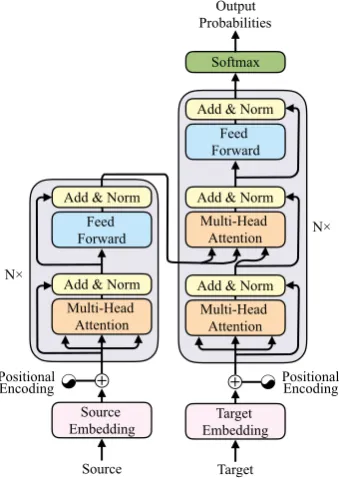
Figure 1: The architecture of Transformer.
consistently improves translation performance, demonstrating the necessity of modeling recur-rence for Transformer. Specifically, the ARN im-plementation outperforms its RNN counterpart, which confirms the strength of ARN.
Further analyses reveal that our approach ben-efits from ashort-cut that bridges the source and target sequences with shorter path. Among all the model variants, the implementation with shortest path performs best, in which the recurrence en-coder is single layer and its output is only fed
to the top decoder layer. It consistently
out-performs its multiple deep counterparts, such as multiple-layer recurrence encoder and feeding the output of recurrence encoder to all the decoder layers. In addition, our approach indeed gener-ates more informative encoder representations, es-pecially representative on syntactic structure fea-tures, through conducting linguistic analyses on probing tasks (Conneau et al.,2018).
2 Background
Figure 1 shows the model architecture of Trans-former. The encoder is composed of a stack ofN identical layers, each of which has two sub-layers. The first sub-layer is a self-attention network, and the second one is a position-wise fully connected feed-forward network. A residual connection (He et al.,2016) is employed around each of two sub-layers, followed by layer normalization (Ba et al.,
2016). Formally, the output of the first sub-layer Cne and the second sub-layerHne are sequentially calculated as:
Cen = LN SELF-ATT(Hen−1) +Hne−1 ,(1)
Hne = LN FFN(Cne) +Cne
, (2)
where SELF-ATT(·), LN(·), and FFN(·) are
re-spectively self-attention mechanism, layer nor-malization, and feed-forward network with ReLU activation in between.
In transformer, SELF-ATT(·) computes
atten-tion over the inputHne−1as follows:
SELF-ATT(Hne−1) =sof tmax(QK
> √
dk
)V (3)
where{Q,K,V}are query, key and value vectors that are transformed from the input representations Hne−1. √dk is the scaling factor where the dk is
the dimension size of the query and key vectors.
The decoder is also composed of a stack ofN
identical layers. In addition to two sub-layers in each decoder layer, the decoder inserts a third sub-layerDnd to perform attention over the output of the encoderHNe :
Cnd = LN SELF-ATT(Hdn−1) +Hnd−1,(4) Dnd = LN ATT(Cnd,HNe ) +Cnd
, (5)
Hnd = LN FFN(Dnd) +Dnd
, (6)
where ATT(Cnd,HNe ) denotes attending the top encoder layerHNe withCndas query. The top layer
of the decoder HN
d is used to generate the final
output sequence.
3 Approach
Output of Transformer Encoder Output of Recurrence Encoder Source Multi-Head Attention Feed Forward
Add & Norm Add & Norm
⊕ ☯ Positional Encoding N× Recurrence Modeling Feed Forward Norm Add & Norm
Source Embedding S el f-At te n ti on En code r Re cu rr en ce En code r
e1 e2 e3 e4 e5 e6 h1 h2 h3 h4 h5 h6
!
e1 e2 e3 e4 e5 e6 c1 c2
h1 h2
!
[image:3.595.338.498.60.222.2]N×
Figure 2: The architecture of Transformer augmented with an additional recurrence encoder, the output of which is directly fed to the top decoder layer.
3.1 Recurrence Modeling
Figure2shows the architecture of the introduced recurrence encoderwhich reads word embeddings of source words and outputs a sequence of hidden states that embeds recurrent information. Similar to the Transformer encoder, it has a stack of N identical layers, each of which has two sub-layers. The first one is a recurrence modeling network and the second is a fully connected feed-forward net-work:
Cnr = LN(REC(Hrn−1) +Hnr−1), (7)
Hnr = LN(FFN(Cnr) +Cnr), (8)
where REC(·) is the function of recurrence mod-eling. Note that at the bottom layer of the recur-rence encoder (N=1), we do not employ a resid-ual connection on the recurrence sub-layer (i.e. Equation7), which releases the constraint thatC1r should share the same length with input embed-dings sequenceEin1. This offers a more flexible
choice of the recurrence functions.
There are many possible ways to implement the general idea of recurrence modeling REC(·). The aim of this paper is not to explore this whole space but simply to show that some fairly straightfor-ward implementations work well. In this work, we investigate two representative implementations,
namely RNN and its variation attentive current
network that combines advantages of both RNN
and attention models, as shown in Figure3.
1The input of the lowest layer in the recurrence encoder is
the word embeddings of input sequenceEin.
Output of Transformer Encoder Output of Recurrence Encoder Source Multi-Head Attention Feed Forward
Add & Norm Add & Norm
⊕ ☯ Positional Encoding N× Recurrence Modeling Feed Forward Norm Add & Norm
Source Embedding S el f-At te n ti on En code r Re cu rr en ce En code r
e1 e2 e3 e4 e5 e6
h1 h2 h3 h4 h5 h6
e1 e2 e3 e4 e5 e6
c1 c2
h1 h2
N×
h0
h0
(a) Recurrent Neural Network Output of Transformer Encoder Output of Recurrence Encoder Source Multi-Head Attention Feed Forward
Add & Norm Add & Norm
⊕ ☯ Positional Encoding N× Recurrence Modeling Feed Forward Norm Add & Norm
Source Embedding S el f-At te n ti on En code r Re cu rr en ce En code r
e1 e2 e3 e4 e5 e6
h1 h2 h3 h4 h5 h6
e1 e2 e3 e4 e5 e6
c1 c2
h1 h2
N×
h0
h0
[image:3.595.81.284.61.238.2](b) Attentive Recurrent Network
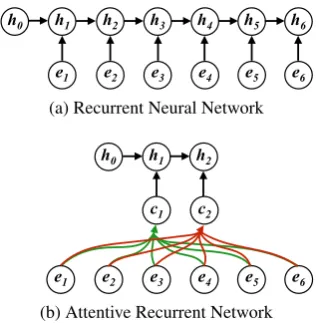
Figure 3: Two implementations of recurrence model-ing: (a) standard RNN, and (b) the proposed ARN.
Recurrent Neural Network (RNN) An
intu-itive choice of recurrence modeling is RNN, which is a standard network to model sequence orders. In this work, we use a bidirectional RNN (BiRNN), which is widely applied in RNN-based NMT mod-els (Bahdanau et al., 2015; Chen et al., 2018). Each hidden state in the output representations
HnRNN={hn
1, . . . ,hnJ}is calculated as
hnj = −→hj;
←− hj , (9) − →
hj =
− →
f(−→hj−1,hnj−1), (10)
←−
hj =
←−
f(←h−j+1,hnj−1), (11)
where−→f(·)and←−f(·)are the activation functions of forward and backward RNN respectively, which
can be implemented as LSTM (Hochreiter and
Schmidhuber, 1997) or GRU (Cho et al., 2014). hn0 is the initial state of RNN, which is the mean ofHnRNN−1. H0RNN represents the word embeddings of the input sequence.
Attentive Recurrent Network (ARN) We can
also extend RNN by recurring over a set of feature vectors extracted with an attention model, which allows the model to learn a compact, abstractive feature vectors over the input sequence. Specifi-cally, the ARN performsT recurrent steps on the attentive output of the input representationHnr−1:
hnt = f(hnt−1,cnt), (12)
cnt = ATT(hnt−1,Hn
−1
r ). (13)
The output representations HnARN =
{hn
1, . . . ,hnT}are fed to the subsequent modules.
Analogous to Equations 9-11, ARN can be
Softmax Output Probabilities
Multi-Head Attention Add & Norm
[AAAI2019] Integration
Multi-Head Attention Add & Norm Feed Forward Add & Norm
Multi-Head Attention Add & Norm
Multi-Head Attention Add & Norm
Multi-Head Attention Add & Norm
⊕
Multi-Head Attention Add & Norm
Gated Sum Softmax Output Probabilities
Feed Forward Add & Norm
Target Embedding
Target
⊕☯PosEnc
Target Embedding
Target
⊕☯
Output of Transformer Encoder
Output of Recurrence Encoder
PosEnc
Output of Transformer Encoder
Output of Recurrence Encoder
N× N×
(a) Gated Sum
Softmax Output Probabilities
Multi-Head Attention Add & Norm
[AAAI2019] Integration
Multi-Head Attention Add & Norm Feed Forward Add & Norm
Multi-Head Attention Add & Norm
Multi-Head Attention Add & Norm
Multi-Head Attention Add & Norm
⊕
Multi-Head Attention Add & Norm
Gated Sum Softmax Output Probabilities
Feed Forward Add & Norm
Target Embedding
Target
⊕ ☯PosEnc
Target Embedding
Target
⊕☯ Output of
Transformer Encoder
Output of Recurrence Encoder
PosEnc Output of
Transformer Encoder
Output of Recurrence Encoder
N× N×
[image:4.595.102.498.70.324.2](b) Stack
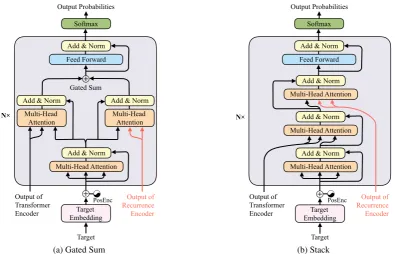
Figure 4: Different strategies to integrate the output of the additionalrecurrence encoderinto the decoder.
except that the input is the attentive context vector
cn
t rather than the individual representation vector
of the input sequence.
Note that, the number of recurrence step T is allowed to be unequal to the length of input
se-quence J. In contrast to RNN which recurs over
the individual symbols of the input sequences, ARN recurrently revises its representations of all symbols in the sequence with an attention model.
3.2 Integrating into Transformer
Since the output of recurrence encoder unneces-sarily shares the same length with that of Trans-former encoder (e.g. when ARN is used as recur-rence function), combination strategy on the en-coder side, such as concatenating the outputs of both encoders (Chen et al., 2018), is not an uni-versal solution in this scenario. Accordingly, we feed the information of the additional recurrence encoder into the decoder of Transformer. Specifi-cally, we serve an additional attention layerRnd as the fourth sub-layer in each decoder block to per-form attention over the output of the recurrence encoderHNr . As shown in Figure 4, we present two strategies to integrateRnd, namelygated sum andstack, which differ at howRn
d interacts with
the output of attention over the Transformer en-coder, i.e.,Dnd in Equation5.
Gated Sum The first strategy combines the
out-puts of the two attention sub-layers in a gating fu-sion (Figure 4(a)), in which the outputs of both encoders are attended simultaneously:
Rnd = LN ATT(Cnd,HNr ) +Cnd, (14)
b
Dnd = λnDnd + (1−λn)Rnd, (15)
Hnd = LN FFN(Dbnd) +Dbnd
, (16)
whereλnis an interpolation weight calculated by
a logistic sigmoid function:
λn=sigmoid(Dnd,Rnd) (17)
As seen, the output of self-attention layer Cnd serves as a query to attend the outputs of both en-coders (Equations 5 and 14), and the outputs of both attention models{Dn
d,Rnd}are combined via
a gated sum (Equation15), which is subsequently fed to the feed-forward layer (Equation16).
Stack We can also arrange the sub-layers in a
stack (Figure 4(b)), in which the outputs of both encoders are attended sequentially:
Rnd = LN ATT(Dnd,HNr ) +Dnd, (18) Hnd = LN FFN(Rnd) +Rnd
, (19)
The decoder first attends the output of
Trans-former encoder, and the attention output Dn
d
3.3 Short-Cut Effect
The introduced recurrence encoder provides an additional computation path ranging from the
input sequence to the output sequence. Chung
et al. (2017) and Shen et al. (2019) have shown that a shortcut for gradient back-propagation ben-efits language modeling. Inspired from them, we use a shorter path to transform the learned recur-rence. We call this the “short-cut effect”.
Among all the model variants, we implement shortest path as: the recurrence encoder is single layer and its output is only fed to the top decoder layer while the firstN−1decoder layers perform the same as the standard Transformer (e.g. Equa-tions4-6). Accordingly, the computation path is
Ein → Hr → RNd → HNd, then the decoder
uses HNd to make a target word prediction. It is much simpler than that of the conventional Trans-former, which transfers information learned from input sequences across multiple stacking encoder and decoder layers. We expect it outperforms its multiple deep counterparts, such as multiple-layer recurrence encoder and feeding the output of re-currence encoder to all the decoder layers.
4 Related Work
Improving Transformer Encoder From the
perspective of representation learning, there has been an increasing amount of work on improving
the representation power of SAN encoder.
Baw-den et al. (2018) and Voita et al. (2018) exploit
external context for SAN encoder, while Yang
et al.(2019) leverage the intermediate representa-tions to contextualize the transformarepresenta-tions in SAN. A number of recent efforts have explored ways to improve multi-head SAN by encouraging in-dividual attention heads to extract distinct infor-mation (Strubell et al., 2018; Li et al., 2018).
Concerning multi-layer SAN encoder, Dou et al.
(2018, 2019) and Wang et al. (2018) propose to aggregate the multi-layer representations, and De-hghani et al. (2019) recurrently refine these rep-resentations. Our approach is complementary to theirs, since they focus on improving the repre-sentation power of SAN encoder, while we aim to complement SAN encoder with an additional re-currence encoder.
Along the direction of modeling recurrence for SAN, Vaswani et al.(2017) andShaw et al.(2018) inject absolute position encoding and relative po-sitional encoding to consider the position
informa-tion respectively.Shen et al.(2018) introduce a di-rectional self-attention network (DiSAN), which allows each token to attend to previous (or fol-lowing) tokens only. Both studies verify the ne-cessity of modeling recurrence for SAN. We re-implemented these approaches on top of Trans-former, and experimental results show that our ap-proach outperforms them by explicitly augment-ing Transformer with an additional recurrence en-coder. It should be emphasized that our approach is complementary to theirs, and combining them together is expected to further improve perfor-mance, which we leave for future work.
Closely related to our work,Chen et al.(2018) propose to combine SAN encoder with an addi-tional RNN encoder. The main differences be-tween our work and theirs are: 1) we enhance the state-of-the-art Transformer with recurrence infor-mation, whileChen et al. (2018) augment RNN-based models with SAN encoder. To this end, we propose a novel attentive recurrent network to implement the additional recurrence encoder in
Transformer. We re-implemented the approach
proposed by Chen et al.(2018) on top of Trans-former. Experimental results indicate the superi-ority of our approach, which confirms our claim. In addition, we elaborately design the integration strategy to effectively feed the recurrence informa-tion to the decoder, and empirically show that the proposed model benefits from theshort-cuteffect.
Comparison to Reviewer Network Attentive
the recurrence, which we expect to complement the Transformer model. In our preliminary exper-iments, attending over the encoder representations does not improve performance, while feeding the feature vectors only to the decoder seriously harms performance.
5 Experiment
5.1 Setup
We conducted experiments on the widely-used WMT14 English-to-German (4.6M sentence pairs, En⇒De) and WMT17 Chinese-to-English (20.6M sentence pairs, Zh⇒En) translation tasks. All the data had been tokenized and segmented into subword symbols using byte-pair encoding (Sennrich et al., 2016) with 32K merge opera-tions2. We used case-sensitive NIST BLEU score (Papineni et al., 2002) as the evaluation metric, andbootstrap resampling(Koehn et al.,2003) for statistical significance test.
We implemented the proposed approaches on top of the Transformer model (Vaswani et al.,
2017). Both in our model and related model of
Subsection 5.3, the RNN is implemented with
GRU (Cho et al., 2014) for fair comparison.
We followed the configurations inVaswani et al. (2017), and reproduced their reported results on the En⇒De task.
We initialized parameters of the proposed mod-els by the pre-trained baseline model. We have tested bothBaseandBigmodels, which differ at hidden size (512 vs. 1024), filter size (2048 vs. 4096), and number of attention heads (8 vs. 16). In consideration of computation cost, we
stud-ied model variations withBasemodel on En⇒De
task, and evaluated overall performances with both
BaseandBigmodels on both En⇒De and Zh⇒En
translation tasks.
5.2 Impact of Components
In this subsection, we conducted ablation studies to evaluate the different implementations of the proposed model, e.g., recurrence encoder and inte-gration strategy, under the proposed architecture.
Effect of Recurrence Modeling We first
inves-tigated the effect of recurrence encoder
imple-mentations, as listed in Table 1. We observed
that introducing an additional recurrence encoder improves translation performance in all cases.
2https://github.com/rsennrich/subword-nmt
Model Rec. Encoder Speed BLEU
BASE n/a 1.28 27.31
OURS
6-Layer BIRNN 1.10 27.54
6-Layer BIARN 1.09 27.72
3-Layer BIARN 1.15 28.10
[image:6.595.314.520.62.147.2]1-Layer BIARN 1.24 28.21
Table 1: Evaluation of recurrence encoder implemen-tations. The output of recurrence encoder is fed to the top decoder layer in a stack fusion. “Speed” denotes the training speed (steps/second).
Model Integration to Dec. BLEU
BASE n/a n/a 27.31
OURS
Gated Sum Top 28.12
Gated Sum All 28.02
Stack Top 28.21
[image:6.595.318.516.216.303.2]Stack All 27.93
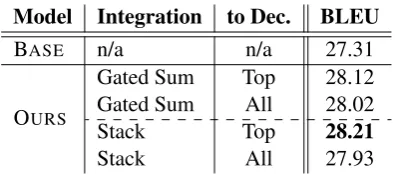
Table 2: Evaluation of decoder integration strategies.
Among all model variations, BIARN outperforms its BIRNN counterpart.
Concerning BIARN models, reducing the lay-ers consistently improves performance. Specifi-cally, the 1-Layer BIARN achieves the best per-formances in both translation quality and train-ing speed. This confirms the claim that the pro-posed approach benefits from ashort-cuton gra-dient back-propagation. Accordingly, we adopted 1-Layer BIARN as the default setting in the fol-lowing experiments.
Effect of Integration Strategies We then tested
the effect of different integration strategies, as
showed in Table 2. We have two observations.
First, feeding only to the top decoder layer con-sistently outperforms feeding to all decoder lay-ers with different integration strategies. This em-pirically reconfirms the short-cut effect. Second, the stack strategy marginally outperforms its gated sum counterpart. Therefore, in the following ex-periments, we adopted the “Stack + Top” model in Table2as defaulting setting.
5.3 Results
Performances across Languages Finally, we
evaluated the proposed approach on the widely used WMT17 Zh⇒En and WMT14 En⇒De data, as listed in Table3.
System Architecture Zh⇒En En⇒De
# Para. BLEU # Para. BLEU
Existing NMT systems
(Vaswani et al.,2017) TRANSFORMER-BASE n/a n/a 65M 27.3
TRANSFORMER-BIG n/a n/a 213M 28.4
(Hassan et al.,2018) TRANSFORMER-BIG n/a 24.2 n/a n/a (Chen et al.,2018) RNMT+ SANEncoder n/a n/a n/a 28.84
Our NMT systems
this work
TRANSFORMER-BASE 107.9M 24.13 88.0M 27.31
+ 1-Layer BIARN +9.4M 24.70⇑ +9.4M 28.21⇑
TRANSFORMER-BIG 303.9M 24.56 264.1M 28.58
[image:7.595.107.498.60.233.2]+ 1-Layer BIARN +69.4M 25.10⇑ +69.4M 28.98↑
Table 3: Comparing with the existing NMT systems on WMT17 Zh⇒En and WMT14 En⇒De test sets. “↑/⇑”: significant over the conventional self-attention counterpart (p <0.05/0.01), tested by bootstrap resampling.
Model BLEU
TRANSFORMER-BASE 27.31
+ RELPOS 27.64
+ DISAN 27.58
+ RNN Encoder 27.47
[image:7.595.94.272.292.376.2]+ BIARN Encoder (OURS) 28.21
Table 4: Comparison with re-implemented related work: “RELPOS”: relative position encoding (Shaw et al.,2018), “DISAN”: directional SAN (Shen et al., 2018), “RNN Encoder”: combining SAN and RNN en-coders with multi-column strategy (Chen et al.,2018).
baselines which outperform the reported results
on the same data. As seen in Table 3,
model-ing recurrence consistently improves translation
performance across model variations (BASE and
BIG models) and language pairs (Zh⇒En and
En⇒De), demonstrating the effectiveness and uni-versality of our approach.
Comparison with Previous Work In order to
directly compare our approach with the previous work on modeling recurrence, we re-implemented their approaches on top of the
TRANSFORMER-BASE in WMT14 En⇒De translation task. For
relative position encoding, we used unique edge representations per layer and head with clipping
distance k = 16. For the DiSAN strategy, we
applied a mask to the TRANSFORMER encoder,
which constrains the SAN to focus on forward or backward elements. For the multi-column en-coder, we re-implemented the additional encoder with six RNN layers.
Table 4 lists the results. As seen, all the
re-currence enhanced approaches achieve improve-ments over the baseline model TRANSFORMER-BASE, which demonstrates the necessity of model-ing recurrence for TRANSFORMER. Among these
approaches, our approach (i.e., 1-Layer BIARN
Encoder) achieves the best performance.
5.4 Analysis
BL
E
U
25 26 27 28 29 30
Length of Source Sentence (0, 15] (15, 30] (30, 45] > 45
Ours Base
BL
E
U
26.6 26.7 26.8 26.9 27.0
Number of Output Capsules 1 2 4 8 16 32 64
128 256 512
BL
E
U
27.0 27.3 27.6 27.9 28.2 28.5
Number of Recurrent Steps 1 4 8 16 J
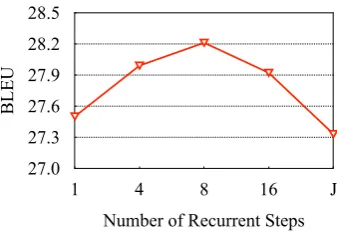
27.31 O URS 1 step 27.50 4 step 27.99 8 step 28.21 16 step 27.92
equal to sentence length 27.33
Figure 5: Effect of recurrent steps. The recurrence en-coder is implemented as a single-layer BIARN.J de-notes the length of the input sequence.
Effect of Recurrent Steps To verify the
[image:7.595.332.501.434.550.2]Model Surface Syntactic Semantic
SeLen WC TrDep ToCo BShif Tense SubN ObjN SoMo CoIn
BASE 92.20 63.00 44.74 79.02 71.24 89.24 84.69 84.53 52.13 62.47
6-Layer BIRNN 89.90 77.46 44.47 79.55 71.53 89.17 85.99 84.96 51.75 61.92
6-Layer BIARN 89.78 72.02 44.45 79.21 71.31 88.38 85.64 85.00 53.27 62.38
3-Layer BIARN 89.80 72.61 44.28 79.43 71.84 88.93 85.79 84.99 53.30 62.42
[image:8.595.82.518.62.170.2]1-Layer BIARN 90.91 73.68 45.15 79.62 72.21 89.00 85.54 84.54 53.44 62.71
Table 5: Classification accuracies on 10 probing tasks of evaluating linguistics embedded in the encoder outputs.
Linguistic Analyses In this section, we
con-ducted 10 probing tasks3 to study what linguistic properties are captured by the encoders (Conneau et al., 2018). A probing task is a classification problem that focuses on simple linguistic proper-ties of sentences. ‘SeLen’ predicts the length of sentences in terms of number of words. ‘WC’ tests whether it is possible to recover information about the original words given its sentence embed-ding. ‘TrDep’ checks whether an encoder infers the hierarchical structure of sentences. In ‘ToCo’ task, sentences should be classified in terms of the sequence of top constituents immediately be-low the sentence node. ‘BShif’ tests whether two consecutive tokens within the sentence have been inverted. ‘Tense’ asks for the tense of the main-clause verb. ‘SubN’ focuses on the number of the main clause’s subject. ‘ObjN’ tests for the number of the direct object of the main clause. In ‘SoMo’, some sentences are modified by replacing a ran-dom noun or verb with another one and the classi-fier should tell whether a sentence has been modi-fied. ‘CoIn’ contains sentences made of two coor-dinate clauses. Half of sentences are inverted the order of the clauses and the task is to tell whether a sentence is intact or modified.
We used the pre-trained encoders of model vari-ations in Table1to generate the sentence represen-tations of input, which are used to carry out
prob-ing tasks. For the TRANSFORMER-BASE model,
the mean of the encoder top layer representations is used as the sentence representation. For the pro-posed models, which have two encoders, two sen-tence representations are generated from the same way in base model. To make full use of the learned representations, we combined these two sentence representations via a gate as the final sentence rep-resentation to conduct the experiments.
3https://github.com/facebookresearch/SentEval/tree/master
/data/probing
Table 5lists the results. Clearly, the proposed models significantly improve the classification ac-curacies, although there is still considerable differ-ence among different variants. More specifically,
• Concerning surface properties, among the
ARN variants, multi-layer ARN inversely de-creases the accuracies, while 1-layer ARN consistently improves the accuracies. Con-sidering the related results presented in
Ta-ble1(Row 3-5), we believe that ARN
bene-fits from the shallow structure.
• ARN tends to capture deeper linguistic
prop-erties, both syntactic and semantic.
Espe-cially, among these probing tasks, ‘TrDep’ and ‘Toco’ tasks are related to syntactic struc-ture modeling. As expected, TRANSFORMER augmented with an additional encoders out-performs the baseline model, which demon-strates that the proposed models successfully model the syntactic structure.
6 Conclusion
further show that our model indeed generates more informative representations, especially representa-tive on syntactic structure features.
Future work includes validating the proposed model in other tasks, such as reading comprehen-sion, language inference, and sentence classifica-tion. Another promising direction is to directly augment Transformer encoder on recurrence mod-eling without the additional encoder.
Acknowledgments
J.Z. was supported by the National Institute of General Medical Sciences of the National Institute of Health under award number R01GM126558. We thank the anonymous reviewers for their in-sightful comments.
References
Jimmy Lei Ba, Jamie Ryan Kiros, and Geoffrey E Hin-ton. 2016. Layer normalization. arXiv preprint arXiv:1607.06450.
Dzmitry Bahdanau, Kyunghyun Cho, and Yoshua Ben-gio. 2015. Neural machine translation by jointly learning to align and translate. InICLR.
Rachel Bawden, Rico Sennrich, Alexandra Birch, and Barry Haddow. 2018. Evaluating Discourse Phe-nomena in Neural Machine Translation. InNAACL.
Mia Xu Chen, Orhan Firat, Ankur Bapna, Melvin Johnson, Wolfgang Macherey, George Foster, Llion Jones, Mike Schuster, Noam Shazeer, Niki Parmar, Ashish Vaswani, Jakob Uszkoreit, Lukasz Kaiser, Zhifeng Chen, Yonghui Wu, and Macduff Hughes. 2018. The best of both worlds: Combining recent advances in neural machine translation. InACL.
Kyunghyun Cho, Bart Van Merri¨enboer, Caglar Gul-cehre, Dzmitry Bahdanau, Fethi Bougares, Holger Schwenk, and Yoshua Bengio. 2014. Learning phrase representations using RNN encoder-decoder for statistical machine translation. InEMNLP.
JunYoung Chung, Sungjin Ahn, and Yoshua Bengio. 2017. Hierarchical Multiscale Recurrent Neural Networks. InICLR.
Alexis Conneau, German Kruszewski, Guillaume Lample, Lo¨ıc Barrault, and Marco Baroni. 2018. What you can cram into a single $&!#∗ vector: Probing sentence embeddings for linguistic proper-ties. InACL.
Mostafa Dehghani, Stephan Gouws, Oriol Vinyals, Jakob Uszkoreit, and Lukasz Kaiser. 2019. Univer-sal transformers. InICLR.
Ziyi Dou, Zhaopeng Tu, Xing Wang, Shuming Shi, and Tong Zhang. 2018. Exploiting deep representations for neural machine translation. InEMNLP.
Ziyi Dou, Zhaopeng Tu, Xing Wang, Longyue Wang, Shuming Shi, and Tong Zhang. 2019. Dynamic layer aggregation for neural machine translation. In AAAI.
Hany Hassan, Anthony Aue, Chang Chen, Vishal Chowdhary, Jonathan Clark, Christian Feder-mann, Xuedong Huang, Marcin Junczys-Dowmunt, William Lewis, Mu Li, et al. 2018. Achieving hu-man parity on automatic chinese to english news translation.arXiv preprint arXiv:1803.05567.
Kaiming He, Xiangyu Zhang, Shaoqing Ren, and Jian Sun. 2016. Deep residual learning for image recog-nition. InCVPR.
Sepp Hochreiter and J¨urgen Schmidhuber. 1997. Long short-term memory. Neural computation, 9(8):1735–1780.
Philipp Koehn, Franz Josef Och, and Daniel Marcu. 2003. Statistical phrase-based translation. InACL.
Jian Li, Zhaopeng Tu, Baosong Yang, Michael R. Lyu, and Tong Zhang. 2018. Multi-Head Attention with Disagreement Regularization. InEMNLP.
Kishore Papineni, Salim Roukos, Todd Ward, and Wei-Jing Zhu. 2002. Bleu: a method for automatic eval-uation of machine translation. InACL.
Matthew E. Peters, Mark Neumann, Mohit Iyyer, Matt Gardner, Christopher Clark, Kenton Lee, and Luke Zettlemoyer. 2018. Deep contextualized word rep-resentations. InNAACL.
Mike Schuster and Kuldip K Paliwal. 1997. Bidirec-tional recurrent neural networks. IEEE Transactions on Signal Processing, 45(11):2673–2681.
Rico Sennrich, Barry Haddow, and Alexandra Birch. 2016. Neural machine translation of rare words with subword units. InACL.
Peter Shaw, Jakob Uszkoreit, and Ashish Vaswani. 2018. Self-Attention with Relative Position Repre-sentations. InNAACL.
Tao Shen, Tianyi Zhou, Guodong Long, Jing Jiang, Shirui Pan, and Chengqi Zhang. 2018. DiSAN: di-rectional self-attention network for RNN/CNN-free language understanding. InAAAI.
Yikang Shen, Shawn Tan, Alessandro Sordoni, and Aaron Courville. 2019. Ordered neurons: Integrat-ing tree structures into recurrent neural networks. In ICLR.
Ilya Sutskever, Oriol Vinyals, and Quoc V Le. 2014. Sequence to sequence learning with neural net-works. InNIPS.
Ke Tran, Arianna Bisazza, and Christof Monz. 2016. Recurrent memory networks for language modeling. InNAACL.
Ke Tran, Arianna Bisazza, and Christof Monz. 2018. The importance of being recurrent for modeling hi-erarchical structure. InEMNLP.
Zhaopeng Tu, Yang Liu, Zhengdong Lu, Xiaohua Liu, and Hang Li. 2017. Context gates for neural ma-chine translation. TACL.
Ashish Vaswani, Noam Shazeer, Niki Parmar, Jakob Uszkoreit, Llion Jones, Aidan N Gomez, Łukasz Kaiser, and Illia Polosukhin. 2017. Attention is all you need. InNIPS.
Elena Voita, Pavel Serdyukov, Rico Sennrich, and Ivan Titov. 2018. Context-aware neural machine transla-tion learns anaphora resolutransla-tion. InACL.
Qiang Wang, Fuxue Li, Tong Xiao, Yanyang Li, Yin-qiao Li, and Jingbo Zhu. 2018. Multi-layer repre-sentation fusion for neural machine translation. In COLING.
Baosong Yang, Jian Li, Derek F. Wong, Lidia S. Chao, Xing Wang, and Zhaopeng Tu. 2019. Context-aware self-attention networks. InAAAI.