Statistical Decision-Tree M o d e l s for Parsing*
D a v i d M . M a g e r m a n B o l t B e r a n e k a n d N e w m a n Inc. 70 F a w c e t t S t r e e t , R o o m 1 5 / 1 4 8
C a m b r i d g e , M A 02138, U S A magerman@bbn, c o m
A b s t r a c t
Syntactic natural language parsers have shown themselves to be inadequate for pro- cessing highly-ambiguous large-vocabulary text, as is evidenced by their poor per- formance on domains like the Wall Street Journal, and by the movement away from parsing-based approaches to text- processing in general. In this paper, I de- scribe SPATTER, a statistical parser based on decision-tree learning techniques which constructs a complete parse for every sen- tence and achieves accuracy rates far bet- ter than any published result. This work is based on the following premises: (1) grammars are too complex and detailed to develop manually for most interesting do- mains; (2) parsing models must rely heav- ily on lexical and contextual information to analyze sentences accurately; and (3) existing n-gram modeling techniques are inadequate for parsing models. In exper- iments comparing SPATTER with IBM's computer manuals parser, SPATTER sig- nificantly outperforms the grammar-based parser. Evaluating SPATTER against the Penn Treebank Wall Street Journal corpus using the PARSEVAL measures, SPAT- T E R achieves 86% precision, 86% recall, and 1.3 crossing brackets per sentence for sentences of 40 words or less, and 91% pre- cision, 90% recall, and 0.5 crossing brackets for sentences between 10 and 20 words in length.
This work was sponsored by the Advanced Research Projects Agency, contract DABT63-94-C-0062. It does not reflect the position or the policy of the U.S. Gov- ernment, and no official endorsement should be inferred. Thanks to the members of the IBM Speech Recognition Group for their significant contributions to this work.
1 I n t r o d u c t i o n
Parsing a natural language sentence can be viewed as making a sequence of disambiguation decisions: de- termining the part-of-speech of the words, choosing between possible constituent structures, and select- ing labels for the constituents. Traditionally, disam- biguation problems in parsing have been addressed by enumerating possibilities and explicitly declaring knowledge which might aid the disambiguation pro- cess. However, these approaches have proved too brittle for most interesting natural language prob- lems.
This work addresses the problem of automatically discovering the disambiguation criteria for all of the decisions made during the parsing process, given the set of possible features which can act as disambigua- tors. The candidate disambiguators are the words in the sentence, relationships among the words, and re- lationships among constituents already constructed in the parsing process.
Since most natural language rules are not abso- lute, the disambiguation criteria discovered in this work are never applied deterministically. Instead, all decisions are pursued non-deterministically accord- ing to the probability of each choice. These proba- bilities are estimated using statistical decision tree models. The probability of a complete parse tree (T) of a sentence (S) is the product of each decision (dl) conditioned on all previous decisions:
P(T[S) = H P(dildi-ldi-2""dlS)"
diET
The claim of this work is that statistics from a large corpus of parsed sentences combined with information-theoretic classification and training al- gorithms can produce an accurate natural language parser without the aid of a complicated knowl- edge base or grammar. This claim is justified by constructing a parser, called SPATTER (Statistical PATTErn Recognizer), based on very limited lin- gnistic information, and comparing its performance to a state-of-the-art grammar-based parser on a common task. It remains to be shown that an accu- rate broad-coverage parser can improve the perfor- mance of a text processing application. This will be the subject of future experiments.
One of the important points of this work is that statistical models of natural language should not be restricted to simple, context-insensitive models. In a problem like parsing, where long-distance lex- ical information is crucial to disambiguate inter- pretations accurately, local models like probabilistic context-free grammars are inadequate. This work illustrates that existing decision-tree technology can be used to construct and estimate models which se- lectively choose elements of the context which con- tribute to disambignation decisions, and which have few enough parameters to be trained using existing resources.
I begin by describing decision-tree modeling, showing that decision-tree models are equivalent to interpolated n-gram models. Then I briefly describe the training and parsing procedures used in SPAT- TER. Finally, I present some results of experiments comparing SPATTER with a grammarian's rule- based statistical parser, along with more recent re- suits showing SPATTER applied to the Wall Street Journal domain.
2
Decision-Tree Modeling
Much of the work in this paper depends on replac- ing human decision-making skills with automatic decision-making algorithms. The decisions under consideration involve identifying constituents and constituent labels in natural language sentences. Grammarians, the human decision-makers in pars- ing, solve this problem by enumerating the features of a sentence which affect the disambiguation deci- sions and indicating which parse to select based on the feature values. The grammarian is accomplish- ing two critical tasks: identifying the features which are relevant to each decision, and deciding which choice to select based on the values of the relevant features.
Decision-tree classification algorithms account for both of these tasks, and they also accomplish a
third task which grammarians classically find dif-
ficult. By assigning a probability distribution to the possible choices, decision trees provide a ranking sys- tem which not only specifies the order of preference for the possible choices, but also gives a measure of the relative likelihood that each choice is the one which should be selected.
2.1 W h a t is a D e c i s i o n T r e e ?
A decision tree is a decision-making device which assigns a probability to each of the possible choices
based on the context of the decision:
P(flh),
wheref is an element of the
future
vocabulary (the set ofchoices) and h is a
history
(the context of the de-cision). This probability
P(flh)
is determined byasking a sequence of questions ql q2 . . . qn about the context, where the ith question asked is uniquely de- termined by the answers to the i - 1 previous ques- tions.
For instance, consider the part-of-speech tagging problem. The first question a decision tree might ask is:
1. What is the word being tagged?
If the answer is
the,
then the decision tree needsto ask no more questions; it is clear that the deci-
sion tree should assign the tag f =
determiner
withprobability 1. If, instead, the answer to question 1 is bear, the decision tree might next ask the question:
2. What is the tag of the previous word?
If the answer to question 2 is
determiner,
the de-cision tree might stop asking questions and assign
the tag f =
noun
with very high probability, andthe tag f = verb with much lower probability. How-
ever, if the answer to question 2 is
noun,
the decisiontree would need to ask still more questions to get a good estimate of the probability of the tagging deci- sion. The decision tree described in this paragraph is shown in Figure 1.
Each question asked by the decision tree is repre- sented by a tree node (an oval in the figure) and the possible answers to this question are associated with branches emanating from the node. Each node de- fines a probability distribution on the space of pos- sible decisions. A node at which the decision tree stops asking questions is a leaf node. The leaf nodes represent the unique states in the decision-making problem, i.e. all contexts which lead to the same leaf node have the same probability distribution for the decision.
2.2 D e c i s i o n Trees vs. n-graxns
A decision-tree model is not really very different from an interpolated n-gram model. In fact, they
I
I
I P(aoun I bear, determiner)f0.8
P(vo~ I bear,
determiner)--0.2 I
-"
Figure I: Partially-grown decision tree for part-of-
speech tagging.
are equivalent in representational power. The main differences between the two modeling techniques are how the models are parameterized and how the pa- rameters are estimated.
2.2.1 M o d e l P a r a m e t e r i z a t i o n
First, let's be very clear on what we mean by an n-gram model. Usually, an n-gram model refers to a Markov process where the probability of a particular token being generating is dependent on the values
of the previous n - 1 tokens generated by the same
process. By this definition, an n-gram model has IWI" parameters, where IWI is the number of unique tokens generated by the process.
However, here let's define an n-gram model more loosely as a model which defines a probability distri- bution on a random variable given the values of n - 1
random variables,
P(flhlh2... hn-1).
There is noassumption in the definition that any of the random variables F or Hi range over the same vocabulary. The number of parameters in this n-gram model is
IFI I'[ IH, I.
Using this definition, an n-gram model can be represented by a decision-tree model with n - 1 questions. For instance, the part-of-speech tagging
model
P(tilwiti_lti_2)
can be interpreted as a 4-gram model, where HI is the variable denoting the word being tagged, Ha is the variable denoting the tag of the previous word, and Ha is the variable de- noting the tag of the word two words back. Hence, this 4-gram tagging model is the same as a decision- tree model which always asks the sequence of 3 ques- tions:
1. What is the word being tagged?
2. What is the tag of the previous word?
3. What is the tag of the word two words back?
But can a decision-tree model be represented by an n-gram model? No, but it can be represented
by an
interpolated n-gram
model. The proof of thisassertion is given in the next section.
2.2.2 M o d e l E s t i m a t i o n
The standard approach to estimating an n-gram model is a two step process. The first step is to count the number of occurrences of each n-gram from a training corpus. This process determines the empir- ical distribution,
Count(hlhz . . .
hn-lf)
P(flhlh2... hn-1)=
C o u n t ( h l h 2 . . .hn-1)
The second step is smoothing the empirical distri- bution using a separate, held-out c o r p u s . This step improves the empirical distribution by finding statis- tically unreliable parameter estimates and adjusting them based on more reliable information.
A commonly-used technique for smoothing is
deleted interpolation. Deleted interpolation es-
timates a model
P(f[hlh2...
hn-1)
by us-ing a linear combination of empirical models
P(f]hklhk=... hk.,),
where m < n and k,-x < ki < n for all i < m. For example, a model[~(fihlh2h3)
might be interpolated as follows:P(.flhl h2hs ) =
AI (hi h2hs)P(.fJhl
h2h3) +:~2(h~h2h3)P(flhlh2) +
As(hlh2h3)P(Ylhzh3) +
)~(hlhuha)P(flh2hs) + As(hzhshs)P(f]hlh2) +
)~ (hi h2h3)P(.flhl) + A~ (hi h2ha)P(.flh2) +
AS ( h l h 2 h s ) P ( f l h 3 )
where
~'~)q(hlh2h3)
= 1 for all historieshlhshs.
The optimal values for the A~ functions can be estimated using the forward-backward algorithm
(Baum, 1972).
A decision-tree model can be represented by an interpolated n-gram model as follows. A leaf node in a decision tree can be represented by the sequence of question answers, or history values, which leads the decision tree to that leaf. Thus, a leaf node defines a probability distribution based on values of those
questions:
P(flhklhk2 ... ha.,),
where m < n andki-1 < ki < n, and where hk~ is the answer to one of the questions asked on the path from the root to the leaf. ~ But this is the same as one of the terms in the interpolated n-gram model. So, a decision
[image:3.612.71.292.63.191.2]tree can be defined as an interpolated n-gram model where the At function is defined as:
1 if h k ~ h k 2 . . , h~. is aleaf,
Ai(hk~hk2...
h k , ) = 0 otherwise.2 . 3 D e c i s i o n - T r e e A l g o r i t h m s
The point of showing the equivalence between n- gram models and decision-tree models is to make clear that the power of decision-tree models is not in their expressiveness, but instead in how they can be automatically acquired for very large modeling problems. As n grows, the parameter space for an n-gram model grows exponentially, and it quickly becomes computationally infeasible to estimate the smoothed model using deleted interpolation. Also, as n grows large, the likelihood that the deleted in- terpolation process will converge to an optimal or even near-optimal parameter setting becomes van- ishingly small.
On the other hand, the decision-tree learning al- gorithm increases the size of a model only as the training data allows. Thus, it can consider very large history spaces, i.e. n-gram models with very large n. Regardless of the value of n, the number of param- eters in the resulting model will remain relatively constant, depending mostly on the number of train- ing examples.
The leaf distributions in decision trees are empiri- cal estimates, i.e. relative-frequency counts from the training data. Unfortunately, they assign probabil- ity zero to events which can possibly occur. There- fore, just as it is necessary to smooth empirical n- gram models, it is also necessary to smooth empirical decision-tree models.
The decision-tree learning algorithms used in this work were developed over the past 15 years by the IBM Speech Recognition group (Bahl et al., 1989). The growing algorithm is an adaptation of the CART algorithm in (Breiman et al., 1984). For detailed descriptions and discussions of the decision- tree algorithms used in this work, see (Magerman, 1994).
An important point which has been omitted from this discussion of decision trees is the fact that only binary questions are used in these decision trees. A question which has k values is decomposed into a se- quence of binary questions using a classification tree on those k values. For example, a question about a word is represented as 30 binary questions. These 30 questions are determined by growing a classifi-
cation tree on the word vocabulary as described in
(Brown et al., 1992). T h e 30 questions represent 30 different binary partitions of the word vocabulary,
and these questions are defined such t h a t it is possi- ble to identify each word by asking all 30 questions. For more discussion of the use of binary decision-tree questions, see (Magerman, 1994).
3 S P A T T E R P a r s i n g
The SPATTER parsing algorithm is based on inter- preting parsing as a statistical pattern recognition process. A parse tree for a sentence is constructed by starting with the sentence's words as leaves of a tree structure, and labeling and extending nodes these nodes until a single-rooted, labeled tree is con- structed. This pattern recognition process is driven by the decision-tree models described in the previous section.
3.1 S P A T T E R R e p r e s e n t a t i o n
A parse tree can be viewed as an n-ary branching tree, with each node in a tree labeled by either a non-terminal label or a part-of-speech label. If a parse tree is interpreted as a geometric pattern, a constituent is no more than a set of edges which meet at the same tree node. For instance, the noun phrase, "a brown cow," consists of an edge extending to the right from "a," an edge extending to the left from "cow," and an edge extending straight up from "brown".
Figure 2: Representation of constituent and labeling of extensions in S P A T T E R .
In SPATTER, a parse tree is encoded in terms
of four elementary components, or
features:
words,tags, labels, and extensions. Each feature has a fixed vocabulary, with each element of a given feature vo- cabulary having a unique representation. The word feature can take on any value of any word. The tag feature can take on any value in the part-of-speech tag set. The label feature can take on any value in the non-terminal set. The extension can take on any of the following five values:
r i g h t - the node is the first child of a constituent;
l e f t - the node is the last child of a constituent;
u p - the node is neither the first nor the last child of a constituent;
u n a r y - the node is a child of a unary constituent;
r o o t - the node is the root of the tree.
For an n word sentence, a parse tree has n leaf nodes, where the word feature value of the ith leaf node is the ith word in the sentence. The word fea- ture value of the internal nodes is intended to con- tain the lexical head of the node's constituent. A deterministic lookup table based on the label of the internal node and the labels of the children is used to approximate this linguistic notion.
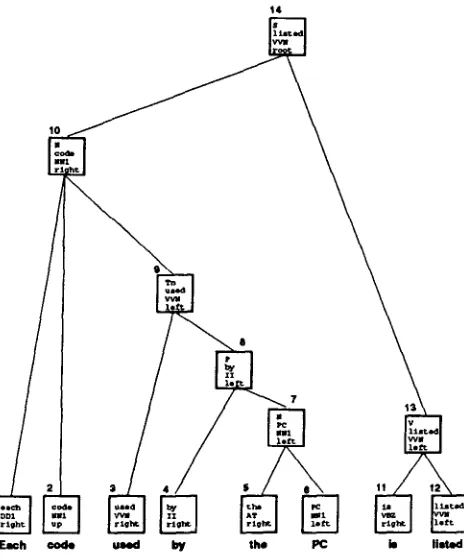
The SPATTER representation of the sentence
(S (N Each_DD1 code_NN1 (Tn used_VVN
(P b y _ I I (N the_AT PC_NN1))))
(V is_VBZ listed_VVN))
is shown in Figure 3. The nodes are constructed bottom-up from left-to-right, with the constraint that no constituent node is constructed until all of its children have been constructed. The order in which the nodes of the example sentence are constructed is indicated in the figure.
14
10
E a c h
| 4 t 2
,~i~4 l ~ t O d
mind ~¢ tho PC ~- I i ~ o d
Figure 3: Treebank analysis encoded using feature values.
3.2 Training S P A T T E R ' s m o d e l s
SPATTER consists of three main decision-tree models: a part-of-speech tagging model, a node- extension model, and a node-labeling model.
Each of these decision-tree models are grown using the following questions, where X is one of word, tag, label, or extension, and Y is either left and right:
• What is the X at the current node?
• What is the X at the node to the Y?
• What is the X at the node two nodes to the Y?
• What is the X at the current node's first child from the Y?
• What is the X at the current node's second child from the Y?
For each of the nodes listed above, the decision tree could also ask about the number of children and span of the node. For the tagging model, the values of the previous two words and their tags are also asked, since they might differ from the head words of the previous two constituents.
The training algorithm proceeds as follows. The training corpus is divided into two sets, approx- imately 90% for tree growing and 10% for tree smoothing. For each parsed sentence in the tree growing corpus, the correct state sequence is tra- versed. Each state transition from si to 8i+1 is an event; the history is made up of the answers to all of
the questions at state sl and the future is the value
of the action taken from state si to state Si+l. Each event is used as a training example for the decision- tree growing process for the appropriate feature's tree (e.g. each tagging event is used for growing the tagging tree, etc.). After the decision trees are grown, they are smoothed using the tree smoothing corpus using a variation of the deleted interpolation algorithm described in (Magerman, 1994).
3.3 Parsing w i t h S P A T T E R
The parsing procedure is a search for the highest probability parse tree. The probability of a parse is just the product of the probability of each of the actions made in constructing the parse, according to the decision-tree models.
Because of the size of the search space, (roughly O(ITI"INJ"), where [TJ is the number of part-of- speech tags, n is the number of words in the sen- tence, and [NJ is the number of non-terminal labels), it is not possible to compute the probability of every parse. However, the specific search algorithm used is not very important, so long as there are no search errors. A search error occurs when the the high- est probability parse found by the parser is not the highest probability parse in the space of all parses.
[image:5.612.65.297.328.608.2]a sentence. First, the parser uses a stack decoding algorithm to quickly find a complete parse for the sentence. Once the stack decoder has found a com- plete parse of reasonable probability ( > 10-5), it switches to a breadth-first mode to pursue all of the partial parses which have not been explored by the stack decoder. In this second mode, it can safely discard any partial parse which has a probability lower t h a n the probability of the highest probabil- ity completed parse. Using these two search modes, S P A T T E R guarantees t h a t it will find the highest probability parse. T h e only limitation of this search technique is t h a t , for sentences which are modeled poorly, the search might exhaust the available mem- ory before completing b o t h phases. However, these search errors conveniently occur on sentences which S P A T T E R is likely to get wrong anyway, so there isn't much performance lossed due to the search er- rors. Experimentally, the search algorithm guaran- tees the highest probability parse is found for over 96% of the sentences parsed.
4
Experiment Results
In the absence of an NL system, S P A T T E R can be evaluated by comparing its top-ranking parse with the t r e e b a n k analysis for each test sentence. T h e parser was applied to two different domains, IBM C o m p u t e r Manuals and the Wall Street Journal.
4.1 I B M C o m p u t e r M a n u a l s
T h e first experiment uses the IBM C o m p u t e r Man- uals domain, which consists of sentences extracted from IBM computer manuals. T h e training and test sentences were a n n o t a t e d by the University of Lan- caster. T h e Lancaster treebank uses 195 part-of- speech tags and 19 non-terminal labels. This tree- bank is described in great detail in (Black et al., 1993).
T h e main reason for applying S P A T T E R to this domain is t h a t IBM had spent the previous ten years developing a rule-based, unification-style prob- abilistic context-free g r a m m a r for parsing this do- main. T h e purpose of the experiment was to esti- mate S P A T T E R ' s ability to learn the s y n t a x for this domain directly from a treebank, instead of depend- ing on the interpretive expertise of a grammarian.
T h e parser was trained on the first 30,800 sen- tences from the Lancaster treebank. T h e test set included 1,473 new sentences, whose lengths range from 3 to 30 words, with a mean length of 13.7 words. These sentences are the same test sentences used in the experiments reported for IBM's parser
in (Black et al., 1993). In (Black et al., 1993),
IBM's parser was evaluated using the 0-crossing- brackets measure, which represents the percentage of sentences for which none of the constituents in the parser's parse violates the constituent bound- aries of any constituent in the correct parse. After over ten years of g r a m m a r development, the IBM parser achieved a 0-crossing-brackets score of 69%. On this same test set, S P A T T E R scored 76%.
4.2 W a l l S t r e e t J o u r n a l
T h e experiment is intended to illustrate S P A T T E R ' s ability to accurately parse a highly-ambiguous,
large-vocabulary domain. These experiments use
the Wall Street Journal domain, as a n n o t a t e d in the Penn Treebank, version 2. T h e P e n n Treebank uses 46 part-of-speech tags and 27 non-terminal labels. 2
T h e WSJ portion of the Penn Treebank is divided into 25 sections, numbered 00 - 24. In these exper- iments, S P A T T E R was trained on sections 02 - 21, which contains approximately 40,000 sentences. T h e test results reported here are from section 00, which contains 1920 sentences, s Sections 01, 22, 23, and 24 will be used as test d a t a in future experiments.
T h e Penn Treebank is already tokenized and sen- tence detected by h u m a n annotators, and thus the test results r e p o r t e d here reflect this. S P A T T E R parses word sequences, not tag sequences. Further-
more, S P A T T E R does n o t simply pre-tag the sen-
tences and use only the best tag sequence in parsing. Instead, it uses a probabilistic model to assign tags to the words, and considers all possible tag sequences according to the probability they are assigned by the model. No information a b o u t the legal tags for a word are e x t r a c t e d from the test corpus. In fact, no information o t h e r t h a n the words is used from the test corpus.
For the sake of efficiency, only the sentences of 40 words or fewer are included in these experiments. 4 For this test set, S P A T T E R takes on average 12
2This treebank also contains coreference information,
predicate-argument relations, and trace information in-
dicating movement; however, none of this additional in- formation was used in these parsing experiments.
SFor an independent research project on coreference, sections 00 and 01 have been annotated with detailed coreference information. A portion of these sections is being used as a development test set. Training SPAT- TER on them would improve parsing accuracy signifi- cantly and skew these experiments in favor of parsing- based approaches to coreference. Thus, these two sec- tions have been excluded from the training set and re- served as test sentences.
4SPATTER returns a complete parse for all sentences of fewer then 50 words in the test set, but the sentences of 41 - 50 words required much more computation than the shorter sentences, and so they have been excluded.
seconds per sentence on an S G I R4400 with 160 megabytes of R A M .
To evaluate S P A T T E R ' s performance on this do-
main, I a m using the P A R S E V A L measures, as de-
fined in (Black et al., 1991):
Precision
no. of correct constituents in S P A T T E R parse
no. of constituents in S P A T T E R parse
Recall
no. of correct constituents in S P A T T E R parse
no. of constituents in treebank parse
C r o s s i n g B r a c k e t s no. of constituents which vio- late constituent boundaries with a constituent in the treebank parse.
The precision and recall measures do not consider constituent labels in their evaluation of a parse, since the treebank label set will not necessarily coincide with the labels used by a given grammar. Since SPATTER uses the same syntactic label set as the Penn Treebank, it makes sense to report labelled precision and labelled recall. These measures are computed by considering a constituent to be correct if and only if it's label matches the label in the tree- bank.
Table 1 shows the results of SPATTER evaluated against the Penn Treebank on the Wall Street Jour- nal section 00.
Comparisons Avg. Sent. Length Treebank Constituents Parse Constituents
Tagging Accuracy
Crossings Per Sentence Sent. with 0 Crossings Sent. with 1 Crossing Sent. with 2 Crossings Precision
Recall
Labelled Precision Labelled Recall
1759 1114 653
22.3 16.8 15.6
17.58 1 3 . 2 1 12.10
17.48 1 3 . 1 3 12.03
96.5% 96.6% 96.5% 1.33 0.63 0.49
55.4%
69.8% 73.8%
69.2% 83.8% 86.8%
80.2% 92.1% 95.1%
86.3% 89.8% 90.8%
85.8% 89.3% 90.3%
84.5% 88.1% 89.0%
84.0% 87.6% 88.5%
Table 1: Results from the WSJ Penn Treebank ex- periments.
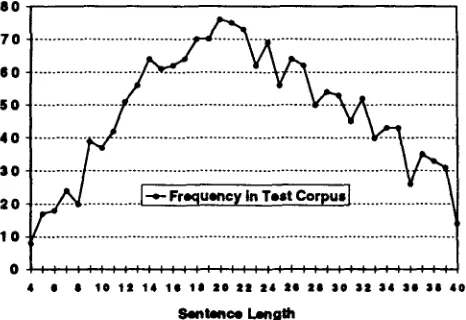
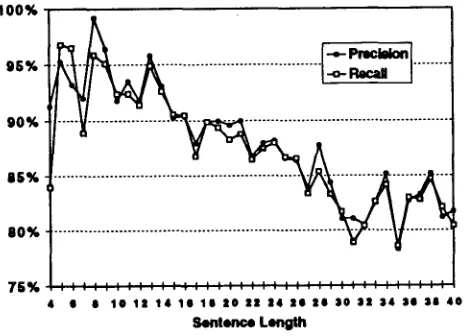
Figures 5, 6, and 7 illustrate the performance of SPATTER as a function of sentence length. SPAT- TER's performance degrades slowly for sentences up
to around 28 words, and performs more poorly and more erratically as sentences get longer. Figure 4 in- dicates the frequency of each sentence length in the test corpus.
8 0
7 0
8 0
SO
4 0
3 0
2 0
1 0
0
iii
4 • II 1 0 1 2 1 4 l i d 1 8 2 0 2 | 2 4 2 i l 2 8 : 1 0 : 1 2 3 4 :ill 3 8 4 0
Senbmce Length
Figure 4: Frequency in the test corpus as a function of sentence length for Wall Street Journal experi- ments.
3 . 5
$
2 . 5
2
1.S
1
0.6
0
t
l ...
$ 8 1 0 1 2 1 4 1 8 1 5 2 0 2 2 2 4 2 8 ~Zll 'lO $ 2 : 1 4 ~ l ~ 8 4 0
Sentence Length
Figure 5: Number of crossings per sentence as a function of sentence length for Wall Street Journal experiments.
5 C o n c l u s i o n
Regardless of what techniques are used for parsing disambiguation, one thing is clear: if a particular piece of information is necessary for solving a dis- ambiguation problem, it must be made available to the disambiguation mechanism. The words in the sentence are clearly necessary to make parsing de-
cisions, and in some cases long-distance structural
[image:7.612.306.539.130.290.2] [image:7.612.303.537.360.532.2] [image:7.612.63.294.448.626.2]1 0 0 %
9 0 %
8 0 %
7 0 %
6 0 %
5 0 %
4 0 %
3 0 %
2 0 %
1 0 %
0%
. . .
. '. : ', '. : : '. : ', ~ ~ ~ I ~ ~ : : : : : : : : : : ', '. ', ~ : : : : : ::
I II; il 1 0 1 2 1 4 1 1 1 8 | 0 2 = J 4 t e 2 0 3 0 5 t $ 4 ~lll ~18 4 0 Sentence L~gth
Figure 6: Percentage of sentence with 0, 1, and 2 crossings as a function of sentence length for Wall Street Journal experiments.
1 0 0 %
9 6 %
9 0 %
85%
00%
76%
- . - e m e m o n
I 8 l O 1 | 1 4 1(1 1 8 s*O | | | 4 | $ 1 8 = 0 S | S4 =e $ 8 4 0
Sentence Length
Figure 7: Precision and recall as a function of sen- tence length for Wall Street Journal experiments.
parsing need to consider many more features of a sentence than can be managed by n-gram modeling techniques and many more examples than a human can keep track of. The SPATTER parser illustrates how large amounts of contextual information can be incorporated into a statistical model for parsing by applying decision-tree learning algorithms to a large annotated corpus.
R e f e r e n c e s
L. R. Bahl, P. F. Brown, P. V. deSouza, and R. L. Mercer. 1989. A tree-based statistical language model for natural language speech recognition.
IEEE ~Pransactions on Acoustics, Speech, and Sig-
nal Processing, Vol. 36, No. 7,
pages 1001-1008. L. E. Baum. 1972. An inequality and associatedmaximization technique in statistical estimation of probabilistic functions of markov processes.
In-
equalities, Vol. 3,
pages 1-8.E. Black and et al. 1991. A procedure for quanti- tatively comparing the syntactic coverage of en- glish grammars.
Proceedings o/ the February 1991
DARPA Speech and Natural Language Workshop,
pages 306-311.E. Black, R. Garside, and G. Leech. 1993.
Statistically-driven computer grammars of english:
the ibm/lancaster approach.
Rodopi, Atlanta, Georgia.L. Breiman, J. H. Friedman, R. A. Olshen, and C. J. Stone. 1984.
Ci~ssi]ication and Regression Trees.
Wadsworth and Brooks, Pacific Grove, California. P. F. Brown, V. Della Pietra, P. V. deSouza, J. C. Lai, and R. L. Mercer. 1992. "Class-based n-gram models of natural language."Computa-
tional Linguistics,
18(4), pages 467-479.D. M. Magerman. 1994.
Natural Language Pars-
ing as Statistical Pattern Recognition.
Doctoral dissertation. Stanford University, Stanford, Cali- fornia. [image:8.612.63.295.138.307.2] [image:8.612.65.300.468.636.2]