Tree-to-String Alignment Template for Statistical Machine Translation
Yang Liu , Qun Liu , and Shouxun Lin Institute of Computing Technology
Chinese Academy of Sciences
No.6 Kexueyuan South Road, Haidian District P. O. Box 2704, Beijing, 100080, China
{yliu,liuqun,sxlin}@ict.ac.cn
Abstract
We present a novel translation model based on tree-to-string alignment template (TAT) which describes the alignment be-tween a source parse tree and a target string. A TAT is capable of generating both terminals and non-terminals and per-forming reordering at both low and high levels. The model is linguistically syntax-based because TATs are extracted auto-matically from word-aligned, source side parsed parallel texts. To translate a source sentence, we first employ a parser to pro-duce a source parse tree and then ap-ply TATs to transform the tree into a tar-get string. Our experiments show that the TAT-based model significantly outper-forms Pharaoh, a state-of-the-art decoder for phrase-based models.
1 Introduction
Phrase-based translation models (Marcu and Wong, 2002; Koehn et al., 2003; Och and Ney, 2004), which go beyond the original IBM trans-lation models (Brown et al., 1993) 1 by model-ing translations of phrases rather than individual words, have been suggested to be the state-of-the-art in statistical machine translation by empirical evaluations.
In phrase-based models, phrases are usually strings of adjacent words instead of syntactic con-stituents, excelling at capturing local reordering and performing translations that are localized to
1
The mathematical notation we use in this paper is taken from that paper: a source stringfJ
1 =f1, . . . , fj, . . . , fJis to be translated into a target stringeI
1 =e1, . . . , ei, . . . , eI. Here,Iis the length of the target string, andJis the length of the source string.
substrings that are common enough to be observed on training data. However, a key limitation of phrase-based models is that they fail to model re-ordering at the phrase level robustly. Typically, phrase reordering is modeled in terms of offset po-sitions at the word level (Koehn, 2004; Och and Ney, 2004), making little or no direct use of syn-tactic information.
Recent research on statistical machine transla-tion has lead to the development of syntax-based models. Wu (1997) proposes Inversion Trans-duction Grammars, treating translation as a pro-cess of parallel parsing of the source and tar-get language via a synchronized grammar. Al-shawi et al. (2000) represent each production in parallel dependency tree as a finite transducer. Melamed (2004) formalizes machine translation problem as synchronous parsing based on multi-text grammars. Graehl and Knight (2004) describe training and decoding algorithms for both gen-eralized tree-to-tree and tree-to-string transduc-ers. Chiang (2005) presents a hierarchical phrase-based model that uses hierarchical phrase pairs, which are formally productions of a synchronous context-free grammar. Ding and Palmer (2005) propose a syntax-based translation model based on a probabilistic synchronous dependency in-sert grammar, a version of synchronous gram-mars defined on dependency trees. All these ap-proaches, though different in formalism, make use of synchronous grammars or tree-based transduc-tion rules to model both source and target lan-guages.
Another class of approaches make use of syn-tactic information in the target language alone, treating the translation problem as a parsing prob-lem. Yamada and Knight (2001) use a parser in the target language to train probabilities on a set of
operations that transform a target parse tree into a source string.
Paying more attention to source language anal-ysis, Quirk et al. (2005) employ a source language dependency parser, a target language word seg-mentation component, and an unsupervised word alignment component to learn treelet translations from parallel corpus.
In this paper, we propose a statistical translation model based on tree-to-string alignment template which describes the alignment between a source parse tree and a target string. A TAT is capa-ble of generating both terminals and non-terminals and performing reordering at both low and high levels. The model is linguistically syntax-based because TATs are extracted automatically from word-aligned, source side parsed parallel texts. To translate a source sentence, we first employ a parser to produce a source parse tree and then ap-ply TATs to transform the tree into a target string.
One advantage of our model is that TATs can be automatically acquired to capture linguistically motivated reordering at both low (word) and high (phrase, clause) levels. In addition, the training of TAT-based model is less computationally expen-sive than tree-to-tree models. Similarly to (Galley et al., 2004), the tree-to-string alignment templates discussed in this paper are actually transformation rules. The major difference is that we model the syntax of the source language instead of the target side. As a result, the task of our decoder is to find the best target string while Galley’s is to seek the most likely target tree.
2 Tree-to-String Alignment Template
A tree-to-string alignment template z is a triple
hT ,˜ S,˜ A˜i, which describes the alignment A˜ be-tween a source parse tree T˜ = T(F1J0) 2 and a target string S˜ = E1I0. A source string F1J0, which is the sequence of leaf nodes of T(F1J0), consists of both terminals (source words) and non-terminals (phrasal categories). A target stringEI0 1
is also composed of both terminals (target words) and non-terminals (placeholders). An alignment
˜
A is defined as a subset of the Cartesian product of source and target symbol positions:
˜
A⊆ {(j, i) :j = 1, . . . , J0;i= 1, . . . , I0} (1)
2We useT(·)to denote a parse tree. To reduce notational
[image:2.595.324.508.124.219.2]overhead, we useT(z)to represent the parse tree inz. Simi-larly,S(z)denotes the string inz.
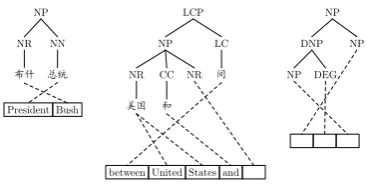
Figure 1 shows three TATs automatically learned from training data. Note that when demonstrating a TAT graphically, we represent non-terminals in the target strings by blanks.
NP
NR
布什 NN
总统
LCP
NP
NR
美国 CC
和 NR
LC
间
NP
DNP
NP DEG NP
President Bush
between United States and
Figure 1: Examples of tree-to-string alignment templates obtained in training
In the following, we formally describe how to introduce tree-to-string alignment templates into probabilistic dependencies to modelP r(eI1|f1J)3. In a first step, we introduce the hidden variable T(f1J)that denotes a parse tree of the source sen-tencef1J:
P r(eI1|f1J) = X
T(fJ
1)
P r(eI1, T(f1J)|f1J) (2)
= X
T(fJ
1)
P r(T(f1J)|f1J)P r(eI1|T(f1J), f1J) (3)
Next, another hidden variable D is introduced to detach the source parse tree T(f1J) into a se-quence ofKsubtreesT˜1Kwith a preorder transver-sal. We assume that each subtree T˜k produces
a target string S˜k. As a result, the sequence
of subtrees T˜1K produces a sequence of target strings S˜1K, which can be combined serially to generate the target sentence eI1. We assume that P r(eI
1|D, T(f1J), f1J)≡P r( ˜S1K|T˜1K)becauseeI1
is actually generated by the derivation of S˜1K. Note that we omit an explicit dependence on the detachmentDto avoid notational overhead.
P r(eI1|T(f1J), f1J) =X
D
P r(eI1, D|T(f1J), f1J) (4)
=X
D
P r(D|T(f1J), f1J)P r(eI1|D, T(f1J), f1J) (5)
=X
D
P r(D|T(f1J), f1J)P r( ˜S1K|T˜1K) (6)
=X
D
P r(D|T(f1J), f1J)
K Y
k=1
P r( ˜Sk|T˜k) (7)
3The notational convention will be as follows. We use
[image:2.595.309.534.600.723.2]NP
DNP
NP
NR
中国 DEG
的 NP
NN
经济 NN
发展
NP
DNP
NP DEG
的 NP
NP
NR
中国 NP
NN NN NN
经济 NN
发展 中国 的 经济 发展
parsing
detachment production
of
China
economic development
combination
[image:3.595.103.259.61.304.2]economic development of China
Figure 2: Graphic illustration for translation pro-cess
To further decompose P r( ˜S|T˜), the tree-to-string alignment template, denoted by the variable z, is introduced as a hidden variable.
P r( ˜S|T˜) =X
z
P r( ˜S, z|T˜) (8)
=X
z
P r(z|T˜)P r( ˜S|z,T˜) (9)
Therefore, the TAT-based translation model can be decomposed into four sub-models:
1. parse model:P r(T(f1J)|f1J)
2. detachment model:P r(D|T(f1J), f1J)
3. TAT selection model:P r(z|T˜)
[image:3.595.306.542.493.711.2]4. TAT application model:P r( ˜S|z,T˜)
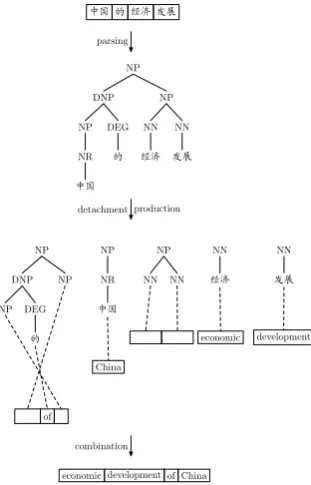
Figure 2 shows how TATs work to perform translation. First, the input source sentence is parsed. Next, the parse tree is detached into five subtrees with a preorder transversal. For each sub-tree, a TAT is selected and applied to produce a string. Finally, these strings are combined serially to generate the translation (we useXto denote the non-terminal):
X1⇒X2ofX3
⇒X2of China
⇒X3X4of China
⇒economicX4 of China
⇒economic development of China
Following Och and Ney (2002), we base our model on log-linear framework. Hence, all knowl-edge sources are described as feature functions that include the given source stringf1J, the target stringeI
1, and hidden variables. The hidden
vari-able T(f1J) is omitted because we usually make use of only single best output of a parser. As we assume that all detachment have the same proba-bility, the hidden variableD is also omitted. As a result, the model we actually adopt for exper-iments is limited because the parse, detachment, and TAT application sub-models are simplified.
P r(eI1, z1K|f1J)
= exp[
PM
m=1λmhm(eI1, f1J, z1K)]
P e0I
1,z0K1 exp[
PM
m=1λmhm(e0I1, f1J, z0K1 )]
ˆ
eI1 = argmax
eI
1,z1K
½XM
m=1
λmhm(eI1, f1J, zK1 )
¾
For our experiments we use the following seven feature functions 4 that are analogous to default feature set of Pharaoh (Koehn, 2004). To simplify the notation, we omit the dependence on the hid-den variables of the model.
h1(eI1, f1J) = log
K Y
k=1
N(z)·δ(T(z),T˜k)
N(T(z))
h2(eI1, f1J) = log
K Y
k=1
N(z)·δ(T(z),T˜k)
N(S(z))
h3(eI1, f1J) = log
K Y
k=1
lex(T(z)|S(z))·δ(T(z),T˜k)
h4(eI1, f1J) = log
K Y
k=1
lex(S(z)|T(z))·δ(T(z),T˜k)
h5(eI1, f1J) = K
h6(eI1, f1J) = log
I Y
i=1
p(ei|ei−2, ei−1)
h7(eI1, f1J) = I
4
When computing lexical weighting features (Koehn et al., 2003), we take only terminals into account. If there are no terminals, we set the feature value to1. We uselex(·)
Tree String Alignment
( NR布什) Bush 1:1
( NN总统) President 1:1
( VV发表) made 1:1
( NN演讲) speech 1:1
( NP ( NR ) ( NN ) ) X1 |X2 1:2 2:1
( NP ( NR布什) ( NN ) ) X|Bush 1:2 2:1
( NP ( NR ) ( NN总统) ) President|X 1:2 2:1 ( NP ( NR布什) ( NN总统) ) President|Bush 1:2 2:1 ( VP ( VV ) ( NN ) ) X1|a|X2 1:1 2:3
( VP ( VV发表) ( NN ) ) made|a|X 1:1 2:3 ( VP ( VV ) ( NN演讲) ) X|a|speech 1:1 2:3 ( VP ( VV发表) ( NN演讲) ) made|a|speech 1:1 2:3
[image:4.595.149.449.60.261.2]( IP ( NP ) ( VP ) ) X1 |X2 1:1 2:2
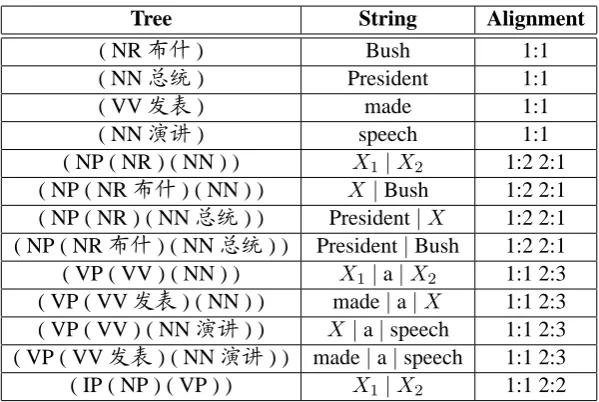
Table 1: Examples of TATs extracted from the TSA in Figure 3 withh= 2andc= 2
3 Training
To extract tree-to-string alignment templates from a word-aligned, source side parsed sentence pair
hT(fJ
1), eI1, Ai, we need first identify TSAs
(Tree-String-Alignment) using similar criterion as sug-gested in (Och and Ney, 2004). A TSA is a triple
hT(fj2
j1), e
i2
i1,A¯)i that is in accordance with the following constraints:
1. ∀(i, j)∈A:i1≤i≤i2↔j1 ≤j≤j2
2. T(fj2
j1) is a subtree ofT(f
J
1)
Given a TSA hT(fjj12), ei2
i1,A¯i, a triple
hT(fj4
j3), e
i4
i3,Aˆi is its sub TSA if and only if:
1. T(fjj34), ei4
i3,Aˆiis a TSA
2. T(fj4
j3) is rooted at the direct descendant of the root node ofT(fjj21)
3. i1 ≤i3 ≤i4 ≤i2
4. ∀(i, j)∈A¯:i3≤i≤i4↔j3 ≤j≤j4
Basically, we extract TATs from a TSA
hT(fj2
j1), e
i2
i1,A¯iusing the following two rules:
1. IfT(fjj12)contains only one node, thenhT(fjj12), ei2
i1,A¯iis a TAT
2. If the height of T(fjj12) is greater than one, then build TATs using those extracted from sub TSAs ofhT(fj2
j1), e
i2
i1,A¯i.
IP
NP
NR
布什 NN
总统 VP
VV
发表 NN
演讲
[image:4.595.374.460.302.413.2]President Bush made a speech
Figure 3: An example of TSA
Usually, we can extract a very large amount of TATs from training data using the above rules, making both training and decoding very slow. Therefore, we impose three restrictions to reduce the magnitude of extracted TATs:
1. A third constraint is added to the definition of TSA:
∃j0, j00:j
1≤j0 ≤j2andj1≤j00≤j2
and(i1, j0)∈A¯and(i2, j00)∈A¯
This constraint requires that both the first and last symbols in the target string must be aligned to some source symbols.
2. The height of T(z) is limited to no greater thanh.
3. The number of direct descendants of a node ofT(z)is limited to no greater thanc.
Table 1 shows the TATs extracted from the TSA in Figure 3 withh= 2andc= 2.
hierar-chical phrase pairs (Chiang, 2005) with tree struc-ture on the source side. At the same time, we face the risk of losing some useful non-syntactic phrase pairs. For example, the phrase pair
布什 总统 发表←→President Bush made
can never be obtained in form of TAT from the TSA in Figure 3 because there is no subtree for that source string.
4 Decoding
We approach the decoding problem as a bottom-up beam search.
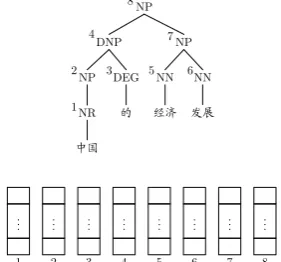
To translate a source sentence, we employ a parser to produce a parse tree. Moving bottom-up through the source parse tree, we compute a list of candidate translations for the input subtree rooted at each node with a postorder transversal. Candidate translations of subtrees are placed in stacks. Figure 4 shows the organization of can-didate translation stacks.
NP
DNP
NP
NR
中国 DEG
的 NP
NN
经济 NN
发展 8
4 7
2 3 5 6
1
.. .
1 .. .
2 .. .
3 .. .
4 .. .
5 .. .
6 .. .
7 .. .
[image:5.595.333.489.126.292.2]8
Figure 4: Candidate translations of subtrees are placed in stacks according to the root index set by postorder transversal
A candidate translation contains the following information:
1. the partial translation
2. the accumulated feature values
3. the accumulated probability
A TATzisusableto a parse treeT if and only ifT(z)is rooted at the root of T and covers part of nodes of T. Given a parse treeT, we find all usable TATs. Given a usable TAT z, if T(z) is equal toT, thenS(z)is a candidate translation of T. If T(z) covers only a portion ofT, we have
to compute a list of candidate translations forT by replacing the non-terminals ofS(z) with can-didate translations of the corresponding uncovered subtrees.
NP
DNP
NP DEG
的 NP 8
4 7
2 3
of
.. .
1 .. .
2 .. .
3 .. .
4 .. .
5 .. .
6 .. .
7 .. .
[image:5.595.110.251.373.504.2]8
Figure 5: Candidate translation construction
For example, when computing the candidate translations for the tree rooted at node 8, the TAT used in Figure 5 covers only a portion of the parse tree in Figure 4. There are two uncovered sub-trees that are rooted at node 2 and node 7 respec-tively. Hence, we replace the third symbol with the candidate translations in stack 2 and the first symbol with the candidate translations in stack 7. At the same time, the feature values and probabil-ities are also accumulated for the new candidate translations.
To speed up the decoder, we limit the search space by reducing the number of TATs used for each input node. There are two ways to limit the TAT table size: by a fixed limit (tatTable-limit) of how many TATs are retrieved for each input node, and by a probability threshold (tatTable-threshold) that specify that the TAT probability has to be above some value. On the other hand, instead of keeping the full list of candidates for a given node, we keep a top-scoring subset of the candidates. This can also be done by a fixed limit (stack-limit) or a threshold (stack-threshold). To perform re-combination, we combine candidate translations that share the same leading and trailing bigrams in each stack.
5 Experiments
System Features BLEU4
d +φ(e|f) 0.0573±0.0033
Pharaoh d + lm +φ(e|f)+ wp 0.2019±0.0083
d + lm +φ(f|e)+ lex(f|e)+φ(e|f)+ lex(e|f)+ pp + wp 0.2089±0.0089
h1 0.1639±0.0077
Lynx h1+h6+h7 0.2100±0.0089
[image:6.595.98.502.63.165.2]h1+h2+h3+h4+h5+h6+h7 0.2178±0.0080
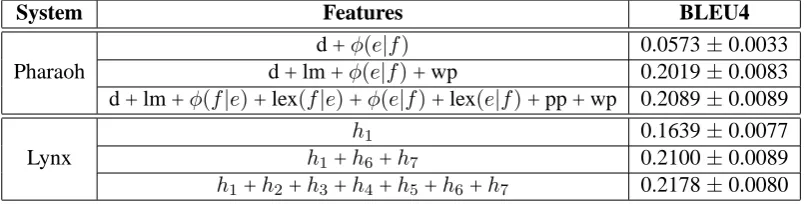
Table 2: Comparison of Pharaoh and Lynx with different feature settings on the test corpus
949,583English words. For the language model, we used SRI Language Modeling Toolkit (Stol-cke, 2002) to train a trigram model with modi-fied Kneser-Ney smoothing (Chen and Goodman, 1998) on the 31,149 English sentences. We se-lected 571 short sentences from the 2002 NIST MT Evaluation test set as our development cor-pus, and used the 2005 NIST MT Evaluation test set as our test corpus. We evaluated the transla-tion quality using the BLEU metric (Papineni et al., 2002), as calculated by mteval-v11b.pl with its default setting except that we used case-sensitive matching ofn-grams.
5.1 Pharaoh
The baseline system we used for comparison was Pharaoh (Koehn et al., 2003; Koehn, 2004), a freely available decoder for phrase-based transla-tion models:
p(e|f) =pφ(f|e)λφ×p
LM(e)λLM×
pD(e, f)λD×ωlength(e)λW(e) (10)
We ran GIZA++ (Och and Ney, 2000) on the training corpus in both directions using its default setting, and then applied the refinement rule “diag-and” described in (Koehn et al., 2003) to obtain a single many-to-many word alignment for each sentence pair. After that, we used some heuristics, which including rule-based translation of num-bers, dates, and person names, to further improve the alignment accuracy.
Given the word-aligned bilingual corpus, we obtained 1,231,959 bilingual phrases (221,453 used on test corpus) using the training toolkits publicly released by Philipp Koehn with its default setting.
To perform minimum error rate training (Och, 2003) to tune the feature weights to maximize the system’s BLEU score on development set, we used optimizeV5IBMBLEU.m (Venugopal and Vogel,
2005). We used default pruning settings for Pharaoh except that we set the distortion limit to 4.
5.2 Lynx
On the same word-aligned training data, it took us about one month to parse all the31,149 Chi-nese sentences using a ChiChi-nese parser written by Deyi Xiong (Xiong et al., 2005). The parser was trained on articles1−270of Penn Chinese Tree-bank version 1.0 and achieved 79.4% (F1 mea-sure) as well as a 4.4% relative decrease in er-ror rate. Then, we performed TAT extraction de-scribed in section 3 with h = 3 and c = 5 and obtained350,575TATs (88,066used on test corpus). To run our decoder Lynx on develop-ment and test corpus, we set tatTable-limit = 20, tatTable-threshold = 0, stack-limit = 100, and stack-threshold= 0.00001.
5.3 Results
Table 2 shows the results on test set using Pharaoh and Lynx with different feature settings. The95% confidence intervals were computed using Zhang’s significance tester (Zhang et al., 2004). We mod-ified it to conform to NIST’s current definition of the BLEU brevity penalty. For Pharaoh, eight features were used: distortion model d, a trigram language model lm, phrase translation probabili-tiesφ(f|e)andφ(e|f), lexical weightings lex(f|e)
and lex(e|f), phrase penalty pp, and word penalty
wp. For Lynx, seven features described in
sec-tion 2 were used. We find that Lynx outperforms Pharaoh with all feature settings. With full fea-tures, Lynx achieves an absolute improvement of 0.006 over Pharaoh (3.1% relative). This differ-ence is statistically significant (p < 0.01). Note that Lynx made use of only 88,066TATs on test corpus while221,453bilingual phrases were used for Pharaoh.
er-Features System
d lm φ(f|e) lex(f|e) φ(e|f) lex(e|f) pp wp Pharaoh 0.0476 0.1386 0.0611 0.0459 0.1723 0.0223 0.3122 -0.2000
[image:7.595.99.502.61.122.2]Lynx - 0.3735 0.0061 0.1081 0.1656 0.0022 0.0824 0.2620
Table 3: Feature weights obtained by minimum error rate training on the development corpus
BLEU4
tat 0.2178±0.0080 tat + bp 0.2240±0.0083
Table 4: Effect of using bilingual phrases for Lynx
ror rate training for both Pharaoh and Lynx are shown in Table 3. We find thatφ(f|e)(i.e. h2) is
not a helpful feature for Lynx. The reason is that we use only a single non-terminal symbol instead of assigning phrasal categories to the target string. In addition, we allow the target string consists of only non-terminals, making translation decisions not always based on lexical evidence.
5.4 Using bilingual phrases
It is interesting to use bilingual phrases to strengthen the TAT-based model. As we men-tioned before, some useful non-syntactic phrase pairs can never be obtained in form of TAT be-cause we restrict that there must be a correspond-ing parse tree for the source phrase. Moreover, it takes more time to obtain TATs than bilingual phrases on the same training data because parsing is usually very time-consuming.
Given an input subtreeT(Fjj12), ifFjj12is a string of terminals, we find all bilingual phrases that the source phrase is equal to Fj2
j1. Then we build a TAT for each bilingual phrase hf1J0, eI10,Aˆi: the tree of the TAT is T(Fjj12), the string is eI10, and the alignment isAˆ. If a TAT built from a bilingual phrase is the same with a TAT in the TAT table, we prefer to the greater translation probabilities.
Table 4 shows the effect of using bilingual phrases for Lynx. Note that these bilingual phrases are the same with those used for Pharaoh.
5.5 Results on large data
We also conducted an experiment on large data to further examine our design philosophy. The train-ing corpus contains 2.6 million sentence pairs. We used all the data to extract bilingual phrases and a portion of 800K pairs to obtain TATs. Two
tri-gram language models were used for Lynx. One was trained on the 2.6 million English sentences and another was trained on the first 1/3 of the Xin-hua portion of Gigaword corpus. We also included rule-based translations of named entities, dates, and numbers. By making use of these data, Lynx achieves a BLEU score of 0.2830 on the 2005 NIST Chinese-to-English MT evaluation test set, which is a very promising result for linguistically syntax-based models.
6 Conclusion
In this paper, we introduce tree-to-string align-ment templates, which can be automatically learned from syntactically-annotated training data. The TAT-based translation model improves trans-lation quality significantly compared with a state-of-the-art phrase-based decoder. Treated as spe-cial TATs without tree on the source side, bilingual phrases can be utilized for the TAT-based model to get further improvement.
It should be emphasized that the restrictions we impose on TAT extraction limit the expressive power of TAT. Preliminary experiments reveal that removing these restrictions does improve transla-tion quality, but leads to large memory require-ments. We feel that both parsing and word align-ment qualities have important effects on the TAT-based model. We will retrain the Chinese parser on Penn Chinese Treebank version 5.0 and try to improve word alignment quality using log-linear models as suggested in (Liu et al., 2005).
Acknowledgement
References
Hiyan Alshawi, Srinivas Bangalore, and Shona Dou-glas. 2000. Learning dependency translation mod-els as collections of finite-state head transducers.
Computational Linguistics, 26(1):45-60.
Peter F. Brown, Stephen A. Della Pietra, Vincent J. Della Pietra, and Robert L. Mercer. 1993. The mathematics of statistical machine translation: Pa-rameter estimation. Computational Linguistics,
19(2):263-311.
Stanley F. Chen and Joshua Goodman. 1998. Am empirical study of smoothing techniques for lan-guage modeling. Technical Report TR-10-98, Har-vard University Center for Research in Computing Technology.
David Chiang. 2005. A hierarchical phrase-based model for statistical machine translation. In
Pro-ceedings of 43rd Annual Meeting of the ACL, pages
263-270.
Yuan Ding and Martha Palmer. 2005. Machine trans-lation using probabilistic synchronous dependency insert grammars. In Proceedings of 43rd Annual
Meeting of the ACL, pages 541-548.
Michel Galley, Mark Hopkins, Kevin Knight, and Daniel Marcu. 2004. What’s in a translation rule? In Proceedings of NAACL-HLT 2004, pages 273-280.
Jonathan Graehl and Kevin Knight. 2004. Training tree transducers. In Proceedings of NAACL-HLT
2004, pages 105-112.
Philipp Koehn, Franz J. Och, and Daniel Marcu. 2003. Statistical phrase-based translation. In Proceedings
of HLT-NAACL 2003, pages 127-133.
Philipp Koehn. 2004. Pharaoh: a beam search de-coder for phrase-based statistical machine trnasla-tion models. In Proceedings of the Sixth
Confer-ence of the Association for Machine Translation in the Americas, pages 115-124.
Yang Liu, Qun Liu, and Shouxun Lin. 2005. Log-linear models for word alignment. In Proceedings
of 43rd Annual Meeting of the ACL, pages 459-466.
Daniel Marcu and William Wong. 2002. A phrase-based, joint probability model for statistical machine translation. In Proceedings of the 2002 Conference
on Empirical Methods in Natural Language Pro-cessing (EMNLP), pages 133-139.
Dan Melamed. 2004. Statistical machine translation by parsing. In Proceedings of 42nd Annual Meeting
of the ACL, pages 653-660.
Franz J. Och and Hermann Ney. 2000. Improved sta-tistical alignment models. In Proceedings of 38th
Annual Meeting of the ACL, pages 440-447.
Franz J. Och and Hermann Ney. 2002. Discriminative training and maximum entropy models for statistical machine translation. In Proceedings of 40th Annual
Meeting of the ACL, pages 295-302.
Franz J. Och and Hermann Ney. 2004. The alignment template approach to statistical machine translation.
Computational Linguistics, 30(4):417-449.
Franz J. Och. 2003. Minimum error rate training in statistical machine translation. In Proceedings of
41st Annual Meeting of the ACL, pages 160-167.
Kishore Papineni, Salim Roukos, Todd Ward, and Wei-Jing Zhu. 2002. BLEU: a method for automatic evaluation of machine translation. In Proceedings
of 40th Annual Meeting of the ACL, pages 311-318.
Chris Quirk, Arul Menezes, and Colin Cherry. 2005. Dependency treelet translation: Syntactically in-formed phrasal SMT. In Proceedings of 43rd
An-nual Meeting of the ACL, pages 271-279.
Andreas Stolcke. 2002. SRILM - an extensible lan-guage modeling toolkit. In Proceedings of
Interna-tional Conference on Spoken Language Processing,
volume 2, pages 901-904.
Ashish Venugopal and Stephan Vogel. 2005. Consid-erations in maximum mutual information and min-imum classification error training for statistical ma-chine translation. In Proceedings of the Tenth
Con-ference of the European Association for Machine Translation (EAMT-05).
Dekai Wu. 1997. Stochastic inversion transduction grammars and bilingual parsing of parallel corpora.
Computational Linguistics, 23(3):377-403.
Deyi Xiong, Shuanglong Li, Qun Liu, Shouxun Lin, and Yueliang Qian. 2005. Parsing the Penn Chinese treebank with semantic knowledge. In Proceedings
of IJCNLP 2005, pages 70-81.
Kenji Yamada and Kevin Knight. 2001. A syntax-based statistical translation model. In Proceedings
of 39th Annual Meeting of the ACL, pages 523-530.
Ying Zhang, Stephan Vogel, and Alex Waibel. 2004. Interpreting BLEU/NIST scores: How much im-provement do we need to have a better system? In
Proceedings of the Fourth International Conference on Language Resources and Evaluation (LREC),