Int. J. Communications, Network and System Sciences, 2009, 2, 786-791
doi:10.4236/ijcns.2009.28091Published Online November 2009 (http://www.SciRP.org/journal/ijcns/).
Performance Analysis of MAC Protocol for LEO Satellite
Networks
Mingxiang GUAN, Ruichun WANG
Department of Electronic Communication Technology, Shenzhen Institute of Information Technology, Shenzhen, China Email: gmx2020@126.com
Received July 14, 2009; revised August 16, 2009; accepted September 22, 2009
Abstract
Considering that weak channel collision detection ability, long propagation delay and heavy load in LEO satellite communications, a valid adaptive APRMA MAC protocol was proposed. Different access probabil-ity functions for different services were obtained and appropriate access probabilities for voice and data users were updated slot by slot based on the estimation of the voice traffic and the channel status. In the proposed MAC protocol limited wireless resource is allocated reasonably by multiple users and high capacity was achieved. Three performance parameters: voice packet loss probability, average delay of data packets and throughput of data packets were considered in simulation. Finally simulation results demonstrated that the performance of system was improved by the APRMA compared with the conventional PRMA, with an ac-ceptable trade-off between QoS of voice and delay of data.
Keywords:
LEO Satellites, Adaptive Packet Reservation Multiple Access, MAC Protocol
1. Introduction
Due to various economic and technical constraints, ter-restrial mobile networks can only provide communica-tion services with a limited coverage. Recently, in re-sponse to increasing demand of real-time multimedia services and the truly global coverage required by per-sonal communication services, there is a vast research on non-geostationary orbit (NGSO) satellites systems, espe-cially on low earth orbit (LEO) satellite constellations with an altitude between 700 km and 1 500 km. LEO satellite constellations equipped with inter-satellite links, such as Iridium, Teledesic, Courier and so on, usually have onboard switching and onboard routing facilities and form an independent network in space. Direct con-nectivity between any pair of satellite mobile users can be achieved through the satellites and ISLs without any essential usage of the terrestrial core network. For the wide application prospect, they have already been the focus of the research on the satellite communication sys-tems. This LEO system can provide real time voice and data traffics in the global range. It is the trend that vari-ous kinds of traffics will be provided by LEO satellites system. It is of great importance that an effective me-dium access control (MAC) protocol will be required to make full use of limited resource and to provide services
with strict quality for users. MAC protocol is used to allow many mobile users to share simultaneously a finite amount of radio spectrum. The sharing of spectrum is required to achieve high capacity by simultaneously al-locating the available bandwidth to multiple users. Thus the appropriate access control protocol will be a key problem for wireless mobile communications develop-ment.
LEO satellites system. They are: 1) The channel collision detection ability is quite weak. 2) The propagation time delay is long comparatively to terrestrial communica-tions system. 3) Heavy load will be supported because of many users in the coverage of the LEO satellites. The three characteristics will bring on increase of packet loss probability, severity of channel congestion and decrease of QoS (Quality of Service).
More improved PRMA protocols were provided based on [4–5]. In literature [6] PRMA-HS with re-transmis-sion character was provided in order to overcome long time delay problem in satellite communication. But the access contention becomes serious and performance of the system degrades under the environment of large number of users or heavy load. Moreover this protocol has a changeable channel access time delay and a certain packet loss probability which are not suitable for services with strict QoS requirement. In literature [7] IPRMA (Integrated Packet Reservation Multiple Access) protocol was proposed for satellite communication. A user can reserve many slots to improve performance of this pro-tocol. But it possibly exists that one user occupies the resource totally. In literature [8] MPRMA (Mini-Packet Reservation Multiple Access) was provided. In the pro-tocol an available slot will be divided into many mini-slots in which competitive packets are transmitted. From [8] we can see that probability of collision in a mini-slot decreases. But this protocol can not support a mass of real-time traffic due to the decline of the effi-ciency of transmission. In literature [9] the author pro-vided NC-PRMA (Non-Collision Integrated Packet Reservation Multiple Access) protocol which adopted queue model to avoid collision resulted from competi-tion and performance was improved. But this protocol is not perfect in the long propagation delay because implementation of this protocol will be in the environ-ment of short RTD (Round Trip propagation Delay) period.
From the analysis above, we can find that access probability for voice and data is obtained from the same access function, without considering the different traffic characteristics and requirements of voice and data users (voice users require real-time delivery but can accom-modate higher bit error rates; data users do not need real-time transmission and can be queued but require low bit error rates or error-free transmission). Therefore it will be expected to be more efficient if priority is given to the transmission of voice, whilst minimizing the ef-fects on the data packets. Considering that weak channel collision detection ability, long propagation delay and a mass of load in communication system in LEO satellites, an adaptive access control protocol improved form PRMA based on channel status, quality of service and estimation of traffic was proposed with priority of voice
traffic referred to [10,11]. Thus in this method, voice packets access to the channel with a priority and a up-dated access probability and then, if the resource is available, data packets can be accepted with an updated access probability slot by slot. Our simulation results show that the efficiency is improved by the new adaptive PRMA protocol.
This paper is organized as follows. In Section 2, two kinds of access probability functions are derived for voice and data traffic respectively. Compared to conven-tional PRMA protocol, three performance parameters of voice packet loss probability, average delay of data packets and throughput of data packets are analyzed by simulation in Section3. Finally system performance and conclusions are obtained.
2. Protocol Model
2.1. Traffic Analysis
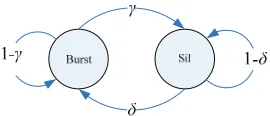
For a voice terminal, the voice source can be character-ized by a two-state Markov chain model, as shown in Figure 1. Four parameters are required for the description of the model. They are: the mean duration of a talk burst , the mean duration of the silence , the transition probability from the talking state to the silent state
1
t t2
and the inverse transition probability . The parameters
and can expressed as follows:
1 1 exp( / )t
(1)
2 1 exp( / )t
(2) where is the width of one time slot. The empirical val-ues for and are 1s and 1.35s. The voice terminal generates one packet per frame which is first composed of an information field with length of
1 t t2
s f
R T , where Rs
is the bit-rate of voice and is the duration of one frame, and a packet header with length
f
T
H bits.
[image:2.595.357.492.643.701.2]Next data users were concerned. A data terminal has a discontinuous stream. Denote the average bit rate of the data terminal by Rs and a data packet which is the same as voice packet is generated independently in each slot with a probability of d. Hence, the mean bit rate of a data terminal is:
M. X. GUAN ET AL. 788
Figure 2. Structure of frame and packet.
d d s
R R A (3) where is the number of slots per frame and can be calculated by:
A
int[ p f / ( s f )]
A R T R T H (4)
p
R is the channel rate before coding.
2.2. Frame Structure
These frames are further subdivided into N time slots as illustrated in Figure 2(a). Information packets transmitted from terminals to satellites consist of both a payload (actual information) and a header (control information) as illustrated in Figure 2(b). The time slot duration is τ and T is the duration of a single frame.
2.3. APRMA Protocol
In the beginning of this paper we have got the conclusion that conventional and improved PRMA protocols sup-ported mixed voice and data traffic with a low efficiency in LEO satellites. In the APRMA protocol, is the access probability of voice and is the access prob-ability of data respectively. Voice user is given priority compared with data user. Appropriate access probabili-ties and are broadcast from the LEO satellite, which is updated slot by slot based on the estimation of the voice traffic and the channel status.
v
P
d
P
v
P Pd
The purpose of APRMA protocol is to guarantee real-time transmission of voice packets by priority trans- mission compared with data packets. When the channel load is light, transmitting data packets is allowed. On the other hand, when the channel load is heavy, transmission of data packet is postponed. We assume that the LEO satellites can recognize the total number of users in a cell and the number of users in reservation mode. Then, based on the statistical characteristics of the traffic mod-els, the number of contending voice terminals is esti-mated and the access probability is calculated. From the voice model described in 2.1, voice terminals are Mv
and voice terminals in reservation mode are Mrsv,
probability of n new terminals arrival talk t and one terminal departing from talk burst can be considered as a binomial distribution:
( , , ) k( ) (1k
B n k p C p
The (5) where burs ) ( | ( , , ) n k n sil sil sil v rsv
p
P n M B M n
M M M
) sil M he p
is number of voice terminals in silent mode. When t opulation of users is large or the probability of p is small, the binomial model approaches the Pos-sion model. Thus Msil is arrival rate of the voice
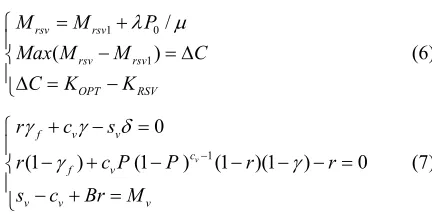
users and u M rsv is departure rate of the voice users respectively. Hence, in the current time slot the estimated value of Mrsv can be expressed by:
1 0/
M M P
1 ( ) rsv rsv rsv OPT RSV rsv
Max M M C
C K K
(6)
0 r 1 0
(1 ) (1 )v (1 )(1 )
f v v
c
v v v
r c s
P P r
s c M
f v r c Br
ers in reserv
e u (7)
where Mrsv1 e number of voice us ation
n the is th
mode i previous time slot and P0 is the access probability of voice users at current tim slot. KOPT is the available number of access channel for voic rs. In the voice system, the balance equation is shown in the
following: Here 1 (1 )B
f B
e
se
, P is the
ac-cess probability. F 7), e following
Equation (8) can be found. rom the Equation ( th
(1
ta syste
) ( f )
v r Mv
(8)
For the da m, the probability of a se
c B
data user to nd a data packet successfully is
w
:(1 (1
d d
w p u r b M/ dB)) (9)
where . Theref
d voic r access prob
(1 ) 1 (1 ) (1c ) b
d
p
d v
u p
e use
ore, the data
user an ability at the balance
point can be shown by the Equation (10):
[ (
(1
1 )(1 (1 ))]
b b
cp r
(1 f)
c M 10)
where
d d d
M
B (
) / (1 )
d d
p p p p
an
. In the voice , the
n (8) c be shown in th
system
Equatio e following.
1 2 v
where h1 (1 / ) ,h2 (1 f / ) . Combination
he relation betw
Equations ), t een b and c
is in the following. (10) and (11
2 1
1
min{ d d ( ), d}
f v
h c
b M M
M h c
(12)
.3.1. Voice Packet Loss Probability
the ratio of the 2
Packet loss probability is defined as
number of loss packets and the number of the generated packets at the terminals.
2 2
2 [1 (1
f f) ] (1 )
1
[1 (1 ) ] 1
[1 (1 ) ]
B N
f f
vdrop B B
f B f
B f
v v P
v v
v v
(13)
where is the maximum time delay of voice packet
t.
)b
(14)
.3.2. Average Time Delay of Data Packet
time from
t is:
N
is
and v the successful access probability of voice packe
1
v (1 (1 / )) (1 ) (1c1 )(1
d d
r b M A p p p
2
Average time delay is defined as the lasting
packet generated to packet received successfully at the LEO satellites. When a data packet arrived at a data user,
j data packets were waited for transmission. Average e delay of this data packet was (j1) /w. Therefore the average time delay of data packe
tim
1
W
(1 )
ad
d
w p (15)
.3.3. Throughput of Data Packet
of the number of 2
Throughput is defined as the ratio
packets received successfully and the number of packets generated at the terminals in a time unit. The Throughput of data packet is defined as the proportion of timeslots that successfully carry information packets.
2
(1 b d) (1
Tthroughput r dMd )
d
M A (16)
. Results Analysis
ites system have taken CDMA
how the simulation re
3
ll the LEO mobile satell A
technology except Iridium system (TDMA technology was taken). LEO satellites adopt multi-beam formation technology to make full use of the finite radio frequency resource. Therefore many cells are formed and users separated by space can re-use the radio channel. In [12] CDMA channel attenuation model in AGWN was
[image:4.595.312.539.165.294.2]pro-posed which adopted BPSK modulation technology and BCH coding (511, 229, 38). Figure 3 shows the access probability of voice users in APRMA protocol and Table 1 shows the simulation parameters.
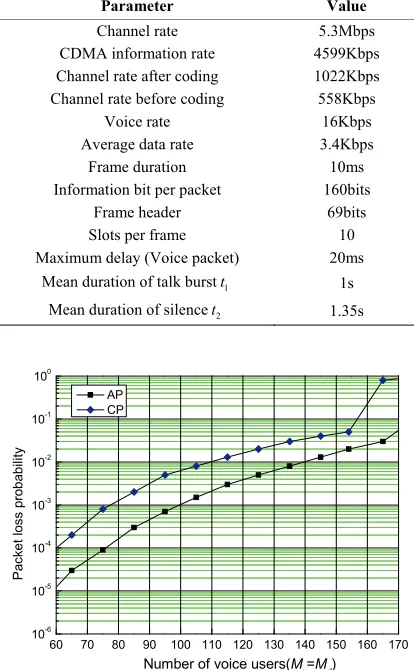
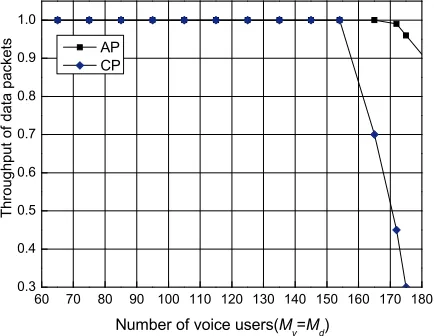
Figure 4, Figure 5 and Figure 6 s
sults with equal loads of voice and data traffic. For 2%
1 2 3 4 5 6 7 8 9 10
0.00 0.05 0.10 0.15 0.20 0.25
Acce
ss probabi
lity
[image:4.595.76.272.219.283.2]Number of users on channel
Figure 3. APRMA voice terminals access probability.
Table 1. Simulation parameters.
Parameter Value
Channel rate 5.3Mbps
CDM rate
Av te
Infor cket
Maximu acket) 2
1. A information 4599Kbps Channel rate after coding 1022Kbps Channel rate before coding 558Kbps
Voice rate 16Kbps
erage data ra 3.4Kbps Frame duration 10ms mation bit per pa 160bits
Frame header 69bits Slots per frame 10
m delay (Voice p 0ms
Mean duration of talk burstt1 1s
Mean duration of silencet2 35s
60 70 80 90 100 110 120 130 140 150 160 170 10-6
10-5
10-4
10-3
10-2
10-1
100
Number of voice users(Mv=Md)
P
ac
ke
t l
os
s pr
ob
ab
ili
ty
AP CP
[image:4.595.319.526.357.692.2] [image:4.595.317.529.357.663.2]M. X. GUAN ET AL. 790
packet loss probability as an acceptable level, then the system capacity is improved about 18% by APRMA compared to CP (Convention PRMA). Furthermore, Ta-ble 2 shows the comparison between AP and CP protocol. From the performance comparison in the Table 2, the
60 70 80 90 100 110 120 130 140 150 160 170 180 0
25 50 75 100 125 150 175 200 225 250
Delay of dat
a
packets(
m
s)
Number of voice users(Mv=Md) AP
CP
Figure 5. Average time delay of data packets.
60 70 80 90 100 110 120 130 140 150 160 170 180
0.3 0.4 0.5 0.6 0.7 0.8 0.9 1.0
Thr
oug
hput
of
da
ta
p
ac
ket
s
Number of voice users(Mv=Md)
[image:5.595.69.272.156.311.2]AP CP
Figure 6. Throughput of data packets.
Table 2. Performance comparison.
Data user 100 150 200
Voice user (PLP) 188 108 78 Voice user (ATDDP) 282 170 138 AP
Voice user (TDP) 260 185 160 Voice user (PLP) 142 85 58 Voice user (ATDDP) 240 134 116 CP
Voice user (TDP) 220 150 135 Voice user (PLP) 24.6 21.2 25.6 Voice user (ATDDP) 14.9 21.7 15.9 Performance
improvement
(%) Voice user (TDP) 15.4 18.9 15.6
PLP, ATDDP and TD prob a m y
and throughput of data packet respectively.
s
-. Conclusions
ent of LEO satellite communication,
. Acknowledgement
his paper supported by the 3rd natural science
founda-. References
. Pecorella, and Giombini, “Stability and
F. Marangoni, “Advanced
dy-An adaptive MAC layer
an, R. A. Valenzuela, and K. T. Gayliard,
, “Performance of PRMA: A packet voice protocol for cellular systems
P stand for packet loss ability, verage ti e dela
ystem performance is improved by the APRMA proto col in all three cases.
4
ith the developm W
it is the base requirement that various kinds of services will be provided. Considering that weak channel colli-sion detection ability, long propagation delay and heavy load in LEO satellite communication system, a valid adaptive access control protocol APRMA is proposed. Different access probability functions for different ser-vices are obtained and appropriate access probabilities for voice and data users are updated slot by slot based on the estimation of the voice traffic and the channel status. Simulation results demonstrate that the performance of system is improved by the APRMA compared with the conventional PRMA, with an acceptable trade-off be-tween QoS of voice and delay of data. Also the APRMA protocol will be suitable for HAPS (high altitude plat-form station) with the character of weak channel colli-sion detection ability, long propagation delay and heavy load.
5
T
tion of institute (No. LG-08010) and 2nd doctoral inno-vation foundation of institute. The author would like to thank Dr. Zhong Weizhi and Li Lu for their revisions of the text, and the editor and the anonymous reviewers for their contributions that enriched the final paper.
6
] R. Fantacci, T [1
performance analysis of a MAC protocol for a time-code air interface in LEO mobile satellite systems [J],” IEEE Transactions on Vehicular Technology, Vol. 52, No. 3, pp. 607–621, May 2003.
[2] F. Chiti, R. Fantacci, and
namic resource allocation schemes for satellite systems [C],” IEEE International Conference on Communications, Vol. 3, pp. 1469–1472, 2005,.
[3] M. Emmelmann and H. Bischl, “
protocol for ATM-based LEO satellite networks [C],” IEEE Vehicular Technology Conference, Vol. 4, 2698– 2702, 2003.
[4] D. J. Goodm
“Packet reservation multiple access for local wireless communications [J],” IEEE Transactions on Communica-tions, Vol. 37, No. 8, pp. 885–890, 1989.
[image:5.595.65.282.354.522.2]low earth orbit-mobile
sat-ltiple-access
ol suitable for voice and data [J],” IEEE Transactions on Vehicular Technology, Vol. 40, No. 3, pp. 584–598, 1991.
[6] E. Del Re and R. Fantacci, “Performance analysis of an improved PRMA protocol for
ellite systems [J],” IEEE Transactions on Vehicular Tech-nology, Vol. 48, No. 3, pp. 985–1001, 1999.
[7] R. Fantacci, T. Pecorella, and I. Habib, “Proposal and performance evaluation of an efficient mu
protocol for LEO satellite packet networks [J],” IEEE Journal on Selected Areas in Communications, Vol. 22, No. 3, pp. 538–545, 2004.
[8] G. Benelli, R. Fantacci, and G. Giambene, “Performance analysis of a PRMA protoc
transmissions in low earth orbit mobile satellite systems [J],” IEEE Transactions on Wireless Communications, Vol. 1, No. 1, pp. 156–168, 2002.
[9] R. Fantacci, G. Giambene, and R. Angioloni, “A modi-fied PRMA protocol for voice and data transmissions in low earth orbit mobile satellite systems [J],” IEEE Transactions on Vehicular Technology, Vol. 49, No. 5, pp. 1856–1876, 2000.
[10] J. W. So, “Adaptive traffic prediction based access con-trol in wireless CDMA systems supporting integrated voice/data/video services [J],” IEEE Communications Letters, Vol. 8, No. 12, pp. 703–705, 2004.
[11] M. C. Vuran and I. F. Akyildiz, “A-MAC adaptive me-dium access control for next generation wireless termi-nals [J],” IEEE/ACM Transactions on Networking, Vol. 99, pp. 1–10, 2007.