1087
Parametric Optimization of PMEDM Process using Chromium Powder
Mixed Dielectric and Triangular Shape Electrodes
Kuldeep Ojha1*, R. K. Garg1, K. K. Singh2
1
Department of Industrial and Production Engineering, Dr B. R. Ambedkar National Institute of Technology, Jalandhar-144011, Punjab, India
2
Department of Mechanical Engineering & Mining Machinery Engineering, Indian School of Mines (ISM), Dhanbad-826004, Jharkhand, India
*Corresponding Author: [email protected]
ABATRACT
In this article, parametric optimization for material removal rate (MRR) and tool wear rate (TWR) study on the powder mixed electrical discharge machining (PMEDM) of EN-8 steel has been carried out. Response surface methodology (RSM) has been used to plan and analyze the experiments. Average current, duty cycle, angle of electrode and concentration of chromium powder added into dielectric fluid of EDM were chosen as process parameters to study the PMEDM performance in terms of MRR and TWR. Experiments have been performed on newly designed experimental setup developed in laboratory. Most important parameters affecting selected performance measures have been identified and effects of their variations have been observed.
Keywords: EDM; PMEDM; MRR; TWR; Optimization
1. INTRODUCTION
discharge machining (PMEDM) is a relatively new material removal process applied to improve the machining efficiency and surface finish in presence of powder mixed dielectric fluid [1, 3-13].
Researchers explained the working principle of powder mixed electrical discharge machining process [1, 14]. When a voltage is applied between the electrode and the work piece facing each
other with a gap, an electric field in the range of 105–107 V/m is created. The powder particles in
the spark gap get energized. These charged particles are accelerated by the developed electric field and act as conductors. The conductive particles promote breakdown in the gap and also increase the spark gap between tool and the workpiece. Under the sparking area, the particles come closer and arrange themselves in chain like structures between both the electrodes. The interlocking between the different powder particles takes place in the direction of current flow. This chain formation helps in bridging the discharge gap between electrodes and also results in decreasing the insulating strength of the dielectric fluid. The easy short circuit takes place, causing early explosion in the gap resulting in series discharges under the electrode area. The faster sparking within a discharge occur causing faster erosion from the workpiece surface and hence the material removal rate (MRR) increases. At the same time, the added powder also modifies the plasma channel making it enlarged and widened. The sparks are uniformly distributed among the powder particles, hence electric density of the spark decreases. Due to uniform distribution of sparks among the powder particles, shallow craters are produced on the workpiece surface resulting in improvement in surface finish.
2. LITERATURE REVIEW
dielectric fluid on MRR and SR of SKD-61 material. Uno et al. [25] Studied the effect of nickel powder mixed with working fluid modifies the surface of aluminum bronze components. Okada et al. [26] proposed a new method for forming hard layer containing titanium carbide by EDM with carbon powder mixed fluid using titanium electrode. Chow et al. [27] studied the EDM process by adding SiC and aluminum powders into kerosene for the micro-slit machining of titanium alloy. Wang et al. [28] investigated the effect of Al and Cr powder mixture in kerosene. Tzeng and Lee [3] reported the effect of various powder characteristics on EDM of SKD-11 material. Furutani and Shiraki [29] proposed a deposition method of lubricant layer during finishing EDM process to produce parts for ultra high vacuum. Simao [30] explored the role of PMEDM in modifying the surface properties of the workpiece by application of Taguchi method. Pecas and Henriques [31] Investigated the influence of silicon powder mixed dielectric on conventional EDM. The relationship between the roughness and pulse energy was roughly investigated under a few sets of the conditions in the removal process. However, the effect of the energy was not systematically analyzed. Kansal [14] worked to optimize the process parameters of PMEDM by using the response surface methodology. Çogun et al. [32] made an experimental investigation on the effect of powder mixed dielectric on machining performance. Kansal et al. [33] studied the effect of Silicon powder mixed EDM on machining Rate of AISI D2 Die Steel. P. Pecas et al. [34, 35] investigated the effect of the electrode area in the surface roughness and topography and also the influence of the powder concentration and dielectric flow in the surface morphology. Prihandana et al. [36] investigated the effect of micro-powder suspension and ultrasonic vibration of dielectric fluid in micro-EDM processes by applying the Taguchi approach. Furutani et al. [37] investigated the influence of electrical conditions on performance of electrical discharge machining with powder suspended in working oil for titanium carbide deposition process. Kung et al. [38] studied the influence of MRR and electrode wear ratio in the PMEDM of cobalt-bonded tungsten carbide. Kojha et al. [39, 40] investigated the effect of Nickel Micro Powder Suspended Dielectric on EDM Performance Measures of EN-19 Steel. Elaborate scrutiny of the literature reveals that material removal mechanism of PMEDM process is very complex and theoretical modeling of the process is very difficult. Regarding empirical results, much research work is required with more work-tool-powder-parametric combinations to make the process commercially applicable. Also, most of the research work is with Al, Si, and graphite powders. Much investigation is needed regarding other types of powder like Cr, Ni, Mo, etc. Also, EDM performance measures are influenced by electrode design [41- 43]. There is a literature gap regarding investigation of influence of electrode profile parameters on PMEDM performance measures.
tensile strength, as well as heavy forging in the normalized condition for automotive & general engineering such as axles, clutch, shafts, presses & Punches Parts, Piston rods & gear rods. Investigation of EN-8 steel with promising emerging area of PMEDM is useful in research field.
3. DESCRIPTION OF EXPERIMENTS
3.1 Experimental Set-Up
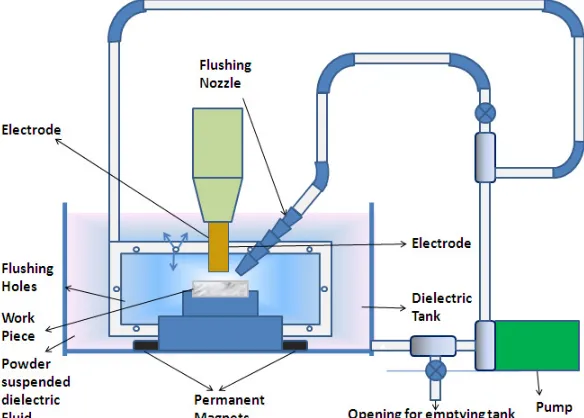
Figure 1 shows line diagram of experimental setup used for experimentation. The experiments have been performed on T- 3822 EDM machine manufactured by Electronica. The points considered in designing PMEDM set-up are-
The powder should not enter the main dielectric tank to avoid filtering of powder particles
[image:4.612.161.453.317.526.2]The dielectric should be continuously stirred or circulated to prevent settling of the powder and to maintain uniform concentration.
Figure 1. Line diagram of experimental setup
3.2Materials used in Experiments
The work piece material used in this study is EN-8 steel. The chemical composition of steel as
determined by optical emission spectrophotometer analysis is summarized in TABLE 1. Other
[image:5.612.129.483.174.301.2]specifications of material given by manufacturer are given in TABLE 2.
TABLE 1: Chemical composition of steel EN-8 Steel
composition
C% Si% Mn% S% P% Iron
0.35 0.09 0.67 0.20% 0.015% Rest
TABLE 2: Specifications of work piece material Specifications
of EN-8
Hardening Temp
Quenching Medium
Tempering Temperature
750-900 Oil 150-200
Commercial copper with 99% purity (having electrical conductivity 5.69 × 10⁷ S/M) has been
applied as tool electrode. By spectrophotometer analysis the composition of electrode material
has been determined. Three different electrodes of constant cross-sectional area of 50 mm2 and
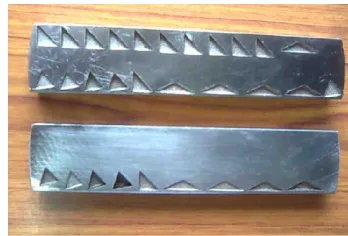
varying angles of 500, 900 and 1300have been manufactured on wire-cut EDM machine. The
fabricated electrodes are shown in Figure 2. Commercial kerosene has been used as dielectric
fluid. The specifications have been summarized in TABLE 3.
Figure 2 Fabricated copper electrodes
TABLE 3: Specifications of kerosene oil Specifications
Kerosene
Dielectric constant
Electrical conductivity
Density Dynamic viscosity
1.8 1.6×10⁻¹⁴
S/m
730 0.94 m
Pas
[image:5.612.142.476.426.647.2]Also, the properties of chromium powder suspended in dielectric have been summarized in
TABLE 4: Specifications of powder used
Particle size Cr
%
C% S% P% Si% Al% Fe% Sieve
Analysis -325 Mesh
Electrical Conductivity
45-55 µm 99 0.01 0.015 0.015 0.09 0.08 0.01 97% 7.9x 10⁶ S m-1
3.3 Experimental Settings
Following experimental settings has been applied in study.
TABLE 5: Experimental settings Experimental
settings
Polarity Supply Volt Dielectric
flow rate
Power factor Machining time
Positive 415, 3phase,50
Hz
500 Lit/hr 0.3 15 inutes
4. DESIGN OF EXPERIMENTS
4.1Selection of Design Factors
The status of chromium powder particles mixed into the dielectric fluid has a significant role in determining and evaluating the EDM characteristics of a product. There are many design factors to be considered concerning the effects of chromium powder particles, but in this study concentration of suspended powder particles has been taken as variable. In addition, the
discharge current (IP, A) and pulse on time (τP, µs) were only taken into account as design
factors. The reason why these two factors have been chosen is that they are the most general and frequently used among EDM researchers. Electrode angle has also been selected as design factor
[image:6.612.218.392.555.673.2]as electrode shape parameter. Figure 3 is final work piece.
4.2 Selection of Response Variables
The response variables selected in this study were MRR and TWR. Both MRR and TWR refer to the machining efficiency of the PMEDM process and the wear of copper electrode, respectively, and are defined as follows.
MRR (mm3/min) = (Wear weight of work piece)/ (time of machining× density of work piece
material)
TWR (mm3/min) = (Wear weight of tool electrode)/ (time of machining× density of electrode
material)
The work piece and electrode were weighed before and after each experiment using an electric balance with a resolution of 0.001 mg to determine the value of MRR and TWR. For efficient evaluation of the PMEDM process, the larger MRR and the smaller TWR are regarded as the best machining performance. Therefore, the MRR is considered as a “the larger-the-better characteristic” and the TWR is considered as “the smaller-the-better characteristic” in this experimentation.
4.3 Experimental Design
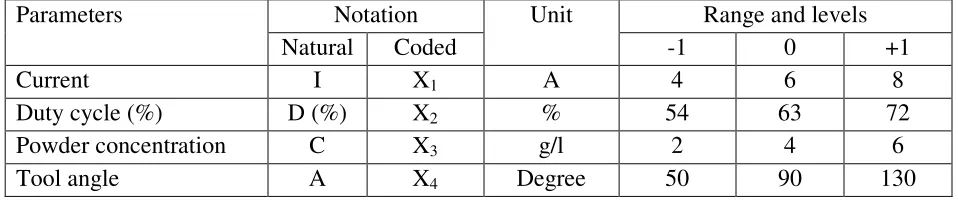
Response surface methodology (RSM) is used in design matrix formation which is an empirical modeling approach using polynomials as the local approximations to obtain true input/output relationships. The experimental plans were designed on the basis of the central composite design (CCD) technique of RSM. The factorial portion of CCD is a full factorial design with all combinations of the factors at two levels (high, +1 and low, −1) and composed of the eight star points and seven central points (coded level 0). Central points are the midpoint between the high and low levels. The star points are at the face of the cube portion on the design that corresponds to an α value of 1, and this type of design is commonly called the “face-centered CCD”. In this study, the experimental plan was conducted using the stipulated conditions according to the face-centered CCD and involved a total of 30 experimental observations at four independent input variables. The machining time for each experimental specimen is 15 min. This was set up before the operation of the machine reached the stable state. The levels of design factors have been selected in accordance with literature consulted as well as by personal experience. The design
factors selected for study with their low and high levels are summarized in TABLE 6.
TABLE 6: Process parameters and their levels
Parameters Notation Unit Range and levels
Natural Coded -1 0 +1
Current I X1 A 4 6 8
Duty cycle (%) D (%) X2 % 54 63 72
Powder concentration C X3 g/l 2 4 6
Tool angle A X4 Degree 50 90 130
5. RESPONSE SURFACE MODELING
As stated earlier Response surface methodology has been applied for modeling and analysis of parameters. The quantitative relationship between desired responses and independent process variables can be represented as
Y= f (X1, X2, X3, ………. Xn)
Where Y is the desired response, f is the response function and X1, X2... are independent parameters. By plotting the expected responses, a surface known as Response surface is
obtained. RSM aims at approximating f by using the fitted second order polynomial regression
model which is called the quadratic model. The model can be represented as follows- n n
Y=C0+ ∑ Ci Xn +∑ di Xi2 ± €
I=1 i=1
6. RESULTS AND DISCUSSIONS
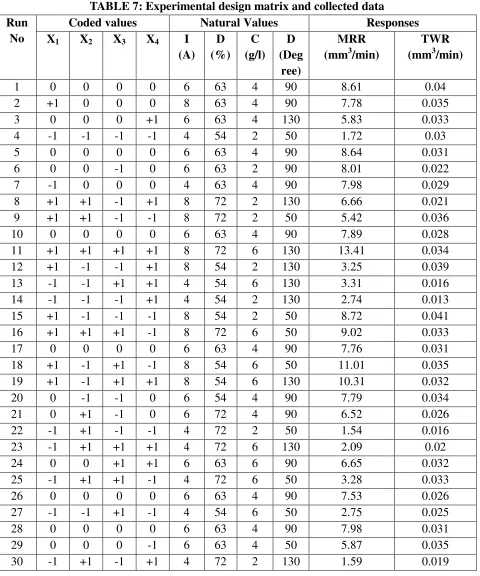
30 experimental runs have been conducted and values of MRR and TWR along with design
matrix are given in TABLE 7 to avoid any systematic error creeping into system. Analysis of
TABLE 7: Experimental design matrix and collected data Run
No
Coded values Natural Values Responses X1 X2 X3 X4 I
(A) D (%) C (g/l) D (Deg ree) MRR (mm3/min)
TWR (mm3/min)
1 0 0 0 0 6 63 4 90 8.61 0.04
2 +1 0 0 0 8 63 4 90 7.78 0.035
3 0 0 0 +1 6 63 4 130 5.83 0.033
4 -1 -1 -1 -1 4 54 2 50 1.72 0.03
5 0 0 0 0 6 63 4 90 8.64 0.031
6 0 0 -1 0 6 63 2 90 8.01 0.022
7 -1 0 0 0 4 63 4 90 7.98 0.029
8 +1 +1 -1 +1 8 72 2 130 6.66 0.021
9 +1 +1 -1 -1 8 72 2 50 5.42 0.036
10 0 0 0 0 6 63 4 90 7.89 0.028
11 +1 +1 +1 +1 8 72 6 130 13.41 0.034
12 +1 -1 -1 +1 8 54 2 130 3.25 0.039
13 -1 -1 +1 +1 4 54 6 130 3.31 0.016
14 -1 -1 -1 +1 4 54 2 130 2.74 0.013
15 +1 -1 -1 -1 8 54 2 50 8.72 0.041
16 +1 +1 +1 -1 8 72 6 50 9.02 0.033
17 0 0 0 0 6 63 4 90 7.76 0.031
18 +1 -1 +1 -1 8 54 6 50 11.01 0.035
19 +1 -1 +1 +1 8 54 6 130 10.31 0.032
20 0 -1 -1 0 6 54 4 90 7.79 0.034
21 0 +1 -1 0 6 72 4 90 6.52 0.026
22 -1 +1 -1 -1 4 72 2 50 1.54 0.016
23 -1 +1 +1 +1 4 72 6 130 2.09 0.02
24 0 0 +1 +1 6 63 6 90 6.65 0.032
25 -1 +1 +1 -1 4 72 6 50 3.28 0.033
26 0 0 0 0 6 63 4 90 7.53 0.026
27 -1 -1 +1 -1 4 54 6 50 2.75 0.025
28 0 0 0 0 6 63 4 90 7.98 0.031
29 0 0 0 -1 6 63 4 50 5.87 0.035
6.1 Analysis of MRR
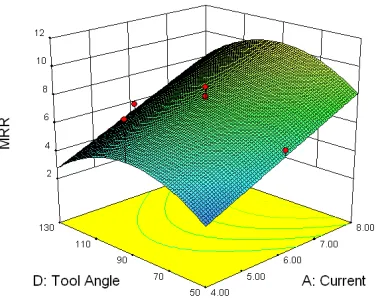
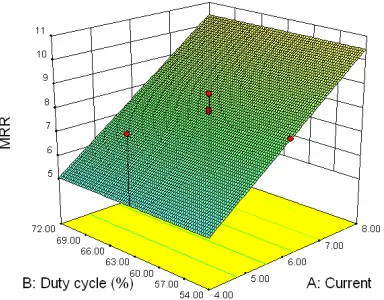
[image:10.612.213.402.266.415.2]Figure 4, Figure 5 and Figure 6 shows the estimated response surface for MRR in relation to the design parameters of average current with tool angle, powder concentration and duty cycle. As can be seen from these figures, the MRR tends to increase, considerably with increase in current for any value of other factors. Hence, maximum MRR is obtained at high current. The MRR increases with increase in tool angle owing to increase in current. After certain level, the MRR tends to decrease due to inefficient flushing. MRR is found to increase with duty cycle and powder concentration. Powder concentration has much significant effect on MRR.
[image:10.612.203.406.500.660.2]Figure 4 Response surface for MRR showing effect of current and tool angle and powder concentration
Figure 6 Response surface for MRR showing effect of current and duty cycle
6.2 Analysis of TWR
[image:11.612.216.396.359.497.2] [image:11.612.211.407.527.677.2]Figure 7, Figure 8 and Figure 9 shows the estimated response surface for TWR in relation to the design parameters of average current with tool angle, powder concentration and duty cycle. As can be seen from these figures, only current and electrode angle are dominant parameter affecting TWR. The TWR decreases with increase in tool angle.
Figure 7 Response surface for TWR showing effect of current and powder concentration
Figure 9 Response surface for TWR showing effect of current and tool angle
6.3 Parametric Optimization
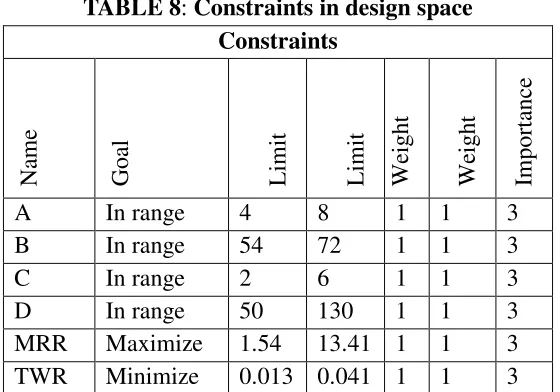
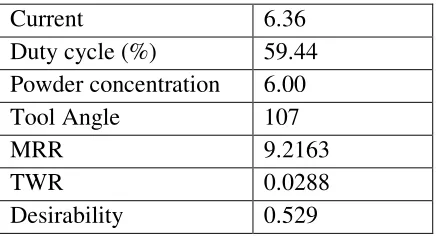
Optimization of parameters with the help of software suggests the following results. Following
constraints on the design space has been applied as shown in TABLE 8.
TABLE 8: Constraints in design space Constraints
N
am
e
G
o
al
L
im
it
L
im
it
W
ei
g
h
t
W
ei
g
h
t
Im
p
o
rt
an
ce
A In range 4 8 1 1 3
B In range 54 72 1 1 3
C In range 2 6 1 1 3
D In range 50 130 1 1 3
MRR Maximize 1.54 13.41 1 1 3
TWR Minimize 0.013 0.041 1 1 3
[image:12.612.167.447.407.603.2]TABLE 9: Optimum value in design space
Current 6.36
Duty cycle (%) 59.44
Powder concentration 6.00
Tool Angle 107
MRR 9.2163
TWR 0.0288
Desirability 0.529
7. CONCLUSIONS
In this article, quantitative analysis of machinability of EN-8 steel in PMEDM process has been carried out. Chromium powder particles are mixed in EDM dielectric fluid. RSM has been applied for analysis. Optimum results have been found as suggested by software.
REFERENCE
1. W.S. Zhao, Q.G. Meng and Z.L. Wang, “The application of research on powder mixed EDM
in rough machining, J. Mater. Process. Technol.129, 30–33, 2002.
2. R.K. Garg, K.K. Singh, A. Sachdeva, V.S. Sharma, K. Ojha and S. Singh, “Review of
research work in sinking EDM and WEDM on metal matrix composite materials” The International Journal of Advanced Manufacturing Technology, Volume 50, Numbers 5-8, 611-624, DOI: 10.1007/s00170-010-2534-5, 2010.
3. Y.F. Tzeng and C.Y. Lee, “Effects of powder characteristics on electro discharge machining
efficiency”, Int. J. Adv. Manuf. Technol. 17 (2001)586–592, 2001.
4. Y.F. Luo, “The dependence of interspace discharge transitivity upon the gap debris in
precision electro-discharge machining”, J. Mater. Process. Technol. 68, 127–131, 1997.
5. H. Narumiya, et al., “EDM by powder suspended working fluid”, in: Proceedings of the 9th
ISEM, pp. 5–8, 1989.
6. N. Mohri, N. Saito and M.A. Higashi, “A new process of finish machining on free surface by
EDM methods”, Ann. CIRP 40 (1), 207–210, 1991.
7. K.Furutani, A. Saneto, H. Takezawa, N. Mohri and H. Miyake, “Accertation of titanium
carbide by electrical discharge machining with powder suspended in working fluid”, Prec. Eng. 25, 138–144, 2001.
8. F.Y. Tzeng and Fu Chen, “A simple approach for robust design of high speed
electrical-discharge machining technology”, Int. J. Mach. Tool Manuf. 43, 217–227, 2003.
9. M. Kunieda and K. Yanatori, “Study on debris movement in EDM gap”, Int. J. Electr. Mach.
10.A. Erden and S. Bilgin, “Role of impurities in electric discharge machining”, in: Proceedings of the 21st International Machine Tool Design and Research Conference, Macmillan, London, pp. 345– 350, 1980.
11.M.L. Jeswani, “Effects of the addition of graphite powder to kerosene used as the dielectric
fluid in electrical discharge machining”, Wear 70, 133–139, 1981.
12.N. Mohri, et al., “Mirror-like finishing by EDM”, in: Proceedings of the 25th International
Symposium on Machine Tool Design and Research, UK, pp. 329–336, 1985.
13.H. Kansal, S. Singh and P. Kumar, “State of the art concerning powder mixed EDM”, in:
Proceedings of the International Conference on Emerging Technology (ICET-2003) KIIT, Bhubansewar, India, 2003.
14.H. K. Kansal, S. Singh and P. Kumar, “Parametric optimization of powder mixed electrical
discharge machining by response surface methodology”, Journal of Materials Processing Technology 169, 427–436, 2005.
15.N. Mohri, J. Tsukamoto and M. Fujino, “Surface modification by EDM—an innovation in
EDM with semi-conductive electrodes”, in: Proceedings of Winter Annual Meet ASME, vol. 34, pp. 21–30, 1988.
16.N. Mohri, N. Saito and M.A. Higashi, “A new process of finish machining on free surface by
EDM methods”, Ann. CIRP 40 (1), 207–210, 1981.
17.B.H. Yan and S.L. Chen, “Effects of dielectric with suspended aluminum powder on EDM”,
J. Chin. Soc. Mech. Eng. 14 (3), 307–312, 1993.
18.B.H. Yan and S.L. Chen, “Characteristics of SKD11 by complex process of electric
discharge machining using liquid suspended with aluminum powder”, J. Jpn. Inst. Light Met. 58 (9), 1067–1072, 1994.
19.B.H. Yan and S.L. Chen, “Effect of ultrasonic vibration on electrical discharge machining
characteristics of Ti–6Al–4V alloy”, J. Jpn. Inst. Light Met. 44 (5), 281–285, 1994.
20.Y. Uno and A. Okada, “Surface generation mechanism in electrical discharge machining
with silicon powder mixed fluid”, Int. J. Elec. Mach. 2, 13–18, 1997.
21.Y.S. Wong, L.C. Lim, I. Rahuman and W.M. Tee, “Near-mirror-finish phenomenon in EDM
using powder-mixed dielectric”, Int. J. Adv. Manuf. Technol. 79, 30–40, 1998.
22.B.H. Yan, Y.C. Lin, F.Y. Huang and C.H. Wang, “Surface modification of SKD 61 during
EDM with metal powder in the dielectric”, Mater Trans 42(12):2597–2604, 2004.
23.K.L. Wu, B.H. Yan, F.Y. Huang and S.C. Chen, “Improvement of surface finish on SKD
steel using electro-discharge machining with aluminum and surfactant added dielectric”, Int J Mach Tools Manu 45:1195–1201, 2005.
24.K. Kobayashi, T. Magara, Y. Ozaki and T. Yatomi, “The present and future developments of
electrical discharge machining”, in: Proceedings of 2nd International Conference on Die and Mould Technology, Singapore, pp. 35–47, 1992.
25.Y. Uno, A. Okada, Y. Hayashi and Y. Tabuchi, “Surface integrity in EDM of aluminum
26.A. Okada, Y. Uno and K. Hirao, “Formation of hard layer by EDM with carbon powder mixed fluid using titanium electrode”, in: Proceedings of 5th International Conference on Progress of Machining Technology, pp. 464–469, 2000.
27.H.M. Chow, B.H. Yan, F.Y. Huang and J.C. Hung, “Study of added powder in kerosene for
the micro-slit machining of titanium alloy using electro-discharge machining”, J. Mater. Process. Technol. 101, 95–103, 2000.
28.Wang, C.H., Lin, Y.C., Yan, B.H., Huang, F.Y. (2001), “Effect of characteristics of added
powder on electrical discharge machining”, J. Jpn. Inst. Light Met., 42(12), 2597-2604.
29.K. Furutani and K. Shiraki, “Deposition of lubricant layer during finishing process by
electrical discharge machining with molybdenum disulphide powder suspended in working fluid”, in: JSME/ASME International Conference on Materials and Processing, 2002, pp. 468–473, 2002.
30.J. Simao, “Work piece surface modification using electrical discharge machining”, Int. J.
Mach. Tools Manuf. 43, 121–128, 2003.
31.P. Pecas and E.A. Henriques, “Influence of silicon powder mixed dielectric on conventional
electrical discharge machining”, Int. J. Mach. Tools Manuf. 43, 1465–1471, 2003.
32.C. Cogun, B. Ozerkan and T.Karacay, “An experimental investigation on the effect of
powder mixed dielectric on machining performance in electrical discharge machining”, J. Engineering Manufacture, Proc. IMechE Vol. 220 Part B, 1035-1050, 2006.
33.H.K. Kansal, S. Singh and P. Kumar, “Effect of Silicon powder mixed EDM on machining
rate of AISI D2 die Steel”, Journal of Manufacturing Processes Vol. 9/No. 1, 2007.
34.P. Peças and E. Henriques, “Effect of the powder concentration and dielectric flow in the
surface morphology in electrical discharge machining with powder-mixed dielectric (PMD-EDM)”, Int J Adv Manuf Technol, 37:1120–1132, DOI 10.1007/s00170-007-1061-5, 2008.
35.P. Peças and E. Henriques, “Electrical discharge machining using simple and powder-mixed
dielectric: The effect of the electrode area in the surface roughness and topography”, journal of materials processing technology 200, 250–258, 2008.
36.G.S. Prihandana, M. Mahardika, M. Hamdi, Y.S.Wong and Kimiyuki Mitsui, “Effect of
micro-powder suspension and ultrasonic vibration of dielectric fluid in micro-EDM processes—Taguchi approach”, International Journal of Machine Tools & Manufacture, 49, 1035–1041, 2009.
37.K. Furutani, H. Sato and M. Suzuki, “Influence of electrical conditions on performance of
electrical discharge machining with powder suspended in working oil for titanium carbide deposition process”, Int J Adv Manuf Technol, 40:1093–1101, DOI 10.1007/s00170-008-1420-x, 2009.
38. K.Y. Kung , J.T. Horng and K.T. Chiang, “Material removal rate and electrode wear ratio
study on the powder mixed electrical discharge machining of cobalt-bonded tungsten carbide”, Int J Adv Manuf Technol, 40:95–104 DOI 10.1007/s00170-007-1307-2, 2009.
39.Ojha, K., Garg, R.K. and Singh, K.K., (2011) “The Effect of Nickel Micro Powder
Engineering and Applied Sciences, Year: 2011, Volume: 6, Issue: 1, Page No.: 27-37, DOI: 10.3923/jeasci.2011.27.37
40.K. Ojha and R.K. Garg, “Parametric Optimization of PMEDM Process with Nickel Micro
Powder Suspended Dielectric and Varying Triangular Shapes Electrodes on EN-19 Steel”, Journal of Engineering and Applied Sciences, Volume: 6, Issue: 2, Page No.: 152-156, DOI: 10.3923/jeasci.2011.152.156, 2011.
41.K. Ojha, R.K. Garg and K.K. Singh, “MRR Improvement in Sinking Electrical Discharge
Machining: A Review”, Journal of Minerals & Materials Characterization & Engineering, Vol. 9, No.8, pp.709-739, 2010.
42.K. Ojha and R.K. Garg, “A review of tool electrode designs for sinking EDM process”,
Published and presented in WSEAS International Conference on Robotics Control and Manufacturing Technology (ROCOM '11), Venice, Italy in March 8-10, 2011.
43.K. Ojha, R.K. Garg and K.K. Singh, “Innovative tool electrode designs for sinking EDM