TransG : A Generative Model for Knowledge Graph Embedding
Han Xiao, Minlie Huang∗, Xiaoyan Zhu
State Key Lab. of Intelligent Technology and Systems National Lab. for Information Science and Technology
Dept. of Computer Science and Technology Tsinghua University, Beijing 100084, PR China {aihuang, zxy-dcs}@tsinghua.edu.cn
Abstract
Recently, knowledge graph embedding, which projects symbolic entities and rela-tions into continuous vector space, has be-come a new, hot topic in artificial intelli-gence. This paper proposes a novel gen-erative model (TransG) to address the is-sue ofmultiple relation semanticsthat a relation may have multiple meanings re-vealed by the entity pairs associated with the corresponding triples. The new model can discover latent semantics for a rela-tion and leverage a mixture of relarela-tion- relation-specific component vectors to embed a fact triple. To the best of our knowledge, this is the first generative model for knowl-edge graph embedding, and at the first time, the issue of multiple relation seman-tics is formally discussed. Extensive ex-periments show that the proposed model achieves substantial improvements against the state-of-the-art baselines.
1 Introduction
Abstract or real-world knowledge is always a ma-jor topic in Artificial Intelligence. Knowledge bases such as Wordnet (Miller, 1995) and Free-base (Bollacker et al., 2008) have been shown very useful to AI tasks including question answering, knowledge inference, and so on. However, tra-ditional knowledge bases are symbolic and logic, thus numerical machine learning methods can-not be leveraged to support the computation over the knowledge bases. To this end, knowledge graph embedding has been proposed to project en-tities and relations into continuous vector spaces. Among various embedding models, there is a line
∗ Correspondence author
[image:1.595.307.525.286.522.2]of translation-based models such as TransE (Bor-des et al., 2013), TransH (Wang et al., 2014), TransR (Lin et al., 2015b), and other related mod-els (He et al., 2015) (Lin et al., 2015a).
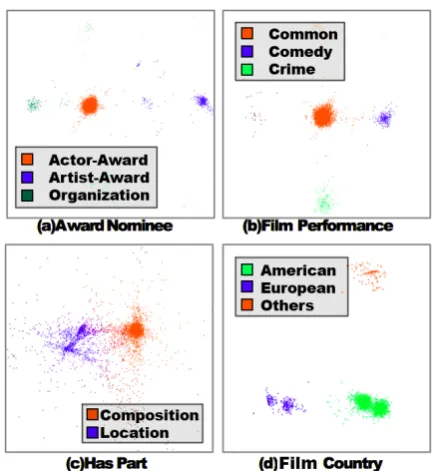
Figure 1: Visualization of TransE embedding vec-tors with PCA dimension reduction. Four relations (a ∼ d) are chosen from Freebase and Wordnet. A dot denotes a triple and its position is decided by the difference vector between tail and head en-tity (t−h). Since TransE adopts the principle of
t−h≈r, there is supposed to be only one cluster whose centre is the relation vectorr. However, re-sults show that there exist multiple clusters, which justifies our multiple relation semantics assump-tion.
A fact of knowledge base can usually be rep-resented by a triple (h, r, t)whereh, r, t indicate a head entity, a relation, and a tail entity, respec-tively. All translation-based models almost follow the same principlehr+r≈trwherehr,r,tr
dicate the embedding vectors of triple (h, r, t), with the head and tail entity vector projected with respect to the relation space.
In spite of the success of these models, none of the previous models has formally discussed the issue of multiple relation semantics that a relation may have multiple meanings revealed by the entity pairs associated with the corresponding triples. As can be seen from Fig. 1, visualization results on embedding vectors obtained from TransE (Bordes et al., 2013) show that, there are different clusters for a specific relation, and different clusters indicate different latent semantics. For example, the relation HasPart has at least two latent semantics: composition-related as (Table, HasPart, Leg) and location-related as (Atlantics, HasPart, NewYorkBay). As one more example, in Freebase, (Jon Snow, birth place, Winter Fall) and (George R. R. Martin, birth place, U.S.) are mapped to schema /fic-tional universe/fic/fic-tional character/place of birth and /people/person/place of birth respectively, indicating thatbirth placehas different meanings. This phenomenon is quite common in knowledge bases for two reasons: artificial simplification and nature of knowledge. On one hand, knowledge base curators could not involve too many similar relations, so abstracting multiple similar relations into one specific relation is a common trick. On the other hand, both language and knowledge representations often involve ambiguous infor-mation. The ambiguity of knowledge means a semantic mixture. For example, when we mention “Expert”, we may refer to scientist, businessman or writer, so the concept “Expert” may be ambigu-ous in a specific situation, or generally a semantic mixture of these cases.
However, since previous translation-based mod-els adopthr+r≈tr, they assign only one
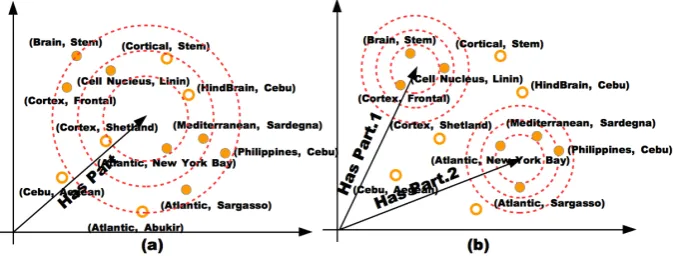
trans-lation vector for one retrans-lation, and these models are not able to deal with the issue of multiple relation semantics. To illustrate more clearly, as showed in Fig.2, there is only one unique representation for relation HasPart in traditional models, thus the models made more errors when embedding the triples of the relation. Instead, in our proposed model, we leverage a Bayesian non-parametric in-finite mixture model to handle multiple relation se-mantics by generating multiple translation compo-nents for a relation. Thus, different semantics are characterized by different components in our
em-bedding model. For example, we can distinguish the two clusters HasPart.1orHasPart.2, where the relation semantics are automatically clustered to represent the meaning of associated entity pairs. To summarize, our contributions are as follows: • We propose a new issue in knowledge graph embedding,multiple relation semanticsthat a relation in knowledge graph may have dif-ferent meanings revealed by the associated entity pairs, which has never been studied previously.
• To address the above issue, we propose a novel Bayesian non-parametric infinite mix-ture embedding model, TransG. The model can automatically discover semantic clusters of a relation, and leverage a mixture of multi-ple relation components for translating an en-tity pair. Moreover, we present new insights from the generative perspective.
• Extensive experiments show that our pro-posed model obtains substantial improve-ments against the state-of-the-art baselines.
2 Related Work
Translation-Based Embedding. Existing translation-based embedding methods share the same translation principle h+r≈t and the score function is designed as:
fr(h, t) =||hr+r−tr||22
where hr,tr are entity embedding vectors
pro-jected in the relation-specific space.TransE (Bor-des et al., 2013), lays the entities in the original en-tity space: hr=h,tr=t. TransH(Wang et al.,
2014) projects entities into a hyperplane for ad-dressing the issue of complex relation embedding:
hr =h−w>rhwr,tr=t−wr>twr. To address
the same issue,TransR(Lin et al., 2015b), trans-forms the entity embeddings by the same relation-specific matrix: hr =Mrh,tr=Mrt. TransR
also proposes an ad-hoc clustering-based method,
Figure 2: Visualization of multiple relation semantics. The data are selected from Wordnet. The dots are correct triples that belong toHasPartrelation, while the circles are incorrect ones. The point coor-dinate is the difference vector between tail and head entity, which should be near to the centre. (a) The correct triples are hard to be distinguished from the incorrect ones. (b) By applying multiple semantic components, our proposed model could discriminate the correct triples from the wrong ones.
2014) leverages the structure of the knowledge graph via pre-calculating the distinct weight for each training triple to enhance embedding.KG2E
(He et al., 2015) is a probabilistic embedding method for modeling the uncertainty in knowledge graph.
There are many works to improve translation-based methods by considering other information. For instance, (Guo et al., 2015) aims at discov-ering the geometric structure of the embedding space to make it semantically smooth. (Wang et al., 2014) focuses on bridging the gap between knowledge and texts, with a loss function for jointly modeling knowledge graph and text re-sources. (Wang et al., 2015) incorporates the rules that are related with relation types such as 1-N and N-1. PTransE(Lin et al., 2015a) takes into ac-count path information in knowledge graph.
Since the previous models are point-wise mod-eling methods,ManifoldE(Xiao et al., 2016) pro-poses a novel manifold-based approach for knowl-edge graph embedding. In aid of kernel tricks, manifold-based methods can improve embedding performance substantially.
Structured & Unstructured Embedding. The structured embedding model (Bordes et al., 2011) transforms the entity space with the head-specific and tail-specific matrices. The score function is defined as fr(h, t) = ||Mh,rh−Mt,rt||.
Ac-cording to (Socher et al., 2013), this model cannot capture the relationship between entities. Seman-tic Matching Energy (SME) (Bordes et al., 2012) (Bordes et al., 2014) can handle the correlations between entities and relations by matrix product
and Hadamard product. The unstructured model (Bordes et al., 2012) may be a simplified version of TransE without considering any relation-related information. The score function is directly defined asfr(h, t) =||h−t||22.
Neural Network based Embedding. Sin-gle Layer Model (SLM) (Socher et al., 2013) applies neural network to knowledge graph embedding. The score function is defined as fr(h, t) = u>rg(Mr,1h+Mr,2t) where
Mr,1,Mr,2 are relation-specific weight
matri-ces. Neural Tensor Network (NTN) (Socher et al., 2013) defines a very expressive score function by applying tensor: fr(h, t) = u>
rg(h>W··rt+Mr,1h+Mr,2t+br), where
ur is a relation-specific linear layer, g(·) is the
tanhfunction,W∈Rd×d×kis a 3-way tensor. Factor Models. The latent factor models (Jenat-ton et al., 2012) (Sutskever et al., 2009) attempt to capturing the second-order correlations between entities by a quadratic form. The score function is defined asfr(h, t) = h>Wrt. RESCAL is a
collective matrix factorization model which is also a common method in knowledge base embedding (Nickel et al., 2011) (Nickel et al., 2012).
3 Methods
3.1 TransG: A Generative Model for Embedding
mix-ture embedding model (Griffiths and Ghahramani, 2011). The generative process of the model is as follows:
1. For an entitye∈E:
(a) Draw each entity embedding mean vec-tor from a standard normal distribution as a prior: uevN(0,1).
2. For a triple(h, r, t)∈∆:
(a) Draw a semantic component from Chi-nese Restaurant Process for this relation: πr,m∼CRP(β).
(b) Draw a head entity embedding vec-tor from a normal distribution: h v
N(uh, σ2hE).
(c) Draw a tail entity embedding vec-tor from a normal distribution: t v
N(ut, σt2E).
(d) Draw a relation embedding vector for this semantics: ur,m = t−h v
N(ut−uh,(σ2h+σt2)E).
where uh and ut indicate the mean embedding
vector for head and tail respectively, σh and σt
indicate the variance of corresponding entity dis-tribution respectively, andur,m is them-th
com-ponent translation vector of relation r. Chinese Restaurant Process (CRP) is a Dirichlet Process and it can automatically detect semantic compo-nents. In this setting, we obtain the score function as below:
P{(h, r, t)} ∝
Mr
X
m=1
πr,mP(ur,m|h, t)
= XMr
m=1
πr,me−
||uh+ur,m−ut||22
σ2h+σ2t (1)
where πr,m is the mixing factor, indicating the
weight of i-th component and Mr is the number
of semantic components for the relationr, which is learned from the data automatically by the CRP. Inspired by Fig.1, TransG leverages a mixture of relation component vectors for a specific re-lation. Each component represents a specific la-tent meaning. By this way, TransG could distin-guish multiple relation semantics. Notably, the CRP could generate multiple semantic compo-nents when it is necessary and the relation seman-tic component number Mr is learned adaptively
[image:4.595.308.527.71.158.2]from the data.
Table 1: Statistics of datasets
Data WN18 FB15K WN11 FB13
#Rel 18 1,345 11 13
#Ent 40,943 14,951 38,696 75,043 #Train 141,442 483,142 112,581 316,232 #Valid 5,000 50,000 2,609 5,908
#Test 5,000 59,071 10,544 23,733
3.2 Explanation from the Geometry Perspective
Similar to previous studies, TransG has geometric explanations. In the previous methods, when the relationr of triple(h, r, t)is given, the geometric representations are fixed, ash+r≈t. However, TransG generalizes this geometric principle to:
m∗
(h,r,t)= arg maxm=1...Mr πr,me
−||uh+ur,m−ut||22 σ2h+σ2t
!
h+ur,m∗
(h,r,t) ≈t (2)
where m∗
(h,r,t) is the index of primary compo-nent. Though all the components contribute to the model, the primary one contributes the most due to the exponential effect (exp(·)). When a triple
(h, r, t) is given, TransG works out the index of primary component then translates the head entity to the tail one with the primary translation vector.
For most triples, there should be only one com-ponent that have significant non-zero value as
πr,me−
||uh+ur,m−ut||22
σh2+σ2t
!
and the others would be small enough, due to the exponential decay. This property reduces the noise from the other semantic components to better characterize mul-tiple relation semantics. In detail, (t−h) is al-most around only one translation vectorur,m∗
(h,r,t)
in TransG. Under the condition m 6= m∗ (h,r,t),
||uh+ur,m−ut||22 σ2
h+σ2t
is very large so that the expo-nential function value is very small. This is why the primary component could represent the corre-sponding semantics.
Table 2: Evaluation results on link prediction
Datasets WN18 FB15K
Metric RawMean RankFilter RawHITS@10(%)Filter RawMean RankFilter RawHITS@10(%)Filter Unstructured (Bordes et al., 2011) 315 304 35.3 38.2 1,074 979 4.5 6.3
RESCAL (Nickel et al., 2012) 1,180 1,163 37.2 52.8 828 683 28.4 44.1
SE(Bordes et al., 2011) 1,011 985 68.5 80.5 273 162 28.8 39.8
SME(bilinear) (Bordes et al., 2012) 526 509 54.7 61.3 284 158 31.3 41.3
LFM (Jenatton et al., 2012) 469 456 71.4 81.6 283 164 26.0 33.1
TransE (Bordes et al., 2013) 263 251 75.4 89.2 243 125 34.9 47.1
TransH (Wang et al., 2014) 401 388 73.0 82.3 212 87 45.7 64.4
TransR (Lin et al., 2015b) 238 225 79.8 92.0 198 77 48.2 68.7
CTransR (Lin et al., 2015b) 231 218 79.4 92.3 199 75 48.4 70.2
PTransE (Lin et al., 2015a) N/A N/A N/A N/A 207 58 51.4 84.6
KG2E (He et al., 2015) 362 348 80.5 93.2 183 69 47.5 71.5
TransG (this paper) 357 345 84.5 94.9 152 50 55.9 88.2
TransG have their own contributions, but the pri-mary one makes the most.
3.3 Training Algorithm
The maximum data likelihood principle is applied for training. As to the non-parametric part, πr,m
is generated from the CRP with Gibbs Sampling, similar to (He et al., 2015) and (Griffiths and Ghahramani, 2011). A new component is sampled for a triple (h,r,t) with the below probability:
P(mr,new) = βe
− ||h−t||22 σ2h+σ2t+2
βe− ||h−t||22
σ2h+σ2t+2 +P{(h, r, t)}
(3)
whereP{(h, r, t)}is the current posterior prob-ability. As to other parts, in order to better distin-guish the true triples from the false ones, we max-imize the ratio of likelihood of the true triples to that of the false ones. Notably, the embedding vec-tors are initialized by (Glorot and Bengio, 2010). Putting all the other constraints together, the final objective function is obtained, as follows:
min uh,ur,m,utL
L=− X
(h,r,t)∈∆ ln
Mr
X
m=1
πr,me−
||uh+ur,m−ut||22
σ2h+σ2t
!
+ X
(h0,r0,t0)∈∆0 ln
XMr
m=1 πr0,me
−||uh0+σur20,m−ut0 ||22 h0+σ2t0
+C X
r∈R Mr
X
m=1
||ur,m||22+ X
e∈E
||ue||22 !
(4)
where∆is the set of golden triples and∆0 is the set of false triples. Ccontrols the scaling degree. Eis the set of entities andRis the set of relations. Noted that the mixing factorsπ and the variances σare also learned jointly in the optimization.
SGD is applied to solve this optimization prob-lem. In addition, we apply a trick to control the parameter updating process during training. For those very impossible triples, the update process is skipped. Hence, we introduce a similar condition as TransE (Bordes et al., 2013) adopts: the train-ing algorithm will update the embeddtrain-ing vectors only if the below condition is satisfied:
P{(h, r, t)}
P{(h0, r0, t0)} =
PMr
m=1πr,me
−||uh+ur,m−ut||22 σ2h+σ2t
PMr0
m=1πr0,me
−||uh0+σur20,m−ut0 ||22 h0+σ2t0
≤ Mreγ (5)
where(h, r, t) ∈ ∆and(h0, r0, t0) ∈ ∆0. γ con-trols the updating condition.
As to the efficiency, in theory, the time com-plexity of TransG is bounded by a small constant M compared to TransE, that is O(TransG) =
O(M ×O(TransE)) where M is the number of
Table 3: Evaluation results on FB15K by mapping properties of relations(%)
Tasks Predicting Head(HITS@10) Predicting Tail(HITS@10)
Relation Category 1-1 1-N N-1 N-N 1-1 1-N N-1 N-N
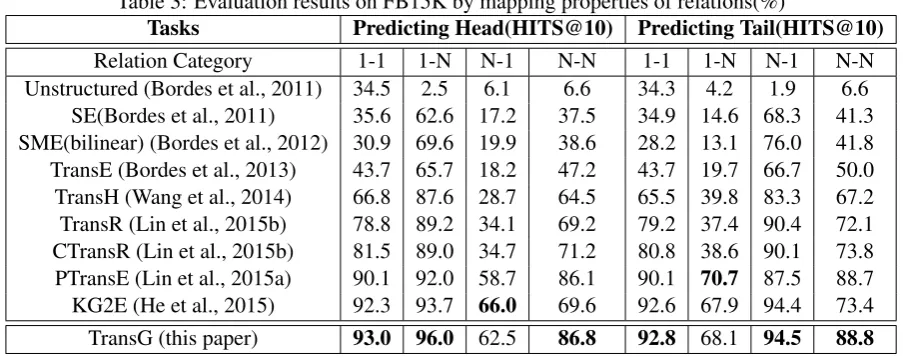
Unstructured (Bordes et al., 2011) 34.5 2.5 6.1 6.6 34.3 4.2 1.9 6.6 SE(Bordes et al., 2011) 35.6 62.6 17.2 37.5 34.9 14.6 68.3 41.3 SME(bilinear) (Bordes et al., 2012) 30.9 69.6 19.9 38.6 28.2 13.1 76.0 41.8 TransE (Bordes et al., 2013) 43.7 65.7 18.2 47.2 43.7 19.7 66.7 50.0 TransH (Wang et al., 2014) 66.8 87.6 28.7 64.5 65.5 39.8 83.3 67.2 TransR (Lin et al., 2015b) 78.8 89.2 34.1 69.2 79.2 37.4 90.4 72.1 CTransR (Lin et al., 2015b) 81.5 89.0 34.7 71.2 80.8 38.6 90.1 73.8 PTransE (Lin et al., 2015a) 90.1 92.0 58.7 86.1 90.1 70.7 87.5 88.7 KG2E (He et al., 2015) 92.3 93.7 66.0 69.6 92.6 67.9 94.4 73.4
TransG (this paper) 93.0 96.0 62.5 86.8 92.8 68.1 94.5 88.8
costs 1200.0s on the same computer for the same dataset.
4 Experiments
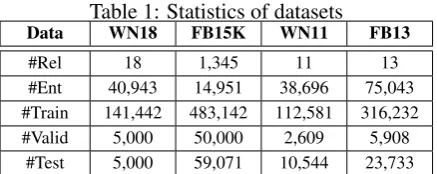
Our experiments are conducted on four public benchmark datasets that are the subsets of Word-net and Freebase, respectively. The statistics of these datasets are listed in Tab.1. Experiments are conducted on two tasks : Link Prediction and Triple Classification. To further demonstrate how the proposed model approaches multiple relation semantics, we present semantic component analy-sis at the end of this section.
4.1 Link Prediction
Link prediction concerns knowledge graph com-pletion: when given an entity and a relation, the embedding models predict the other missing en-tity. More specifically, in this task, we predictt given (h, r,∗), or predict h given (∗, r, t). The WN18 and FB15K are two benchmark datasets for this task. Note that many AI tasks could be en-hanced by Link Prediction such as relation extrac-tion (Hoffmann et al., 2011).
Evaluation Protocol.We adopt the same proto-col used in previous studies. For each testing triple
(h, r, t), we corrupt it by replacing the tailt(or the headh) with every entityein the knowledge graph and calculate a probabilistic score of this corrupted triple(h, r, e)(or(e, r, t)) with the score function fr(h, e). After ranking these scores in
descend-ing order, we obtain the rank of the original triple. There are two metrics for evaluation: the averaged rank (Mean Rank) and the proportion of testing triple whose rank is not larger than 10 (HITS@10). This is called “Raw” setting. When we filter out
the corrupted triples that exist in the training, val-idation, or test datasets, this is the“Filter” setting. If a corrupted triple exists in the knowledge graph, ranking it ahead the original triple is also accept-able. To eliminate this case, the “Filter” setting is preferred. In both settings, a lower Mean Rank and a higher HITS@10 mean better performance.
Implementation. As the datasets are the same, we directly report the experimental results of sev-eral baselines from the literature, as in (Bordes et al., 2013), (Wang et al., 2014) and (Lin et al., 2015b). We have attempted several settings on the validation dataset to get the best configuration. For example, we have tried the dimensions of 100, 200, 300, 400. Under the “bern.” sampling strat-egy, the optimal configurations are: learning rate α = 0.001, the embedding dimensionk = 100, γ = 2.5, β = 0.05 on WN18; α = 0.0015,
k = 400, γ = 3.0, β = 0.1 on FB15K. Note
that all the symbols are introduced in “Methods”. We train the model until it converges.
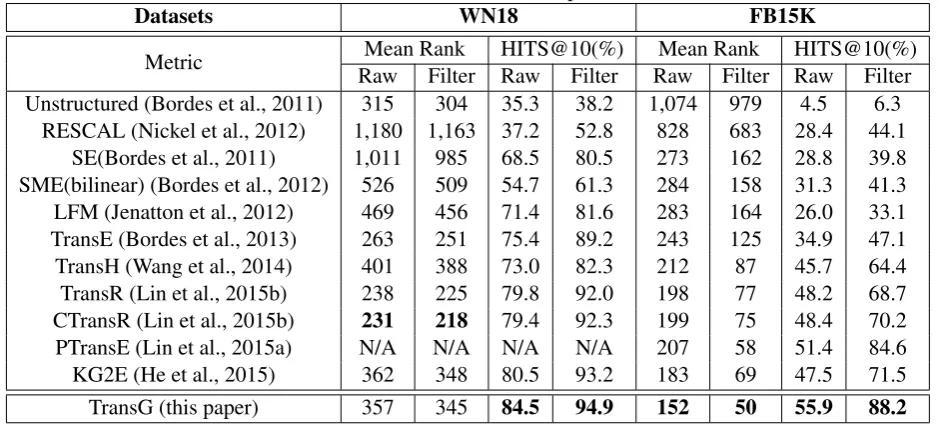
Results. Evaluation results on WN18 and FB15K are reported in Tab.2 and Tab.31. We
ob-serve that:
1. TransG outperforms all the baselines obvi-ously. Compared to TransR, TransG makes improvements by 2.9% on WN18 and 26.0% on FB15K, and the averaged semantic com-ponent number on WN18 is 5.67 and that on FB15K is 8.77. This result demonstrates cap-turing multiple relation semantics would ben-efit embedding.
1Note that correctly regularized TransE can produce much
Table 4: Different clusters in WN11 and FB13 relations.
Relation Cluster Triples (Head, Tail)
PartOf CompositionLocation (Monitor, Television), (Bush, Adult Body), (Cell Organ, Cell)...(Capital of Utah, Beehive State), (Hindustan, Bharat) ...
Religion CatholicismOthers (Michal Czajkowsk, Islam), (Honinbo Sansa, Buddhism) ...(Cimabue, Catholicism), (St.Catald, Catholicism) ...
DomainRegion AbstractSpecific (Computer Science, Security System), (Computer Science, PL)..(Computer Science, Router), (Computer Science, Disk File) ...
Profession BusinessmanScientist (Enoch Pratt, Entrepreneur), (Charles Tennant, Magnate)...(Michael Woodruf, Surgeon), (El Lissitzky, Architect)... Writer (Vlad. Gardin, Screen Writer), (John Huston, Screen Writer) ...
2. The model has a bad Mean Rank score on the WN18 dataset. Further analysis shows that there are 24 testing triples (0.5% of the test-ing set) whose ranks are more than 30,000, and these few cases would lead to about 150 mean rank loss. Among these triples, there are 23 triples whose tail or head entities have never been co-occurring with the correspond-ing relations in the traincorrespond-ing set. In one word, there is no sufficient training data for those relations and entities.
3. Compared to CTransR, TransG solves the multiple relation semantics problem much better for two reasons. Firstly, CTransR clus-ters the entity pairs for a specific relation and then performs embedding for each cluster, but TransG deals with embedding and multi-ple relation semantics simultaneously, where the two processes can be enhanced by each other. Secondly, CTransR models a triple by only one cluster, but TransG applies a mix-ture to refine the embedding.
Our model is almost insensitive to the dimen-sion if that is sufficient. For the dimendimen-sions of 100,200,300,400, the HITS@10 of TransG on FB15 are 81.8%,84.0%,85.8%,88.2%, while those of TransE are47.1%,48.5%,51.3%,49.2%.
4.2 Triple Classification
In order to testify the discriminative capability be-tween true and false facts, triple classification is conducted. This is a classical task in knowledge base embedding, which aims at predicting whether a given triple (h, r, t) is correct or not. WN11 and FB13 are the benchmark datasets for this task. Note that evaluation of classification needs nega-tive samples, and the datasets have already pro-vided negative triples.
Figure 3: Accuracies of each relations in WN11 for triple classification. The right y-axis is the number of semantic components, corresponding to the lines.
Evaluation Protocol. The decision process is very simple as follows: for a triple (h, r, t), if fr(h, t)is below a thresholdσr, then positive;
oth-erwise negative. The thresholds {σr} are
deter-mined on the validation dataset.
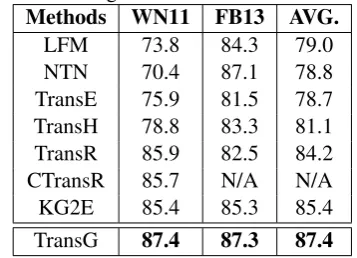
Table 5: Triple classification: accuracy(%) for dif-ferent embedding methods.
Methods WN11 FB13 AVG.
LFM 73.8 84.3 79.0
NTN 70.4 87.1 78.8
TransE 75.9 81.5 78.7
TransH 78.8 83.3 81.1
TransR 85.9 82.5 84.2
CTransR 85.7 N/A N/A
KG2E 85.4 85.3 85.4
TransG 87.4 87.3 87.4
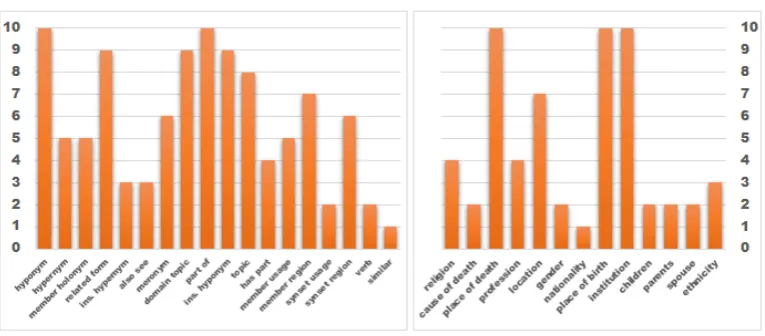
[image:7.595.325.504.568.697.2]Figure 4: Semantic component number on WN18 (left) and FB13 (right).
the best configuration. The optimal configurations of TransG are as follows: “bern” sampling, learn-ing rateα = 0.001, k = 50, γ = 6.0, β = 0.1
on WN11, and “bern” sampling, α = 0.002, k= 400,γ = 3.0,β = 0.1on FB13.
Results. Accuracies are reported in Tab.5 and Fig.3. The following are our observations:
1. TransG outperforms all the baselines remark-ably. Compared to TransR, TransG improves by 1.7% on WN11 and 5.8% on FB13, and the averaged semantic component number on WN11 is 2.63 and that on FB13 is 4.53. This result shows the benefit of capturing multiple relation semantics for a relation.
2. The relations, such as “Synset Domain” and “Type Of”, which hold more semantic ponents, are improved much more. In com-parison, the relation “Similar” holds only one semantic component and is almost not pro-moted. This further demonstrates that cap-turing multiple relation semantics can benefit embedding.
4.3 Semantic Component Analysis
In this subsection, we analyse the number of se-mantic components for different relations and list the component number on the dataset WN18 and FB13 in Fig.4.
Results.As Fig. 4 and Tab. 4 show, we have the following observations:
1. Multiple semantic components are indeed necessary for most relations. Except for re-lations such as “Also See”, “Synset Usage” and “Gender”, all other relations have more than one semantic component.
2. Different components indeed correspond to different semantics, justifying the theoretical analysis and effectiveness of TransG. For example, “Profession” has at least three semantics: scientist-related as (ElLissitzky,Architect),
businessman-related as
(EnochPratt,Entrepreneur) and
writer-related as(Vlad.Gardin,ScreenWriter).
3. WN11 and WN18 are different subsets of Wordnet. As we know, the semantic compo-nent number is decided on the triples in the dataset. Therefore, It’s reasonable that sim-ilar relations, such as “Synset Domain” and “Synset Usage” may hold different semantic numbers for WN11 and WN18.
5 Conclusion
In this paper, we propose a generative Bayesian non-parametric infinite mixture embedding model, TransG, to address a new issue, multiple relation semantics, which can be commonly seen in knowl-edge graph. TransG can discover the latent se-mantics of a relation automatically and leverage a mixture of relation components for embedding. Extensive experiments show our method achieves substantial improvements against the state-of-the-art baselines.
6 Acknowledgements
No. 61272227/61332007, and the Beijing Higher Education Young Elite Teacher Project.
References
Kurt Bollacker, Colin Evans, Praveen Paritosh, Tim Sturge, and Jamie Taylor. 2008. Freebase: a col-laboratively created graph database for structuring
human knowledge. InProceedings of the 2008 ACM
SIGMOD international conference on Management of data, pages 1247–1250. ACM.
Antoine Bordes, Jason Weston, Ronan Collobert, Yoshua Bengio, et al. 2011. Learning structured
embeddings of knowledge bases. InProceedings of
the Twenty-fifth AAAI Conference on Artificial Intel-ligence.
Antoine Bordes, Xavier Glorot, Jason Weston, and Yoshua Bengio. 2012. Joint learning of words and meaning representations for open-text semantic
parsing. In International Conference on Artificial
Intelligence and Statistics, pages 127–135.
Antoine Bordes, Nicolas Usunier, Alberto Garcia-Duran, Jason Weston, and Oksana Yakhnenko. 2013. Translating embeddings for modeling
multi-relational data. InAdvances in Neural Information
Processing Systems, pages 2787–2795.
Antoine Bordes, Xavier Glorot, Jason Weston, and Yoshua Bengio. 2014. A semantic matching en-ergy function for learning with multi-relational data.
Machine Learning, 94(2):233–259.
Miao Fan, Qiang Zhou, Emily Chang, and
Thomas Fang Zheng. 2014. Transition-based
knowledge graph embedding with relational map-ping properties. InProceedings of the 28th Pacific Asia Conference on Language, Information, and Computation, pages 328–337.
Alberto Garc´ıa-Dur´an, Antoine Bordes, Nicolas Usunier, and Yves Grandvalet. 2015. Combining two and three-way embeddings models for link
pre-diction in knowledge bases. CoRR, abs/1506.00999.
Xavier Glorot and Yoshua Bengio. 2010. Understand-ing the difficulty of trainUnderstand-ing deep feedforward neural networks. In International conference on artificial intelligence and statistics, pages 249–256.
Thomas L Griffiths and Zoubin Ghahramani. 2011. The indian buffet process: An introduction and
re-view. The Journal of Machine Learning Research,
12:1185–1224.
Shu Guo, Quan Wang, Bin Wang, Lihong Wang, and Li Guo. 2015. Semantically smooth knowledge
graph embedding. InProceedings of ACL.
Shizhu He, Kang Liu, Guoliang Ji, and Jun Zhao.
2015. Learning to represent knowledge graphs
with gaussian embedding. In Proceedings of the
24th ACM International on Conference on Informa-tion and Knowledge Management, pages 623–632. ACM.
Raphael Hoffmann, Congle Zhang, Xiao Ling, Luke Zettlemoyer, and Daniel S Weld. 2011. Knowledge-based weak supervision for information extraction of overlapping relations. InProceedings of the 49th Annual Meeting of the Association for Computa-tional Linguistics: Human Language Technologies-Volume 1, pages 541–550. Association for Compu-tational Linguistics.
Rodolphe Jenatton, Nicolas L Roux, Antoine Bordes, and Guillaume R Obozinski. 2012. A latent
fac-tor model for highly multi-relational data. In
Ad-vances in Neural Information Processing Systems, pages 3167–3175.
Yankai Lin, Zhiyuan Liu, and Maosong Sun. 2015a. Modeling relation paths for representation
learn-ing of knowledge bases. Proceedings of the 2015
Conference on Empirical Methods in Natural Lan-guage Processing (EMNLP). Association for Com-putational Linguistics.
Yankai Lin, Zhiyuan Liu, Maosong Sun, Yang Liu, and Xuan Zhu. 2015b. Learning entity and relation
em-beddings for knowledge graph completion. In
Pro-ceedings of the Twenty-Ninth AAAI Conference on Artificial Intelligence.
George A Miller. 1995. Wordnet: a lexical
database for english. Communications of the ACM,
38(11):39–41.
Maximilian Nickel, Volker Tresp, and Hans-Peter Kriegel. 2011. A three-way model for collective learning on multi-relational data. InProceedings of the 28th international conference on machine learn-ing (ICML-11), pages 809–816.
Maximilian Nickel, Volker Tresp, and Hans-Peter Kriegel. 2012. Factorizing yago: scalable machine learning for linked data. InProceedings of the 21st international conference on World Wide Web, pages 271–280. ACM.
Richard Socher, Danqi Chen, Christopher D Manning, and Andrew Ng. 2013. Reasoning with neural
ten-sor networks for knowledge base completion. In
Ad-vances in Neural Information Processing Systems, pages 926–934.
Ilya Sutskever, Joshua B Tenenbaum, and Ruslan Salakhutdinov. 2009. Modelling relational data us-ing bayesian clustered tensor factorization. In Ad-vances in neural information processing systems, pages 1821–1828.
Quan Wang, Bin Wang, and Li Guo. 2015. Knowl-edge base completion using embeddings and rules. InProceedings of the 24th International Joint Con-ference on Artificial Intelligence.