Proceedings of the 56th Annual Meeting of the Association for Computational Linguistics (Long Papers), pages 110–121 110
Improving Knowledge Graph Embedding Using Simple Constraints
Boyang Ding1,2, Quan Wang1,2,3∗, Bin Wang1,2, Li Guo1,2
1Institute of Information Engineering, Chinese Academy of Sciences 2School of Cyber Security, University of Chinese Academy of Sciences 3State Key Laboratory of Information Security, Chinese Academy of Sciences
{dingboyang,wangquan,wangbin,guoli}@iie.ac.cn
Abstract
Embedding knowledge graphs (KGs) into continuous vector spaces is a focus of cur-rent research. Early works performed this task via simple models developed over KG triples. Recent attempts focused on either designing more complicated triple scoring models, or incorporating extra information beyond triples. This paper, by contrast, in-vestigates the potential of using very sim-ple constraints to improve KG embedding. We examinenon-negativity constraintson entity representations andapproximate en-tailment constraintson relation represen-tations. The former help to learn compact and interpretable representations for enti-ties. The latter further encode regularities of logical entailment between relations in-to their distributed representations. These constraints impose prior beliefs upon the structure of the embedding space, without negative impacts on efficiency or scalabil-ity. Evaluation on WordNet, Freebase, and DBpedia shows that our approach is sim-ple yet surprisingly effective, significantly and consistently outperforming competi-tive baselines. The constraints imposed in-deed improve model interpretability, lead-ing to a substantially increased structurlead-ing of the embedding space. Code and data are available athttps://github.com/i
ieir-km/ComplEx-NNE_AER.
1 Introduction
The past decade has witnessed great achievements in building web-scale knowledge graphs (KGs), e.g., Freebase (Bollacker et al., 2008), DBpedia (Lehmann et al.,2015), and Google’s Knowledge
∗
Corresponding author: Quan Wang.
Vault (Dong et al.,2014). A typical KG is a multi-relational graph composed of entities as nodes and relations as different types of edges, where each edge is represented as a triple of the form (head entity,relation,tail entity). Such KGs contain rich structured knowledge, and have proven useful for many NLP tasks (Wasserman-Pritsker et al.,2015; Hoffmann et al.,2011;Yang and Mitchell,2017).
Recently, the concept of knowledge graph em-beddinghas been presented and quickly become a hot research topic. The key idea there is to embed components of a KG (i.e., entities and relations) into a continuous vector space, so as to simplify manipulation while preserving the inherent struc-ture of the KG. Early works on this topic learned such vectorial representations (i.e., embeddings) via just simple models developed over KG triples (Bordes et al., 2011,2013;Jenatton et al., 2012; Nickel et al.,2011). Recent attempts focused on either designing more complicated triple scoring models (Socher et al.,2013;Bordes et al., 2014; Wang et al., 2014; Lin et al., 2015b;Xiao et al., 2016;Nickel et al.,2016b;Trouillon et al.,2016; Liu et al., 2017), or incorporating extra informa-tion beyond KG triples (Chang et al.,2014;Zhong et al.,2015;Lin et al.,2015a;Neelakantan et al., 2015; Guo et al., 2015; Luo et al., 2015b; Xie et al.,2016a,b;Xiao et al.,2017). See (Wang et al., 2017) for a thorough review.
distributed representations, which might be advan-tageous to downstream tasks like link prediction and relation extraction (Rockt¨aschel et al., 2015; Guo et al.,2016). These constraints impose prior beliefs upon the structure of the embedding space, and will help us to learn more predictive embed-dings, without significantly increasing the space or time complexity.
Our work has some similarities to those which integrate logical background knowledge into KG embedding (Rockt¨aschel et al.,2015;Wang et al., 2015;Guo et al.,2016,2018). Most of such works, however, need grounding of first-order logic rules. The grounding process could be time and space in-efficient especially for complicated rules. To avoid grounding,Demeester et al.(2016) tried to model rules using only relation representations. But their work creates vector representations for entity pairs rather than individual entities, and hence fails to handle unpaired entities. Moreover, it can only in-corporate strict, hard rules which usually require extensive manual effort to create. Minervini et al. (2017b) proposed adversarial training which can integrate first-order logic rules without grounding. But their work, again, focuses on strict, hard rules. Minervini et al.(2017a) tried to handle uncertainty of rules. But their work assigns to different rules a same confidence level, and considers only equiva-lence and inversion of relations, which might not always be available in a given KG.
Our approach differs from the aforementioned works in that: (i) it imposes constraints directly on entity and relation representations without ground-ing, and can easily scale up to large KGs; (ii) the constraints, i.e., non-negativity and approximate entailment derived automatically from statistical properties, are quite universal, requiring no man-ual effort and applicable to almost all KGs; (iii) it learns an individual representation for each enti-ty, and can successfully make predictions between unpaired entities.
We evaluate our approach on publicly available KGs of WordNet, Freebase, and DBpedia as well. Experimental results indicate that our approach is simple yet surprisingly effective, achieving signif-icant and consistent improvements over competi-tive baselines, but without negacompeti-tive impacts on ef-ficiency or scalability. The non-negativity and ap-proximate entailment constraints indeed improve model interpretability, resulting in a substantially increased structuring of the embedding space.
The remainder of this paper is organized as fol-lows. We first review related work in Section 2, and then detail our approach in Section3. Exper-iments and results are reported in Section4, fol-lowed by concluding remarks in Section5.
2 Related Work
Recent years have seen growing interest in learn-ing distributed representations for entities and re-lations in KGs, a.k.a. KG embedding. Early works on this topic devised very simple models to learn such distributed representations, solely on the ba-sis of triples observed in a given KG,e.g., TransE which takes relations as translating operations be-tween head and tail entities (Bordes et al.,2013), and RESCAL which models triples through bilin-ear operations over entity and relation representa-tions (Nickel et al.,2011). Later attempts roughly fell into two groups: (i) those which tried to design more complicated triple scoring models,e.g., the TransE extensions (Wang et al., 2014; Lin et al., 2015b; Ji et al., 2015), the RESCAL extensions (Yang et al.,2015;Nickel et al.,2016b;Trouillon et al.,2016;Liu et al.,2017), and the (deep) neural network models (Socher et al.,2013;Bordes et al., 2014;Shi and Weninger,2017;Schlichtkrull et al., 2017;Dettmers et al.,2018); (ii) those which tried to integrate extra information beyond triples,e.g., entity types (Guo et al.,2015;Xie et al.,2016b), relation paths (Neelakantan et al.,2015;Lin et al., 2015a), and textual descriptions (Xie et al.,2016a; Xiao et al., 2017). Please refer to (Nickel et al., 2016a;Wang et al., 2017) for a thorough review of these techniques. In this paper, we show the po-tential of using very simple constraints (i.e., non-negativity constraints and approximate entailmen-t consentailmen-trainentailmen-ts) entailmen-to improve KG embedding, wientailmen-thouentailmen-t significantly increasing the model complexity.
considers only equivalence and inversion between relations, which might not always be available in a given KG. Our approach, in contrast, imposes con-straints directly on entity and relation representa-tions without grounding. And the constraints used are quite universal, requiring no manual effort and applicable to almost all KGs.
Non-negativity has long been a subject studied in various research fields. Previous studies reveal that non-negativity could naturally induce sparsity and, in most cases, better interpretability (Lee and Seung, 1999). In many NLP-related tasks, non-negativity constraints are introduced to learn more interpretable word representations, which capture the notion of semantic composition (Murphy et al., 2012;Luo et al.,2015a;Fyshe et al.,2015). In this paper, we investigate the ability of non-negativity constraints to learn more accurate KG embeddings with good interpretability.
3 Our Approach
This section presents our approach. We first intro-duce a basic embedding technique to model triples in a given KG (§3.1). Then we discuss the non-negativity constraints over entity representations (§3.2) and the approximate entailment constraints over relation representations (§3.3). And finally we present the overall model (§3.4).
3.1 A Basic Embedding Model
We choose ComplEx (Trouillon et al.,2016) as our basic embedding model, since it is simple and effi-cient, achieving state-of-the-art predictive perfor-mance. Specifically, suppose we are given a KG containing a set of triplesO={(ei, rk, ej)}, with each triple composed of two entitiesei, ej ∈ Eand their relationrk ∈ R. HereE is the set of entities andRthe set of relations. ComplEx then repre-sents each entitye∈ Eas a complex-valued vector e∈Cd, and each relationr ∈ Ra complex-valued vectorr∈Cd, wheredis the dimensionality of the embedding space. Eachx ∈Cdconsists of a real
vector component Re(x)and an imaginary vector component Im(x),i.e.,x=Re(x) +iIm(x). For any given triple(ei, rk, ej)∈ E × R × E, a multi-linear dot product is used to score that triple,i.e.,
φ(ei, rk, ej),Re(hei,rk,¯eji)
,Re(X
`[ei]`[rk]`[¯ej]`), (1)
whereei,rk,ej ∈Cdare the vectorial representa-tions associated withei, rk, ej, respectively;e¯j is
the conjugate ofej;[·]`is the`-th entry of a vector; and Re(·)means taking the real part of a complex value. Triples with higherφ(·,·,·)scores are more likely to be true. Owing to the asymmetry of this scoring function,i.e.,φ(ei, rk, ej)6=φ(ej, rk, ei), ComplEx can effectively handle asymmetric rela-tions (Trouillon et al.,2016).
3.2 Non-negativity of Entity Representations
On top of the basic ComplEx model, we further re-quire entities to have non-negative (and bounded) vectorial representations. In fact, these distributed representations can be taken as feature vectors for entities, with latent semantics encoded in different dimensions. In ComplEx, as well as most (if not all) previous approaches, there is no limitation on the range of such feature values, which means that both positive and negative properties of an entity can be encoded in its representation. However, as pointed out byMurphy et al.(2012), it would be uneconomical to store all negative properties of an entity or a concept. For instance, to describe cats (a concept), people usually use positive properties such as cats are mammals, cats eat fishes, and cats have four legs, but hardly ever negative properties like cats are not vehicles, cats do not have wheels, or cats are not used for communication.
Based on such intuition, this paper proposes to impose non-negativity constraints on entity repre-sentations, by using which only positive properties will be stored in these representations. To better compare different entities on the same scale, we further require entity representations to stay within the hypercube of[0,1]d, as approximately Boolean embeddings (Kruszewski et al.,2015),i.e.,
0≤Re(e),Im(e)≤1, ∀e∈ E, (2)
wheree∈ Cdis the representation for entitye∈
E, with its real and imaginary components denoted by Re(e),Im(e)∈Rd;0and1ared-dimensional
vectors with all their entries being0or1; and≥,≤
,=denote the entry-wise comparisons throughout the paper whenever applicable. As shown byLee and Seung (1999), non-negativity, in most cases, will further induce sparsity and interpretability.
3.3 Approximate Entailment for Relations
of relations that the former approximately entails the latter,e.g.,BornInCountryandNationality, stating that a person born in a country is very like-ly, but not necessarilike-ly, to have a nationality of that country. Each such relation pair is associated with a weight to indicate the confidence level of entail-ment. A larger weight stands for a higher level of
confidence. We denote byrp λ
−→ rq the approxi-mate entailment between relationsrp andrq, with confidence levelλ. This kind of entailment can be derived automatically from a KG by modern rule mining systems (Gal´arraga et al., 2015). Let T
denote the set of all such approximate entailments derived beforehand.
Before diving into approximate entailment, we first explore the modeling of strict entailment,i.e., entailment with infinite confidence levelλ= +∞. The strict entailmentrp →rqstates that if relation rp holds then relationrqmust also hold. This en-tailment can be roughly modelled by requiring
φ(ei, rp, ej)≤φ(ei, rq, ej), ∀ei, ej ∈ E, (3)
whereφ(·,·,·)is the score for a triple predicted by the embedding model, defined by Eq. (1). Eq. (3) can be interpreted as follows: for any two entities ei andej, if (ei, rp, ej) is a true fact with a high scoreφ(ei, rp, ej), then the triple(ei, rq, ej)with an even higher score should also be predicted as a true fact by the embedding model. Note that given the non-negativity constraints defined by Eq. (2), a sufficient condition for Eq. (3) to hold, is to further impose
Re(rp)≤Re(rq), Im(rp) =Im(rq), (4)
whererpandrqare the complex-valued represen-tations forrpandrqrespectively, with the real and imaginary components denoted by Re(·),Im(·) ∈
Rd. That means, when the constraints of Eq. (4)
(along with those of Eq. (2)) are satisfied, the re-quirement of Eq. (3) (or in other wordsrp → rq) will always hold. We provide a proof of sufficien-cy as supplementary material.
Next we examine the modeling of approximate entailment. To this end, we further introduce the confidence levelλand allow slackness in Eq. (4), which yields
λ Re(rp)−Re(rq)
≤α, (5)
λ Im(rp)−Im(rq)
2
≤β. (6)
Hereα,β≥0are slack variables, and(·)2means an entry-wise operation. Entailments with higher
confidence levels show less tolerance for violating the constraints. When λ = +∞, Eqs. (5) – (6) degenerate to Eq. (4). The above analysis indicates that our approach can model entailment simply by imposing constraints over relation representations, without traversing all possible(ei, ej)entity pairs (i.e., grounding). In addition, different confidence levels are encoded in the constraints, making our approach moderately tolerant of uncertainty.
3.4 The Overall Model
Finally, we combine together the basic embedding model of ComplEx, the non-negativity constraints on entity representations, and the approximate en-tailment constraints over relation representations. The overall model is presented as follows:
min
Θ,{α,β} X
D+∪D−
log 1 + exp(−yijkφ(ei, rk, ej))
+µX
T 1
>(α+β) +ηkΘk2 2, s.t. λ Re(rp)−Re(rq)≤α,
λ Im(rp)−Im(rq)2≤β,
α,β≥0, ∀rp λ
−→rq∈ T,
0≤Re(e),Im(e)≤1, ∀e∈ E. (7)
Here,Θ,{e:e∈ E} ∪ {r:r ∈ R}is the set of all entity and relation representations;D+andD−
are the sets of positive and negative training triples respectively; a positive triple is directly observed in the KG,i.e., (ei, rk, ej) ∈ O; a negative triple can be generated by randomly corrupting the head or the tail entity of a positive triple,i.e.,(e0i, rk, ej) or(ei, rk, ej0);yijk = ±1is the label (positive or negative) of triple(ei, rk, ej). In this optimization, the first term of the objective function is a typical logistic loss, which enforces triples to have scores close to their labels. The second term is the sum of slack variables in the approximate entailment con-straints, with a penalty coefficientµ≥0. The mo-tivation is, although we allow slackness in those constraints we hope the total slackness to be smal-l, so that the constraints can be better satisfied. The last term isL2 regularization to avoid over-fitting, andη≥0is the regularization coefficient.
be rewritten as:
min
Θ
X
D+∪D−
log 1 + exp(−yijkφ(ei, rk, ej))
+µX
T λ1 >
Re(rp)−Re(rq)
+
+µX
T λ1
>Im(rp)−Im(rq)2
+ηkΘk22,
s.t. 0≤Re(e),Im(e)≤1, ∀e∈ E, (8)
where[x]+ = max(0,x)withmax(·,·)being an entry-wise operation. The equivalence between E-q. (7) and EE-q. (8) is shown in the supplementary material. We use SGD in mini-batch mode as our optimizer, with AdaGrad (Duchi et al., 2011) to tune the learning rate. After each gradient descen-t sdescen-tep, we projecdescen-t (by descen-truncadescen-tion) real and imagi-nary components of entity representations into the hypercube of[0,1]d, to satisfy the non-negativity constraints.
While favouring a better structuring of the em-bedding space, imposing the additional constraints will not substantially increase model complexity. Our approach has a space complexity ofO(nd+
md), which is the same as that of ComplEx. Here, nis the number of entities, m the number of re-lations, andO(nd+md)to store ad-dimensional complex-valued vector for each entity and each re-lation. The time complexity (per iteration) of our approach isO(sd+td+¯nd), wheresis the average number of triples in a mini-batch, n¯ the average number of entities in a mini-batch, andtthe total number of approximate entailments inT. O(sd)
is to handle triples in a mini-batch,O(td)penalty terms introduced by the approximate entailments, and O(¯nd) further the non-negativity constraints on entity representations. Usually there are much fewer entailments than triples,i.e.,ts, and also
¯
n≤2s.1 So the time complexity of our approach is on a par withO(sd),i.e., the time complexity of ComplEx.
4 Experiments and Results
This section presents our experiments and results. We first introduce the datasets used in our exper-iments (§4.1). Then we empirically evaluate our approach in the link prediction task (§4.2). After that, we conduct extensive analysis on both entity representations (§4.3) and relation representation-s (§4.4) to show the interpretability of our model.
1There will be at most2sentities contained instriples.
Code and data used in the experiments are avail-able at https://github.com/iieir-km/
ComplEx-NNE_AER.
4.1 Datasets
The first two datasets we used are WN18 and F-B15K, released byBordes et al. (2013).2 WN18 is a subset of WordNet containing 18 relations and 40,943 entities, and FB15K a subset of Freebase containing 1,345 relations and 14,951 entities. We create our third dataset from the mapping-based objects of core DBpedia.3 We eliminate relations not included within the DBpedia ontology such as HomePageandLogo, and discard entities appearing less than 20 times. The final dataset, referred to as DB100K, is composed of 470 relations and 99,604 entities. Triples on each datasets are further divid-ed into training, validation, and test sets, usdivid-ed for model training, hyperparameter tuning, and evalu-ation respectively. We follow the original split for WN18 and FB15K, and draw a split of 597,572/ 50,000/50,000 triples for DB100K.
We further use AMIE+ (Gal´arraga et al.,2015)4 to extract approximate entailments automatically from thetrainingset of each dataset. As suggested byGuo et al.(2018), we consider entailments with PCA confidence higher than 0.8.5 As such, we ex-tract 17 approximate entailments from WN18, 535 from FB15K, and 56 from DB100K. Table1gives some examples of these approximate entailments, along with their confidence levels. Table2further summarizes the statistics of the datasets.
4.2 Link Prediction
We first evaluate our approach in the link predic-tion task, which aims to predict a triple(ei, rk, ej) witheiorejmissing,i.e., predicteigiven(rk, ej) or predictejgiven(ei, rk).
Evaluation Protocol: We follow the protocol introduced by Bordes et al.(2013). For each test triple(ei, rk, ej), we replace its head entityeiwith every entitye0i ∈ E, and calculate a score for the corrupted triple (e0i, rk, ej), e.g., φ(e0i, rk, ej) fined by Eq. (1). Then we sort these scores in
de-2https://everest.hds.utc.fr/doku.php?
id=en:smemlj12
3
http://downloads.dbpedia.org/2016-10/ core/
4https://www.mpi-inf.mpg.de/departmen
ts/databases-and-information-systems/res earch/yago-naga/amie/
5PCA confidence is the confidence under the partial
hypernym−1−−→1.00 hyponym
synset domain topic of−1−−→0.99 member of domain topic instance hypernym−1−−→0.98 instance hyponym
/people/place of birth−1−−→1.00 /location/people born here /film/directed by−1−−→0.98 /director/film
/country/admin divisions−−→0.91 /country/1st level divisions
owner−−→0.95 owning company child−1−−→0.92 parent
distributing company−−→0.92 distributing label
Table 1: Approximate entailments extracted from WN18 (top), FB15K (middle), and DB100K (bot-tom), wherer−1means the inverse of relationr.
Dataset # Ent # Rel # Train/Valid/Test # Cons
WN18 40,943 18 141,442 5,000 5,000 17
FB15K 14,951 1,345 483,142 50,000 59,071 535 DB100K 99,604 470 597,572 50,000 50,000 56
Table 2: Statistics of datasets, where the columns respectively indicate the number of entities, rela-tions, training/validation/test triples, and approxi-mate entailments.
scending order, and get the rank of the correct enti-tyei. During ranking, we remove corrupted triples that already exist in either the training, validation, or test set,i.e., the filteredsetting as described in (Bordes et al.,2013). This whole procedure is re-peated while replacing the tail entityej. We report on thetestset the mean reciprocal rank (MRR) and the proportion of correct entities ranked in the top n(HITS@N), withn= 1,3,10.
Comparison Settings: We compare the perfor-mance of our approach against a variety of KG em-bedding models developed in recent years. These models can be categorized into three groups:
• Simple embedding models that utilize triples alone without integrating extra information, including TransE (Bordes et al.,2013), Dist-Mult (Yang et al.,2015), HolE (Nickel et al., 2016b), ComplEx (Trouillon et al., 2016), and ANALOGY (Liu et al., 2017). Our ap-proach is developed on the basis of ComplEx.
• Other extensions of ComplEx that integrate logical background knowledge in addition to triples, including RUGE (Guo et al., 2018) and ComplExR(Minervini et al.,2017a). The former requires grounding of first-order logic rules. The latter is restricted to relation
equiv-alence and inversion, and assigns an identical confidence level to all different rules.
• Latest developments or implementations that achieve current state-of-the-art performance reported on the benchmarks of WN18 and F-B15K, including R-GCN (Schlichtkrull et al., 2017), ConvE (Dettmers et al.,2018), and S-ingle DistMult (Kadlec et al., 2017).6 The first two are built based on neural network ar-chitectures, which are, by nature, more com-plicated than the simple models. The last one is a re-implementation of DistMult, generat-ing 1000 to 2000 negative traingenerat-ing examples per positive one, which leads to better perfor-mance but requires significantly longer train-ing time.
We further evaluate our approach in two differ-ent settings: (i) ComplEx-NNE that imposes only the Non-Negativity constraints on Entity represen-tations,i.e., optimization Eq. (8) withµ= 0; and (ii) ComplEx-NNE+AER that further imposes the Approximate Entailment constraints over Relation representations besides those non-negativity ones, i.e., optimization Eq. (8) withµ >0.
Implementation Details: We compare our ap-proach against all the three groups of baselines on the benchmarks of WN18 and FB15K. We direct-ly report their original results on these two datasets to avoid re-implementation bias. On DB100K, the newly created dataset, we take the first two groups of baselines,i.e., those simple embedding models and ComplEx extensions with logical background knowledge incorporated. We do not use the third group of baselines due to efficiency and complex-ity issues. We use the code provided byTrouillon et al.(2016)7for TransE, DistMult, and ComplEx, and the code released by their authors for ANAL-OGY8 and RUGE9. We re-implement HolE and ComplExRso that all the baselines (as well as our approach) share the same optimization mode,i.e., SGD with AdaGrad and gradient normalization, to facilitate a fair comparison.10We followTrouillon et al.(2016) to adopt a ranking loss for TransE and a logistic loss for all the other methods.
6We do not consider Ensemble DistMult (Dettmers et al.,
2018) which combines several different models together, to facilitate a fair comparison.
7https://github.com/ttrouill/complex
8https://github.com/quark0/ANALOGY
9
https://github.com/iieir-km/RUGE
10An exception here is that ANALOGY uses asynchronous
WN18 FB15K
HITS@N HITS@N
MRR 1 3 10 MRR 1 3 10
TransE (Bordes et al.,2013) 0.454 0.089 0.823 0.934 0.380 0.231 0.472 0.641 DistMult (Yang et al.,2015) 0.822 0.728 0.914 0.936 0.654 0.546 0.733 0.824 HolE (Nickel et al.,2016b) 0.938 0.930 0.945 0.949 0.524 0.402 0.613 0.739 ComplEx (Trouillon et al.,2016) 0.941 0.936 0.945 0.947 0.692 0.599 0.759 0.840
ANALOGY (Liu et al.,2017) 0.942 0.939 0.944 0.947 0.725 0.646 0.785 0.854
RUGE (Guo et al.,2018) — — — — 0.768 0.703 0.815 0.865
ComplExR(Minervini et al.,2017a) 0.940 — 0.943 0.947 — — — —
R-GCN (Schlichtkrull et al.,2017) 0.814 0.686 0.928 0.955 0.651 0.541 0.736 0.825 R-GCN+ (Schlichtkrull et al.,2017) 0.819 0.697 0.929 0.964 0.696 0.601 0.760 0.842 ConvE (Dettmers et al.,2018) 0.942 0.935 0.947 0.955 0.745 0.670 0.801 0.873
Single DistMult (Kadlec et al.,2017) 0.797 — — 0.946 0.798 — — 0.893
[image:7.595.70.527.62.264.2]ComplEx-NNE (this work) 0.941 0.937 0.944 0.948 0.727∗ 0.659∗ 0.772∗ 0.845∗ ComplEx-NNE+AER (this work) 0.943 0.940 0.945 0.948 0.803∗ 0.761∗ 0.831∗ 0.874∗
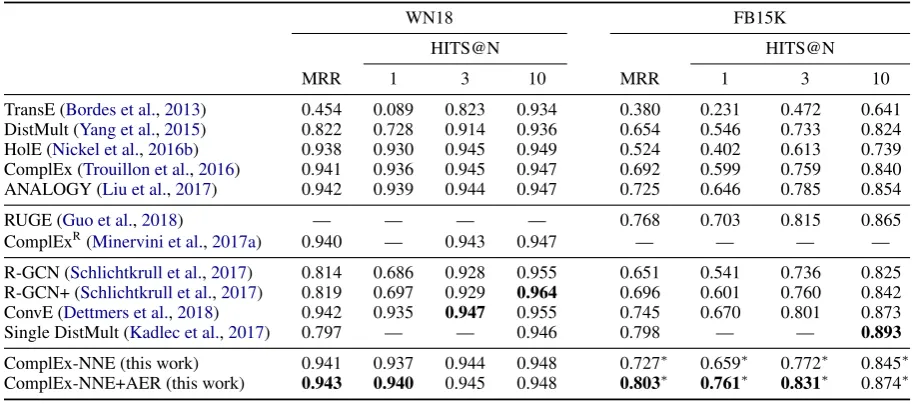
Table 3: Link prediction results on the test sets of WN18 and FB15K. Results for TransE and DistMult are taken from (Trouillon et al.,2016). Results for the other baselines are taken from the original papers. Missing scores not reported in the literature are indicated by “—”. Best scores are highlighted in bold, and “∗” indicates statistically significant improvements over ComplEx.
HITS@N
MRR 1 3 10
TransE 0.111 0.016 0.164 0.270
DistMult 0.233 0.115 0.301 0.448
HolE 0.260 0.182 0.309 0.411
ComplEx 0.242 0.126 0.312 0.440
ANALOGY 0.252 0.143 0.323 0.427
RUGE 0.246 0.129 0.325 0.433
ComplExR 0.253 0.167 0.294 0.420
ComplEx-NNE 0.298∗ 0.229∗ 0.330∗ 0.426 ComplEx-NNE+AER 0.306∗ 0.244∗ 0.334∗ 0.418
Table 4: Link prediction results on the test set of DB100K, with best scores highlighted in bold, sta-tistically significant improvements marked by “∗”.
Among those baselines, RUGE and ComplExR require additional logical background knowledge. RUGE makes use of soft rules, which are extracted by AMIE+ from thetrainingsets. As suggested by Guo et al.(2018), length-1 and length-2 rules with PCA confidence higher than 0.8 are utilized. Note that our approach also makes use of AMIE+ rules with PCA confidence higher than 0.8. But it only considers entailments between a pair of relations, i.e., length-1 rules. ComplExR takes into account equivalence and inversion between relations. We derive such axioms directly from our approximate entailments. Ifrp
λ1
−→rqandrq λ2
−→rpwithλ1, λ2 >0.8, we think relationsrpandrqare equivalent.
And similarly, ifr−p1 −→λ1 rq andrq−1 λ2
−→rpwith
λ1, λ2 >0.8, we considerrp as an inverse ofrq. For all the methods, we create 100 mini-batches on each dataset, and conduct a grid search to find hyperparameters that maximize MRR on the val-idation set, with at most 1000 iterations over the training set. Specifically, we tune the embedding size d ∈ {100,150,200}, the L2 regularization coefficientη∈ {0.001,0.003,0.01,0.03,0.1}, the ratio of negative over positive training examplesα
∈ {2,10}, and the initial learning rateγ ∈ {0.01,
0.05,0.1,0.5,1.0}. For TransE, we tune the mar-gin of the ranking loss δ ∈ {0.1,0.2,0.5,1,2,5,
10}. Other hyperparameters of ANALOGY and RUGE are set or tuned according to the default set-tings suggested by their authors (Liu et al.,2017; Guo et al.,2018). After getting the best ComplEx model, we tune the relation constraint penalty of our approach ComplEx-NNE+AER (µin Eq. (8)) in the range of {10−5,10−4,· · · ,104,105}, with all its other hyperparameters fixed to their optimal configurations. We then directly setµ = 0to get the optimal ComplEx-NNE model. The weight of soft constraints in ComplExRis tuned in the same range asµ. The optimal configurations for our ap-proach are: d= 200,η = 0.03,α = 10,γ = 1.0, µ= 10on WN18;d= 200,η= 0.01,α= 10,γ = 0.5,µ= 10−3on FB15K; andd= 150,η= 0.03, α= 10,γ = 0.1,µ= 10−5on DB100K.
[image:7.595.71.292.344.482.2]previous literature. Table4further provides the re-sults on the test set of DB100K, with all the meth-ods tuned and tested in (almost) the same setting. On all the datasets, we test statistical significance of the improvements achieved by ComplEx-NNE/ ComplEx-NNE+AER over ComplEx, by using a paired t-test. The reciprocal rank or HITS@N val-ue withn= 1,3,10for each test triple is used as paired data. The symbol “∗” indicates a signifi-cance level ofp <0.05.
The results demonstrate that imposing the non-negativity and approximate entailment constraints indeed improves KG embedding. ComplEx-NNE and ComplEx-NNE+AER perform better than (or at least equally well as) ComplEx in almost all the metrics on all the three datasets, and most of the improvements are statistically significant (except those on WN18). More interestingly, just by intro-ducing these simple constraints, ComplEx-NNE+ AER can beat very strong baselines, including the best performing basic models like ANALOGY, those previous extensions of ComplEx like RUGE or ComplExR, and even the complicated develop-ments or implementations like ConvE or Single DistMult. This demonstrates the superiority of our approach.
4.3 Analysis on Entity Representations
This section inspects how the structure of the enti-ty embedding space changes when the constraints are imposed. We first provide the visualization of entity representations on DB100K. On this dataset each entity is associated with a single type label.11 We pick 4 typesreptile,wine region,species, andprogramming language, and randomly select 30 entities from each type. Figure1visualizes the representations of these entities learned by Com-plEx and ComCom-plEx-NNE+AER (real components only), with the optimal configurations determined by link prediction (see§4.2for details, applicable to all analysis hereafter). During the visualization, we normalize the real component of each entity by
[˜x]`= [x]`
−min(x)
max(x)−min(x), wheremin(x)ormax(x)is the minimum or maximum entry ofxrespectively. We observe that after imposing the non-negativity constraints, ComplEx-NNE+AER indeed obtains compact and interpretable representations for enti-ties. Each entity is represented by only a relatively small number of “active” dimensions. And entities
11http://downloads.dbpedia.org/2016-10/
core-i18n/en/instance_types_wkd_uris_en. ttl.bz2
0 50 100 150 0 50 100 150
[image:8.595.309.523.62.162.2]ComplEx-NNE+AER ComplEx
Figure 1: Visualization of real components of en-tity representations (rows) learned by ComplEx-NNE+AER (left) and ComplEx (right). From top to bottom, entities belong to typereptile,wine region,species, andprogramming languagein turn. Values range from 0 (white) via 0.5 (orange) to 1 (black). Best viewed in color.
0 2 4 6 8 10 12 14 16 18 20
k value
3.8 4.0 4.2 4.4 4.6 4.8
Average entropy
ComplEx ComplEx-NNE ComplEx-NNE+AER
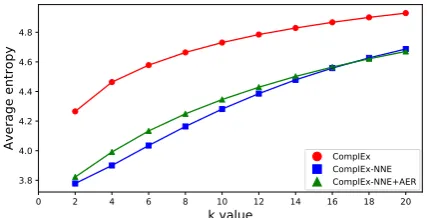
Figure 2: Average entropy over all dimensions of real components of entity representations learned by ComplEx (circles), ComplEx-NNE (squares), and ComplEx-NNE+AER (triangles) asKvaries.
with the same type tend to activate the same set of dimensions, while entities with different types of-ten get clearly different dimensions activated.
[image:8.595.309.523.288.397.2]country
location_country
owning_company
owner
spouse−1
spouse
child−1
parent
position
honours
offical_language
language
-0.57 -0.08 -0.52 -0.81 -0.05 -0.10 -0.00 0.01 -0.06 -0.00
-0.57 -0.08 -0.52 -0.81 -0.05 -0.09 -0.00 0.02 -0.06 -0.00
-0.06 -0.42 0.60 -0.68 0.30 -0.06 -0.05 0.80 0.22 0.56
-0.06 -0.42 0.60 -0.68 0.30 -0.06 -0.05 0.80 0.22 0.57
0.15 1.39 -0.87 -0.63 -0.10 -0.00 0.00 -0.00 0.00 -0.00
0.15 1.39 -0.87 -0.63 -0.10 -0.00 0.00 -0.00 0.00 -0.00
0.33 -0.29 0.47 -0.63 0.45 -0.13 -0.04 0.08 -0.21 -0.02
0.33 -0.29 0.47 -0.64 0.45 0.13 0.04 -0.08 0.20 0.02
-0.81 -0.11 -0.39 -1.01 -0.09 -0.21 -0.01 0.23 0.16 -0.34
-0.81 -0.10 0.73 -1.01 0.30 -0.20 -0.01 0.23 0.16 -0.35
-0.84 -0.44 -0.61 -0.86 -0.04 -0.39 -0.32 -0.02 0.09 -0.01
[image:9.595.79.282.59.259.2]-0.84 -0.41 -0.60 -0.80 -0.04 -0.39 -0.32 -0.03 0.09 -0.01 Real Component Imaginary Component
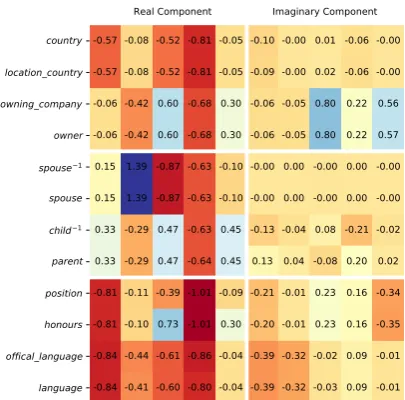
Figure 3: Visualization of relation representations learned by ComplEx-NNE+AER, with the top 4 relations from the equivalence class, the middle 4 the inversion class, and the bottom 4 others.
AER, as K varies. We can see that after impos-ing the non-negativity constraints, ComplEx-NNE and ComplEx-NNE+AER can learn entity repre-sentations with latent dimensions of consistently higher semantic purity. We have conducted the same analyses on imaginary components of entity representations, and observed similar phenomena. The results are given as supplementary material.
4.4 Analysis on Relation Representations
This section further provides a visual inspection of the relation embedding space when the constraints are imposed. To this end, we group relation pairs involved in the DB100K entailment constraints in-to 3 classes: equivalence, inversion, and others.12 We choose 2 pairs of relations from each class, and visualize these relation representations learned by ComplEx-NNE+AER in Figure3, where for each relation we randomly pick 5 dimensions from both its real and imaginary components. By imposing the approximate entailment constraints, these rela-tion representarela-tions can encode logical regularities quite well. Pairs of relations from the first class (e-quivalence) tend to have identical representations rp ≈ rq, those from the second class (inversion) complex conjugate representations rp ≈ ¯rq; and the others representations that Re(rp) ≤ Re(rq) and Im(rp)≈Im(rq).
12Equivalence and inversion are detected using heuristics
introduced in§4.2(implementation details). See the supple-mentary material for detailed properties of these three classes.
5 Conclusion
This paper investigates the potential of using very simple constraints to improve KG embedding. T-wo types of constraints have been studied: (i) the non-negativity constraints to learn compact, inter-pretable entity representations, and (ii) the approx-imate entailment constraints to further encode log-ical regularities into relation representations. Such constraints impose prior beliefs upon the structure of the embedding space, and will not significantly increase the space or time complexity. Experimen-tal results on benchmark KGs demonstrate that our method is simple yet surprisingly effective, show-ing significant and consistent improvements over strong baselines. The constraints indeed improve model interpretability, yielding a substantially in-creased structuring of the embedding space.
Acknowledgments
We would like to thank all the anonymous review-ers for their insightful and valuable suggestions, which help to improve the quality of this paper. This work is supported by the National Key Re-search and Development Program of China (No. 2016QY03D0503) and the Fundamental Theory and Cutting Edge Technology Research Program of the Institute of Information Engineering, Chi-nese Academy of Sciences (No. Y7Z0261101).
References
Kurt Bollacker, Colin Evans, Praveen Paritosh, Tim S-turge, and Jamie Taylor. 2008. Freebase: A collab-oratively created graph database for structuring hu-man knowledge. In Proceedings of the 2008 ACM SIGMOD International Conference on Management of Data. pages 1247–1250.
Antoine Bordes, Xavier Glorot, Jason Weston, and Yoshua Bengio. 2014. A semantic matching ener-gy function for learning with multi-relational data. Machine Learning94(2):233–259.
Antoine Bordes, Nicolas Usunier, Alberto Garc´ıa-Dur´an, Jason Weston, and Oksana Yakhnenko. 2013. Translating embeddings for modeling multi-relational data. InAdvances in Neural Information Processing Systems. pages 2787–2795.
Kai-Wei Chang, Wen-tau Yih, Bishan Yang, and Christopher Meek. 2014. Typed tensor decompo-sition of knowledge bases for relation extraction. In Proceedings of the 2014 Conference on Empiri-cal Methods in Natural Language Processing. pages 1568–1579.
Thomas Demeester, Tim Rockt¨aschel, and Sebastian Riedel. 2016. Lifted rule injection for relation em-beddings. InProceedings of the 2016 Conference on Empirical Methods in Natural Language Process-ing. pages 1389–1399.
Tim Dettmers, Minervini Pasquale, Stenetorp Pon-tus, and Sebastian Riedel. 2018. Convolutional 2D knowledge graph embeddings. In Proceedings of the 32nd AAAI Conference on Artificial Intelligence. pages 1811–1818.
Xin Dong, Evgeniy Gabrilovich, Geremy Heitz, Wilko Horn, Ni Lao, Kevin Murphy, Thomas Strohman-n, Shaohua SuStrohman-n, and Wei Zhang. 2014. Knowl-edge vault: A web-scale approach to probabilistic knowledge fusion. InProceedings of the 20th ACM SIGKDD International Conference on Knowledge Discovery and Data Mining. pages 601–610.
John Duchi, Elad Hazan, and Yoram Singer. 2011. Adaptive subgradient methods for online learning and stochastic optimization. Journal of Machine Learning Research12(Jul):2121–2159.
Alona Fyshe, Leila Wehbe, Partha P. Talukdar, Brian Murphy, and Tom M. Mitchell. 2015. A composi-tional and interpretable semantic space. In Proceed-ings of the 2015 Conference of the North American Chapter of the Association for Computational Lin-guistics: Human Language Technologies. pages 32– 41.
Luis Antonio Gal´arraga, Christina Teflioudi, Katja Hose, and Fabian M. Suchanek. 2015. Fast rule min-ing in ontological knowledge bases with AMIE+. The VLDB Journal24(6):707–730.
Shu Guo, Quan Wang, Bin Wang, Lihong Wang, and Li Guo. 2015. Semantically smooth knowledge graph embedding. InProceedings of the 53rd An-nual Meeting of the Association for Computational Linguistics and the 7th International Joint Confer-ence on Natural Language Processing. pages 84–94.
Shu Guo, Quan Wang, Lihong Wang, Bin Wang, and Li Guo. 2016. Jointly embedding knowledge graphs and logical rules. InProceedings of the 2016 Con-ference on Empirical Methods in Natural Language Processing. pages 192–202.
Shu Guo, Quan Wang, Lihong Wang, Bin Wang, and Li Guo. 2018. Knowledge graph embedding with iterative guidance from soft rules. InProceedings of the 32nd AAAI Conference on Artificial Intelligence. pages 4816–4823.
Raphael Hoffmann, Congle Zhang, Xiao Ling, Luke Zettlemoyer, and Daniel S. Weld. 2011. Knowledge-based weak supervision for information extraction of overlapping relations. InProceedings of the 49th Annual Meeting of the Association for Computational Linguistics. pages 541–550.
Rodolphe Jenatton, Nicolas L. Roux, Antoine Bordes, and Guillaume R. Obozinski. 2012. A latent fac-tor model for highly multi-relational data. In Ad-vances in Neural Information Processing Systems. pages 3167–3175.
Guoliang Ji, Shizhu He, Liheng Xu, Kang Liu, and Jun Zhao. 2015. Knowledge graph embedding vi-a dynvi-amic mvi-apping mvi-atrix. In Proceedings of the 53rd Annual Meeting of the Association for Compu-tational Linguistics and the 7th International Joint Conference on Natural Language Processing. pages 687–696.
Rudolf Kadlec, Ondrej Bajgar, and Jan Kleindienst. 2017. Knowledge base completion: Baselines strike back. InProceedings of the 2nd Workshop on Rep-resentation Learning for NLP. pages 69–74.
German Kruszewski, Denis Paperno, and Marco Ba-roni. 2015. Deriving Boolean structures from distri-butional vectors.Transactions of the Association for Computational Linguistics3:375–388.
Daniel D. Lee and H. Sebastian Seung. 1999. Learning the parts of objects by non-negative matrix factor-ization. Nature401:788–791.
Jens Lehmann, Robert Isele, Max Jakob, Anja Jentzsch, Dimitris Kontokostas, Pablo N. Mendes, Sebastian Hellmann, Mohamed Morsey, Patrick van Kleef, S¨oren Auer, et al. 2015. DBpedia: A large-scale, multilingual knowledge base extracted from Wikipedia. Semantic Web Journal6(2):167–195.
Yankai Lin, Zhiyuan Liu, Huanbo Luan, Maosong Sun, Siwei Rao, and Song Liu. 2015a. Modeling rela-tion paths for representarela-tion learning of knowledge bases. In Proceedings of the 2015 Conference on Empirical Methods in Natural Language Process-ing. pages 705–714.
Yankai Lin, Zhiyuan Liu, Maosong Sun, Yang Liu, and Xuan Zhu. 2015b. Learning entity and relation em-beddings for knowledge graph completion. In Pro-ceedings of the 29th AAAI Conference on Artificial Intelligence. pages 2181–2187.
Hanxiao Liu, Yuexin Wu, and Yiming Yang. 2017. Analogical inference for multi-relational embed-dings. InProceedings of the 34th International Con-ference on Machine Learning. pages 2168–2178.
Yuanfei Luo, Quan Wang, Bin Wang, and Li Guo. 2015b. Context-dependent knowledge graph em-bedding. InProceedings of the 2015 Conference on Empirical Methods in Natural Language Process-ing. pages 1656–1661.
Pasquale Minervini, Luca Costabello, Emir Mu˜noz, V´ıt Nov´aˇcek, and Pierre-Yves Vandenbussche. 2017a. Regularizing knowledge graph embeddings via e-quivalence and inversion axioms. InJoint European Conference on Machine Learning and Knowledge Discovery in Databases. pages 668–683.
Pasquale Minervini, Thomas Demeester, Tim Rock-t¨aschel, and Sebastian Riedel. 2017b. Adversarial sets for regularising neural link predictors. In Pro-ceedings of the 33rd Conference on Uncertainty in Artificial Intelligence.
Brian Murphy, Partha Talukdar, and Tom Mitchell. 2012. Learning effective and interpretable seman-tic models using non-negative sparse embedding. In Proceedings of COLING 2012. pages 1933–1950.
Arvind Neelakantan, Benjamin Roth, and Andrew M-cCallum. 2015. Compositional vector space model-s for knowledge bamodel-se completion. In Proceedings of the 53rd Annual Meeting of the Association for Computational Linguistics and the 7th International Joint Conference on Natural Language Processing. pages 156–166.
Maximilian Nickel, Kevin Murphy, Volker Tresp, and Evgeniy Gabrilovich. 2016a. A review of relational machine learning for knowledge graphs. Proceed-ings of the IEEE104(1):11–33.
Maximilian Nickel, Lorenzo Rosasco, and Tomaso Poggio. 2016b. Holographic embeddings of knowl-edge graphs. InProceedings of the 30th AAAI Con-ference on Artificial Intelligence. pages 1955–1961.
Maximilian Nickel, Volker Tresp, and Hans-Peter Kriegel. 2011. A three-way model for collective learning on multi-relational data. In Proceedings of the 28th International Conference on Machine Learning. pages 809–816.
Tim Rockt¨aschel, Sameer Singh, and Sebastian Riedel. 2015. Injecting logical background knowledge in-to embeddings for relation extraction. In Proceed-ings of the 2015 Conference of the North Ameri-can Chapter of the Association for Computational Linguistics: Human Language Technologies. pages 1119–1129.
Michael Schlichtkrull, Thomas N. Kipf, Peter Bloem, Rianne van den Berg, Ivan Titov, and Max Welling. 2017. Modeling relational data with graph convolu-tional networks. arXiv:1703.06103.
Baoxu Shi and Tim Weninger. 2017. ProjE: Embed-ding projection for knowledge graph completion. In Proceedings of the 31st AAAI Conference on Artifi-cial Intelligence. pages 1236–1242.
Richard Socher, Danqi Chen, Christopher D. Manning, and Andrew Y. Ng. 2013. Reasoning with neural tensor networks for knowledge base completion. In Advances in Neural Information Processing System-s. pages 926–934.
Th´eo Trouillon, Johannes Welbl, Sebastian Riedel, Eric Gaussier, and Guillaume Bouchard. 2016. Complex embeddings for simple link prediction. In Proceed-ings of the 33rd International Conference on Ma-chine Learning. pages 2071–2080.
Quan Wang, Zhendong Mao, Bin Wang, and Li Guo. 2017. Knowledge graph embedding: A survey of approaches and applications. IEEE Transactions on Knowledge and Data Engineering29(12):2724– 2743.
Quan Wang, Bin Wang, and Li Guo. 2015. Knowl-edge base completion using embeddings and rules. InProceedings of the 24th International Joint Con-ference on Artificial Intelligence. pages 1859–1865.
Zhen Wang, Jianwen Zhang, Jianlin Feng, and Zheng Chen. 2014. Knowledge graph embedding by trans-lating on hyperplanes. In Proceedings of the 28th AAAI Conference on Artificial Intelligence. pages 1112–1119.
Evgenia Wasserman-Pritsker, William W. Cohen, and Einat Minkov. 2015. Learning to identify the best contexts for knowledge-based WSD. In Proceed-ings of the 2015 Conference on Empirical Methods in Natural Language Processing. pages 1662–1667.
Han Xiao, Minlie Huang, and Xiaoyan Zhu. 2016. TransG: A generative model for knowledge graph embedding. In Proceedings of the 54th Annual Meeting of the Association for Computational Lin-guistics. pages 2316–2325.
Han Xiao, Minlie Huang, and Xiaoyan Zhu. 2017. SSP: Semantic space projection for knowledge graph embedding with text descriptions. In Pro-ceedings of the 31st AAAI Conference on Artificial Intelligence. pages 3104–3110.
Ruobing Xie, Zhiyuan Liu, Jia Jia, Huanbo Luan, and Maosong Sun. 2016a. Representation learning of knowledge graphs with entity descriptions. In Pro-ceedings of the 30th AAAI Conference on Artificial Intelligence. pages 2659–2665.
Ruobing Xie, Zhiyuan Liu, and Maosong Sun. 2016b. Representation learning of knowledge graphs with hierarchical types. InProceedings of the 25th Inter-national Joint Conference on Artificial Intelligence. pages 2965–2971.
Bishan Yang, Wen-tau Yih, Xiaodong He, Jianfeng Gao, and Li Deng. 2015. Embedding entities and relations for learning and inference in knowledge bases. InProceedings of the International Confer-ence on Learning Representations.