Activity Metadata
Harshvardhan J. Pandit, Declan O’Sullivan, and Dave Lewis
ADAPT Centre, Trinity College Dublin, Dublin, Ireland
{harshvardhan.pandit|declan.osullivan|dave.lewis}@adaptcentre.ie
Abstract. This position paper explores changes concerning the rela-tionship between consent and activities in context of the General Data Protection Regulation (GDPR). Detecting and recording such changes with their effects can provide assistance in demonstration and manage-ment of compliance. We present an approach for using metadata-driven change detection and representation towards supporting querying for GDPR compliance. We use P-Plan (an extension to PROV) for rep-resenting provenance of activities and ODRL for reprep-resenting consent. We explore the presented approach by means of a use-case.
1
Introduction
Consent under the General Data Protection Regulation (GDPR)1 can be con-sidered as an evolving entity based on the right to change or withdraw consent as well as the requirement to re-acquire consent upon certain changes in pro-cessing. In this paper, we explore this relationship between change in consent and the change in activities related to it. We consider consent as a set of per-missions and prohibitions over activities that use the personal data, where the given consent provides the legal basis for their execution. We reuse the example use of ‘Sue’ [1], a data subject that uses a fitness tracking service for logging fitness activity. This service uses the given consent to send advertisements to the registered email, which is later withdrawn. This results in the consent represen-tation reflecting this change, as well as a removing the corresponding activity from workflow.
The scope of this position paper is limited to identifying the relationship between changes in consent and activity metadata, along with approaches to-wards their detection and representation. The use-case provides an example for understanding the approach and the changes involved. We discuss these using P-Plan2 (an extension to PROV) to represent provenance of activities and ODRL
to represent consent. This work provides a discussion on how this change can be detected and modeled, with potential applications in systems that assist in GDPR compliance.
1
http://purl.org/adaptcentre/openscience/resources/GDPRtEXT#article4-11
2
2
Change in consent
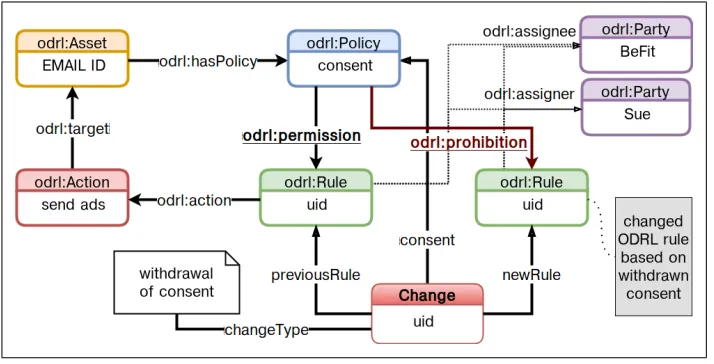
Using ODRL, each permission and prohibition (odrl:Rule) is expressed as an indi-vidual policy concerning the use of personal data (odrl:Asset) through an activity (odrl:Action). The changed consent in the case study, depicted3 in Fig 1, shows
[image:2.612.134.491.301.483.2]odrl:Rule being updated fromodrl:permissiontoodrl:prohibition. Since each per-mission or prohibition within the consent is represented as a distinctodrl:Rule, once a policy is instantiated, itsodrl:Asset (personal data) andodrl:Action (ac-tivity) will not change. Therefore, the Change object captures only the change type (withdrawal of consent) and change in rule from permit to prohibit. The captured change is useful in determining the effects of change in consent. In the case study, the change results in a prohibition over the activity of sending advertisements using email. This cause-effect relationship is further explored in Section 4.
Fig. 1.Change in given consent modeled using ODRL
3
Representing change in activities
We use P-Plan, an extension of PROV since PROV represents things that have happened in the past, whereas P-Plan models the intent of what should happen. P-Plan acts as a template for workflows that are then used to cap-ture executions using PROV, and provides a way to model interactions between activities, personal data, and consent at an abstract level. This approach for ex-pression of consent and data metadata related to GDPR can be achieved using
3
targeted vocabularies such as GDPRov [4]. for provenance and GDPRtEXT [3]. for compliance terms and concepts.
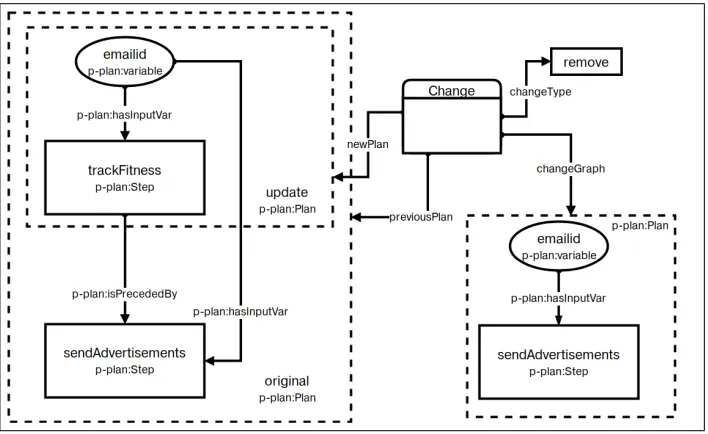
[image:3.612.135.489.268.485.2]Detecting changes within activities (workflows) represented usingp-plan:Plan is helpful to determine whether an updated consent is required from the data subject based as stipulated by GDPR requirements. Fig 2. depicts captured changes for the use case, where the step sendAdvertisements has been removed following changes in consent. TheChange object links the original and updated workflows along with specifying the change type as ‘remove’ and a change graph containing differing elements in the two workflows. The task of change detection for workflows is considerably complex, and can be simplified by reducing the graph to simpler forms for easier analysis [2].
Fig. 2.Change in workflows modeled using P-Plan
4
Linking the changes to enable compliance queries
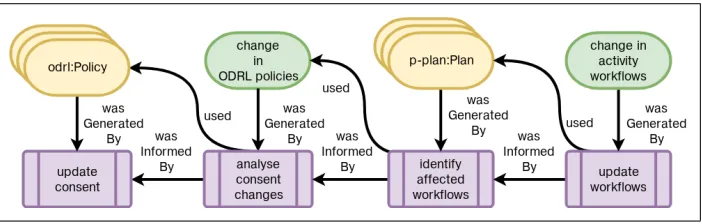
Demonstrating changes in consent led to corresponding changes in activity work-flows is part of compliance towards GDPR obligations. In the specified use-case, the withdrawal of consent resulted in a change in the ODRL policies representing consent, and led to a corresponding change in the activity workflows represented using P-Plan. This cause-effect relationship can be represented as a provenance trace as shown4 in Fig 3, and can act as documentation towards GDPR
obliga-4
tions. This can aid in the compliance process to demonstrate whether withdrawal of consent resulted in appropriate changes in workflows.
Fig. 3.Provenance trace showing change in consent leading to change in workflows
5
Conclusion & Future Work
This position paper discusses the detection and representation of changes in the context of consent and activities for GDPR compliance. The outlined approach deals with change within consent and activity metadata along with linking such changes in a cause-effect relationship. The approach discusses the use of ODRL for representing consent, with P-Plan (an extension of PROV) used to represent provenance of activities and workflows. A case study is used to explore and discuss the approach with a view towards documentation and demonstration of compliance.
In terms of potential future work, the change detection approach described in this paper can be used to automate processes associated with compliance, es-pecially where a large number of data subjects are involved. A change in consent metadata is useful to identify its effects on the processing of personal data. As part of the compliance process, an individual’s provenance trace may need to be queried for all changes in given consent. By identifying and storing change in consent and activity metadata along with their provenance, it is possible to ret-rospectively demonstrate that such changes were accompanied by the necessary actions necessary to maintain compliance.
be optimised to highlight only those changes that are relevant to the compliance obligations, such as the use of personal data within activities.
Linking changes between ‘events’ such as change in consent and change in ac-tivity workflows, it is possible to create a system that can perform a ‘self-check’ analysis for compliance based on whether expected activities occur upon detec-tion of certain changes. This can automate the process of compliance analysis on graphs which contain a large number of data subjects where it is not possible to manually investigate the effects and behaviour of each individual change in given consent and activities. The automated system can analyse the provenance logs to ensure that the required changes have correctly occurred, and can be used to detect and alert for situations where manual intervention is required to ensure compliance.
It is possible that the approach may not be scalable where a large amount of metadata is generated. In such cases, the approach is still useful as a mechanism to demonstrate that required behaviour takes place within a model of the system.
Acknowledgements
This paper is supported by the ADAPT Centre for Digital Content Technology, which is funded under the SFI Research Centres Programme (Grant 13/RC/2106) and is co-funded under the European Regional Development Fund.
References
1. Bonatti, P., Kirrane, S., Polleres, A., Wenning, R.: Transparent Personal Data Processing: The Road Ahead. In: Computer Safety, Reliability, and Secu-rity. pp. 337–349. Lecture Notes in Computer Science, Springer, Cham (Sep 2017). https://doi.org/10.1007/978-3-319-66284-8 28, https://link.springer. com/chapter/10.1007/978-3-319-66284-8_28
2. Garijo, D., Corcho, O., Gil, Y., Gutman, B.A., Dinov, I.D., Thompson, P., Toga, A.W.: Fragflow automated fragment detection in scientific workflows. In: e-Science (e-Science), 2014 IEEE 10th International Conference on. vol. 1, pp. 281–289. IEEE (2014)
3. Pandit, H.J., Fatema, K., O’Sullivan, D., Lewis, D.: GDPRtEXT - GDPR as a Linked Data Resource. In: 15th European Semantic Web Conference (in-press. Her-aklion, Crete, Greece (2018),http://purl.org/ADAPT/pub/E18ESWC_GDPRtEXT 4. Pandit, H.J., Lewis, D.: Modelling Provenance for GDPR Compliance using Linked