Abstract—A family of transformations is the one of several methods to analyze the data that do not correspond with the assumption. A well-known family of transformations often used in many studies was proposed by Box and Cox. However, Box-Cox transformation is not always applicable. It should be used with caution in some cases such as failure time and survival data. The simple case, some observations in the set of failure time data may be zero but the value of observation in the condition of Box-Cox transformation is greater than zero. In this case, Manly transformation may be appropriated than Box-Cox transformation because it was proposed as a family of exponential transformations that negative x values are also allowed. In this paper, a new family of transformation is proposed to manage with the problem as mentioned and Manly transformation were compared in the lifetime data those have exponential gamma and weibull distribution. They were investigated for some sets of the lifetime data. It is found that the proposed transformation and Manly transformation have not different efficiency in
sense of normality. The proposed transformation performs better than Manly transformation in
sense of homogeneity of variances for some data set of weibull distributions and exponential distributions when the sample sizes are large.
Index Terms— Manly transformation, proposed
transformation, homogeneity of variances, lifetime data,
normality
I. INTRODUCTION
N statistical data analysis, many statistical procedures require data to be approximately normal. If the data are not normally distributed, a transformation that transforms the data set to achieve normality is used. Tukey [1] suggested that when analyzing data that do not match the assumptions of a conventional method of analysis, there are two choices; transform the data to fit the assumptions or develop some new robust methods of analysis. Montgomery
Manuscript received February 24, 2014; revised March 17, 2014. This work was supported in part by the Faculty of Science, Maejo University, Chiang Mai, Thailand.
L. Watthanacheewakul is with the Faculty of Science, Maejo University, Chiang Mai, Thailand (phone: 66-53-873-551; fax: 66-53-875-205; e-mail: [email protected]; [email protected]).
[2] suggested that transformations are used for three purposes; stabilizing response variance, making the distribution of the response variable closer to a normal distribution and improving the fit of the model to the data. There are several alternatives for transforming such as transformations based on the relationship between the standard deviation and the mean. Furthermore, it is possible to transform the data using a family of transformations already extensively studied over a long period of time, e.g. Box and Cox [3], Manly [4], and John and Draper [5] . A well-known family of transformations often used in previous studies was proposed by Box and Cox. Doksum and Wong [6] indicated that the Box-Cox transformation should be used with caution in some cases such as failure time and survival data.John and Draper [5] showed that the Box-Cox transformation was not satisfactory even when the best value of transformation parameter had been chosen.
II. AFAMILY OF TRANSFORMATIONS
A family of transformations applied over a long period can be used for data from any population so that the transformed data are normally distributed.
Let X be a random variable distributed as non-normal,Y the transformed variable of X, x the value of X, c the range of data set and λ a transformation parameter.
Box and Cox [3] gave a simple modified form of the power transformation to avoid discontinuity at λ=0. They considered
1 , 0 ln , 0
⎧ − ≠
⎪ = ⎨
⎪ =
⎩ X Y
X λ
λ λ
λ
for . (1)
This has become well known as Box-Cox transformation. Manly [4] suggested a one parameter family of exponential transformations
exp( ) 1
, 0
, 0.
−
⎧ ≠
⎪ = ⎨
⎪ =
⎩ X Y
X
λ λ
λ
λ
(2)
This is a useful alternative to Box-Cox transformations because negative x values are also allowed. It has been
x 0
>
A New Family of Transformations for
Lifetime Data
Lakhana Watthanacheewakul
found in particular that this transformation is quite effective at turning skew unimodal distributions into nearly symmetric normal distributions.
Yeo and Johnson [8] proposed a family of modified Box and Cox transformation
[
]
[
]
[
]
[
]
1 1, 0, 0
ln 1 , 0, 0
1 1
, 0, 0
ln 1 , 0, 0
⎧ + − ⎪ ≥ ≠ ⎪ ⎪ + ≥ = ⎪ = ⎨ + − ⎪ < ≠ ⎪ ⎪
⎪ + < =
⎩ X x X x Y X x X x λ λ λ λ λ λ λ λ (3)
In this paper, the alternative family of transformations for lifetime data is proposed in this form
1 1
, 0, 0
ln 1 , 0, 0.
⎧⎡⎣ + ⎤⎦ − ⎪ ≥ ≠ ⎪ = ⎨ ⎪ ⎡ + ⎤ ≥ = ⎪ ⎣ ⎦ ⎩ X x Y X x λ λ λ λ (4)
III. LIFETIME DATA
Lifetime data are important in reliability analysis and survival analysis. It is often of interest to estimate the reliability of the system/component from the observed lifetime data.
Weibull Exponential and Gamma distributions are involved lifetime data. The Weibull distribution is a natural starting point in the modeling of failure times in reliability, material strength data and many other applications. The probability density function of a two parameter Weibull random variable X is
1
, 0; , 0
( )
0 , <0
− ⎛ ⎞ −⎜ ⎟ ⎝ ⎠
⎧ ⎛ ⎞
⎪ ⎜ ⎟ ≥ >
= ⎨ ⎝ ⎠ ⎪ ⎩ x x e x f x x α α β
α α β
β β ’ (5)
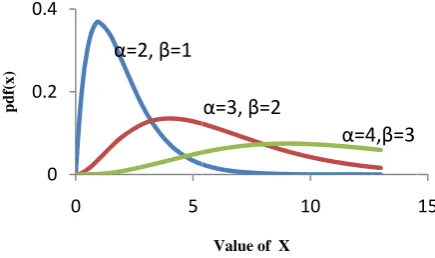
where α is the shape parameter and β is the scale parameter. It is related to the other probability distribution such as the Exponential distribution when α=1. The probability density function of one parameter Exponential random variable X is
1
, 0; 0
( )
0 , <0
⎛ ⎞ −⎜ ⎟ ⎝ ⎠
⎧
⎪ ≥ >
= ⎨ ⎪ ⎩ x e x f x x β β
β ’ (6)
where β is the scale parameter.
Gamma distribution is the common choices of frailty distribution in lifetime data models.
1 1
, 0; 0
( ) ( )
0 , <0
⎛ ⎞ −⎜ ⎟ − ⎝ ⎠
⎧
⎪ ≥ >
= ⎨ Γ ⎪ ⎩
x
x e x
f x
x β α
α β
β α (7)
where α is the shape parameter and β is the scale parameter.
IV. ESTIMATION OF THE TRANSFORMATION PARAMETER For several groups of data, the value of λ in (2) and (3) need to be found so that the transformed variables will be independently normal distribution with homogeneity of variances. The probability density function of each Yij is in
the form
2 2
1 2
2 2
1 1
( , ) exp ( )
2 (2 )
⎧ ⎫
= ⎨− − ⎬
⎩ ⎭
ij i ij i
f y μ σ y μ
σ
πσ , (8)
where μi is the mean of the ith transformed population data,
2
σ the pooled variance of all transformed population data and yij the observed value of Yij. For (2), the likelihood
function in relation to the observations xij is given by
2
2
2
2 2 1 1
( , , )
exp( ) 1
1 1
exp . ( ; )
2
(2 ) = =
= ⎧ ⎡ − ⎤ ⎫ ⎪− − ⎪ ⎨ ⎢ ⎥ ⎬ ⎣ ⎦ ⎪ ⎪ ⎩
∑∑
⎭ i i ij n k ij i n i j L x xJ y x
μ σ λ
λ μ σ λ πσ (9) where 1 1 ( ; ) = = ∂ = ∂
∏∏
k niij
i j ij
y J y x
x . For a fixed λ, the MLE’s forμi and
2
σ are
1
exp( ) 1
1 ˆ = − ⎡ ⎤ = ⎢ ⎥ ⎣ ⎦
∑
niij i j i x n λ μ
λ and
2 2
1 1 1
exp( ) 1 exp( ) 1
1 1 ˆ = = = ⎧ − ⎛ − ⎫⎞ ⎪ ⎪ = ⎨ − ⎜ ⎟⎬ ⎪ ⎝ ⎠⎪ ⎩ ⎭
∑∑
k ni∑
niij ij
i j i j
x x
n n
λ λ
σ
λ λ
Substitute ˆμiand
2 ˆ
σ into the likelihood equation (9). Thus for fixed λ, the maximized log likelihood is
2
1 1 1
1 1 ln ( )
exp( ) 1 exp( ) 1
1 1
ln 2 ln
2 2 2 = = = = = = ⎧ − ⎛ − ⎞⎫ ⎪ ⎪ − − ⎨ − ⎜ ⎟⎬ ⎪ ⎝ ⎠⎪ ⎩ ⎭ +
∑∑
∑
∑∑
i i i ij n n k ij iji j i j
n k ij i j L x x x n n n n n x λ λ λ π λ λ λ - , (10) except for a constant, the maximum likelihood estimate of
λ
is obtained by solving the likelihood equation
( )
2
1 1 1 1 1
2 2
1 1 1 1
1 1 ln 1 1 0. = = = = = = = = = = = = ⎡ ⎛ ⎞⎛ ⎞⎤ − ⎢ − ⎜ ⎟⎜ ⎟⎥ ⎢ ⎝ ⎠⎝ ⎠⎥ ⎣ ⎦ ⎛ ⎞ − ⎜ ⎟ ⎝ ⎠ + + =
∑∑
∑ ∑
∑
∑∑
∑ ∑
∑∑
i i i
ij ij ij
i i
ij ij
i
n n n
k k
x x x
ij ij
i j i i j j
n n
k k
x x
i j i i j
n k ij i j d L d
n e x e e x
n
e e
n
n
x
λ λ λ
λ λ λ λ λ (11) Similar procedures yield the same results for (4), the
co m th th fu nu va tra si = an an pa be W Fi Fig
(
1 1 1 1 1 ln 1 = = = = = ⎡ ⎢ ⎢ − ⎢ ⎢ ⎢⎣ + +∑∑
∑
∑∑
∑∑
i n k i j k i i k i j k i j d L d n n n λ λ λSince λappe onsidered to maximized log
he value of th he slope of th unction is ne umerical meth alue of λ.
In order to ansformations gnificant valu 3, ni= samp
nd 80, βi= sc
nd Gamma p arameter of t etween 2 and Weibull Expon
igure 1 – 7.
g. 1. Graph of W same and s
0 0.2 0.4 0.6 0.8 1 0 pdf(x)
)
(
)
(
)
(
)
(
2 1 2 1 1 1 ln 1 1 ln 1 = = = = + ⎛ + ⎜ ⎝ + +∑
∑
∑
i i i ij n ij j n ij j n ij j x x x x λ λ λears on the ex be too com likelihood fun e transformat e curvature o arly zero [3] hod such as b
V. SIMUL attain the m s, we set the ue as follows:
le size from t cale parameter
opulations is the ith Weib
4, the signifi nential and Ga
Weibull distributio scale parameters a
1 α=2,
(
)
(
(
)
1 1 1 n 1 1 0. = = = + − ⎞⎛ + ⎟⎜ ⎠⎝ ⎛ − ⎜ ⎝ =∑
∑ ∑
i i ij n ij j n ki i j
x
x
n λ
λ
xponent of the mplicated for nction is a un ion parameter of the maximi ]. Hence we bisection for f
LATION STUDY most effective e values of p
k = number the ith popula r of the ith W between 1 a bull and Gam icant level = 0 amma distribu
ons when shape p are different.
2 3
Value of X
β=1
α=2,β=2
) (
)
2 1 ln 1 + + ⎞ + ⎟ ⎠ ij ij x x λ λ e observations r solving it.imodal functi r is obtained ized log likeli can also us finding the sui
Y
e use of the arameters and
of the popula ation is betwee Weibull Expone and 3, αi= s mma populatio 0.05. The grap utions are show
parameters are the 4
α=2,β=3
)
1 ⎤ ⎥ ⎥ ⎥ ⎞⎥⎟ ⎥ ⎠⎦ (12) s, it is The on so when ihood e the itable e two d the ations en 10 ential shape on is aph of wn in e Fig. 2 Fig. 3 Fig. 4 Fig. 5 5 pdf(x ) pdf(x ) 0 0 pdf(x)2. Graph of Weib parameters are
3. Graph of Weib and scale param
4. Graph of Expo different.
5. Graph of Gamm same and scale
0 0.2 0.4 0.6 0.8 1 0 pdf(x ) 0 0.5 1 1.5 2 0 0 1 2 3 4 0 pdf(x
) β=3
β=2 0 0.2 0.4 0 bull distributions e different. bull distributions meters are the sam
onential distributio
ma distributions w e parameters are d
1 α=2, 0.5 1 V α=2, 1 Va β= 2 5 Va
α=2, β=1
α=2,β=2
when shape para
when shape para me.
ons when scale p
when shape param different.
2
Value of X , β=1
α=3, β=
1.5
Value of X , β=1
α=3,β=1
α= 4, β
2
alue of X =1
10
alue of X 2
α=2,β=3
ameters and scale
ameters are differ
parameters are
meters are the 3
=2
α=4,β=3
[image:3.595.67.293.53.204.2] [image:3.595.327.552.57.184.2] [image:3.595.311.556.198.369.2] [image:3.595.319.535.411.543.2] [image:3.595.59.298.510.650.2]Fig Fig po di sa da tra go re fo IV V
g. 6. Graph of G parameters
g. 7. Graph of G and scale p As a numeri opulations of ifferent value amples, each o
ata was tran ansformation oodness-of-fit eplicated samp or Weibull da V for Exponen V-VII for Gam
AVERAGES
USING DATA T
WEIBULL D
0 0.2 0.4 0 pdf(x ) 0 0.2 0.4 0 pdf(x) Transformatio Manly Proposed Manly Proposed Manly Proposed Manly Proposed Gamma distributio s are different.
Gamma distributio parameters are the ical study, We size Ni =5,0 s of paramete of size ni, are
nsformed to and Manly tr t tests in se ples of various ata. Similarly, ntial data and mma data.
TA
OF THE P-VALUE
TRANSFORMED BY
DATA WHEN αi =
5
α=2, β=1
5
α=2, β=1
α=3,β=
ons ni
10 10 30 30 80 80 10,20,30 10,20,30
ons when shape p
ons when shape p e same. eibull, Expon 000 ( 1,2,3)i=
ers βi,αi. Th
e drawn. Each normality ansformation. ense of norm
s sizes are sho the results ar d the results a
ABLEI
ES FOR K-STEST
Y THE TWO TRAN
2,
= β1=1,β2
1
Value of X
α=3, β=2
Value of X 1
α= 4, β=1
Averages of K of Tran 0.8086 0 0.8142 0 0.7487 0 0.7005 0 0.6195 0 0.3941 0 0 0.8180 0 0 0.8172 0
arameters and sca
arameters are dif
nential and Ga ) are generate hen 5,000 ran h set of the sa
by the prop . The results o mality with 5 own in Table I
re shown in T are shown in T
OF NORMALITY
SFORMATIONS WI
2 =2,β3=3
0
α=4,β=3
10
f the p-Values for K-S Test sformed Data 0.8284 0.8038 0.8135 0.8107 0.6593 0.5869 0.5390 0.5826 0.3482 0.1904 0.1454 0.1620 0.7699 0.6871 0.6992 0.6440 ale fferent amma ed for ndom ample posed of the 5,000 I – III Table Table ITH A DA DA U U 15 15 r 8 7 9 6 4 0 1 0
AVERAGES OF THE
TA TRANSFORME
ATA WHEN α1=
AVERAGES OF
USING DATA TRAN
WEIBULL DATA
AVERAGES OF
USING DATA TRAN
EXPONENTIA Transformations Manly Proposed Manly Proposed Manly Proposed Manly Proposed Transformations Manly Proposed Manly Proposed Manly Proposed Manly Proposed Transformations Manly Proposed Manly Proposed Manly Proposed Manly Proposed TABL
E P-VALUES FOR K
ED BY THE TWO T
2 3
2, 3,
= α = α
TABLE
THE P-VALUES F
NSFORMED BY TH
A WHEN α1=2,
TABLE
THE P-VALUES F
NSFORMED BY TH
AL DATA WHEN β
i n 10 10 30 30 80 80 10,20,30 10,20,30 i n 10 10 30 30 80 80 10,20,30 10,20,30 i n 10 10 30 30 80 80 10,20,30 10,20,30 LEII
K-STEST OF NOR
TRANSFORMATION
3 =4,β1=1,β
EIII
OR K-STEST OF N
HE TWO TRANSFO
2 3
,α =3,α =
EIV
OR K-STEST OF N
HE TWO TRANSFO
1=1, 2 =2,
β β
Averages of the K-S T of Transfor 0.8054 0.82 0.8129 0.81 0.7712 0.72 0.7759 0.69 0.7035 0.43 0.7060 0.35 0.8126 0.79 0.8247 0.78
Averages of the K-S T of Transfor 0.8101 0.82 0.8331 0.81 0.7029 0.70 0.7704 0.61 0.4754 0.35 0.6222 0.18 0.7857 0.77 0.8047 0.74
Averages of the K-S T of Transfor 0.7302 0.75 0.8094 0.79 0.5127 0.54 0.7439 0.66 0.2090 0.23 0.6049 0.42 0.7193 0.68 0.8079 0.79
RMALITY USING
NS WITH WEIBULL
2 =2, 3=3
β β
NORMALITY
ORMATIONS WITH
4 = ,βi =1
NORMALITY
ORMATIONS WITH
3
, β =3 e p-Values for Test rmed Data 245 0.8079 196 0.8097 222 0.5031 936 0.5183 382 0.0772 588 0.0866 937 0.5167 897 0.4950
e p-Values for Test rmed Data 224 0.7832 144 0.7735 030 0.5337 181 0.4662 530 0.1459 834 0.0898 792 0.6451 457 0.5954
[image:4.595.60.278.57.186.2] [image:4.595.52.290.232.387.2]TABLEV
AVERAGES OF THE P-VALUES FOR K-STEST OF NORMALITY
USING DATA TRANSFORMED BY THE TWO TRANSFORMATIONS WITH
GAMMA DATA WHEN αi =2, β1=1,β2 =2,β3=3
From Table I to VII, we see that the results from both of two transformations the averages of the p-value of K-S test are small different in each situation. Moreover, the averages of the p-value of K-S test decrease as the sample sizes increase.
TABLEVI
AVERAGES OF THE P-VALUES FOR K-STEST OF NORMALITY USING
DATA TRANSFORMED BY THE TWO TRANSFORMATIONS WITH GAMMA
DATA WHEN α1=2,α2 =3,α3 =4,β1=1,β2=2,β3 =3
TABLEVII
AVERAGES OF THE P-VALUES FOR K-STEST OF NORMALITY
USING DATA TRANSFORMED BY THE TWO TRANSFORMATIONS WITH
GAMMA DATA WHEN α1 =2,α2 =3,α3 =4,βi =1
For the check of validity in sense of homogeneity of variance, the results of the Levene test with 5,000 replicated samples of various sizes and data are shown in Table VIII.
TABLEVIII
AVERAGES OF THE P-VALUES FOR LEVENE TEST USING DATA
TRANSFORMED BY THE TWO TRANSFORMATIONS
From Table VIII, for Case I to VII, we see that averages of the p-value of Levene test of proposed transformation are higher than them of Manly transformation in each of sample sizes. In case I and IV when the sample sizes are large, proposed transformation performs better than Manly transformation at significant level 0.05. For Case III, we see that both proposed transformation and Manly transformation work well with only the small sample size. Moreover, the averages of the p-value of Levene test decrease as the sample sizes increase.
VI. CONCLUSION
The efficiency of the proposed transformation is compared with Manly transformation in sense of normality and homogeneity of variance. Both of them can transform the lifetime data to correspond with the basic assumptions in some situation. In sense of normality, it is found that the proposed transformation and Manly transformation have not different efficiency. The proposed transformation performs better than Manly transformation in
sense of homogeneity of variances for some data set of weibull distributions and exponential distributions when the sample sizes are large.
Transformations ni
Averages of the p-Values for K-S Test
of Transformed Data
Manly 10 0.7655 0.7777 0.7919
Proposed 10 0.7688 0.7800 0.7940
Manly 30 0.5820 0.6333 0.6592
Proposed 30 0.5954 0.6408 0.6670
Manly 80 0.2911 0.3585 0.4298
Proposed 80 0.3151 0.3704 0.4416 Manly 10,20,30 0.7814 0.7038 0.6602 Proposed 10,20,30 0.7842 0.7099 0.6683
Transformations ni
Averages of the p-Values for K-S Test
of Transformed Data
Manly 10 0.7507 0.7773 0.7767
Proposed 10 0.7574 0.7760 0.7802
Manly 30 0.5588 0.6026 0.6501
Proposed 30 0.5809 0.5933 0.6583
Manly 80 0.2468 0.3298 0.4063
Proposed 80 0.2812 0.3203 0.4240 Manly 10,20,30 0.7754 0.6837 0.5850 Proposed 10,20,30 0.7810 0.6833 0.5818
Transformations ni
Averages of the p-Values for K-S Test
of Transformed Data
Manly 10 0.7733 0.7749 0.7844
Proposed 10 0.7776 0.7758 0.7842
Manly 30 0.5976 0.6150 0.6398
Proposed 30 0.6048 0.6179 0.6417
Manly 80 0.3073 0.3633 0.3691
Proposed 80 0.3188 0.3682 0.3746 Manly 10,20,30 0.7903 0.7503 0.6347 Proposed 10,20,30 0.7907 0.7521 0.6333
Data ni Manly Proposed
Weibull (Case I) 10 0.4017 0.4873 2
=
i
α 30 0.1344 0.2453
1=1, 2=2, 3=3
β β β 80 0.0108 0.0571
10,20,30 0.1944 0.2999
Weibull (Case II) 10 0.5742 0.6013
1=2, 2=3, 3=4
α α α 30 0.4343 0.5032
1=1, 2=2, 3=3
β β β 80 0.2384 0.3637
10,20,30 0.5199 0.5873
Weibull (Case III) 10 0.1901 0.1751
1=2, 2=3, 3=4
α α α 30 0.0093 0.0068
1
=
i
β 80 0.0000 0.0000
10,20,30 0.0615 0.0547
Exponential (Case IV) 10 0.3304 0.4519
1=1, 2=2, 3=3
β β β 30 0.0839 0.2498
80 0.0025 0.0554
10,20,30 0.2354 0.3870
Gamma (Case V) 10 0.6602 0.6971 2
=
i
α 30 0.5596 0.6604
1=1, 2=2, 3=3
β β β 80 0.3575 0.5976
10,20,30 0.5934 0.6639
Gamma (Case VI) 10 0.6357 0.6576
1=2, 2=3, 3=4
α α α 30 0.4823 0.5539
1=1, 2=2, 3=3
β β β 80 0.2303 0.3594
10,20,30 0.5849 0.6088
Gamma (Case VII) 10 0.6033 0.7020
1=2, 2=3, 3=4
α α α 30 0.6696 0.6781
1
=
i
β 80 0.6174 0.6372
REFERENCES
[1] W. Tukey, “On the comparative anatomy of transformations,” Annals
of Mathematical Statistics, vol. 28, no. 3, pp. 525-540, Sep. 1957.
[2] D. C. Montgomery, Design and Analysis of Experiments, 5thed. New York: Wiley, 2001, pp. 590.
[3] G. E. P. Box and D. R. Cox, “An analysis of transformations (with discussion),” Journal of the Royal Statistical Society, Ser.B. vol. 26, no. 2, pp.211-252, Apr. 1964.
[4] B. F. J. Manly, “Exponential Data Transformations,” Statistician . vol. 25, no. 1, pp.37-42, Mar. 1976.
[5] J. A. John and N. R. Draper, “An alternative family of
transformations,” Applied Statistics, vol. 29, no. 2, pp.190-197, 1980. [6] K. A. Doksum, and C. Wong, “Statistical tests based on transformed
data,” Journal of the American Statistical Association, vol. 78, no. 382, pp. 411-417, Jun. 1983.
[7] N. L. Johnson, S. Kotz,andN.Balakrishnan. Continuous Univariate
Distributions, 2nd ed. vol. 1. New York: Wiley, 1994.