© 2019, IRJET | Impact Factor value: 7.211 | ISO 9001:2008 Certified Journal
| Page 3394
Comparative Study on Cost Estimation of GFRG Wall Panel System with
Conventional Building
Siddhant Singhal
1, Bilal Siddiqui
21
M.Tech. Student, Dept. Of Civil Engineering, Babu Banarasi Das University, Uttar Pradesh, India
2Assistant Professor, Dept. Of Civil Engineering, Babu Banarasi Das University, Uttar Pradesh, India
---***---Abstract -
Being a civil engineer it is our priority to providecost effective solutions to our clients. With the escalating prices, the houses are becoming unaffordable with the current technology and hence we needed to explore another types of construction systems to reduce the cost of construction. This paper is an attempt made to give an idea as to how can we reduce the construction cost as well as reduce the construction time using the prefabrication technology. This review paper compiles and retrospect the developments in the field of prefabricated building systems using GFRG construction technology also known as Rapidwall© construction technology in India. Glass fiber reinforced gypsum panels, manufactured in standardized parts are sections prepared for rapid erection of buildings, as they are ready-made gypsum structural panels with hollow cavities. This Rapidwall is employed in residential as well as commercial constructed establishments. GFRG walls can be used both for esthetical as well as structural component as walls and slabs, with no external columns and beams needed. It has currently found great utilization, even without exercising complicated codes of structural design, largely for the reason that they are environmental friendly. For the cost comparison, the fundamental materials considered were three types of building construction method such as low cost building using prefabrication technology as GFRG wall panel system and Conventional building construction systems like SMRF structure and Load bearing wall structure. Costs of these building materials were collected from contractors of the nearby areas. The focus in this paper is comparative study on cost estimation between prefab system (GFRG) and conventional building systems.
Key Words: Cost Comparison, GFRG, Prefabrication, Construction, Wall panels, Rapidwall, New building system, etc...
1. INTRODUCTION
In this new era of construction, several different building systems orientated for housing appeared in India. Most of these systems were introduced from first world countries and many were not able to fit into the Indian construction standards. This incursion of technology was originated after the announcement of the reconstruction plan for affected areas due to El Nino phenomena and Nazca earthquake. On the other hand, many of these systems were functional in countries lacking earthquake trouble and the majority of
them employed foreign supplies. In this case of India, structural systems were supposed to be designed according with earthquake standard E-030 of the National Building Code. On the other hand, Indian researchers in the last 20 years developed different solutions for building systems using locally available materials and most of them were tested and had the approval and registration of BMTPC. The present work introduced five construction systems that are approved by BMTPC. The economic issues are also the main reason for these different building systems. So we have to select the most viable and low cost construction for avoid the financial problems.
2. OBJECTIVE
The purpose of this paper focuses on views of the construction industry about the difference of the two building methods such as GFRG (Glass Fiber Reinforced Gypsum) wall panel system and conventional building construction system of SMRF structure and load bearing wall structure based on the estimation value and we have to generate some construction management results. We have to accumulate properties and cost details of the building materials. Comparing the methods, details were taken of cost and time duration for finishing each construction activity.
3. CONVENTIONAL BUILDING WORK
The major bulk of building construction work is small renovation, such as addition of a room, or renovation of a restroom. Often, the owner of the property work as the introspect, paymaster, and design team for the entire project. Although, all building construction projects consist of some elements in general – design, financial, estimation and legal considerations. Many projects of different sizes reach unwanted consequences, such as structural failure, cost overruns, and/or lawsuits. Due to such reasons, those with expertise in the field make comprehensive plans and keep cautious supervision throughout the project to ensure a positive result.
© 2019, IRJET | Impact Factor value: 7.211 | ISO 9001:2008 Certified Journal
| Page 3395
Residential construction practices, technologies, andresources should match to the regulations of local building authority and codes of practice. Materials readily accessible in the region usually dictate the building materials used (e.g. brick vs stone vs concrete). Cost of building construction can vary considerably based on site conditions, local policy, economy of scale (custom designed residences are often more costly to build) and the availability of trained workers and labours. As residential building construction (as well as all other types of construction) can produce a lot of waste, so careful planning again is required here.
4. OVERVIEW OF (GFRG) WALL PANEL SYSTEM
Glass fiber reinforced gypsum, or GFRG (also known as Rapidwall in the trade) is the name of a new building panel, made of gypsum plaster, reinforced with glass fibers. GFRG is of exceptional relevance to India, where there is a massive need for cost-effective mass-scale affordable housing, and here gypsum is available in plentiful amount as an industrial by-product waste. The product not only proves to be environmental friendly or green, but also resistant to damage by water and fire. GFRG panels are currently manufactured in a panel size of length of 12m, a height of 3m and a thickness of 124 mm. Although its main function is in the construction of walls, it was found to be effective to be used in floor and roof slabs in combination with reinforced concrete. IIT Madras and BMTPC have been involved, since 2003, in the development of prefabricated building systems (especially with respect to use of GFRG panels as floor slabs and earthquake resistant design) for utilization in India. The panel contains cavities that can be filled with concrete and reinforced with steel bars to provide additional strength and ductility, if required. Experimental researches and studies have shown that GFRG panels, when properly filled with reinforced concrete, acquires significant strength to act not only as load-bearing elements, but also as shear walls, able of resisting lateral forces due to earthquake and wind. It is possible to design such buildings up to ten storeys in low seismic zones (and to smaller elevation in high seismic zones). However, such building needs to be suitably calculated by a qualified structural engineer for safety. 5. METHODOLOGY
The major element of this work is estimating the total cost of the construction work for a residential house based on the Quotation gathered from five different zones for each part of work. The compilation of quotation contains Cost for each construction Material like Cement, Sand, Aggregate, bricks, etc and every activity like Excavation, Centering work, Flooring, Plastering, Labour charges, etc. The estimation work is carried out for both types of building system of wall panel system and conventional building system.
The approximate time requirement and time difference for every work of Prefabrication system and conventional Building system was also taken into account to calculate the
cost due to time elapsed as time also plays an important role in determining the cost of the construction.
Any one of the following three methods can be employed to carry out the estimation of the building quantities:
• Centre line method
• Long wall – short wall method
• Partly centre line and short wall method
5.1. Centre line method
This technique is appropriate for walls of similar cross sections. Here, the total centre line length is multiplied by width and depth of the individual component to get the total quantity at an instance. When cross walls or partition walls or false walls or verandah walls join with main wall, the centre line length is reduced by half of width at each joint. Such junction or joints are calculated cautiously while calculating total centre line length. The estimation prepared by this technique is most precise and quick.
5.2. Long wall-short wall method
In this method, the larger wall along the length of room is measured to be long wall whereas the shorter wall perpendicular to long wall is said to be short wall. To get the span of long wall or short wall, compute the centre line length of each wall first. After that, the length of long wall, (out to out) may be calculated by adding half width of the wall at each end to its centre line length i.e., long wall equals to centerline length plus the width of the wall. Similarly, the length of short wall is measured (in to in) and may be calculated by deducting half width from its centre line length at each end i.e., short wall equals to centerline length minus the width of the wall.
The length of long wall typically decreases from earth work to brick work in super structure whereas the short wall increases. These lengths are multiplied by width and depth to get quantities and then are used for estimated.
5.3. Partly centre line and partly cross wall
method:
This technique is adopted when outer (i.e., around the building) wall is of one thickness and the internal walls having different thicknesses. In such cases, centre line method is applied to outer walls and long wall-short wall method is applied for internal walls. This technique suits for variable thicknesses of the walls and different levels of foundations. It is because of this reason; all Engineering departments prefer this technique for calculations purposes.
© 2019, IRJET | Impact Factor value: 7.211 | ISO 9001:2008 Certified Journal
| Page 3396
From the Comparative study on estimation of prefabricationsystem and conventional building system, we can evaluate the cost difference for different working methodology.
The central focus of this paper is to spread awareness among engineers, contractors and public about the new and innovative construction materials available at affordable cost with good life span.
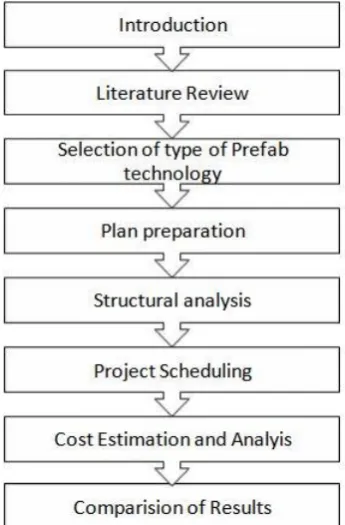
Fig 1 : Flow Chart of work
[image:3.595.51.561.194.763.2]6. COST ESTIMATION AND ANALYSIS
Fig -2 : Typical floor Plan
Standard size of the panel = 12m x 3m x 0.124 m Rate of GFRG panels (per square meter) = Rs. 1120 Quantity of panels required for G+3 building- In slab = 2883.41 Sq. Mt.
In walls = 3217.80 Sq. Mt.
[image:3.595.70.243.204.467.2]In parapet = 265.55 Sq. Mt. In stairs = 26.24 Sq. Mt. In openings =341.28 Sq. Mt Total = 6061.72 Sq. Mt. Total cost of panels = Rs. 67.89 Lakhs
Table -1: Cost Comparison of GFRG Building with Load Bearing Wall Structure and Framed Structure
Description
Types of Building Savings/Benefits in GFRG when
compared to
GFRG building
Load bearing wall Str.
RCC Framed Str.
Load bearing wall Str.
RCC Framed
Str.
Dwelling
units 16 16 16 - -
Carpet Area 122.19 SqM 116.02 SqM 119.02 SqM 5.32% 2.66%
Total Build
up area 2341.36 sqm 2341.36 sqm 2341.36 sqm - -
Excavation Rs. 74,560 Rs. 83,987 Rs. 95,025 11.22% 21.54%
Steel 16,21,540 Rs. 11,91,679 Rs. 21,54,550 -36.07% 24.74% Rs.
Cement 14,22,490 Rs. 24,46,373 Rs. 33,20,647 Rs. 41.85% 57.16%
Bricks - 25,33,360 Rs. 15,45,745 Rs. - -
Panels 67,89,126 Rs. 0 0 - -
Course
Aggregate 13,47,046 Rs. 13,52,470 Rs. 23,42,706Rs. 0.40% 42.50%
Fine
Aggregate 4,09,045 Rs. 10,52,702 Rs. 12,05,517Rs 61.14% 66.07%
Shuttering
cost Rs. 0 4,85,590 Rs. Rs 8,13,477 100% 100%
Labour Rs.6,24,271 27,71,050 Rs. 28,91,952 Rs. 77.47% 78.41%
Sub Total 1,22,88,078 Rs. 1,19,17,211 Rs. 1,42,74,596 Rs. - -
Miscelaneo
us 13,41,600 Rs. 37,45,862 Rs. 41,68,461 Rs. - -
© 2019, IRJET | Impact Factor value: 7.211 | ISO 9001:2008 Certified Journal
| Page 3397
7. RESULT AND DISCUSSION
The miscellaneous expenses include charges of Water supply, site-cleaning cost, transportation cost, etc.
On the extensive comparison between the three models taken into account results in huge savings in GFRG structure when compared to Load bearing structure and Framed structure of 12.98 % and 26.10 % respectively.
Chart -1: Cost comparison of materials required
In the above calculated cost, cost of finishing work like painting, wall putty, plumbing, electrification, sanitary fitting, installation of doors and windows, etc are not calculated as they are common in all three models and would not cause variation in prices for the comparison.
It is also important to note, the money saved due to early completion of the work and the gains in form of early selling or rent from the customers of the duration saved in construction time is additional to the comparative cost, which would further increase the benefits of the GFRG construction. We also see the carpet area increases in GFRG construction by 5.32% and 2.66% in comparison to other methods reducing the per SQ. Mt. cost of construction even further.
Chart -2: Total cost of construction
Chart -3: Cost per Sq. Ft.
8. CONCLUSIONS
With the above cost analysis, we return to the conclusion that opting for the GFRG Structure is much cost effective and also the time saving properties of this construction method is need of the hour under the increasing demand of the houses.
The panels also have good life span compared to conventional materials also help us save the environment by reducing our carbon foot prints. Nowadays, the use of panels in building advance gradually. Still, most of the people and engineers, suffer from lack of awareness about this type of building practices for residential buildings.
From this paper, we attempt to create some awareness about the construction of GFRG panel systems and about the costing, time management, resource allocation, etc.
9 FUTURE SCOPE
1. Analyze the cost of building in different seismic zones and with different materials with respect to local rates.
2. Analyze the cost of other types of prefabricated systems approved by BMTPC.
3. Analyze the reduction in carbon foot prints in construction, moving towards more sustainable development, by use of new construction technologies.
648 785
900
INR 500 INR 550 INR 600 INR 650 INR 700 INR 750 INR 800 INR 850 INR 900 INR 950 INR 1,000
C
os
t
P
e
r
SQ
.Ft
.
in
IN
R
GFRG 648
LB Structure 785
SMRF structure 900
Cost per Sq.Ft.
0 5 10 15 20 25 30 35
co
st
in
la
kh
s
Steel Cement Sand Gravel
GFRG Load bearing Framed structure
100 120 140 160 180 200
Co
st
(
in
la
kh
s)
© 2019, IRJET | Impact Factor value: 7.211 | ISO 9001:2008 Certified Journal
| Page 3398
ACKNOWLEDGEMENT
First, I would like to express my heartily thanks to Mr. Bilal Siddiqui for being a great guide and helping me during this work. Also I would like to express my sincere gratitude towards all the scholars whose articles were referred to and a remarkable help was obtained while working on this project. I would like to extend my regards to all the evaluators and contractors, who selflessly helped me in obtaining the data correctly and paved the way to the results.
REFERENCES
1. Devdas Menon, Maganti Janardhana, and A. Meher
Prasad(2003) “ Studies on the Behavior of Glass Fiber Reinforced Gypsum Wall Panels”
2. Huiqing Ying and Zhengyong Liu “Elastic Lateral
Features of a New Glass Fiber Reinforced Gypsum Wall” International Journal of science Index Vol:4 2010-03-29
3. Hegazy and Ayed (1998), Gunaydin and Dogan
(2004), and M. – Y. Cheng Et Al. (2009) “Method of Estimation Using Neural Network”
4. IIT Madras, Department of Civil Engineering(2003)
“Constuction Manual for Glass Fibre Reinforced Gypsum Based Building Panels”
5. Kang Liu, Xin-Liang Jliang and Yu-Fei WuShear(2008)
“Strength of Concrete Filled Glass Fiber Reinforced Gypsum Walls” Materials and Structures Vol 41:649– 662
6. Karshenas (1984), Trost and Oberlender (2003),
Sonmez (2004), Lowe Et Al. (2006) “Method of Estimation Using Regression Model”
7. Kim Et Al. G - H (2004), Dogan Et Al. (2006), Wang Et
Al. (2008) “Method of Estimation Using Case Based Reasoning Model”
8. Yu-Fei Wu (2004) “The Effect of Longitudinal
Reinforcement on the Cyclic Shear Behavior of Glass Fiber Reinforced Gypsum Wall Panels: Tests”
9. Yu-Fei Wu (2009) “The Structural Behavior and
Design Methodology for a New Building System Consisting of Glass Fiber Reinforced Gypsum Panels”
10. Glass Fibre Reinforced Gypsum Load Bearing Panels
for Affordable Housing In Fast Track & Environmental Protection
11. Estimating and costing in civil engineering by
B.N.Dutta.
12. Wu YF, Dare MP (2004) Axial and shear behavior of
glass fiber reinforced gypsum wall panels: test. J Compos Constr ASCE8(6):569–678
13. Maganti Janardhana, A. Meher Prasad, Devdas
Menon, “Studies On the behaviour of Glass Fiber Reinforced Gypsum Wall Panels”, Structural engineering division, IIT Madras
14. GFRG/RAPIDWALL Building Structural Design
Manual, prepared by Structural Engineering Division, Department of Civil Engineering, IIT Madras,2012.
15. Arvind reddy, R. J. Fernandes, “Seismic analysis of RC
regular and irregular frame structures” International Research Journal of Engineering and Technology, Volume. 02, Issue 05, Aug 2015
16. Rapid wall manufacturer (2012) Rapidwall
installation manual, Building Materials & Technology Promotion Council, Ministry of Housing & Urban Poverty Alleviation, Government of India.
17. Cost Model For Using Glass Fibre Reinforced Gypsum
System (GFRG) Mohamed Said Meselhy Elsaeed International Journal of Development and Economic Sustainability Vol.4, No.3, pp.33- 47, June 2016.
BIOGRAPHIES
Mr. Siddhant Singhal was born in 1995 in Varanasi, (U.P.). He received his Bachelor Degree in Civil Engineering from AKTU, Lucknow in 2017. He is currently pursuing his Masters Degree in Structural Engineering from Babu Banarasi Das University, Lucknow.