MOBILE BANKING AND PERFORMANCE OF COMMERCIAL BANKS IN KENYA
*,1
Kato, G. K.,
Department of Business Administration,
ARTICLE INFO ABSTRACT
Mobile banking is the provision of banking services using the mobile phone. In keeping with the advancement in technology, commercial banks have in the recent past undergone major technological leaps in the provision of banking services by adoption of mobi
banking is particularly useful in providing efficiency and accessibility of banking services without the barriers of location and time. Many studies have been done to assess the impact of mobile banking on financial inc
respect of the impact of mobile banking on performance of commercial banks. This research sought to study the relationship between mobile banking and performance of commer
The setting of this study was Kakamega town where banks operating in the town were studied. To attain this, the banks perceptions and attitudes towards mobile banking, and its effects on performance on financial and customer based meas
questionnaires to the customer service and operations staff. Various journal articles, print media articles, and books were reviewed to provide findings of previous work on the area of study. This study was correlational
establish the relationship among the variables. A structured questionnaire was used to collect data. The collected data was analyzed by inferential statistics where Pearson’s P
Correlation and multiple regression analysis were used in measuring relationships among the various variables. This study established that there was positive relationship between mobile banking and performance of commercial banks. It found ou
banks can be attributed to mobile banking. The findings of this research will be useful to bank management and other stakeholders as well as researchers in the area of mobile banking. The research will offer
proper implementation of mobile banking and will form a basis for future research in this area.
Copyright © 2014 Kato et al. This is an open access article distributed under th distribution, and reproduction in any medium, provided the original work is properly cited.
INTRODUCTION
Background of the Study
The discovery and adoption of the global net, the internet, has turned the world upside down and more so the business world. Business activities have taken a different turn as
the general consumers become more complex. Their purchase behavior is becoming more and more complex and highly unpredictable. Information communication technology (ICT) has become a key component in the banking industry and is at the forefront of packing up services that make banking a pleasant experience for the customer. Banking is only one of the many business areas that have been affected by the information technology revolution. In the banking sector the level of competition is cut–throat and the opportunities offered by the new technology, though accessible by all, can be exploited to obtain an edge in the industry.
*Corresponding author:Kato, G. K.
Department of Business Administration, Masinde Muliro and Technology, Kenya.
ISSN: 0975-833X
Vol. 6, Issue,
Article History:
Received 10th September, 2014
Received in revised form 25th October, 2014
Accepted 29th November, 2014
Published online 27th December,2014
Key words:
Mobile Banking, Bank Performance, Commercial Banks in Kenya.
RESEARCH ARTICLE
MOBILE BANKING AND PERFORMANCE OF COMMERCIAL BANKS IN KENYA
,
2Otuya, W. I.,
3Owunza, J. D. and
4Nato, J. A
Department of Business Administration, Masinde Muliro University of Science and Technology, Kenya
ABSTRACT
Mobile banking is the provision of banking services using the mobile phone. In keeping with the advancement in technology, commercial banks have in the recent past undergone major technological leaps in the provision of banking services by adoption of mobile banking technology. This model of banking is particularly useful in providing efficiency and accessibility of banking services without the barriers of location and time. Many studies have been done to assess the impact of mobile banking on financial inclusion. Not many known studies have been carried out in the Kenyan banking sector in respect of the impact of mobile banking on performance of commercial banks. This research sought to study the relationship between mobile banking and performance of commer
The setting of this study was Kakamega town where banks operating in the town were studied. To attain this, the banks perceptions and attitudes towards mobile banking, and its effects on performance on financial and customer based measures were assessed by administering questionnaires to the customer service and operations staff. Various journal articles, print media articles, and books were reviewed to provide findings of previous work on the area of study. This study was correlational in nature as it sought to fully describe all the key variables under study and establish the relationship among the variables. A structured questionnaire was used to collect data. The collected data was analyzed by inferential statistics where Pearson’s P
Correlation and multiple regression analysis were used in measuring relationships among the various variables. This study established that there was positive relationship between mobile banking and performance of commercial banks. It found out that improvements in performance of commercial banks can be attributed to mobile banking. The findings of this research will be useful to bank management and other stakeholders as well as researchers in the area of mobile banking. The research will offer insight into the area of mobile banking to bank management and strategists in proper implementation of mobile banking and will form a basis for future research in this area.
This is an open access article distributed under the Creative Commons Attribution License, which distribution, and reproduction in any medium, provided the original work is properly cited.
The discovery and adoption of the global net, the internet, has turned the world upside down and more so the business world. Business activities have taken a different turn as customers and the general consumers become more complex. Their purchase behavior is becoming more and more complex and highly Information communication technology (ICT) has become a key component in the banking industry and is at nt of packing up services that make banking a pleasant experience for the customer. Banking is only one of the many business areas that have been affected by the In the banking sector the t and the opportunities offered by the new technology, though accessible by all, can be
Department of Business Administration, Masinde Muliro University of Science
The rapid development of information and communication technology is shaking the foundation of the banking industry (Feng, 2001). Until recently studies of most banks have been based on strategy of process int
economy and monopolization of extensive branch network (Fang, 2009). However, new developments in the mobile and related technology are questioning the basic assumption of this integrated model. The growth of wireless tech
increased the number of people using mobile devices and accelerated the development of mobile service conducted with
these devices (Wang et al., 2006). As competition in the
banking industry intensifies, each player in the industry is positioning himself to take advantage of these developments to get ahead of the rest. The number of mobile banking users globally is forecasted to grow from 55 million users in 2009 to an incredible 894 million in 2015, exceeding the use of online banking (Berg Insight, 2010). All these are potential customers for the global banking industry. This new technology is changing every aspect of daily life and bringing new opportunities in many areas (Fjermestad
International Journal of Current Research
Vol. 6, Issue, 12, pp.10670-10674, December, 2014
MOBILE BANKING AND PERFORMANCE OF COMMERCIAL BANKS IN KENYA
J. A.
Masinde Muliro University of Science and Technology, Kenya
Mobile banking is the provision of banking services using the mobile phone. In keeping with the advancement in technology, commercial banks have in the recent past undergone major technological le banking technology. This model of banking is particularly useful in providing efficiency and accessibility of banking services without the barriers of location and time. Many studies have been done to assess the impact of mobile banking on lusion. Not many known studies have been carried out in the Kenyan banking sector in respect of the impact of mobile banking on performance of commercial banks. This research sought to study the relationship between mobile banking and performance of commercial banks in Kenya. The setting of this study was Kakamega town where banks operating in the town were studied. To attain this, the banks perceptions and attitudes towards mobile banking, and its effects on ures were assessed by administering questionnaires to the customer service and operations staff. Various journal articles, print media articles, and books were reviewed to provide findings of previous work on the area of study. This in nature as it sought to fully describe all the key variables under study and establish the relationship among the variables. A structured questionnaire was used to collect data. The collected data was analyzed by inferential statistics where Pearson’s Product Moment Correlation and multiple regression analysis were used in measuring relationships among the various variables. This study established that there was positive relationship between mobile banking and t that improvements in performance of commercial banks can be attributed to mobile banking. The findings of this research will be useful to bank management and other stakeholders as well as researchers in the area of mobile banking. The insight into the area of mobile banking to bank management and strategists in proper implementation of mobile banking and will form a basis for future research in this area.
e Creative Commons Attribution License, which permits unrestricted use,
The rapid development of information and communication technology is shaking the foundation of the banking industry ng, 2001). Until recently studies of most banks have been based on strategy of process integration, service bundling, scale economy and monopolization of extensive branch network ). However, new developments in the mobile and related technology are questioning the basic assumption of this integrated model. The growth of wireless technology has increased the number of people using mobile devices and accelerated the development of mobile service conducted with ., 2006). As competition in the banking industry intensifies, each player in the industry is g himself to take advantage of these developments to get ahead of the rest. The number of mobile banking users globally is forecasted to grow from 55 million users in 2009 to an incredible 894 million in 2015, exceeding the use of online ght, 2010). All these are potential customers for the global banking industry. This new technology is changing every aspect of daily life and bringing new
areas (Fjermestad et al., 2006). Banks
have also begun to provide mobile banking services, to enable customers to transact using mobile technologies such as phones, PDAs, and smart-phones (Barnes and Corbitt, 2003). These mobile services facilitate customers to check the balance and transactions of their accounts, pay invoices and transfer funds between accounts, and confirm the direct payment via
the phone’s micro browser (Mallat et al., 2004).
Mobile banking is evolving as the new front on which banks can differentiate their service delivery. Banks and other financial services companies have an opportunity to generate new business, attract or retain customers, control costs, and gain other advantages by deploying applications for mobile phone users (Johnstone, 2010). The mobile banking platform allows increased penetration by banks to areas not viable for physical presence that involves huge investments in physical infrastructure. Banks are also able to sell more services to existing customers through mobile banking thus increasing the banks’ share of wallet.
Further, the banks most valuable customers, who constitute about 20% of all customers and account for about 80% of the banks business, can be retained through the increased efficiency and value brought about by mobile banking, according to Mas and Kumar (2008), it is very difficult to have individual services unique to a bank because they are easily replicable. He argues that the important thing is to ‘embed the non-unique services within a unique customer experience’. With informational and transactional capability in customers’ pockets (the mobile-as-Internet-machine), banks may be able to propose new services to their customers in a much more targeted way. Banks also can fully exploit the immediacy of the mobile environment to extend the benefits of control and choice, and hence convenience, across their entire product range (the “new way to interact” view). Costs of service can also be significantly reduced through adoption of mobile banking. This is because of the ‘self service’ capabilities brought about by mobile banking, as well as the non use of stationery, man hours and other physical resources. Various services can be offered through mobile banking. These include funds transfers, bank alerts, service requests, information inquiries, and bill payment.
Being a recent platform, there is need to understand the main services that can be channeled through this platform, how they should be packaged and what precautions need to be taken in using this technology. Studies carried out on mobile banking do not clearly expose its contribution to the performance of banks. This research sought to establish the impact of mobile banking on performance of commercial banks in Kenya. It aims to provide such learning to banks in order to help in increased efficiency and quality in their service delivery and hence their performance.
Objective of the study
The objective of this study was to establish the relationship between mobile banking and performance of commercial banks in Kenya.
Conceptual framework
The conceptual framework used in this research depicts the various variables under study in the research. The variables used in this research are as follows: The independent variable under study was mobile banking. This refers to all the services offered through the mobile banking platform. These services include, interbank funds transfer, cash withdrawal, balance inquiry, bill payment, and information inquiry. The dependent variable under study was performance. This encompasses two perspectives of measurement. The customer based measures include customer loyalty, share of wallet, and customer advocacy. The financial based measures include profit margin, cost effectiveness, and sales volume. These variables lead to the conceptual framework of this study illustrated in figure below:
MATERIALS AND METHODS
Research design
This research adopted a correlational survey design. It was meant to establish the relationship between mobile banking and performance of commercial banks in Kenya. Correlational survey design was more suitable for this research since the number of banks studied was small and hence the necessity to
do a survey on all the banks within the scope of the study. The research was correlational in nature as it sought to fully describe all the key variables under study and establish the relationship among the variables.
The study population and Sample Size
The population of study comprised all banks operating in Kakamega town. According to the Kenya Bankers Association (KBA), there are 9 commercial banks in Kakamega. These include Standard Chartered Bank, Kenya Commercial Bank, Barclays Bank, Co-operative Bank, National Bank of Kenya, Equity Bank, Family Bank, Diamond Trust Bank and Equatorial Commercial Bank. The population of this study was also the sample and so no sampling procedure was required. This was because of the survey enumeration done for all items in the population.
Data collection Methods
Census survey was conducted. The research instrument was administered to all the banks operating in Kakamega town. These banks represent the main banks that operate in Kenya. A structured questionnaire was designed and used. It was administered through drop and pick technique.
Analysis Methods
The collected data was analyzed by inferential statistics where multiple regression and Pearson Correlation analysis was used in measuring relationship between the various mobile banking services and performance of commercial banks. The following regression model was used:
PERF= β0+β1IT+β2CW+β3BI+β4BP+β5IQ+Ƹi, where:
PERF- Performance of commercial banks IT- Interbank Transfer
CW- Cash Withdrawal BI- Balance inquiry BP- Bill payment IQ- Information Inquiry
Ƹi -Error term, which captures all the other variables that
explain behavior of the dependent variable but are not captured in the model
βo, β1, β2, β3, β4, β5˃0, are regression coefficients. βo is the slope coefficient whose purpose is to anchor the regression model. While the other coefficients measure the sensitivity of the dependent variable to the changes in the respective independent variables. The explanatory power of the above regression model was measured using the coefficient of
determination (R2), while the significance of the model was
determined by calculating P value where 0.05 was used as the benchmark. The linear relationship between mobile banking and performance of commercial banks was measured using Pearson correlation coefficient.
RESULTS AND DISCUSSION
From regression analysis the below discussed results were obtained.
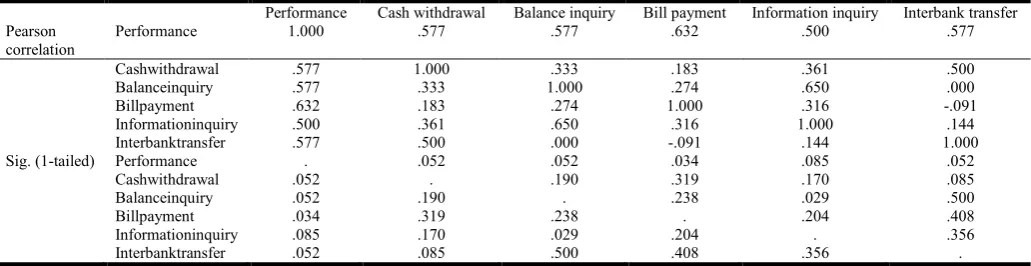
The linear relationship between mobile banking and performance of commercial banks was measured using Pearson correlation coefficient. From the above table, it was established that there existed a medium positive relationship between performance of commercial banks and interbank transfer (0.577), cash withdrawal (0.577), balance inquiry (0.577), bill payment (0.632), and information inquiry (0.5). This finding is consistent with a study carried out by Kosmidou and Zopounidis (2008) which established that there is a strong correlation between bankng methodologies and productivity and efficiency in the banking industry. This consistency could nbe explained by the fact that the banking environment is similar across the globe. The finding is further propounded by Revell (1980) whose study also lends credence to the fact that banking methodology have astrong correlation with the banks profit margins.
The coefficient of determination, R2 equals 0.974, which
[image:3.595.41.557.574.707.2]means that about 97.4% of the variations in the performance of commercial banks can be explained by mobile banking. This is an indication of strong robustness of the regression model. The model has a p-value of 0.014 which gives enough confidence that variation of the five explanatory variables used in the model can significantly explain variation of the dependent variable.
Table 4.20. Correlation between mobile banking and performance of commercial banks
Performance Cash withdrawal Balance inquiry Bill payment Information inquiry Interbank transfer Pearson
correlation
Performance 1.000 .577 .577 .632 .500 .577
Cashwithdrawal .577 1.000 .333 .183 .361 .500
Balanceinquiry .577 .333 1.000 .274 .650 .000
Billpayment .632 .183 .274 1.000 .316 -.091
Informationinquiry .500 .361 .650 .316 1.000 .144
Interbanktransfer .577 .500 .000 -.091 .144 1.000
Sig. (1-tailed) Performance . .052 .052 .034 .085 .052
Cashwithdrawal .052 . .190 .319 .170 .085
Balanceinquiry .052 .190 . .238 .029 .500
Billpayment .034 .319 .238 . .204 .408
Informationinquiry .085 .170 .029 .204 . .356
Interbanktransfer .052 .085 .500 .408 .356 .
Table 4.21. Coefficient of determination
Model R R Square Adjusted R Square Std. Error of the Estimate Change Statistics
R Square Change F Change df1 df2 Sig. F Change
From the above table, β0=-0.264, β1=0.361, β2=0.02, β3=0.267,
β4=0.554, β5=-0.067.
Therefore the regression equation takes the following form:
PERF=-0.264+0.361IT+0.02CW+0.267BI+0.554BP-0.067IQ. The regression coefficient for interbank transfer is 0.011 which means that a unit increase in interbank transfers will lead to 0.011 of a unit increase in performance, holding all other explanatory variables constant. The regression coefficient for cash withdrawal is 0.02 which implies that a unit increase in cash withdrawal will lead to a 0.02 of a unit increase in performance holding all other explanatory variables constant. A unit increase in balance inquiry will lead to a 0.267 of a unit increase in performance holding all other explanatory variables constant. Its regression coefficient is 0.267. The regression coefficient for bill payment is 0.554 and thus a unit increase in bill payment will lead to a 0.554 of a unit increase in performance of commercial banks holding all other explanatory variables constant. Finally, a unit increase in information inquiry is expected to lead to a 0.067 of a unit decrease in performance, holding all other explanatory variables constant.
This regression finding is supported by a previous study by Arshadi and Lawrence (1987) whose study sought to establish the effect of banking methodology and banks profitability. His study had similar results to those this study has established. The consistency can be accounted for by the fact that banking techniques are universal and applicable in every banking scenario. This similarity is further supported by a similar study done by Mas and Kumar (2008) whose study findings show that mobile banking greatly impacts on mobile performance.
Conclusion
From the findings of this study, mobile banking is a significant contributor to performance of commercial banks. This therefore means that banks need to take more interest in mobile banking. They need to address the issues that lead to low uptake of this service by customers, optimize on the enormous potential of mobile banking and synchronize their systems with those of mobile banking to ensure full integration of this service and thus enjoy the benefits brought about by mobile banking. It is clear that mobile banking is the next platform for superior banking service offering.
Recommendation
As supported by the research findings, mobile banking is a key contributor to bank performance as well as a sure value
addition to consumers of banking services, this study therefore recommends the following:
1. Banks need to take mobile banking as a premium service
offering in order to derive maximum value from it. The assumption that customers are too cautious with mobile banking no longer holds and in fact customers are increasingly embracing the service.
2. The government has a lot to gain from mobile banking in
terms of making financial services accessible to its citizens. It should take a leading role in terms of creating legislation that will enhance awareness and use of this service. This includes educating people about use of the mobile phone which is the single most important device used in mobile banking.
3. Though mobile banking can be an additional income
stream for banks, banks should not load extra costs from the service to their customers. This is because of the slow adoption of this service. Customers perceiving it as an expensive channel will dwarf its growth. This is important as the benefits of mobile banking are more if consumed in mass.
4. Mobile phone companies, being beneficiaries, should
develop applications that support mobile banking and which are simple to use yet secure for mobile banking service users. They are best placed to understand what will best suit their customers deriving from their vast experience in offering mobile services.
5. Great attention needs to be accorded to the component of
foreign exchange and foreign currency. This is because banking goes beyond the Kenyan borders. The time and place convenience brought about by mobile banking could be high value to customers in need of banking services across the borders.
REFERENCES
Arshadi, N. and Lawrence, E. C. 1987. “An Empirical
Investigation of New Bank Performance”, Journal of
Banking and Finance, 11, 33-48.
Barnes, S.J and Corbitt, B. 2003. “Mobile banking:
concept and potential”; International Journal of Mobile
Communications, 1, 3, 273-288.
Fang, K. and T. Yu, 2009. Measuring the post-adoption
customer perception of mobile banking services. Cyber
Psychology and Behavior, 12, 33-35.
Feng, L. 2001. “The Internet and the Deconstruction of the
Integrated Banking Model”. British Journal of
Management, vol 12, issue 4, 16.12.2002
Fjermestad, J. et al. 2006. “Moving towards generation
telecommunications standards: the good and Bad of the
'Anytime Anywhere' solutions”; Communication of the
[image:4.595.87.514.79.157.2]association for information systems, 17, 3, 71-89.
Table 4.22. Regression Coefficients
Model Unstandardized coefficients Standardized coefficients T Sig.
B Std. Error Beta
1 (constant) -.264 .374 -.705 .532
Cash withdrawal .020 .068 .035 .300 .784
Balance inquiry .267 .073 .463 3.674 .035
Bill payment .554 .095 .584 5.838 .010
Information inquiry -.067 .095 -.089 -.697 .536
Johnstone, B. et al. 2010. Mobile Banking: A catalyst for improving bank performance. Deloitte consulting.
Kosmidou K.and Zopounidis C. 2008. “Measurement of bank
performance in Greece”. South-Eastern Europe Journal of
Economics, I 79-95
Mallat, N. et al. 2004. “Mobile banking services”;
Communication of the ACM, 47.
Mas, I and K. Kumar. 2008. “Banking on Mobiles: Why, How, for Whom?” Focus Note 48. Washington, D.C.: CGAP, June.
Revell, J. 1980. “Costs and Margins in Banking: An International Survey”, Paris, OECD.
Wang, Y. 2006. “Predicting customer intention to use mobile
service”; Information System Journal, 16, 157-179.
www.berginsight.com as at 23rd May 2011.