© 2019, IRJET | Impact Factor value: 7.211 | ISO 9001:2008 Certified Journal
| Page 2219
Power Quality Improvement by using DSTATCOM with PSO Tuned
PI Controller
S. Karuna
1*, P.V. Prasad
21*
EEE Department, CBIT, Gandipet, Hyderabad, India
2EEE Department, CBIT, Gandipet, Hyderabad, India
---***---Abstract - The Distribution static synchronous compensator (DSTATCOM) is used for reactive power compensation, Power factor
correction, reduction in total harmonic distortion and to stabilize the source and PCC currents. DSTATCOM is a parallel connected device connected at a point of common coupling (PCC). The Controlling algorithm for DSTATCOM is developed by using synchronous reference frame theory (SRF) and which is utilized for generating the reference currents. The DSTATCOM comprises of VSI, dc link capacitor and control circuit. The dc link capacitor voltage is regulated by using the PI controller. The Kp, KI values obtained with conventional method may not give accurate results. Hence, In this paper a PSO based technique is proposed to obtain optimal results. The simulation representation is progressed using MATLAB simulation software.
Keywords:DSTATCOM; voltage source inverter (VSI); SRF Theory; PI controller; PSO.
1. INTRODUCTION
In current years because of new advancement in technology most of the industries and commercial customers prefer the usage of Power electronics devices. Because of these non-linear loads distribution system is facing power quality (PQ) problems such as poor power factor, harmonics injection, voltage sag, voltage swell, high neutral current, unbalance in three phase loading, distortions in source currents. These distortions may pass through the entire network. These PQ problems may responsible for increase of power losses, violates the power flow limits, and reduce the system response time [1]. Various custom power devices such as DSTATCOM (Distribution Static Synchronous Compensator), Unified Power Quality Conditioner (UPQC), and Dynamic Voltage Regulator (DVR) are operating for power quality (PQ) improvement [2-3]. Among these devices DSTATCOM is preferred because of its features such as low power losses, generating few harmonics, ability of high regulatory, less cost, and compact size. For controlling of DSTATCOM various methods are used such as Synchronous Reference Frame (SRF) Theory, Instantaneous Reactive Power (IRP) Theory [4], and Instantaneous Symmetrical Component (ISC) Theory [5]. The performance of DSTATCOM depends on the reference currents generation. DSTATCOM is a VSI based custom device. For switching of VSI Hysteresis current controller [6-8] is used. Among the other PWM current controllers, Hysteresis controller gives the fast response, reduce peak current and shows better performance. PI controller is operated for regulating the DC link voltage [9-11]. For tuning of PI controller trial and error method is the simplest but it consume more time and the performance is also not good. Instead of Trial and error if soft computing techniques are used such as Ant colony Optimization, Genetic Algorithm (GA), Ziegler-Nichols technique and Particle Swarm Optimization (PSO) [12-15] technique, better results can be obtained. In this paper PSO which gives the best global gains for PI controller is applied for obtaining gains and DSTATCOM is simulated using MATLAB/SIMULINK software.
2. CONFIGURATION OF DSTATCOM
DSTATCOM is a practice power device connected at PCC through interfacing inductor. DSTATCOM is used for injecting or absorbing the reactive power into system to stabilize the voltages in the system due to variation of the load. It is also used to inject the compensating currents into the system. Isa, Isb, and Isc are the source currents and Vsa, Vsb and Vsc are the source
voltages of phase a, b, c, Ila, Ilb and Ilc are the load currents and compensating currents are symbolized as Ifa, Ifb and Ifc. Non
© 2019, IRJET | Impact Factor value: 7.211 | ISO 9001:2008 Certified Journal
| Page 2220
Fig – 1: Schematic diagram of DSTATCOM
3. CONTROL ALGORITHM FOR DSTATCOM
The control circuit for DSTATCOM is shown in Fig – 2:
Fig – 2: Control circuit for DSTATCOM
The control scheme, for DSTATCOM is divided into two parts.
1. From the feedback signals reference signal will be produced.
2. By comparison of reference signal and actual sinusoidal signal, gate signal will be produced by using Hysteresis current controller.
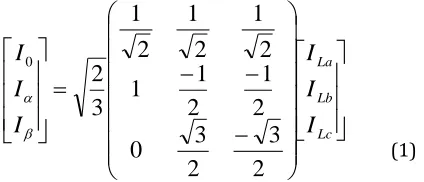
From the control scheme, reference current signals will be generated by using proportional and integral controllers with SRF Theory, the three phase currents at the load are converted into α-β-0 axis by using Clark transformation. It is given by
Lc Lb LaI
I
I
I
I
I
2
3
2
3
0
2
1
2
1
1
2
1
2
1
2
1
3
2
0 (1) [image:2.612.43.255.531.622.2]© 2019, IRJET | Impact Factor value: 7.211 | ISO 9001:2008 Certified Journal
| Page 2221
I
I
I
I
I
I
Lq Ld 0 0cos
sin
0
sin
cos
0
0
0
1
(2)
The PLL consists of phase comparator and low pass filter within the loop. The input and output difference is measured in the phase comparator and outcome value is passed through the low pass filter which filter out and produces an error signal which gives the generated output current. The variables ILd and ILq are obtained from the synchronous reference frame, which are
passed through Low pass filter to generate the exact reference signals. The each current component having a mean and oscillating values are given by (2).
ILd=Id dc + Id ac (3)
ILq=Iq dc+ Iq ac (4)
The fundamental current is transferred into the mean value or dc component and remaining all other higher order harmonic components are transferred into the non dc components including the negative sequence currents components, but these are having the repetitive variation nature, it looks like ripples, these ripples are eliminated by using the filter. So now the reference current components are given by the equation (5) & (6).
ILd=Vd dc (5)
ILq=Vq dc (6)
Source must deliver the direct axis load current (ILd) along with the injected current component to keep the DC bus voltage and
to supply the losses (Iloss) in DSTATCOM. The output of the PI controller is examined as the current loss (Iloss).
Iloss(n)=I loss(n-1)+Kpd(Ide(n)-Ide(n-1))+KidIde(n) (7)
Where Ide(n)=I*dc-Idc(n) which is the error generated between the reference current (I*dc) and injected dc current (Idc) at the
instant of nth sampling. Kpd, Kid are the proportional and integral gains of the dc bus voltage PI controller respectively. The
reference current is given by
Idc ref=Id dc+Iloss (8)
To regulate the voltage at the load end, the sum of the Quadrature axis current (Iq dc) and the output of the PI controller current
(Iqr) are used.
The ac source voltage amplitude is obtained from the equation given below.
)
)
(
)
(
)
(
(
3
2
2 2 2ac b
a
source
v
v
v
v
(9)
By using PI controller, the load current (Is) is controlled to its reference current (I*s) .Output of this PI controller is examined
as the reactive current component (Iqr), which is given by the equation.
Iqr(n)=Iqr(n-1)+Kpq(Ite(n)-Ite(n-1))+KiqIte(n) (10)
Where Ite(n)=I*s-Ie(n) which is the error between reference current (I*s) and actual measured current at load end at the instant of
nth sampling. Where Kpq ,Kiq are the proportional gain and integral gain of the PI controller.
The quadrature axis reference current is given by
© 2019, IRJET | Impact Factor value: 7.211 | ISO 9001:2008 Certified Journal
| Page 2222
The reference current signals Id ref , Iq ref are transformed into α-β-0 axis frame which is obtained by using the equation givenbelow
qref dref s s sI
I
I
I
I
0
cos
sin
0
sin
cos
0
0
0
1
0
(12)The reference currents in a-b-c reference frame are obtained by the following equation.
s s s sc sb saI
I
I
I
I
I
02
3
2
1
0
2
3
2
1
0
0
1
0
3
2
(13)The obtained reference currents from the control block are transferred to hysteresis current controller to supply switching signals to the VSI to compensate the harmonics injected by the non linear loads.
4. DESIGN OF PI CONTROLLER
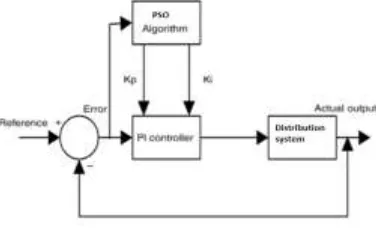
[image:4.612.211.399.450.564.2]To make the steady state error zero and to increase the response of the system PI controller is used. PI controller is the mostly used controller in industries because of its simple structure, which can be easily understood and implemented. The location of the PI controller is shown in Fig - 3. Tuning of PI controller is the main task [9,10]. If system is linear PI controller can be tuned by trial and error method but for complicated plants with higher order must be followed some tuning methods. Here the PSO technique is used to tune the PI controller in getting best results [11].
Fig – 3: Location of PI controller.
5. PARTICLE SWARM OPTIMIZATION (PSO) TECHNIQUE
© 2019, IRJET | Impact Factor value: 7.211 | ISO 9001:2008 Certified Journal
| Page 2223
( )( ) ( )( ) (14)
(15)
A large inertia weight (w) facilitates a global search while a small inertia weight facilitates a local search. Where C1 and C2 are
acceleration coefficients, r1 and r2 are the random numbers taken between [0, 1]. Second term represents cognitive
[image:5.612.238.384.194.364.2]component where the particle changes its velocity and position based on their own thinking and memory, the third term represents the social component where the particle changes its velocity and position based on their neighboring particles.
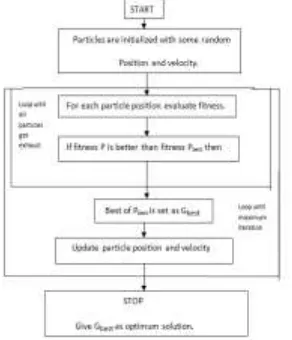
Fig – 4: PSO loop iteration Flow chart
6. RESULTS AND DISCUSSION
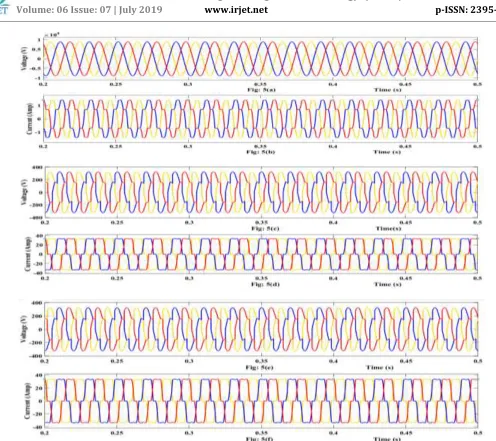
Execution of proposed DSTATCOM model is done in MATLAB/SIMULINK software by using SRF theory with PSO tuned PI controller. This model is tested under non linear load conditions. 0.2 to 0.5 is the simulation time for better results. The parameters of DSTATCOM and PI Controller with PSO are given in Appendix. DSTATCOM is used for Power factor improvement, reactive power compensation, compensates the harmonics to reduce THD values and to maintain the Voltage at PCC within limits. This model shows the comparison of PI controller tuned with conventional method and with PSO technique. The performance of DSTATCOM is given with the following cases:
Non Linear Load without DSTATCOM Non Linear Load with PI controller
Non Linear Load with PSO tuned PI controller.
6.1. System Response for Non Linear Load without DSATCOM
© 2019, IRJET | Impact Factor value: 7.211 | ISO 9001:2008 Certified Journal
| Page 2224
Fig – 5: (a) Source Voltage, (b) Source Current, (c) PCC Voltage, (d)PCC Current, (e) Load Voltage and (f) Load Currentrespectively.
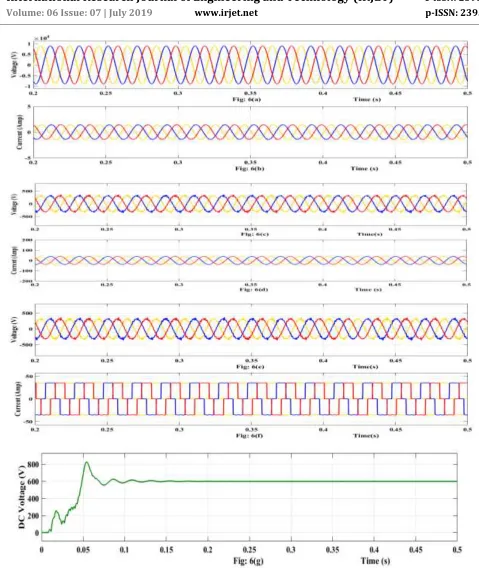
6.2. System Response for Non Linear Load with PI controller
[image:6.612.55.551.61.502.2]© 2019, IRJET | Impact Factor value: 7.211 | ISO 9001:2008 Certified Journal
| Page 2225
Fig – 6: (a) Source Voltage, (b) Source Current, (c) PCC Voltage, (d) PCC Current, (e) Load Voltage, (f) Load Current, (g) DC Link [image:7.612.65.544.58.626.2]© 2019, IRJET | Impact Factor value: 7.211 | ISO 9001:2008 Certified Journal
| Page 2226
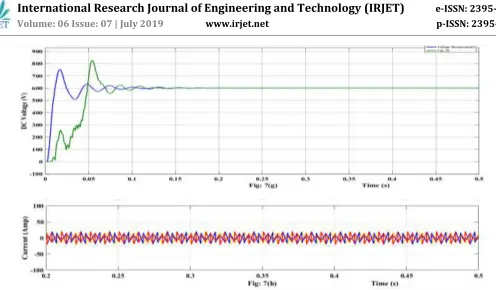
6.3. System Response with PSO tuned PI Controller.
© 2019, IRJET | Impact Factor value: 7.211 | ISO 9001:2008 Certified Journal
| Page 2227
Fig – 7: (a) Source Voltage, (b) Source Current, (c) PCC Voltage, (d) PCC Current, (e) Load Voltage, (f) Load Current, (g) DC LinkVoltage, (h) Compensator current.
Fig – 8(a): Source THD without DSTATCOM 8(b): Source THD with PI controller 8(c): Source THD with PSO-PI
7. CONCLUSION
In this paper, The VSI based DSTATCOM is executed through MATLAB/SIMULINK software. DSTATCOM which injects the compensating currents into the system which produce the source currents as balanced with reduced THD and maintains the Voltage at PCC as constant .The simple and easy SRF Theory is used for controlling of DSTATCOM. DC voltage is maintained as constant with PI controller. Tuning of PI controller is done by conventional method and by using PSO technique and their comparison is analyzed. PSO technique which gives the best global gains for PI controller is observed.
REFERENCES
[1] Firas M.F. Flaih, Lin Xiangning, Qasim K. Mohin and Samir M. Dawoud , “Improving Voltage Profile in Distribution System Using PSO-TISO Fuzzy in DSTATCOM Control”, 2016, 424-429.
[image:9.612.54.550.47.337.2] [image:9.612.101.515.383.491.2]© 2019, IRJET | Impact Factor value: 7.211 | ISO 9001:2008 Certified Journal
| Page 2228
[3] K. A Dharmadhikar,1 V. R. Doifode2, S. P Gawande3, M. R. Ramteke4 “Open Loop and Closed Loop Control Schemes forCapacitor Voltage Equalization in DSTATCOM Applications” IEEE International Conference on Advanced Communications, Control and Computing Technologies, May (2014)
[4] Bhim Singha , P. Jayaprakashb,* , D.P Kothari, “New Control Approach for Capacitor Supported DSTATCOM in three- phase
four wire distribution system under non-ideal supply voltage conditions based on synchronous reference frame theory”, Electrical power and Energy Systems 33 (2011) 1109-1117.
[5] Hareesh Myneni, G.Siva Kumar, D.Sreenivasarao, ”Power Quality Enhancement by Current Controlled Voltage Source Inverter Based DSTATCOM for Load Variations”, 2015 IEEE JOINT INDUSTRIAL AND COMMERCIAL POWER SYSTEMS/PETROLEUM AND CHEMICAL INDUSTRY CONFERENCE (ICPSPCIC), 182-188.
[6] Alamelu Nachiappan, Sundararajan K2 and Malarselvam V3, “Current Controlled Voltage Source Inverter Using Hysteresis
Controller and PI Controller”, 2012.
[7] Shirsikar Prachi Gopal. Dr.D.R.Patil, “Hysteresis Band Current Controller for Voltage Regulation and Harmonic Mitigation using DSTATCOM”, 2016 International Conference on Computation of Power, Energy Information and Communication (ICCPEIC).
[8] Vasudeva Naidu Pudi, Basavaraja, “ PSO Based Optimal PI Tuning of AHCC D- STATCOM”, 2015.
[9] Subhadip Bhattacharya, Benjamin A. Shimray “ Power Quality Improvement and Mitigation of Harmonic using DSTATCOM with PI and FUZZY Logic Contriller”, 2017, 183-189.
[10] Ritu Sharma, Alka Singh, A.N.Jha, ”Performance Evaluation of Tuned PI Controller for Power Quality Enhancement for Linear and Non Linear loads”, IEEE International Conference on Recent Advances and Innovations in Engineering (ICRAIE-2014), May 09-11, 2014,Jaipur, India.
[11] Rinat R. Nasyrov, Raseel I. Aljendy, “Comprehensive Comparison between Hybrid Fuzzy- PI and PSO- PI Controllers Based Active Power Filter for Compensation of Harmonics and Reactive Power under Different Load Conditions”, 2018, 725-730.
[12] T.Eswaran, V.Suresh Kumar, “Particle Swarm Optimization (PSO)-based tuning technique for PI controller for management of a distributed static synchronous compensator (DSTATCOM) for improved dynamic response and power supply”, Journal of Applied Research and Technology, 15 (2017), 173-189.
[13] M.A. Abido*, “Optimal Power flow using Particle Swarm Optimization”. Electrical power and energy systems, 24, (2002),
563-571.
[14] P.S. Kopulwar, S.M.Sahare, T.M.Atram, Y.V.Ninghot, V.Ujawane, S.P.Gawande,”Particle Swarm Optimization Based distribution Static compensator for Load compensation”,IEEE International Conference on Advanced Communication Control and Computing Technologies (ICACCCT), 2014, 391-397.
[15] Rinat R. Nasyrov1, Raseel I. Aljendy2, Ahmed A. Zaki Diab3, Adaptive PI Controller of Active Power Filter For Compensation
of Harmonic and Voltage Fluctuation Based on Particle Swarm Optimization (PSO)”, IEEE Conference of Russian Young Researchers in Electrical and Electronics Engineering, 2018, 725-729.
APPENDIX
Source Voltage 11KV, 50Hz Cdc 3000µF
Vdc 600V
Hysteresis band ±0.2