• No results found

1H Indole 3 carbaldehyde

N/A
N/A
Protected

Academic year: 2020

Share "1H Indole 3 carbaldehyde"

Copied!
6
0
0

Loading.... (view fulltext now)

Full text

(1)

1

H

-Indole-3-carbaldehyde

C. S. Dileep,aM. M. M. Abdoh,bM. P. Chakravarthy,c K. N. Mohanacand M. A. Sridhara*

a

Department of Studies in Physics, Manasagangotri, University of Mysore, Mysore 570 006, India,bDepartment of Physics, Faculty of Science, An Najah National University, Nabtus, West Bank, Palestinian Territories, andcDepartment of Studies in Chemistry, Manasagangotri, University of Mysore, Mysore 570 006, India Correspondence e-mail: [email protected]

Received 14 September 2012; accepted 25 September 2012

Key indicators: single-crystal X-ray study;T= 293 K; mean(C–C) = 0.003 A˚; Rfactor = 0.029;wRfactor = 0.069; data-to-parameter ratio = 7.1.

In the title compound, C9H7NO, the benzene ring forms a

dihedral angle of 3.98 (12) with the pyrrole ring. In the

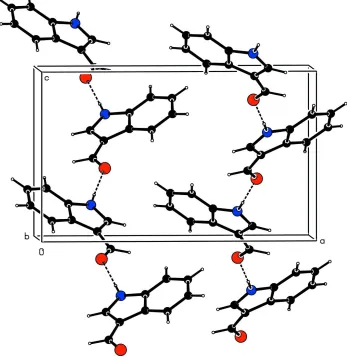
crystal, N–H O hydrogen bonds links the molecules into chains which run parallel to [021].

Related literature

For a related structure, see: Rizalet al.(2008).

Experimental

Crystal data

C9H7NO Mr= 145.16

Orthorhombic,Pca21

a= 14.0758 (9) A˚

b= 5.8059 (4) A˚

c= 8.6909 (5) A˚

V= 710.24 (8) A˚3

Z= 4

MoKradiation

= 0.09 mm1

T= 293 K

0.300.200.20 mm Data collection

Bruker Kappa APEXII CCD diffractometer

3791 measured reflections

775 independent reflections 699 reflections withI> 2(I)

Rint= 0.024

Refinement

R[F2> 2(F2)] = 0.029

wR(F2) = 0.069

S= 1.08 775 reflections 109 parameters 1 restraint

H atoms treated by a mixture of independent and constrained refinement

max= 0.11 e A˚

3

min=0.09 e A˚

3

Table 1

Hydrogen-bond geometry (A˚ ,).

D—H A D—H H A D A D—H A

N1—H1A O1i

0.94 (3) 1.92 (3) 2.831 (2) 165 (3)

Symmetry code: (i)xþ3 2;y1;zþ

1 2.

Data collection:APEX2(Bruker, 2004); cell refinement:APEX2

and SAINT (Bruker, 2004); data reduction: SAINT and XPREP

(Bruker, 2004); program(s) used to solve structure: SHELXS97

(Sheldrick, 2008); program(s) used to refine structure:SHELXL97

(Sheldrick, 2008); molecular graphics:PLATON(Spek, 2009); soft-ware used to prepare material for publication:PLATON.

CSD would like to acknowledge the UGC–BRS and the University of Mysore for financial asistance.

Supplementary data and figures for this paper are available from the IUCr electronic archives (Reference: GO2070).

References

Bruker (2004).APEX2,SAINT andXPREP. Bruker AXS Inc., Madison, Wisconsin, USA.

Rizal, M. R., Ali, H. M. & Ng, S. W. (2008).Acta Cryst.E64, o555. Sheldrick, G. M. (2008).Acta Cryst.A64, 112–122.

Spek, A. L. (2009).Acta Cryst. D65, 148–155. Acta Crystallographica Section E

Structure Reports Online

(2)

supporting information

Acta Cryst. (2012). E68, o3135 [doi:10.1107/S1600536812040573]

1

H

-Indole-3-carbaldehyde

C. S. Dileep, M. M. M. Abdoh, M. P. Chakravarthy, K. N. Mohana and M. A. Sridhar

S1. Comment

The molecule is shown with its labelling in Figure 1. The molecules are connected into one-dimensional chains by the

N1–H1A···O1(3/2-x,-1+y,1/2+z hydrogen bond which links the molecules into one dimensional chains which run parellel

to [2-10], Table 1 and Figure2.

S2. Experimental

Indole was converted to 1H-indole-3-carbaldehyde in the presence of DMF, POCl3, NaOH. 1H-indole-3-carbaldehyde

was taken and recrystallized in methanol solvent. The purity of the compound is confirmed by the TLC. A little quantity

of compound was taken again for recrystallization to get a pure crystal in methanol solvent medium.

S3. Refinement

H atoms were treated as riding atoms with C—H(aromatic), 0.93 Å with Uiso = 1.2Ueq(C). The H atoms attached to C1

(3)

Figure 1

[image:3.610.134.481.114.475.2]

ORTEP of the title compound with the ellipsoids for non-H atoms are drawn at the 50% probability.

Figure 2

Molecular packing view of down the b axis. Dashed lines indicate hydrogen bonds.

1H-Indole-3-carbaldehyde

Crystal data

C9H7NO Mr = 145.16

Orthorhombic, Pca21 Hall symbol: P 2c -2ac a = 14.0758 (9) Å b = 5.8059 (4) Å c = 8.6909 (5) Å V = 710.24 (8) Å3

Z = 4 F(000) = 304 Dx = 1.357 Mg m−3

Mo Kα radiation, λ = 0.71073 Å µ = 0.09 mm−1

T = 293 K Block, colourless 0.30 × 0.20 × 0.20 mm

Data collection

Bruker Kappa APEXII CCD diffractometer

(4)

775 independent reflections 699 reflections with I > 2σ(I) Rint = 0.024

θmax = 26.5°, θmin = 2.9°

h = −17→16 k = −6→7 l = −10→8

Refinement

Refinement on F2 Least-squares matrix: full R[F2 > 2σ(F2)] = 0.029 wR(F2) = 0.069 S = 1.08 775 reflections 109 parameters 1 restraint

Primary atom site location: structure-invariant direct methods

Secondary atom site location: difference Fourier map

Hydrogen site location: inferred from neighbouring sites

H atoms treated by a mixture of independent and constrained refinement

w = 1/[σ2(F

o2) + (0.0297P)2 + 0.0895P] where P = (Fo2 + 2Fc2)/3

(Δ/σ)max = 0.002 Δρmax = 0.11 e Å−3 Δρmin = −0.09 e Å−3

Extinction correction: SHELXL, Fc*=kFc[1+0.001xFc2λ3/sin(2θ)]-1/4 Extinction coefficient: 0.031 (5)

Special details

Geometry. All e.s.d.'s (except the e.s.d. in the dihedral angle between two l.s. planes) are estimated using the full covariance matrix. The cell e.s.d.'s are taken into account individually in the estimation of e.s.d.'s in distances, angles and torsion angles; correlations between e.s.d.'s in cell parameters are only used when they are defined by crystal symmetry. An approximate (isotropic) treatment of cell e.s.d.'s is used for estimating e.s.d.'s involving l.s. planes.

Refinement. Refinement of F2 against ALL reflections. The weighted R-factor wR and goodness of fit S are based on F2, conventional R-factors R are based on F, with F set to zero for negative F2. The threshold expression of F2 > σ(F2) is used only for calculating R-factors(gt) etc. and is not relevant to the choice of reflections for refinement. R-factors based on F2 are statistically about twice as large as those based on F, and R- factors based on ALL data will be even larger.

Fractional atomic coordinates and isotropic or equivalent isotropic displacement parameters (Å2)

x y z Uiso*/Ueq

(5)

Atomic displacement parameters (Å2)

U11 U22 U33 U12 U13 U23

C1 0.0516 (13) 0.0432 (10) 0.0382 (12) −0.0002 (9) 0.0027 (11) −0.0014 (10) C2 0.0514 (11) 0.0368 (9) 0.0323 (10) 0.0032 (9) 0.0004 (9) 0.0009 (8) C3 0.0557 (14) 0.0476 (11) 0.0435 (14) 0.0109 (11) 0.0050 (11) 0.0022 (10) C4 0.0557 (12) 0.0341 (9) 0.0354 (11) −0.0017 (8) −0.0038 (10) 0.0013 (10) C5 0.0666 (14) 0.0435 (12) 0.0399 (13) −0.0135 (11) −0.0021 (12) 0.0050 (10) C6 0.0499 (13) 0.0624 (14) 0.0484 (14) −0.0136 (11) 0.0036 (11) −0.0011 (12) C7 0.0466 (12) 0.0576 (13) 0.0536 (15) 0.0036 (10) −0.0017 (12) −0.0041 (14) C8 0.0512 (12) 0.0406 (10) 0.0428 (13) 0.0013 (9) −0.0046 (11) 0.0037 (9) C9 0.0473 (11) 0.0344 (10) 0.0293 (10) −0.0027 (8) −0.0052 (9) −0.0017 (8) N1 0.0680 (12) 0.0395 (9) 0.0455 (11) 0.0102 (8) 0.0016 (10) 0.0113 (10) O1 0.0658 (11) 0.0442 (8) 0.0596 (11) −0.0002 (7) 0.0058 (8) 0.0163 (8)

Geometric parameters (Å, º)

C1—O1 1.218 (2) C5—C6 1.363 (3) C1—C2 1.422 (3) C5—H5 0.9300 C1—H1 1.00 (2) C6—C7 1.390 (3) C2—C3 1.372 (3) C6—H6 0.9300 C2—C9 1.441 (3) C7—C8 1.375 (3) C3—N1 1.334 (3) C7—H7 0.9300 C3—H3 0.9300 C8—C9 1.391 (3) C4—N1 1.380 (3) C8—H8 0.9300 C4—C5 1.388 (3) N1—H1A 0.94 (2) C4—C9 1.396 (3)

O1—C1—C2 125.4 (2) C5—C6—C7 121.4 (2) O1—C1—H1 120.6 (14) C5—C6—H6 119.3 C2—C1—H1 114.0 (14) C7—C6—H6 119.3 C3—C2—C1 123.8 (2) C8—C7—C6 121.4 (2) C3—C2—C9 105.93 (19) C8—C7—H7 119.3 C1—C2—C9 130.22 (19) C6—C7—H7 119.3 N1—C3—C2 110.8 (2) C7—C8—C9 118.5 (2) N1—C3—H3 124.6 C7—C8—H8 120.7 C2—C3—H3 124.6 C9—C8—H8 120.7 N1—C4—C5 129.30 (19) C8—C9—C4 118.84 (19) N1—C4—C9 107.95 (18) C8—C9—C2 134.75 (19) C5—C4—C9 122.65 (19) C4—C9—C2 106.31 (18) C6—C5—C4 117.2 (2) C3—N1—C4 109.04 (17) C6—C5—H5 121.4 C3—N1—H1A 126.4 (16) C4—C5—H5 121.4 C4—N1—H1A 124.4 (16)

(6)

N1—C4—C5—C6 175.0 (2) C3—C2—C9—C8 175.3 (2) C9—C4—C5—C6 −0.9 (3) C1—C2—C9—C8 −2.8 (4) C4—C5—C6—C7 0.7 (4) C3—C2—C9—C4 −0.7 (2) C5—C6—C7—C8 0.3 (4) C1—C2—C9—C4 −178.9 (2) C6—C7—C8—C9 −1.1 (3) C2—C3—N1—C4 −0.8 (3) C7—C8—C9—C4 0.9 (3) C5—C4—N1—C3 −176.0 (2) C7—C8—C9—C2 −174.8 (2) C9—C4—N1—C3 0.4 (2)

Hydrogen-bond geometry (Å, º)

D—H···A D—H H···A D···A D—H···A

N1—H1A···O1i 0.94 (3) 1.92 (3) 2.831 (2) 165 (3)

Figure

Figure 2

References

Related documents

In this study, we identified 9 protein markers for predicting time to recurrence using the protein expression data on 222 TCGA pri- marily high-grade serous ovarian cancers

For the purpose of analyzing the impurities in the water samples coming from different roofs, four building within the KCAET campus viz location 1(library -

To overcome the problems and weakness, this project need to do some research and studying to develop better technology. There are list of the objectives to be conduct

The above block diagram shows the SPV fed to Dc/Dc Converter for different dc applications, To analysis the performance of dc-dc converters(Buck, Boost,

22 subjects showing low or undetectable activities of BAT were randomly divided into 2 groups: one was exposed to cold at 17°C for 2 hours every day for 6 weeks (cold group; n

Foxo deletion on osteoblast differentiation in both bone marrow and calvaria cells suggests that the increases in ALP activity and mineralization observed in the bone

Histologically, the lesion is composed of fibrous connective tissue trabeculae (top quarter of image) and adipose connective tissue (bottom three quarters of image); within

• Data shows credit using and rationing of risk averts, risk neutrals and risk lovers respectively. As to risk averts, the credit is mainly used to pay children’s tuition, medical