Crystal structure of fenclorim
Eunjin Kwon, Jineun Kim,* Gihaeng Kang and Tae Ho Kim*
Department of Chemistry and Research Institute of Natural Sciences, Gyeongsang National University, Jinju 660-701, Republic of Korea. *Correspondence e-mail: [email protected], [email protected]
Received 27 August 2015; accepted 31 August 2015
Edited by J. Simpson, University of Otago, New Zealand
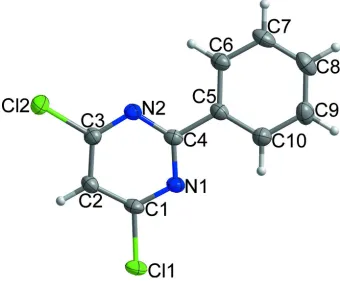
In the title compound, C10H6Cl2N2 (systematic name: 4,6-dichloro-2-phenylpyrimidine), which is used commercially as the herbicide safener, fenclorim, the dihedral angle between the dichloropyrimidyl and phenyl rings is 9.45 (10). In the
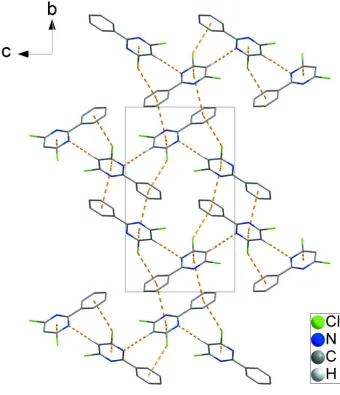
crystal, C—H N hydrogen bonds link adjacent molecules, forming chains along the c-axis direction. In addition, weak intermolecular C—Cl [3.6185 (10) A˚ ] and –
[3.8796 (11) A˚ ] interactions are present, forming a three-dimensional network.
Keywords:crystal structure; herbicide; fenclorim; pyrimidine; C—Cl
interactions;–interactions; hydrogen bonding.
CCDC reference:1421258
1. Related literature
For information on the herbicidal properties of the title compound, see: Wu et al.(1999). For a related crystal struc-ture, see: Leban & Polanc (1992).
2. Experimental
2.1. Crystal data
C10H6Cl2N2 Mr= 225.07
Monoclinic,P21=c a= 5.6210 (6) A˚ b= 17.0659 (18) A˚ c= 10.2582 (12) A˚
= 99.690 (6)
V= 970.00 (19) A˚3 Z= 4
MoKradiation
= 0.62 mm1 T= 173 K
0.160.060.04 mm
2.2. Data collection
Bruker APEXII CCD diffractometer
Absorption correction: multi-scan (SADABS; Bruker, 2013) Tmin= 0.690,Tmax= 0.746
9071 measured reflections 2212 independent reflections 1750 reflections withI> 2(I) Rint= 0.034
2.3. Refinement
R[F2> 2(F2)] = 0.034 wR(F2) = 0.077 S= 1.07 2212 reflections
127 parameters
H-atom parameters constrained
max= 0.28 e A˚
3
min=0.23 e A˚
3
Table 1
Hydrogen-bond geometry (A˚ ,).
D—H A D—H H A D A D—H A
C2—H2 N2i
0.95 2.46 3.317 (2) 151
Symmetry code: (i)x;yþ1 2;z
1 2.
Data collection: APEX2 (Bruker, 2013); cell refinement: SAINT (Bruker, 2013); data reduction:SAINT; program(s) used to solve structure:SHELXS97(Sheldrick, 2008); program(s) used to refine structure: SHELXL2013 (Sheldrick, 2015); molecular graphics: DIAMOND(Brandenburg, 2010); software used to prepare material for publication:SHELXTL(Sheldrick, 2008).
Acknowledgements
This research was supported by the Basic Science Research Program through the National Research Foundation of Korea (NRF) funded by the Ministry of Education, Science and Technology (No. 2015R1D1A4A01020317).
Supporting information for this paper is available from the IUCr electronic archives (Reference: SJ5469).
References
Brandenburg, K. (2010).DIAMOND. Crystal Impact GbR, Bonn, Germany. Bruker (2013).APEX2,SAINTandSADABS. Bruker AXS Inc., Madison,
Wisconsin, USA.
Leban, I. & Polanc, S. (1992).Acta Cryst.C48, 2227–2229. Sheldrick, G. M. (2008).Acta Cryst.A64, 112–122. Sheldrick, G. M. (2015).Acta Cryst.C71, 3–8.
supporting information
Acta Cryst. (2015). E71, o714 [doi:10.1107/S2056989015016187]
Crystal structure of fenclorim
Eunjin Kwon, Jineun Kim, Gihaeng Kang and Tae Ho Kim
S1. Comment
Fenclorim [systematic name: 4,6-dichloro-2-phenylpyrimidine] is a herbicide safener that is used in many rice-producing
countries to protect rice plants from damage likely to be caused by the chloroacetanilide herbicide pretilachlor. (Wu et al.,
1999). The dihedral angle between the dichloropyrimidyl and phenyl rings is 9.45 (10)°. All bond lengths and bond angles
are normal and comparable to those observed in a similar crystal structure (Leban & Polanc, 1992).
In the crystal structure (Fig. 2), C–H···N hydrogen bonds (Table 1) link adjacent molecules, forming a one-dimensional
chains along the c-axis. In addition, weak intermolecular C3–Cl2···Cg2iii [Cl2···Cg2 = 3.6185 (10) Å] (Cg2 is the centroid
of the C5–C10 ring) and Cg1···Cg2iv [Cg1···Cg2 = 3.8796 (11) Å] interactions are present (Cg1 is the centroid of the
N1,N2,C1–C4 ring), forming a three-dimensional network [symmetry codes: (ii), x - 1, y, z; (iii), x - 1, -y + 1/2, z - 1/2;
(iv), -x + 1, -y + 1, -z].
S2. Experimental
The title compound was purchased from the Dr. Ehrenstorfer GmbH Company. Slow evaporation of a solution in CH2Cl2
gave single crystals suitable for X-ray analysis.
S3. Refinement
All H-atoms were positioned geometrically and refined using a riding model with d(C—H) = 0.95 Å, Uiso = 1.2Ueq(C) for
Figure 1
The asymmetric unit of the title compound with the atom numbering scheme. Displacement ellipsoids are drawn at the
Figure 2
Crystal packing viewed along the a axis. The intermolecular interactions are shown as dashed lines.
4,6-Dichloro-2-phenylpyrimidine
Crystal data
C10H6Cl2N2 Mr = 225.07
Monoclinic, P21/c a = 5.6210 (6) Å b = 17.0659 (18) Å c = 10.2582 (12) Å β = 99.690 (6)°
V = 970.00 (19) Å3
Z = 4
F(000) = 456 Dx = 1.541 Mg m−3
Mo Kα radiation, λ = 0.71073 Å Cell parameters from 2286 reflections θ = 2.3–25.9°
µ = 0.62 mm−1
T = 173 K Plate, colourless 0.16 × 0.06 × 0.04 mm
Data collection
Bruker APEXII CCD diffractometer φ and ω scans
2212 independent reflections 1750 reflections with I > 2σ(I) Rint = 0.034
h = −6→7 k = −19→22 l = −13→9
Refinement
Refinement on F2 Least-squares matrix: full R[F2 > 2σ(F2)] = 0.034 wR(F2) = 0.077 S = 1.07 2212 reflections 127 parameters 0 restraints
Hydrogen site location: inferred from neighbouring sites
H-atom parameters constrained
w = 1/[σ2(F
o2) + (0.0277P)2 + 0.269P] where P = (Fo2 + 2Fc2)/3
(Δ/σ)max < 0.001 Δρmax = 0.28 e Å−3 Δρmin = −0.23 e Å−3
Special details
Geometry. All e.s.d.'s (except the e.s.d. in the dihedral angle between two l.s. planes) are estimated using the full
covariance matrix. The cell e.s.d.'s are taken into account individually in the estimation of e.s.d.'s in distances, angles and torsion angles; correlations between e.s.d.'s in cell parameters are only used when they are defined by crystal symmetry. An approximate (isotropic) treatment of cell e.s.d.'s is used for estimating e.s.d.'s involving l.s. planes.
Fractional atomic coordinates and isotropic or equivalent isotropic displacement parameters (Å2)
x y z Uiso*/Ueq
Cl1 0.65642 (9) 0.34546 (3) −0.36827 (4) 0.04016 (15) Cl2 0.00001 (9) 0.21187 (3) −0.11631 (4) 0.03800 (15) N1 0.6078 (2) 0.37521 (8) −0.12511 (13) 0.0265 (3) N2 0.3094 (2) 0.31826 (8) −0.01497 (13) 0.0251 (3) C1 0.5151 (3) 0.33485 (10) −0.23126 (16) 0.0266 (4) C2 0.3205 (3) 0.28518 (10) −0.24028 (16) 0.0274 (4) H2 0.2551 0.2580 −0.3190 0.033* C3 0.2296 (3) 0.27863 (10) −0.12406 (16) 0.0258 (4) C4 0.4978 (3) 0.36583 (9) −0.01979 (15) 0.0239 (4) C5 0.5944 (3) 0.41068 (10) 0.10104 (15) 0.0248 (4) C6 0.4715 (3) 0.41288 (10) 0.20807 (16) 0.0294 (4) H6 0.3240 0.3851 0.2044 0.035* C7 0.5644 (4) 0.45554 (11) 0.31979 (17) 0.0355 (4) H7 0.4809 0.4566 0.3929 0.043* C8 0.7773 (4) 0.49654 (12) 0.32573 (18) 0.0381 (5) H8 0.8395 0.5259 0.4026 0.046* C9 0.9000 (3) 0.49498 (12) 0.22019 (19) 0.0391 (5) H9 1.0460 0.5236 0.2239 0.047* C10 0.8099 (3) 0.45159 (11) 0.10867 (18) 0.0332 (4) H10 0.8964 0.4498 0.0367 0.040*
Atomic displacement parameters (Å2)
U11 U22 U33 U12 U13 U23
N1 0.0314 (8) 0.0280 (8) 0.0213 (7) −0.0007 (7) 0.0077 (6) −0.0002 (6) N2 0.0290 (8) 0.0250 (8) 0.0217 (7) −0.0008 (6) 0.0056 (6) 0.0012 (6) C1 0.0352 (10) 0.0268 (9) 0.0194 (8) 0.0042 (8) 0.0095 (7) 0.0021 (7) C2 0.0346 (10) 0.0265 (9) 0.0210 (8) −0.0003 (8) 0.0042 (7) −0.0027 (7) C3 0.0296 (9) 0.0234 (9) 0.0244 (8) −0.0008 (7) 0.0043 (7) 0.0021 (7) C4 0.0278 (9) 0.0240 (9) 0.0200 (8) 0.0047 (7) 0.0046 (7) 0.0033 (6) C5 0.0307 (9) 0.0226 (9) 0.0209 (8) 0.0032 (7) 0.0035 (7) 0.0011 (6) C6 0.0375 (10) 0.0264 (9) 0.0253 (9) 0.0013 (8) 0.0080 (7) 0.0005 (7) C7 0.0500 (12) 0.0366 (11) 0.0206 (9) 0.0080 (9) 0.0078 (8) −0.0013 (7) C8 0.0442 (12) 0.0383 (11) 0.0276 (9) 0.0086 (10) −0.0063 (8) −0.0079 (8) C9 0.0323 (10) 0.0415 (12) 0.0406 (11) −0.0028 (9) −0.0019 (8) −0.0081 (9) C10 0.0316 (10) 0.0375 (11) 0.0311 (9) −0.0021 (8) 0.0073 (8) −0.0037 (8)
Geometric parameters (Å, º)
Cl1—C1 1.7362 (17) C5—C6 1.393 (2) Cl2—C3 1.7333 (17) C6—C7 1.384 (2) N1—C1 1.319 (2) C6—H6 0.9500 N1—C4 1.342 (2) C7—C8 1.379 (3) N2—C3 1.320 (2) C7—H7 0.9500 N2—C4 1.342 (2) C8—C9 1.378 (3) C1—C2 1.375 (2) C8—H8 0.9500 C2—C3 1.379 (2) C9—C10 1.385 (2) C2—H2 0.9500 C9—H9 0.9500 C4—C5 1.480 (2) C10—H10 0.9500 C5—C10 1.389 (2)
C1—N1—C4 115.52 (14) C6—C5—C4 120.90 (15) C3—N2—C4 115.88 (14) C7—C6—C5 119.93 (17) N1—C1—C2 125.22 (15) C7—C6—H6 120.0 N1—C1—Cl1 116.28 (13) C5—C6—H6 120.0 C2—C1—Cl1 118.49 (13) C8—C7—C6 120.49 (17) C1—C2—C3 113.49 (15) C8—C7—H7 119.8 C1—C2—H2 123.3 C6—C7—H7 119.8 C3—C2—H2 123.3 C9—C8—C7 120.06 (17) N2—C3—C2 124.69 (16) C9—C8—H8 120.0 N2—C3—Cl2 116.58 (13) C7—C8—H8 120.0 C2—C3—Cl2 118.70 (13) C8—C9—C10 119.83 (18) N1—C4—N2 125.13 (15) C8—C9—H9 120.1 N1—C4—C5 117.31 (15) C10—C9—H9 120.1 N2—C4—C5 117.55 (14) C9—C10—C5 120.63 (17) C10—C5—C6 119.06 (16) C9—C10—H10 119.7 C10—C5—C4 120.04 (15) C5—C10—H10 119.7
C4—N2—C3—Cl2 175.70 (12) C4—C5—C6—C7 −179.64 (15) C1—C2—C3—N2 3.2 (3) C5—C6—C7—C8 0.5 (3) C1—C2—C3—Cl2 −174.72 (13) C6—C7—C8—C9 −0.3 (3) C1—N1—C4—N2 1.6 (2) C7—C8—C9—C10 −0.6 (3) C1—N1—C4—C5 −179.38 (14) C8—C9—C10—C5 1.2 (3) C3—N2—C4—N1 −0.3 (2) C6—C5—C10—C9 −1.0 (3) C3—N2—C4—C5 −179.36 (14) C4—C5—C10—C9 178.79 (16)
Hydrogen-bond geometry (Å, º)
D—H···A D—H H···A D···A D—H···A
C2—H2···N2i 0.95 2.46 3.317 (2) 151