Decentralized Peer-to-Peer Data Dissemination
in Wireless Sensor Networks
Ricardo Simon Carbajo1, Ciar´an Mc Goldrick
School of Computer Science and Statistics Trinity College Dublin (Ireland)
Abstract
Next generation Wireless Sensor Networks will operate as self-regulated ad hoc networks of tiny devices that sense, actuate and communicate in a collaborative, autonomous and decentralised manner. This new context aligns with the paradigms of edge and fog computing where it is paramount to reliably distribute data among a large sub(set) of con-sumer/producer devices. This paper presents a communications architecture for scalable selective data dissemination in wireless sensor networks which is comprised of a decentralised data distribution layer that is tightly coupled to a re-liable gradient-based routing protocol. The system supports mechanisms for selective data pushing and pulling within the sensornet where unstructured Peer-to-Peer content distribution concepts are utilised to fairly distribute pieces of data amongst an overlay of consumer and producer nodes. The system has been evaluated under a variety of network conditions and scenarios, both via simulation and real-world deployment, and it is shown to be reliable, scalable, and capable of distributing data in a fair and efficient manner across the network.
Keywords: Wireless Sensor Networks, Peer-to-Peer Networking, Decentralized P2P Data Distribution, Selective
Data Dissemination, Gradient Routing
1. Introduction
1
Wireless Sensor Networks (WSNs) are a particular realisation of wireless technologies characterised by the use 2
of small, low power, low data rate, wireless devices with sensing and actuating capabilities. WSNs enable the mon-3
itoring of environmental conditions and infrastructures in a pervasive manner. In effect, the range of applications of 4
traditional wired sensor technologies has been extended through the use of small unobtrusive wireless devices which 5
may also form ad hoc networks. However, research has not yet unlocked the full potential of the technology, as envi-6
sioned by many authors in the late 90’s. Pervasive networks of co-operative tiny mobile wireless devices, capable of 7
interacting with the environment, will be the next research challenge in ubiquitous computing and will contribute to 8
accomplishing the vision of ambient intelligence [1]. In this regard, one of the main goals is to transparently connect 9
WSNs to the Internet such that WSNs can also be globally and transparently inter-connected and easily accessible to 10
any user in any network, including via mobile cellular networks. At the same the fog computing paradigm will be 11
enabled where services can be hosted at the edge of the network thus enhancing performance, quality of service and 12
even quality of experience. 13
For this purpose, wireless sensor networks will be required to operate as self-regulated networks of static and tran-14
sient devices behaving as autonomous colonies - sensing, acting and communicating in a collaborative way. Pushing 15
and pulling data from any point in the sensor network is necessary such that nodes receive up-to-date information on 16
its surroundings for collaborative decision making. When a node needs to communicate to a distant area within the 17
same WSN, or to another WSN, backbone networks, such as the Internet, should be employed when possible. For 18
instance, nodes sensing and acting over a wide area might require to be aware of certain events and data produced at, 19
Email addresses:[email protected](Ricardo Simon Carbajo),[email protected](Ciar´an Mc Goldrick)
say, 30 hops away. Backbone networks can be used to transparently push data closer to, or into the requesting area, via 20
gateway nodes placed at any point in the network. However, when a gateway is not accessible, a dissemination process 21
will be required to reliably push data towards disparate areas. Moreover, data needs to be replicated and disseminated 22
so that the sensor network acts as an autonomous distributed storage medium preserving data to be uploaded to other 23
nodes, or to the Internet, from different points in the network in a reliable, robust and efficient manner. In this re-24
gard, data needs to be distributed to multiple points in the WSN to reduce the risk of data being lost in the event of 25
devices or entire areas failing or being disconnected. This is something which could occur due to the error-prone 26
wireless medium, the limited energy of motes, and/or the unreliable physical conditions of the environment where 27
motes can be deployed. For instance, consider a scenario where sensors are tracking and monitoring glaciers which 28
might suddenly break into smaller ice blocks. Climate scientists will be interested in periodically retrieving data from 29
those small separated ice blocks from different accessible points of the isolated network at a later stage. Selective 30
dissemination and storage of data at multiple points will give the sensor network such degree of required autonomy 31
when performing data collection. As another example, consider a set of robots working on a collective task where the 32
hazardous nature of the environment and conditions represent a high risk for their safe operation, e.g. scenarios of 33
disaster rescue and exploration where robots are subject to be destroyed by the unstable surrounding elements. The 34
group of sensing and actuating robots should work as a self-organised decentralised network capable of cooperating 35
and adapting to the changing conditions. For this purpose, the decentralised dissemination of data to a sub(set) of 36
robots will not only avoid data loss but also enable decision making based on historical data, perhaps in order to 37
rearrange the cooperative strategy. This also increases data integrity, makes the network fault tolerant and reduces 38
the appearance of the hot spot and flash crowd problems. Nevertheless, nodes should decide whether to participate in 39
the dissemination and storage process according to their capabilities or the status of their resources. To achieve such 40
a level of data distribution, a reliable data dissemination protocol is required which distributes data replicas over the 41
network to a set of nodes. This goal necessitates a communications architecture composed of a set of reliable and 42
efficient protocols capable of providing fault tolerant decentralised data distribution in unreliable scalable wireless 43
sensor networks. 44
This paper presents such a communications architecture, known as the TinyTorrents (TT) framework. TinyTorrents 45
leverages existing Peer-to-Peer (P2P) content distribution concepts from wired and wireless networks. Previous work 46
[2] presented the TinyTorrents infrastructure in its centralized version. This paper describes the decentralized version 47
of the system which provides the substrate for the development of co-operative decision-making applications for 48
scalable wireless sensor networks. The TinyTorrents framework has been designed to efficiently distribute data inside 49
the sensor network in a decentralized and scalable manner. As a P2P architecture, TinyTorrents moves the resource 50
management to the edge of the network, i.e. to the “peers”. This is achieved by enabling direct communication 51
among peers, which encourages them to cooperate autonomously amongst each other in managing the resource. This 52
behaviour enhances the reliability and availability of the system, as they are more resistant to individual node failures. 53
Peer autonomy also means that peers are equipped with discovery protocols, which allow them to find functioning 54
peers in the network when neighbouring peers have failed. This ability for “self-organisation” greatly adds to the 55
reliability of P2P systems, mainly when the network operates in a fully decentralised fashion through the use of 56
structured or unstructured discovery mechanisms. TinyTorrents is designed as a two-tier architecture. The upper 57
tier is a selective data dissemination protocol for reliable data distribution in sensor networks, i.e. the TinyTorrents 58
protocol. This protocol employs P2P communication mechanisms to replicate data amongst nodes in a fair, efficient, 59
reliable and scalable manner across the WSN. The TinyTorrents protocol operates above a suitable routing mechanism. 60
For this purpose, a gradient-based reactive routing protocol, known as Ubiquitous Mobile Gradient (UMG), has been 61
designed to achieve efficient P2P communication. This incorporates an efficient lookup mechanism to support content 62
distribution and discovery techniques in TinyTorrents. The TinyTorrents system has been evaluated by simulation and 63
in a real testbed comprised of 64 TelosB devices. 64
The rest of the paper is organised as follows. Section 2 explains the rationale for the concepts and approaches pre-65
sented in this paper and positions the work in the context of the state of the art in the areas of data dissemination and 66
structured and unstructured P2P systems in wireless sensor networks. In the following section 3, the TinyTorrents sys-67
tem architecture is presented. The UMG routing protocol [3] is also briefly described in section 4. Subsequently, the 68
TinyTorrents protocol is expounded in section 5. Section 6 presents a performance analysis of the system through both 69
simulations and real world deployment, and assesses its performance when compared against epidemic dissemination 70
2. Rationale and Related Work
72
Data disseminationtechniques over wireless sensor networks have been proposed to reliably distribute data with 73
the aim of achieving high data delivery rates and low delivery latency whilst minimizing communication and energy 74
consumption. Much of the research in wireless sensor networks targets the problem of data dissemination from the 75
perspective of the initiator of the communication: i) source-to-sink, i.e. pushing or ii) sink-to-node i.e. pulling. A 76
sink node pulls data by sending a request to the source node. However, a source node may decide to push data to the 77
sink at any given time. Pushing data towards a sink, or set of sinks, can be seen as a data collection process. Sinks can 78
be placed at different points in the network for continuous collection or can act as opportunistic or nomadic points of 79
collection which move to another area once data has been exchanged. Nomadic mobile sinks are sometimes known as 80
data mules. Sink nodes usually have more resources and can communicate with other networks such as the Internet. 81
Hence they are employed as gateways to perform pulling activities over the WSN and to push data outside the WSN. 82
For reconfigurable systems, pushing data into the sensor network is employed for programming purposes where the 83
goal is to reliably deliver big chunks of data to all, or most of the nodes, in the network. 84
Initial approaches in the area of dissemination employed the flooding and gossiping mechanisms. However, flood-85
ing and gossiping, in their basic forms, are considered low complexity, inefficient solutions which do not optimise the 86
process of data dissemination. One of the first approaches in the design of data dissemination mechanisms for wireless 87
sensor networks was a protocol called Directed Diffusion [4]. In Directed Diffusion, source nodes describe data using 88
attributes, introducing the concept of data-centric routing (replacement for the tradition address-centric approach). 89
Around the same time, the SPIN [5, 6] protocol tackled the problem of data dissemination from a data-centric per-90
spective with a negotiation-based paradigm in which nodes decide whether to acquire the data from neighbour nodes. 91
These two protocols establish the concept of metadata packets, known as “interests”, which travel the network to 92
inform other nodes of the availability of data while preparing the path for data communication. In this regard, data 93
dissemination protocols, where the sink propagates the interest and the source responds with data, might be classi-94
fied as Sink Oriented Data Dissemination protocols. Examples of this type are Directed Diffusion [7, 4, 8], TTDD 95
[9], Declarative Routing Protocol (DRP) [10] and GRAB [11]. When sinks become mobile, these algorithms need
96
to update their sources of information. For instance in [12], a data dissemination algorithm employs the concept of
97
pseudo-distance to create an estimation of how far the mobile sink is as it travels through the network. This metric is
98
calculated based on the concept of forwarding interest packets which the mobile sink node broadcasts periodically for
99
other sensor nodes to update or estimate the nodes new position. The approach assumes that all links are bidirectional
100
and no control messages are lost and seeks to reduce the control overhead involved in forwarding data to mobile sink
101
nodes. The design of Sink Oriented Data Dissemination protocols revolves around the subscribe-publish paradigm 102
where nodes disseminate the interest or query towards potential sources of data such that data is forwarded to nodes 103
which manifest an interest [13]. On the other hand, Source Oriented Data Dissemination protocols are characterised 104
by source nodes initiating the dissemination of metadata towards the sink. On reception, the sink performs some data 105
acquisition process which might be based on negotiations. A good example of this is SPIN [5]. The Source Oriented 106
Data Dissemination protocols are based only on source nodes publishing and disseminating metadata towards the net-107
work in order to alert nodes on the availability of data. This type of protocol can easily be enhanced with a subscribe 108
mechanism if the dissemination process can be controlled. The adoption of each scheme brings different benefits and 109
drawbacks related to scalability, network topology dynamics, resource-efficiency and real-time data acquisition. 110
Dissemination protocols have also been employed for multi-hop network reprogramming where large objects of 111
data/code are disseminated over the network in a reliable manner. Examples of these types of protocols are Pump 112
Slowly Fetch Quickly (PSFQ) [14], GARUDA [15] and Reliable Multi-Segment Transport (RMST) [16] which em-113
ploy hop-by-hop retransmissions for reliability. Multihop Over-the-Air Programming (MOAP) [17] is another ap-114
proach to network reprogramming over multihop networks which delivers the whole object to a node before the latter 115
become a source for the next hop. In [18], the Multihop Network Reprogramming protocol (MNP) adds a sender 116
selection algorithm which attempts to guarantee that at most one source is transmitting within a neighbourhood to 117
minimize collisions. Other approaches rely on network coordination to minimize collision at a higher complexity 118
cost.Splash [19], a dissemination protocol for large objects in wireless sensor networks, creates a tree structure rooted
119
at the source and combines recent advances in constructive interference broadcast and multiple-channel pipelining to
120
eliminate contention overhead. It controls when and which set of nodes transmit packets based on their height to root,
121
thus reducing contention. Recent works address the problem of dissemination for reprogramming wireless sensor
networks in a fast and energy efficient manner by i) using a correlated tree structure which is constructed according
123
to the wireless link qualities and correlations [20] and ii) reducing the transmit power in a multi-hop wireless
net-124
work using game theory, where every node is modeled as a player in a game model and the action of forwarding the
125
packet depends on the actions of other nodes [21]. Specifically in TinyOS [22], the embedded operating system 126
employed in the evaluation of this work, two data dissemination protocols are available for reprogramming purposes: 127
i) Deluge [23], and ii) Typhon [24]. However, for small to medium data size dissemination, DIP [25] and DHV [26] 128
are employed in TinyOS as lightweight solutions. They operate by finding nodes in need of data updates in order to 129
maintain consistency over the network and employ the Trickle [27] protocol for maintaining code updates. Trickle 130
utilizes beacons to disseminate data which is smaller than the payload of a packet, and self-regulates the periodicity 131
of the update beacon based on the changes in the neighbourhood. 132
All of these dissemination protocols are employed to deliver the whole object to a node before the latter becomes 133
a source for the next hop. Pushing data to the network is achieved by these protocols in a reliable manner. However, 134
they are based on hop-by-hop data communication primitives, forwarding data packets through pre-established routes 135
or in an epidemic fashion. These algorithms become inefficient in terms of communication when a dynamic subset of 136
nodes in a sparse network is comprised of producers and consumers of data with the remainder of the nodes acting as 137
relays. This motivates the research problem of how to disseminate data reliably and efficiently amongst a subset of 138
consumer and producer nodes in scalable and unstructured networks. 139
The novel approach presented in this paper provides selective data dissemination to a sub(set) of consumers in 140
the network in a collaborative manner which balances the traffic load. This is achieved by leveraging the concept of 141
peer-to-peer (P2P) networking which enables distribution of the burden of centralised servers by turning networks into 142
a set of self-organised devices capable of communicating with each other and sharing resources. This paradigm offers 143
advantages such as i) network traffic load distribution, ii) fault-tolerance, iii) enhanced reliability, and iv) robustness 144
to change. Decentralised P2P approaches scale better and can adapt to local changes in the network topology, and 145
are ideal for data dissemination in WSNs. However data discovery poses a challenging problem in decentralised P2P 146
networks. In the area of ad hoc wireless networks, data discovery presents greater challenges than in traditional wired 147
networks. This is mainly due to the unreliable wireless medium and the inefficiency of routing to distant nodes. Both 148
structured and unstructured mechanisms have been designed for data discovery in wireless ad hoc networks. 149
2.1. Structured P2P systems
150
Structured P2P systems create virtual overlays employing Distributed Hash Table (DHT) schemes for data search
151
and retrieval through the network. A variety of DHT-based schemes has been employed in WSNs for data management
152
[28] and for developing routing protocols capable of scaling [29, 30]. One of the first approaches to distribute, 153
store and query data in WSNs was published in the papers Data-Centric Storage in Sensornets (DCS) [31, 32] and 154
Geographic Hash Tables for Data-Centric Storage (GHT) [33]. The authors presented the idea of distributing data by 155
replicating it amongst nodes in the network such that a failure in the area will not affect the already gathered data. In 156
order to distribute the data, a geographical routing protocol called Greedy Perimeter Stateless Routing (GPSR) [34] 157
is employed. Another approach was proposed in Chord for Sensor Networks (CSN) [35] as a protocol which follows 158
the principles of the DHT-based Chord algorithm [36] to provide a lookup mechanism capable of searching data with 159
logarithmic complexity. The authors claim it scales well as it maintains a finger table ofO(log(n)) entries and employs 160
O(log(n)) messages to locate data. Cluster hierarchies and overlays are formed such that virtual neighbours are closer 161
geographically. The same authors propose a case for P2P overlay networks in sensor networks [37]. This paper 162
outlines the design goals to consider when applying overlays in sensor networks, proposing a DHT-based protocol 163
known as Tiered Chord (TChord). A solution for implementing a DHT in MANETS was proposed in Ekta [38]. 164
The idea provides a peer-to-peer substrate by the integration of DHT-abstraction Pastry [39] in the network layer, 165
employing DSR [40], a reactive routing protocol for multi-hop communication. Ekta updates its routing table and leaf 166
set by snooping packets. A similar approach to Ekta, that integrates Pastry with the AODV [41] routing protocol, was 167
later presented as MADPastry [42]. DHT tables are formed considering physical locality. It employs a set of random 168
landmark keys spread evenly in terms of geographic coordinates which define temporal cluster nodes. In a paper by 169
Zheng et al. [43], a DST is used to maintain the ranges of keys in a DHT, therefore obtaining the range query, i.e. 170
all keys within a range, and the cover query, i.e. all ranges for a key. Ghose et al. proposed a DHT approach with 171
circular virtual overlays over a geographical routing protocol, the Greedy Perimeter Stateless Routing (GPSR) [34], 172
There has also been research on constructing DHT according to the topology of the network, such that virtual 174
neighbours in the overlay are also close in terms of routing (hops) [45]. For instance, Topology-based DHT (T-DHT) 175
[46] selects “reference” nodes by flooding mechanisms to offer support for other nodes to perform triangulation and to 176
calculate the relative position of a node. Then, a virtual two-dimensional coordinate system is generated and mapped 177
into a DHT which is used to store and retrieve data deterministically. A similar approach for data-centric storage 178
and routing is also proposed in GEM [47], which uses graph embedding and tree routing, maintaining a two hop 179
neighbourhood. A routing protocol which applies DHT concepts on top of the link layer was presented as Virtual 180
Ring Routing (VRR) [48]. The goals in designing the routing protocol were: i) to avoid flooding and ii) to avoid 181
location-dependent addresses. On the other hand, scalability issues were not evaluated. Routing between virtual 182
neighbours in the Pastry-based overlay ring is performed in such a way that there is knowledge about other nodes in 183
the network, rather than only predecessors and successors. The complexity (in number of hops) to locate a virtual 184
node can be reduced fromO(log(n)) to O(√n). This is achieved by taking into account link layer information of 185
closer nodes when routing in the virtual ring. In the same line, Awad et al. presented Virtual Cord Protocol (VCP) 186
as a DHT-based routing protocol which sits on top of the MAC layer [49, 50]. It also takes into account geographical 187
proximity (2 hops away) of virtual nodes to minimize communication. Like in VRR, routing is based on virtual and 188
routing knowledge. Finally, ScatterPastry [51] is another DHT approach using Pastry on top, or integrated, at routing 189
level. It is evaluated in a real WSN testbed called ScatterWeb. The authors try to minimize energy consumption 190
and address scalability by using Pastry concepts both on top of, and in combination with, the Destination-Sequenced 191
Distance Vector (DSDV) [52] routing protocol. In trying to avoid mismatch between the structured overlay and the
192
physical network, the authors in [53] create a 3-dimensional overlay for P2P over MANETs which logically interprets
193
the physical relationship of a peer with its (logical) neighbour peers. Each peer constructs a 3D rectangular coordinate
194
system with three planes that divide the space into six dimensions and eight octants, where the peer acts as the origin
195
of the structure and each neighboring peer obtains a transient logical identifier that reflects their physical proximity
196
in the overlay. Weights are assigned to each link using the inverse distance function, providing connectivity to a
197
nodes neighboring peers on the basis of their hop distances which are obtained from the underlying routing protocol,
198
OLSR [54]. Periodic probe messages between direct logical neighboring peers are employed to maintain the overlay.
199
More recently, the Motion-MiX routing protocol [55] has been designed to track mobile nodes in a wireless network
200
in time and space, focusing on their data resources. The hashing of the node identifier is employed to generate a
201
logical address interval (LAIs) in the DHT for the data resource and each node can take several LAIs. In a one-hop
202
communication manner, the network stores the motions of every node and the LAIs as distributed encounter milestones
203
in a cooperative manner, and thus provides a shared virtual geographic map to approximate the motion trails of every
204
node and its resources. However, as this algorithm needs to exploit the mobility assisted milestone sharing, it thus
205
depends on the motion of nodes.
206
Many of the above structured P2P data discovery concepts explore the impact that unreliable peers produce when 207
entering and leaving the structure of the DHT. Solutions have been proposed to ameliorate this effect by considering 208
peer proximity thus enhancing DHT robustness. However, when facing lossy networks where peers suffer from short 209
and long periods of connectivity disruption, and may even have mobility, DHT lookup schemes have proven to be 210
ineffective. On the other hand, unstructured discovery systems have also been proposed which do not require the 211
formation and maintenance of overlay networks. In Wireless Sensor Networks, unstructured lookup mechanisms 212
offer a good solution for data searching in dynamic network topologies where structured lookup mechanisms (DHT-213
based) lose performance. The benefits of unstructured query systems are highlighted in scenarios with a high degree 214
of data replication over the network. This situation makes the unstructured searching process efficient when compared 215
to DHT-based methods at a much lower complexity and low maintenance cost. 216
2.2. Unstructured P2P discovery mechanisms
217
These mechanisms can be classiffied in two categories: i) Flooding and ii) Random Walks (RW). In Flooding, three 218
types of enhancements can be identified [56]: i) Expanding Ring Search (ERS), Blocking Expanding Ring Search 219
(BERS), and iii) Local Indices (LI). Random walks [57] are subdivided into a) K-Parallel and b) Agent Cloning. In 220
the area of WSNs, different approaches exist which employ the above methods as the basis for unstructured discovery. 221
For instance, the comb-needle mechanism [58] is an unstructured approach where the searching process benefits from 222
a previous data dissemination phase. This paradigm exploits the redundancy factor of information spread over the 223
which can provide either the data itself or information about the location of the data being queried. This can also 225
be categorized as a biased k-parallel random walk technique. Dimakis et al. proposed an unstructured solution on 226
how to enable ubiquitous access to distributed data in WSN [59, 60]. The goal is to retrieve a set of distributed data 227
packets by querying as many nodes as the number of data packets required. Storage nodes are randomly selected 228
and data is pre-routed with a complexity per data node ofO(ln(n)). Distributed erasure codes are employed as a 229
solution to achieve reliable distributed storage. Similarly, Rachuri et al. presented Increasing Ray Search (IRS) 230
[61], a highly scalable, density independent unstructured solution to achieve efficient search in high density scenarios 231
when compared to ERS and Random Walks. This paper aims to minimize the number of messages employed in the 232
query mechanisms in an unstructured network in a non-deterministic way. In ACQUIRE [62], a packet is injected 233
containing an active query which employs random walks, biased random walks or even a predetermined path. Each 234
node receiving a query packet performs, if information is not available, an on-demand request for information, within 235
a scoped distance in terms of hops, in order to improve on the selection of the next neighbour. When the active 236
query is completely resolved, the query reply is sent directly to the source. A combination of biased random walks 237
for Pull-type unstructured search where sensor nodes are considered stationary is presented in [63]. Sensor nodes 238
need to be aware of their neighbourhood and the distance in hops to the sink, i.e. the level. A set of protocols are 239
presented which employs a combination of Several Short Random Walks (SSRW) and Level Biased Walks (LBW). 240
In LBW a query is propagated from the sink in such a way that it is forwarded to a neighbour with a higher level 241
until it reaches a limit. If the query is not successful, another is started. A query walk can alternate a sequence of 242
steps using LBW and then perform SSRW. The idea of LBW is to increase the coverage by reducing the correlation of 243
visited nodes. The protocols are efficient in terms of energy, communications and latency when compared to simple 244
random walks and multiple random walks techniques. In the category of biased random walks, searching based on 245
Bloom Filters (BFs) [64] come as a probabilistic-based memory-efficient solution. The Bloom Filter is a memory 246
efficient structure for data compression which has been used as a query mechanism in peer-to-peer networks in the 247
Internet. The filter acts as a probabilistic membership structure in the form of a bit vector which can be queried to 248
find out, with a certain likelihood, whether an element has been previously stored. Different approaches to BF-based 249
searching exist. The simple one is that where the BF storing a description of the content in a node is spread to all the 250
nodes in the network. Queries are then resolved by checking the BF table and the use of a routing protocol. On the 251
other hand, BFs have been employed as data-centric routing mechanisms [65, 66, 67] where queries are forwarded 252
based on the BF information cached at a given node about its neighbours. The routing process is usually performed 253
by a greedy approximation which selects the next node whose BF best matches the BF in the query. Approaches such 254
as the Attenuated Bloom Filter (ABF) [68] aggregates filters according to their proximity in terms of hops while the 255
Exponential Decay Bloom Filer (EDBF) [69] applies a decay proportional to the hop count to introduce noise in the 256
received BF. In the area of WSN, Hebden et al. [66] employed a hierarchical BF structure where a cluster formation 257
protocol assigns nodes to monitor an area via caching data from packets in a counting Bloom filter - a BF which keeps 258
count on how many times an element has been inserted. Query routing is performed between cluster heads according 259
to the BF structures. Li et al. adopted a flat-network approach presenting the Scope Decay Bloom Filter (SDBF) 260
as a structure to disseminate event hints [67]. Bloom Filter-based searching has been proved to increase the query 261
success rate, reduce energy consumption and decrease latency when compared to flooding-based or random walks at 262
the cost of BF dissemination overhead. Resource discovery mechanisms also seek to exploit information from the 263
dissemination process at each local peer.For instance, each peer in [70] contains a database with local information of
264
resources and routing information and is leveraged to improve the accuracy during discovery. A ranking function on
265
this data helps prioritize the information transmitted according to the interest and mobility of peers.
266
Moreover, a set of algorithms in unstructured data dissemination employ mobile nodes to spread the packets
267
and update the network view of available resources. This mechanism depends on the mobility of nodes for the
268
dissemination activity. For instance, the Energy-Efficient Message Dissemination protocol (EMD) [71] performs data
269
dissemination in delay-tolerant WSANs. The algorithm seeks to disseminate data from mobile actors as they come in
270
contact with static nodes which receive and store the messages, and subsequently forward them to other participants
271
when they come into communication range. This is performed in an energy-efficient manner and within a given delay
272
constraint and coverage rate. Similarly, in “A spatio-temporal approach to selective data dissemination in mobile
273
peer-to-peer networks” [72] mobile nodes, when encountering other nodes within communication range, enter into an
274
exchange of so called reports which contain information on the age and distance of the data resource. By ranking the
275
set of cached reports from previous mobile nodes encounters, based on the aforementioned features, only a subset of
reports is transmitted according to the novelty probability of each report being new to the other node and the bandwidth
277
and energy of each moving object. The algorithm assumes that each moving object knows its current location through
278
some localization technique, such as a GPS. In a further example, TOSS [73], a token-passing, multi-point relays,
279
data dissemination scheme in mobile Peer-to-Peer environments, employs a location-based scheduling approach to
280
disseminate messages. These data dissemination algorithms improve their performance by using location information
281
at the cost of energy demanding techniques and devices.
282
In this paper, unstructured searching paradigm concepts are employed in the design of the TinyTorrents system
283
which employs a push phase to spread information on the available data and a pull phase which leverages the spread
284
information for the efficient P2P data distribution process. In addition, the TinyTorrents unstructured P2P layer makes
285
use of a gradient-based routing protocol, known as Ubiquitous Mobile Gradient (UMG) [3], which employs Bloom
286
filters for data advertisement and discovery. Other approaches in the literature have employed unstructured P2P data
287
distribution on top of routing protocols. For instance, in “An Efficient Overlay for Unstructured P2P File Sharing over
288
MANET using Underlying Cluster-based Routing” [74], an unstructured approach leverages the underlying
cluster-289
based routing protocol (CBRP) [75]. Cluster heads need to be elected and a proactive paradigm is employed for
290
updating peers in the cluster - our proposed UMG routing protocol operates in an on-demand fashion and cluster
291
heads are not required. In [74] data packets and other unicast packets are forwarded using the GPSR algorithm
292
[34] and thus requires location-based techniques which consume energy. Each peer maintains a peer-routing table
293
that stores the information of the root-peer and neighbor peers to build up a minimum-spanning tree which removes
294
distant redundant links and constructs an overlay closer to the physical network using location information. However,
295
the algorithm is not fault tolerant as it relies on one of the peers in the P2P network to act as a root-peer to connect all
296
peers.
297
The TinyTorrents system proposed in this paper operates in a decentralised manner and does not need to maintain
298
a logical overlay network to provide selective data distribution over the sensornet to consumers. The TinyTorrents
299
protocol provides a fault-tolerance solution which eliminates the unique central tracker and makes the system scalable.
300
The decentralised design is based on the concept of every consumer node (peer involved in the data distribution
301
process) acting as an opportunistic unstructured local point of coordination/information (i.e. partial tracker which
302
keeps track of a subset of the peers in the swarm within a nearby scope. The scope is not a fixed value and depends
303
on the distribution of consumer nodes in the network. The Ubiquitous Mobile Gradient (UMG) routing protocol has
304
been designed to reliably transport data packets within the local scope of each consumer, providing key functionality
305
to make the system scalable and decentralized. UMG operates on a fully reactive manner and does not require
306
localization information, thus being energy efficient, specially as communication in the network only occurs when
307
data needs to be produced or consumed.
308
3. The TinyTorrents System Architecture
309
The concept of TinyTorrents leverages existing P2P content distribution ideas from traditional wired networks to 310
replicate and store data within a Wireless Sensor Network and on the Internet. It provides mechanisms to distribute 311
data in such a way that the WSN can be converted into an autonomous decision-making system capable of operating 312
independently and also interoperating with other networks via the Internet. The TinyTorrents framework comes from 313
the idea of employing both existing technology and concepts from the BitTorrent [76] protocol to disseminate WSN 314
data in a peer-to-peer fashion, having each sensor node acting as a logical peer in the Internet BitTorrent network. 315
Hence, the TinyTorrents framework can be divided in two functional entities which transparently integrate with each 316
other: i) the Gateway-BitTorrent Communications Architecture, and ii) the WSN Communications Architecture. 317
3.1. The Gateway-BitTorrent Communications Architecture
318
The TinyTorrents framework provides a generic and versatile way of distributing data from the WSN to the In-319
ternet, interconnecting the networks in a transparent manner. The interconnection between the Internet and the WSN 320
employs existing peer-to-peer (P2P) ideologies where data is encapsulated into torrents and stored at different nodes in 321
the Internet. This is achieved via the use of the BitTorrent protocol to create a distributed fault-tolerant database. For 322
BitTorrent connectivity purposes, the Vuze P2P content distribution client-server application [77] is employed. The 323
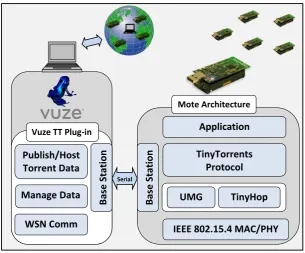
depicted in Figure 1. The plugin deals with translating WSN torrents into BitTorrent format and making the data 325
accessible in a variety of ways. 326
TinyTorrents
Protocol
UMG
TinyHop
Base
Station
Application
IEEE 802.15.4 MAC/PHY
Serial
Publish/Host
Torrent Data
WSN Comm
Base
Station
Vuze TT Plug-in
Manage Data
[image:8.595.145.451.144.397.2]Mote Architecture
Figure 1: The TinyTorrents Communications Architecture
3.2. The WSN Communications Architecture
327
A communications architecture runs in each node of the Wireless Sensor Network capable of providing selective 328
data distribution over the sensornet. The architecture provides functionality for each node to connect to the “Vuze TT 329
Plugin” and thus act as a gateway. The architecture for each sensor node (mote) is depicted in Figure 1 under the head-330
ing “Mote Architecture”. A data distribution protocol has been specifically designed to suit the constraints of WSN, 331
known as the TinyTorrents protocol. The TinyTorrents protocol employs P2P data distribution techniques to replicate 332
data amongst peers in a fair, selective, efficient and reliable manner across the WSN. The protocol, which employs 333
concepts from the BitTorrent protocol, makes use of the metadata files to describe data, and generates unique keys 334
to identify data files. Similar to the BitTorrent protocol and other content distribution protocols, files are partitioned 335
into pieces which are then distributed amongst other peers which, in turn, become distributors. This approach suits 336
WSN where selective data replication is required as a mechanism to protect against network failures and to push data 337
closer to consumers. In addition, the concept of every peer being able to become a distributor ameliorates the burden 338
at the data source node and balances the network traffic to help avoid partitions. Two increasingly complex designs of 339
the “Mote Architecture” have been developed. Initially, in version 1, the TinyTorrents protocol operates with a single 340
tracker, a central node which manages the list of peers containing the data, i.e. centralised version. The results of this 341
work are summarised in [2]. However, this paper focuses on the decentralised version of the TinyTorrents protocol 342
which has been designed to operate in a fully decentralised manner where the single point of failure, the tracker, is 343
eliminated. Instead, every consumer (peer) becomes a partial tracker for the data it holds. Unstructured discovery 344
mechanisms are proposed to discover proximate peers holding pieces of data. The approach is efficient in terms 345
of communication and does not require constant maintenance or updates. In addition, efficient peer-piece selection 346
mechanisms are presented which distribute the traffic load in the network in a fair manner while fostering diversity 347
and reducing communications. The TinyTorrents protocol manages the logical distribution of data and thus needs to 348
sit on top of a multi-hop routing protocol for the end-to-end multi-hop connectivity. Two routing protocols, Ubiq-349
cross-layer support to the TinyTorrents protocol. The first routing protocol, employed in version 1 of the “Mote Ar-351
chitecture”, is called TinyHop [78], which is an on-demand, peer-to-peer, flat-topology, reliable routing protocol. The 352
second protocol is called Ubiquitous Mobile Gradient (UMG) and introduces improvements with respect to TinyHop 353
by using the concept of gradients while providing key functionality to make the system scalable and decentralized. 354
UMG also introduces an efficient mechanism to support lookup content distribution techniques in TinyTorrents and 355
is designed to work in an environment where sinks can be mobile. The remainder of this paper focuses on the design 356
of the protocols which shape the “Mote Architecture”, specifically the UMG routing protocol (see Section 4) and the 357
TinyTorrents protocol (see Section 5). 358
4. The UMG Routing Protocol
359
A dynamic gradient-based reactive routing protocol, known as Ubiquitous Mobile Gradient (UMG), has been 360
designed for Wireless Sensor Networks [3]. UMG has been designed to operate as the main routing substrate for the 361
TinyTorrents protocol, providing end-to-end communication between consumers and producers of data. UMG follows 362
the reactive paradigm, employing eavesdropping to update neighbours rather than using periodic updates. It employs 363
the gradient concept while offering reliable mechanisms for the creation, update and navigation of the gradient field. 364
It supports point-to-point, multipoint-to-point and point-to-multipoint communication. UMG is address-centric in the 365
sense that node addresses are employed for routing, but it also integrates support for data-centric routing by making 366
use of Bloom filters [64] as compressed mechanisms for storing data descriptions. Bloom filter-based descriptors are 367
integrated in the gradient formation thus providing a mechanism for nodes to advertise their services. The routing 368
protocol provides functionality to efficiently search and compare descriptors. In this sense, UMG acts as a service 369
advertisement protocol and facilitates the data-centric searching process. The possibility for each node to be able to 370
describe itself allows for applications to create multiple overlays according to node’s services or node’s interests in 371
data. 372
4.1. Gradient Setup
373
The Ubiquitous Mobile Gradient (UMG) routing protocol is based on the idea that a node wishing to be contacted 374
must spread its gradient first. The proper formation of the gradient is a key element in the quality of the routing 375
process, i.e. avoid local minimum points and inefficient path lengths. The node spreads its gradient either because 376
has taken a producer/consumer role in the network or because another node requests to contact the node. A node 377
spreading its gradient at any given time will be known as a “sink”. Multiple sinks might exist in the UMG network 378
which establish end-to-end communication. The rest of the nodes act as pure routers, i.e. relays for packets. 379
A node spreads (setup) its gradient by employing a reactive controlled flooding process which can be limited in 380
scope by setting a maximum coverage distance in terms of hops. When flooding the network, the gradient origin node 381
broadcasts a gradient message with its address and a descriptor; the descriptor contains the services/data which the 382
node either provides or is interested in. Only the first gradient packet is forwarded from those received for a given 383
gradient process from a gradient origin node. UMG implements a backoffmechanism for the proper formation of the 384
gradient, which delays the next broadcast based on the hop distance from the gradient origin node. UMG employs the 385
fastest route metric, i.e. the sender of the first packet received by a router node becomes the next hop when descending 386
the gradient route back to the gradient origin node. This metric produces short path lengths (despite not always being 387
optimal) while requiring low complexity and inherently considering the current congestion status of the nodes and the 388
wireless medium. The key idea is that a node controls the number of packets to be broadcast such that the implosion 389
problem is minimized. For this purpose, and in order to avoid loops, duplicate packets are detected. UMG adds a 390
delayed extra retransmission (broadcast) of the first gradient packet in order to increase the reliability of the gradient 391
formation when contention problems or inactivity of the node are given. 392
4.2. Gradient-based Data Transport
393
Once initial gradients are established, communication with the gradient origin node (sink) can be started from 394
any other participating node in the gradient. This is achieved by descending the gradient in a reliable manner. Every 395
data packet descending the gradient is acknowledged at each hop, either with an explicit packet or by snooping the 396
for a valid candidate to keep on descending the gradient. If the local repair fails, the entry in the routing table is 398
provisionally disabled. The next end-to-end message will launch another local repair process without considering 399
nodes with disabled entries for the gradient. This mechanism can be seen as a special one hop backtracking in which 400
the failing node is not selected in the next end-to-end gradient descending process. 401
UMG provides end-to-end acknowledgements to enhance the reliability of the data delivery process. End-to-end 402
acknowledgement packets climb the gradient towards the originator of the communication. For this purpose, UMG 403
implements a short time-out cache structure which stores key information from received and sent packets in order to 404
avoid cycles and identify whether the node forwarded a previous data packet. According to this, the acknowledgement 405
packet is only broadcast by those nodes which previously participated in the sending of the data packet. If bidirectional 406
end-to-end communication can not be achieved, the option of sending the acknowledgement packet via the gradient 407
of the originator of the communication is enabled; for this purpose, the originator of the communication must have 408
spread its gradient. In the worse case scenario, the originator node has the option to spread its gradient in requesting 409
mode, i.e. requesting the gradient origin node to spread its gradient. 410
4.3. Mobility Support
411
The UMG routing protocol has been designed to support dynamic changing topologies, where sink nodes leave 412
their current neighbourhoods to become part of other areas. The UMG routing protocol employs a probabilistic 413
mobility assessment mechanism developed to estimate whether a node has changed neighbourhood [79]. A predefined 414
table model utilises the neighbourhood activity information stored in a structure of temporal shifting Bloom filters to 415
determine if the node is changing its position. When mobility is detected, UMG estimates the number of new and old 416
neighbours and spreads the gradient with a limited scope in order to reach old neighbours and reconfigure them to 417
forward data packets towards the new position. 418
4.4. UMG and the TinyTorrents protocol
419
UMG’s design inherently supports the unstructured creation of clusters where some consumer/producer nodes 420
might spread their gradient with a limited scope within a virtual cluster. Specially selected nodes can spread the gradi-421
ent with a wider scope such that they act as an inter-area backbone network node. While UMG transports data within 422
the scope of the gradients, the TinyTorrents protocol employs a selective data dissemination approach to push data to 423
distant nodes in the network. In this way, scalability is achieved in a reliable cross-layer fashion. The rationale behind 424
this approach is that nodes in large sensor networks tend to limit communication within a certain scope for efficient 425
routing, as routing at higher hop distances has proved to be inefficient and impractical. In addition, the TinyTorrents 426
protocol has been designed to advertise its services via descriptions of data. In this context, UMG’s advertisement 427
mechanism provides support for describing the “interest” of data producer and consumer nodes. Moreover, descrip-428
tors can be used for searching purposes in content distributed algorithms. This can be exploited by higher layers in 429
areas like distributed data fusion, service discovery, distributed storage or swarm decision making. 430
5. The TinyTorrents Protocol
431
The TinyTorrents protocol offers an efficient mechanism for data publication and selective data distribution over 432
the sensor network which allow for a collaborative distribution of data by employing application-level decision poli-433
cies. TinyTorrents provides service advertisement and discovery mechanisms which allow for data tagging using 434
human readable vocabulary. A data file is represented with a file called “TinyTorrent” also referred as “torrent”. A 435
torrent contains a description of the data and some data control information, for instance the number of pieces in which 436
the data is divided, data integrity values, and the next node to contact in the discovery of other peers, i.e. the tracker 437
node. Peer-to-peer data communication is achieved amongst nodes belonging to the swarm of the torrent, seeking to 438
balance resource consumption and to dissipate the burden of data transfers and network overhead fairly. 439
5.1. Phases of the Protocol
440
The TinyTorrents protocol is comprised of the following phases which are executed when a node in the network 441
5.1.1. Publish Phase
443
This phase is initiated when a node, known as the “initial seeder”, contains data to be published, i.e. the node is 444
a “producer” in the network. A torrent is created which describes and represents the data file in the network. Every 445
node in the network potentially participates in the dissemination of the torrent file. Different dissemination strategies 446
can be employed to distribute the torrent. When a torrent is received at a node, the application layer decides whether 447
to acquire the data file associated with the torrent and whether to forward the torrent file. Nodes starting to fetch the 448
data file for a received torrent become “peers” of the swarm of the torrent. 449
5.1.2. Peer List Request Phase
450
A node wishing to fetch the data file associated with a received torrent, thus becoming a “consumer” of the 451
torrent, needs to request a list of peers, known as the “peer list”, by contacting a designated tracker node. A tracker 452
node maintains a list of peers participating in the data fetching process of each torrent. At any given time, the complete 453
list of peers for a torrent is known as the “swarm of the torrent”. The tracker is in charge of selecting a small subset 454
of the swarm of peers to send back to the requesting node, the latter automatically becoming a peer in the swarm of 455
the torrent. 456
5.1.3. Handshake Phase
457
Once a node receives a list of peers from which to acquire the data file, a handshake process is performed with each 458
of the peers in the list. The handshake process is responsible for finding out: i) whether the peer is still contactable 459
and, ii) the list of pieces of the data file contained by each peer. The data file is segmented into smaller “pieces” of data 460
which become the atomic data unit in the TinyTorrents protocol; a piece of data fits in a single message for efficient 461
and reliable transportation. 462
5.1.4. Piece Request Phase
463
Once the handshake phase is completed, the node starts to request pieces of data from those contactable peers 464
which contain the piece/s. The node performs a piece selection process in order to choose the rarest piece from all 465
the pieces contained in the list of peers. The rarest piece from the remaining pieces is acquired first in order to foster 466
a uniform piece distribution and a quick piece dispersion over the network. This minimizes the risk of a data file not 467
being completed, i.e. some of the pieces unavailable. A peer selection process is then launched to select the peer from 468
which to acquire the piece of data such as to increase fairness and make the data distribution process more uniform 469
and efficient. 470
5.2. Centralized vs. Decentralized
471
The TinyTorrents protocol has been designed to operate in both a partially centralised and a decentralised manner. 472
In the centralised approach, a central node, i.e. the tracker, keeps control of the peers involved in the swarm of 473
each torrent. On request from a peer wishing to join the swarm, the tracker node selects the list of peers which the 474
requesting node should employ to fetch the data. In the centralised version, the benefits of having a central point for 475
data distribution management are diminished by the reduced scalability of the protocol and the lack of information 476
about the localization of peers. The decentralised version of the TinyTorrents protocol has been designed as a fault-477
tolerance solution which eliminates the unique central tracker and makes the system scalable. The decentralised 478
design is based on the concept of every consumer node (peer involved in the data distribution process) acting as 479
an opportunistic unstructured local point of coordination/information (i.e. partial tracker). The concept of “partial 480
tracker” arises from the fact that the node only keeps track of a subset of the peers in the swarm within a nearby 481
area/scope. The scope is not a fixed value and depends on the distribution of consumer nodes in the network, amongst 482
other factors. A two-tier approach is employed to achieve a decentralised and scalable design. In the higher-tier, the 483
TinyTorrents protocol coordinates the gradual distribution of data files over the whole network. At the lower-tier, the 484
UMG routing protocol is in charge of reliably transporting data packets within the local scope of each node (a few 485
hops away). 486
The decentralised version of the TinyTorrents protocol employs a set of unstructured discovery mechanisms for 487
efficient location of partial trackers (consumers) capable of providing a list of peers from which to download the data 488
tracker nodes and for the selection of peers from which data pieces are acquired (see Section 5.4). The mechanisms 490
operate at the TinyTorrents layer and leverage UMG routing information and functionality. 491
5.3. Scalability of the Decentralized TinyTorrents System
492
The design of the decentralised version of the TinyTorrents protocol tackles some of the issues encountered in the 493
centralised version with the use of “partial trackers”. The central tracker, in charge of maintaining the swarm of peers 494
for all the torrents in the network, is replaced by consumer nodes acting as partial trackers only for their stored torrents. 495
A consumer acts as a partial tracker for a given torrent by keeping track of a list of peers which do not necessarily 496
need to comprise the whole swarm of the torrent. A partial tracker discovers and updates peers when i) the torrent 497
data is being fetched, ii) peer list request messages are received, or iii) messages in the protocol are intercepted which 498
contain the key of the torrent. Each consumer node is capable of acting as a partial tracker for nearby consumers. 499
Thus peer lists are formed from a set of peers which are likely to be close to the requesting node. This behaviour 500
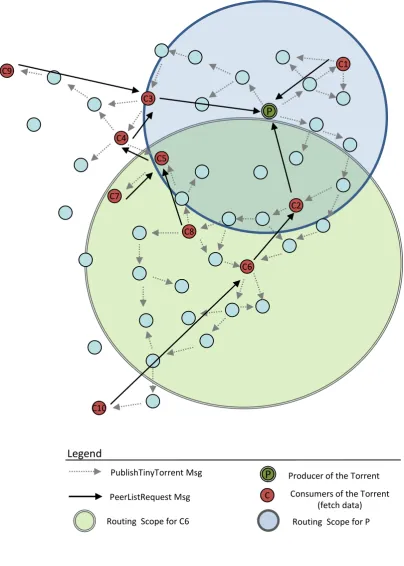
can be seen in Figure 2 where consumer nodes send their “PeerListRequest” messages to nearby consumers acting as 501
partial trackers. 502
In Figure 2, the cardinality in the consumer label (“C#”) sorts consumers according to the time when they start 503
acquiring the peer list for the torrent. For instance, “C2” requests a peer list from the initial seeder “P” which only 504
contains “C1” and itself as peers for the torrent. By the same token, “C8” selects “C5” as its partial tracker. “C5” 505
contains in its swarm, at least, the peer list provided by “C4” which includes “C3”, “C2”, “C1” and “P’. This is due 506
to the default size of the peer list being set to 4 and “C2” and “C1” being in the swarm of “P” when “C3” requests the 507
peer list. In addition, “C5” acts as a partial tracker for “C7” which has also been included in its swarm of the torrent. 508
For memory efficiency purposes, the maximum number of peers in the swarm of a partial tracker for a torrent is set 509
by default to 10. When the swarm is full and new peers are discovered for the torrent, the current policy replaces the 510
furthest peer (in hops) if the new peer is closer. This mechanism tends to populate the swarm of each partial tracker 511
with closer peers. In this regard, a consumer needs to locate a nearby partial tracker to receive an efficient peer list 512
in terms of proximity. Hence, the scalability of the system only depends on the distribution of consumers over the 513
network, such that the highest distance between any two closest consumers is equal or less than the discovery scope of 514
the routing protocol. For instance, in Figure 2, “C2” is within the routing scope of its partial tracker, i.e. “P”. However, 515
“C10” is an isolated consumer due to the fact that the closer partial tracker is “C6” which is not within its routing 516
scope; in other words, “C10” does not contain routing information about “C6” in its routing table. Therefore, the 517
successful discovery of a nearby partial tracker is the key mechanism for the efficient operation of the decentralised 518
version of the TinyTorrents protocol. In this regard, a set of mechanisms to discover partial trackers are presented in 519
Section 5.5. 520
5.4. Peer Selection Strategies
521
In the TinyTorrents protocol appropriate selection of the peers from which to gather pieces of data impacts the 522
efficiency of the traffic flow in terms of fairness, throughput, resource consumption and communications reliability. 523
Peer selection strategies contribute to make the system scalable, to foster data dispersion, and to avoid the flash crowd 524
problem at initial seeders. 525
5.4.1. Peer List Selection Strategies
526
In a partial tracker node, the selection of a peer list from the swarm of a torrent is mainly performed according to 527
the chronological position at which a peer entered the swarm of the torrent for the tracker (position-based selection). 528
The peer list selection strategy is a stochastic process where the distribution of probabilities amongst electable peers 529
is based on their position in the swarm of the torrent. It is a weighting scheme where the probability of a peer “i” 530
being selected for inclusion in the peer list “PselPos(i)” can be calculated according to Equation 1, 531
PselPos(i)=
Position(i)log(α) P
x∈S Position(x)log(α)
(1)
where “Position(i)” is the position at which the peer “i” entered the swarm of the torrent in the tracker. The 532
denominator is computed as the sum of the weighted positions where “S” is the set of peers in the swarm except from 533
PeerListRequest Msg PublishTinyTorrent Msg
Legend
Routing Scope for P Consumers of the Torrent
(fetch data) C
Producer of the Torrent C1
C2 C3
C5
C8 C4
C7
C6
P
C9C10
C1
C2 C3
C5
C8 C4
C7
T
C6
P
C9C10
P
PeerListRequest Msg PublishTinyTorrent Msg
Legend
Central Tracker Node
T
Consumers of the Torrent (fetch data) # indicates position in the
swarm of the torrent C#
Producer of the Torrent
P
[image:13.595.93.498.118.685.2]Routing Scope for C6
to increase the probability of selecting peers with higher positions, i.e. recently received peers, over peers which have 535
been longer in the swarm, a coefficientαis utilised as a weighting parameter to control the growth of the position-536
based probability distribution. In the situation where a peer can not complete the data file with the first requested peer 537
list and needs to request another peer list, the tracker can lower theαcoefficient to the minimum value (αcan take 538
values from 1 to 255). A lower value ofαincreases the likelihood of peers with lower positions being selected under 539
the assumption that, the lower the position in the swarm, the higher the likelihood for the peer to contain most of the 540
pieces of data. However, when the peer list is requested for the first time for a given torrent, the value ofαis set 541
high in order to increase the probabilities of including recently joined peers in the peer list. While this is employed 542
to achieve fairness in the data distribution process, including peers which recently joined the swarm in the peer list is 543
of interest in the decentralised version since most of the torrent dissemination strategies would expand concentrically 544
from the producer. This means that the likelihood of two nodes being in close proximity would increase as peers have 545
a close value of position in the swarm. 546
5.4.2. Peer Selection Strategies
547
A set of different strategies are proposed for the peer selection process when a peer is in thePiece Request Phase, 548
i.e. it has already received a peer list from the tracker,Peer List Request Phase, and has also performed theHandshake 549
Phasewith all, or some, of the peers in the list. In this phase, the peer has stored updated information on a set of peers 550
from which to acquire pieces. For each contactable peer, the requesting peer contains the following information for 551
the torrent: i) the piece bit vector and ii) the position in the swarm. Additionally, proximity to each of the contactable 552
peers in terms of hops is known via the UMG routing protocol. While the position in the swarm and the piece bit 553
vector of each peer are initially acquired in theHandshake Phase, the piece bit vector of a peer is updated with every 554
message received in thePiece Request Phase. Thus, the peer selection process is executed when a new piece is to 555
be retrieved as the current piece status of peers might have changed. This way, information about peers in the list is 556
updated as the data fetching process progresses, which enhances the selection process in order to achieve fairness in 557
the data distribution. 558
While the position in the swarm of a peer is a relevant factor to achieve fairness in a distributed manner and to 559
alleviate the burden in initial seeders, the hop distance to each peer is the key factor to control the communications 560
overhead and therefore the overall performance of the protocol. In single channel wireless sensor networks, a peer at a 561
hop distance of 1 should always be chosen over 2 hops or more, to reduce the contention factor in the neighbourhood. 562
However, when the peer selection process involves peers at a distance greater or equal to 2 hops, the unknown spatial 563
distribution of the peers in their areas and the unknown contention conditions are insufficient information to assert 564
that the closer peer in terms of hops becomes the most efficient choice. In this situation, the position in the swarm of 565
the peer should be taken into account in the peer selection process. 566
The performance of a set of peer selection strategies under different configurations of the TinyTorrents protocol 567
and network scenarios was studied. The highest degree of fairness in the data distribution process was obtained with 568
strategies selecting peers with the most number of remaining pieces to be acquired. The strategies primarily seek to 569
balance the flow of traffic towards those peers with a low number of pieces in order to reduce the load on seeders. 570
However, strategies selecting proximate peers produced the best results in terms of communications, with a high 571
degrees of fairness. The latter is due to the decentralized design of the system where partial trackers progresively 572
distribute data amongst close consumers as the network scales. As a result, the Closest First Piece Remaining-based 573
(CFP) Peer Selection strategy produced the most efficient results in terms of communications with high degree of data 574
distribution fairness amongst peers. The CFP strategy firstly includes peers with the minimum number of hops from 575
the list of contactable peers which have the piece to be requested. Then, the peer is selected by using the “PselPos(i)” 576
in Equation 1) where “Position(i)” is replaced by “PieceRemaining(i)”. PieceRemaining(i) indicates the remaining 577
number of pieces to be acquired by peer “i” according to its piece bit vector. The higher the number of pieces to 578
be acquired, the higher the probabilities for the peer to be selected. This strategy achieves efficiency in terms of 579
communication while at the same time serves to update peers in need of pieces of data on the availability of pieces 580
at other peers, thereby reducing potential subsequent peer list requests to a partial tracker. In addition, this strategy 581
balances the load of traffic within the near proximities due to the fact that the piece bit vector of nearby peers is also 582
updated at the requesting node when the piece is received; this increases the chances of nearby peers being selected 583
5.5. Unstructured Discovery of Partial Trackers
585
A set of combined mechanisms for the discovery of partial trackers are presented for the scalable and efficient 586
operation of the TinyTorrents protocol in its decentralised version. 587
5.5.1. Torrent Dissemination Control
588
This discovery mechanism can be classified as push-pull, where initial seeders push the torrent message to the 589
network in a way that can optimise the query/searching process of requesting consumers. The application layer 590
controls the flooding process of the torrent by deciding at each receiving node if and when to forward the message. 591
The first message received is forwarded after a delay, and thus a reception window is opened for the admission 592
of further messages of the same torrent type. In this way, the reception of duplicate torrent messages is leveraged to 593
update the consumer on the set of closest partial trackers as messages come from spatially separated consumers. When 594
a node becomes a consumer of the torrent, the torrent message is broadcast with its address appointed as the partial 595
tracker. Additionally, consumer nodes assign a smaller value of delay as compared to the rest of the nodes, which 596
increments the likelihood of potential consumers receiving a higher number of instances of the message coming from 597
disparate partial trackers. When the torrent is selected to be fetched or forwarded, the address of the closest partial 598
tracker in the array is selected. However, the closest partial tracker can be a consumer which is due to start the fetching 599
process at a later stage and thus it can not provide a peer list yet. In this case, the node contacts the array of potential 600
partial trackers in a round-robin fashion until one of them provides a valid peer list. A delay is introduced in between 601
requests to i) wait for these nodes to become partial trackers, and ii) avoid overloading the network. 602
5.5.2. “PeerListRequest” Message Interception
603
This mechanism enhances the previous mechanism by intercepting the “PeerListRequest” message en route to the 604
previously discovered partial tracker. Every relay node in the route towards the partial tracker checks whether it can 605
act as a tracker for the requested torrent key. In this case, if the node can provide a peer list for the torrent, then it 606
becomes the new partial tracker. 607
5.5.3. Routing Discovery Scope Increment
608
This mechanism is employed when the appointed partial tracker cannot be contacted, either because the end-to-609
end routing connectivity fails, or because the node is out of the routing discovery scope (i.e. its address is not in the 610
routing table). In this situation, the TinyTorrents protocol instructs the routing layer to increase its default discovery 611
scope while searching for the partial tracker node. Thus, the default routing discovery scope is incremented by a factor 612
of 3 hops to try to reach the node. When and if a partial tracker is discovered, the “PeerListRequest” message is sent 613
towards the node. 614
5.5.4. UMG Service Discovery
615
When neither the appointed partial tracker nor the initial seeder can be reached and theRouting Discovery Scope 616
Incrementmechanism fails or is not employed, then the TinyTorrents protocol makes use of the Ubiquitous Mobile 617
Gradient (UMG) routing protocol service advertisement and discovery functionality in the search for potential partial 618
trackers. Two mechanisms are available: 619
Local Discovery: This approach exploits local information in the routing table to provide a potential target node 620
in the peer list search process. Currently up to a maximum of three nodes from the routing table are selected to be 621
contacted which best match the description of the torrent. 622
Network Discovery: When theLocal Discoverymechanism can not find potential trackers within the local routing 623
table, the UMG routing protocol leverages the gradient spreading process to discover nearby nodes with a similar 624
service description. Nodes receiving the gradient packet spread their own gradients if their service descriptor matches 625
the descriptor of the torrent in the packet within a certain degree of accuracy in the comparison of the descriptors; the 626
accuracy is also transported in the packet and indicates the percentage value of similarity when comparing the bits of 627
the two descriptors, i.e. Bloom filters (see Section 4). The scope of the gradient is incremented when the discovery 628
is not successful up to a maximum number of hops (the default scope is 5 with an increment of 3). This approach 629