
İSTANBUL TECHNICAL UNIVERSITY INSTITUTE OF SCIENCE AND TECHNOLOGY
M.Sc. Thesis by
Mehmet Erhan YİĞİTBAŞI, B.Sc.
Department : Computer Engineering Programme: Computer Engineering
JULY 2005
AUTHENTICATION IN WIRELESS
SENSOR NETWORKS
İSTANBUL TECHNICAL UNIVERSITY INSTITUTE OF SCIENCE AND TECHNOLOGY
M.Sc. Thesis by
Mehmet Erhan YİĞİTBAŞI, B.Sc. (504021500)
Date of submission : 6 July 2005 Date of defence examination: 6 July 2005 Supervisor (Chairman): Prof. Dr. Bülent ÖRENCİK
Members of the Examining Committee Prof.Dr. A. Emre HARMANCI (I.T.U.) Assoc.Prof.Dr. Erdal ÇAYIRCI (War Col.)
AUTHENTICATION IN WIRELESS
SENSOR NETWORKS
ĠSTANBUL TEKNĠK ÜNĠVERSĠTESĠ FEN BĠLĠMLERĠ ENSTĠTÜSÜ
KABLOSUZ DUYARGA AĞLARINDA
ASILLAMA
YÜKSEK LĠSANS TEZĠ Müh. Mehmet Erhan YĠĞĠTBAġI
(504021500)
TEMMUZ 2005
Tezin Enstitüye Verildiği Tarih : 6 Temmuz 2005 Tezin Savunulduğu Tarih : 6 Temmuz 2005
Tez DanıĢmanı : Prof. Dr. Bülent ÖRENCĠK
Diğer Jüri Üyeleri Prof.Dr. A. Emre HARMANCI (Ġ.T.Ü.) Doç.Dr. Erdal ÇAYIRCI (Harp Akademileri)
FOREWORD
First, I would like to thank my advisor Prof. Bülent Örencik for his support and guidance during my master’s program. He introduced new areas of research and helped me to understand the approach to solve research problems. Next, I would like to thank my guidance committee members for their valuable comments on my thesis. Finally, I would like to thank my parents for their love and affection. I thank them for their support in whatever efforts I make.
Mehmet Erhan YĠĞĠTBAġI July 2005
TABLE OF CONTENTS
FOREWORD iii
ABBREVATIONS ix
TABLE LIST x
FIGURE LIST xi
SYMBOL LIST xii
ÖZET xiii
SUMMARY xiv
1. INTRODUCTION 1
2. SENSOR NETWORK ARCHITECTURE 3
2.1 Environment 3
2.2 Data Types 3
2.3 Communications Architecture and Layers 4
2.3.1 Physical Layer 5
2.3.2 Network Routing Layer 5
2.3.3 Transport Layer 6
3. SENSOR NODE TECHNOLOGY 7
3.1 Sensor Node Hardware 7
3.1.1 Hardware Design 7
3.1.2 Sensor Node Energy 7
3.1.3 Sensor Node Mobility 8
3.1.4 Sensing Capabilities 8 3.2 Software 8 4. SECURITY REQUIREMENTS 9 4.1 Confidentiality 9 4.2 Authenticity 9 4.3 Integrity 9 4.4 Non Repudiation 10 4.5 Freshness 10 4.6 Scalability 10 4.7 Availability 10 4.8 Accessibility 10 4.9 Self Organization 11
4.10 Flexibility 11 5. DENIAL OF SERVICE THREATS IN NETWORK LAYERS 12
5.1 Physical Layer 12
5.2 Link Layer 13
5.3 Network and Routing Layer 13
5.4 Transport Layer 15
6. SENSOR NODE CONSTRAINTS 16
6.1 Battery Power and Energy 16
6.1.1 Computational Energy Consumption 16
6.1.2 Communications Energy Consumption 17
6.2 Sleep Patterns 18
6.3 Transmission Range 18
6.4 Memory 18
6.4.1 Program Storage and Working Memory 18
6.4.2 Programmable Storage for Security Information 19
6.5 Location Sensing 19
6.6 Time 19
7. NETWORKING CONSTRAINTS 20
7.1 Data Rate and Packet Size 20
7.2 Channel Error Rate 20
7.3 Unreliable Communications 20
7.4 Latency 21
7.5 Frequent Routing Changes 21
8. CLASSIFICATION OF AUTHENTICATION MECHANISMS 22
8.1 According to Authentication Models 22
8.1.1 Direct Authentication 23
8.1.2 Threshold Authentication 23
8.2 According to Communication Organization and Network Topology 23
8.2.1 Static 24
8.2.2 Dynamic 24
8.3 According to Key Management Systems 24
8.3.1 Symmetric Authentication 25
8.3.2 Asymmetric Authentication 26
8.5 According to Involved Parties 28
8.5.1 Unilateral Authentication 28
8.5.2 Mutual Authentication 28
8.5.3 Broadcast Authentication 28
9. RESEARCH AND ALGORITHMS 30
9.1 Proposed Algorithms and Specifications 30
9.2 A Distributed Light-Weight Authentication Model for Ad-hoc Networks 33
9.2.1 Previous Works 33
9.2.2 Distributed Light-Weight Authentication Model 36
9.2.3 Security Analysis 38
9.2.4 Conclusions 39
9.3 Authentication Framework for Hierarchical Sensor Networks Using Tesla39
9.3.1 Hierarchical Sensor Network 40
9.3.2 Tesla and Tesla Certificates 41
9.3.3 Overview of the Authentication Framework 42
9.3.4 Certificates 43
9.3.5 Certificate Renewal 44
9.3.6 Entity Authentication 45
9.3.7 Data Origin Authentication 46
9.3.8 Security Analysis 47
9.3.9 Performance Analysis 48
9.3.10 Conclusion 49
9.4 A Lightweight Hop-by-Hop Authentication Protocol for Ad-Hoc Networks49
9.4.1 Introduction 49
9.4.2 Main Components of the Protocol 50
9.4.3 A Lightweight Hop-by-hop Authentication Protocol 51
9.4.4 LHAP in Detail 53
9.4.5 Security Analysis 55
9.4.6 Performance Analysis 57
9.5 LEAP Efficient Security Mechanisms for Distributed Sensor Networks 58
9.5.1 Introduction 58
9.5.2 Leap: Localized Encryption and Authentication Protocol 59
9.5.3 Performance Evaluation 62
9.5.4 Conclusions 62
9.6 Efficient and Secure Source Authentication for Multicast 63
9.6.1 Sender Setup 64
9.6.2 Bootstrapping a New Receiver 64
9.6.4 Receiver Tasks 65
9.6.5 Extensions 66
9.6.6 Time Synchronization Issues 67
9.6.7 Security Discussion and Robustness to DoS 68
9.6.8 Conclusions 69
9.7 A Novel Authentication Scheme for Ad hoc Networks 69
9.7.1 Overview of the Clustering Phenomenon 69
9.7.2 Assumptions 70
9.7.3 Key Definitions and Distribution Methodology 70
9.7.4 Proposed Steps 70
9.7.5 Description of the Algorithm 71
9.7.6 Advantages and Limitations of the Proposed System 72 9.8 On Communication Security in Wireless Ad-Hoc Sensor Networks 72
9.8.1 Communication Security Scheme 73
9.8.2 Implementation 75
9.8.3 Conclusion 76
9.9 SPINS: Security Protocols for Sensor Networks 76
9.9.1 SNEP 77
9.9.2 µTESLA: Authenticated Broadcast 77
9.9.3 µTESLA Overview 78
9.9.4 Implementation 79
9.9.5 Performance 80
9.9.6 Conclusion 81
10. TINYSEC: A LINK LAYER SECURITY ARCHITECTURE FOR
WIRELESS SENSOR NETWORKS 82
10.1 Introduction 82 10.2 Sensor Networks 82 10.3 Security 84 10.3.1 Security Goals 84 10.3.2 Security Primitives 84 10.4 Design of TinySec 85 10.4.1 Approaches 86
10.4.2 TinySec Design and Packet format 88
10.6 Implementation 92
10.7 Measurements 93
11. RELATED WORK 99
11.1 Underlying Encryption and Decryption Algorithms 99
11.1.1 Skipjack 99
11.1.2 RC5 102
11.1.3 Differences between RC5 and Skipjack 105
11.2 Using Skipjack and RC5 with TinySec for Authentication 105
11.2.1 Simulation and Test Environment 106
11.3 Comparison and Results 109
12. CONCLUSIONS 115
REFERENCES 116
ABBREVATIONS
DARPA : American Defense Advanced Research Projects Agency PDA : Personal Digital Assistant
WLAN : Wireless Local Area Networks
IEEE : Institute of Electrical & Electronic Engineers
MAC : Medium Access Control, Message Authentication Code
RTS : Request to Send
CTS : Clear to Send
IV : Initialization Vector
EEPROM : Electrically Erasable Programmable Read Only Memory
ROM : Read Only Memory
RAM : Random Access Memory
BS : Base Station
QoS : Quality of Service CA : Certificate Authority DSS : Digital Signature Standard TTP : Trusted Third Party
SAP : Space Authentication Portal AS : Authentication Server TGS : Ticket Granting Server SEAL : Self Authenticating Value
LHAP : A Lightweight Hop by Hop Authentication Protocol GPS : Global Positioning Systems
LEAP : Localized Encryption and Authentication Protocol CBRP : Cluster Based Routing Protocol
DTG : Date Time Group
ARM : Advanced RISC Machines
PRG : Pseudo Random Number Generator CVS : Concurrent Version System
DES : Data Encryption Standard NSA : National Security Agency
PC : Personal Computer
UART : Universal Asynchronous Receiver Transceiver SNEP : Security Network Encryption Protocols
TESLA : Timed Efficient Stream Loss Tolerant Authentication µTESLA : Micro Timed Efficient Stream Loss Tolerant Authentication
TABLE LIST
Page Number Table 5.1. Sensor network layers, denial of service attacks and defenses ……... 12 Table 6.1. Computation time and energy consumption for 128-bit multiply
result ……… 17 Table 9.1. Classification of the described algorithms …...………... 32 Table 9.2. Performance of security primitives in TinyOS ………... 80 Table 10.1. Table listing the expected overhead costs using TinySec for a 24
byte data payload ………. 94 Table 10.2. Total energy consumed to send a 24 byte packet ……… 96 Table 11.1. RC5 and Skipjack comparison with sample application ………. 113 Table 11.2. RC5 and Skipjack per packet energy consumption ………... 113
FIGURE LIST Page Number Figure 2.1 Figure 8.1 Figure 8.2 Figure 8.3 Figure 8.4 Figure 8.5 Figure 9.1 Figure 9.2 Figure 9.3 Figure 9.4 Figure 9.5 Figure 9.6 Figure 9.7 Figure 9.8 Figure 9.9 Figure 9.10 Figure 9.11 Figure 10.1 Figure 10.2 Figure 10.3 Figure 10.4 Figure 10.5 Figure 10.6 Figure 10.7 Figure 10.8 Figure 10.9 Figure 10.10 Figure 10.11 Figure 10.12 Figure 11.1 Figure 11.2 Figure 11.3 Figure 11.4 Figure 11.5
: Sensor Networks Communication Layers ……… : Classification according to authentication models .……… : Classification according to communication organization .……... : Classification according to key management systems …………. : Classification according to replay attacks protection .…………. : Classification according to involved parties …...……….. : Three tier hierarchical ad hoc sensor network ………. : The steps involved in using Tesla certificates ………. : A scenario where node A joins the ad hoc network ………. : Various attacks on LHAP ………. : Immediate authentication packet example ………... : The receiver synchronizes its time with the sender ………. : Example of network divided into clusters ……… : Cells, Extended cells and areas with multiple keys ……….. : Clock cycles versus the number of rounds for RC6 ………. : Using a Time Released Key Chain for Source Authentication … : Energy costs of adding security protocols to the sensor network : The Mica2 Mote ………... : CBC mode for encryption length ………. : CBC-MAC for authentication ……….. : Counter (CTR) mode for encryption ……… : TinyOS packet format ……….. : TinySec-Auth packet format ……… : TinySec-AE packet format ………... : TinySec and TinyOS interfaces ……… : End to end latency measurements ………. : Increase in latency when TinySec is used (byte times) …………. : The power consumption for sending a packet ……….. : Bandwidth as a function of the number of send-receive pairs …. : Rule A for the Skipjack algorithm ……… : Rule B for the Skipjack algorithm ……… : G permutation diagram ………. : Total current, plotted as a function of time (RC5) ……… : Total current, plotted as a function of time (Skipjack) …………
5 22 24 25 27 28 40 41 54 56 66 67 69 74 75 78 81 83 87 87 88 89 89 89 93 95 96 97 98 100 101 102 114 114
SYMBOL LIST
F : Pseudo random functions H, h : Hash functions
G : Hash function family Ki, K(i) : ith key
KFA : Traffic key KTA : Tesla key T, t : Time
KABLOSUZ DUYARGA AĞLARINDA ASILLAMA
ÖZET
DüĢük güç tüketimli duyargalardan oluĢturulmuĢ kablosuz ağlar yakın gelecekte pek çok yerde kullanılır hale gelecektir. Hatta geliĢtirilecek olan uygulamaların birçoğu kablosuz duyarga ağlarını hedefleyecektir. GerçekleĢtirilecek bu çalıĢmalardan askeri alandan sağlık ve çevre alanına kadar pek çok sahada faydalanılacaktır. Nano teknoloji, mikro elektronik ve mekanik sistemler, radyo haberleĢmesi ve mikroiĢlemci dünyasındaki birçok geliĢme de duyarga ağlarının yaygınlaĢması sağlamıĢ ve kullanılabilirliğini arttırmıĢtır.
Kablosuz duyarga ağlarındaki duyargaların sayılarının çokluğu ve bu cihazların kısıtlı kaynaklar ile olabildiğince düĢük güç tüketecek Ģekilde yönetilmesi gerekliliği bu ağlarda güvenli iletiĢim sağlamayı zorlaĢtırmaktadır. Genel güvenlik servislerinin (gizlilik, asıllama, bütünlük vs.) sağlanabilmesi için, yapılan çalıĢmalarda bu duyargaların kaynak kısıtları büyük ölçüde göz önünde bulundurulmalıdır.
Yapılan tez çalıĢmasında önerilmiĢ veya gerçekleĢtirilmiĢ kablosuz duyarga ağları asıllama protokolleri incelenmiĢ ve ayrıntılarıyla açıklanmıĢtır. Son olarak, tamamıyla gerçeklenmiĢ olan ilk kablosuz duyarga ağları veri bağı katmanı asıllama protokolü TinySec incelenmiĢtir. TinySec duyargalardaki kaynak kısıtlarına bağlı olarak TinyOS iĢletim sistemi üzerinde geliĢtirilmiĢ, birçok donanımla uyumlu çalıĢabilen bir protokoldür.
TinySec alınan mesajların asıllanabilmesi için mesajların sonuna kapalı anahtarla hesaplanan ve bir Ģifreleme algoritmasına dayanan mesaj asıllama kodu eklemektedir. Tez çalıĢmasında mesaj asıllama kodu hesaplanmasında kullanılan Ģifreleme algoritması ve altyapı değiĢtirilerek, performans karĢılaĢtırılması yapılmıĢtır. RC5 ve Skipjack algoritmaları kullanılarak yapılan karĢılaĢtırmalarda RC5 ile yapılan asıllamanın daha hızlı olduğu ve daha az güç tükettiği sonucuna varılmıĢtır.
AUTHENTICATION IN WIRELESS SENSOR NETWORKS
SUMMARY
Wireless networks of low-power sensing devices are going to be used in everywhere in the near future. These wireless sensor network applications will become a ubiquitous part of the computing landscape. Proposed applications of these networks range from health care to warfare. The emergence of low-power sensor networking has been propelled by the convergence of advances in several fields, including nano technology, Micro Electronic Mechanical Systems (MEMS), radio frequency communications, and microprocessors.
The potentially unlimited size of a sensor network with thousands of nodes and the need to manage with limited resources and conserve energy as much as possible, on each single node as well as throughout the network, makes secure communication challenging. Nodes depend on each other for correct operation. Messages have to be transmitted over several hops, since direct communication between arbitrary nodes is impossible due to limited radio range. Nodes have little knowledge of other, distant nodes. The challenge for the information security community is to develop the common security services (confidentiality, integrity, etc.) for sensor networks in a manner that meets the very strict resource constraints of these devices.
In this thesis, a broad range of on-going research efforts in authentication within the wireless sensor networks are described in detail. Finally, TinySec which is said to be the first fully-implemented link layer security architecture for wireless sensor networks is discussed which addresses sensors’ resource constraints with a good design and which is also portable to a variety of hardware and radio platforms as it uses TinyOS.
TinySec uses message authentication codes for authentication which are formed by secure hash functions and an encryption algorithm. In this thesis TinySec’s underlying authentication and encryption mechanism is changed and compared by using two different encryption algorithms which are RC5 and Skipjack. It is seen that using RC5 for authentication within TinySec is slightly faster than using Skipjack and it consumes less power.
1. INTRODUCTION
Today microprocessors are embedded in nearly all electronic devices such as cellular phones, televisions and camcorders. In combination with computing devices such as desktop computers, notebooks and personal digital assistants (PDAs) this could form a huge wireless network of mobile and static devices communicating without fixed infrastructure or centralized administration. In such a self-organized network each node relies on its neighbor nodes to keep the network connected. The security issues for ad-hoc networks are different than the ones for fixed networks. System constraints include low power microprocessor, small memory, small bandwidth, and limited battery power.
―An ad-hoc network is a wireless network made up of mobile hosts that do not require any fixed infrastructure to communicate. As early in the 1970s, ad-hoc networks were called packet radio networks which were investigated for military applications and were developed by the DARPA‖ [1]. When designing the 802.11
standard for WLAN, the IEEE replaced the term packet radio network by ad-hoc network. Ad hoc networks are frequently associated with self organization, which means that they run solely by the operation of end users.
Communication links are wireless to guarantee mobility. Ad-hoc networks act independently from any provider. The network topology may be very dynamic, making the links and routes very unstable. Power management is an important system design criteria. Finally, security is a critical issue because of the weak connectivity and of the limited physical protection of the mobile hosts.
Because packet radio networks have been developed initially for military purposes, potential applications are very often associated with critical situations such as
Other examples can be emergency situations, where the existing network infrastructure is not reliable and distributed networks for data collection and device monitoring like sensor networks, home networks and inter-vehicle communications. There can be need for creation of temporary networks for ad-hoc meetings, conferences or brainstorming. Most of the application areas are health, military, and security. For example, the physiological data about a patient can be monitored remotely by a doctor [2].
Realization of these and other sensor network applications require wireless ad hoc networking techniques. However sensor networks differ from ad hoc networks with some different characteristics. The number of sensor nodes in a sensor network can be several orders of magnitude higher than the nodes in an ad hoc network where sensor nodes are densely deployed. The topology of a sensor network changes very frequently and sensor nodes mainly use broadcast communication whereas most ad hoc networks use point-to-point communications. Sensor nodes are limited in power, computational capacities and memory [2].
The sensors in the sensor network make measurements, such as local temperature or pressure, and share this data with the appropriate application via the network. Providing security mechanisms for sensor networks is a critical issue since sensors will be used everywhere. Authentication of the data source and the data are critical concerns since somebody might attempt to capture sensors and tamper with sensor data.
Traditional authentication frameworks based on public key cryptography are not suitable for sensor networks since the sensors consist of small, low-powered microcontrollers that are mobile. The resources of the sensor are limited and as a result of this, the authentication and encryption mechanisms for sensor networks should be very lightweight.
2. SENSOR NETWORK ARCHITECTURE
Various factors should be considered in design of a sensor network. Environment, data types, communication layers and communication architecture are the important factors for a sensor network architecture.
2.1 Environment
The sensor network environment can be physically demanding on sensor nodes. The communications environment may be problematic due to interference and fading due to ground placement. ―The population density of sensor nodes in the network may vary depending upon the application, the communication capabilities of the sensor nodes, and the environment (e.g., desert, rain forest)‖ [3]. For example, a
one-dimensional boundary application may require sensor nodes be placed every 100 meters in a line. The same application may require a closer placement in a denser terrain that limits signal propagation. In most scenarios, it is assumed that once deployed sensor nodes have no mobility which implies that the network is somewhat static. However, although nodes are not mobile, the topology of the network may change as nodes are added or deleted from the network. Nodes may be added to replace nodes that have lost power or were destroyed.
2.2 Data Types
Within the sensor network, the amount and type of data exchanged is greatly influenced by the battery and energy constraints of the sensor nodes. The energy required to transmit a bit can be much greater than the cost to internally process a bit. For this reason, raw data will typically be processed locally and the results are
include raw sensor data, sensor node event reports destined for a remote command center or dismounted soldier in the field, or sensor commands and controls [4]. In order to conserve energy, raw sensor data is not usually forwarded within the network but processed locally into event reports that may include target classification and direction information. Data fusion helps to reduce the total amount of bits of data routed within the network. For some sensor applications it is assumed that raw real time data such as voice or video may be exchanged without significant local processing.
2.3 Communications Architecture and Layers
The distributed sensor network is an ad hoc wireless network where the membership and roles of sensor nodes is generally not known until the deployment of the network. Sensor nodes may be deleted permanently from the network when their available energy falls below acceptable limits or temporarily when they return to a sleep state. Once deployed, the network is self-organizing, developing a routing topology that provides strong connectivity throughout the network.
In order to maintain the energy balance within the network, re-organization is required throughout the life of the network as nodes are deleted and added to the network. This creates a fault tolerant network design where the loss of a fraction of the nodes causes a graceful degradation in network performance.
It is assumed that the sensor network supports a layered protocol stack as shown in Figure 2.1 [4]. The physical layer provides a wireless link between neighboring sensor nodes while the network layer allows for routing and delivery of data throughout the network. Some applications may require reliable delivery services from a transport layer and various sensor applications are supported at the application layer.
Application Transport Network Physical Medium Access Control (MAC) LPI, LPD Reliability Connection oriented services Distributed Low-Energy Routing Target Identification Target Tracking Data Fusion Data Link
Figure 2.1: Sensor Networks Communication Layers [4]
2.3.1 Physical Layer
The physical layer defines the mechanisms for medium access control (MAC) for the wireless sensor network. There are various physical layer MAC protocols that may be used for sensor routing. It is assumed that nodes have variable control over their radiant RF energy allowing them to dynamically control the range of their communications and provide a lower probability of interception [5].
2.3.2 Network Routing Layer
The sensor network utilizes a multihop packet based network routing protocol to deliver data throughout the network. ―The finite energy of the network is the primary design constraint in developing a low-energy routing algorithm that balances energy throughout the network. Nodes that are a focal point for network traffic will lose energy more quickly than those nodes at the edges of the network‖ [5].
Self-organization is required at time of deployment to initialize routing tables without the assistance of a human administrator. Re-organization is also necessary because of the ad hoc nature of the network and sensor nodes may be added and deleted from the network over its lifetime.
As a multi-hop network, packets are transferred from node to node until they reach their final destination. Intermediary nodes make routing decisions based on their
2.3.3 Transport Layer
The transport layer protocols can provide reliability and session control for sensor node applications. The majority of sensor network communications are packet oriented communications that do not require the reliability of the transport layer. Using real-time multimedia applications over the sensor network may require the ordering and reliability mechanisms of transport layer protocols.
3. SENSOR NODE TECHNOLOGY
The sensor node is the basic component of the sensor network. Nodes are designed for ease of deployment and to be low cost, compact, lightweight, and disposable. Local and collaborative signal processing across the wireless network enhances sensor nodes primitive sensing functions (e.g., seismic, acoustic, magnetic).
3.1 Sensor Node Hardware
Sensor nodes provide the core sensing functions of the sensor network. The sensor node hardware design and communications architecture are greatly influenced by their finite battery limitations.
3.1.1 Hardware Design
The exact function of each sensor node may not be determined until deployment and may change over the course of its mission. ―Flexibility is an important requirement in reducing the amount of equipment needed in order to deploy a sensor network and in supporting remote deployment techniques. They can be remotely re-programmable to support new functionality and they can support location determination mechanisms to define their exact or relative position‖ [4].
Energy is the most constraining factor, affecting all aspects of a sensor node design. Microprocessor selection is one area where energy conservation is important. There are numerous commercially available microprocessors designed for embedded low power environments. These microprocessors are suitable for both commercial applications and sensor nodes with similar energy constraints [4].
deployed, the sensor node battery cannot be recharged or replaced while in the field. However, some developers are investigating using solar arrays to add recharging capabilities. ―The actual amount of energy available by a sensor node’s battery is a
function of temperature, the rate of dissipation, and the battery technology. A battery’s potential capacity is measured in milliampere-hours (mAh) and is a function of the temperature and the load on the battery‖ [4].
In order to conserve energy, embedded processors typically have low power modes that slow or halt the processor clock and place the device in a state that consumes less power. In most of the developed sensor nodes the microprocessor is switched to the sleep mode when it has no data to process.
3.1.3 Sensor Node Mobility
In most of the designed systems it is assumed that once deployed, the sensor nodes will not be physically moved. However, in some environments, sensor nodes may be replaced if the battery supplies are low or the nodes are damaged. The topology of the network changes over time as nodes are added or deleted from the network. 3.1.4 Sensing Capabilities
Sensors may contain any number of sensing capabilities including seismic, acoustic, magnetic, infrared, radar, and video. ―Although the sensing of events is done in real time, the reporting of events may not be in real time. Reports may be fused with reports from other sensor nodes. Sensor nodes may deliver video in real time and require suitable QoS to support its delivery” [4].
3.2 Software
Mostly sensor nodes employ an embedded operating system to manage and support its applications for providing real-time performance. The operating system should be trustworthy. In order to support the implementation of any security requirements, the embedded operating system is not bypassable. Sensor nodes can support remote reconfiguration and reprogramming to incorporate flexibility.
4. SECURITY REQUIREMENTS
Security requirements for a sensor network are similar to other network types. Generally confidentiality, authenticity, integrity, non-repudiation, freshness and scalability should be considered. Also availability, accessibility, self organization and flexibility can be an important requirement for sensor networks.
4.1 Confidentiality
The data must be protected from disclosure to authorized parties. Similarly, public sensor information, such as sensor identities and public keys, should also be encrypted to protect against traffic analysis. Confidentiality should be provided by keys with as small a scope as possible to discourage a single break from compromising a large portion of the sensor network. Establishing unique keys between every pair of communicating sensor nodes is more secure than using a single network wide key.
4.2 Authenticity
At a minimum the access to the sensor data should be limited to only those parties identified in the protocol, (e.g. implicit key authentication or data origin authentication of the shared key).
4.3 Integrity
The sensor data must not be modified by the actions of outsiders of the protocol. In other words, an adversary should not be able influence the value of the keys or the
4.4 Non Repudiation
―Non repudiation is an attribute of communications that seeks to prevent future false denial of involvement by either party. Non repudiation with proof of origin provides the recipient of sensor data with evidence that proves the origin of the data. Non repudiation with proof of receipt provides the originator of the sensor data with evidence that proves the data was received as addressed‖ [5].
4.5 Freshness
A protocol ideally should guarantee its participants that each shared key or the data is fresh and not been reused or resent.
4.6 Scalability
Large networks can not utilize a protocol that has poor scaling properties. The system should be scalable to be used in large networks.
4.7 Availability
Services must ensure that confidentiality and group level authentication services are available to authorized parties when needed, protecting against active attacks that attempt to interrupt service within the network. To ensure the availability of message protection, the sensor network should protect its resources (e.g. sensor nodes) from unnecessary processing of messages in order to minimize energy consumption and extend the life of the network.
4.8 Accessibility
End to end confidentiality of sensor data should not be performed since it prevents sensor data fusion by intermediate nodes from taking place. An effective technique to extend sensor network lifetime is to limit the amount of data sent back to reporting nodes. Limiting this data reduces communications energy consumption [4].
4.9 Self Organization
As distributed sensor networks must self organize their routing, they must also self organize their key management. ―The self organizing capability of sensor networks must also be able to deal with nodes failing during deployment or at other times during the lifetime of the network‖ [4]. These failures may be caused by energy
exhaustion, adversary actions like jamming and capture or through natural causes.
4.10 Flexibility
Some sensor networks will be used in dynamic battlefield scenarios where environmental conditions, threat and mission may change rapidly. Changing mission goals may require sensors to be removed from or added to an established sensor node. Furthermore, two or more sensor networks may be fused into one or a single network may be split in two [4].
5. DENIAL OF SERVICE THREATS IN NETWORK LAYERS
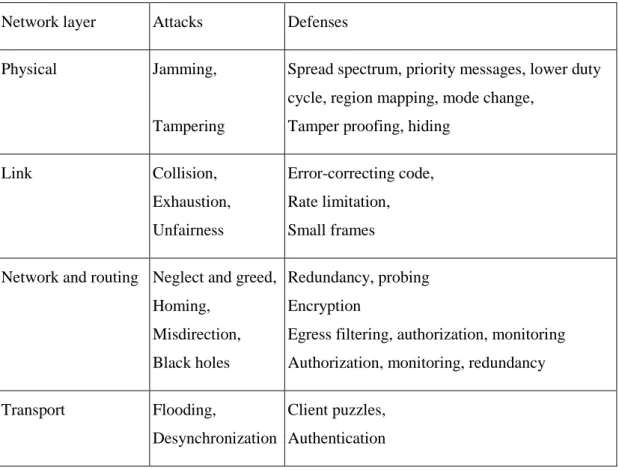
A DoS attack is any event that diminishes or eliminates a network's capacity to perform its expected function. Hardware failures, software bugs, resource exhaustion, environmental conditions, or any complicated interaction between these factors can cause DoS (see Table 5.1).
Table 5.1: Sensor network layers, denial of service attacks and defenses.
Network layer Attacks Defenses
Physical Jamming,
Tampering
Spread spectrum, priority messages, lower duty cycle, region mapping, mode change, Tamper proofing, hiding
Link Collision, Exhaustion, Unfairness Error-correcting code, Rate limitation, Small frames Network and routing Neglect and greed,
Homing, Misdirection, Black holes
Redundancy, probing Encryption
Egress filtering, authorization, monitoring Authorization, monitoring, redundancy
Transport Flooding,
Desynchronization
Client puzzles, Authentication
5.1 Physical Layer
Nodes in a sensor network use wireless communication because the network type is ad hoc, large-scale deployment makes anything else impractical. Base stations or uplink nodes can use wired or satellite communication, but limitations on their mobility and energy make them scarcer.
A well-known attack on wireless communication, jamming interferes with the radio frequencies of the nodes. For single-frequency networks, this attack is simple and effective. A node can easily distinguish jamming from the failure of its neighbors by determining the constant energy [6].
An attacker can damage or replace sensor and computation hardware or extract sensitive material such as cryptographic keys to gain unrestricted access to higher levels of communication. One defense involves tamper proofing the node's physical package. When possible, the node should react to tampering in a fail complete manner, for example it could erase cryptographic or program memory. Other traditional physical defenses include camouflaging or hiding nodes [6].
5.2 Link Layer
The link or media access control (MAC) layer provides channel arbitration for neighbor to neighbor communication. Cooperative schemes that rely on carrier sense, which let nodes detect if other nodes are transmitting, are particularly vulnerable to DoS.
Adversaries may only need to induce a collision in one octet of a transmission to disrupt an entire packet. A change in the data portion causes a checksum mismatch, a corrupted ACK control message causes back-off. Error correcting codes provide a mechanism for tolerating variable levels of corruption in messages [6].
Constant transmission of some packets would eventually exhaust the energy resources of both nodes. For example, IEEE 802.11-based MAC protocols use request to send (RTS), clear to send (CTS) to reserve channel access. To exhaust the energy resources the node could repeatedly request channel access with RTS, and get a CTS response from the targeted neighbor. [2].
relaying a packet increases, the probability that the network will drop or misdirect the packet along the way also increases.
One simple form of DoS attacks the node as router vulnerability by arbitrarily neglecting to route some messages. The malicious node can still participate in lower level protocols, and may even acknowledge reception of data to the sender, but it drops messages on a random or arbitrary basis where such a node is neglectful. If it also gives undue priority to its own messages, it is also greedy [6].
In most sensor networks, some nodes will have special responsibilities, such as being elected the leader of a local group for coordination. These nodes attract an adversary's interest because they provide critical services to the network.
A more active attack, misdirection, forwards messages along wrong paths. As a mechanism for diverting traffic away from its intended destination, this DoS attack targets the sender. By verifying the source addresses, parent routers can verify that all routed packets from below could have been originated legitimately by their children.
Nodes advertise zero cost routes to every other node, forming routing black holes within the network [6]. As their advertisement propagates, the network routes more traffic in their direction. In addition to disrupting message delivery, this causes intense resource contention around the malicious node as neighbors compete for limited bandwidth. These neighbors may themselves be exhausted prematurely, causing a hole or partition in the network. One defense against misdirection and black-hole attacks let only authorized nodes exchange routing information.
Nodes can also monitor their neighbors to ensure that they observe proper routing behavior. In one approach, the node relays a message to the next hop and then acts as a watchdog that verifies the next-hop transmission of the same packet [6].
Networks using geography based routing can use knowledge of the physical topology to detect black holes by periodically sending probes that cross the network's diameter. Subject to transient routing errors and overload, a probing node can identify blackout regions.
―Redundancy can lessen the probability of encountering a malicious node. The network can send duplicate messages along the same path to protect against intermittent routing failure or random malice. If each message uses a different path, one of them might bypass consistently neglectful adversaries or even black holes. A more clever approach uses diversity coding to send encoded messages along different paths, but with lower cost than full duplication‖ [6].
5.4 Transport Layer
This layer manages end to end connections. The service the layer provides can be both simple or complex and costly. Sensor networks tend to use simple protocols to minimize the communication overhead of acknowledgments and retransmissions. Protocols that must maintain state at either end are vulnerable to memory exhaustion through flooding. Limiting the number of connections prevents complete resource exhaustion, which would interfere with all other processes at the victim. However, this solution also prevents legitimate clients from connecting to the victim, as queues and tables fill with abandoned connections. Protocols that are connectionless, and therefore stateless, can naturally resist this type of attack.
An existing connection between two end points can be disrupted by desynchronization. In this attack, the adversary repeatedly forges messages to one or both end points. These messages carry sequence numbers or control flags that cause the end points to request retransmission of missed frames. If the adversary can maintain proper timing, it can prevent the end points from exchanging any useful information, causing them to waste energy in an endless synchronization recovery protocol.
One counter to this attack authenticates all packets exchanged, including all control fields in the transport protocol header. Assuming that the adversary also cannot forge the authentication mechanism, the end points could then detect and ignore the
6. SENSOR NODE CONSTRAINTS
6.1 Battery Power and Energy
Energy is perhaps the greatest constraint to sensor node capabilities and once sensor nodes are deployed in a sensor network, they cannot be recharged. Therefore, the battery charge taken with them to the field must be conserved to extend the life of the individual sensor node and the entire sensor network [2]. Various mechanisms within the network architecture, including the sensor node hardware, take this limitation into account. When considering implementing a cryptographic function or protocol within a sensor node, the impact on the sensor node’s available energy must be considered.
The extra power consumed by sensor nodes due to security is related to the processing required for security functions, the energy required to transmit the security related data and the energy required to store security parameters in a secure manner. Since the amount of additional energy consumed for protecting each message is relatively small, the greatest consumer of energy in the security realm is data transmission.
6.1.1 Computational Energy Consumption
The amount of computational energy consumed by a security function on a given microprocessor is primarily determined by the processor power consumption, the processor clock frequency, and the number of clocks needed by the processor to compute the security function. The cryptographic algorithm and the efficiency of the software implementation determine the number of clocks necessary to perform the security function.
Public key cryptographic algorithms such as RSA are computationally intensive, executing thousands or even millions of multiplication instructions to perform a
single security operation. Thus, a microprocessor’s public key algorithm efficiency is primarily determined by the number of clocks required to perform a multiply instruction. Table 6.1 shows the wide variance of energy consumption for representative embedded microprocessors in computing a basic public key algorithm building block, a multiply function with a 128-bit result [4].
Table 6.1: Computation Time and Energy Consumption for 128-bit Multiply Result [4]
Processor Power Consumption (mW) Clock Freq. (MHz) Native Mult. Result # clocks to compute128 bit result Time required (μs) Energy consumed (nJ) MIPS R4000 230 80 128 40 0.50 115.0
SA-1110 "Strong ARM" 240 133 64 60 0.45 108.0
Z-180 300 10 32 912 91 27000.0
MC68328 "Dragon Ball" 52 16 32 1920 120. 6200.0
MCF5204 "Cold Fire" 625 33 32 304 9.2 5800.0
MMC2001"M-Core" 81 33 32 416 12.6 1020.0
ARC 3 2 40 32 168 4.2 8.4
6.1.2 Communications Energy Consumption
In addition to consuming energy through computational processing, security functions also consume energy due to the communication of information between sensor nodes. Communications energy consumption attributable to security includes exchange of key management information, including encrypted keys, certificates, and nonces, per-message additions, including initialization vectors (IVs), encryption padding, authentication tags, and signatures.
6.2 Sleep Patterns
In order to conserve energy sensor nodes spend most of their time in low power sleep modes and only awake when required to processes an event. For this reason, a node’s availability within the sensor network may be limited. The result of these sleep patterns is potential unavailability of a node to receive data. In order to maintain cryptographic synchronization throughout the sensor network, it is essential that all nodes use the proper cryptographic material when communicating.
6.3 Transmission Range
The communications range of sensor nodes is limited in order to conserve energy. Reducing the transmission power saves sensor node energy and provides a lower probability of detection. The actual range achieved from a given transmission signal strength is dependent on various environmental factors.
6.4 Memory
Sensor processors require different types of memory to perform various processing functions. ROM or EPROM is needed for storing the general purpose programming such as an embedded operation system, security functions, and basic networking capability. RAM is needed for storing application programs, sensor data, and intermediate computations. Programmable memory such as EEPROM and FLASH are needed for storing downloaded application code, data between sleep periods [4]. 6.4.1 Program Storage and Working Memory
The amount of program storage available for storing security functionality, such as security mechanism implementations, is unlikely to be a constraining factor on security design. Even the most sophisticated cryptographic algorithms can be represented in the tens of kilobytes of memory, whereas the amount of program storage available in ROM, EEPROM, or other nonvolatile memory is likely to be in the hundreds of kilobytes or megabytes.
It is stated that the amount of working memory available for security functionality can also not be a constraining factor. Most symmetric encryption and hashing functions can be executed in less than one kilobyte of RAM. Even the more memory consuming public key functions can be executed in just a few kilobytes of RAM [4]. 6.4.2 Programmable Storage for Security Information
Key management functions often require some form of programmable memory to store long term symmetric, public, or private keys. Depending on the concept of operations, security architecture, and memory technology, programming may take place during manufacture, during pre-deployment, or even when deployed on the battlefield.
6.5 Location Sensing
The sensor network environment may not be supportive of satellite location determination technologies like GPS. ―GPS may not be well suited for environments that shield its signals (e.g., inside a building). Other technologies like the Localizer enable sensor nodes to determine relative position to other sensor nodes‖ [7].
6.6 Time
Time data within the sensor network is required for synchronization of events. Time synchronization messages issued from a time source must be resistant to modification attacks in order to maintain network synchronization of events. For example, sensor node event reports can be time critical. An alteration of their time stamps may change the significant of the report. GPS offers a non-spoofable time source. If GPS is not available, other methods can be used to maintain time within the network. This includes accurate local clocks or network time protocols that synchronize time across a network.
7. NETWORKING CONSTRAINTS
Sensor networks are ad hoc in nature with the composition of the network determined at the time of deployment. During the sensor node mission, the composition of the network and its routing topology may change. This constraint limits ability to pre-configure sensor nodes for specific purposes. Sensor nodes should be able to support various roles in the network to ensure the reliability of the network.
7.1 Data Rate and Packet Size
Both the data rate and packet size affect the overall sensor node energy consumption. Generally packet sizes within the sensor network are relatively small, potentially as small as 30 bytes with header and the data rates are relatively low, less than 1 kbit/second.
7.2 Channel Error Rate
Low-layer communications protocols offer error detection and correction services. Errors that propagate into the layers where confidentiality, integrity, or authentication services are applied will affect their verification and authentication processes preventing any application data from being exchanged.
7.3 Unreliable Communications
The packet-based routing of the sensor network is connectionless and unreliable. Packets may get damaged due to channel errors or dropped at highly congested nodes. Connection oriented transport protocols such as TCP may be added for reliability. Reliability is required for the distribution of key material and security critical commands [4].
7.4 Latency
The multihop routing of the sensor network introduces delay within the network. Congestion and node processing can be a factor to the amount of latency in the network. For critical event reports and cryptographic key distribution, latency should be kept to a minimum in order to insure the timeliness of the data.
7.5 Frequent Routing Changes
As the available energy decreases in key nodes throughout the network, the need to change the routing topology to balance the energy usage within the network becomes important. Frequent routing changes can mean that the intermediate nodes processing data for end to end session can change.
8. CLASSIFICATION OF AUTHENTICATION MECHANISMS
Authentication exists to establish trust between two parties, or authentication entities. These entities consist of an identity and a key. Authentication is established by performing a cryptographic operation on the parties’ identities and keys. The cryptographic operation, or authentication algorithm, establishes the nature of the trust between the parties.
Authentication algorithms can be classified according to the model they use, according to the communication organization and network topology, according to the key management system they use, according to the replay attacks protection or according to the involved parties in the algorithm.
8.1 According to Authentication Models
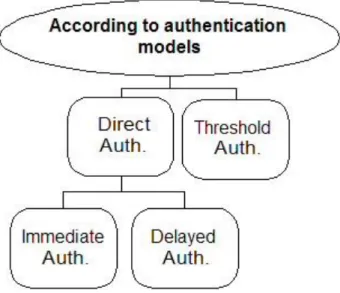
Some of the algorithms use direct authentication methods and some of them use threshold cryptography (Figure 8.1).
8.1.1 Direct Authentication
In this model authentication is done within the two parties that are communicating directly and this process can be done immediately or delayed.
8.1.1.1 Immediate Authentication
In Some kind of protocols and frameworks authentication is done immediately when packet is received. Generally the required data for authentication is appended in the current packet.
8.1.1.2 Delayed Authentication
Some of the protocols does not enable immediate authentication of the packets. Authentication can only be done after some amount of time. For example after the disclosure of the key in the key chain.
8.1.2 Threshold Authentication
Authentication is done according to the other nodes in the network. For an (n,t) threshold authentication t of the n nodes must trust and authenticate the node for authentication to be accepted.
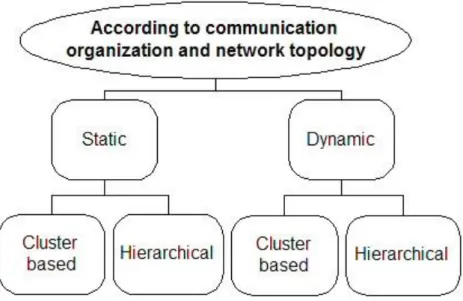
8.2 According to Communication Organization and Network Topology
The network topology and the architecture of the network also affect the authentication protocols. The nodes in the network can be static or mobile. And also the network can be supposed to operate cluster based or hierarchical. For example some of the authentication protocols are only designed for static and hierarchical networks (Figure 8.2).
Figure 8.2: Classification of authentication schemes according to communication organization and network topology
8.2.1 Static
It is supposed that the nodes in the network never move and the topology generally does not change. The network can also be hierarchical or cluster based. In cluster based protocols communication in the network is based on clusters and some special routing protocols can be used. Some of the protocols assume a hierarchical network where all the data flow is from the sensor nodes to the application or a base station. 8.2.2 Dynamic
It is supposed that the nodes in the network can move and the topology can change. Within this type of topology hierarchical and cluster based communication can also be considered.
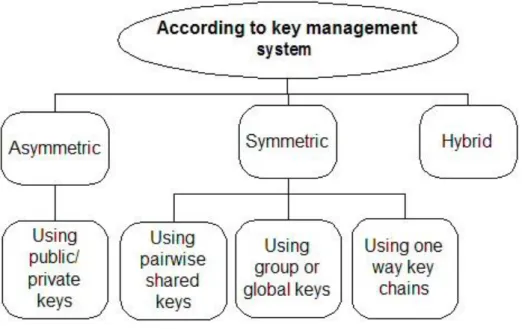
8.3 According to Key Management Systems
Authentication mechanisms and algorithms can be classified according to the key management systems that they use. First, there is symmetric authentication where symmetric key management schemes are used and secondly, there is asymmetric authentication where asymmetric key management schemes are used. Finally, there exists a hybrid authentication where both of the symmetric and asymmetric schemes can be used (Figure 8.3).
Figure 8.3: Classification of authentication schemes according to key management systems
8.3.1 Symmetric Authentication
In a symmetric key scheme there is a mutually agreed trusted server S which establishes the trust relationship between A and B. Each entity shares a secret key with the server. First, A asks S to establish a relationship to B. Then S sends A and B a session key K which these can use for authentication. A typical scenario can be:
A sends a hello message to S. S sends E(K, KA) to A. S sends E(K, KB) to B.
For each authentication, do the following:
A computes MACM = MAC(M, K) and sends M, MACM to B. B checks whether MACM = MAC(M, K).
Here, E(M, K) is the encryption of a message M by the key K, MAC(M, K) is the message authentication code of a message M by a key K, and KA is the shared key between the server S and A.
shared key K. The remaining steps are performed for each authentication process. However, if all devices share the same key, or if there are predistributed keys first three steps are not necessary :
A computes MACM = MAC(M, K) and sends M, MACM to B. B checks whether MACM = MAC(M, K).
8.3.2 Asymmetric Authentication
This is a public key scenario where each entity has a certificate (PK) issued by a certificate authority (CA) and an assigned public/private key pair. A message authentication works as :
A signs a message M as S = SIGN(M, SK) and sends M, S, (PK) to B.
B verifies whether (PKi) valid and whether VERIFICATION(S, M, PK) valid.
SIGN(M, SK) is the signature of the message M by the private key SK, and VERIFICATION(S, M, PK) be the verification of the signature S to the message M by the public key PK. VERIFICATION(S, M, PK) is valid if S is the signature of M by the corresponding secret key of PK, if S = SIGN(M, SK) and it is invalid otherwise.
8.3.3 Hybrid Authentication
In hybrid systems the algorithm uses both symmetric and asymmetric algorithms for authentication. In a public key scenario, an equivalent approach is to use a key agreement scheme such as Diffie Hellman followed by a symmetric MAC scheme for each authentication process. A sample hybrid authentication scheme can be as follows:
A sends B its public key KA and B sends A its public key KB. A computes K = a . KB.
B computes K = b . KA.
For each authentication, do the following:
B checks whether MACM = MAC(M, K).
In the above scenario, a and b are the private keys, and KA = a . G and KB = b . G with base element G are the public keys of A and B, respectively. Computation of K is done like K = a . KB = a(bG) = b(aG) = b . KA.
8.4 According to Replay Attacks Protection
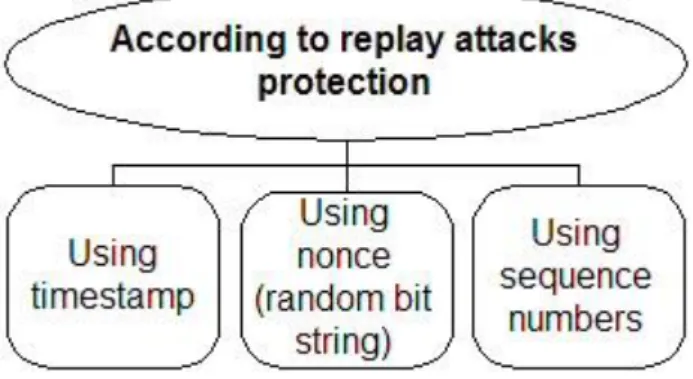
Authentication algorithms can be classified according to their replay attacks protection mechanisms. Some of the algorithms use timestamp, some of them use sequence numbers and some of them use nonce (a nonce is an unpredictable bit string, usually used to achieve freshness) for replay attacks protection (Figure 8.4).
Figure 8.4: Classification of authentication schemes according to replay attacks protection
8.4.1 Timestamp Usage
In some of the protocols a timestamp is added to every packet for checking freshness. It is needed for some type of DoS attacks. This model needs time synchronization. 8.4.2 Sequence Number Usage
In some of the protocols a counter value is added to every packet and the counter value is incremented after a packet is sent.
8.5 According to Involved Parties
Authentication algorithms and frameworks can also be classified by using the involved parties. There can be unilateral, mutual and broadcast authentication types (Figure 8.5).
Figure 8.5: Classification of authentication schemes according to involved parties
8.5.1 Unilateral Authentication
Only one party needs to do authentication for message authentication. All of the message authentication protocols only rely on this kind of authentication.
8.5.2 Mutual Authentication
This type is valid for only entity authentication. Mutual authentication can be achieved by performing a unilateral authentication twice. A sample scenario can be: B sends random rB to A.
A computes MACA = MAC(rB || rA,K) and sends MACA, rA to B. B checks whether MACA = MAC(rB || rA,K), computes
MACB = MAC(rA || rB,K) and sends MACB to A. A checks whether MACB = MAC(rA || rB,K). 8.5.3 Broadcast Authentication
Broadcast authentication is the process where one entity authenticates messages to several parties. In symmetric schemes MAC usage with pairwise shared keys only
provides mutual (pairwise) authentication whereas a digital signature also provides broadcast authentication.
For providing broadcast authentication with symmetric schemes multiple keys and multiple MACs can be used. The sender can append the MAC calculations for all of the involved parties in its target to the packet.
9. RESEARCH AND ALGORITHMS
9.1 Proposed Algorithms and Specifications
For this thesis nine proposed authentication algorithm and frameworks are studied and they are described in detail. In section 9.2 a distributed authentication model is discussed. The model uses the idea of threshold cryptography. The authentication model suggests using a distributed trust model. This model is mainly based on human behavior. The nodes in the network ask a trust value for a node by using its trusted nodes. For example for an (n, t) threshold scheme if a node asks n nodes for a trust relationship with a specific node and t of the nodes tell that the node is trustworthy, then according to this model the node is said to be authenticated.
In section 9.3 an authentication framework for hierarchical sensor networks is proposed. It is mainly based on Tesla [13]. The main difference between Tesla and this framework is the usage of asymmetric key systems. This framework does not depend on asymmetric systems; the distribution of the keys is done by a system wide private key.
Another lightweight authentication scheme is proposed in section 9.4. This scalable and efficient authentication protocol is called LHAP (A Lightweight Hop-by-Hop Authentication Protocol). This model uses one way key chains for authentication. For the initial trust Tesla algorithm is used. By using the digital signature scheme of Tesla, a secret key between two entities are defined. By using this secret key and some one way hash functions a key chain is created. This algorithm uses message authentication codes and these codes are calculated by using the specific key in the key chain. Normally, there are defined time periods in Tesla where one of the keys in the key chain is selected every time period. The key that is used in message authentication code calculation is disclosed in the next packets at the end of the period. However, this framework does not depend on periodic or delayed key disclosure. It proposes using traffic keys for immediate authentication. There is also a traffic key chain in addition to the Tesla key chain. The traffic keys in the chain are sent to the nodes by using Tesla. Source nodes append the traffic key in the packet and enables immediate authentication.
In section 9.5 another encryption and authentication protocol is proposed. It is called LEAP (Localized Encryption and Authentication Protocol) [15]. It is supposed that the network is cluster based and static. The proposed protocol states that the different types of messages have different security requirements. There is a base station and every node in the network share a secret key with the base station. There is also a cluster key where all the nodes in the same cluster share the same key. Neighboring nodes also share secret keys between each other. It is based on µTESLA [16] which needs delayed key disclosure and loose time synchronization. However this framework needs authentication in every hop and using µTESLA with delayed key disclosure is not suitable, so immediate authentication is supplied by adding an extra MAC calculation with the cluster key.
An efficient and secure authentication protocol is proposed in section 9.6. It is a multicast based system which uses Tesla. For immediate authentication it adds the next packet’s MAC in the current packet. For example it appends the third packet’s MAC calculation in the second packet. So the receiver can immediately authenticate the third packet when it is received. This algorithm needs time synchronization and for synchronizing the time an asymmetric scheme is used.
In section 9.7 another cluster based authentication scheme is proposed. It is designed for hierarchical networks. Authentication is done by using the special tags and a session key that are generated by the cluster head. There is also a cluster key which is distributed by using asymmetric systems (system public/private key pairs). Every node should have a public/private key pair to be used as a cluster key.
Another authentication scheme is described in section 9.8 where there are 3 types of security levels. ―Security level I is for mobile code which the most sensitive information and security level II is dedicated to the location information in messages, the security level III is applied to the application specific information”
[18]. For this framework RC6 is used with its configurable parameters. There is also a key chain is defined in this algorithm. One of the keys in the key chain is active in every time period. The key that is going to be used is defined by the participation of the nodes in the network. By using this main key the keys for other security levels are defined.
special packet where this packet is encrypted by using SNEP. Within this framework for SNEP, RC5 and counter mode is used and for MAC calculation CBC-MAC mode is used.
Finally, TinySec [19] which is a link layer authentication and encryption scheme is described. It uses a symmetric key system for authentication and encryption. It uses the same algorithm for both encryption and authentication. It uses message authentication codes in CBC mode. It uses Skipjack algorithm for encryption purposes.
The general properties and classification of the described algorithms can be seen in table 9.1.
Table 9.1: Classification of the Described Algorithms.
D es cr ibed A lgo ri th m ’s Sect ion Im m ed ia te Au th.( I) , D el aye d A ut h. (D ), Thre sh ol d A u th. (T) Sta ti c To pol o gy( S ), D ynam ic Top ol og y( D ), C lust er B ase d (C ), H ier ar ch ic al (H ) Sym m et ri c( S ), As ym m et ri c( A ), H ybr id( H ) Tim e Synch ron iza ti on( T ), N once U sa g e( N ), Sequenc e Num ber s( S ) U ni la te ral ( U ), Mu tua l( M) , B roadc as t( B ) 9.2 T S,D S - U 9.3 D D,H H T B 9.4 I D H T U 9.5 I S,C S - U 9.6 I D H T B 9.7 I D,C,H H S U 9.8 I S,D S T B 9.9 D S,D S T B 10 I S,D S S B
9.2 A Distributed Light-Weight Authentication Model for Ad-hoc Networks
In this work a security model for low-value transactions in ad-hoc networks is presented. It is focused on authentication, since this is the core requirement for commercial transactions. The proposed model does not require devices with strong processors as public-key systems.
9.2.1 Previous Works
9.2.1.1 Distributed Trust Model
These kinds of systems should be robust against attackers. The Distributed Trust Model [8] mainly depends on the values about trust. In this model there must exist a value of trust describing how much an entity is trusted. There can also be a hierarchy of trust relationships. The Distributed Trust Model protocol exchanges trust-related information for its protocol. The model assumes that trust relationships are unidirectional and take place between two entities. In this model the entities have values for trust relationships. ―The protocol works by requesting a trust value in a trust target and after getting a response an evaluation function is used to obtain an overall trust value in the target‖ [9]. The protocol also allows recommendation
refreshing and revocation. The recommender sends the same recommendation with another recommendation value to revoke. The model is suited to establish trust relationships that are less formal, temporary or targeting ad-hoc commercial transactions.
An implementation of Distributed Trust Model for ad-hoc networks would be particularly vulnerable to malicious and compromised agents. Since ad-hoc network topology is flexible it is unclear if enough trustworthy entities are available to obtain a recommendation. Finally the requestor could ask for information regarding what other entities think about each other. This could be data that other entities would not want to reveal.
9.2.1.2 Password-Based Key Agreement
![Figure 2.1: Sensor Networks Communication Layers [4]](https://thumb-us.123doks.com/thumbv2/123dok_us/10972796.2985334/20.892.168.785.105.316/figure-sensor-networks-communication-layers.webp)
![Table 6.1: Computation Time and Energy Consumption for 128-bit Multiply Result [4]](https://thumb-us.123doks.com/thumbv2/123dok_us/10972796.2985334/32.892.164.796.320.730/table-computation-time-energy-consumption-bit-multiply-result.webp)

![Figure 9.1: Three tier hierarchical ad hoc sensor network [12].](https://thumb-us.123doks.com/thumbv2/123dok_us/10972796.2985334/55.892.245.721.519.865/figure-tier-hierarchical-ad-hoc-sensor-network.webp)
![Figure 9.3: A scenario where node A joins the ad hoc network [14].](https://thumb-us.123doks.com/thumbv2/123dok_us/10972796.2985334/69.892.317.642.729.911/figure-scenario-node-joins-ad-hoc-network.webp)
