Living Well - Within Limits
SDC Discussion Document on Wellbeing Indicators for Sustainable Development May 2007
Summary
The aim of this paper is to contribute to on-going discussions – in government and elsewhere – on measuring progress towards the goal of sustainable development. The paper makes some specific recommendations about measuring wellbeing, and about the relationship between measures of wellbeing, measures of economic progress and measures of environmental impact.
In broad terms, the suggestion made here is that the UK should adopt a ‘triad’ or ‘troika’ of high-level indicators of progress, measuring three indispensable components of societal progress: economic wellbeing, societal wellbeing, and environmental wellbeing. The SDC also believes that the concept of fairness (both within and between generations) must also play a key role in the construction of these measures.
Ultimately, sustainable development is about living well, within certain limits. What we mean by living well and how we measure our proximity to those limits is a vital task for Government and for society more broadly. The approach offered here is the starting point for a much wider debate on these issues. But our suggestions are all pragmatic and could all be implemented – at least in some form – rather quickly. If implemented, we believe they would make a constructive difference to the pursuit of sustainable development.
Contacts:
Tim Jackson: [email protected]
Introduction
The Sustainable Development Commission (SDC) has a long-standing interest in understanding what progress means and in how it is measured. Our (2003) report Redefining Prosperity1 argued that sustainable development demands a concept of
prosperity that goes beyond the simple pursuit of rising Gross Domestic Product (GDP). As part of our input to the government’s review of their Sustainable Development Strategy in 2005, the SDC suggested that the concept of wellbeing might play a useful part in defining and measuring social progress in this broader sense.
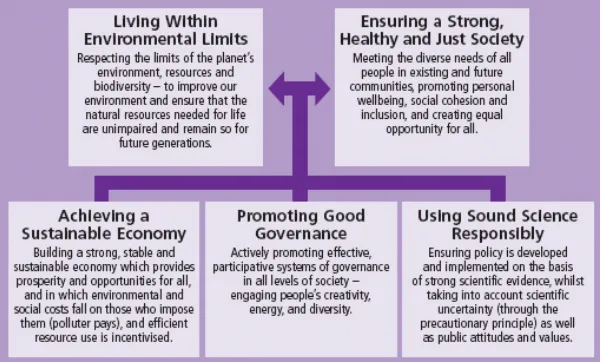
During the consultation process for the (2005) UK Sustainable Development Strategy, the SDC hosted a workshop in which the five principles of sustainable development – now set out in Securing the Future2 – were first formulated (Figure 1). The basic goal of
[image:2.595.148.449.384.565.2]sustainable development to secure a ‘strong, healthy and just society’ which is ‘living within environmental limits’ is one that the SDC applauds. The SDC also welcomes the work on wellbeing that is now being carried out across government as a way of capturing what might be entailed in this goal. In particular, we welcome the review of evidence on wellbeing, carried out by the Whitehall Wellbeing Working Group (W3G) and the on-going work on wellbeing indicators being developed by the Wellbeing Indicators Group.
Figure 1: Principles of Sustainable Development
The next section in this paper outlines the concepts and principles that have guided the development of our position on wellbeing indicators. Many of these concepts and principles are drawn from the deliberations of the Commission over a number of years and reinforced by an extensive web-based consultation on progress and wellbeing carried out between September and November 2006.3 The subsequent section sets out specific
1 SDC, 2003. http://www.sd-commission.org.uk/publications.php?id=41
2 2004. http://www.sustainable-development.gov.uk/publications/uk-strategy/index.htm 3 Further details on this consultation, which involved around 300 respondents two periods of
consultation, can be found on the SDC website at
proposals for a ‘troika’ of top-level indicators of sustainable development. Finally we discuss the need for further refinements of these suggestions and the implications for on-going work on wellbeing and across Government.
Concepts and Principles
Unsurprisingly, the SDC believes that any indicator of national performance needs to be conceived in terms of measuring progress towards sustainable development. This view was, in the main, supported by the deliberations of the panel. There was also some evidence in the panel of a visionary, almost philosophical, approach to what progress should mean – particularly in a world beset by environmental limits and resource constraints. This broader philosophical approach is a natural ally to discussions of sustainable development. The idea that the goal of sustainable development is about ‘strong healthy and just societies’ which are ‘living within environmental limits’ clearly begs some questions about what such a society looks like. But it does not preclude considerations of cultural diversity, social inclusivity and connectedness, personal fulfilment and spiritual development – all of which were raised by the more philosophical interventions from the panel.
Another related issue voiced by the panel (and within the Commission) is that indicators should always be seen within a holistic framework in which nature, society and economy are all related. There is a danger of artificial separation in specifying individual indicators and this separation was, in part, felt to be responsible for many of the unsustainable trends evident today.
The SDC is sympathetic to these viewpoints. At the same time, it is clear that useful indicators of progress towards sustainable development must start from a pragmatic basis rooted in clear measurable components of that wider vision. In particular, we suggest that a meaningful vision of sustainable development must identify ‘good enough’ measures in relation to the following three key principles of sustainable development:
• ensuring a strong, healthy and just society • living within environmental limits
• achieving a sustainable economy.
The two additional sustainable development principles shown in Figure 1 (namely, ‘sound science’ and ‘good governance’) are also important, but can to some extent be thought of as ‘framing conditions’ for establishing robust indicators in relation to the three principles identified above.
We note that the existing sixty four sustainable development indicators (‘environment in your pocket’4) already includes components which measure some aspects of the three
principles. A key recommendation from our analysis, however, is that the existing set of sustainable development (SD) indicators – as currently structured and operationalised – is inadequate to give appropriate guidance regarding progress towards sustainable development. One of the reasons for this is the sheer number of indicators. Another relevant to the question of measuring progress and wellbeing can be found at Annex A to this paper.
(related) reason is the inability to understand with any great clarity the relationships and conflicts between them. This lack of clarity and focus has meant that policy tends to default to ‘tried and trusted’ indicators such as GDP – in spite of the fact that this is a limited measure of progress in relation to sustainable development.
Our panel recognised this dilemma. In particular they discussed (and were to some extent divided over) the question of whether or not it was possible to identify one, clear indicator of national progress – perhaps an indicator of overall wellbeing – which could guide and frame policy. Essentially, there is a compromise to be made here between ‘resonance’ and ‘complexity’.
Any top level social and environmental indicator needs to be in a format that is supported by, visible in and resonant with government, business, media and the public: something – like growth in GDP – which provides a compelling and ‘snappy pitch’5 that communicates
readily to government, lay and business audiences alike.
At the same time, panel members pointed to the need for a robust understanding of underlying complexities and tradeoffs in the measurement of progress. As one member put it: “measuring progress is complex and we shouldn’t misguide an intelligent public by suggesting otherwise.”6
Our view is that the compromise between resonance and complexity is best faced by addressing both demands in a structured way. We are very supportive therefore of developing an underlying set of robust individual measures and indicators to reflect a wide range of aspects of sustainable development. In fact, we believe that this is essential not just to capture the complexity in delivering sustainable development, but also in understanding the relationships and correlations between different aspects of society. At the same time the SDC is convinced that a much smaller number of top-level indicators is an essential pre-requisite for meaningful policy progress in relation to the three SD principles cited above.
We do not believe however, that indicators covering the three principles (ensuring a strong, healthy and just society, living within environmental limits and achieving a sustainable economy) are reducible to one. Calls for government to be led by a single, commensurable indicator such as Gross National Happiness, for example, seem misguided in the face of the complexity we have highlighted here. Equally, retrenchment to a position in which GDP, by default, trumps other concerns is unacceptable. The approach suggested in the following section, based on three high-level indicators, is, we argue, a pragmatic, workable compromise between these conflicting demands.
Two other important issues have informed our development of specific recommendations. The first is the question of fairness, and in particular the question of distributional equity between and within generations. Equity and fairness were issues that were integral to almost all of the panel members’ conceptions of progress. Fair and equitable distribution of resources, access to basic needs, and equality of opportunity in the realisation of human potential, should be set at the heart of progress towards sustainable development. As a result, we recommend that distributional issues, nationally and globally, need to be a defining condition in the development of any high-level indicator, addressed either implicitly or explicitly in the proposed measures.
Finally, it was highlighted through panel responses that any national progress indicator cannot be seen in isolation. There needs to be an emphasis on establishing geographical and time-series comparisons, on a regional and international level. In the case of wellbeing, comparison figures at a local level should be developed as a complement to the local authority powers of wellbeing.
The SD ‘troika’: three high-level indicators of progress
As suggested above, our recommended approach to developing indicators of progress towards sustainable development is based around the development of three high-level indicators responding explicitly to the three sustainable development principles:
• ensuring a strong, healthy and just society • living within environmental limits
• achieving a sustainable economy
In broad terms, we characterise our three suggested principles as measures of: • societal wellbeing
• environmental wellbeing; and • economic wellbeing
Our intention here is that the societal wellbeing indicator should represent the goal of a strong, healthy and just society, the environmental wellbeing indicator would relate to the question of environmental limits, and the economic wellbeing indicator would reflect the goal of achieving a sustainable economy. In the following subsections we outline some of what we believe to be relevant to the development of each high-level indicator. We also make pragmatic suggestions for a ‘working indicator’ which could be adopted with reasonable ease, right now. In the following section, we discuss the need for an on-going programme of work to refine these initial suggestions.
1. Societal Wellbeing
Wellbeing, happiness, life-satisfaction and quality of life are all terms that have risen up the political agenda over the last few years. This surge of interest in the dimensions and measurement of people’s wellbeing arises in part from an increasing realisation of a disparity between economic progress and wellbeing, particularly in richer countries. SDC believe this is a fertile and useful debate, particularly in the context of sustainable development.
As one panel member summarised it, the concept of wellbeing is pertinent because it “encourages an outlook which can more easily adopt a sustainable lifestyle.”7
Specifically, the concept of wellbeing offers the prospect of a ‘double dividend’ in sustainable development, the possibility that we can reduce our impact on the environment, and at the same time live better. Obviously, the existence (or not) of this dividend cannot be taken for granted. Some of the panel believed that the wellbeing of individuals can often be in conflict with wider societal goals and with environmental wellbeing. "’Me and my mates knifed someone in the street last night and we feel good’
is not a societal indicator that will stand scrutiny and be valued.” 8 Testing the existence
of a ‘double dividend’ would require independently measuring levels of subjective wellbeing and testing the correlation against objective measures such as financial security, community cohesion, family stability, health and so on. This testing emerges as a crucial task for Government in the pursuit of societal wellbeing.
It emerges from these concerns that the subjective wellbeing of the population is an entirely legitimate objective for policy. But it cannot be pursued in the absence of some more objective measures of societal wellbeing. Our vision for a top-level indicator of societal wellbeing is therefore for some form of composite measure which includes both objective and subjective components. Such measures are currently being developed or have already been developed in a number of other countries, including Australia, Thailand, Bhutan, Canada and China.
When it comes to measuring subjective wellbeing itself, there are numerous different candidate measures. Some are based on self-reports of people’s own mental state covering life satisfaction or reported ‘happiness’ usually along a scale. Others involve measuring expressed or observed emotional response to different activities. The SD panel was not unanimous in its endorsement of subjective measures of wellbeing for a number of reasons. Some pointed to the difficulties in cross-sectional and cross-country comparisons with subjective data. Others pointed to the limitations of subjective wellbeing in relation to sustainable development and inter-generational equality. A particular concern was that subjective wellbeing measures would simply replace a one-dimensional measure of economic output with a one-one-dimensional measure of ‘hedonistic’ output. The pursuit of a subjective wellbeing indicator might be taken as an inducement to people (and governments) to pursue individual hedonism at any cost to future society or the environment.
We are sensitive to these concerns. The SDC also recognises that any measure of wellbeing raises big questions about causality and correlation of variables (such as the relationship between health and wellbeing or, more problematically, between measures of societal and economic wellbeing). Nonetheless, there are clearly possibilities to explore a meaningful, high-level indicator of societal wellbeing that goes beyond a simple aggregation of subjective wellbeing. For example, one option could be to triangulate subjective wellbeing measures with ‘objective’ data on healthy life expectancy, mental health in the population, or levels of social capital and trust. There is also a very strong case for supplementing any indicator of aggregate societal wellbeing with data on the distribution of wellbeing within the population to reflect concerns about fairness, empathy and tolerance. This is clearly not a trivial task. But we believe that it is a particularly useful focus for taking forward the work currently being carried out in the Wellbeing Indicator Group.
In summary, the SDC proposes the development of a single, high-level indicator of societal wellbeing – incorporating data relating both to subjective and to objective wellbeing, and making some attempt to represent concerns about fairness and the distribution of wellbeing in the population.
2. Environmental Wellbeing
Throughout our web-based consultation, the SD panel expressed concern that any indicator of progress (that wasn’t itself a measure of environmental limits) should be seen in the context of environmental limits. An economy or society operating outside environmental limits cannot be seen as sustainable. In this context, the SDC sees all three headline indicators as intimately linked, there is no option for crude ‘trade-offs’ between societal, environmental and economic wellbeing if the goal is sustainable development.
Candidates for a headline indicator in relation to environmental limits are legion and eventually this should be a robust ecological footprint measure. However, the SDC has some concerns about the robustness and transparency of the methodologies currently in use. Furthermore, the single most obvious area in which modern society is faced with environmental limits is in relation to climate change. A strong candidate for a headline indicator of environmental wellbeing is therefore the concentration of greenhouse gases in the atmosphere; though the obvious difficulty with this is that any individual nation has a very limited control over the performance measure.
Arguably, there is no need to go this far. Both scientists and politicians have started to emphasise the need for a fair and equitable level of per capita greenhouse gas emissions as the only practical way of achieving a global solution to the problem of climate change. ‘Contraction and convergence’ is the proposition that developed countries need to contract their emissions to give breathing space for less developed countries to expand. Ultimately both ends of the spectrum need to converge to an equitable and sustainable level for per capita emissions. A ‘contract and converge’ target for UK emissions could provide the basis against which environmental wellbeing is assessed – at least initially. This approach to an environmental wellbeing measure would automatically incorporate concerns about social equity at a fundamental level.
Our proposal here is that environmental wellbeing in the UK should be measured – at least initially – through a carbon footprint for UK consumption. This indicator would need to reflect not only the direct emissions associated with consumption in the UK, but also the emissions ‘embedded’ in imported goods and services.
Developing such an indicator clearly lies outside the work of the Wellbeing Indicators Group, as currently constituted. One possibility is that developing this indicator should be a role for the new Climate Change Committee set up in the Climate Change Bill to advise the Government on the pathway to the 2050 target for carbon emission reductions. This proposal could build explicitly on work that is already being carried out, on embedded emissions and material flows in the economy, particularly in the context of Defra’s Sustainable Consumption and Production Evidence Base. With equity as a central guiding principle, the target should be to reduce this indicator to a level consistent with the ultimate goal of global contraction and convergence.
3. Economic Wellbeing
As the SD-panel almost unanimously highlighted, there are considerable deficiencies with Gross Domestic Product (GDP9) as a measure of progress. The economic pedigree of the
critique of GDP as a measure of economic wellbeing is very long and very strong. It fails
9 GDP measures the size of the UK economy. The figure is calculated using monetary transactions
to subscribe any value to goods and services that cannot be easily monetised (such as clean air and housework). It also fails in what is the true purpose of income accounts, namely giving people an indication of what they can consume today ‘without being impoverished tomorrow’. Adjusting GDP for the net depreciation of physical and financial assets, and ultimately also for measurable changes in natural and social capital, would lead to a far better measure of economic wellbeing than we have at the moment. It is clearly important to have a headline measure which reflects the goal of achieving a sustainable economy. Our recommendation for this measure is that, in the absence of a strong and internationally recognised alternative, GDP has to remain the default measure of economic wellbeing, for the time-being at least. Economic wellbeing remains central to sustainable development and the global economy is structured in such a way that the opposite of GDP growth is economic instability and recession – states that are clearly not welfare enhancing. At the same time, we believe there is a very strong case of developing the GDP measure and improving its robustness as a measure of economic wellbeing.
A further key concern for the SDC is that, in measuring aggregate incomes, the GDP fails to pick up on the wellbeing implications associated with an unequal distribution of those incomes. Research for Defra recently concluded that it is our wealth relative to others and not absolute levels of income that most impacts wellbeing.10 By implication, wellbeing
decreases the more unequal a society is. Ultimately, an appropriate indicator of economic wellbeing needs to address this failing, potentially by adjusting the measure for the welfare losses associated with unequal distribution of incomes.11
Given the importance of international comparison of economic progress, there clearly needs to be government emphasis on gaining international agreement to any adjustment of the GDP measure. A number of existing international initiatives are relevant here. These include work looking ‘beyond GDP’ by the World Bank and on-going initiatives of the UNEP Economics and Trade Division who have been working on environmental and economic accounting for several decades. Although progress in these initiatives has been modest to date, the ever growing pressures of climate change should work to increase international awareness of the necessity for this kind of analysis.
Irrespective of our specific suggestions for such adjustments, we believe that it is vital to have a robust measure of economic wellbeing amongst the high-level policy indicators. Though this may have to be GDP in the short-term, our recommendation is for a high-level commitment to improving the robustness of this measure as an indicator of economic wellbeing. This could become a specific task for HM Treasury in support of sustainable development.
Discussion
In summary, our position is that the UK Government should identify and adopt a three-fold set – a troika – of high-level progress indicators. Specifically, we believe that these indicators should reflect three key aspects of progress: societal wellbeing (a strong, healthy and just society); environmental wellbeing (living within environmental limits) and economic wellbeing (achieving a sustainable economy).
10 For details of research see Defra:
http://www2.defra.gov.uk/research/project_data/More.asp?I=SD12005&M=CFO&V=USF
Initial suggestions for these measures have been identified above. Though as outlined, none of these is necessarily available in perfect form for use by policy-makers. However, reasonable interim ‘proxies’ exist for all of them. The simultaneous presentation of equally-ranked measures of societal wellbeing (for example, life-satisfaction or healthy life-expectancy), environmental wellbeing (for example, the UK’s carbon footprint) and economic wellbeing (initially, GDP) would be, in our view, a clear improvement over a complex array of less resonant indicators.
Moreover, we believe there is considerable potential to develop and improve these interim ‘proxies’ for progress.
An important task is to develop a rich and resonant indicator of societal wellbeing. As we have indicated above, the foundation for this may well be in hedonic, mental state accounts, though we suggest further investigation of using more objective measures of the health of society in moderating this measure. It is also important for such a measure to incorporate distributional concerns.12
A headline measure of environmental wellbeing is increasingly vital. Eventually this should be a robust ecological footprint measure, but in the short term the SDC recommend that this is based on a ‘contract and converge’ carbon footprint for the UK. This footprint should reflect the domestic as well as ‘embedded’ emissions in imported goods and services.
In particular, there is a good deal of work that could be done to improve the robustness of the GDP as a measure of economic wellbeing. Ultimately this figure needs to be adjusted for net depreciation of physical, social and natural resources, as well as for the welfare impacts of inequality. The emphasis must be on international agreement to any adjustment to the measure.
Particularly important to our recommendations is that these three high-level indicators all represent important aspects of sustainable development and must be addressed in equal measure. A particular task is to be able to identify and understand the relationships and interdependencies between these different dimensions of progress. Government must also be able to identify absolute limits in relation to each of these aspects of society. Where such limits are identified, these might legitimately take priority. At the very least, however, our approach calls for simultaneous reporting and target setting against all three high-level indicators.
There is some danger here that (legitimate) criticisms of the earlier ‘four objectives’ of sustainable development could re-surface, and in particular that policy defaults to a position in which economics trumps other concerns where advancing all objectives simultaneously becomes problematic. However, in our view, one of the obvious failings of the earlier approach was the absence of robust headline indicators for all the high-level SD objectives. It was this absence which tended inevitably to favour default to the conventional measure, and it is this that we are trying to avoid by proposing three high-level indicators of equal status.
12 One possibility here would be to extend the use of the Atkinson inequality measure to use
In summary, sustainable development is about living well – within certain limits. What we mean by living well and how we measure our proximity to those limits is a vital task for government and for society more broadly. The approach offered here is the starting point for a much wider debate on these issues. But our suggestions are all pragmatic and could all be implemented – at least in some form – rather quickly. If implemented, we believe they would make a constructive difference to the pursuit of sustainable development.
Annex 1: An overview of responses from the SDC’s SD-Panel
During two rounds of electronic responses, a specially-commissioned SD-Panel, answered a variety of questions related to progress, what it means and how it is measured. They were also asked explicitly about the concept of wellbeing and its relationship to the measurement of progress and to sustainable development. The following paragraphs summarise, very briefly, some of the key points made by the respondents.
Progress in the 21st Century
The majority of respondents felt that GDP was an outdated concept of progress for the 21st Century. GDP and economic growth gave an indication of material wealth but not, most crucially, the uses to which it was put, or the distribution of wealth globally or within society. Though there was general dissatisfaction with our existing conceptualisation of progress as predominately economic, respondents fell into two broad categories when responding to what progress should mean. Some saw progress as a vision of future society and outlined key features and characteristics of that society. Others saw progress within the context of sustainable development. Within both of these categories, responses fell along a line between aspirational goals and incremental changes.
Some responses did however question whether in fact we were even in the position able to know what progress should mean. A number were of the opinion that progress would be working towards a consensus within society about what the goal for the future would be. Others took a further step back and questioned our ability even to reach a consensus, as a result the only thing society could reasonably aim for would be the maximisation of human potential or the expansion of the pool of human knowledge. Those conceptualising progress within sustainable development, a good number felt that progress would be living within environmental limits, others saw it as integration of SD principles within government policy making or, more fundamentally a shift in culture and values that put quality above quantity.
The words most mentioned within the visions of progress were happiness, wellbeing, tolerance, respect, equity, basic needs, knowledge and fulfilment. Within the context of sustainable development, responses covered efficient and equitable resource use, governance, individual responsibility, consumption and education.
Economic growth as progress
However, despite the dislike of GDP and its mutation from measure into goal, few respondents recommended its removal as an indicator of progress. Economic wellbeing was felt to be crucial to progress, particularly for the poorest in society and for many living in developing countries. It also provided a useful international benchmark. Again responses fell into two categories. The first felt that GDP had the potential to be a good measure of progress if the methodology could be amended to take into account of externalities and un-costed goods and services. The second, felt that although GDP had merit it should instead be balanced out with complementary top level indicators on environmental and social ‘growth’.
The concept of wellbeing
When asked about the concept of wellbeing as an alternative measure of progress, many respondents did feel that maximising wellbeing should be the ultimate goal for society and therefore government. Greater wellbeing was felt to be a resonant concept for individuals and communities to aspire to. Many respondents were however cautious of defining the concept as individual wellbeing only, as some activities that may currently enhance individual happiness, such as some forms of consumption, may be in conflict with sustainability or inflict externalities on society.
However, ultimately, wellbeing was felt by many to be a useful measure of progress within the context of sustainable development as “it encourages an outlook which can more easily adopt a sustainable lifestyle.” A number of members conceptualised wellbeing in richer nations as an acceptance of what material wealth you have, rather than a constant ambition for more, predominately fuelled by the envy of others. Wellbeing and progress within sustainable development requires a better conception of ‘enough’. Maximising wellbeing should therefore involve questioning our existing culture of continually rising material aspirations and status exhibitionism.
Defining and measuring wellbeing
Though the concept of wellbeing was felt to be broadly useful, the issue of whether or not it was possible to define and then measure wellbeing, was felt to be a fundamental stumbling block to whether or not it was feasible to have wellbeing as a goal of policy. The key issue being that factors determining wellbeing were culturally determined and dependent on personal values, the result being that definitions of wellbeing are in a continuous state of flux in society. If the aim was to be able to measure progress towards a goal, how could this be possible if the measure itself changes over time and varies between cultures?
In the second round, members were asked to comment specifically on the format and makeup of a wellbeing indicator. The majority of the respondents said they would prefer to measure wellbeing directly rather than to measure its absence through illbeing. There was only an indirect correlation between wellbeing and illbeing as someone in relative ill-health may class themselves as happy with life more generally. The panel were therefore relatively supportive of subjective or self-reported measures of wellbeing being part of an indicator, however this support was relative to the concerns voiced in earlier responses that individual wellbeing may be at odds with societal wellbeing or indeed sustainability. The panel therefore felt that in order to support a subjective measure, there should be some triangulation with objective measures, or definition within the context of sustainability, i.e. wellbeing relative to ecological footprint.
was expected given the previous results, relatively few were happy with a single proxy measure such as subjective wellbeing or life satisfaction. However, the panel disagreed over the need for a set of measures that gave an accurate picture of wellbeing of the nation, or an aggregate figure that gave a headline ‘snappy pitch’.
Conclusion:
In general the panel were agreed that the principle of progress being synonymous with economic growth was inappropriate and insufficient. Economic growth measures were however felt to constitute part, but not all, of a more holistic conception of progress that was more conducive to the pursuit of sustainable development.