Proceedings of the Workshop on Multilingual and Cross-lingual Methods in NLP, pages 20–29,
Cross-lingual Dependency Transfer : What Matters?
Assessing the Impact of Pre- and Post-processing
Oph´elie Lacroix, Guillaume Wisniewski and Franc¸ois Yvon
LIMSI, CNRS, Univ. Paris-Sud, Universit´e Paris-Saclay, F-91405 Orsay {ophelie.lacroix, guillaume.wisniewski, francois.yvon}@limsi.fr
Abstract
In this paper, we propose to analyze the pre-and post-processing steps applied in the con-text of cross-lingual dependency transfer. To this aim, we employ a simple transfer strat-egy that operates on partially annotated pro-jected data. We show that a good data se-lection strategy is a key point in successfully transferring dependencies and that better data selection techniques need to be developed in order to achieve the performance of fully su-pervised methods.
1 Introduction
Supervised learning techniques nowadays lie at the core of most Natural Language Processing (NLP) tools. Their use is however hindered by the scarcity of annotated data, which are only available for a re-stricted number of tasks, genres, domain, and lan-guages. The supervision information that exists for well-resourced languages can however be trans-ferred to under-resourced languages through the use of cross-lingual techniques. In this work, we focus on the transfer of syntactic dependency annotations. Two main transfer strategies have been proposed in the literature: direct transfer model and annota-tion transfer. The first approach is mainly based on delexicalized parsing (Zeman and Resnik, 2008; McDonald et al., 2011) which assumes of com-mon morpho-syntactic representation (e.g. PoS tags) between the source and target languages. It has been improved with the use of self-training, data selection, relexicalization and multi-source transfer (Naseem et al., 2010; Cohen et al., 2011; Søgaard, 2011; T¨ackstr¨om et al., 2013).
The second approach (transfer of annotations), re-lies on parallel corpora to project, through align-ment links, the dependencies automatically pre-dicted from a rich language to a resource-poor language. This approach pioneered by Hwa et al. (2005) requires various heuristic transformation rules to cope with the non-isomorphism between the source and target structures as well as with the noise in source annotations and in alignments. It has since enjoyed a great popularity and been improved by many works (see the overview in Section 2).
In spite of the simplicity of the annotation trans-fer principle, all these methods have several (hidden) parameters, such as the symmetrization heuristic or filtering thresholds, that make any direct comparison of their performance very hard. That is why, in this work, we aim at analyzing the impact of external factors used as pre- and post-processing steps and their significance in the whole transfer process. To this end, we propose to use the simple transfer strat-egy exploiting partially annotated data introduced in Lacroix et al. (2016) to systematically compare various design decisions.
The transfer strategy used in our experiments is explained in Section 2. We then propose to explore and analyze different external factors: projected data filtering (Section 3.1), enhancement of the pars-ing strategy (Section 3.2) and multi-source transfer (Section 3.3). Finally, we compare the efficiency of dependency transfer and supervised parsing (Sec-tion 3.4) and analyze the performance achieved for the different kind of labels (Section 3.5).
2 Transfer strategy
In this Section, we describe the two main steps of the transfer process considered in our experiments: the projection of the dependencies through word align-ments from a source language to a target language and the training method of Lacroix et al. (2016) for transition-based parser that can learn a parser from partial dependency trees. We also present the dataset used in our experiments and evaluate the proposed approach.
2.1 Dependency Projection
Most works on dependency transfer use a similar setting. They consider sentence-aligned bitexts for which an automatically parsed text in a resource-rich language is associated with its translation in a target language. Parallel sentences are then aligned in both directions and these alignments are merged with a symmetrization heuristics. To further guar-antee their quality, alignments are generally filtered using various hand-crafted rules, for instance, to re-move alignment links that associate words with dif-ferent PoS tags (Rasooli and Collins, 2015) or sen-tences in which the number of alignment links is too low. Finally dependencies are projected through alignment links.
Dependencies for which both the head and the de-pendent are each aligned to exactly one word (i.e.
1:1alignment) can be readily transferred to the tar-get language. Difficulties with the projection arise with many-to-many links and un-aligned tokens. Some heuristics were proposed by Hwa et al. (2005), and reused by Tiedemann (2014), to deal with these multiple alignments. Nonetheless, to avoid this problem several works have proposed ad hoc rules to complete the trees. For instance, Spreyer and Kuhn (2009) propose to attach unaligned tokens to a fake root in order to ignore the actions associated with these dependencies during learning; Li et al. (2014) choose to add all dependency possibilities of the unaligned tokens to preserve ambiguity during learning; Ma and Xia (2014) consider, the poten-tially noisy, dependencies predicted by a delexical-ized parser. Applying these heuristics allows, at the expense of adding potentially fake tokens or noisy dependencies, to label automatically a corpus of full parsing trees in the target language on which a
stan-dard learning method can be used.
In this work, we consider another approach and choose to ignore unattached words as well as many-to-many alignments: we focus on the projection through 1:1 alignments that are, intuitively, the most reliable. More precisely, to prevent annotations of noisy dependencies to be transferred, we decide to remove all multiple alignment links, and among the remaining links, we remove the ones that asso-ciate words with different PoS (following the soft rules proposed by Rasooli and Collins (2015)). Af-ter projection, we filAf-ter the sentences in which less than 80% of the words receive a dependency as they often result from bad quality alignments. At the end, we obtain an automatically annotated corpus for the target language that contains partial but accurate an-notations.1 We will describe, in the following
Sec-tion, how a parser can be trained on such data. In spite of its simplicity, this way to transfer de-pendency has several (hidden) parameters, such as the symmetrization heuristic or the filtering thresh-old, that can have a large impact on the quality of the transferred parser. We will evaluate, in Section 3 trough 3.1 the impact of these design decisions.
2.2 Partial Transition-based Learning
We consider a transition-based dependency parser based on the arc-eager algorithm (Nivre, 2003): this parser builds a dependency tree incrementally by performing a sequence ofactions. At each step of the parsing process, a classifier scores each possible action and the highest scoring one is applied.
Training relies on the dynamic oracle of Goldberg and Nivre (2012): for each sentence, a parse tree is built incrementally; at each step, if the predicted action creates an erroneous dependency (or, equiva-lently, prevents the creation of a gold dependency), a weight vector is updated, according to the percep-tron rule. The set of all ‘correct’ actions is built con-sidering the (potentially wrong) predicted tree and the gold action is defined as the correct action with the highest model score.
It is crucial to note that the training algorithm is an
error-correction learning procedure that solely relies on its capacity to detect when an action choice will result in an error: when no error is detected, the con-struction of the parse tree continues according to the model prediction. Consequently, this training pro-cedure can also be used, as such, to train a depen-dency parser from partially annotated data: when no supervision information is available (no correct de-pendencies are known), all actions are considered as correct; in this case, the predicted action is necessar-ily equal to the correct action, the weight vector is not updated, and the training process goes on.
2.3 Dataset
All our experiments are carried out on six lan-guages2 of the Universal Dependency Treebank
Project v2.0 (UDT) (McDonald et al., 2013): Ger-man (de), English (en), Spanish (es), French (fr), Italian (it) and Swedish (sv). We consider as par-allel corpora a subset of the Europarl corpus that have exactly the same English sentences, collect-ing1,231,216parallel sentences for the 6 language pairs.
For the evaluation, the original splits (train/test/dev) of the UDT corpora are kept for training the source and evaluate the target.
2.4 Experiments
The parallel sentences are aligned in both direc-tions with Giza++ (Och and Ney, 2003). These alignments are then merged with the intersection and grow-diag heuristics. For each language pair, the source dataset (Europarl) is PoS-tagged and parsed using the transition-based version of the MateParser (Bohnet and Nivre, 2012) with a beam of 40, which was trained on the UDT corpus. These predicted annotations are then partially projected on the target language data using the projection strategy described in Section 2.1.
To train a parser on partially projected target data, we used our own implementation of the arc-eager dependency parser, using the features de-scribed in Zhang and Nivre (2011). The greedy ver-sion of the parser is used in all but one experiments of the Section 3 while a search (with a beam-size of 8 for learning & parsing) is used to achieve
2These are the languages present in both Europarl and UDT.
the best performances of the proposed method (Sec-tion 2.5).3
2.5 Performance
We present the results of our transfer strategy in the table 1. The results are first presented for cross-lingual transfer from English and second, applying a voting method for transferring from multiple source languages.4 These scores are obtained using the
most appropriate external factors: filtering of the projected sentences for which less than 80% words are attached, beam-search strategy for parsing the source and target data. The effects of this param-eters on the transfer results are clarified respectively in sections 3.1 and 3.2.
This method achieves results that are competitive with recent state-of-the-art methods such as (Ma and Xia, 2014; Rasooli and Collins, 2015), at a much cheaper computational cost,5 which allows us to
make all the experiments required to compare the various design decisions. The results of Table 1 also show that using the grow-diag heuristic to sym-metrize the alignments rather than the intersection heuristic hurts performance for all languages.
intersection grow-diag sup. source (en) (multi) (en) (multi)
tar
get
de 73.7 76.8 71.2 75.6 84.4
es 76.8 79.3 75.4 79.0 85.5
fr 77.9 80.9 76.7 81.0 85.8
it 77.8 80.1 76.2 80.1 86.9
sv 82.1 83.3 80.1 83.1 87.8 Table 1:Results of our transfer method. ‘sup’ present the fully supervised scores.
3 Analysis
3.1 The importance of filtering
To assess the usefulness of filtering on transfer per-formance, we conduct experiments on several
lan-3The beam search parser used in our experiments is de-scribed in (Aufrant and Wisniewski, 2016)
4For a target language, projection is applied from each of the other 5 languages. For each token of a sentence the most fre-quent head among the projected heads is saved (from the most frequent one to the less) if it does not impede the projectivity of the resulted tree (which then can be partially annotated).
guage pairs, considering two symmetrization heuris-tics: the intersection and the grow-diag heuristics. After the projection step, several greedy parsers are learned for increasing sizes of projected datasets. The sentences are included in the learning set in or-der of decreasing percentage of attached tokens.
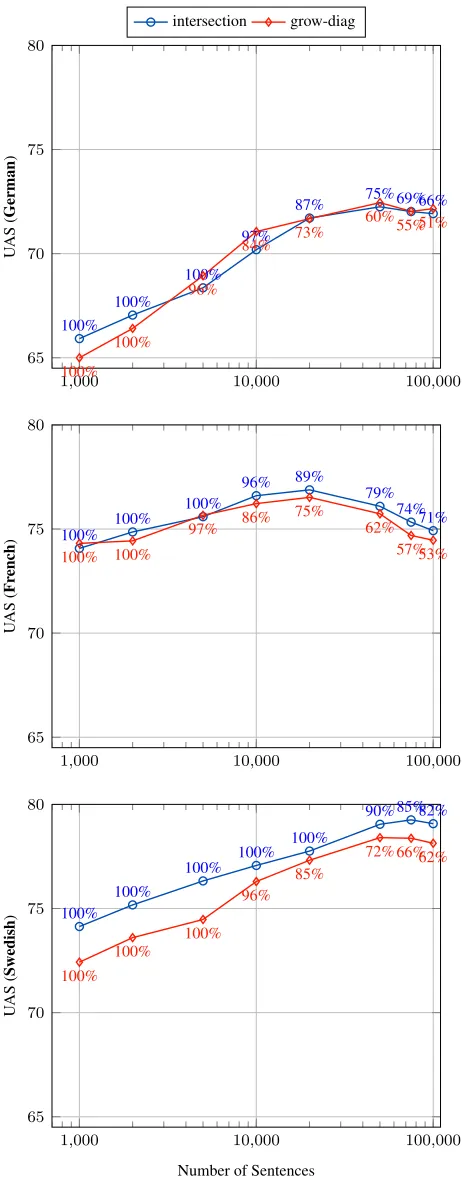
The results for French, German and Swedish are presented respectively in Figure 1. Similar curves are obtained for Italian and Spanish. These results show that adding partially annotated sentences im-proves parsing performance as long as these sen-tences have enough attached tokens. For instance, in French (focusing on the scores obtained with the intersection heuristics), a parser trained only on fully labelled sentences achieves a UAS of 75.6%; when sentences in which more than 80% of dependencies are known are added, parsing performance is im-proved to 76.9%, but adding more sentences hurts performance. Indeed, sentences with a small num-ber of attached tokens correspond to sentence pairs with few alignment links that are often not perfect translation of each other and may have very differ-ent grammatical structures.
One can notice that, while the number of sen-tences needed to reach the top scores varies greatly from a language to another, the average percentage of attached token per sentence remains in a short in-terval (from 74.9 % (de) to 84.9 % (sv)). Adding more sparse data seems to bring more noise than rel-evant syntactic information. Controlling the quality of the projected data, over the quantity, is therefore a key point in the success of the transfer process. This observation justifies our decision to consider only sentences with more than 80% of attached tokens.
Finally, the scores obtained with the use of the heuristic of symetrization intersection are mostly higher than those obtained with the grow-diag heuristic. It is worth noting that the number of sen-tences fully annotated with the grow-diag heuristic is far less important than with the intersection. For instance in French, the training filtered data con-tains 21,381 sentences when the intersection tic is used, but only 6,534 for the grow-diag heuris-tic. Indeed, the number of projected dependencies is lower because multiple alignments impede the pro-jection of dependencies. This restrains the projec-tion of potentially wrong dependencies from am-biguous alignments but also the diversity of the
syn-1,000 10,000 100,000 65
70 75 80
100% 100%
100% 97%
87% 75%69%66%
100% 100%
96%
84% 73% 60%55%51%
U
AS
(
German
)
intersection grow-diag
1,000 10,000 100,000 65
70 75 80
100% 100%
100% 96%
89%
79% 74%71% 100% 100%
97% 86% 75% 62%
57%53%
U
AS
(
Fr
ench
)
1,000 10,000 100,000 65
70 75 80
100% 100%
100% 100%
100%
90%85%82%
100%
100% 100%
96% 85%
72%66%62%
Number of Sentences
U
AS
(
Swedish
[image:4.612.315.546.69.661.2])
tactic information transferred on the target language, and then the parsing performances. In the rest of the paper we will only consider the intersection heuris-tic.
This experiment shows that an appropriate selec-tion of the alignment strategy and thus of the pro-jected data used for learning could benefit the trans-fer scores of the methods that exploit (raw or even completed) partial data.
3.2 Pumping the parsing
It is well known that different techniques can boost parsing performance. For instance, clusters (Koo et al., 2008) may be used to reduce lexical sparse-ness, which is particularly appropriate in the case of dependency parser transfer since parallel data are generally not from the same domain as the corpus used to train and evaluate the parser. Another ap-proach for boosting parsing performance is the use of a beam-search strategy that reduces the number of search errors (Zhang and Nivre, 2012). In this sec-tion, we aim at assessing, first, how parsing perfor-mance of the source language impacts the quality of the transferred parser, and second, how using more ‘advanced’ parsing techniques may boost parsing in the target language.
Using a similar transfer process as in the previ-ous section, we conduct experiments in which the source and target parsers will be progressively en-riched: we consider, in a first experiment, a greedy parser to predict the dependencies of the source and target sentences; the source greedy parsers are then replaced by a beam-search parser and features de-scribing Brown clusters learned from the Europarl data are added. Finally, we also consider a beam-search parser for parsing the target language, us-ing our own implementation of the transition based parser presented in Section 2.2 with a beam size of 8, and enrich it with Brown clusters.
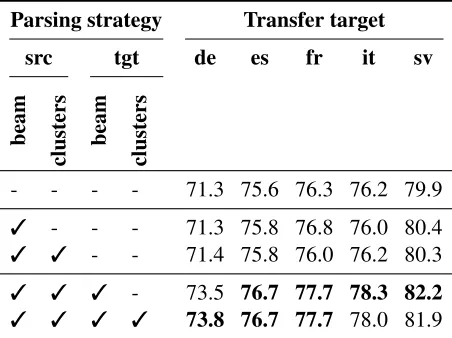
The transfer scores are presented in Table 2. First, these results show that the alignments are not good enough to reflect improvements in (source) parsing quality on the target data: the use of beam-search on parsing the source language allows an average im-provement of 0.2 UAS point on the target languages, while the source (English) performance is improved by 2.3. The use of clusters does not improve the
Parsing strategy Transfer target src tgt de es fr it sv
beam
clusters beam clusters
- - - - 71.3 75.6 76.3 76.2 79.9
3 - - - 71.3 75.8 76.8 76.0 80.4
3 3 - - 71.4 75.8 76.0 76.2 80.3
3 3 3 - 73.5 76.7 77.7 78.3 82.2
[image:5.612.314.540.72.241.2]3 3 3 3 73.8 76.7 77.7 78.0 81.9
Table 2:Transfer results according to the parsing strategy used on the source and target data. Evaluation, in UAS, on Gold PoS-tagged data.
average score, nor the source parsing performance.6
However, the beam-search strategy is surely useful for parsing the projected target languages: scores are, on average, 1.34 higher. The use of clusters is not interesting: only German performance is im-proved (+0.3) while Italian and Swedish are both negatively impacted (−0.3for both).
We have observed that the use of clusters is mostly useless in any case and, globally, that boost-ing the source parsboost-ing performance have very little effect on transfer final scores. However, not sur-prisingly, the use of beam-search for parsing the tar-get data is highly effective for boosting the transfer scores.
3.3 Multisource impact
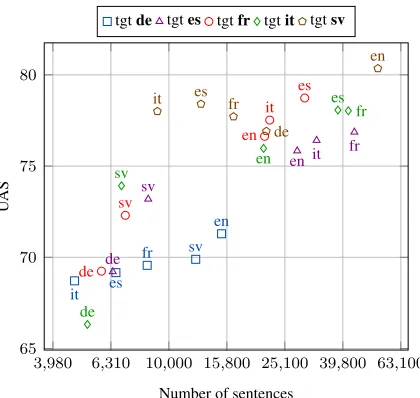
We have seen in Section 3.1 that filtering the pro-jected data is a key point to achieve good transfer scores, as adding too much data for learning reduces the parsing performance. However, for a similar per-centage of attached token, the number of sentences kept for learning varies a lot depending on the tar-get language. For instance, when transferring from English, the number of sentences having more than 80% dependencies reaches 52,554 for Swedish but only 15,191 for German; the parsing scores differ greatly as well: their UAS is, respectively, 81.9 and 73.8. Spanish, Italian and French achieve relatively
3,980 6,310 10,000 15,800 25,100 39,800 63,100 65
70 75 80
en
es fr
it
sv
de
en it fr sv
de
en es it
sv
de
en
es fr
sv
de
en es
fr it
Number of sentences
U
AS
[image:6.612.77.287.69.268.2]tgtde tgtes tgtfr tgtit tgtsv
Figure 2:Results of the multi-lingual transfer depending on the number of sentences saved for learning. The label of each node indicates the source language and its color the target language.
close scores for the same order of number of sen-tences (around 20/30K).
These observations show that there is a correlation between the number of dependencies transferred and the parsing performance: the more filtered sentences there are the better the scores are. A natural way to increase the number of sentences with a high num-ber of dependencies is to transfer dependencies from different languages: good projections result from good word alignments, that depend on source and target languages at stake.
We conduct multi-lingual experiments, similar to the experiments from English, in which each lan-guage (among German, Spanish, French, Italian and Swedish) is considered as the source language for the other ones. We consider as a parallel corpora a subset of the Europarl corpus (as detailed in Sec-tion 2.3). The sentences are filtered as previously after the dependencies have been transferred across alignment links. All reported results are achieved by a greedy parser considering gold PoS-tagged data.
The results of this multi-lingual experiment are presented in Figure 2, with, for every source lan-guage, the number of sentences that survived filter-ing.7 These results show that, for each target
guage, the best score is achieved for the source
lan-7It is important to note that the number of sentences is pro-portional to the number of dependencies.
guage with the largest training set (which is: En-glish for German and Swedish, French for Spanish and Italian, and Spanish for French). With the ex-ception of Swedish, for a given target language, the UAS is proportional to the number of sentences, re-gardless of the source parsing performance.8 As
ex-pected, languages from the same family, such as the ones derived from Latin (Spanish, French and Ital-ian), are beneficial for each other. This observation has already been reported several times (e.g. by Mc-Donald et al. (2013)), but Figure 2 suggests that the increase in performance may mainly result from a good alignment between the source and the target languages. Overall, these results stress the fact that the alignment quality has a large impact on the trans-fer performance and should not be neglected.
As seen in the previous section, the source pars-ing performance does not appear to be the parame-ter having the greatest impact on transfer. The qual-ity of the alignment deriving from the choice of the source language is quite crucial.
3.4 Transfer vs Supervised Parsing
Cross-lingual transfer strategies are mainly used with the aim of developing swiftly NLP tools for resource-poor languages without the need of an-notated corpora that are expensive to build from scratch. Results presented in the previous sections show that parsers trained on transferred data are still outperformed by supervised parsers. It is however difficult to evaluate how prejudicial this loss is. That is why, to assess the usefulness of transfer methods, we propose to determine the amount of gold anno-tated sentences needed to achieve performance sim-ilar to the performance of transferred parsers.
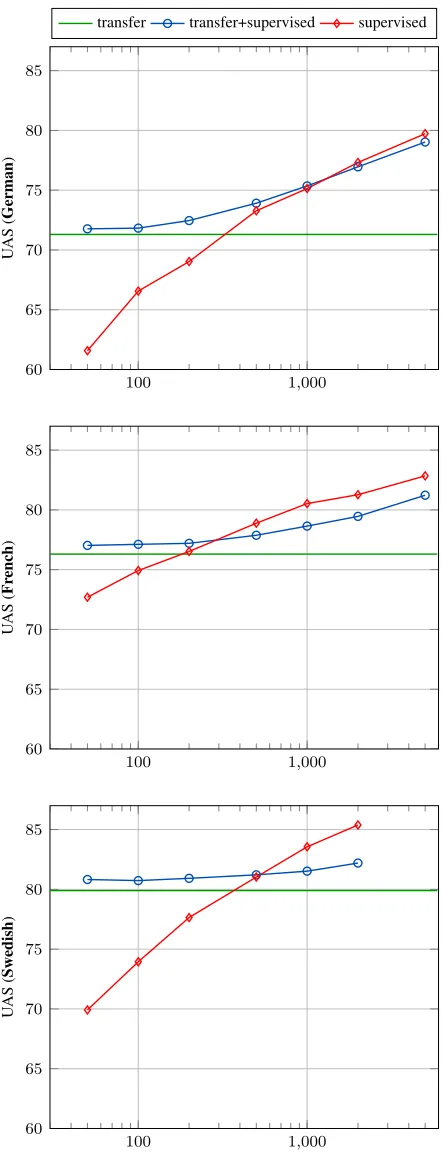
In a first series of experiments, we compare the performance of a cross-lingual dependency parser to supervised parsers learned from increasing amount of data (starting with 50 sentences). All the experi-ments are performed on 10 runs to mitigate the im-pact of selecting labelled data randomly, using the greedy version of the parser. Scores are evaluated on gold PoS-tagged data. The results, presented in Figure 3,9 show that the amount of supervised 8The source performances obtained with the MateParser (predicted PoS-tags) are: 92.4 (en), 80.4 (de), 83.1 (es), 83.8 (fr), 84.2 (it) and 85.7 (sv).
data needed to achieve transfer scores are respec-tively around 250, 200 and 400 sentences for Ger-man, French and Swedish. This observation strongly question the interest of cross-lingual transfer: only a very limited amount of annotated data is required to outperform a parser trained on transferred annota-tions.
Wisniewski et al. (2014) show that the perfor-mance difference between a supervised and trans-ferred PoS taggers partially results from divergences in annotation conventions and from evaluating the tagger on out-of-domain data: as in the setting de-scribed in Section 2, the taggers are trained on Eu-roparl and evaluated on UDT. To assess the impact on parsing performance of this two elements, we propose, in a second series of experiments, to en-rich the data labelled automatically by transferring annotations with an increasing amount of in-domain labelled data to learn new parsers.
Results of this experiments are presented in Fig-ure 3. They show that a small amount of supervised data ('300 sentences) provide useful information to projected data for parsing target languages: the performance of a parsers trained on the combination of transferred and labelled data outperforms both a parser trained on the labelled data only and a parser trained only on the transferred data. However above a specific threshold projected data become useless, and worse, adding them to labelled data hurts pars-ing performance. This could mean that the projected data, do not just lack syntactic diversity but also con-tain substantial amount of projection errors, even if the alignments have been filtered with very conser-vative rules.
3.5 Label scores and frequencies
The previous experiments suggest that cross-lingual parsers suffer from alignment errors (or from their absence) even if the alignments are filtered (re-stricted to 1:1and PoS-coherent links). To reveal systematic syntactic errors, we propose to examine the transfer scores depending on the (gold) syntactic label of the dependency. Our hypothesis is that the UAS of a given target label depends both on the ca-pacity of the source parser to predict this label and on the ability of the transfer method to project the syntactic information. For the sake of clarity, we only report results for English to French transfer.
100 1,000
60 65 70 75 80 85
U
AS
(
German
)
transfer transfer+supervised supervised
100 1,000
60 65 70 75 80 85
U
AS
(
Fr
ench
)
100 1,000
60 65 70 75 80 85
Number of supervised sentences for learning
U
AS
(
Swedish
[image:7.612.316.537.68.647.2])
Table 3 shows10the frequencies of the labels
pre-dicted by a supervised parser on the English and French EUROPARL corpora as well as the
frequen-cies of these labels on the French projected (from English) and filtered data. It appears that the fre-quencies of the labels tend to look like the source frequencies, introducing a systematic bias in the data used to train a cross-lingual parser. In par-ticular, some dependencies, such as the root, are over-projected but no label is entirely skipped. The syntactic information are quite proportionally trans-ferred. Table 3 also reported the supervised UAS of these labels for English and French, as well as the UAS of the transferred parser for French. We ob-serve that the prediction of each label suffers from transfer: each score is generally lower than the (source or target) supervised score. One can also no-tice that over-projection do not benefit label scores. Overall, it may suggest that projection errors are also quite proportionally transferred among the various labels.
Results of Table 3 also suggest that the capacity of the source parser to predict a given kind of depen-dency has not much impact on the performance of the target parser. For instance, theADPOBJandDET
are both very well predicted by the English parser, but the prediction of the cross-lingual French parser are far better forDETthan forADPOBJ
Similar scores and frequencies are observed for different pair of source-target languages. In addi-tion, it is worth noting that we observe comparable behaviour when scores are computed depending on the PoS of the tokens. Frequencies are relatively well preserved and the loss in UAS is shared among the PoS tags.
4 Conclusion
We have proposed to apply a simple method that learns transferred dependency parsers from partially projected data with the aim of analyzing the vari-ous parameters that impact the parsing performance. Our observations are valid for many methods of de-pendency transfer that operates on annotations (par-tially) projected via alignments links.
We have shown that the selection of the
align-10We are only considering the most frequent labels. The fre-quency of all ignored labels is less than 1%.
label frequencies (%) UAS(%)
parsed tr. sup. tr. fr en fr en fr fr
adpmod 14.5 10.9 9.9 83.5 78.8 70.0 adpobj 13.2 10.7 9.8 95.4 92.2 85.1 det 13.3 10.4 12.9 96.9 96.6 95.3 nsubj 6.2 7.1 8.8 90.4 88.3 81.8 amod 6.0 5.9 6.7 94.1 92.1 88.2 root 3.3 3.6 8.4 89.8 78.0 71.3 dobj 4.9 4.2 4.8 92.4 91.6 86.2 advmod 3.4 4.3 4.2 83.5 74.2 71.5 conj 3.3 3.3 2.8 69.7 57.3 49.5 cc 2.7 3.2 2.8 75.2 62.9 54.3 Table 3:English-to-French transfer scores per dependency la-bel and frequencies of these lala-bels in the Europarl corpus, parsed and transferred (tr.). Supervised (sup.) scores for the source and target languages are also reported.
ments (thus the dependencies) and the filtering of the projected data are crucial. The quantity of pro-jected data used for learning is not relevant if qual-ity is not controlled. However, the quantqual-ity of train-ing data is correlated to the parstrain-ing performance, as quantity is rather a consequence of the quality of the alignments. Finally, the quality of alignment greatly depends on the relation shared between the source and target languages. It appear that all these choices are far more important that the quality of the source parsing.
Acknowledgments
This work has been partly funded by a DGA-RAPID project under grant agreement N.o1429060465
(Pa-pyrus). We thank the reviewers for their accurate comments and suggestions.
References
Lauriane Aufrant and Guillaume Wisniewski. 2016. PanParser: a Modular Implementation for Efficient Transition-Based Dependency Parsing. Technical re-port, LIMSI-CNRS, March.
Bernd Bohnet and Joakim Nivre. 2012. A transition-based system for joint part-of-speech tagging and la-beled non-projective dependency parsing. In Proceed-ings of the 2012 Joint Conference on Empirical Meth-ods in Natural Language Processing and Computa-tional Natural Language Learning, pages 1455–1465, Jeju Island, Korea, July. Association for Computa-tional Linguistics.
Shay B. Cohen, Dipanjan Das, and Noah A. Smith. 2011. Unsupervised Structure Prediction with Non-Parallel Multilingual Guidance. In Proceedings of EMNLP 2011, the Conference on Empirical Methods in Nat-ural Language Processing, pages 50–61, Edinburgh, Scotland, UK., July.
Yoav Goldberg and Joakim Nivre. 2012. A Dynamic Or-acle for Arc-Eager Dependency Parsing. In Proceed-ings of COLING 2012, the International Conference on Computational Linguistics, pages 959–976, Bom-bay, India.
Rebecca Hwa, Philip Resnik, A.Weinberg, C. Cabezas, and O. Kolak. 2005. Bootstrapping Parsers via Syn-tactic Projection accross Parallel Texts. Natural lan-guage engineering, 11:311–325.
Terry Koo, Xavier Carreras P´erez, and Michael Collins. 2008. Simple Semi-supervised Dependency Parsing. InProceedings of the 46th Annual Meeting of the As-sociation for Computational Linguistics, pages 595– 603.
Oph´elie Lacroix, Lauriane Aufrant, Guillaume Wis-niewski, and Franc¸ois Yvon. 2016. Frustratingly easy cross-lingual transfer for transition-based depen-dency parsing. InThe 15th Annual Conference of the North American Chapter of the Association for Com-putational Linguistics: Human Language Technolo-gies, NAACL 2016, San Diego, California, USA. Zhenghua Li, Min Zhang, and Wenliang Chen. 2014.
Soft Cross-lingual Syntax Projection for Dependency Parsing. In Proceedings of COLING 2014, the 25th International Conference on Computational Linguis-tics: Technical Papers, pages 783–793, Dublin,
Ire-land. Dublin City University and Association for Com-putational Linguistics.
Xuezhe Ma and Fei Xia. 2014. Unsupervised depen-dency parsing with transferring distribution via paral-lel guidance and entropy regularization. In Proceed-ings of the 52nd Annual Meeting of the Association for Computational Linguistics (Volume 1: Long Papers), pages 1337–1348, Baltimore, Maryland, June. David Mareˇcek. 2011. Combining Diverse
Word-Alignment Symmetrizations Improves Dependency Tree Projection. InComputational Linguistics and In-telligent Text Processing, pages 144–154. Springer. Ryan McDonald, Slav Petrov, and Keith Hall. 2011.
Multi-source Transfer of Delexicalized Dependency Parsers. InProceedings of EMNLP 2011, the Confer-ence on Empirical Methods in Natural Language Pro-cessing, pages 62–72.
Ryan McDonald, Joakim Nivre, Yvonne Quirmbach-Brundage, Yoav Goldberg, Dipanjan Das, Kuzman Ganchev, Keith Hall, Slav Petrov, Hao Zhang, Oscar T¨ackstr¨om, Claudia Bedini, N´uria Bertomeu Castell´o, and Jungmee Lee. 2013. Universal Dependency An-notation for Multilingual Parsing. InProceedings of ACL 2013, the 51st Annual Meeting of the Associa-tion for ComputaAssocia-tional Linguistics (Volume 2: Short Papers), pages 92–97, Sofia, Bulgaria, August. Tahira Naseem, Harr Chen, Regina Barzilay, and Mark
Johnson. 2010. Using Universal Linguistic Knowl-edge to Guide Grammar Induction. InProceedings of EMNLP 2010, the Conference on Empirical Methods in Natural Language Processing, pages 1234–1244, Stroudsburg, PA, USA.
Rudolf Rosa, Shadi Saleh, Sebastian Schuster, Wolf-gang Seeker, Mojgan Seraji, Natalia Silveira, Maria Simi, Radu Simionescu, Katalin Simk´o, Kiril Simov, Aaron Smith, Jan ˇStˇep´anek, Alane Suhr, Zsolt Sz´ant´o, Takaaki Tanaka, Reut Tsarfaty, Sumire Uematsu, Lar-raitz Uria, Viktor Varga, Veronika Vincze, Zdenˇek ˇZabokrtsk´y, Daniel Zeman, and Hanzhi Zhu. 2015. Universal dependencies 1.2. LINDAT/CLARIN digi-tal library at Institute of Formal and Applied Linguis-tics, Charles University in Prague.
Joakim Nivre. 2003. An Efficient Algorithm for Pro-jective Dependency Parsing. InProceedings of IWPT 2003, the 8th International Workshop on Parsing Tech-nologies, Nancy, France.
Franz Joseph Och and Hermann Ney. 2003. A system-atic comparison of various statistical alignment mod-els. Computational Linguistics, 29:19–51.
Mohammad Sadegh Rasooli and Michael Collins. 2015. Density-driven cross-lingual transfer of dependency parsers. In Proceedings of the 2015 Conference on Empirical Methods in Natural Language Processing, pages 328–338, Lisbon, Portugal, September. Associ-ation for ComputAssoci-ational Linguistics.
Anders Søgaard. 2011. Data point selection for cross-language adaptation of dependency parsers. In Pro-ceedings of ACL 2011, the 49th Annual Meeting of the Association for Computational Linguistics: Hu-man Language Technologies, pages 682–686, Port-land, Oregon, USA, June.
Kathrin Spreyer and Jonas Kuhn. 2009. Data-Driven Dependency Parsing of New Languages Using Incom-plete and Noisy Training Data. In Proceedings of CoNLL 2009, the Thirteenth Conference on Compu-tational Natural Language Learning, pages 12–20, Boulder, Colorado, June.
Oscar T¨ackstr¨om, Ryan McDonald, and Joakim Nivre. 2013. Target Language Adaptation of Discriminative Transfer Parsers. In Proceedings of ACL 2013, the Conference of the North American Chapter of the As-sociation for Computational Linguistics: Human Lan-guage Technologies, pages 1061–1071, Atlanta, Geor-gia.
J¨org Tiedemann. 2014. Rediscovering Annotation Pro-jection for Cross-Lingual Parser Induction. In Pro-ceedings of COLING 2014, the 25th International Conference on Computational Linguistics: Technical Papers, pages 1854–1864, Dublin, Ireland, August. Dublin City University and Association for Computa-tional Linguistics.
Guillaume Wisniewski, Nicolas P´echeux, Souhir Gahbiche-Braham, and Franc¸ois Yvon. 2014. Cross-lingual part-of-speech tagging through ambiguous learning. In Proceedings of the 2014 Conference on
Empirical Methods in Natural Language Processing (EMNLP), pages 1779–1785, Doha, Qatar, October. Daniel Zeman and Philip Resnik. 2008. Cross-Language
Parser Adaptation between Related Languages. In
Proceedings of the IJCNLP-08 Workshop on NLP for Less Privileged Languages, pages 35–42, Hyderabad, India, January. Asian Federation of Natural Language Processing.
Yue Zhang and Joakim Nivre. 2011. Transition-based Dependency Parsing with Rich Non-local Features. In Proceedings of ACL 2011, the 49th Annual Meet-ing of the Association for Computational LMeet-inguistics: Human Language Technologies, pages 188–193, Port-land, Oregon, USA, June. Association for Computa-tional Linguistics.