Proceedings of NAACL-HLT 2018, pages 1146–1155
Cross-lingual Abstract Meaning Representation Parsing
Marco Damonte Shay B. Cohen School of Informatics, University of Edinburgh
10 Crichton Street, Edinburgh EH8 9AB, UK
[email protected] [email protected]
Abstract
Abstract Meaning Representation (AMR) re-search has mostly focused on English. We show that it is possible to use AMR annota-tions for English as a semantic representation for sentences written in other languages. We exploit an AMR parser for English and paral-lel corpora to learn AMR parsers for Italian, Spanish, German and Chinese. Qualitative analysis show that the new parsers overcome structural differences between the languages. We further propose a method to evaluate the parsers that does not require gold standard data in the target languages. This method highly correlates with the gold standard evaluation, obtaining a (Pearson) correlation of 0.95.
1 Introduction
Abstract Meaning Representation (AMR) parsing is the process of converting natural language sen-tences into their corresponding AMR representa-tions (Banarescu et al.,2013). An AMR is a graph with nodes representing the concepts of the sen-tence and edges representing the semantic rela-tions between them. Most available AMR datasets large enough to train statistical models consist of pairs of English sentences and AMR graphs.
The cross-lingual properties of AMR across languages has been the subject of preliminary dis-cussions. The AMR guidelines state that AMR is not an interlingua (Banarescu et al.,2013) and Bojar (2014) categorizes different kinds of diver-gences in the annotation between English AMRs and Czech AMRs. Xue et al. (2014) show that structurally aligning English AMRs with Czech and Chinese AMRs is not always possible but that refined annotation guidelines suffice to re-solve some of these cases. We extend this line of research by exploring whether divergences among languages can be overcome, i.e., we investigate
This is the sovereignty of each country
sovereignty
country this
each
Questa `e la sovranit`a di ogni paese
:poss :domain
[image:1.595.323.500.224.374.2]:mod
Figure 1: AMR alignments for a English sentence and its Italian translation.
whether it is possible to maintain the AMR an-notated for English as a semantic representation for sentences written in other languages, as in Fig-ure1.
We implement AMR parsers for Italian, Span-ish, German and Chinese using annotation pro-jection, where existing annotations are projected from a source language (English) to a target lan-guage through a parallel corpus (e.g., Yarowsky et al., 2001; Hwa et al., 2005; Pad´o and Lapata, 2009;Evang and Bos, 2016). By evaluating the parsers and manually analyzing their output, we show that the parsers are able to recover the AMR structures even when there exist structural differ-ences between the languages, i.e., although AMR is not an interlingua it can act as one. This method also provides a quick way to prototype multilin-gual AMR parsers, assuming that Part-of-speech (POS) taggers, Named Entity Recognition (NER) taggers and dependency parsers are available for the target languages. We also propose an alterna-tive approach, where Machine Translation (MT) is used to translate the input sentences into En-glish so that an available EnEn-glish AMR parser can
be employed. This method is an even quicker so-lution which only requires translation models be-tween the target languages and English.
Due to the lack of gold standard in the target languages, we exploit the English data to evalu-ate the parsers for the target languages. Hence-forth, we will use the term target parser to indicate a parser for a target language. We achieve this by first learning the target parser from the gold stan-dard English parser, and then inverting this pro-cess to learn a new English parser from the tar-get parser. We then evaluate the resulting English parser against the gold standard. We call this “full-cycle” evaluation.
Similarly toEvang and Bos(2016), we also di-rectly evaluate the target parser on “silver” data, obtained by parsing the English side of a parallel corpus.
In order to assess the reliability of these evalua-tion methods, we collected gold standard datasets for Italian, Spanish, German and Chinese by ac-quiring professional translations of the AMR gold standard data to these languages. We hypothesize that the full-cycle score can be used as a more reli-able proxy than the silver score for evaluating the target parser. We provide evidence to this claim by comparing the three evaluation procedures (silver, full-cycle, and gold) across languages and parsers.
Our main contributions are:
• We provide evidence that AMR annotations can be successfully shared across languages.
• We propose two ways to rapidly implement non-English AMR parsers.
• We propose a novel method to evaluate
non-English AMR parsers when gold annotations in the target languages are missing. This method highly correlates with gold standard evaluation, obtaining a Pearson correlation coefficient of 0.95.
• We release human translations of an AMR dataset (LDC2015E86) to Italian, Spanish, German and Chinese.
2 Cross-lingual AMR parsing
AMR is a semantic representation heavily bi-ased towards English, where labels for nodes and edges are either English words or Propbank frames (Kingsbury and Palmer,2002). The goal of AMR is to abstract away from the syntactic realization
of the original sentences while maintaining its un-derlying meaning. As a consequence, different phrasings of one sentence are expected to provide identical AMR representations. This canonicaliza-tion does not always hold across languages: two sentences that express the same meaning in two different languages are not guaranteed to produce identical AMR structures (Bojar,2014;Xue et al., 2014). However, Xue et al.(2014) show that in many cases the unlabeled AMRs are in fact shared across languages. We are encouraged by this find-ing and argue that it should be possible to develop algorithms that account for some of these differ-ences when they arise. We therefore introduce a new problem, which we call cross-lingual AMR parsing: given a sentence in any language, the goal is to recover the AMR graph that was originally devised for its English translation. This task is harder than traditional AMR parsing as it requires to recover English labels as well as to deal with structural differences between languages, usually referred as translation divergence. We propose two initial solutions to this problem: by annota-tion projecannota-tion and by machine translaannota-tion.
2.1 Method 1: Annotation Projection
AMR is not grounded in the input sentence, there-fore there is no need to change the AMR anno-tation when projecting to another language. We think of English labels for the graph nodes as ones from an independent language, which incidentally looks similar to English. However, in order to train state-of-the-art AMR parsers, we also need to project the alignments between AMR nodes and words in the sentence (henceforth called AMR alignments). We use word alignments, similarly to other annotation projection work, to project the AMR alignments to the target languages.
assump-tion is:
∀i, j, v tj ∈W(si)∧v∈As(si)⇒v∈At(tj)
In the example of Figure 1, Questa is word-aligned withThisand therefore AMR-aligned with the node this, and the same logic applies to the other aligned words. The words is, the and of
do not generate any AMR nodes, so we ignore their word alignments. We apply this method to project existing AMR annotations to other lan-guages, which are then used to train the target parsers.
2.2 Method 2: Machine Translation
We invoke an MT system to translate the input sen-tence into English so that we can use an available English parser to obtain its AMR graph. Naturally, the quality of the output graph depends on the quality of the translations. If the automatic trans-lation is close to the reference transtrans-lation, then the predicted AMR graph will be close to the refer-ence AMR graph. It is therefore evident that this method is not informative in terms of the cross-lingual properties of AMR. However, its simplic-ity makes it a compelling engineering solution for parsing other languages.
2.3 Evaluation
We now turn to the problem of evaluation. Let us assume that we trained a parser for a target lan-guage, for example using the annotation projec-tion method discussed in Secprojec-tion2.1. In line with rapid development of new parsers, we assume that the only gold AMR dataset available is the one re-leased for English.
SILVER We can generate a silver test set by
running an automatic (English) AMR parser on the English side of a parallel corpus and use the output AMRs as references. However, the silver test set is affected by mistakes made by the English AMR parser, therefore it may not be reliable.
FULL-CYCLE In order to perform the
evalua-tion on a gold test set, we propose full-cycle eval-uation: after learning the target parser from the English parser, we invert this process to learn a new English parser from the target parser, in the same way that we learned the target parser from the English parser. The resulting English parser is then evaluated against the (English) AMR gold standard. We hypothesize that the score of the new
English parser can be used as a proxy to the score of the target parser.
GOLD To show whether the evaluation methods proposed can be used reliably, we also generated gold test AMR datasets for four target languages (Italian, Spanish, German and Chinese). In order to do so, we collected professional translations for the English sentences in the AMR test set.1 We
were then able to create pairs of human-produced sentences with human-produced AMR graphs.
A diagram summarizing the different evaluation stages is shown in Figure 2. In the case of MT-based systems, the full-cycle corresponds to first translating from English to the target language and then back to English (back-translation), and only then parsing the sentences with the English AMR parser. At the end of this process, a noisy version of the original sentence will be returned and its parsed graph will be a noisy version of the graph parsed from the original sentence.
3 Experiments
We run experiments on four languages: Italian, Spanish, German and Chinese. We use Europarl (Koehn, 2005) as the parallel corpus for Italian, Spanish and German, containing around 1.9M sentences for each language pair. For Chinese, we use the first 2M sentences from the United Nations Parallel Corpus (Ziemski et al., 2016). For each target language we extract two paral-lel datasets of 20,000/2,000/2,000 (train/dev/test) sentences for the two step of the annotation pro-jection (English →target and target → English).
These are used to train the AMR parsers. The pro-jection approach also requires training the word alignments, for which we use all the remaining sentences from the parallel corpora (Europarl for Spanish/German/Italian and UN Parallel Corpus for Chinese). These are also the sentences we use to train the MT models. The gold AMR dataset is LDC2015E86, containing 16,833 training sen-tences, 1,368 development sensen-tences, and 1,371 testing sentences.
Word alignments were generated using fast align (Dyer et al., 2013), while AMR align-ments were generated with JAMR (Flanigan et al., 2014). AMREager (Damonte et al., 2017) was chosen as the pre-existing English AMR parser. AMREager is an open-source AMR parser that
1These datasets are currently available upon request from
Golde Silverf Goldf
Parser e Parser f
Parser e FULL-CYCLE
Ref
Eval
SILVER Ref Eval
GOLD Ref
[image:4.595.90.505.58.184.2]Eval
Figure 2: Description of SILVER, FULL-CYCLE and GOLD evaluations. estands for English andf stands for the target (foreign) language. Dashed lines represent the process of transferring learning across languages (e.g. with annotation projection). SILVER uses a parsed parallel corpus as reference (“Ref”), FULL-CYCLE uses the English gold standard (Golde) and GOLD uses the target language gold standard we collected (Silverf).
needs only minor modifications for re-use with other languages.2 It requires tokenization, POS
tagging, NER tagging and dependency parsing, which for English, German and Chinese are provided by CoreNLP (Manning et al.,2014). We use Freeling (Carreras et al.,2004) for Spanish, as CoreNLP does not provide dependency parsing for this language. Italian is not supported in CoreNLP: we use Tint (Aprosio and Moretti, 2016), a CoreNLP-compatible NLP pipeline for Italian.
In order to experiment with the approach of Sec-tion 2.2, we experimented with translations from Google Translate.3 As Google Translate has
ac-cess to a much larger training corpus, we also trained baseline MT models using Moses (Koehn et al.,2007) and Nematus (Sennrich et al.,2017), with the same training data we use for the projec-tion method and default hyper-parameters.
Smatch (Cai and Knight,2013) is used to eval-uate AMR parsers. It looks for the best align-ment between the predicted AMR and the refer-ence AMR and it then computes precision, re-call and F1 of their edges. The original English
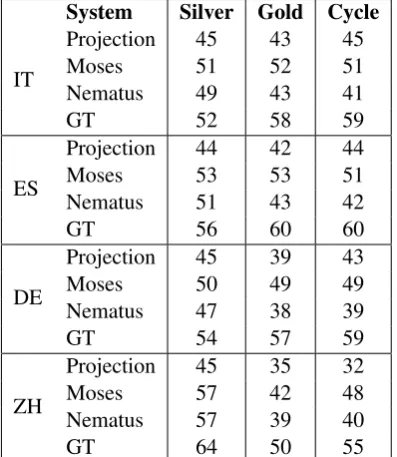
parser achieves 65% Smatch score on the test split of LDC2015E86. Full-cycle and gold evaluations use the same dataset, while silver evaluation is performed on the split of the parallel corpora we reserved for testing. Results are shown in Ta-ble1. The Google Translate system outperforms all other systems, but is not directly comparable to them, as it has the unfair advantage of being
2The multilingual adaptation of AMREager is
avail-able at http://www.github.com/mdtux89/
amr-eager-multilingual. A demo is available at
http://cohort.inf.ed.ac.uk/amreager.html.
3https://translate.google.com/toolkit.
System Silver Gold Cycle
IT
Projection 45 43 45
Moses 51 52 51
Nematus 49 43 41
GT 52 58 59
ES
Projection 44 42 44
Moses 53 53 51
Nematus 51 43 42
GT 56 60 60
DE
Projection 45 39 43
Moses 50 49 49
Nematus 47 38 39
GT 54 57 59
ZH
Projection 45 35 32
Moses 57 42 48
Nematus 57 39 40
GT 64 50 55
Table 1: Silver, gold and full-cycle Smatch scores for projection-based and MT-based systems.
trained on a much larger dataset. Due to noisy JAMR alignments and silver training data involved in the annotation projection approach, the MT-based systems give in general better parsing re-sults. The BLEU scores of all translation systems are shown in Table2.
[image:4.595.318.517.262.491.2]Model Moses Nematus GT
EN-IT 23.83 21.27 61.31 IT-EN 23.74 19.77 42.20 EN-ES 29.00 26.14 78.14 ES-EN 27.66 21.63 50.78 EN-DE 15.47 15.74 63.48 DE-EN 21.50 14.96 41.78
EN-ZH 9.19 8.67 26.75
[image:5.595.94.271.60.186.2]ZH-EN 10.81 10.37 22.21
Table 2: BLEU scores for Moses, Nematus and Google Translate (GT) on the (out-of-domain) LDC2015E86 test set
4 Qualitative Analysis
Figure 3 shows examples of output parses4 for
all languages, including the AMR alignments by-product of the parsing process, that we use to dis-cuss the mistakes made by the parsers.
In the Italian example, the only evident error is that Infine (Lastly) should be ignored. In the Spanish example, the word medida (measure) is wrongly ignored: it should be used to generate a child of the nodeimpact-01. Some of the:ARG
roles are also not correct. In the German exam-ple, meines (my) should reflect the fact that the speaker is talking about his own country. Finally, in the Chinese example, there are several mistakes including yet another concept identification mis-take:intend-01is erroneously triggered.
Most mistakes involve concept identification. In particular, relevant words are often erroneously ig-nored by the parser. This is directly related to the problem of noisy word alignments in annota-tion projecannota-tion: the parser learns what words are likely to trigger a node (or a set of nodes) in the AMR by looking at their AMR alignments (which are induced by the word alignments). If an im-portant word consistently remains unaligned, the parser will erroneously learn to discard it. More accurate alignments are therefore crucial in order to achieve better parsing results. We computed the percentage of words in the training data that are learned to be non-content-bearing in each parser and we found that the Chinese parser, which is our least accurate parser, is the one that most suffer from this, with 33% non-content-bearing words. On the other hand, in the German parser, which is the highest scoring, only 26% of the words are
4In this section, all parsed graphs were generated with the
projection-based system of Section2.1.
non-content-bearing, which is the lowest percent-age amongst all parsers.
4.1 Translational Divergence
In order to investigate the hypothesis that AMR can be shared across these languages, we now look at translational divergence and discuss how it affects parsing, following the classification used in previous work (Dorr et al.,2002;Dorr,1994), which identifies classes of divergences for several languages. Sulem et al. (2015) also follow the same categorization for French.
Figure 4 shows six sentences displaying these divergences. The aim of this analysis is to as-sess how the parsers deal with the different kind of translational divergences, regardless of the overall quality of the output.
Categorical. This divergence happens when two
languages use different POS tags to express the same meaning. For example, the English sentence
I am jealous of youis translated into Spanish as
Tengo envidia de ti(I have jealousy of you). The English adjectivejealousis translated in the Span-ish nounenvidia. In Figure4a we note that the cat-egorical divergence does not create problems since the parsers correctly recognized thatenvidia( jeal-ousy/envy) should be used as the predicate, regard-less of its POS.
Conflational. This divergence happens when
verbs expressed in a language with a single word can be expressed with more words in another lan-guage. Two subtypes are distinguished: manner
and light verb. Manner refers to a manner verb that is mapped to a motion verb plus a manner-bearing word. For example, We will answer is translated in the Italian sentenceNoi daremo una riposta(We will give an answer), whereto answer
is translated asdaremo una risposta(will give an answer). Figure 4b shows that the Italian parser generates a sensible output for this sentence by creating a single node labeled answer-01for the expressiondare una riposta.
adopt-01
date-entity
commission
communicate-01
1998
final another
Infine,
Lastly, nelin 1998,1998, lathe CommissionCommissione hahave adottatoadopted un’altraanother comunicazionecommunication Lastly, in 1998, the Commission adopted a further communication
:ARG0
:time :ARG1
:year
:mod :ARG0 :mod
assess-01
impact-01
type export-01
this cocoa
Una
One evaluaci´onevaluation deof elthe impactoimpact deof unaa medidameasure deof estethis tipotype sobreon lasthe exportacionesexports deof cacaococoa A study into the impact of such a measure on the export of cocoa
:ARG1
:ARG1 :ARG1
:mod :ARG0 :ARG1
do-02
country
state
-many
have-org-role-91
member
Viele
Lots Mitgliedsl¨ander,Member State, inklusiveincluded meinesmy eigenenown Landes,country, habenhave diesthis nichtnot getandone Many Member States, including my own, did not do as required
:location :polarity
:ARG0
:ARG0-of :quant
:ARG2
and
intend-01 society repatriate-01
refugee
:op2 :op2 :op1
:ARG1
n´an m´ın
[image:6.595.93.503.167.704.2]refugee d´ıof qiˇan fˇanrepatriation h´eand zh`ong x¯inre- r´ong r´uassimilate into sh`e hu`ısociety Repatriation and reintegration of Malian refugees
Structural. This divergence happens when verb arguments result in different syntactic configura-tions, for example, due to an additional PP attach-ment. When translatingHe entered the housewith
Lui `e entrato nella casa(He entered in the house), the Italian translation has an additionalin prepo-sition. Also this parsed graph, in Figure 4c, is structurally correct. The missing node he is due to pronoun-dropping, which is frequent in Italian.
Head swapping. This divergence occurs when
the direction of the dependency between two words is inverted. For example, I like eating, wherelikeis head ofeating, becomesIch esse gern
(I eat likingly) in German, where the dependency is inverted. Unlike all other examples, in this case, the German parser does not cope well with this di-vergence: it is unable to recognize like-01as the main concept in the sentence, as shown in Fig-ure4d.
Thematic. Finally, the parse of Figure 4f has
to deal with a thematic divergence, which hap-pens when the semantic roles of a predicate are inverted. In the sentence I like grapes, translated to Spanish asMe gustan uvas, I is the subject in English whileMe is the object in Spanish. Even though we note an erroneous reentrant edge be-tween grapeand I, the thematic divergence does not create problems: the parser correctly recog-nizes the:ARG0relationship betweenlike-01and
I and the:ARG1relationship betweenlike-01and
grape. In this case, the edge labels are important, as this type of divergence is concerned with the semantic roles.
5 Discussion
Can AMR be shared across these languages?
As mentioned in Section 2.2, the MT-based sys-tems are not helpful in answering this question and we instead focus on the projection-based parsers. Qualitative analysis showed that the parsers are able to overcome translational divergence and that concept identification must be more accurate in order to provide good parsing results. We there-fore argue that the suboptimal performance of the parsers in terms of Smatch scores is due to the many sources of noise in the annotation projection approach rather than instability of AMR across languages. We provide strong evidence that cross-lingual AMR parsing is indeed feasible and hope that the release of the gold standard test sets will
motivate further work in this direction.
Are silver and full-cycle evaluations reliable?
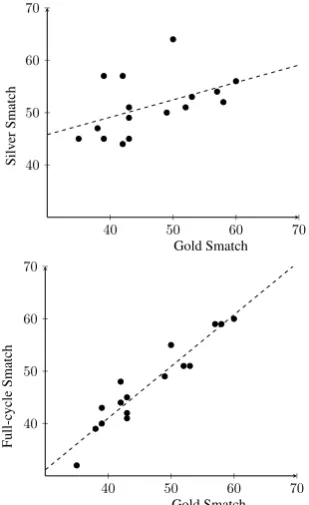
We computed the Pearson correlation coefficients for the Smatch scores of Table1to determine how well silver and full-cycle correlate with gold eval-uation. Full-cycle correlates better than silver: the Pearson coefficient is 0.95 for full-cycle and 0.47 for silver. Figure5shows linear regression lines. Unlike silver, full-cycle uses the same dataset as gold evaluation and it does not contain parsing mistakes, which makes it more reliable than silver. Interestingly, if we ignore the scores obtained for Chinese, the correlation between silver and gold dramatically increases, perhaps indicating that Eu-roparl is more suitable than the UN corpus for this task: the Pearson coefficient becomes 0.97 for full-cycle and 0.87 for silver. A good proxy for gold evaluation should rank different systems sim-ilarly. We hence computed the Kendall-tau score (Kendall,1945), a measure for similarity between permutations, of the rankings extracted from Table 1. The results further confirm that full-cycle ap-proximate gold better than silver does: the score is 0.40 for silver and 0.82 for full-cycle. Full cycle introduces additional noise but it is not as expen-sive as gold and is more reliable than silver.
6 Related Work
AMR parsing for languages other than English has made only a few steps forward. In previous work (Li et al., 2016; Xue et al., 2014; Bojar, 2014), nodes of the target graph were labeled with ei-ther English words or with words in the target lan-guage. We instead use the AMR annotation used for English for the target language as well, with-out translating any word. To the best of our knowl-edge, the only previous work that attempts to auto-matically parse AMR graphs for non-English sen-tences is byVanderwende et al.(2015). Sentences in several languages (French, German, Spanish and Japanese) are parsed into a logical represen-tation, which is then converted to AMR using a small set of rules. A comparison with this work is difficult, as the authors do not report results for the parsers (due to the lack of an annotated corpus) or release their code.
envy
I :domain
(a) ES: Tengo envidia de ti (I am jealous of you)
answer-01
we :ARG0
(b) IT: Noi daremo una risposta (We will answer)
enter-01
home :ARG1
(c) IT: Lui `e entrato nella casa (He entered the house)
eat-01
I :ARG0
(d) DE: Ich esse gern (I like eating)
fear-01
I I
:ARG0 :ARG0
(e) IT: Io ho paura (I fear)
like-01
I grape
:ARG1 :ARG0
:ARG0
[image:8.595.100.496.57.303.2](f) ES: Me gustan uvas (I like grapes)
Figure 4: Parsing examples in several languages involving common translational divergence phenomena: (a) con-tains a categorical divergence, (b) and (e) conflational divergences, (c) a structural divergence, (d) an head swapping and (f) a thematic divergence.
40 50 60 70
40 50 60 70
Gold Smatch
Silv
er
Smatch
40 50 60 70
40 50 60 70
Gold Smatch
Full-c
ycle
Smatch
Figure 5: Linear regression lines for silver and full-cycle.
work as it uses a projection mechanism similar to ours for CCG. A crucial difference is that, in order to project CCG parse trees to the target languages, they only make use of literal translation. Previ-ous work has also focused on assessing the
stabil-ity across languages of semantic frameworks such as AMR (Xue et al., 2014;Bojar,2014), UCCA (Sulem et al., 2015) and Propbank (Van der Plas et al.,2010).
Cross-lingual techniques can cope with the lack of labeled data on languages when this data is available in at least one language, usually English. The annotation projection method, which we fol-low in this work, is one way to address this prob-lem. It was introduced for POS tagging, base noun phrase bracketing, NER tagging, and inflectional morphological analysis (Yarowsky et al., 2001) but it has also been used for dependency parsing (Hwa et al., 2005), role labeling (Pad´o and Lap-ata,2009;Akbik et al.,2015) and semantic parsing (Evang and Bos,2016). Another common thread of cross-lingual work is model transfer, where parameters are shared across languages (Zeman and Resnik, 2008; Cohen and Smith, 2009; Co-hen et al.,2011;McDonald et al.,2011;Søgaard, 2011).
7 Conclusions
[image:8.595.103.258.374.627.2]lan-guages tested and that it is possible to overcome translational divergences. We further proposed a novel way to evaluate the target parsers that does not require manual annotations of the tar-get language. The full-cycle procedure is not lim-ited to AMR parsing and could be used for other cross-lingual problems in NLP. The results of the projection-based AMR parsers indicate that there is a vast room for improvements, especially in terms of generating better alignments. We encour-age further work in this direction by releasing pro-fessional translations of the AMR test set into four languages.
Acknowledgments
The authors would like to thank the three anony-mous reviewers and Sameer Bansal, Gozde Gul Sahin, Sorcha Gilroy, Ida Szubert, Esma Balkır, Nikos Papasarantopoulos, Joana Ribeiro, Shashi Narayan, Toms Bergmanis, Clara Vania, Yang Liu and Adam Lopez for their helpful comments. This research was supported by a grant from Bloomberg and by the H2020 project SUMMA, under grant agreement 688139.
References
Alan Akbik, Laura Chiticariu, Marina Danilevsky, Yunyao Li, Shivakumar Vaithyanathan, and Huaiyu Zhu. 2015. Generating high quality proposition banks for multilingual semantic role labeling. In
Proceedings of ACL.
Alessio Palmero Aprosio and Giovanni Moretti. 2016. Italy goes to stanford: a collection of corenlp mod-ules for italian. arXiv preprint arXiv:1609.06204.
Laura Banarescu, Claire Bonial, Shu Cai, Madalina Georgescu, Kira Griffitt, Ulf Hermjakob, Kevin Knight, Philipp Koehn, Martha Palmer, and Nathan Schneider. 2013. Abstract meaning representation for sembanking. Linguistic Annotation Workshop.
Zdenka Ureˇsov´a Jan Hajic Ondrej Bojar. 2014. Com-paring czech and english amrs. InWorkshop on Lex-ical and GrammatLex-ical Resources for Language Pro-cessing.
Shu Cai and Kevin Knight. 2013. Smatch: an evalua-tion metric for semantic feature structures. Proceed-ings of ACL.
Xavier Carreras, Isaac Chao, Llu´ıs Padr´o, and Muntsa Padr´o. 2004. Freeling: An open-source suite of lan-guage analyzers. InProceedings of LREC.
Silvie Cinkov´a, Josef Toman, Jan Hajic, Krist`yna Cerm´akov´a, V´aclav Klimeˇs, Lucie Mladov´a,
Jana ˇSindlerov´a, Krist`yna Tomˇsu, and Zdenek Zabokrtsk`y. 2009. Tectogrammatical annota-tion of the wall street. The Prague Bulletin of Mathematical Linguistics.
Shay B. Cohen, Dipanjan Das, and Noah A. Smith. 2011. Unsupervised structure prediction with non-parallel multilingual guidance. In Proceedings of EMNLP.
Shay B Cohen and Noah A Smith. 2009. Shared logis-tic normal distributions for soft parameter tying in unsupervised grammar induction. InProceedings of NAACL-HLT.
Marco Damonte, Shay B Cohen, and Giorgio Satta. 2017. An incremental parser for abstract meaning representation. InProceedings of EACL.
Bonnie J Dorr. 1994. Machine translation divergences: A formal description and proposed solution. Com-putational Linguistics20(4):597–633.
Bonnie J Dorr, Lisa Pearl, Rebecca Hwa, and Nizar Habash. 2002. Improved word-level alignment: In-jecting knowledge about mt divergences. Technical report, DTIC Document.
Chris Dyer, Victor Chahuneau, and Noah A Smith. 2013. A simple, fast, and effective reparameteri-zation of ibm model 2. InProceedings of NAACL-HLT.
Kilian Evang and Johan Bos. 2016. Cross-lingual learning of an open-domain semantic parser. In Pro-ceedings of COLING.
Jeffrey Flanigan, Sam Thomson, Jaime G Carbonell, Chris Dyer, and Noah A Smith. 2014. A discrim-inative graph-based parser for the abstract meaning representation. Proceedings of ACL.
Andrea Gesmundo, James Henderson, Paola Merlo, and Ivan Titov. 2009. A latent variable model of synchronous syntactic-semantic parsing for multiple languages. InProceedings of CoNLL.
Beryl Hoffman. 1992. A ccg approach to free word order languages. InProceedings of ACL.
Rebecca Hwa, Philip Resnik, Amy Weinberg, Clara Cabezas, and Okan Kolak. 2005. Bootstrapping parsers via syntactic projection across parallel texts.
Natural language engineering11(03):311–325.
Maurice G Kendall. 1945. The treatment of ties in ranking problems.Biometrika33(3):239–251.
Paul Kingsbury and Martha Palmer. 2002. From tree-bank to proptree-bank. Proceedings of LREC.
Philipp Koehn, Hieu Hoang, Alexandra Birch, Chris Callison-Burch, Marcello Federico, Nicola Bertoldi, Brooke Cowan, Wade Shen, Christine Moran, Richard Zens, et al. 2007. Moses: Open source toolkit for statistical machine translation. In Pro-ceedings of ACL.
Bin Li, Yuan Wen, Lijun Bu, Weiguang Qu, and Ni-anwen Xue. 2016. Annotating the little prince with chinese amrs. Linguistic Annotation Workshop.
Christopher D. Manning, Mihai Surdeanu, John Bauer, Jenny Finkel, Steven J. Bethard, and David Mc-Closky. 2014. The Stanford CoreNLP natural lan-guage processing toolkit. InProceedings of ACL.
Ryan McDonald, Slav Petrov, and Keith Hall. 2011. Multi-source transfer of delexicalized dependency parsers. InProceedings of EMNLP.
Sebastian Pad´o and Mirella Lapata. 2009. Cross-lingual annotation projection for semantic roles. Journal of Artificial Intelligence Research
36(1):307–340.
Rico Sennrich, Orhan Firat, Kyunghyun Cho, Alexan-dra Birch, Barry Haddow, Julian Hitschler, Marcin Junczys-Dowmunt, Samuel L¨aubli, Antonio Valerio Miceli Barone, Jozef Mokry, and Maria Nadejde. 2017. Nematus: a toolkit for neural machine trans-lation. InProceedings of EACL.
Anders Søgaard. 2011. Data point selection for cross-language adaptation of dependency parsers. In Pro-ceedings of ACL-HLT.
Elior Sulem, Omri Abend, and Ari Rappoport. 2015. Conceptual annotations preserve structure across translations: A french-english case study. In
Workshop on Semantics-Driven Statistical Machine Translation.
Lonneke Van der Plas, Tanja Samardˇzi´c, and Paola Merlo. 2010. Cross-lingual validity of propbank in the manual annotation of French. InLinguistic An-notation Workshop.
Lucy Vanderwende, Arul Menezes, and Chris Quirk. 2015. An amr parser for english, french, german, spanish and japanese and a new amr-annotated cor-pus. InProceedings of NAACL-HLT.
Nianwen Xue, Ondrej Bojar, Jan Hajic, Martha Palmer, Zdenka Uresova, and Xiuhong Zhang. 2014. Not an interlingua, but close: Comparison of english amrs to chinese and czech. InProceedings of LREC.
David Yarowsky, Grace Ngai, and Richard Wicen-towski. 2001. Inducing multilingual text analysis tools via robust projection across aligned corpora. InProceedings of NAACL-HLT.
Daniel Zeman and Philip Resnik. 2008. Cross-language parser adaptation between related lan-guages. InProceedings of IJCNLP.