CMU: Arc-Factored, Discriminative Semantic Dependency Parsing
Sam Thomson Brendan O’Connor Jeffrey Flanigan David BammanJesse Dodge Swabha Swayamdipta Nathan Schneider Chris Dyer Noah A. Smith
Language Technologies Institute Carnegie Mellon University Pittsburgh, PA 15213, USA
{sthomson,brenocon,jflanigan,dbamman,jessed, swabha,nschneid,cdyer,nasmith}@cs.cmu.edu
Abstract
We present an arc-factored statistical model for semantic dependency parsing, as de-fined by the SemEval 2014 Shared Task 8 on Broad-Coverage Semantic Dependency Parsing. Our entry in the open track placed second in the competition.
1 Introduction
The task of broad coverage semantic dependency parsing aims to provide a shallow semantic analysis of text not limited to a specific domain. As distinct from deeper semantic analysis (e.g., parsing to a full lambda-calculus logical form), shallow seman-tic parsing captures relationships between pairs of words or concepts in a sentence, and has wide application for information extraction, knowledge base population, and question answering (among others).
We present here two systems that produce seman-tic dependency parses in the three formalisms of the SemEval 2014 Shared Task 8 on Broad-Coverage Semantic Dependency Parsing (Oepen et al., 2014). These systems generate parses by extracting fea-tures for each potential dependency arc and learn-ing a statistical model to discriminate between good arcs and bad; the first treats each labeled edge de-cision as an independent multiclass logistic regres-sion (§3.2.1), while the second predicts arcs as part of a graph-based structured support vector machine (§3.2.2). Common to both models is a rich set of features on arcs, described in§3.2.3. We include a discussion of features found to have no discernable effect, or negative effect, during development (§4).
Our system placed second in the open track of the Broad-Coverage Semantic Dependency Parsing
[image:1.595.306.537.207.307.2]This work is licensed under a Creative Commons Attribution 4.0 International License. Page numbers and proceedings footer are added by the organizers. License details:http: //creativecommons.org/licenses/by/4.0/
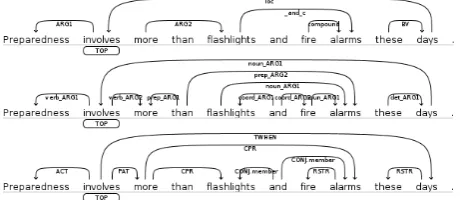
Figure 1:Example annotations forDM(top),PAS(middle), andPCEDT(bottom).
task (in which output from syntactic parsers and other outside resourcescanbe used). We present our results in§5.
2 Formalisms
The Shared Task 8 dataset consists of annota-tions of the WSJ Corpus in three different se-mantic dependency formalisms. DM is derived from LinGO English Resource Grammar (ERG) annotations in DeepBank (Flickinger et al., 2012). PASis derived from the Enju HPSG treebank us-ing the conversion rules of Miyao et al. (2004). PCEDTis derived from the tectogrammatical layer of the Prague Czech-English Dependency Treebank (Hajiˇc, 1998). See Figure 1 for an example.
The three formalisms come from very different linguistic theories, but all are represented as labeled directed graphs, with words as vertices, and all have “top” annotations, corresponding roughly to the semantic focus of the sentence. (A “top” need not be a root of the graph.) This allows us to use the same machinery (§3) for training and testing statistical models for the three formalisms. 3 Models
We treat the problem as a three-stage pipeline. The first stage prunes words by predicting whether they have any incoming or outgoing edges at all (§3.1); if a word does not, then it is not considered for any attachments in later stages. The second stage
predicts where edges are present, and their labels (§3.2). The third stage predicts whether a predicate word is atopor not (§3.3). Formalisms sometimes annotate more than one “top” per sentence, but we found that we achieve the best performance on all formalisms by predicting only the one best-scoring “top” under the model.
3.1 Singleton Classification
For each formalism, we train a classifier to rec-ognize singletons, nodes that have no parents or children. (For example, punctuation tokens are of-ten singletons.) This makes the system faster with-out affecting accuracy. For singleton prediction, we use a token-level logistic regression classifier, with features including the word, its lemma, and its part-of-speech tag. If the classifier predicts a probability of 99% or higher the token is pruned; this removes around 10% of tokens. (The classi-fier performs differently on different formalisms; onPASit has perfect accuracy, while onDMand PCEDTaccuracy is in the mid-90’s.)
3.2 Edge Prediction
In the second stage of the pipeline, we predict the set of labeled directed edges in the graph. We use the same set of edge-factored features (§3.2.3) in two alternative models: an edge-independent mul-ticlass logistic regression model (LOGISTICEDGE,
§3.2.1); and a structured SVM (Taskar et al., 2003; Tsochantaridis et al., 2004) that enforces a deter-minismconstraint for certain labels, which allows each word to have at most one outgoing edge with that label (SVMEDGE,§3.2.2). For each formalism, we trained both models with varying features en-abled and hyperparameter settings and submitted the configuration that produced the best labeledF1 on the development set. ForDMandPCEDT, this was LOGISTICEDGE; forPAS, this was SVMEDGE. We report results only for the submitted configu-rations, with different features enabled. Due to time constraints, full hyperparameter sweeps and comparable feature sweeps were not possible.
3.2.1 LOGISTICEDGEParser
The LOGISTICEDGEmodel considers only token index pairs (i, j) where |i− j| ≤ 10, i 6= j, and bothtiandtj have been predicted to be non-singletons by the first stage. Although this prunes some gold edges, among the formalisms, 95%–97% of all gold edges are between tokens of distance
10 or less. Both directionsi → j andj → iare considered between every pair.
LetLbe the set ofK+ 1possible output labels: the formalism’s originalK edge labels, plus the additional label NOEDGE, which indicates that no edge exists fromitoj. The model treats every pair of token indices(i, j)as an independent multiclass logistic regression over output spaceL. Letxbe an input sentence. For candidate parent index i, child indexj, and edge label`, we extract a feature vectorf(x, i, j, `), where`is conjoined with every feature described in§3.2.3. The multiclass logis-tic regression model defines a distribution overL, parametrized by weightsφ:
P(`|φ, x, i, j) = P exp{φ·f(x, i, j, `)}
`0∈Lexp{φ·f(x, i, j, `0)}. φ is learned by minimizing total negative log-likelihood of the above (with weighting; see be-low), plus`2regularization. AdaGrad (Duchi et al., 2011) is used for optimization. This seemed to opti-mize faster than L-BFGS (Liu and Nocedal, 1989), at least for earlier iterations, though we did no sys-tematic comparison. Stochastic gradient steps are applied one at a time from individual examples, and a gradient step for the regularizer is applied once per epoch.
The output labels have a class imbalance; in all three formalisms, there are many more NOEDGE examples than true edge examples. We improved F1 performance by downweighting NOEDGE examples through a weighted log-likelihood objective, Pi,jP`w`logP(`|φ, x, i, j), with wNOEDGE= 0.3(selected on development set) and
w`= 1otherwise.
Decoding: To predict a graph structure at test-time for a new sentence, the most likely edge label is pre-dicted for every candidate(i, j)pair of unpruned tokens. If an edge is predicted for both directions for a single(i, j)pair, only the edge with the higher score is chosen. (There are no such bidirectional edges in the training data.) This post-processing ac-tually did not improve accuracy onDMorPCEDT; it did improvePASby≈0.2% absoluteF1, but we did not submit LOGISTICEDGEforPAS.
3.2.2 SVMEDGEParser
than one child with edge label “ARG1.” Ld was chosen to be the set of edges that were>99.9%
deterministic in the training data.1
Consider the fully dense graph of all edges be-tween all words predicted as not singletons by the singleton classifier§3.1 (in all directions with all possible labels). Unlike LOGISTICEDGE, the la-bel set Ldoes not include an explicit NOEDGE label. Ifψ denotes the model weights, andf de-notes the features, then an edge fromitoj with label ` in the dense graph has a weight c(i, j, `)
assigned to it using the linear scoring function c(i, j, `) =ψ·f(x, i, j, `).
Decoding:For each node and each label`, if`∈
Ld, the decoder adds the highest scoring outgoing edge, if its weight is positive. For` 6∈ Ld, every outgoing edge with positive weight is added. This procedure is guaranteed to find the highest scoring subgraph (largest sum of edge weights) of the dense graph subject to the determinism constraints. Its runtime isO(n2).
The model weights are trained using the struc-tured SVM loss. If x is a sentence and y is a graph over that sentence, let the features be de-notedf(x, y) =P(i,j,`)∈yf(x, i, j, `). The SVM loss for each training example(xi, yi)is:
−ψ>f(x
i, yi)+maxy ψ>f(xi, y)+cost(y, yi)
wherecost(y, yi) = α|y\yi|+β|yi\y|. αand β trade off between precision and recall for the edges (Gimpel and Smith, 2010). The loss is min-imized with AdaGrad using early-stopping on a development set.
3.2.3 Edge Features
Table 1 describes the features we used for predict-ing edges. These features were computed over an edge ewith parent token sat index i and child tokentat indexj. Unless otherwise stated, each feature template listed has an indicator feature that fires for each value it can take on. For the sub-mitted results, LOGISTICEDGE uses all features except Dependency Path v2, POS Path, and Dis-tance Thresholds, and SVMEDGEuses all features except Dependency Path v1. This was due to SVMEDGE being faster to train than LOGISTIC-EDGEwhen including POS Path features, and due
1 By this we mean that of the nodes that have at least
one outgoing`edge,99.9%of them have only one outgo-ing`edge. ForDM,Ld =L\{“ and c,” “ or c,” “ then c,” “loc,” “mwe,” “subord”}; forPAS,Ld=L; and forPCEDT,
Ld={“DPHR,” “INTF,” “VOCAT”}.
Tokens:The tokenssandtthemselves.
Lemmas:Lemmas ofsandt.
POS tags:Part of speech tags ofsandt.
Linear Order:Fires ifi < j.
Linear Distance:i−j.
Dependency Path v1 (LOGISTICEDGE only): The
concatenation of all POS tags, arc labels and up/down directions on the path in the syntactic dependency tree fromstot. Conjoined withs, witht, and without either.
Dependency Path v2 (SVMEDGEonly):Same as
De-pendency Path v1, but with the lemma ofsortinstead of the word, and substituting the token for any “IN” POS tag.
Up/Down Dependency Path:The sequence of upward and downward moves needed to get fromstotin the syntactic dependency tree.
Up/Down/Left/Right Dependency Path: The unla-beled path through the syntactic dependency tree froms
tot, annotated with whether each step through the tree was up or down, and whether it was to the right or left in the sentence.
Is Parent:Fires ifsis the parent oftin the syntactic dependency parse.
Dependency Path Length:Distance betweensandtin the syntactic dependency parse.
POS Context:Concatenated POS tags of tokens ati−1,
i,i+ 1,j−1,j, andj+ 1. Concatenated POS tags of tokens ati−1, i, j−1, andj. Concatenated POS tags of tokens ati, i+ 1, j, andj+ 1.
Subcategorization Sequence:The sequence of depen-dency arc labels out ofs, ordered by the index of the child. Distinguish left children from right children. Ift
is a direct child ofs, distinguish its arc label with a “+”. Conjoin this sequence with the POS tag ofs.
Subcategorization Sequence with POS:As above, but add the POS tag of each child to its arc label.
POS Path (SVMEDGEonly):Concatenated POS tags between and includingiandj. Conjoined with head lemma, with dependent lemma, and without either.
Distance Thresholds (SVMEDGEonly):Fires for
ev-ery integer between1andblog(|i−j|+ 1)/log(1.39)c
inclusive.
Table 1:Features used in edge prediction
to time constraints for the submission we were un-able to retrain LOGISTICEDGEwith these features.
3.2.4 Feature Hashing
The biggest memory usage was in the map from feature names to integer indices during feature extraction. For experimental expedience, we im-plemented multitask feature hashing (Weinberger et al., 2009), which hashes feature names to indices, under the theory that errors due to collisions tend to cancel. No drop in accuracy was observed.
3.3 Top Prediction
least one outbound edge) are possible candidates to be “top”; the classifier probabilities are evalu-ated, and the highest-scoring node is chosen to be “top.” This is suboptimal, since some graphs have multiple tops (in PCEDTthis is more common); but selection rules based on probability thresholds gave worseF1performance on the dev set. For a given tokentat indexi, the top classifier’s features includedt’s POS tag,i, those two conjoined, and the depth oftin the syntactic dependency tree. 4 Negative Results
We followed a forward-selection process during feature engineering. For each potential feature, we tested the current feature set versus the current feature set plus the new potential feature. If the new feature did not improve performance, we did not add it. We list in table 2 some of the features which we tested but did not improve performance. In order to save time, we ran these feature se-lection experiments on a subsample of the training data, for a reduced number of iterations. These re-sults thus have a strong caveat that the experiments were not exhaustive. It may be that some of these features could help under more careful study. 5 Experimental Setup
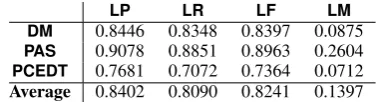
We participated in the Open Track, and used the syntactic dependency parses supplied by the orga-nizers. Feature engineering was performed on a development set (§20), training on§§00–19. We evaluate labeled precision (LP), labeled recall (LR), labeledF1(LF), and labeled whole-sentence match (LM) on the held-out test data using the evaluation script provided by the organizers. LF was aver-aged over the formalisms to determine the winning system. Table 3 shows our scores.
6 Conclusion and Future Work
We found that feature-rich discriminative models perform well at the task of mapping from sentences to semantic dependency parses. While our final approach is fairly standard for work in parsing, we note here additional features and constraints which did not appear to help (contrary to expecta-tion). There are a number of clear extensions to this work that could improve performance. While an edge-factored model allows for efficient infer-ence, there is much to be gained fromhigher-order features (McDonald and Pereira, 2006; Martins et al., 2013). The amount of information shared
Word vectors: Features derived from 64-dimensional vectors from (Faruqui and Dyer, 2014), including the concatenation, difference, inner product, and element-wise multiplication of the two vectors associated with a parent-child edge. We also trained a Random Forest on the word vectors using Liaw and Wiener’s (2002)R
implementation. The predicted labels were then used as features in LOGISTICEDGE.
Brown clustersFeatures derived from Brown clusters (Brown et al., 1992) trained on a large corpus of web data. Parent, child, and conjoined parent-child edge features from cluster prefixes of length 2, 4, 6, 8, 10, and 12. Conjunctions of those features with the POS tags of the parent and child tokens.
Active/passive: Active/passive voice feature (as in Jo-hansson and Nugues (2008)) conjoined with both the Linear Distance features and the Subcategorization Se-quence features. Voice information may already be cap-tured by features from the Stanford dependency–style parses, which include passivization information in arc labels such asnsubjpassandauxpass(de Marneffe and Manning, 2008).
Connectivity constraint: Enforcing that the graph is connected (ignoring singletons), similar to Flanigan et al. (2014). Almost all semantic dependency graphs in the training data are connected (ignoring singletons), but we found that enforcing this constraint significantly hurt precision.
[image:4.595.320.513.420.471.2]Tree constraint:Enforces that the graph is a tree. Un-surprisingly, we found that enforcing a tree constraint hurt performance.
Table 2:Features and constraints giving negative results.
LP LR LF LM
DM 0.8446 0.8348 0.8397 0.0875
PAS 0.9078 0.8851 0.8963 0.2604
PCEDT 0.7681 0.7072 0.7364 0.0712
Average 0.8402 0.8090 0.8241 0.1397
Table 3: Labeled precision (LP), recall (LR),F1 (LF), and
whole-sentence match (LM) on the held-out test data.
between the three formalisms suggests that a multi-task learning(Evgeniou and Pontil, 2004) frame-work could lead to gains. And finally, there is additional structure in the formalisms which could be exploited (such as the deterministic processes by which an original PCEDT tree annotation was converted into a graph); formulating more subtle
graph constraintsto capture this a priori knowl-edge could lead to improved performance. We leave such explorations to future work.
Acknowledgements
References
Peter F. Brown, Peter V. deSouza, Robert L. Mercer, Vin-cent J. Della Pietra, and Jenifer C. Lai. 1992. Class-based n-gram models of natural language. Computational Lin-guistics, 18(4):467–479.
Marie-Catherine de Marneffe and Christopher D. Manning. 2008. The Stanford typed dependencies representation. In
Coling 2008: Proc. of the Workshop on Cross-Framework and Cross-Domain Parser Evaluation, pages 1–8. Manch-ester, UK.
John Duchi, Elad Hazan, and Yoram Singer. 2011. Adap-tive subgradient methods for online learning and stochas-tic optimization.Journal of Machine Learning Research, 12:2121–2159.
Theodoros Evgeniou and Massimiliano Pontil. 2004. Regular-ized multitask learning. InProc. of KDD, pages 109–117. Seattle, WA, USA.
Manaal Faruqui and Chris Dyer. 2014. Improving vector space word representations using multilingual correlation. InProc. of EACL, pages 462–471. Gothenburg, Sweden. Jeffrey Flanigan, Sam Thomson, Jaime Carbonell, Chris Dyer,
and Noah A. Smith. 2014. A discriminative graph-based parser for the Abstract Meaning Representation. InProc. of ACL, pages 1426–1436. Baltimore, MD, USA. Dan Flickinger, Yi Zhang, and Valia Kordoni. 2012.
Deep-Bank: a dynamically annotated treebank of the Wall Street Journal. InProc. of the Eleventh International Workshop on Treebanks and Linguistic Theories, pages 85–96. Lisbon, Portugal.
Kevin Gimpel and Noah A. Smith. 2010. Softmax-margin training for structured log-linear models. Technical Report CMU-LTI-10-008, Carnegie Mellon Univer-sity. URL http://lti.cs.cmu.edu/sites/ default/files/research/reports/2010/ cmulti10008.pdf.
Jan Hajiˇc. 1998. Building a syntactically annotated corpus: the Prague Dependency Treebank. In Eva Hajiˇcov´a, ed-itor,Issues of Valency and Meaning. Studies in Honour of Jarmila Panevov´a, pages 106–132. Prague Karolinum, Charles University Press, Prague.
Richard Johansson and Pierre Nugues. 2008. Dependency-based semantic role labeling of PropBank. InProc. of EMNLP, pages 69–78. Honolulu, HI, USA.
Andy Liaw and Matthew Wiener. 2002. Classification and regression by randomForest. R News, 2(3):18– 22. URL http://cran.r-project.org/web/ packages/randomForest/.
Dong C. Liu and Jorge Nocedal. 1989. On the limited memory BFGS method for large scale optimization. Mathematical Programming, 45(3):503–528.
Andr´e F. T. Martins, Miguel Almeida, and Noah A. Smith. 2013. Turning on the turbo: Fast third-order non-projective turbo parsers. InProc. of ACL, pages 617–622. Sofia, Bulgaria.
Ryan McDonald and Fernando Pereira. 2006. Online learning of approximate dependency parsing algorithms. InProc. of EACL, pages 81–88. Trento, Italy.
Yusuke Miyao, Takashi Ninomiya, and Jun’ichi Tsujii. 2004. Corpus-oriented grammar development for acquiring a head-driven phrase structure grammar from the Penn Tree-bank. InProc. of IJCNLP, pages 684–693. Hainan Island, China.
Stephan Oepen, Marco Kuhlmann, Yusuke Miyao, Daniel Zeman, Dan Flickinger, Jan Hajiˇc, Angelina Ivanova, and Yi Zhang. 2014. SemEval 2014 Task 8: Broad-coverage semantic dependency parsing. InProc. of SemEval. Dublin, Ireland.
Ben Taskar, Carlos Guestrin, and Daphne Koller. 2003. Max-margin Markov networks. InProc. of NIPS, pages 25–32. Vancouver, British Columbia, Canada.
Ioannis Tsochantaridis, Thomas Hofmann, Thorsten Joachims, and Yasemin Altun. 2004. Support vector machine learning for interdependent and structured output spaces. InProc. of ICML, pages 104–111. Banff, Alberta, Canada. Kilian Weinberger, Anirban Dasgupta, John Langford, Alex