Systematic Comparison of Professional and Crowdsourced Reference
Translations for Machine Translation
Rabih Zbib, Gretchen Markiewicz, Spyros Matsoukas, Richard Schwartz, John Makhoul
Raytheon BBN Technologies Cambridge, MA 02138, USA
{rzbib,gmarkiew,smatsouk,schwartz,makhoul}@bbn.com
Abstract
We present a systematic study of the effect of crowdsourced translations on Machine Trans-lation performance. We compare Machine Translation systems trained on the same data but with translations obtained using Amazon’s Mechanical Turk vs. professional translations, and show that the same performance is ob-tained from Mechanical Turk translations at 1/5th the cost. We also show that adding a Me-chanical Turk reference translation of the de-velopment set improves parameter tuning and output evaluation.
1 Introduction
Online crowdsourcing services have been shown to be a cheap and effective data annotation resource for various Natural Language Processing (NLP) tasks (Callison-Burch and Dredze, 2010; Zaidan and Callison-Burch, 2011a; Zaidan and Callison-Burch, 2011b). The resulting quality of annotations is high enough to be used for training statistical NLP mod-els, with a saving in cost and time of up to an or-der of magnitude. Statistical Machine Translation (SMT) is one of the NLP tasks that can benefit from crowdsourced annotations. With appropriate quality control mechanisms, reference translations collected by crowdsourcing have been successfully used for training and evaluating SMT systems (Zbib et al., 2012; Zaidan and Callison-Burch, 2011b).
In this work, we used Amazon’s Mechanical Turk (MTurk) to obtain alternative reference translations of four Arabic-English parallel corpora previously released by the Linguistic Data Consortium (LDC)
for the DARPA BOLT program. This data, totaling over 500K Arabic tokens, was originally collected from web discussion forums and translated profes-sionally to English. We used alternative MTurk translations of the same data to train and evalua-tion MT systems; and conducted the first systematic study that quantifies the effect of the reference trans-lation process on MT output. We found that:
• Mechanical Turk can be used to translate enough data for training an MT system at 1/10th the price of professional translation, and at a much faster rate.
• Training MT systems on MTurk reference translations gives the same performance as training with professional translations at 20% of the cost.
• A second translation of the development set ob-tained via MTurk improves parameter tuning and output evaluation.
2 Previous Work
There have been several publications on crowd-sourcing data annotation for NLP. Callison-Burch and Dredze (2010) give an overview of the NAACL-2010 Workshop on using Mechanical Turk for data annotation. They describe tasks for which MTurk can be used, and summarize a set of best practices. They also include references to the workshop con-tributions.
Zaidan and Callison-Burch (2011a) created a monolingual Arabic data set rich in dialectal con-tent from user commentaries on newspaper web-sites. They hired native Arabic speakers on MTurk
to identify the dialect level and used the collected la-bels to train automatic dialect identification systems. They did not translate the collected data, however. Zaidan and Callison-Burch (2011b) obtained mul-tiple translations of the NIST 2009 Urdu-English evaluation set using MTurk. They trained a statis-tical model on a set of features to select among the multiple translations. They showed that the MTurk translations selected by their model approached the range of quality of professional translations, and that the selected MTurk translations can be used reliably to score the outputs of different MT systems submit-ted to the NIST evaluation. Unlike our work, they did not investigate the use of crowdsourced trans-lations for training or parameter tuning. Zbib et al. (2012) trained a Dialectal Arabic to English MT sys-tem using Mechanical Turk translations. But the data they translated on MTurk does not have profes-sional translations to conduct the systematic com-parison we do in this paper.
It is well known that scoring MT output against multiple references improves MT scores such as BLEU significantly, since it increases the chance of matchingn-grams between the MT output and the references. Tuning system parameter with multi-ple references also improves machine translation for the same reason Madnani et al. (2007) and Madnani et al. (2008) showed that tuning on additional ref-erences obtained by automatic paraphrasing helps when only few tuning references are available.
3 Data Translation
The data we used are Arabic-English parallel cor-pora released by the LDC for the DARPA BOLT Phase 1 program1. The data was collected from Egyptian online discussion forums, and consists of separate discussion threads, each composed of an initial user posting and multiple reply postings. The data tends to be bimodal: the first posting in the thread is often formal and expressed in Modern Standard Arabic, while the subsequent threads use a less formal style, and contain colloquial Egyptian dialect. The data was manually segmented into sen-tence units, and translated professionally.
We used non-professional translators hired on MTurk to get second translations. We used several
1Corpora: LDC2012E15, LDC2012E19, LDC2012E55
measures to control the quality of translations and detect cheaters. Those include the rendering of Ara-bic sentences as images, comparing the output to Google Translate and Bing Translator, and other au-tomatic checks. The quality of individual worker’s translations was quantified by asking a native Ara-bic speaker judge to score a sample of the Turker’s translations. The translation task unit (aka Human Intelligence Task or HIT) consisted of a sequence of contiguous sentences from a discussion thread amounting to between 40 and 60 words. The in-structions were simply to translate the Arabic source fully and accurately, and to take surrounding sen-tence segments into account to help resolve ambigu-ities. The HIT rewards were set to 2.5¢ per word.
At the end of the effort, we had 26 different work-ers translate 567K Arabic tokens in 4 weeks. The resulting translations were less fluent than their pro-fessional counterparts, and 10% shorter on average. The following section presents results of MT exper-iments using the MTurk translations.
4 MT Experiments
The MT system used is based on a string-to-dependency-tree hierarchical model of Shen et al. (2008). Sentence alignment was done using GIZA++ (Och and Ney, 2003). Decoder fea-tures include translation probabilities, smoothed lex-ical probabilities, and a dependency tree language model. Additionally, we used 50,000 sparse, binary-valued source and target features based on Chiang et al. (2009). The English language model was trained on 7 billion words from the LDC Gigaword corpus and from a web crawl. We used expected BLEU maximization (Devlin, 2009) to tune feature weights.
We defined a tuning set (3581 segments, 43.3K tokens) and a test set (4166 segments, 47.7K to-kens) using LDC2012E30, the corpus designated as a development set by the LDC, augmented with around 50K Words held out from LDC2012E15 and LDC2012E19, to make a development set large enough to tune the large number of feature weights2. The remaining data was used for training. We de-fined three nested training sets containing 100K, 200K and 400K Arabic tokens respectively, with
Training Web-forum Only Newswire(10MW)+Web-forum
100KW 200KW 400KW 0KW 100KW 200KW 400KW
Prof. refs 17.71 20.23 22.61 22.82 24.05 24.85 25.19
MTurk refs 16.41 18.43 20.08 22.82 23.79 24.20 24.51
Two Training refs 19.03 21.19 23.06 22.82 24.26 25.19 25.38
[image:3.612.101.505.55.139.2]Add’l Training data - 19.80 21.53 22.82 - 24.31 25.16
Table 1: Comparison of the effect of web forum training data when using professional and MTurk reference transla-tions. All results use professional references for the tuning and test sets.
two versions of each set: one with the professional reference translations for the target, and the other with the same source data, but the MTurk transla-tions. We defined two versions of the test and tuning sets similarly. We report translation results in terms of lower-case BLEU scores (Papineni et al., 2002).
4.1 Training Data References
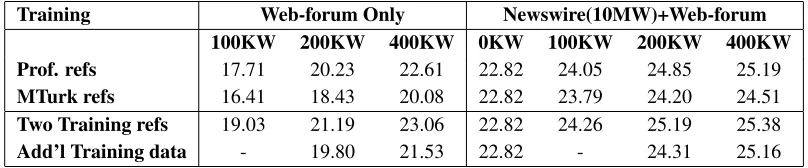
We first study the effect of training data refer-ences, varying the amount of training data and type of translations, while using the same professional translation references for tuning and scoring. The first set of baseline experiments were trained on web forum data only, using professional transla-tions. The first line of Table 1 shows that doubling of the training data adds 2.5 then 2.3 BLEU points. We repeated the experiments, but with MTurk training references, and saw that the scores are lower by 1.3-2.5 BLEU points, depending on the size of training data, and that the gain obtained from doubling the training data decreases to 2.0 and 1.6 BLEU points. The lower MT scores and slower learning curve of the MTurk systems are both due to the lower quality of the translations, and to the mismatch with the pro-fessional development set translations (we discuss this issue further in §4.3). However, by interpolation of the MT scores, we find that the same MT perfor-mance can be obtained by using twice the amount of MTurk translated data as professional data. Consid-ering that the MTurk translations is 10 times cheaper than professional translations (2.5¢ versus 25-30¢), this constitutes a cost ratio of 5x.
We repeated the above experiments, but this time added 10 million words of parallel data from the NIST MT 2012 corpora (mostly news) for training. We weighted the web forum part of the training data by a factor of 5. Note from the results in the right half of Table 1 that the newswire data improves the
BLEU score by 2.5 to 6.3 BLEU points, depend-ing on the size of the web forum data. This signif-icant improvement is because some of the web fo-rum user postings are formal and written in MSA (§3). More relevant to our aims is the comparison when we vary the web forum training references in the presence of the newswire training. The differ-ence between the MTurk translation systems and the professional translation drops to 0.26-0.68 points. We conclude that in a domain adaptation scenario, where out-of-domain training data (i.e. newswire) already exists, crowdsourced translations for the in-domain (i.e. web forum) training data can be used with little to no loss in MT performance.
4.2 More Data vs. Multiple Translations
ad-Training Tuning Test Training Data Size
100KW 200KW 400KW 400KW(no lex)
Prof. Prof. Prof. 17.71 20.23 22.61 20.01
Prof. Prof. Prof.+MTurk 22.53 25.75 28.38 25.42
Prof. Prof. (len=0.95) Prof.+MTurk 23.63 26.84 29.54 26.17
Prof. Prof.+MTurk Prof.+MTurk 25.26 28.44 30.94 27.22
MTurk MTurk MTurk 16.66 18.47 20.35 17.75
MTurk MTurk Prof.+MTurk 23.83 26.45 28.66 25.44
MTurk MTurk (len=1.05) Prof.+MTurk 23.73 26.19 28.74 25.87
[image:4.612.94.514.53.193.2]MTurk Prof.+MTurk Prof.+MTurk 24.91 27.66 29.78 26.45
Table 2: Effect of Tuning and Scoring References on MT.
vantage of new web forum source data disappears (lower-right quadrant of Table 1).
4.3 Development Data References
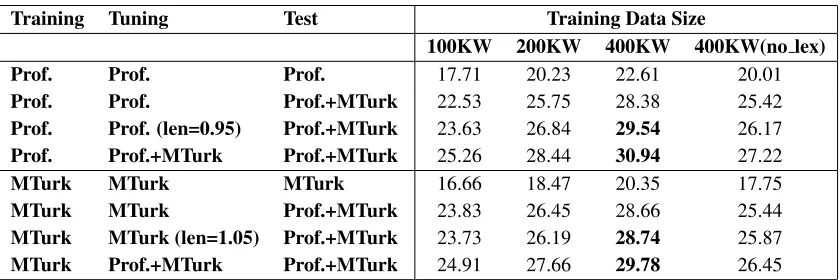
So far, we have focused on varying training data conditions, and kept the tuning and evaluation con-ditions fixed. But since we have re-translated the tuning and test sets on MTurk as well, we can study the effect of their reference translations on MT. As Table 2 shows, scoring the MT output using both reference translations, the BLEU scores increase by over 5 points (and more for the MTurk-trained sys-tem). This increase by itself is not remarkable. What is important to note is that the gain obtained by dou-bling the amount of training data is larger when mea-sured using the multiple reference test set. We also ran experiments with 400KW training data, but with the lexical smoothing features (Koehn et al., 2003; Devlin, 2009) turned off. The bigger gains show that improvements in the MT output (from additional training or new features) can be better measured us-ing a second MTurk reference of the test set.
Finally, we study the effect of tuning the system parameters using both translation references. Look-ing at the system trained on the professional trans-lations, we see a gain of 2.5 to 2.7 BLEU points from adding the MTurk references to the tuning set. But as we mentioned earlier, the MTurk transla-tions are shorter than the professional translatransla-tions by around 10% on average. Tuning on both ref-erences, therefore, shortens the system output by around 5%. To neutralize the effect of length mis-match, we compared to a fairer baseline tuned on the professional references only, but we tuned the output-to-reference length ratio to be 0.95 (thus
pro-ducing a shorter output). In this case, we see a gain of 1.4 points from adding the MTurk references to the tuning set.
We also used the multiple-reference tuning set to retune the systems trained on MTurk transla-tions. Comparing that to a baseline that is tuned and scored using MTurk references only, we see a gain of around 1%. Note, however, that in this case the length mismach is reversed, and the output of the multiple-reference system is around 5% longer than that of the baseline. If we compare with a baseline that is tuned with a length ratio of 1.05 (to produce a longer output), we see the gain shrink only slightly.
To sum up this section, a second set of refer-ence translations obtained via MTurk makes mea-surements of improvement on the test set more re-liable. Also, a second set of references for tuning improves the output of the MT systems trained on either professional or MTurk references.
5 Conclusion
We compared professional and crowdsourced trans-lations of the same data for training, tuning and scor-ing Arabic-English SMT systems. We showed that the crowdsourced translations yield the same MT performance as professional translations for as lit-tle as 20% of the cost. We also showed that a sec-ond crowsourced reference translation of the devel-opment set allows for a more accurate evaluation of MT output.
Acknowledgments
Program. The views expressed are those of the au-thors and do not reflect the official policy or position of the Department of Defense or the U.S. Govern-ment. Distribution Statement A (Approved for Pub-lic Release, Distribution Unlimited).
References
Chris Callison-Burch and Mark Dredze. 2010. Creating speech and language data with Amazon’s Mechanical Turk. InProceedings of the NAACL HLT 2010 Work-shop on Creating Speech and Language Data with Amazon’s Mechanical Turk, pages 1–12, Los Angeles, June.
David Chiang, Kevin Knight, and Wei Wang. 2009. 11,001 new features for statistical machine translation. InNAACL ’09: Proceedings of the 2009 Human Lan-guage Technology Conference of the North American Chapter of the Association for Computational Linguis-tics, Boulder, Colorado.
Jacob Devlin. 2009. Lexical features for statistical ma-chine translation. Master’s thesis, University of Mary-land, December.
P. Koehn, F. J. Och, and D. Marcu. 2003. Statistical phrase-based translation. InProceedings of the 2003 Human Language Technology Conference of the North American Chapter of the Association for Computa-tional Linguistics, pages 48–54, Edmonton, Canada. Nitin Madnani, Necip Fazil, Ayan, Philip Resnik, and
Bonnie Dorr. 2007. Using paraphrases for parameter tuning in statistical machine translation. In Proceed-ings of the Second Workshop on Statistical Machine Translation, pages 120–127, Prague, Czech Republic. Association for Computational Linguistics.
Nitin Madnani, Philip Resnik, Bonnie Dorr, and Richard Schwartz. 2008. Are multiple reference transla-tions necessary? investigating the value of paraphrased reference translations in parameter optimization. In
Proceedings of the 8th Conf. of the Association for Machine Translation in the Americas (AMTA 2008), Waikiki, Hawaii, USA.
Franz Josef Och and Hermann Ney. 2003. A system-atic comparison of various statistical alignment mod-els. Computational Linguistics, 29(1):19–51.
Kishore Papineni, Salim Roukos, Todd Ward, and Wei-Jing Zhu. 2002. Bleu: a method for automatic evalua-tion of machine translaevalua-tion. InProceedings of the 40th Annual Meeting of the Association for Computational Linguistics (ACL), Philadelphia, PA.
Libin Shen, Jinxi Xu, and Ralph Weischedel. 2008. A new string-to-dependency machine translation algo-rithm with a target dependency language model. In
Proceedings of the 46th Annual Meeting of the As-sociation for Computational Linguistics (ACL), pages 577–585, Columbus, Ohio.
Omar F. Zaidan and Chris Callison-Burch. 2011a. The Arabic online commentary dataset: an annotated dataset of informal Arabic with high dialectal content. InProceedings of the 49th Annual Meeting of the As-sociation for Computational Linguistics: Human Lan-guage Technologies, pages 37–41, Portland, Oregon, June.
Omar F. Zaidan and Chris Callison-Burch. 2011b. Crowdsourcing translation: Professional quality from non-professionals. InProceedings of the 49th Annual Meeting of the Association for Computational Lin-guistics: Human Language Technologies, pages 1220– 1229, Portland, Oregon, June.