A VALIDATED RP-HPLC METHOD FOR THE SIMULTANEOUS
DETERMINATION OF LEVODOPA, CARBIDOPA AND
ENTACAPONE IN TABLET DOSAGE FORMS
Gandla. Kumara Swamy1*, JM Rajendra Kumar 2, J.V.L.N.Seshagiri Rao3.
1
Research Scholar, Department of Pharmaceutical Analysis, Jawaharlal Nehru Technological
University Kakinada, Kakinada - 533 003-Andhra Pradesh, India.
2
Mylan Laboratories Limited, Plot No 31, 32, 33&34-A, Anrich Industrial Estate, Bollaram,
Medak(Dist) 502325, India.
3
Srinivasa Rao College of Pharmacy, Vis Akhapatnam-500041.A.P.India.
ABSTRACT
A Stability indicating RP-HPLC method has been developed for the
simultaneous estimation of Levodopa, Carbidopa and Entacapone in
tablet dosage forms using an RP- Hypersil BDS column (150 x 4.6
mm; 5). A mobile phase consisting of Potassium Dihydrogen
orthophosphate and Acetonitrile in the ratio of 95:5.0 was pumped
through the column at a flow rate of 1.0 mL/min. The separations of
drugs were monitored at 280 nm. Linearities of quantification were
observed in the concentration range of 75–225 µg/ml for Levodopa,
18.75-56.25 µg/ml for Carbidopa and 100 -300 µg/ml for Entacapone.
The method was duly validated. A%RSD of less than 2% indicates the
high degree of accuracy and precision of the method. Due to its high
precision and accuracy, the proposed Stability indicating RP-HPLC
method can be applied for determining Levodopa, Carbidopa and
Entacapone simultaneously in bulk and Combined Tablet dosage
forms.
KEYWORDS: Levodopa, Carbidopa and Entacapone; RP-HPLC Method; Forced Degradation studies; Tablet dosage forms.
*Correspondence for Author
Gandla.Kumara Swamy
Research Scholar,
Department of
Pharmaceutical Analysis,
Jawaharlal Nehru
Technological University
Kakinada, Kakinada - 533
003-Andhra Pradesh,
India.
Volume 3, Issue 10, 1684-1699. Research Article ISSN 2277– 7105
Article Received on 15 Oct 2014,
INTRODUCTION
Stalevo® (carbidopa, levodopa and entacapone) is a combination of carbidopa, levodopa and
entacapone for the treatment of Parkinson's disease.
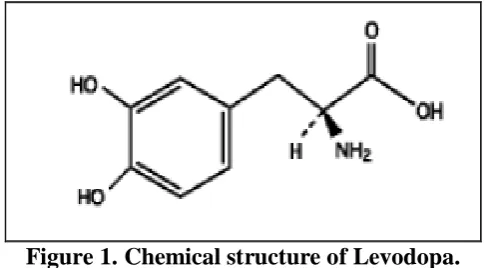
1. Levodopa is an aromatic amino acid, is a white, crystalline compound, slightly soluble in water, with a molecular weight of 197.2. It is designated chemically as
(-)-L-α-amino-β-(3,4 dihydroxybenzene) propanoic acid. Its empirical formula is C9H11NO4, and its
[image:2.595.176.423.244.378.2]structural formula is shown in fig.1.
Figure 1. Chemical structure of Levodopa.
2. Carbidopa is an inhibitor of aromatic amino acid decarboxylation, is a white, crystalline compound, slightly soluble in water, with a molecular weight of 244.3. It is designated
chemically as (-)-L-(α-hydrazino-(α-methyl-β-(3,4-dihydroxybenzene) propanoic acid
monohydrate. Its empirical formula is C10H14N2O4•H2O and its structural formula is
[image:2.595.193.401.527.640.2]shown in figure.2.
Figure 2.Chemical structure of Carbidopa.
Tablet content is expressed in terms of anhydrous carbidopa, which has a molecular weight of
226.3.Tablet content is expressed in terms of anhydrous carbidopa, which has a molecular
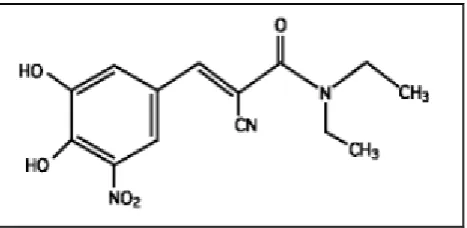
3. Entacapone is an inhibitor of catechol-O-methyltransferase (COMT), is a nitro-catechol-structured compound with a molecular weight of 305.3. The chemical name of
entacapone is (E)-2-cyano-3-(3,4-dihydroxy-5-nitrophenyl)-N,N-diethyl-2-propenamide.
[image:3.595.182.416.167.281.2]Its empirical formula is C14H15N3O5 and its structural formula is shown in fig.3.
Figure .3.Chemical structure of Entacapone.
In the literature, various analytical methods have been reported for quantitative determination
of Levodopa, Carbidopa and Entacapone alone and in combination. However, the reported
HPLC[6-9] method for the simultaneous estimation of LDP, CDP and EPN used phosphate
buffer which is not LC-MS compatible and the retention times were longer. Hence, the aim of
present investigation is to develop a validated Stability indicating RP-HPLC-PDA method for
the simultaneous estimation of LDP, CDP, and EPN in bulk and dosage forms which is
sensitive, Precise and Accurate.
Reagents and Chemicals
Carbidopa, Levodopa and Entacapone standard drugs were provided as gift samples from Dr.
Reddy’s laboratories limited, Hyderabad. The branded formulations (tablets) a (Stalevo)
containing Levodopa (150mg), Carbidopa (37.5 mg), and Entacapone (200mg) were
commercially purchased.) Were procured from the local market. Acetonitrile, Water,
Potassium dihyrogen ortho phosphate and orthophosphoric acid used were of HPLC grade
and purchased from Merck Specialties Private Limited, Mumbai, India.
Instrumentation
RP-HPLC waters 2695 separation module equipped with 2996 Photodiode Array Detector
was employed in this method. The Empower -2 software was used for LC peak integration
along with data acquisition and data processing. High performance liquid chromatograph
volume of 10 μl. 2696 Photo diode Array detector and Empower-2 software, Hypersil BDS
C18 column (150 mm × 4.6 mm I.d.,5 μ size particle) forms the stationary phase,
Chromatographic conditions
Flow rate : 1.0 ml/min
Column : Hypersil BDS C18, 150 x 4.6 mm, 5. Detector wave length : 280 nm
Column temperature : 30°C
Injection volume : 10L
Run time : 13 min
Diluent : Buffer: ACN (1:1) OBJECTIVE
To develop a simple, accurate and precise RP-HPLC method for simultaneous estimation of
Levodopa, Carbidopa and Entacapone, validating the method according to ICH guidelines
and testing its applicability for the routine analysis of levodopa, carbidopa and entacapone in
combined tablet dosage forms.
EXPERIMENTAL METHODS OPTIMIZED METHOD
Buffer
Weigh accurately 6.8 gm of potassium Di hydrogen orthophosphate into a 1000ml beaker
.add about 900ml of milli-Q water and sonicate and make up to the final volume. Adjust the
solution to pH-2.5 with dilute ortho phosperic acid.
Method Development and Optimization
Optimization of UV conditions: The method development work was started by taking UV-spectra in the range 200-400 nm of Levodopa, carbidopa and entacapone (10PPM) standard
solution. These samples were scanned in the range 200-400 nm using UV-visible
spectrophotometer. By observing the UV spectra of standard solutions, the detection
wavelength was selected as 280 nm for trails to develop HPLC method.
Preparation of sample.
Twenty tablets of (Stalevo) were weighed and the average weight of one tablet was
determined. The tablets were finely powdered and the powder equivalent to the weight of 5
tablets was weighed (3600 mg) and transferred into a 500 mL volumetric flask. 350 mL of
filtered. From the filtered solution, 1.0 mL was pipeted out into a 10 ml volumetric flask and
the volume made up with the diluent.
Preparation of Standard Solutions
Accurately Weighed and transferred 75mg of Levodopa ,18.75 mg of Carbidopa and 100mg
of Entacapone working Standards into a 50 ml clean dry volumetric flask, add 37ml of
diluent, sonicated for 5 minutes and make up to the final volume with diluent(standard stock).
Method development
The proposed method was developed using a mixture of Potassium Dihydrogen
orthophosphate and Acetonitrile in the ratio of 95:5.0 (pH 2.5) as the mobile phase in
isocratic mode. The flow rate was 1.0 ml/min and the eluate was monitored at 280 nm for
detection of the analytes.
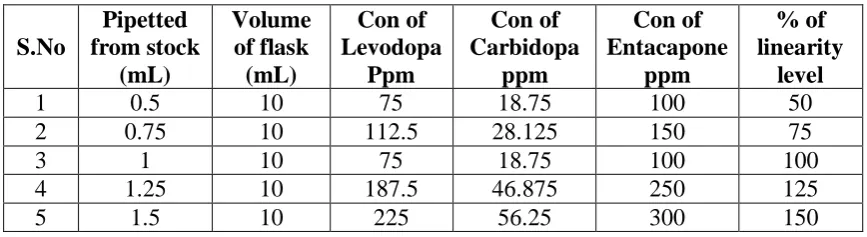
The relevant calibration curves were linear in the concentrations ranges of 25-225, 18.75 and
100-300 g/ml for levodopa, carbidopa and entacapone respectively (Table 1). For analysis
of tablet formulation, the tablet powder equivalent to 25 mg was taken, dissolved in 25 ml
volumetric flask and made up to 25 ml with Acetonitrile. The solution was sonicated for
15min, centrifuged at 100 rpm for 15 min and filtered through a Whatmann filter paper
No.41. From the clear solution, further dilutions were made to get 10 g/ml of levodopa,
carbidopa and entacapone theoretically. For recovery studies, to the pre-analyzed formulation
samples, different concentrations of pure drug solutions were added and the amounts of drugs
recovered were calculated by using the calibration graphs. Finally the method was validated
as per ICH guide lines for precision, accuracy, specificity, linearity, limit of detection and
[image:5.595.81.515.604.722.2]limit of quantification.
Table No.1.Linearty values of Levodopa, Carbidopa, and Entacapone. S.No Pipetted from stock (mL) Volume of flask (mL) Con of Levodopa Ppm Con of Carbidopa ppm Con of Entacapone ppm % of linearity level
1 0.5 10 75 18.75 100 50
2 0.75 10 112.5 28.125 150 75
3 1 10 75 18.75 100 100
4 1.25 10 187.5 46.875 250 125
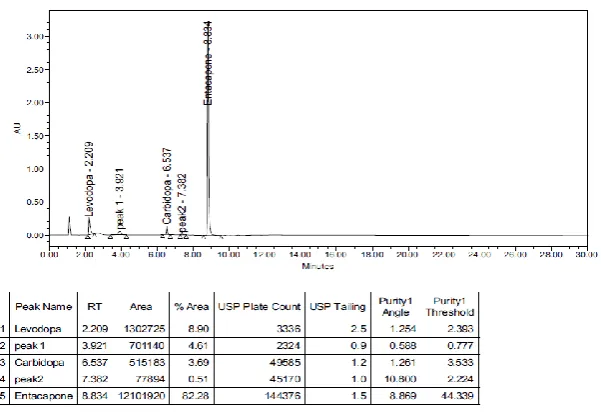
Fig.4.Optimum Chromatogram for mixture of Levodopa, Carbidopa, Entacapone. Method Validation: The HPLC method was validated in according to ICH guidelines[10-11] for validation of analytical procedures for different validation parameters. The method was
validated for its specificity, linearity, accuracy, precision, robustness, ruggedness, LOD and
LOQ.
RESULTS AND DISCUSSIONS
In this work, an isocratic, accurate and sensitive HPLC method suitable for the simultaneous
determination of Levodopa, Carbidopa and Entacapone in pure form and in pharmaceutical
formulations using a 150 mm x 4.6 mm, i.d. Hypersil ODS C18 5μ analytical column has been
developed. The mobile phase was chosen after several trials to match the optimum
stationary/mobile phase. The present method contains mobile phase phosphate buffer
(pH-2.5): Acetonitrile (90:05 v/v) which was found to be the most suitable, as the
chromatographic peaks obtained were better defined, well resolved and almost free from
tailing. The flow rate is 1 ml/min. The average retention times under the conditions described
were minutes for Levodopa, Carbidopa 2.17, 6.48 minutes and 8.863 for Entacapone. The
total run time is 13 minutes with which all the system suitability parameters are ideal for the
mixture of standard solutions.
was evaluated for the system suitability of the proposed method. Data from six injections
(10μg/mL) were utilized for calculating parameters like theoretical plates, resolution, tailing
factor and %RSD of 6 injections.
Specificity: The specificity studies were carried out by varying specific conditions i.e., placebo study. Specificity of the method was established by demonstrating that there was no
interference from the excipients. This was demonstrated by preparing the placebo containing
all excipients except the drug and also the sample prepared from the same. The samples were
injected individually and chromatogram was obtained.
Linearity: Linearity of an analytical procedure is its ability (within a given range) to obtain test results that are directly proportional to the concentration (amount) of analyte in the
samples 23. The linearity of the method was determined by preparing serial dilutions of
minimum 5 concentration of working stock solutions in the range of 17-225, 18.75-56 μg/ml
for Levodopa, Carbidopa and 100-300 μg/ml for Entacapone. The area of each injection was
obtained and the peak area was plotted against actual concentration. The regression
coefficient 'r2', y-intercept and slope of the regression were calculated. Results were
represented on figure 5, 6 and 7.and Table 2.
Figure 6.Calibration curve of Carbidopa
Figure 7.Calibration curve of Entacapone Table 2. Linearity Results
S.No Concentration (µg/mL) Peak Area
LDP CDP EP
N
LDP CDP EPN
1. 75 18.75 100 665968 273680 6237108
2. 112.5 28.125 150 987339 405089 9339241
3. 150 37.5 200 1305575 526295 12343694
4. 187.5 46.875 250 1625391 658295 15119727
Limit of Quantity and Limit of Detection: The LOD is defined as the lowest concentration of an analyte in a sample that can be detected but not quantified. The LOQ is defined as the
lowest concentration of an analyte in a sample that can be determined with acceptable
precision and accuracy. The LOD and LOQ can be calculated based on the standard deviation
of the response and the slope of calibration curve. The Values are Shown by Table 3.
Table 3 LOD and LOQ values
S.No Levodopa Carbidopa Entacapone
LOD (s/n ratio) 3.2 3.4 3.1
LOQ (s/n ratio) 9.2 10.2 10.00
Accuracy: Accuracy was carried out by % recovery studies of LDP and CDP and EPN at three different concentration levels (50%, 100%, 150%). In the proposed method recovery
studies were carried out by collecting the sample solution of 20 tablets containing LDP and
CDP and EPN and analyzed. Percentage of recovery was calculated from the amount added
and amount recovered. The percentage recovery was within the acceptance criteria, this
indicates the accuracy of the method. (Acceptance criteria: % recovery between 98 to 102).
Table 2. Recovery Studies of Levodopa, Carbidopa and Entacapone.
*Avg. of three determinations for 50, 150 &100%, R.S.D. is relative standard deviation
Precision: Precision of an analytical procedure as the closeness of agreement between a series of measurements obtained from multiple sampling of the same homogeneous sample
Drug Name
Level of %
Recovery % Mean Recovery*
S.D %
System precision (Reproducibility): System precision of method was carried out by measuring the peak response of LDP and CDP and EPN for six replicate injections of
standard solution. The retention time and area ratio of six determinations were measured and
percent coefficient variation (% RSD) calculated. (Acceptance criteria: % RSD not more than
2%). The values were represented Table 4.
Table 4 System precission No. of injections
Peak Area
Levodopa Carbidopa Entacapone
1. Injection 1339842 537516 12508101
2. Injection 1324974 535429 12395770
3. Injection 1351580 536151 12810757
4. Injection 1388298 534357 12159907
5. Injection 1361448 541507 12493026
6. Injection 1319983 548971 12591001
Average 1347688 538988.5 12493094
Method precision: It can be done by 2 methods.
Repeatability (Intraday precision): Repeatability was carried out by analyzing six replicate injections of assay concentration of standard and sample solutions over a short time interval
(within a day) under same conditions. The percentage relative standard deviation (% RSD)
[image:10.595.128.467.487.650.2]was calculated for the resultant peak areas. (Shown on Table.5).
Table .5.Intraday Precision
No.of injections Peak Area
Levodopa Carbidopa Entacapone
1. Injection 98.23 99.04 100.71
2. Injection 99.98 101.71 101.54
3. Injection 100.34 100.4 98.74
4. Injection 101.34 99.8 99.03
5. Injection 100.96 99.11 101.12
6. Injection 101.33 99.77 98.68
Average 100.3633 99.97167 99.97
S.D 1.178383 0.988522 1.295809
%RSD 1.174117 0.988803 1.296197
Intermediate precision (Inter day precision): Intermediate precision was assessed by analyzing the same standard and sample solutions on different days. % RSD of assay results
were calculated. To assess the degree of reproducibility of the method was analyzed on
different day. The assay procedure was repeated six times and the chromatogram was
Robustness: The robustness of an analytical procedure as a measure of its capacity to remain unaffected by small, but deliberate variations in method parameters such as flow rate, column
temperature and mobile phase were varied within a realistic range and the quantitative
influence of the variables was determined. It provides an indication of the procedure’s
reliability during normal usage. It is concluded that the method is robust as it is found that the
% RSD is less than 1 concerning % assay despite deliberate variations done concerning flow
rate (± 0.1 ml), composition of mobile phase (±10 ml) and temperature (±5 ºC)
Stability studies: Forced degradation studies typically involved the exposure of samples of the drugs to the relevant stress conditions of acid, base, hydrolysis, oxidation, thermal, photo
stability. Stability testing was established for estimating the allowed time span between
sample collection and sample analysis. It is also important to evaluate an analytical method’s
ability to measure drug products in the presence of its degradation products.
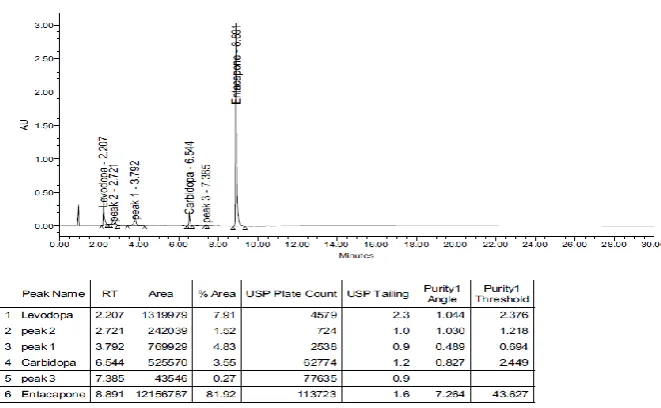
Degradation procedure Oxidation
To 1 ml of stock solution of Levodopa, Carbidopa and Entacapone, 1 ml of 20% hydrogen
peroxide (H2O2) was added separately. The solutions were kept for 30 min at 600c. For
HPLC study, the resultant solution was diluted to obtain 75µg/ml, 18.75 µg/ml
&100µg/ml solution and 10 µl were injected into the system and the chromatograms were
[image:11.595.148.449.508.715.2]recorded to assess the stability of sample. Figure 8.
Acid Degradation Studies
To 1 ml o f stock s solut ion Levodopa, Carbidopa and Entacapone, 1 ml o f 2N Hydrochloric
acid was added and refluxed for 30mins at 600c .The resultant solution was diluted
to obtain 75µg/ml, 18.75 µg/ml&100µg/ml solution and 10 µl solutions were injected
[image:12.595.129.460.209.413.2]into the system and the chromatograms were recorded to assess the stability of sample.
Figure 9.
Figure .9 Chromatogram for Acid degradation Alkali Degradation Studies
To 1 ml of stock solution Levodopa, Carbidopa and Entacapone, 1 ml of 2N sodium
hydroxide was added and refluxed for 30mins at 600c. The resultant solution was
diluted to obtain 75µg/ml, 18.75 µg/ml &100µg/ml solution and 10 µl were injected into the
[image:12.595.136.462.567.748.2]system and the chromatograms were recorded to assess the stability of sample. Figure 10.
Dry Heat Degradation Studies
The standard drug solution w a s placed in oven at 105 °C for 6 h to study dry heat
degradation. For HPLC study, the resultant solution was diluted to 75µg/ml, 18.75
µg/ml&100µg/ml solution and10µl were injected into the system and the chromatograms
[image:13.595.138.455.188.386.2]were recorded to assess the stability of the sample. Figure 11.
Figure .11 Typical Chromatogram for dry heat Degradation Photo Stability studies
The photochemical stabilit y of the drug was also studied by exposing the 75µg/ml, 18.75
µg/ml&100µg/ml solution to UV Light by keeping the beaker in UV Chamber for 7days or
200 Watt hours/m2 in photo stability chamber. For HPLC study, the resultant solution was
diluted to obtain 75µg/ml, 18.75 µg/ml&100µg/ml solutions and 10 µl were injected into the
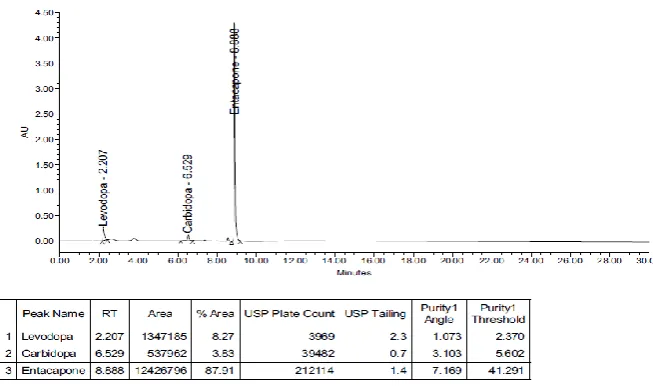
Neutral Degradation Studies
Stress testing under neutral conditions was studied by refluxing the drug in water for 6h r s
at a temperature of 60º. For HPLC study, the resultant solution was diluted to 75µg/ml,
18.75 µg/ml&100µg/ml solution and 10 µl were injected into the system and the
chromatograms were recorded to assess the stability of the sample. Figure 13 and All the
[image:14.595.134.461.208.401.2]above Forced degradation studies values represented by Table 6.
Figure .13 Typical Chromatogram for Natural Degradation Table 6 Forced degradation studies Results
Name of drug
Sample Treatment
% Assay
% Degradation
Purity Angle
Purity Threshold
Levodopa
Acid 97.65 2.35 0.44 2.376
Base 97.74 2.26 0.901 1.437
Peroxide 96.37 3.63 1.254 2.393
Thermal 99.41 0.059 0.941 1.375
Uv 99.52 0.48 0.778 0.985
Water 99.66 0.34 1.073 2.370
Carbidopa
Acid 96.82 3.18 0.827 2.449
Base 97.56 2.44 8.091 42.419
Peroxide 94.91 5.09 1.016 2.353
Thermal 98.75 1.25 0.256 0.956
Uv 99.16 0.84 1.261 3.533
Water 99.11 0.89 3.103 5.602
Entacapone
Acid 97.01 2.99 7.264 43.627
Base 97.50 2.5 8.091 42.419
Peroxide 96.57 3.43 8.869 44.339
Thermal 98.72 1.2 10.601 48.075
Uv 99.48 0.52 6.800 41.610
CONCLUSION
The stability indicating RP-HPLC method developed for simultaneous estimation of
Levodopa, Carbidopa and Entacapone is simple, selective, rapid and precise. The simplicity
and ease of operation of this duly validated method ensures that it can be successfully used
for routine estimation of these three drugs simultaneously in tablet dosage formulations.
The developed and validated method is precise, accurate, isocratic and stability-indicating
RP-HPLC analytical method. The method was validated for specificity, linearity, accuracy,
precision, and LOD, LOQ, robustness and system suitability. No interfering peaks were
found in chromatogram, indicating that the estimation of drugs is free from inference of
excipients. The rapid run time of 6 min and the relatively low flow rate (1 ml/min) allows the
analysis of large number of samples with less mobile phase that proves to be cost-effective.
Therefore, the developed method can be used for routine analysis for simultaneous estimation
and stability indicating studies of Levodopa, Carbidopa and Entacapone in bulk and
pharmaceutical dosage form.
ACKNOLEDGEMENT
The authors wish to thank Dr. Reddy’s Laboratories, Hyderabad for providing the gift
samples of all standard drugs (Levodopa, Carbidopa, and Entacapone).
REFERENCES
1. http//www.rx list.com/ Levodopa, Carbidopa and Entacapone.
2. The Merk Index: An encyclopedia of chemicals, drug and biologicals. 13th ed. White
House, Merck research laboratories., 2001; 301.
3. James ER. Martindale-The Complete Drug Reference. 33rd ed. London, Pharmaceutical
press, The Royal Pharmaceutical Society., 2005; 1169.
4. The Indian Pharmacopoeia, addendum, The Controller of Publication, New Delhi
1996,volume II, A-19 , A-169.
5. The United State Pharmacopoeia, 23rd ed., US Pharmacopoeia Convention Inc,
Rockville., 2004; 269.
6. Maitreyi Zaveri, Bhavita Dhru and Amit Khandhar “simultaneous estimation of
levodopa, carbidopa and entacapone in Pharmaceutical dosage by validated reverse phase
high Performance liquid chromatography, International Journal of Institutional Pharmacy
7. Nashwah GM, Mohamed SultanM, Determination of antiparkinsons drug entacapone,
J.Chil.Chem.Soc., 2010; 55(1): 85-89.
8. Suresh Kumar S, Natraj K, Khan A, Kumar B, Kalyan Rao J, Venkateswara J,
Development and Validation of RP-HPLC Method for simultaneous estimation of
Levodopa and Carbidopa in pharmaceutical dosage forms, J Pharm Res., 2011; 4(11):
40-60.
9. Prafullachandra T, Vinayak SM, Pai NR., Chandrabhanu M, Smruthi T, Estimation of
Entacapone tablets by Reverse Phase High Performance Liquid Chromatography Method,
Bioscience Discovery., 2011; 2(3): 294-298.
10.ICH Q2A; Guidelines on Validation of Analytical Procedure; Definitions and
terminology, Federal Register, 1994; 27 October 1-
11.ICH Q2B; Guidelines on Validation of Analytical Procedure; Methodology, Federal