F
F
O
O
R
R
M
M
U
U
L
L
A
A
T
T
I
I
O
O
N
N
A
A
N
N
D
D
E
E
V
V
A
A
L
L
U
U
A
A
T
T
I
I
O
O
N
N
O
O
F
F
S
S
U
U
S
S
T
T
A
A
I
I
N
N
E
E
D
D
R
R
E
E
L
L
E
E
A
A
S
S
E
E
M
M
E
E
T
T
O
O
C
C
L
L
O
O
P
P
R
R
A
A
M
M
I
I
D
D
E
E
H
H
Y
Y
D
D
R
R
O
O
C
C
H
H
L
L
O
O
R
R
I
I
D
D
E
E
M
M
A
A
T
T
R
R
I
I
X
X
T
T
A
A
B
B
L
L
E
E
T
T
A Dissertation work submitted to
THE TAMILNADU Dr. M.G.R.MEDICAL UNIVERSITY, CHENNAI
In partial fulfillment of the requirements for the award of degree of
MASTER OF PHARMACY
IN
PHARMACEUTICS
BY
REG. NO: 26105110
Under the guidance of
Dr. V. GANESAN, M. Pharm., Ph.D.,
Professor and Head
Department of Pharmaceutics
MAY-2012
THE ERODE COLLEGE OF PHARMACY & RESEARCH INSTITUTE
ERODE- 638112
The Erode College of Pharmacy & Research Institute
Dr. V. Ganesan, M. Pharm., PhD.,
Professor and Head,
Department of Pharmaceutics,
The Erode College of Pharmacy & Research Institute
Erode – 638112.
CERTIFICATE
This is to certify that the investigation in this thesis entitled
FO
F
OR
RM
MU
UL
LA
AT
TI
IO
ON
N
A
AN
ND
D
EV
E
VA
AL
LU
UA
AT
TI
I
ON
O
N
OF
O
F
SU
S
US
ST
TA
AI
IN
NE
ED
D
R
RE
EL
LE
EA
AS
SE
E
ME
M
ET
TO
OC
CL
LO
O
PR
P
R
AM
A
MI
ID
DE
E
H
HY
YD
D
RO
R
OC
CH
H
LO
L
OR
RI
ID
DE
E
MA
M
AT
TR
RI
IX
X
TA
T
AB
BL
LE
ET
T
submitted to the Tamil Nadu Dr.
M.G.R Medical University, Chennai, for the partial fulfillment of the award of
degree of
Master of Pharmacy
in
Pharmaceutics,
was carried out by
Regd. No.
26105110
in the department of pharmaceutics,
The Erode College of Pharmacy
and Research
Institute
,
Erode 638112
, under my guidance and supervision.
The Erode College of Pharmacy & Research Institute
Dr.V. Ganesan, M. Pharm., Ph.D.,
Principal,
The Erode College of Pharmacy and Research Institute,
Erode- 638112.
ENDORSEMENT BY THE PRINCIPAL
This is to certify that the investigation described in this dissertation entitled
“
FO
F
OR
RM
MU
U
LA
L
AT
TI
IO
ON
N
A
AN
ND
D
EV
E
VA
AL
LU
UA
AT
TI
IO
ON
N
O
OF
F
SU
S
US
ST
TA
AI
I
NE
N
ED
D
RE
R
EL
LE
EA
AS
SE
E
M
ME
ET
TO
OC
CL
LO
O
PR
P
R
AM
A
MI
ID
DE
E
H
HY
YD
DR
RO
O
CH
C
HL
LO
OR
R
ID
I
DE
E
MA
M
A
TR
T
RI
IX
X
TA
T
AB
BL
LE
ET
T”
”
,
submitted
in Partial fulfillment of the requirements for the Degree of
Master of Pharmacy
in
PHARMACEUTICS
was carried out in the laboratories of The Erode College
of Pharmacy and Research Institute, Erode by
Reg. No. 26105110
under the
guidance of
Dr. V. GANESAN, M. Pharm., Ph.D., Principal,
The Erode
College of Pharmacy and Research
Institute
,
Erode 638112
, during the
academic year 2011-2012.
DECLARATION
The research work embodied in this dissertation entitled
FO
F
OR
RM
MU
UL
LA
A
TI
T
IO
ON
N
AN
A
N
D
D
E
EV
VA
AL
LU
UA
A
TI
T
IO
ON
N
OF
O
F
SU
S
US
ST
TA
AI
IN
NE
ED
D
RE
R
EL
LE
EA
AS
SE
E
ME
M
ET
TO
OC
CL
LO
OP
PR
RA
A
MI
M
I
DE
D
E
H
HY
YD
D
RO
R
OC
CH
H
LO
L
OR
RI
ID
DE
E
MA
M
AT
TR
RI
IX
X
TA
T
AB
BL
LE
ET
T
was carried out by me in the
Department of Pharmaceutics
,
The Erode College of Pharmacy & Research
Institute, Erode
, under the direct supervision of
Dr. V. GANESAN, M. Pharm.,
Ph.D., Principal,
Dept. of Pharmaceutics, The Erode College of Pharmacy &
Research Institute, Erode – 638 112.
This dissertation submitted to
The Tamil Nadu Dr. M.G.R Medical
University
,
Chennai,
as a partial fulfillment for the award of
Degree of Master of
Pharmacy
in Pharmaceutics during the academic year 2011 – 2012
The work is original and has not been submitted in part or full for the award
of any other Degree or Diploma of this or any other University.
Place:Erode
ACKNOWLEDGEMENT
The grace of the
GOD
and sincere hard work has made the presentation of this
dissertation possible. A sense of triumph is very much justified at this stage of
completion of my dissertation. It’s a pleasure to utilize this opportunity of
acknowledging all those people who have helped me to complete my dissertation.
First of all, it is by the love and blessings of God and my parents that I am able
to complete my investigation studies successfully and I present this piece of work
which I am eternally indebted.
I owe a debt of gratitude to my Research Guide
Dr. V.GANESAN, M.
Pharm., Ph.D., Principal,
THE ERODE COLLEGE OF PHARMACY AND
RESEARCH INSTITUTE, Erode
for spending her valuable time for giving me
knowledge and in successful completion of my research work..
I now take this opportunity to express sincere thanks to our
Principal,
Dr. V. Ganesan, M.Pharm, Ph.D.,
for valuable guidance and constant
encouragement throughout the project work.
I am also thankful to
Mr.A.Natarajan,
Secretary and Correspondent
and
Mr. M. Thangamuthu,
President, The Erode College of pharmacy
and Research Institute.
I am also thankful to our Head of the Department
Mr. S. P. Senthil.,
M.Pharm. (Ph.D),
Assistant Professor
,
THE ERODE COLLEGE OF
PHARMACY AND RESEARCH INSTITUTE, Erode
for his valuable support
and encouragement.
Finally I am glad to express my warm gratitude to all my friends
Mr.
Amode, Mayur, Bhushan, Aziz, Jayesh, Bhupendra, Chetan, All My
friends & Juniors
for their kind co- operation and help rendered at various
stages. All their efforts and valuable time is always an unforgettable part for
me.
From deepest depth of my heart I express my love and gratitude for my
beloved
Parents
and
family
for giving me more than what I deserved, what I
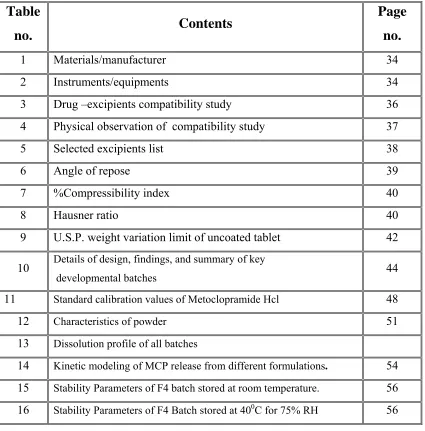
LIST OF TABLES
Table
no.
Contents
Page
no.
1 Materials/manufacturer 34
2 Instruments/equipments 34
3 Drug –excipients compatibility study 36
4 Physical observation of compatibility study 37
5 Selected excipients list 38
6 Angle of repose 39
7 %Compressibility index 40
8 Hausner ratio 40
9 U.S.P. weight variation limit of uncoated tablet 42
10 Details of design, findings, and summary of key
developmental batches 44
11 Standard calibration values of Metoclopramide Hcl 48
12 Characteristics of powder 51
13 Dissolution profile of all batches
14 Kinetic modeling of MCP release from different formulations. 54
15 Stability Parameters of F4 batch stored at room temperature. 56
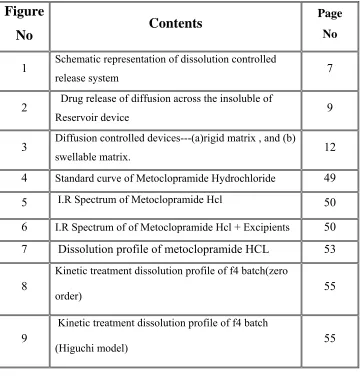
[image:7.612.96.521.126.557.2]LIST OF FIGURE
Figure
No
Contents
Page No
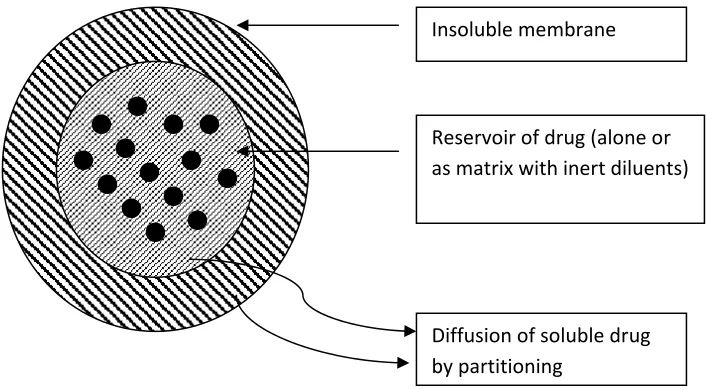
1 Schematic representation of dissolution controlled
release system 7
2 Drug release of diffusion across the insoluble of
Reservoir device 9
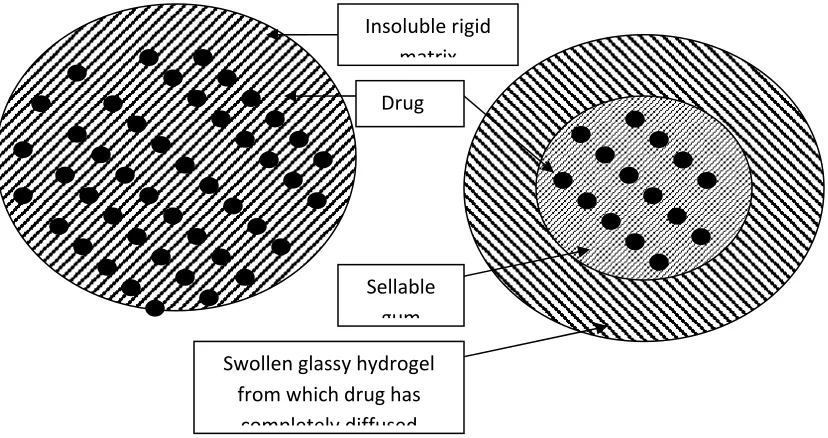
3 Diffusion controlled devices---(a)rigid matrix , and (b)
swellable matrix. 12
4 Standard curve of Metoclopramide Hydrochloride 49
5 I.R Spectrum of Metoclopramide Hcl 50
6 I.R Spectrum of of Metoclopramide Hcl + Excipients 50
7 Dissolution profile of metoclopramide HCL 53
8
Kinetic treatment dissolution profile of f4 batch(zero
order) 55
9
Kinetic treatment dissolution profile of f4 batch
Abbrevations
λmax = Wavelenght of maximum absorption
Cm = Centimeter
CAP = Cellulose Acetate Phatlate
Conc.= Concentration
Fig. = Figure
FTIR = Fourier Transform Infrared
Gm = Gram
GI = Gastro Intestinal
HCL = Hydrochloric acid
HPMC = Hydroxypropyl methyl cellulose
IPA = Isopropyl alcohol
I P = Indian Pharmacopoeia
[image:9.612.68.272.141.680.2]Kg = Kilogram
MCC = Micro crystalline cellulose
Mm = Millimeter
Mg = Milligram
Ml = Milliliter
MCP = Metoclopramide
Ng = Nanogram
PEG = Poly ethylene Glycol
RH = Relative Humidity
RS = Reference Standard
SR = Sustained Release
USP = United States Pharmacopoeia
CONTENTS
Sr. no. Particulars Pageno.
1.
2.
3.
4.
5.
6.
7.
8.
9.
INTRODUCTION
REVIEW OF LITERATURE
DRUG AND EXCIPIENT PROFILE
AIM AND OBJECTIVE PLAN OF WORK
MATERIALS AND METHOD
EXPERIMENTAL
RESULTS AND DISCUSSION
SUMMARY AND CONCLUSION
BIBLIOGRAPHY
1
18
26
33
34
44
46
57
ABSTRACT
Metoclopramide hydrochloride (MCP) is commonly used for the management ofgastrointestinal
disorders. Frequent administration and the undesired side effects (extrapyramidal symptoms) of
the drug on the central nervous system due to the fluctuationsof its plasma concentrations may
lead to patient incompliance, and hence, impropertherapy. Therefore, the present work will be
devoted to formulate the drug in sustainedrelease formulations. Metoclopramide hydrochloride
MCP was incorporated in 7 formulae containing differentpolymers and/or different polymer
ratios. These polymers were hydroxypropylmethylcellulose (HPMC), Sodium
carboxymethylcellulose (CMC).Mannitolwas added to f4-f7 formulae in different amounts in
order tosoften and/or disintegrate the tablets. Both direct compression and
granulationtechniques were used to prepare the tablets. The physical properties were found to
besatisfactory for all the formulae. The dissolution profiles of the tablets were constructedusing
the change-over method. The drug release involved a combination of bothdiffusion and
polymer-chain relaxation mechanisms. The time required to release 50%of MCP ranged from
1.2 to more than 8 hours. Direct compression technique produced sufficient sustaining of the
drug release.
INTRODUCTION
Oral drug delivery has been known for decades as the most widely utilized route of administered among all the routes that have been employed for the systemic delivery of drug via various pharmaceutical products of different dosage forms. The reasons that the oral route achieved such popularity may be in part attributed to its ease of administration and the belief that oral administration of the drug is well absorbed1.
All the pharmaceutical products formulated for systemic delivery via the oral route of administration irrespective of the mode of delivery (immediate sustained or controlled release) and the design of dosage forms (either solid dispersion or liquid) , must be developed within the intrinsic characteristics of GI physiology , pharmacokinetics , pharmacodynamics and formulation design is essential to achieve a systemic approach to the successful development of an oral pharmaceutical dosage form.2,3
RATIONAL OF SUSTAINED AND CONTROLLED DRUG DELIVERY
SUSTAINED AND CONTROLLED RELEASE DRUG DELIVERY SYSTEMS
Over the Past 30 years, as the expense and complications involved on marketing new drug entities have increased , with concomitant recognition of the therapeutic advantages of controlled drug delivery , greater attention has been focused on development of sustained or controlled release drug delivery systems. The attractiveness of these dosage forms is due to awareness to toxicity and infectiveness of drugs when administered or applied by conventional method in the form off tablets, capsules , injectables , ointments etc. Usually conventional dosage form produces wide- ranging fluctuation in drug concentration in the bloodstream and tissues with consequent undesirable toxicity and poor efficiency. These factors as well as factors such as repetitive dosing and unpredictable absorption lead to the concept of controlled delivery systems. The goal in designing sustained or controlled delivery system is to reduce the frequency of the dosing or to increase effectiveness of the drug by localization at the site of action, reducing the dose required or providing uniform drug delivery. So sustained release dosage form is a dosage form that release one or more drugs continuously in predetermined pattern for a fixed period of time, either systematically or to a specified target organ. Sustained release dosage forms provide a better control of plasma drug level, less dosage forms provide a better control of plasma drug levels, less dosage frequency, less side effect, increased efficiency and constant delivery.
2.1 Terminology4
Modified release delivery system may be divided conveniently into four categories.
Delayed release:
These systems are those that use repetitive, intermittent dosing of a drug from one or more immediate release units incorporated into a single dosage form. Examples of delayed release systems include repeated action tablets and capsules and enteric-coated tablets where timed to release is achieve by a barrier coating.
Sustained release:
These systems include any drug delivery system that achieves slow, release of drug over an extended period of time.
Controlled release:
These system also provide a slow release of drug over an extended period of a time and can provide some control, whether this be of a temporal or spatial nature, or both, of drug release in the body, or in other words, the system is successful at maintaining constant drug levels in the target tissue or cells.
Extended Release:
Pharmaceutical dosage forms that release the drug slower than normal manner of predetermined rate & necessarily reduce the dosage frequency by two folds.
Site specific targeting drug delivery:
Receptor targeting Drug Delivery:
These systems refer to targeting of a drug directly to a certain biological location. In this case the target is the particular receptor for a drug within an organ or tissue.
Site specific targeting & receptor targeting systems satisfy the spatial aspect of drug delivery & are also considered to be controlled drug delivery system.
2.2 Release Rate and Dose Consideration:
As already mention, conventional dosage forms include solutions, Capsules, tablets, emulsions, aerosols, foams, ointment & suppositories. These dosage forms can be release their active ingredients into an absorption pool immediately.
Kr KaKe
Dosage form ---Æ Absorption pool ----Æ Target area----ÆElimination
Drug Release absorption
Kr = First order rate constant for drug release.
Ka = First order rate constant for drug absorption.
Ke = First order rate constant for overall drug elimination.
For immediate release dosage forms Kr >>> Ka or alternatively absorption of drug across a biological membrane is the rate- limiting step in delivery of the drug to its target area.
Kr Ke
Dosage form ---Æ Target Area ---Æelimination
Drug Release
Thus, the effort to develop a no immediate release delivery system must be directed primarily by altering the release rate by affecting the value of Kr.
The ideal goal of designing sustained –release system is to deliver drug to the desired site at a rate according to needs of the body,i.e., a self regulated system based on its feedback control the release system but this is a difficult assignment.
The pivotal question is at what rate should be drug delivered to maintain a constant blood drug level? This constant rate should be analogous to that achieved by continuous intravenous infusion where a drug is provided to the patient at a constant rate s just equal to its rate of elimination. This implies that the rate of delivery must be independent on the amount of drug remaining in the dosage form & constant over time. That is , release from the dosage form should follow Zero-order kinetics, as shown by,
Kro = Rate in=Rate out= Ke Cd Vd
Where
Kro= Zero order rate constant for drug release(amount/time)
Ke = First order rate constant for overall drug elimination(time”)
Cd= Desired drug level in the body(amount/volume)
For many drug, more complex elimination kinetics and other factors affects their deposition. This is then affects the nature of release kinetics necessory to maintain a constant drug level. It is important to recognize that while Zero - order release may be desirable theoretically; non Zero-order release may be equivalent clinically to constant release in many cases. Aside from the extent of intra and inter subject variation is the observation that for many drugs, modest changes in drug tissue levels do not result in an improvement in clinical performance. Thus, a constant drug level may be indistinguishable clinically from a constant drug level.
To achieve a therapeutic level promptly and sustain the level for a given period of time, the dosage generally consists of two parts: an initial primary dose, Di, that releases drug immediately and a maintenance or sustaining dose, Dm.
The total dose, W, thus required for the system is
W= Di |+ Dm
For a system in which the maintenance dose releases the drug by a zero order process for a specified period of time, the total dose is
W= Di + Kr0 Td
Kr0= Zero order rate constant for drug release
Td = Total time desired for a sustained release from one dose.
W=Di + Kr0 Td – Kr 0 Kr 0Tp
The correction factor , Kr 0Tp is the amount of drug provided during the period from t=0 to the time of the peak drug level , Tp No correction factor is needed if the dosage form is constructed in such a fashion that the maintenance dose not begin to release drug until time Tp.
Suitable combination of the initial dose and maintenance dose that releases its drug can be obtained satisfactorily in approximation of a constant drug level by a first order process.
The total dose for such a system is
W=Di +(KeCd/Kr)Vd
Kr = first order drug release constant (time 1)
If the maintenance dose begins releasing drug at t = 0, a correction factor is required just as it was in the zero order case. The correction expression in this case
W= Di +(KeCd/Kr)Vd-DmKeTp
2.3Oral Sustained and controlled Release System:
• Total 5 types of oral controlled release systems are available. • Dissolution controlled release system.
• Diffusion controlled system.
• Bioerodible and combination diffusion and dissolution system. • Osmotically controlled release system.
• Ion exchange systems.
2.3.1 Dissolution controlled release system: 6
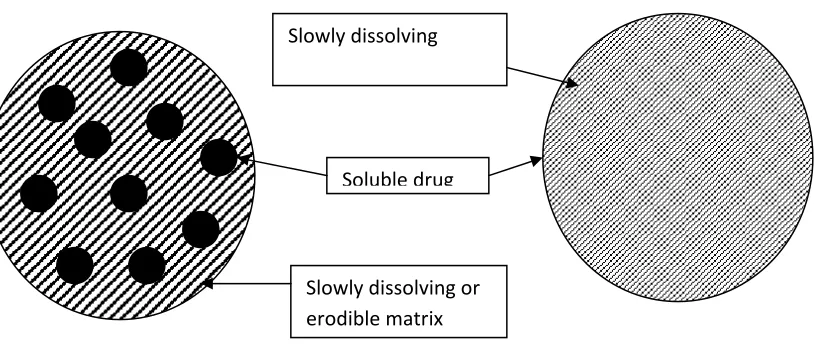
[image:20.612.80.487.420.592.2]A drug with a slow dissolution rate will sustain release rate of the drug from the dosage form. Here the rate –limiting step is dissolution.This is true, sustain release preparation of drugs could be made by decreasing their rate of dissolution. These approaches are achieved by preparing appropriate salts or derivatives, coating the drug with a slow dissolving material or incorporating it into a tablet with a slowly dissolving carrier.
Figure .1. Schematic representation of dissolution controlled release system
(a) matrix system ,
(b) coated / encapsulated system
Soluble drug
Dissolution controlled systems can be made either by rate controlling coats or by administering the drugs as a group of beads that have coating of different thickness. In first case if the outer layer is a quickly releasing bouls of drug, initial levels of drug in the body can be quickly established with plused intervals.
In second case since the beads have different coating thickness; there release will occur in progressive manner. Those with the thinnest layer will provide the initial dose and the maintenance of drug levels at later times will be achieved from those with thicker coating. The Noyes – Whitney equation, describes this dissolution process at steady state
Dc D
---- = KD A (Cs-C) = ---- A (Cs-C)
Dt h
Where,
Dc/dt = dissolution rate
Kr = dissolution rate constant.
D = diffusion coefficient
Cs = Saturation solubility of the solid.
C = Concentration of solute in the bulk solution.
The above equation predicts that the rate release can be constant only if the following parameters are constant.
b) Diffusion coefficient c) Diffusion layer thickness i. Concentration difference.
But these parameters are not easily maintained constant, especially surface area. For spherical particles, the change in surface area can be related to the weight of the particle that is under assumption of sink conditions, above equation can be rewritten as cube root dissolution equation.
W0 1/3 - W 1/3 = KDt
Where,
Kd = cube root dissolution rate constant
Wo = Initial weight
W = weight of the amount remaining at time t
2.3.2 Diffusion systems:
In this system release rate of a drug being dependent on its diffusion through an inert membrane barrier. Usually, this barrier is an insoluble polymer , it’s again having two subclasses.
a) Reservoir devices b) Matrix devices.
a) Reservoir devices:
Figure 2.Drug release of diffusion across the insoluble membrane of Reservoir device
The process of diffusion is described by Ficks equation. This equation states that the amount of drug passing across a unit area is proportional to the concentration differences across that barrier.
The equation is given as
J= Ddc/dx………(1)
Where ‘J’ given in units of amount/area-time, ‘D’ is the diffusion coefficient of the drug in the membrane (Area/time), dc/dx represents the rate of change in concentration ‘C’ relative to a distance ‘X’ in the membrane.
Equation (1) can be integrated and simplified to give.
Insoluble membrane
Reservoir of drug (alone or as matrix with inert diluents)
J=DK C/d ……… (2)
Where
K = Partition co-efficient
c = Concentration difference across the membrane.
d = Thickness of the diffusion layer.
In the equation (2) it is assumed that “D” and ‘k’ are constant.
Drug release will vary, depending on the geometry of the system 6 ..The Simplest system to consider is that of a slab, where drug release is from only one surface. In this case equation (2) can be written as
dMt= ADK C ---(3)
dt d
Where
‘Mt’ is the mass of drug released after time‘t’
d Mt /dt the steady – state release rate at time ‘t’ and
‘A’ the surface area of the device.
devices, a system that is used relatively soon after construction will demonstrate a large time in release, since it will take time for
the drug to diffuse from the reservoir to the membrane surface. On the other hand, systems that are stored will demonstrate a burst effect, since, on standing the membrane becomes saturated with available drug. The magnitude of these effects is dependent on the diffusing distance (i.e. the membrane thickness).
Advantages:
i) This device can offer zero-order release of the drug.
ii) Kinetics of a particular drug can be controlled by changing the characteristics of the polymer to meet the particular therapeutic conditions.
Disadvantages:
i) System must be physically removed from implant sites. ii) Difficult to deliver high molecular weight compounds. iii) Generally increased cost per dosage unit.
iv) Potential toxicity if system fails.
a) Matrix devices:
Figure.3. Diffusion controlled devices---(a)rigid matrix , and (b) swellable matrix.
The rate of release of drugs dispersed in an inert matrix system , have been derived by Higuchi.
dM / dh =Codh-Cs/2. –(1)
Where,
dM = Change in the amount of drug released per unit area.
dh = change in the thickness of the zone of matrix that has been depleted of
drug.
Co = total amount of drug in a unit volume of the matrix.
Cs = saturated concentration of the drug within the matrix.
From diffusion theory,
dM = (DmCs/h). dt ---(2)
Insoluble rigid matrix
Drug
Swollen glassy hydrogel from which drug has
completely diffused Sellable
Where,
Dm is the diffusion coefficient in the matrix
equation (1) and (2) integrating and solving for ‘h’ gives.
M =[(CsDm2C0-Cs) t]1/2 ---(3)
When amount of drug is in excess of the saturation concentration that is Co>> Cs
M = [2CsDmCot] 1/2 ---(4)
Equation (4) indicates that the amount of drug released is a function of the square root of time.
The drug release from a porous or granular matrix can be described by
M= (Ds. Ca {P/T} [2Co –Pca]t)1/2
Where
P = porosity of the matrix.
T = tortuosity
Ca = solubility of the drug in the release medium
D5 = diffusion coefficient in the release medium.
The system is slightly different from the previous matrix system in that the drug is able to pass out of the matrix through fluid filled channels and does not pass through the polymer directly
Advantages of matrix diffusion system: i) Easier to produce that reservoir devices.
Disadvantages of matrix diffusion system:
i) Cannot obtain zero order release.
ii) Removal of remaining matrix is necessary for implanted system.
2.3.3. Bioerodible and combination diffusion and dissolution systems7,8,9
Therapeutic systems are not only dependent on either dissolution or diffusion system. In practice, the dominant mechanism for release will be either dissolution rate limited or diffusion controlled Bioerodible devices constitute a group of system for which release characteristics are complex. The mechanism of release from simple erodible slabs, cylinders and spheres can be described by following mathematical model.
Mt /M = 1-(1-Kot/Coa)n
Where,
Mt = Mass of drug release at time t
M = Mass release at infinite time
a = Radius of sphere or cylinder or the half height of a slab.
n = 3 for a sphere, 2 for a cylinder and 1 for a slab.
This system is the combination of both diffusion and dissolution of matrix material and the drug. Drug not only can diffuse out of the dosage form but the matrix itself undergoes a dissolution process.
An advantage of such a system is that the bioerodible property of the matrix does not result in a host matrix. The disadvantage of these matrix systems is that release kinetics is often hard to control.
Another method for the preparation of bioerodible system is to attach the drug directly to the polymer by a chemical bond. Generally drug is released from the polymer by hydrolysis or enzymatic reactions.
Advantage of such system is control of the rate of release somewhat easier. Another advantage of the system is the ability to achieve very high drug loading.
Third type is the swelling controlled matrix. Here the drug is dissolved in the polymer, but instead of an insoluble or eroding polymer. Swelling of the polymer occurs. This allows entrance of water, which causes dissolution of the drug and diffusion out of the swollen matrix. In these systems the release rate is highly dependent on the polymer swelling rate, drug solubility and the amount of soluble fraction in the matrix. This system usually minimizes burst effects, since polymer swelling must occur before drug release.
2.3.4. Osmotically controlled system:
In these systems, osmotic pressure provides the driving force to generate controlled release of drug. In this system a tablet containing a core of drug surrounded by a semipermiable membrane, which is permeable to water, but not to drug. When this device is exposed to water or any body fluid, water will flow into the tablet owing to the osmotic pressure difference. The rate of flow , dv/dt, of water into the device can be represented by as.
Dv/dt = AK/h ( T - P)
Where,
K = Membrane permeability
A = Area of the Membrane
T = Osmotic pressure difference
P = Hydrostatic pressure difference.
These systems are generally appear in two different forms:
• The drug as a solid core together with electrolyte, which is dissolved by the incoming water. The electrolyte provides the high osmotic pressure difference.
• This system contains the drug in solution in an impermeable membrane within device. The electrolyte surrounds the bag.
Advantages:
i. This system can deliver large volumes and some are refillable. ii. Release of drug is in theory independent of the drug’s properties. iii. Zero order release is obtainable.
Disadvantages:
i. Systems can be much more expensive than conventional counterparts. ii. Quality control is more expensive than most conventional tablets.
2.3.5. Ion exchange systems:
This system generally uses resins composed of water insoluble cross linked polymers. These polymers contain salt forming functional groups in repeating positions on the polymer chain. The drug is bound to the resin and released by exchanging with appropriately changed ions in contacting with the ion exchange groups.
Resin +- drug-+x ---Æ Resin+- X-- + drug –
Resin +- drug-+Y ---Æ Resin+- Y-- + drug +
The rate of drug diffusing out of the resin is controlled by the area of diffusion, diffusion path length and rigidity of the resin, which is a function of the amount of cross-linking agent used to prepare the resin.
The system is advantageous for drugs that are highly susceptible to degradation by enzymatic process, since it offers a protective mechanism by temporarily altering the substrate. The limitation of this system is to release rate which is proportional to the concentration of the ions present in the area of administration.
2.4Drug properties relevant to controlled release formulation :
The design of controlled –release delivery system is subject to several variables of considerable importance. Among these are the route of drug delivery, the type of delivery system, the disease being treated, the patient, the length of therapy and the properties of the drug. Each of these variables are interrelated and this imposes certain constrains upon choices for the route of delivery, the design of the delivery system and the length of therapy. Properties of drugs are very important for designing a sustained release dosage form mainly physicochemical and biological properties of the drug are most important.
2.5Metoclopramide and ExtrapyramidalSymptoms:
10-mg dose of metoclopramide.Keywords: metoclopramide, extrapyramidal symptoms, drug induced movement disorders, akathisia, case study, perianesthesiacare.
LITERATURE REVEIW
ShalinModiet al(2011)10:Now a days as very few drugs are coming out of research and
development and already existing drugs are suffering the problem of resistance due to their irrational use specifically in case of drugs like antibiotics. Hence, change in the operation is a suitable and optimized way to make the some drug more effective by slight alteration in the drug delivery.Sustained Release is also providing promising way to decrease the side effect of drug by preventing the fluctuation of the therapeutic concentration of the drug in the body. This article contains the basic information regarding sustained-release formulationand also the different types of the same.
Ramdaset al (2011)11: Oral sustained release dosage forms are the most commonly formulated
but still offer highest attention in the area of novel drug delivery systems. (1-2). This system can also help in optimizing oral controlled delivery of drugs having ‘absorption window’ by continuously releasing drug prior to absorption window, for prolonged period of time thus causing optimal bioavailability (3). Gastric emptying of dosage forms is an extremely variable process and ability to prolong and control the emptying time is a valuable asset for dosage forms, which reside in the stomach for a longer period of time than conventional dosage forms (4). Prolonged gastric residence time (GRT) and controlled release of drugs within the GI tract helps to reduce dosing frequency and total dose, improve patient compliance and convenience, maintain a less fluctuating plasma level, as well as reduce GI side effects. Prolonging the GRT of therapeutic agents is thought to be beneficial especially under several circumstances such as for drugs acting topically on the gastric region, for drugs with a narrow therapeutic window or for drugs with the major absorption site in the upper GI tract (5-6).
S.A. Modiet al (2011)12:The objective of the present study is to prepare sustained release drug
contained Drug: Guar gum: Xanthan gum in the ratio 1:2:1 and 1:2:2 respectively, showed desire drug release rate up to 10 hour.
Indranil Kumar Yadavet al (2010)13:The objective of the present study was to develop the oral
sustained release matrix tablets of aceclofenac using hydrophilic and hydrophobic polymers. Aceclofenac is a non steroidal anti-inflammatory agent used in symptomatic treatment of rheumatoid arthritis, osteoarthritis and ankylosing spondylitis and its biological half life is 4 hrs. FTIR studies were carried to know the interaction between the drug and polymer. Controlled release formulations of aceclofenac (200 mg) were prepared by direct compression method. The tablets were subjected to physicochemical, invitro drug release and stability studies. Optimization of the formulation was done by studying effect of drug to polymer ratio on drug release. FTIR studies indicated absence of any interaction between aceclofenac and polymers. The physicochemical properties of tablets were found within the limits. The drug release from optimized formulations F1, F4 and F7 was extended for a period of 12 hrs. The kinetic treatment to optimized formulations showed that the release of drug follows zero order model and Super Case II transport for F1 and F7 while the drug release of F4 was best explained by Higuchi’s model and Super Case II transport. Release of the drug was retarded with increase in polymer concentrations. The optimized formulations were subjected to stability studies for three months at 45° temperature with RH 75±5%, and showed stability with respect to physicochemicalparameters and release pattern. Results of the present study indicated the suitability of hydrophilic and hydrophobic polymers in the preparation of matrix based sustained release formulation of aceclofenac.
R.Charulathaet al (2012)14:Carbamazepine is a widely used anti-epileptic drug in the therapy of
hours. All the physical characters of the fabricated tablet were within acceptable limits. In vitro release profile of marketed controlled release formulation (tegretol) showed the drug release 84% in 12th hour,where as our selected formulations F13 (HPMCK4m) released at 88% of drug in 12th hour respectively. The relative bioavailability of the selected formulation was 0.435 μg/ml of tmax at 12 hr compared with marketed product of 0.369μg/ml. The stability studies showed that it followed zero order kinetics when fitted to kinetic models (Higuchi, Hixson and Peppas).It was clear from the dissolution profile of carbamazepine from matrix tablets prepared using different polymers were indicated an increase in the polymer ratio retarded the drug release to a greater extent. As a concluding remark, F13 carbamazepine matrix tablet showed better oral bioavailability than the marketed tablet, and further animal studies/human studies could be under taken with large number of subjects in order to confirm these results.
V.C. Modiet al (2010)15:Sustained releases tablets of Diltiazem hydrochloride were formulated
by employing hydroxypropyl methylcellulose (HPMC K100 M) and the sustained release behaviour of the fabricated tablets was investigated. Sustained release matrix tablets containing 120 mg Diltiazem hydrochloride were developed using different drug: polymer (HPMC K100 M) ratios. Tablets were prepared by wet granulation technique. Formulation was optimized on the basis of acceptable tablet properties and invitro drug release. The resulting formulation produced robust tablets with optimum hardness, consistent weight uniformity and low friability. All tablets but one exhibited gradual and near-complete sustained release for Diltiazem hydrochloride (96-100%) at the end of 24 h. The results of dissolutionstudies indicated that formulation B5 (drug to polymer 1:1.25) was found to be most successful as it exhibits drug release pattern very close to theoretical release profile. A decrease in release kinetics of the drug was observed on increasing polymer ratio.
Kamlesh J. Wadheret al (2011)16:Metformin hydrochloride is recommended globally as first
blends, matrix tablets based on S-100/RLPO and S-100/RSPO mixtures gave the more sustained release pattern. The excipients used in this study did not alter physicochemical properties of the drug, as tested by Fourier transform Infrared Spectroscopy and the thermal analysis using differential scanning calorimetry. All the batches were evaluated for thickness, weight variation, hardness, and drug content uniformity. The in vitro drug dissolution study was carried out using USP 22 apparatus II, paddle method and the release mechanisms were explored. Mean dissolution time is used to characterize drug release rate from a dosage form and indicates the drug release retarding efficiency of polymer. Kinetic modeling of in vitro dissolution profiles revealed the drug release mechanism ranges from diffusion controlled to anomalous type. Fitting the data to Korsmeyer equation indicated that diffusion along with erosion could be the mechanism of drug release.
R. Gendleet al (2010)17: The objective of this work was to develop sustained release tablets of
highly water soluble Tramadol HClusing polymers (HPMC K100M, HPMC K15M, HPMC K 4M) as cost effective, non toxic easily available and suitablehydrophilic matrix system. Sustained release tablet of Tramadol HCl (dose 50mg) were produced by wet granulationmethod. After the evaluation of physical characteristics of tablets. The dissolution test was performed in 0.1 N HCl fortwo hr. and phosphate buffer pH 6.8 for ten hr. The release profile remains unchanged after three months storage oftablets. The best fit release kinetics was achieved with the zero order plot followed by the Higuchi and Korsmyer andPeppas equation. The data obtained proved that the formulations are useful for a sustained release of Tramadol HCl dueto the percentage released after 12 hr. is nearly to 100%.
Suresh V Kulkarni43 et al., (2010)20:investigation an attempt was made to reduce
Zeroorder to evaluate the kinetics and mechanism of the drug release was found to bediffusion coupled with erosion.
RaghavendraRao N.et al., (2009)21:was to develop sustained release matrix tablets of water
soluble Tramadol hydrochloride using different polymers viz.Hydroxy propyl methyl cellulose (HPMC) and natural gums like Karaya gum (KG)and Carrageenan (CG). Varying ratios of drug and polymer like 1:1 and 1:2 wereselected for the study. After fixing the ratio of drug and polymer for control therelease of drug up to desired time, the release rates were modulated by combinationof two different rates controlling material and triple mixture of three different ratecontrolling material. After evaluation of physical properties of tablet, the in vitro release study was performed in 0.1N HCl pH 1.2 for 2 hrs and in phosphate buffer pH 6.8 up to 12 hrs. The effect of polymer concentration and polymer blendconcentration were studied. Different ratios like 80:20, 60:40, 50:50, 40:60 and 20:80were taken. Dissolution data was analyzed by Korsmeyer-Peppas power lawexpression and modified power law expression. It was observed that matrix tabletscontained polymer blend of HPMC/CG were successfully sustained the release ofdrug upto 12 hrs. Among all the formulations, formulation F16 which contains 20%HPMC K15M and 80% of CG release the drug which follow Zero order kinetics via, swelling, diffusion and erosion and the release profile of formulation F16 was comparable with the marketed product. Stability studies (40±2ºC/75±5%RH) for 3months indicated that Tramadol hydrochloride was stable in the matrix tablets. TheDSC and FTIR study revealed that there was no chemical interaction between drugand excipients.
Jolly M. Sankalia49 et al., (2008)22:examined in vitro–in vivo correlation for
glipizidehydrophilic sustained-release matrices tablets on various polymers like ethyl cellulose, microcrystalline cellulose, hydroxyl propyl methylcellulose, xanthan gum,guar gum, Starch 1500, and lactose on in vitro release profiles was studied and fittedto various release kinetics models.
Alok Rayet al (2003)23:studied the role of modulating factors such as drug topolymer ratio, drug
following observation on releaserate were made using Korsmeyer–Peppas's and Higuchi's equations I) thecompaction pressure had no significant effect on release. ii) the effect of particle sizepolysaccharide on release was insignificant except in the range of 250-150 microns.iii) the increase in polymer content showed decreases in both rate of release anddissolution. Iv) the increase in drug loading showed the rate of release anddissolution decreased. v) the presence of lubricant up to 2% had no effect on the rateof release. The mechanism of release was found to be anomalous (n>0.5) in all thecases.
Jordanet al25 “Metoclopramide HCl showed controlled release behavior when embedded in a
hydrophilic matrix of chitosan and sodium alginate. The in vitro release data was found to be first order according to the Higuchi mechanism. An in vivo evaluation of the metoclopramide controlled release matrix on six male volunteers was carried out. The plasma samples were analyzed using a high-performance liquid chromatography (HPLC) method using a mobile phase of acetonitrile:acetic acid (30:70), with the pH adjusted to 4.7, a reverse phase Hypersil BDS Phenyl column (4 μm, 250×4 mm) and the detection was performed at 305 nm. The controlled release formula was found to be effective in delaying absorption (tmax 4.5 h as compared to 1.2 h), reducing the peak plasma concentrations (Cmax 63.4 ng/ml as compared to 95.9 ng/ml) and maintaining higher concentrations during the elimination phase when compared to the immediate release formula. This proves the suitability of the suggested system for further studies.”
disintegration time (Y1) and release at 15 minutes (Y2). Response surface plots were drawn, and optimum formulations were selected by grid search method. X1, X2 and X3 when used individually gave satisfactory results but when used in combination gave better results. The results showed a good relationship between the experimental and predicted values, which confirms the predictability of the model.”
R F Thoeni et ai27 “The value of orally administered metoclopramide hydrochloride to enhance
bowel opacification during abdominal and pelvic computed tomography (CT) was analyzed prospectively in 202 patients in a control group and 334 patients in an experimental group who received 10 mg of metoclopramide with the first dose of oral contrast material. Five hundred milliliters of 2% sodium diatrizoate was given orally 45-60 minutes and 30 minutes before the study, and 250 mL was given 5-10 minutes before the study. Opacification of stomach, duodenum, and small and large bowels was graded from 0 to 3+, and the presence of pseudotumors or side effects from metoclopramide were noted. No significant difference was found in the opacification of stomach, duodenum, and jejunum between control and experimental studies. Opacification was significantly better in metoclopramide studies than control studies in the proximal ileum (P less than .05), distal ileum (P less than .05), right colon (P less than .05), and transverse colon (P less than .05). Pseudotumors were seen in 7% of control and 3% of experimental subjects. No side effects were encountered. Routine oral administration of metoclopramide before abdominal and pelvic CT examinations is recommended for rapid opacification of the ileum and proximal colon for all outpatients and for inpatients who must undergo CT on an emergency basis.”
V. F. Patel et al (2007)24studied the influence of viscosity of hydroxypropyl methyl cellulose
It was observed as the viscosity of polymer increases the release rate constant was decreased. Release rate obtained was highest when microcrystalline cellulose was employed as filler followed by dicalcium phosphate and lactose. Mechanism of release was anomalous type and depends upon viscosity of polymer and types of filler used. A major controlling factor for kinetics of drug release was viscosity of polymer and it can be modified by incorporation of different types of filler.
Santanu Ghosh41 et al., (2010)18: was to develop matrix tablets for oral controlledrelease of
aceclofenac. Matrix tablets of aceclofenac, using various viscosity of hydrophilic polymer HPMC in two different proportions, hydrophobic polymer ethylcellulose and Guar gum were prepared by wet granulation method and subjected toin vitro drug release studies. Based on the results of the in vitro studies, it wasconcluded that the HPMC matrix tablets provided oral controlled release ofaceclofenac.
SantanuGhosh and Barik42 et al., (2010)19: was to develop matrix tablets for oral controlled
DRUG PR Metoclopr ¾ Chemic ¾ Chemic ¾ Molecu ¾ Melting
¾ Half Li
¾ Drug c
¾ Metocl conditi infectio (parace aspirin
¾ Mode o
9 Metocl appears 5-HT3 r
9 The ant chemor nausea may als
ROFILE ramide28,29
cal name : 4 cal structure
ular weight : g point :- 14 ife :- 5–6 h ategory 30:- lopramide is
ons includin on.[6][7] It is a etamol/metoc (MigraMax of Action31,3
lopramide w s to bind to d receptor anta ti-emetic act receptor trig and vomitin so contribute
DRU
4-amino-5-ch e- 299.80 g/m 47.3 °C (297 hours
antiemetic a commonly u ng: emetogen
also used by clopramide a x) for the reli
2
was first desc dopamine D agonist/5-HT tion of meto gger zone (CT
ng triggered e to the
anti-UG AND E
hloro-N-(2-(
mol °F)
and gastropro used to treat nic drugs, ur y itself or in c
available in ief of migrai
ribed by Dr. 2 receptors w T4 receptor a clopramide TZ) in the ce
by most stim -emetic effec
EXCIPIEN
(diethylamin
okinetic agen t nausea and remia, radiat combination the UK as P ne.
. Louis Justin where it is a
agonist. is due to its entral nervou muli.[3] At hi
ct.
NT PROFI
no)ethyl)-2-m
nt
d vomiting (e tion sickness n with parace Paramax, and
n-Besançon receptor ant
antagonist a us system (C igher doses,
ILE
methoxybenz emesis) assoc s, malignanc etamol (aceta d Australia aand C. Lavi tagonist, and
activity at D2 CNS)—this a
5-HT3 antag
zamide
ciated with y, labor, and aminophen) as Metomax)
ille in 1964.[ d is also a mi
2 receptors in action preve gonist activit d
) or
[2] It
ixed
n the ents
9 The prokinetic activity of metoclopramide is mediated by muscarinic activity, D2 receptor antagonist activity and 5-HT4 receptor agonist activity.[4][5] The prokinetic effect itself may also contribute to the anti-emetic effect.
Adverse Effect33,34,35:
¾ Common adverse drug reactions (ADRs) associated with metoclopramide therapy include: restlessness, drowsiness, dizziness, lassitude, and/or dystonia. Infrequent ADRs include: headache, extrapyramidal effects such as oculogyric crisis, hypertension, hypotension,
hyperprolactinaemia leading to galactorrhoea, constipation, and/or depression. Rare but serious ADRs associated with metoclopramide therapy include: agranulocytosis, supraventricular tachycardia, hyperaldosteronism, neuroleptic malignant syndrome, akathisia and/or tardive dyskinesia.[7] Dystonic reactions are usually treated with benztropine or procyclidine.
¾ The risk of extrapyramidal effects is increased in young adults (<20 years) and children, and with high-dose or prolonged therapy.[6][7] Tardive dyskinesias may be persistent and
irreversible in some patients.
EXCIPIENT PROFILE
1
.MICROCRYSTALLINE CELLULOSE
36:
¾ Synonym:Cellulose gel, crystalline cellulose, Avicel PH 101, 102
¾ Empirical Formula: (C6H10O5)n
¾ Molecular weight:Approx.36000
¾ Description: Purified, partially depolymerised cellulose occurs as a white, odorless, tasteless, crystalline, powder composed of porous particles available in different particle size grades with different properties , i.e. 101 ,102
¾ Bulk Density: 0.28gm/cm 3
¾ Tapped Density: 0.43gm/cm3
¾ Solubility: Insoluble in water, dilute acids and most organic solvents .Slightly soluble in sodium hydroxide solution.
¾ Stability and storage condition: Stable and hygroscopic. Store in a well – closed container.
¾ Incompatibility: None cited in the literature.
¾ Handling precautions: No restrictions.
¾ Uses: Tablet binder / diluent (5-20%), tablet disintegrant (5-15%), tablet glidant (5-15%) antiadherent (5-20%), capsule diluents (10-30%).
2.MANNITOL37
¾ Chemical name:hexanitromannitol
¾ Synonym: mannitolhexanitrate, nitromannite, nitromannitol, nitranitol, mannitrin
¾ IUPAC: (2R,3R,4R,5R)-Hexane-1,2,3,4,5,6-hexol-1,2,3,4,5,6-hexanitrate
¾ Molecular formula: C6H8N6O18
¾ Molar mass: 452.15712
¾ Density: 1.604 g/cc
¾ Formula:C6H14O6
¾ Mol. mass:182.172
¾ Use: This polyol is used as an osmotic diuretic agent and a weak
renalvasodilatorMannitol is also the first drug of choice for the treatment of acute
glaucoma in veterinary medicine. It is administered as a 20% solution IV. It dehydrates the vitreous humor and, thus, lowers the intraocular pressure. However, it requires an intact blood-ocular barrier to work. Mannitol can also be used to temporarily encapsulate a sharp object (such as a helix on a lead for an artificial pacemaker) while it is passed through the venous system. Because the mannitol dissolves readily in blood, the sharp point will become exposed at its destination.Mannitol may be administered in cases of severe Ciguatera poisoning. Severe ciguatoxin, or "tropical fish poisoning" can produce stroke-like symptoms. Mannitol is the primary ingredient of Mannitol Salt Agar, a bacterial growth medium, and is used in others. In oral doses larger than 20 g, mannitol acts as an osmotic laxative, and is sometimes sold as a laxative for children
3.HYDROXY PROPYL METHYL CELLULOSE38
¾ Synonym: Benecel MHPC; E464; hydroxypropyl methylcellulose;
HPMC;hypromellosum; Methocel; methylcellulose propylene glycol ether; methyl hydroxypropylcellulose; Metolose; MHPC; Pharmacoat; Tylopur; Tylose MO.
¾ Nonproprietary Name: BP: Hypromellose JP: HypromellosePhEur: Hypromellose USP: Hypromellose
¾ Empirical Formula: CH2CH(OH)CH3.
¾ Molecular Weight: 591.3
¾ Description: Fine, white, precipitated or milled, impalpable powder of low bulk density. Odour and taste are slight but characteristic. The powder is readily adheres to the skin.
¾ Density, bulk: 0.519 gm/cm3
¾ Density, tapped: 0.286gm/cm3
¾ Stability And Storage Condition : Stable, non self polymerisable, store in cool and dry place in a well closed container.
¾ Incompatibilities: Incompatable with strong acid substances, alkaline substances, iron salts, avoid mixing with strong oxidizing materials .Use with caution with drugs , which are incompatible with alkali.
¾ Uses: POLYMERt, glidant or antiadherent (0.25-2.0%).
4.MAGNESIUM STEARATE39
¾ Synonym: Metallic stearate; octadecanoic acid; magnesium salt; Stearic acid.
¾ Nonproprietary Name: Magnesium Stearate (BP); Magnesium Stearate (JP); Magnesium Stearate(USP).
¾ Empirical Formula: C36H70MgO4
¾ Molecular Weight: 591.3
¾ Description: Fine, white, precipitated or milled, impalpable powder of low bulk density. Odour and taste are slight but characteristic. The powder is readily adheres to the skin.
¾ Density, bulk: 0.519 gm/cm3
¾ Density,tapped: 0.286gm/cm3
¾ Melting point: 117-1500C
¾ Stability And Storage Condition : Stable, non self polymerisable, store in cool and dry place in a well closed container.
¾ Incompatibilities: Incompatable with strong acid substances, alkaline substances, iron salts, avoid mixing with strong oxidizing materials .Use with caution with drugs , which are incompatible with alkali.
¾ Uses: tablet and capsule lubricant, glidant or antiadherent (0.25-2.0%).
5.Carboxymethylcellulose Sodium40
¾ Nonproprietary Names: Carmellose Sodium
Glykocellan, Nymcel ZSB; SCMC; sodium carboxymethylcellulose; sodium cellulose glycolate; Sunrose; Tylose CB; Tylose MGA; Walocel C; Xylo-Mucine.
¾ Chemical Name and CAS Registry Number :Cellulose, carboxymethyl ether, sodium salt
¾ Functional Category: Coating agent; stabilizing agent; suspending agent; tablet andcapsule disintegrant; tablet binder; viscosity-increasing agent; water-absorbing agent.
¾ Applications in Pharmaceutical Formulation :Carboxymethylcellulose sodium is widely used in oral and topicalpharmaceutical formulations, primarily for its viscosity-increasing properties. Viscous aqueous solutions are used to suspend powders intended for either topical application or oral and parenteral administration.Carboxymethylcellulose sodium may also beused as a tablet binder and disintegrant, (3–6)and to stabilizeemulsions. (7,8) Higher concentrations, usually 3–6%, of the medium viscositygrade are used to produce gels that can be used as the base forapplications and pastes; glycols are often included in such gels to
¾ Density (bulk): 0.52 g/cm3
¾ Density (tapped): 0.78 g/cm3
¾ Dissociation constant pKa : 4.30
¾ Melting point: Browns at approximately 2278C, and chars at approximately 2528C.
¾ Moisture content :Typically contains less than 10% water.However, carboxymethylcellulose sodium is hygroscopic and absorbs significant amounts of water at temperatures up to 378C at relative humidities of about 80%.
¾ Solubility :Practically insoluble in acetone, ethanol (95%), ether, and toluene. Easily dispersed in water at all temperatures, forming clear, colloidal solutions. The aqueous solubility varieswith the degree of substitution (DS).Viscosity Various grades of carboxymethylcellulose sodium are commercially available that have differing aqueous viscosities, Aqueous 1% w/v solutions with viscosities of 5–2000mPa s (5–2000 cP) may be obtained. An increase in concentration results in an increase in aqueous solution viscosity.
AIM AND OBJECTIVES
¾ The aim of the present study was to develop the oral sustained release matrix tablets of Metoclopramide using hydrophobic polymers.
¾ These dosage forms are designed to deliver the drug at a controlled and predetermined rate, thus maintaining a therapeutically effective concentration of the drug in the systemic circulation for a long period of time.
¾ To increase duration of action.
¾ To achieve better patient compliance.
¾ To maintain steady state concentration of drug in plasma.
¾ To reduce dosing frequency.
¾ Cost effective.
PLAN OF WORK
¾ Literature survey.
¾ Procurement of drug and polymer substances.
¾ Preformulation studies.
¾ Preparation of Std. Curves of Metoclopramide HCL
¾ Formulation development of SR tablet.
¾ Evaluation of SR tablet for
¾ Extended evaluation & optimize batch ( drug release kinetic std.)
MATERIALS AND METHODS
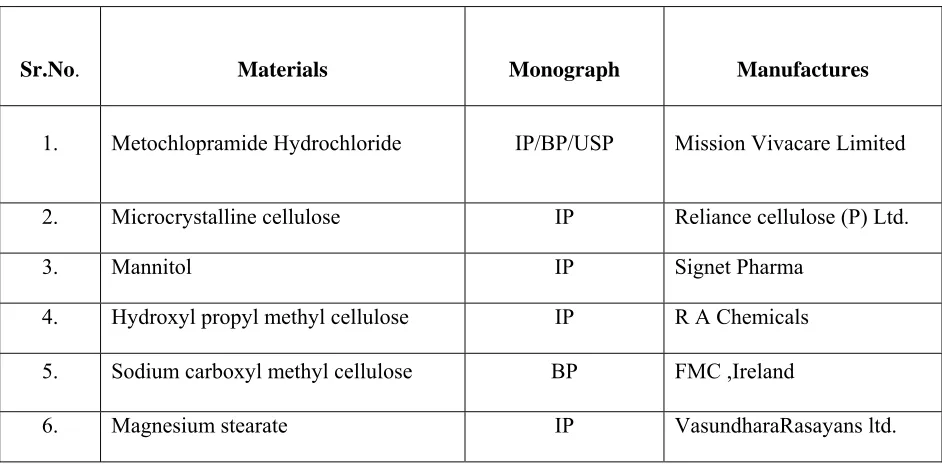
Table -1Materials and manufacturer
Sr.No. Materials Monograph Manufactures
1. Metochlopramide Hydrochloride IP/BP/USP Mission Vivacare Limited
2. Microcrystalline cellulose IP Reliance cellulose (P) Ltd.
3. Mannitol IP Signet Pharma
4. Hydroxyl propyl methyl cellulose IP R A Chemicals
5. Sodium carboxyl methyl cellulose BP FMC ,Ireland
6. Magnesium stearate IP VasundharaRasayans ltd.
Table -2Equipments used in the formulation
Sr.No. Instruments Manufacturer
1 Electronic Balance Shimadzu Corporation AW 220 and BX 6205
2 Tray Dryer Erweka Pvt. Ltd.
3 Dissolution Apparatus (USP) Electrolab Pvt. Ltd
4 High Performance Liquid Chromatography Agilent Ltd. 1100
PREFORMULATION
Preformulation is a branch of pharmaceutical sciences that utilizes biopharmaceutical principles in the determination of physiochemical properties of a drug substance. The goal of pre-formulation studies is to choose the correct form of the substance, evaluate its physical properties and understanding of the material’s stability under various conditions, leading to the optimal drug delivery system. The
preformulation study focuses on the physiochemical parameters that could effect the development of efficacious dosage form. These properties may ultimately provide a rationale for formulation design. Also it will help in minimizing the problems in later stages of drug development, reducing drug development costs decreasing products time to market. It gives the information needed to define the nature of the drug substance and provide framework for the drug combination with pharmaceutical excipients in the dosage form.
Objective:
The overall objective of preformulation testing is to generate information useful to the formulation in developing stable and bioavilable dosage form.
Preformulation encompasses at least following test.
6 Friability test apparatus Electrolab Pvt. Ltd EF 2 USP
7 Ultra Violet Visible Spectrophotometer Shimadzu Corporation UV- 1700
8 FTIR Spectrometer Shimadzu Corporation, 8400S
9 Tap density Apparatus Erweka Pvt. Ltd
10 Granulate Flow Tester Erweka Pvt. Ltd
11 Vernier Caliper Digimatic
12 pH Meter, Systronics(335)
I) Bulk Characterization:
• Crystalline And Polymorphism, hygroscopicity.
• Powder properties (flow, compaction, density, particle size, surface area etc.)
• Microscopy (morophology, particle characteristics)
• Molecular spectroscopy (FT-IR)
II) Solubility Analysis:
• Ionization constant (pka)
• PH solubility profile
• Common ion effect
• Thermal effect on solubility
• Solubilization
• Partition coefficient (logP or logD)
• Dissolution
III) Stability Analysis:
• Stability (heat, light, base, acid, oxidizer)
• Solution stability
• Solid-state stability
• Excipient compatibility
Identification of drug
The identification of drug was done by IR Spectroscopy.
Method: Triturate 1-2 mg of the substance to be examined with 300-400 mg, unless otherwise specified, of finely powdered and dried potassium bromide R or potassium chloride R. These quantities are usually sufficient to give a disc of 10-15 mm diameter and a spectrum of suitable intensity. Infrared spectrometers are used for recording spectra in the region of 4000-650
identification of stable storage conditions for drug in the solid state and identification of compatible excipients for a formulation.
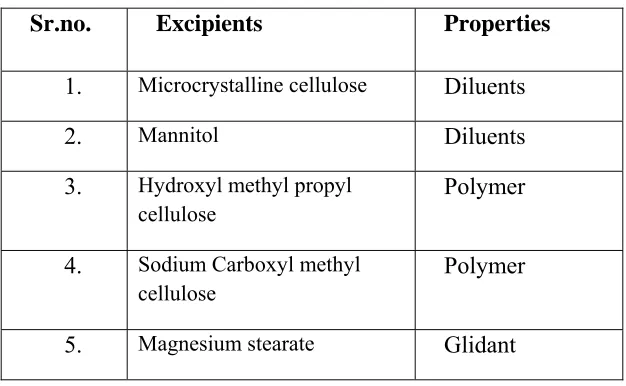
[image:52.612.150.463.261.454.2]For drug excipients compatibility study selected excipients given below:-
Table -3 Drug –excipients compatibility study:
Sr.no. Excipients Properties
1. Microcrystalline cellulose Diluents
2. Mannitol Diluents
3. Hydroxyl methyl propyl cellulose
Polymer
4. Sodium Carboxyl methyl cellulose
Polymer
5. Magnesium stearate Glidant
According to the functional category these excipients were mixed in the different ratio. These mixtures were kept at 300C +65% RH, and 400C+75%, in a 2ml glass vial in exposed condition for 1 month.
At interval of 4 weeks, the sample was withdrawn and subjected for analysis and related substances. At the interval of 2 week, the samples were withdrawn and given to analytical development for analysis of following parameters:
• Moisture content
• Assay
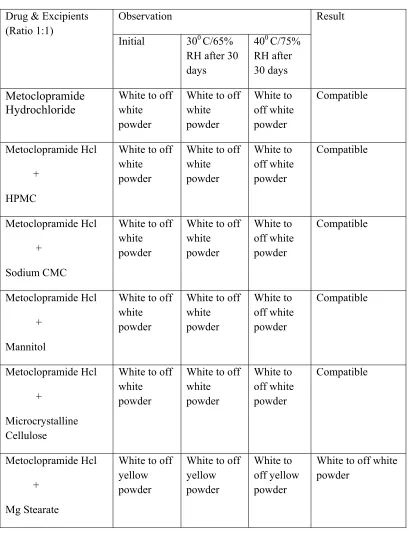
Table .4 PHYSICAL OBSERVATION OF COMPATIBILITY STUDY:
Drug & Excipients (Ratio 1:1)
Observation Result
Initial 300 C/65%
RH after 30 days
400 C/75%
RH after 30 days
Metoclopramide Hydrochloride
White to off white powder
White to off white powder White to off white powder Compatible Metoclopramide Hcl + HPMC
White to off white powder
White to off white powder White to off white powder Compatible Metoclopramide Hcl + Sodium CMC
White to off white powder
White to off white powder White to off white powder Compatible Metoclopramide Hcl + Mannitol
White to off white powder
White to off white powder White to off white powder Compatible Metoclopramide Hcl + Microcrystalline Cellulose
White to off white powder
White to off white powder White to off white powder Compatible Metoclopramide Hcl + Mg Stearate
White to off yellow powder
White to off yellow powder
White to off yellow powder
White to off white powder
Table 5Selected excipients for prototype formulation:
Evaluation of Metoclopramide Hcl sustained release matrix tablets
1) Angle of repose41: it was measured by fixed funnel. The fixed funnel method employ a funnel that
was secured with its tips at a given height H, above graph paper that was placed on a flat horizontal surface. Granules were carefully poured through the funnel until the apex of the conical pile just
touches the tips of the funnel. Thus, with R being the radius of the base of the conical pile.
Tan θ =H/R
Where,
θ = angle of repose
H =Height of pile
R = Radius of pile
Sr. no. Excipients Category
1. Microcrystalline cellulose Diluents
2.
Mannitol Diluents
3. Hydroxyl methyl propyl cellulose
Polymer
4. Sodium Carboxyl methyl cellulose
Polymer
Table 6 Angle of Repose
ANGLE OF REPOSE PROPERTIES
25-30 Excellent 31-35 Good 36-40 Fair 41-45 Passable 46-50 Poor
51-55 Very poor
>56 Extremely poor
2) Determination of tap density and bulk density41: An accuratelyweighed quantity of the powder
(W), was carefully poured into the graduated cylinder and the volume (V0) was measured. Then the
graduated cylinder was closed with lid, set in to the density determination apparatus, (Erweka Pvt. Ltd). The density apparatus was set for 100 taps and after that the volume (Vf) was measured and continued
operation till the two consecutive readings were equal. The bulk density, and tapped density were calculated using the following formulas,
Bulk density = W/Vo
Tapped density = W/ Vf
Where,
W = weight of powder
Vo = Initial volume
3) Compressibility index (Carr index)41:
Compressibility index is an important measure that can be obtained from the bulk and tapped densities.carrs index a material having values of less than 15 to 20 % is defined as the free flowing material.
Ci= ( V0- Vf) × 100
[image:56.612.122.451.307.479.2]Vo
Table 7Compressibility index
%Compressibility index Properties
5 – 12 Free flowing
12 – 16 Good
18 – 21 Fair
23 – 35 Poor
33 - 38 Very poor
>40 Extremely Poor
4)Hausner Ratio41: It indicates the flow properties of the powder and is measured by the ratio of
tapped density to bulk density.
Table 8Hausner ratio
Sr. No Hausner ratio Property
1 0-1.2 Free flowing
2 1.2-1.6 Cohesive powder
5) Sieve analysis: the main aim of sieve analysis is to determine the different size of particles present.
A series of standard sieves were stacked one above the other so that sieves with larger pore size ( less sieve number) occupy top position followed by sieves of decreasing pore size (larger sieve number) towards the bottom
Procedure: A series of sieves were arranged in the order of decreasing pore diameter. (Increasing in
sieve number) i.e. sieve numbers #20, #40, #60, #100. 100gm of drugs were weighed accurately and transferred to sieve #20 which kept on top. The sieves were shaken for about 5 minutes. Then the drug retained on each sieve were taken, weighed separately and expressed in terms of percentage.
6) L.O.D. :( loss on drying) of granules- the main aim of LOD of granules is to find out the presence
of moisture content.
Procedure: LOD of granules was determined by using I.R. moisture balance (Sartorius).Required
amount of granules was placed on I.R. plate and temperature was maintained at 1050 C for 5 minutes.
(Limit of moisture contained was 1.6%).
EVALUATION OF TABLET:
Description: Uncoated oval shaped embossed tablets were prepared. Check a representative sample for
1) Tablet dimensions41,43: Thickness and diameter were measured using a calibrated dial calipers. Ten tablets of each formulation were evaluated.
2) Hardness43: Monsanto hardness tester was used to evaluate hardness of tablet. The tester consists of a barrel containing a compressible spring held between two plungers. The lower plunger was placed in contact with the tablet, and a zero reading was taken. The upper plunger wa