
1
3/13/2018
Master of Science (MSc.) Business Administration, Purchasing & Supply Management University of Twente
Faculty of Behavioural, Management and Social Sciences
The preferred customer status: the relevant
antecedents in problematic relationships.
Master Thesis
Author: Mesbah Chouman University: University of Twente Program: MSc Business Administration Track: Purchasing & Supply Management Organisation: [Buyer X]
2
Acknowledgements
Hereby I would like to present my master thesis about the relevant antecedents in problematic relationships. This thesis was written with the aim of completing the Master of Science in Business Administration (Specialization; Purchasing and Supply Management) at the University of Twente.
I would like to thank a number of people who have helped me in various ways during the research and writing of this thesis.
From the academy, I would like a major thanks to my supervisor and my assessor, dr. Niels Pulles and dr. Raymond Loohuisfor their guidance during the research and their critical assessment of the thesis.
I would also like to thank Mrs Charlotte Röring for all the trust and patience she has had during this eventful period of my thesis.
Likewise, I would also like to thank all interviewees who will remain anonymous, but who have made a big contribution to answering all my questions and the
ideas / thought corridors that have been exchanged.
I would like to thank my business coach; Mr Paul Meijer, for his good guidance and support during the thesis.
My last word of thanks goes out to my family, friends and the one I forgot to mention above for all the support and trust during my thesis. You have extremely motivated me to constantly focus on the final goal and that is to achieve my Master of Science degree.
Thank you All!
Furthermore, I wish all the readers a lot of fun reading my thesis.
Mesbah Chouman
3
Abstract
Nowadays, the function of purchasing is becoming more and more perceived as a
strategic function. Many firms seek competitive advantage by gaining the preferred
customer status from their suppliers. However, many firms in practice struggle in
attaining and maintaining the preferred customer status. Moreover, there are times
where abrupt problems occur in the relationship between buyer and supplier in which
the preferred customer status could play a role in mitigating the problems. The current
literature of preferred customer status does not elaborate on strategies to deal with
mitigation of problems. Furthermore, the literature does not elaborate the relational
factors that play a role in those situation. This study aims to fill this gap in literature in
a case where problems arise in the relationship between buyer and supplier. This paper
will discuss the relevant dimensions of preferred customer status in abrupt problem
situations that contribute in achieving and maintaining the preferred customer status.
Finally, this study will deliver propositions on how buyers can better satisfy suppliers
and improve the chances of becoming a preferred customer. In the end, possibilities
about future research will be discussed.
Keywords: preferred customer status, customer satisfaction, supplier satisfaction,
4
Table of contents
1 INTRODUCTION: A GAP IN LITERATURE ... 5
1.1 PRACTICAL BACKGROUND... 6
1.2 RESEARCH MOTIVATION ... 9
2 LITERATURE BACKGROUND ... 10
2.1 THE IMPORTANCE OF BUYER-SUPPLIER RELATIONSHIPS ... 10
2.2 THE IMPORTANCE OF NOT HAVING THE PREFERRED CUSTOMER STATUS ... 10
2.3 USE OF PREFERRED CUSTOMER STATUS LITERATURE IN THIS RESEARCH ... 12
2.4 BECOMING THE PREFERRED CUSTOMER BY STEPS ... 12
2.5 SOCIAL EXCHANGE THEORY:TO PRESSURE OR TO REWARD ... 14
2.5.1 Power ... 14
2.5.2 Trust ... 15
2.6 PURCHASING TACTICS INVOLVING THE PCS ... 16
3 RESEARCH METHODOLOGY ... 19
3.1 DATA ANALYSIS ... 21
4 RESULTS ... 22
4.1 RELATIONAL FACTORS ... 23
4.2 [BUYER X]INTERNAL ISSUES ... 28
5 A ROADMAP TO AN IMPROVED RELATIONSHIP ... 30
6 CONCLUSION AND DISCUSSION ... 34
6.1 MANAGERIAL IMPLICATIONS ... 35
6.2 LIMITATIONS OF RESEARCH ... 36
APPENDIX I: INTERVIEW PROTOCOL – BUYER ([BUYER X]) ... 42
APPENDIX II: INTERVIEW PROTOCOL – SUPPLIER ([SUPPLIER Y]) ... 44
5
1
Introduction: A gap in literature
The function of purchasing and the management of supplier relationships has a large
impact on the competitive position of a firm (Carter and Narasimhan, 1996; Ellram and
Carr, 1994). More developed purchasing functions can lead to greater contributions in
terms of overall firm performance (Schiele, 2007). Moreover, a mature purchasing
function can even provide supplier information which can potentially solve problems
before it turns into a major crisis situation (Pearson and Gritzmacher, 1990). Finally,
by adequately managing supplier relationships, firms can obtain competitive
advantages (Chen et al., 2004; Leenders et al., 2002). Going deeper into literature of
supplier relationships, the importance of acquiring the preferred customer has been
stressed out on many occasions by supply management academics, as it serves as a
beneficial mechanism in supplier development programs. The preferred customer
theory has also relevance for many firms as buyer-supplier relationships can establish
valuable benefits (Lindgreen & Wynstra, 2005) and is crucial for acquiring firm-level
competitive advantage (Ellram et al., 2013). Also, successful collaborations can
improve performance as suppliers can provide resources such as ideas, capabilities,
and materials that build competitive advantages (Krause, Handfield, & Tyler, 2007;
Bernardes & Zsidisin, 2008; Nyaga, Whipple, & Lynch, 2010, Pulles et al., 2016).
However, many firms in practice struggle in attaining and maintaining the preferred
customer status. Moreover, there are times where abrupt problems occur in the
relationship between buyer and supplier in which the preferred customer status could
play a role in mitigating the problems. Conflicts inevitably occur in any type of
inter-organizational relationships. The current literature of preferred customer does not
elaborate on how could be dealt in such situations. This study aims to fill this gap in
literature in a case where problems arise in the relationship between buyer and
supplier. This paper will discuss the antecedents of preferred customer status and
relevant tactics that might contribute in achieving and maintaining the preferred
customer status. Ultimately, advice will be given on how the buyer-supplier
relationship can be strengthened through the usage of the theory. Consequently, the
6 1.1 Practical Background
The mentioned buyer in this study is [Buyer X], whereas the supplier is [Supplier Y].
[Buyer X] is established in The Netherlands with a facility for the production and
distribution of flexible ducting. Over the years [Buyer X]® has become one of the
world's largest manufacturers of flexible ducting systems and is recognized globally for its superior quality, its machine engineering and services. [Buyer X]® is also a
pre-eminent manufacturer of flexible stainless steel flue liners and since 1994 certified
according ISO 9001. The delivered quality is surely incorporated in the firm’s strategy.
This is not an easy task as [Buyer X]'s product line include a full range of flexible
ducting and ductwork accessories for low-, medium- and high- pressure air
conditioning as well as exhaust, ventilation and heating systems. [Buyer X]® recently
markets its products in over 55 countries. Hence, all the processes can surely be
complicated. The overall goal of [Buyer X] is to supply better indoor air for increasing
comfort and wellbeing in the workplace, public facilities and in residential buildings.
[Buyer X]'s product development is the key that enables them to provide clean and
healthy air for demanding environments all over the world.1 [Buyer X] has no
competitors in Europe in distributing flexible hoses for air ventilation systems,
including the processing of glass wool. [Supplier Y] does not deliver the same type of
glass wool to competitors of [Buyer X]. On the other hand, [Buyer X]'s production
department 'Insulation' is entirely dependent on [Supplier Y], as there is no other
supplier providing the glass wool which meets [Buyer X]'s wishes. When it comes to
the European environmental regulations, which are annually sharply changed in the
industry of air ventilation systems and flue gas removal systems, [Buyer X] has to
focus every year, more and more on products and materials which are friendly for the
environment. [Supplier Y] reduces its impact on the environment by constantly
working on innovations and adjustments for even better environmental performance.
Therefore, [Supplier Y] is focused on their production process and on their product
performance, which should make [Buyer X] an important pioneer in collaboration.
However, this does not seem to be the case as [Buyer X] is not a preferred customer. In
fact, there were big problems in the production process of [Supplier Y], which couldn’t
be addressed for a long period of time. The quality of glass wool that [Buyer X]
1
7 procures was inconsistent for a long period of time. [Buyer X] found it difficult to
address this issue due to the lack of a healthy buyer-supplier relationship. At the
production plant of [Supplier Y], the glass wool rolls that [Buyer X] procures are
normally cut in thicknesses of 50 cm. All clients of the firm procure this commodity in
the same production standards. However, it appears that [Supplier Y] cuts the thickness
of these rolls by two for [Buyer X]. As a result, the final thickness of the product that
[Buyer X] procures comes down to 25 cm. Thus, [Buyer X] procures a customized
type of glass wool rolls in comparison to the other clients of [Supplier Y]. This is
necessary for [Buyer X] as they use an unique reassemble production method when it
comes to the processing of glass wool. Other clients of [Supplier Y] cut the rolls
manually based on deviating lengths and place them in cavities. However, the glass
wool rolls of [Buyer X] are processed by machines and are continuously peeled during
production. The glass wool rolls are pulled through a funnel in order to produce
flexible hoses, but the problem was that the rollers continually snapped during the
production phase. As the investigation continued, the insulation departments of [Buyer
X] noted that the rollers were being processed wet, which was very striking for them.
The inconsistency problems occurred for many years. However, the problem is never
addressed properly and solved eventually. Sometimes the glass wool was just good
enough to use it during production for flexible hoses. However, inconsistencies in the
glass wool continued. The roles that were handed over to other customers did not show
any problems in terms of quality of the glass wool. Before analyzing the relationship,
we [Buyer X]ided to identify the problem first. During an investigation into the
inconsistencies, we checked when the problems arose exactly. The rolls that were all
too fast and too wet were put aside and stickered on which the badge numbers of
production were written along with the further information. We checked whether these
inconsistencies could be attributed to a certain or multiple operators. However, the
glass wool rolls of [Buyer X] were run by the same operators, so there was nothing to
catch up. After a visit at [Buyer X], we also experienced that the rollers ripped too fast
and were wet. However, during the investigation, it came also into light that the reports
came in after a deviating storage method of glass wool rolls. The production plant of
the glass wool is located in the Netherlands. However, it is stored in one another
storage location elsewhere in the Netherlands. It appears that the designated storage
8 analyzing the flow of logistics and comparing two storage facilities, the problem of the
inconsistencies was identified. The ceiling of the new storage facility has metal ceiling
whereas the old facilities’ ceiling was composed out of different materials. Back then,
it was considered to be efficient to set up the storage depot as it resulted into a faster
allocation of materials. However, it was not taken into account that if the glass wool
rolls were produced from the machine, they were manufactured at a certain
temperature. After the roll is produced, it is wrapped up with a special foil. After this,
they are immediately transferred to the storage facility by truck. When these are stored
in the new storage facility, the hot air that came off the wool conflicting with the metal
ceiling. This resulted into condensation which leaked back from above the ceiling into
the rollers. The rollers did not dry up as the cycle repeated. This problem lead to
another complication, it seemed that [Supplier Y] did not really want to solve the
problem as they has not find a solution for this problem. Thus, the supplier does not
seem to be willing to change as the buyer is not a preferred customer. Regardless, it is
9 1.2 Research motivation
As mentioned before, this paper identifies relational elements in the relationship
between buyer and supplier in problem situations. It is expected to find the several
factors that can contribute to the current stream of literature. The assignment was
sourced by [Buyer X] as they felt the analysis should be realised by a unbiased
researcher. This bears also the inclusion of practical implications to [Buyer X] in how
they could address these issues through the use of the preferred customer status theory
and to excel afterwards. Furthermore, this study also aims to identify tactics that could
be used in problem situations. In order to clarify the research, the following research
questions are formulated:
1. What are the relational factors that influence the willingness to solve a
problem?
2. What PCS factors are relevant to the problem between [Buyer X] and
10
2
Literature background
2.1 The importance of Buyer-Supplier Relationships
Managing a buyer-supplier relationship is key to the success of the supply chain
(Ambrose et al., 2010) and thus impacts the performance of a firm (Tan et al. 1999).
As also mentioned before, successful buyer-supplier relationships can establish
valuable benefits (Lindgreen & Wynstra, 2005) and is crucial for acquiring firm-level
competitive advantage (Ellram et al., 2013). Desired performance improvements of
buying firms are generally only feasible when they commit to long-term oriented
relationships with key suppliers (Krause et al., 2007). Research show that when
procuring firms do not commit to long-term oriented relationships, suppliers may be
more unwilling to commit in resource investments (Krause et al, 1999). Hence,
theoretically, suppliers should be prepared to improve in accordance with the
expectations of their customers. However, suppliers see relationship specific
investments as vulnerable to opportunism when resource commitments are not
forthcoming from the buying firm (Krause, et al., 2007). However, when buying firms
signal a commitment to a long-term relationship and indicate a willingness to make
investments in key suppliers to help them improve performance, supplier performance
is also be expected to improve (Krause et al., 2000). Thus, the relationship should be
observed carefully in which the commitment of both firms should be taken into
account.
2.2 The importance of not having the preferred customer status
Supplier relationship programs pose several new managerial challenges (e.g. See
Hartley et al., 1997; Primo & Amundson, 2002; Wognum et al., 2002; Petroni &
Panciroli, 2002; Rutten, 2003; Zsidisin & Smith, 2005). One of these challenge is
securing the preferred customer status, which refers to buyer attractiveness from a supplier’s point of view. Schiele et al. (2012) argues that a supplier awards a buyer
with preferred customer status if this customer is perceived as attractive and if the
supplier is currently more satisfied with this customer than with alternative customers.
11 resource allocation to this preferred customer. A customer is perceived as attractive by
a supplier if the supplier in question has a positive expectation towards the relationship
with this customer. The conditions for this perception of the supplier include an awareness of the existence of the customer and knowledge of the customer’s needs
(Schiele, 2012). These needs could be fulfilled through value creation, which is the
basis of all business relationships (Anderson, 1995; Ulaga & Eggert, 2005; Walter et
al., 2001). Thus, the more appealing a value proposition is, the more motivated the
supplier will be to award the preferred customer status. A form of value creation may
be the purchaser's ability to present a credible offer that would surpass the supplier
available alternatives will influence the supplier's [Buyer X]ision to participate in the
exchange (Ramsay & Wagner, 2009). Additionally, value could be realised through
relational rents which needs intensive cooperation and expertise (Dyer & Singh, 1998).
Nowadays, manufacturers are actively focusing on relationship-based strategies and
supplier-specific strategies in the interest of to have the best suppliers to contribute in
the value addition process (Hesping & Schiele, 2015). In order for a supplier to pay
attention to a purchaser, it must be aware both that the purchaser exists and what some
of its characteristics are, as well as have a positive expectation towards the purchasing
organization (Schiele et al., 2011). Another step and challenge in becoming a preferred
customer is to satisfy the supplier's expectations. Legitimately understanding the
supplier's expectations is hereby essential, since this allows the purchaser to anticipate
and better assess the supplier's behaviour (Nollet et al., 2012). Benton & Maloni
(2005) found that supplier satisfaction seems to be driven primarily by the nature of the
buyer–supplier relationship rather than by performance. However, this might differ in
innovation orientated relationships due to other needs. (Nyaga et al., 2010) found a
different perspective namely that supplier's satisfaction is strongly linked to trust and
commitment; in order to demonstrate their commitment to suppliers, buyers need to
initiate and participate in collaborative activities such as information sharing which has
already been proven to be more important to suppliers than to buyers (Whipple et al.,
2002). Nevertheless, the satisfaction of the supplier determines the quality of the
buyer-seller relationship and is directly linked to value creation. If a supplier is more
satisfied with one customer than with the other, he may award the former with
12 2.3 Use of Preferred Customer Status literature in this research
It is evident that healthy relationships with suppliers offer many opportunities for
buying firms. Suppliers can provide resources such as ideas, capabilities, and materials
that build competitive advantages that might not be achieved otherwise (Koufteros,
Vickery, & Dröge, 2012). Earlier, it has been pointed out that supplier relationship
programs pose several new managerial challenges (e.g. See Hartley et al., 1997; Primo
& Amundson, 2002; Wognum et al., 2002; Petroni & Panciroli, 2002; Rutten, 2003;
Zsidisin & Smith, 2005). This paper discusses how a firm can become preferred
customer in problematic situations, defined as a particular buying firm to whom the
supplier allocates preferential resources to. Although there are various theories and models on how to become a preferred customer (e.g. Schiele et al., 2012, Ellis et al.,
2012 & Nollet et al., 2012), the usage of the model of Nollet (2012) is proposed in this
research, as it seems to be a more adequate fit in problematic situations due to its
pragmatic design. Moreover, the model comes with several managerial tactics, which
can be used in building a theoretical roadmap in becoming and maintaining the
preferred customer status. More on this will be elaborated in the upcoming chapters.
2.4 Becoming the preferred customer by steps
In prior literature, the social exchange theory has been used to explain why exchange
partners intensify cooperation and treat selected customers more preferentially than
others (Schiele, 2012). Nollet et al. (2012) define preferred customer as that a
purchaser (buying organization) receives better treatment than other customers from a
supplier, in terms of product quality, delivery and/or prices. They suggested a
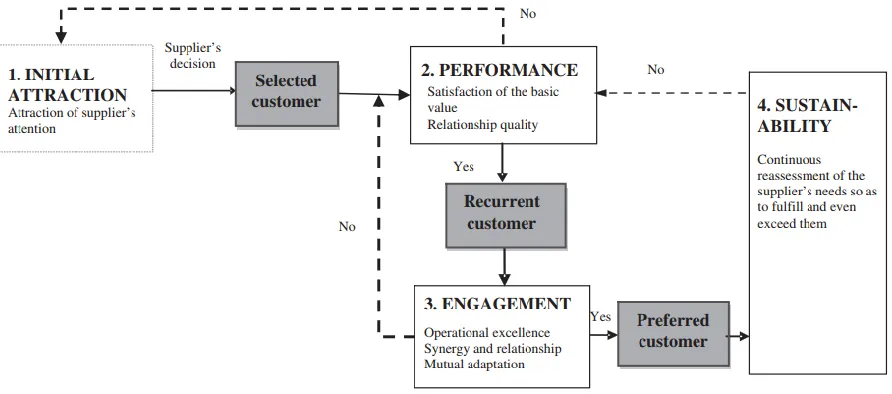
pragmatic four-step model (i.e. initial attraction, performance, engagement and
13 Figure 1: Four-step model of Nollet et al. (2012)
Similarly, Schiele et al. (2012) proposed a cycle model of preferred customership. This
model is also rooted in social exchange theory, but expands it by not only discussing
continuation or discontinuation of a relationship, but by differentiating between two
levels of continuing industrial exchange relationships (Schiele, 2012). The model
consists out of three stages, namely customer attractiveness, supplier satisfaction and
the preferred customer status. Each of these stages has their own empirical
manifestations and are sequentially linked to each other. Customer attractiveness is
necessary to initiate or intensify an exchange relationship. If the expectations are met,
the next stage is supplier satisfaction. The preferred customer status will be awarded to
the company that gives the most satisfaction and will enjoy the associated benefits
(Hüttinger et al., 2012). The study of Hüttinger et al. (2014) show three antecedents of
customer attractiveness, namely operative excellence, growth opportunity and
relational. The latter is in great interest as this thesis focuses on mainly relational
aspects. Furthermore, relational behavior is also an antecedent of supplier satisfaction.
Other two antecedents of supplier satisfaction are growth opportunity and reliability,
which are also the antecedents of the preferred customer status. Other factors in the study are not significantly correlated. Important findings for management in practice are that buying firm’s reliability and its relational behavior toward suppliers should
considered in acquiring the preferred customer status. Buyers who strive for
preferential treatment by suppliers should avoid acting opportunistically, showing
14 shared values rather than on transactional exchange relationships seems to be
conducive to the goal of securing preferential customer treatment (Hüttinger et al.,
2014).
2.5 Social Exchange Theory: To pressure or to reward
The problems around the inconsistencies in supplies could be addressed by the usage
of the Social Exchange Theory. The theory is a broad framework that spans various
social scientific disciplines such as management. Resources are exchanged through a
process of reciprocity, whereby one party repays the deeds of another party (Gergen,
1969; Gouldner, 1960). This could be executed through the usage of rewards or by
punishments, which leads to the following question; Should one pressure or reward?
Pulles et al. (2014) show how certain mechanisms can improve the allocation of
resources. They find that coercive tactics do not necessarily affect supplier resource
allocation negatively and goodwill trust does not inherently affect supplier resource
allocation positively. Furthermore, they find that that the share of turnover off a
supplier on the buying firm affects the relationship. Finally, they find that goodwill
trust only affects supplier resource allocation when the buyer has a large share in the
supplier's turnover, while competence trust is more effective if buyers account for a
small share in the supplier's turnover (Pulles et al., 2014). The latter is also the only
mechanism that is significant and positively correlated with the allocation of physical
and innovation resources.
2.5.1 Power
Power could be described as a fundamental force in social relationships and is
pervasive throughout numerous types of interactions (Sturm & Antonakis, 2015).
Consequently, it has been researched by scholars in many diverse disciplines such as
management (Shervani, Frazier, & Challagalla, 2007). There are various ways to
define power. Scholars argue that it is difficult to comprehensively define the concept
of power (Lukes, 1986), as the definition varies in different research fields (Shervani,
Frazier, & Challagalla, 2007). Examples of definitions are expressed in terms of antecedents, units of analysis, actor’s intentions, target’s responses, and outcomes of
15 the modification of others’ states (cf. Keltner et al., 2003; Sturm & Antonakis, 2015).
The distribution of power in most exchange relationships in society are characterized
as unequal between parties (Dwyer & Walker 1981; Johnston & Bonoma 1983). It is
tough to realise a bargaining setting, in which each party has the same dependence
position, negotiating skills, credibility, expertise, and outcome at stake (Dwyer, 1984).
Consequently, purchasing at alternative suppliers and acquiring product information
from other sources might be difficult for buying firms. A less powerful party therefore
has less to demand of another. It is evident that the concept of power plays a great role
in buyer-supplier relationships. It is assumed that problem-solving thinking partially
depend on power dimensions and may play a role becoming the preferred customer.
2.5.2 Trust
Trust is a multilevel notion that can exist between employees, organization and
individuals. Similar to power, trust has different dimensions (Pulles et al., 2014) Das
and Teng (2001) distinguish goodwill trust and competence trust as two dimensions of trust. Competence trust refers to an organization’s expectation of another firms’
technical competence whether for example they are able to deliver what they promise
(Mayer et al., 1995), whereas goodwill trust refers to the degree to which a person
trusts another person (or firms) and is willing to act in ways that exceed the stipulated
contractual agreements without explicitly asking for such help (Ireland & Webb, 2007;
Roy et al. 2004). Trust is considered to be a central fundamental for firms when
engaging and to develop a relationship (Ireland & Webb, 2007; Morgan & Hunt
(1994). It has been shown that both dimensions of trust are significantly and positively
correlated with innovation resource allocation, depending on the share in turnover
(Pulles et al., 2014). Therefore, it is argued that the level of trust can is an important
underlying dimension of customer attractiveness and leads to preferred customer
16 2.6 Purchasing tactics involving the PCS
Using purchasing tactics is key in becoming the preferred customer. Nollet (2012) argue that attaining the preferred customer status requires a structured – albeit
sometimes complicated – approach. This implies process and operations renewal, as
well as a change in the usual approach of a firm (Nollet, 2012). It is important to
underlie that purchasing tactics should be based on a structured framework. As for this
paper, the framework of (Nollet, 2012) is used as is described in chapter 2.4.
Step 1: Initial attraction
Harris et al. (2003) define attraction as the extent to which relational partners perceive
past, current, future or potential partners as professionally appealing in terms of their
ability to provide superior economic benefits, access to important resources and social
compatibility. Hence, a supplier should become aware of the existence of a firm in the
first place. Preferably, the firm should have a positive perception of that very firm. The
literature describes the following tactics that could be used in this stage2:
Be a member of associations in the industry
Communicate, in a consistent fashion, realizations and growth potential Develop a system of impression management with that supplier
Develop extensive field contact by inviting the supplier at the buyer's site Organize events with partners
Organize meetings between top management members from both organizations. Participate at events (e.g. industrial conferences)
Put forward the organization's uniqueness or the exclusiveness of its products and services by highlighting their distinct advantages
Regularly involve satisfied clients in the promotional effort Revise and update website content to grow traffic from suppliers Set up and send pertinent information on a regular basis
Take part in relevant social media Visit the supplier's establishments
Step 2: Performance
The second step in becoming a preferred customer is to gratify the supplier's
expectations. Consequently, understanding the supplier's expectations is crucial as this
allows the buyer to anticipate the supplier's behaviour. In fact, it is a matter of
2
17 achieving a performance level that will satisfy the supplier. If the level reached is one
of delight, then step 3 and the recognition as a preferred customer should come more
easily (Nollet, 2012). The following tactics are proposed in this phase3: Assign the best people to impress the supplier and to increase success in the
transactions.
Be open to share relevant information. Behave fairly.
Ensure equitable treatment.
Fulfill all contract obligations without hassle or argument. Give the supplier full inventory visibility.
Make confidentiality an important part of the approach. Make timely payments.
Order in large quantities and use no haggling.
Recruit buyers with a solid technical background, thus making communication easier and more effective.
Use face-to-face contact at both the buyer's and the supplier's sites (training, support for problems, etc.).
Step 3: Engagement
For instance, is the customer willing and capable to standardize and simplify its supply
chain practices? Is there openness to reassess processes and find creative solutions to
problems? Intentions are great, but the ability to perform at a high level must also be
there. The following tactics are proposed in this phase:4 Ensure operational excellence
o Assess the potential use of reverse marketing with that supplier. o Reassess processes to find creative solutions to problems. o Standardize and simplify supply chain practices.
Create relational value
o Be committed to causes considered important to the supplier (sustainable development, ethical procurement).
o Initiate common projects.
o Invest in the relationship with parsimony.
o Involve higher-ranked personnel (president, vice-presidents) in problem-solving, so as to build and maintain supplier relationships.
o Keep the supplier informed of innovations, market developments, etc. o Locate closer to the supplier's premises.
o Make joint research.
3
Source: Adapted from Christiansen and Maltz (2002), Essig and Amann (2009), Morash and Clinton (1998), Nyaga et al. (2010), Ramsay and Wagner (2009), Ulaga and Eggert (2006), Walter et al. (2001) & Nollet et al. (2012).
4
18 o Make some staff exchanges.
o Motivate the supplier to adapt some of its products to make them more suited to the characteristics desired by the buyer.
o Motivate the supplier to invest in the relationship. o Plan joint activities.
o Promote exchanges with partner organizations that could benefit the supplier. o Redesign end-products in order to concentrate business with the supplier. o Share performance measurement results with the supplier.
Step 4: Sustainability
No customer rests assured of maintaining its status for long: “Buyers need to recognize
that they, together with other firms competing for resources from their suppliers, are
continuously being evaluated and consequently, getting differential treatment”
(Lindwall et al., 2010). Hence, the buyer must ensure that it continues obtaining a
better evaluation by the supplier than its competitors. And this implies having the right
mechanisms in place to do so. For instance, good communication is a key condition to
remain a preferred customer (Hald et al., 2009, Nollet, 2012). The following tactics are
proposed in this phase:5
Anticipate risks and problems in the realization of objectives.
Communicate problems and changes regularly and reassess objectives when required. Create disincentives for relational dissolution
Evaluate regularly and take into consideration the supplier's perception of the extent of having reached the objectives
Follow-up of the results in comparison to the initial objectives Integrate supplier awards in supplier development program Manage reputation through:
o Regularly monitoring opinions about the purchaser and prepare means to modify negative opinions
o Reassess the external environment of the organization (other partners and their tactics).
Measure performance frequently
Participate actively to the evaluation of the dyad's needs and to setting its objectives Participate to the planning of events with the supplier
Share performance results with the supplier
5
19
3
Research methodology
This study involves a case study through several in-depth interviews with the buyer
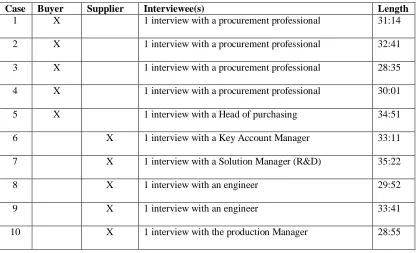
([Buyer X]) and their supplier ([Supplier Y]). In order to find relational elements from the buyer’s perspective, five interviews are held with the procurement department of
[Buyer X]. Thereafter, five interviews with officials of [Supplier Y] are held. The
positions of these officials are either engineers or managers. In all cases, the
interviewees are directly involved in the buyer-supplier relationship. In total, there are
10 interviews. We travelled to the designated locations to conduct the interviews in a
period of few weeks. In appendix I & II, an overview of the interview protocols can be
found. The aim of the questions was to identify rich and descriptive data about people’s behaviours, attitudes and perceptions which all derive from the processes
between the two firms. In order to do this, the suggestions of Galletta (2013) are
followed, who proposed such interviews could be done in three stages. The first stage
contains the work of creating a level of comfort. Therefore, in order to effectuate a
sufficient research, a pleasant atmosphere is essential. While reflecting the truthfulness
of the research, the atmosphere should be preserved during the entire interview.
Subsequently, the research will need to provoke additional insights which not have
been covered in the interview protocol. In order to generate space for the members to
tell their experiences, in this stage the questions were open-ended and focused on
theory of preferred customer. Consequently, a solid environment for research is
established in where the richest and most proactive source of data was collected.6 The
second phase is conceptualized to carry on the situation in more depth. In essence, this
phase forms the core of the research. It was essential to hold on the story that has been
shared in the opening section and extract data of bigger specificity and wider
framework stages. In order to make the respondents to talk as much as possible, the
questions are formulated broadly while following the flow of the interview. The
questions are based on both insights from the practical background as also literature
(e.g. Pulles, 2016). For instance, power and trust are known dimensions that play a role
in the theory of preferred customer. Depending on the answers, an improvisation took
6
20 place in the follow-up questions. The questions are mainly based on relevance: it had
to reflect to the research questions in order to answer them.
The last stage of the interview is used to a check and to wrap the interview up. This
phase functioned as a tool to ascertain that the collected data is accurately interpreted.
In order to check if the important questions are asked during the interview, a brief
summary after the interviews took place. Finally, the interview could be finalized. The
choice for these interviewees is made on the basis their involvement in the relationship
of the buyer and supplier. Furthermore, some of the interviewees are involved in the
inconsistency problem, which also brought helpful insights. These two angles were the
basics of selecting the right respondents. The results are validated by cross-referencing
the findings with each other whenever possible. There were no contradicting results.
The respondents form a majority in the people that are involved in the relationship and
thus can be regarded reliable as a data source. In the appendices, the interview
questions can be found.
Case Buyer Supplier Interviewee(s) Length
1 X 1 interview with a procurement professional 31:14
2 X 1 interview with a procurement professional 32:41
3 X 1 interview with a procurement professional 28:35
4 X 1 interview with a procurement professional 30:01
5 X 1 interview with a Head of purchasing 34:51
6 X 1 interview with a Key Account Manager 33:11
7 X 1 interview with a Solution Manager (R&D) 35:22
8 X 1 interview with an engineer 29:52
9 X 1 interview with an engineer 33:41
[image:20.584.89.506.386.639.2]10 X 1 interview with the production Manager 28:55
21 3.1 Data Analysis
All collected data in this study are recorded and transcribed. This was necessary as the research otherwise would be [Buyer X]lined. The relevant data of the transcripts are
exported to a data analysis software called Nvivo, which supports qualitative and mixed methods research analysis. It’s designed to allow the researcher to organize,
analyse and find insights in unstructured, or qualitative data like: interviews,
open-ended survey responses, articles, social media and web content. The program works
with setting up nodes, in which various references are recorded.
After importing the data into Nvivo, key findings were translated in key words such as “commitment”. This resulted in the creation of the nodes and ultimately served as a
measure tool as findings were systematically organized. In essence, frequently
recorded topics which are registered into nodes bear relevancy for the research. Hence,
the data is collected by an inductive approach. As a rule of thumb, nodes that have over
10 references are regarded to be relevant. This approach of analysis made it possible to
22
4
Results
The inconsistency problems that were addressed in background research and are due to
relational problems. For instance, the supplier was not willing to solve problems.
Hence, the following research question was formulated: What are the relational factors
that influence the willingness to solve a problem? As expected, the interviews reveal
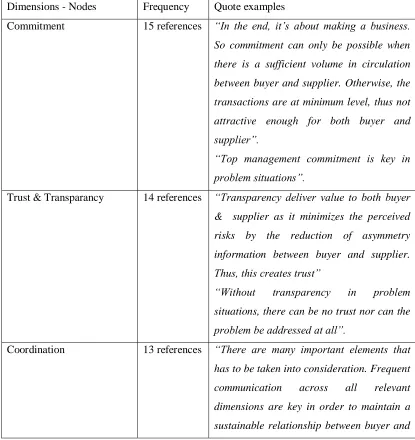
several factors that influence the willingness to solve a problem. The findings reveal
that the critical antecedents associated with the willingness to solve a problem include
[image:22.584.81.496.323.763.2]dimensions such as commitment, trust & transparency, coordination and power. The
table below summarizes these dimensions and shows the frequencies of references and
accompanying quotes.
Dimensions - Nodes Frequency Quote examples
Commitment 15 references “In the end, it’s about making a business. So commitment can only be possible when
there is a sufficient volume in circulation
between buyer and supplier. Otherwise, the
transactions are at minimum level, thus not
attractive enough for both buyer and
supplier”.
“Top management commitment is key in problem situations”.
Trust & Transparancy 14 references “Transparency deliver value to both buyer & supplier as it minimizes the perceived
risks by the reduction of asymmetry
information between buyer and supplier.
Thus, this creates trust”
“Without transparency in problem
situations, there can be no trust nor can the
problem be addressed at all”.
Coordination 13 references “There are many important elements that has to be taken into consideration. Frequent
communication across all relevant
dimensions are key in order to maintain a
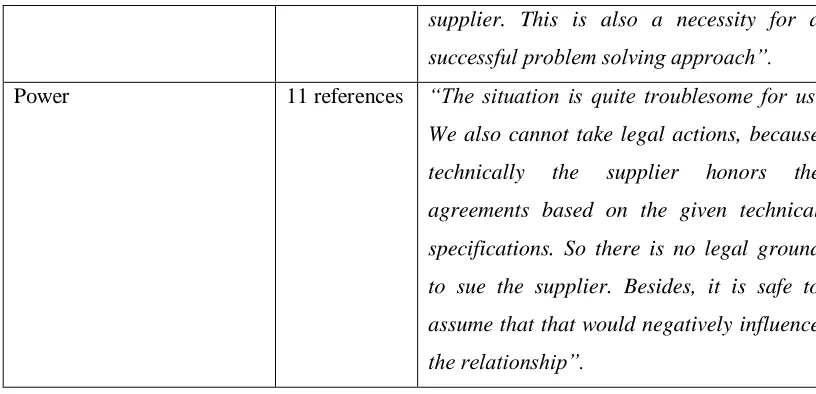
23 supplier. This is also a necessity for a
successful problem solving approach”.
Power 11 references “The situation is quite troublesome for us. We also cannot take legal actions, because
technically the supplier honors the
agreements based on the given technical
specifications. So there is no legal ground
to sue the supplier. Besides, it is safe to
assume that that would negatively influence
[image:23.584.81.489.76.273.2]the relationship”.
Table 2: The usage of nodes
4.1 Relational factors
Commitment
There is a consensus among all respondents that commitment is the most important
antecedent in problem solving situations. Without commitment, the role of the other factors seem to diminish. For example, interviewee 6 stressed out that “if there is no
commitment, then there can also be no trust”. Hence, all concepts are regarded
coherent and should derive from both parties. However, this might be ambiguous as commitment is not necessarily is present always. Interviewee 6 expressed that “In the end, it’s about making a business. So commitment can only be possible when there is a
sufficient volume in circulation between buyer and supplier”. It is important to underlie
that measures as volumes are relative. Thus, one party could regard volume as
sufficient whereas for another party this bear no significant importance. According to interviewee 5, “[Supplier Y] has around 40 billion euros on sales turnover worldwide
in which they have only a few million euros of turnover with [Buyer X]”. On the other
hand, the supplier is regarded as a strategic partner by [Buyer X] as they produce and
deliver key materials for their end products. These findings are confirmed by interviewee 1 as he states “[Supplier Y] is our key supplier in glass wool materials.
However, they do not regard us as a key buyer due to their broad customer base in
24 that “We tend to believe that [Supplier Y] lines up in a unfriendly manner towards us,
in which they are hardly open for new suggestions”. On the other hand, interviewee 6
emphasized that “All of our customers are treated equally. We do have preferred
customers which enjoy benefits in various forms. But these customers deserved to
receive so”. Associated benefits are favourable pricing and several extra considerations
which apply in both normal as problem situations. This occurs through consultations in
which both parties coordinate with each other. Moreover, all clients of [Supplier Y]
procure the commodity in the same production standards, whereas [Buyer X] enjoys
the benefit of a customized type of glass wool. While this is necessary for [Buyer X] as
they use an unique reassemble production method when it comes to the processing of
glass wool, it still indicates that [Supplier Y] does sees [Buyer X] as an attractive
customer. Finally, interviewee 6 confirms this by stating “We prefer to do business and
allocate materials accordingly to parties we conduct business in the long term” and
implying that they can be triggered by a long-time investment agreement. This is also
in line with the literature; when buying firms signal a commitment to a long-term
relationship and indicate a willingness to make investments in key suppliers, supplier
performance is also be expected to improve (Krause et al., 2000). Finally, Interviewee
7 expressed that “Top managerial interference sometimes forces us to adjust our
behavior”, implying that top management commitment can influence the willingness to
solve a problem. In conclusion, it seems that [Buyer X] is very committed whereas
[Supplier Y] is less committed in the buyer-supplier relationship. On the other hand,
[Supplier Y] hints that a preferred customer status for [Buyer X] is feasible.
Trust & transparency
Earlier, it was acknowledged that trust is a central fundamental for firms when
engaging and to develop a relationship (Ireland & Webb, 2007; Morgan & Hunt
(1994). This is argued through the dimensions of competence- and goodwill trust (Das
& Teng, 2001). However, less emphasis was shown in problem scenario’s. This study reveal new findings in the dimension of trust. Interviewee 3 argue that “Without
transparency in problem situations, there can be no trust nor can the problem be
addressed at all”. Furthermore, the same interviewee expressed that “Transparency
deliver value to both buyer and supplier and contributes to the concepts of customer
25
asymmetry information between buyer and supplier”. Thus, transparency can reduce
the chances of opportunistic behavior as it gives trust. The current situation show that
the inconsistency problem was neglected as there is poor interaction and no
transparency at all. The buyer failed to adequately address the problem, whereas the supplier neglected the problem. Interviewees 8 & 9 expressed that “We can’t fix an
issue when the existence is unknown”. Moreover, interviewee claimed the following:
“Our processes operate in the same manner for [Buyer X]ades. We can’t be bothered
to investigate nor disclose some of our sensitive infirm operations”. However,
interviewee 5 expressed that “We tried to address the problem, but they just didn’t see
it. If the solution was evident, we would have addressed this immediately”.
In conclusion, the supplier failed to listen and was not bothered at all. This also shows
the relationship between trust and transparency. The problem eventually resulted into
distrust between the two parties, which negatively influenced the problem solving
process.
Coordination
In interview 2, the interviewee state that “frequent communication across all relevant
dimensions are key in order to maintain a sustainable relationship between buyer and
supplier”, hinting to that coordination is a very critical factor in both normal as
problem situations. As also pointed out in the literature background, collaboration
between buyer and supplier is a crucial factor of a successful business. In fact, interviewee X stressed out that “the willingness and to adequately coordinate is key in
solving problems”. Interviewee 7 emphasises “that there should be knowledge sharing between buyer and supplier, especially in problem situations”. By being
communicative about all developments, solutions and its applications could be
accomplished in sync. However, this is not the case in the situation of [Buyer X] and
[Supplier Y] as the latter refuses to respond to vague issues that require deeper
investigation. Consequently, problems cannot be solved as they cannot be tackled.
Another problem for [Buyer X] is the lack of innovation of the manufactured materials.
Both parties agree that adequate coordination could possibly result into certain
innovation of products. However, it appears that [Buyer X] lacks the personnel to
26
stake”. Interviewee 6 stressed out that “If the customer does not operate integer,
he/she will never become a preferred customer. In some cases we will even cease to do
business”, hinting that integrity is an important behavioural factor in the willingness to
coordinate. The buying firm should be “[Buyer X]ent and fair” in their operations and
wishes. Finally, interviewee 6 expressed that “there should be a chemistry between
employees of both firms in problem solving situations”. In conclusion, it appears that
the willingness to solve a problem depends on adequate coordination between the
buyer and supplier.
Power
This study shows that the concept of power as described in the literature review also
play a role in problem solving situations. Leveraging for allocation in such situations
seems to be more feasible when the buying firm has more power over the supplying
firm. When the latter holds more power over another, it could neglect the buyer by not
offering adequate solutions in these kind of situations. Interviewee X expressed the following: “We cannot really poke the bear due to not having an alternative supplier
for glass-wool materials”, hinting that they are afraid to upset the supplier due to a
lock-in situation. Furthermore, he expressed that “We also cannot take legal actions,
because technically the supplier honors the agreements based on the given technical
specifications”, which are described in appendix III. It’s feasible that this finding is the
outcome of a monopolistic market and does not necessarily have to be always like this.
Power also derives from position, negotiating skills, credibility and expertise in which
[Buyer X] is lacking. More on this will be elaborated in the following chapter. Interviewee 3 stressed that “We lack purchasing power, we believe that this is why our
problems was not being taken seriously”. On the other hand, the supplier stated the
following: “We always strive for the best customer experience. Offering solutions to problems is done accordingly”. Though the supplier has the upper hand in the
buyer-supplier relationship, they claim that do not exploit this. However, this contradicts with the following statement in interview 10: “Our processes operate in the same manner
for [Buyer X]ades. We can’t be bothered to investigate nor disclose some of our
sensitive infirm operations”. Later when the inconsistency was identified and
27 solution. In conclusion, power seem to play a role in the willingness to solve a
problem. Higher power of the supplier may result in not willing to solve a problem.
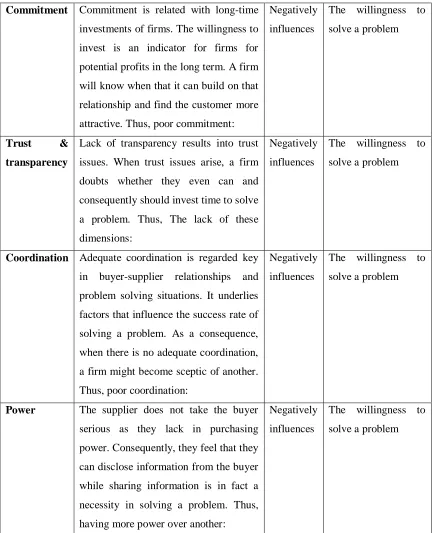
Commitment Commitment is related with long-time investments of firms. The willingness to invest is an indicator for firms for potential profits in the long term. A firm will know when that it can build on that relationship and find the customer more attractive. Thus, poor commitment:
Negatively influences
The willingness to solve a problem
Trust & transparency
Lack of transparency results into trust issues. When trust issues arise, a firm doubts whether they even can and consequently should invest time to solve a problem. Thus, The lack of these dimensions:
Negatively influences
The willingness to solve a problem
Coordination Adequate coordination is regarded key in buyer-supplier relationships and problem solving situations. It underlies factors that influence the success rate of solving a problem. As a consequence, when there is no adequate coordination, a firm might become sceptic of another. Thus, poor coordination:
Negatively influences
The willingness to solve a problem
Power The supplier does not take the buyer serious as they lack in purchasing power. Consequently, they feel that they can disclose information from the buyer while sharing information is in fact a necessity in solving a problem. Thus, having more power over another:
Negatively influences
[image:27.584.77.511.138.671.2]The willingness to solve a problem
28 4.2 [Buyer X] Internal issues
Initially, this thesis was going to focus on how [Buyer X] could use the preferred customer theory to solve the problem it was facing. Meanwhile, [Buyer X] would want
to acquire some preferential treatment. However, it quickly became evident that the
serious issues derived from relational problems between the buyer and supplier. In fact,
[Buyer X] has even bigger challenges than initially anticipated. The purchasing
department of [Buyer X] appears to be very immature, with only four procurement
professionals working, whom procure over 1000 different kinds of materials. The list
of purchasing flaws is very long, therefore it is presented in bullet points:
No purchasing and sourcing strategy
Relationship with most suppliers are of transactional nature
Not enough manpower to ensure adequate purchasing
No supplier development policy
Responsibilities of purchasing is vague
Suppliers are not incorporated in product development
Risk management is minimal
No spend analysis
Negotiation mandates and responsibilities are not defined
No collaboration with quality engineering and R&D
Processes are not well defined
No adequate insight in supplier base and their operations
Although this list of purchasing flaws are not directly related to the relation problems
between [Buyer X] and [Supplier Y], it is still worth mentioning them as it shows the
level of purchasing maturity of [Buyer X]. In the relation of the [Supplier Y], thus
relational problems, the following purchasing flaws are found:
No defined Key Performance Indicators
No (internal) alignment
No documentation
o Lack of roadmaps
o Processes are not well defined
The first point is relevant because [Buyer X] cannot identify and how something is
29 the [Supplier Y]. As a result, the supplier cannot nor does wishes to solve problems.
Secondly, there is no alignment internally as both externally. Different people make
different appointments between the firms. This lack of coordination sometimes lead to
problems in the production process as wrong materials are procured. Finally, there is
no feedback protocol as there is no documentation in the purchasing department of
[Buyer X]. Due to these circumstances, [Supplier Y] is very vague about whether they
are willing to change and contribute as a problem solver whenever issues arise. The
issue is that [Buyer X] is not being able to manage and coordinate their purchasing
activities. As a consequence, [Supplier Y] takes the buyer less serious. Thus, the
customer is perceived less attractive as they are not sufficiently competent. As [Buyer
X] is not perceived as an attractive customer, they eventually fail to attain the preferred
customer status and do not attain any preferential treatment. This issue will be
addressed by the usage of certain purchasing tactics in supplier development programs,
30
5
A Roadmap to an improved relationship
Understanding the minimum maturity point of an organisation, below which there is
nothing to be gained from introducing best practices, is an important managerial task.
It enables managers to avoid overinvesting in methods, tools and so on that the firm is not yet ready to absorb (Schiele, 2007). Considering that there is no understanding for
professional purchasing, setting up and carrying out a supplier development program is impossible. Thus, the relationship problems are not so surprising as they couldn’t be
managed to begin with. Furthermore, problems may also arise in other supplier
relationships as well. The theory of preferred customer describe many tactics that
[Buyer X] could use to tackle the relational problems and to achieve the preferred
customer status. However, the implication of these tactics cannot be used as [Buyer X]
has no resources to effectuate them. Hence, maturing the purchasing department is a
necessity and should be done in the short term. First, the purchasing strategy and
policy should be well defined, which can be derived from the corporate strategy.
Second, the right purchasing staff should be installed. For instance, besides hiring
additional (regular) purchasers, it is also advisable to hire procurement engineers that
focus on the technical aspects of the procured materials. These professionals are also
known as quality engineers and ensure that procured goods meet up to the specified
standards. Another associated benefit related to this is that communication in relation
to technical between relevant parties is made easier, thus more effective.
Simultaneously, [Buyer X] should the possibilities investigate whether their
information systems are capable enough to effectuate their purchasing strategy. After
these steps, [Buyer X] should focus on the mid-term, which includes their methods and
procedures. At this, the lever analysis can been applied in terms of methods. A
commodity sourcing strategy may comprise several sourcing levers. Schuh &
Bremicker (2005) suggest six sourcing levers: pooling, price evaluation, global
sourcing, product optimisation, process improvement and supply relationship. In
addition to these levers, Schiele (2007) suggested an extra lever: Commodity-spanned
lever. Hence, there are 7 levers in total that [Buyer X] can focus on. In the end, all
seven levers must be considered together to eliminate trade-offs (Schiele, 2007). As for
31 processes. This can be done by defining clear internal guidelines and considering the
purchasing conditions of the firm.
Finally, for the long term, [Buyer X] should define and measure Key Performance
Indicators and communicate these with its strategic suppliers, such as [Supplier Y].
Consequently, they can monitor the performance and operate accordingly.
Furthermore, the supplier will know where to improve In order effectuate this, they
need to work on a clear feedback-protocol, which can be easily interpreted by the
supplier. Following these steps will allow [Buyer X] to develop and sustain an
improved relationship. Ultimately, they could also achieve the preferred customer
status and attain preferential treatment from [Supplier Y]. Figure 2 illustrates the
33 Coming back at purchasing tactics that can be used in general problem situations, these
can be described more pragmatic. It is important to underlie that the upcoming tactics
are general and should be adopted based on the situation, whereas some elements
should be adopted in almost every case. Hence, these are not recommendations
specifically to [Buyer X]. The recommended tactics are given on the basis of the four
dimensions that were identified in this research, namely: Commitment, Coordination,
Transparency & Trust and power. The following tactics are possible to use in problem
situations:
Assign the best people to impress the supplier and to increase success in the transactions (Commitment)
Be open to share relevant information (Transparency)
Behave and position fairly (Trust)
Fulfill all contract obligations without hassle or argument. (Trust)
Give the supplier full inventory visibility. (Transparency)
Order in large quantities and use no haggling. (Commitment)
Ensure operational excellence (Coordination)
o Reassess processes to find creative solutions to problems. (Commitment & Coordination)
o Standardize and simplify supply chain practices. (Coordination)
Create relational value
o Initiate common projects. (Commitment)
o Invest in the relationship with parsimony. (Commitment) o Keep the supplier informed of innovations (Coordination) o Make joint research. (Commitment & Coordination)
o Motivate the supplier to invest in the relationship. (Commitment) o Plan joint activities. (Coordination)
o Share performance measurement results with the supplier. (Coordination)
Communicate problems and changes regularly and reassess objectives when required. (Coordination)
Evaluate regularly and take into consideration the supplier's perception of the extent of having reached the objectives (Coordination)
Follow-up of the results in comparison to the initial objectives (Coordination)
Integrate supplier awards in supplier development program (Trust)
Measure and share performance results frequently (Coordination)
34
6
Conclusion and discussion
It has been shown that problem situations in buyer-supplier relationships require a
specific approach in order to be solved. Coming back to the research question on
which relational factors influence the willingness to solve a problem, we conclude through this exploratory research that several dimensions play a role. In the light of
this information, we argue that new insights are introduced to the current stream of
literature. Firstly, we see that commitment in the buyer-supplier relationship is also of
great importance for both buyer as supplier in problem situations. No or poor
commitment negatively influences the willingness to solve a problem. However, when
there are signals for investments in the relationship, the tide turns and firms become
more willing to solve problems. This effect is reinforced with investments that are
long-term driven. Also, though commitment should come from both parties, the
commitment coming from the buying firm is especially important as it also could
contributes in becoming the preferred customer. These findings are in line with the
literature: Nyaga et al. (2010) found that supplier's satisfaction is strongly linked to
trust and commitment; in order to demonstrate their commitment to suppliers, buyers
need to initiate and participate in collaborative activities such as information sharing
(Whipple et al., 2002). Accordingly, another found dimension is trust & transparency.
We found that if there if there is no transparency, automatically trust issues arise in the
relationship. A transparent relationship mitigates the chances for opportunistic
behaviour (Krause, et al., 2007). Moreover, when processes are transparent problems
can be addressed more effectively and easier. This has somewhat overlap with the
dimension of coordination, which is considering key in solving problem situations.
Frequent communication is a necessity in order to maintain a sustainable relationship
between buyer and supplier. There could be more knowledge sharing between buyer
and supplier, especially in problem situations. Furthermore, there should be a
chemistry between employees of both firms when addressing these problems. In this
manner, coordination activities can be done more effectively. As a consequence, good
coordination positively influences the willingness to solve a problem. Finally, the last
dimension that was found in this study power. It is important to underlie however that
35 interest, and it has been measured in terms of dependency, influence, resistance, and the modification of others’ states (cf. Keltner et al., 2003; Sturm & Antonakis, 2015).
We found that the supplier does not take the buyer serious due to a lack of purchasing
power. Thus, poor purchasing power or superior supplier power negatively influences
the willingness to solve a problem. All of the identified dimensions are in the context
of a problem situation, which was not covered before in the current stream of literature.
6.1 Managerial implications
Within this paper, a conceptual model of tactics has been developed comprising the
elements related to the preferred customer status in problem situations. These tactics influence the willingness to collaborate and could be used my managers in the
industrial sector. However, it is important to underlie that a firm should have sufficient
purchasing maturity to be able to effectuate them. The role of maturity is also not
covered in the current stream of literature. One could try to become to preferred
customer. However, the efforts in this process are likely to go in vein if a buying firm
cannot sustain it. The proposed dimensions are in essence a blueprint to use in problem
situations. A customer is perceived as attractive by a supplier if the supplier in question
has a positive expectation towards the relationship with this customer. These needs
could be done through value creation, which is the basis of all business relationships
(Anderson, 1995; Ulaga & Eggert, 2005; Walter et al., 2001). Thus, the more
appealing a value proposition is, the more motivated the supplier will be to award the
preferred customer status. A form of value creation may be the purchaser's ability to
present a credible offer that would surpass the supplier available alternatives will
influence the supplier's [Buyer X]ision to participate in the exchange (Ramsay &
![Figure 2: A roadmap to a sustainable relationship between [Buyer X] and [Supplier Y]](https://thumb-us.123doks.com/thumbv2/123dok_us/9670558.468888/32.830.111.769.59.501/figure-roadmap-sustainable-relationship-buyer-x-supplier-y.webp)
