From
n
-gram-based to CRF-based Translation Models
Thomas Lavergne Josep Maria Crego LIMSI/CNRS
BP 133
F-91 403 Orsay C´edex
{lavergne,jmcrego}@limsi.fr
Alexandre Allauzen Franc¸ois Yvon LIMSI/CNRS & Uni. Paris Sud
BP 133
F-91 403 Orsay C´edex {allauzen,yvon}@limsi.fr
Abstract
A major weakness of extant statistical ma-chine translation (SMT) systems is their lack of a proper training procedure. Phrase extrac-tion and scoring processes rely on a chain of crude heuristics, a situation judged problem-atic by many. In this paper, we recast the ma-chine translation problem in the familiar terms of a sequence labeling task, thereby enabling the use of enriched feature sets and exact train-ing and inference procedures. The tractabil-ity of the whole enterprise is achieved through an efficient implementation of the conditional random fields (CRFs) model using a weighted finite-state transducers library. This approach is experimentally contrasted with several con-ventional phrase-based systems.
1 Introduction
A weakness of existing phrase-based SMT systems, that has been repeatedly highlighted, is their lack of a proper training procedure. Attempts to de-sign probabilistic models of phrase-to-phrase align-ments (e.g. (Marcu and Wong, 2002)) have thus far failed to overcome the related combinatorial prob-lems (DeNero and Klein, 2008) and/or to yield im-proved training heuristics (DeNero et al., 2006).
Phrase extraction and scoring thus rely on a chain of heuristics see (Koehn et al., 2003), which evolve phrase alignments from “symmetrized” word-to-word alignments obtained with IBM models (Brown et al., 1990) and the like (Liang et al., 2006b; Deng and Byrne, 2006; Ganchev et al., 2008). Phrase scoring is also mostly heuristic and relies on an
op-timized interpolation of several simple frequency-based scores. Overall, the training procedure of translation models within conventional phrase-based (or hierarchical) systems is generally considered un-satisfactory and the design of better estimation pro-cedures remains an active research area (Wuebker et al., 2010).
To overcome the NP-hard problems that derive from the need to consider all possible permutations of the source sentence, we make here a radical simplification and consider training the translation model given a fixed segmentation and reordering. This idea is not new, and is one of the grounding principle ofn-gram-based approaches (Casacuberta and Vidal, 2004; Mari˜no et al., 2006) in SMT. The novelty here is that we will use this assumption to re-cast machine translation (MT) in the familiar terms of a sequence labeling task.
This reformulation allows us to make use of the efficient training and inference tools that exists for such tasks, most notably linear CRFs (Lafferty et al., 2001; Sutton and McCallum, 2006). It also en-ables to easily integrate linguistically informed (de-scribing morphological or morpho-syntactical prop-erties of phrases) and/or contextual features into the translation model. In return, in addition to having a better trained model, we also expect (i) to make estimation less sensible to data sparsity issues and (ii) to improve the ability of our system to make the correct lexical choices based on the neighbor-ing source words. As explained in Section 2, this reformulation borrows much from the general ar-chitecture of n-gram MT systems and implies to solve several computational challenges. In our
proach, the tractability of the whole enterprise is achieved through an efficient reimplementation of CRFs using a public domain library for weighted finite-state transducers (WFSTs) (see details in Sec-tion 3). This approach is experimentally contrasted with more conventional n-gram based and phrase-based approaches on a standard benchmark in Sec-tion 4, where we also evaluate the benefits of various feature sets and training regimes. We finally relate our new system with alternative proposals for train-ing discriminatively SMT systems in Section 5, be-fore drawing some lessons and discussing possible extensions of this work.
The main contribution of this work are thus (i) a detailed presentation of the CRF in translation in-cluding all necessary implementation details and (ii) an experimental study of various feature functions and of various ways to integrate target side LM in-formation.
2 MT as sequence labeling
In this section, we briefly review then-gram based approach to SMT, originally introduced in (Casacu-berta and Vidal, 2004; Mari˜no et al., 2006), which constitutes our starting point. We then describe our new proposal, which, in essence, consists in replac-ing the modelreplac-ing of compound source-target trans-lation units by a conditional model where the prob-ability of each target side phrase is conditioned on the source sentence.
2.1 Then-gram based approach in SMT
Then-gram based approach of (Mari˜no et al., 2006) is a variation of the standard phrase-based model, characterized by the peculiar form of the translation model. In this approach, the translation model is based on bilingual units called tuples. Tuples are the analogous of phrase pairs, as they represent a matchingu = (e, f) between a sourcef and a tar-geteword sequence. The probability of a sequence of tuples is computed using a conventionaln-gram model as:
p(u1. . . uI) = I
Y
i=1
p(ul|ui−1. . . ui−n+1).
The probability of a sentence pair (f,e)is then ei-ther recovered by marginalization, or approximated
by maximization, over all possible joint segmenta-tions off andeinto tuples.
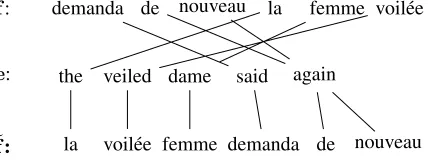
As for anyn-gram model, the parameters are es-timated using statistics collected in a training corpus made of sequences of tuplesderived from the par-allel sentences in a two step process. First, a word alignment is computed using a standard alignment pipeline1based on the IBM models. Source words are then reordered so as to disentangle the align-ment links and to synchronize the source and tar-get texts. Special care has to be paid to non-aligned source words, which have to be collapsed with their neighbor words. A byproduct of this process is a de-terministic joint segmentationof parallel sentences into minimal bilingual units, the tuples, that consti-tute the basic elements in the model. This process is illustrated on Figure 1, where the unfolding process enables the extraction of tuples such as: (demanda, said) or (de nouveau,again).
f: demanda de nouveau la femme voil´ee
e: the veiled dame said again
˜
[image:2.612.322.536.331.411.2]f: la voil´ee femme demanda de nouveau
Figure 1: The tuple extraction process The original (top) and reordered (bottom) French
sentence aligned with its translation.
At test time, the source text is reordered so as to match the reordering implied by the disentangle-ment procedure. Various proposals has been made to perform such source side reordering (Collins et al., 2005; Xia and McCord, 2004), or even learn-ing reorderlearn-ing rules based on syntactic or morpho-syntactic information (Crego and Mari˜no, 2007). The latter approach amounts to accumulate reorder-ing patterns durreorder-ing the trainreorder-ing; test source sen-tences are then non-deterministically reordered in all possible waysyielding a word graph. This graph is then monotonously decoded, where the score of a translation hypothesis combines information from the translation models as well as from other infor-mation sources (lexicalized reordering model, target
side language model (LM), word and phrase penal-ties, etc).
2.2 Translating with CRFs
A discriminative version of the n-gram approach consists in modeling P(e|f) instead of P(e,f), which can be efficiently performed with CRFs (Laf-ferty et al., 2001; Sutton and McCallum, 2006). As-suming matched sequences of observations (x =
xL1) and labels (y = y1L), CRFs express the con-ditional probability of labels as:
P(y1L|xL1) = 1
Z(xL1;θ)exp(θ TG(xL
1, yL1)),
whereθis a parameter vector andGdenotes a vec-tor offeature functionstesting various properties of
x and y. In the linear-chain CRF, each compo-nent Gk(xI1, y1I) of G is decomposed as a sum of local features: Gk(xI1, yI1) =
P
igk(xI1, yi−1, yi)2.
CRFs are trained by maximizing the (penalized) log-likelihood of a corpus containing observations and their labels.
In principle, the data used to train n-gram trans-lation models provide all the necessary information required to train a CRF3. It suffices to consider that the alphabet of possible observations ranges over all possible source side fragments, and that each tar-get side of a tuple is a potential label. The model thus defines the probability of a segmented target
e
e = eeI1 given the segmented and reordered source sentence˜f = fe1I. To complete the model, one just needs to define a distribution over source segmen-tationsP(˜f|f). Given the deterministic relationship betweeneandeeexpressed by the “unsegmentation” functionφwhich maps eewith e = φ(ee), we then have:
P(e|f) = X
˜
f,ee|φ(ee)=e
P(ee,˜f|f)
= X
˜
f,ee|φ(ee)=e
P(ee,|˜f,f)P(˜f|f)
= X
˜
f,ee|φ(ee)=e
P(ee,|˜f)P(˜f|f)
2
Assuming first order dependencies.
3
This is a significant difference with (Blunsom et al., 2008), as we do not need to introduce latent variables during training.
In practice, we will only consider a restricted number of possible segmentation/reorderings of the source, denotedL(f), and compute the best transla-tione∗asφ(ee
∗), where:
e
e∗= arg max
e
e
P(ee|f)
≈arg max
˜
f∈L(f),ee
P(ee,|˜f,f)P(˜f|f) (1)
Even with these simplifying assumptions, this approach raises several challenging computational problems. First, training a CRF is quadratic in the number of labels, of which we will have plenty (typ-ically hundreds of thousands). A second issue is de-coding: as we need to consider at test time a combi-natorial number of possible source reorderings and segmentations, we can no longer dispense with the computation of the normalizerZ(˜f;θ)which is re-quired to computeP(ee,˜f|f)asP(˜f|f)P(ee|˜f)and to compare hypotheses associated with different values of˜f. We discuss our solutions to these problems in the next section.
3 Implementation issues
3.1 Training
Basic training The main difficulties in training are caused by the unusually large number of labels, each of which corresponds to a (small) sequence of target words. Hopefully, each observation (source side tu-ple) occurs with a very small number of different labels. A first simplification is thus to consider that the set of possible “labels”eefor a source sequence
e
f is limited to those that are seen in training: all the other associations(f ,eee)are deemed impossible, which amounts to setting the corresponding param-eter value to−∞.
per-formed using the Rprop algorithm4 (Riedmiller and Braun, 1993), which provides the memory efficiency needed to cope with the very large feature sets con-sidered here.
Training with a target language model One of the main strength of the phrase-based “log-linear” models is their ability to make use of powerful target side language models trained on very large amounts of monolingual texts. This ability is crucial to achieve good performance and has to be preserved no matter the difficulties that occur when one moves away from conventional phrase-based systems (Chi-ang, 2005; Huang and Chi(Chi-ang, 2007; Blunsom and Osborne, 2008; K¨a¨ari¨ainen, 2009). It thus seems appropriate to include a LM feature function in our model or alternatively to define:
P(ee|˜f) = 1
Z(˜f;θ)PLM(ee) exp(θ TG(˜f,
e
e)),
where PLM is the target language model and
Z(˜f;θ) = P
eePLM(ee) exp(θ TG(˜f,
ee)). Imple-menting this approach implies to deal with the lack of synchronization between the units of the trans-lation models, which are variable-length (possibly empty) tuples, and the units of the language models, which are plain words.
In practice, this extension is implemented by per-forming training and inference over a graph whose nodes are not only indexed by their position and the left target context, but also by the requiredn-gram (target) history. In most cases, for small values of nsuch as considered in this study, the n-gram his-tory can be deduced from the left target tuple. The most problematic case is when the left target tuple is NULL, which require to copy the history from the previous states. As a consequence, for the values of n considered here, the impact of this extension on the total training time is limited.
Reference reachability A recurring problem for discriminative training approaches is reference un-reachability(Liang et al., 2006a): this happens when the model cannot predict the reference translation, which means in our case that the probability of the reference cannot be computed. In our implementa-tion, this only happens when the reference involves
4Adapted to handle a locally non-differentiable objective.
a tuple (fe,ee) that is too rare to be included in the model. As a practical workaround, when this hap-pens for a given training sentence, we make sure to “locally” augment the tuple dictionary with the missing part of the reference, which is then removed for processing the rest of the training corpus.
3.2 Inference
Our decoder is implemented as a cascade of weighted finite-state transducers (WFSTs) using the functionalities of the OpenFst library (Allauzen et al., 2007). This library provides many basic opera-tion for WFSTs, notably the left (π1) and right (π2) projections as well as the composition operation (◦). The related notions and algorithms are presented in detail in (Mohri, 2009), to which we refer the reader. In essence, our decoder is implemented of a finite-state cascade involoving the following steps: (i) source reordering and segmentation (ii) application of the translation model and (optionally) (iii) com-position with a target side language model, an ar-chitecture that is closely related to the proposal of (Kumar et al., 2006). A more precise account of these various steps is given below, where we de-scribe the main finite-state transducers involved in our decoder:
• S, the acceptor for the source sentencef;
• R, which implements segmentation and re-ordering rules;
• T, the tuple dictionary, associating source side sequences with possible translations based on the inventory of tuples;
• F, the feature matcher, mapping each feature with the corresponding parameter value;
transducer computing all the possible segmentations of its input into sequences of source side tuples5.
The output ofS◦Rare sequences of source side tuples ˜f; each path in this transducer is addition-ally weighted with a simplisticn-tuple segmentation model, estimated using the source side of the paral-lel training corpus. Note that these scores are nor-malized, so that the weight of each path labelled˜fin S◦RislogP(˜f|f).
The feature matcher F The feature matcher is also implemented as a series of elementary weighted transducers, each transducer being responsible for a givenclass of feature functions. The simplest trans-ducer in this family deals with the class ofunigram feature functions, ie. feature functions that only test the current observation and label. It is represented on the left part of Figure 3.2, where for the sake of readability we only display one example for each test pattern (here: an unconditional feature that al-ways returns true for a given label, a test on the source word, and a test on the source POS label). As long as dependencies between source and/or tar-get symbols remain local, they can be captured by finite-state transducers such as the ones on the mid and right part of Figure 3.2, which respectively com-putebigramtarget features, and joint bigram source and target features.
The feature matcher F is computed as the com-position of these elementary transducers, where we only include source and target labels that can occur given the current input sentence. Weights inF are interpreted in the tropical semiring. exp(F) is ob-tained by replacing weightswinF withexp(w)in the real semiring.
Decoding a word graph If the input segmentation and reordering were deterministically set, meaning that the automatonI = π1(S◦R◦T)would only contain one path, decoding would amount to finding the best path inS◦R◦T◦F. However, we need to compute:
arg max
ee
P(ee|f) = arg max e
e
X
˜
f
P(ee,˜f|f)
= arg max
e
e
X
˜
f
P(ee|˜f)P(˜f|f).
5
When none is found, we also consider a maximal segmen-tation into isolated words.
This requires to compare model scores for mul-tiple source segmentations and reorderings˜f, hence to computeP(˜f|f) andP(ee|˜f), rather than just the non-normalized value that is usually used in CRFs.
Computing the normalizer Z(˜f;θ) for all se-quences inS◦Ris performed efficiently using stan-dard finite-state operations as :
D= det(π1(π2(S◦R)◦T◦ exp(F))).
In fact, determinization (in the real semiring) has the effect of accumulating for each˜f the corresponding normalizerZ(˜f;θ). Replacing each weightwinD by −log(w)and using the logsemiring enables to compute−log(Z(˜f;θ)). The best translation is then obtained as:bestpath(π2(S◦R)◦ −log(D)◦T◦F)
in the tropical semiring.
Decoding and Rescoring with a target language model An alternative manner of using a (large) target side language model is to use it for rescoring purposes. The consistent use of finite-state machines and operations makes it fairly easy to include one during decoding : it suffices to perform the search in π2(S◦R)◦ −log(D)◦T◦F◦L, whereLrepresents an-gram language model. When combining several models, notably a source segmentation model and/or a target language model for rescoring, we have made sure to rescale the (log)probabilities so as to balance the language model scores with the CRF scores, and to use a fixed word bonus to make hypotheses of dif-ferent length more comparable. All these parameters are tuned as part of the decoder development pro-cess. It is finally noteworthy that, in our architecture, alternative decoding strategies, such as MBR (Ku-mar and Byrne, 2004) are also readily implemented.
4 Experiments
4.1 Corpora and metrics
For these experiments, we have used a medium size training corpus, extracted from the datasets made available for WMT 20116evaluation campaign, and have focused on one translation direction, from French to English7.
Translation model training uses the entire News-Commentary subpart of the WMT’2011 training
6statmt.org/wmt11
0 le:the/θle,the
DET :the/θDET ,the
∗:the/θthe 0 1
∗:the/0
∗:cat/θthe,cat
0 1
∗:the/0
[image:6.612.87.525.64.144.2]chat:cat/θchat,cat
Figure 2: Feature matchers. The star symbol (*) matches any possible observation.
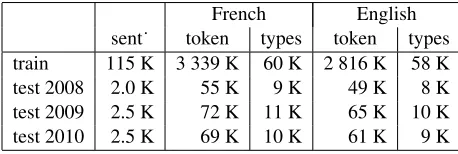
French English sent˙ token types token types train 115 K 3 339 K 60 K 2 816 K 58 K test 2008 2.0 K 55 K 9 K 49 K 8 K test 2009 2.5 K 72 K 11 K 65 K 10 K test 2010 2.5 K 69 K 10 K 61 K 9 K
Table 1: Corpora used for the experiments
data; for language models, we have considered two approaches (i) a “large” bigram model highly opti-mized using all the available monolingual data and (ii) a “small” trigram language model trained on just the English side of the NewsCommentary cor-pus. The regularization parameters used in training are tuned using the WMT 2009 test set; the various parameters implied in the decoding are tuned (for BLEU) on WMT 2008 test set; the internal tests re-ported below are performed on the 2010 test lines (see Table 1) using the best parameters found during tuning. Various statistics regarding these corpora are reproduced on Table 1.
All the training corpora were aligned using MGIZA++ with standard parameters8, and pro-cessed in the standard tuple extraction pipeline. The development and test corpora were also processed analogously. For the sake of comparison, we also trained a standardn-gram-based and a Moses sys-tem (Koehn et al., 2007) with default parameters and a 3-gram target LM trained using only the tar-get side of our parallel corpus. The development set (test 2009) was used to tune these two systems. All performance are measured using BLEU (Papineni et al., 2002).
8As part of a much larger batch of texts.
4.2 Features
The baseline system is composed only of transla-tion features[trs] andtarget bigram features[t2g]. The former correspond to functions of the form
gus,t(˜f,ee, i) = I(fei = s ∧ eei = t), where s andtrespectively denote source and target phrases and I() is the indicator function. These are also
generalized to part-of-speech and also to any pos-sible source phrase, giving rise to features such as
gu∗,t = (˜f,ee, i) =I(eei =t). Target bigram features correspond to functions of the formgbt,t0(˜f,ee, i) = I(eei−1 =t∧eei =t
0). The last baseline feature is the
copy feature, which fires whenever the source and target segments are identical.
Supplementary groups of features are considered in further stages:
• suffix/prefix features [ix]. These features allow to generalize baseline features on the source side to fixed length prefixes and suffixes, thus smoothing the parameters.
• context features [ctx]. These features are sim-ilar to unigram features, but also test the left source tuple and the corresponding part-of-speech.
• segmentation features [seg]. These features are meant to express a preference for longer tuples and to regulate the number of target words per source word. We consider the following feature functions (|e|denotes the length ofe):
– target length features :
gl∗,l(˜f,ee, i) =I(|eei|=l)
– source-target length features :
gll,l0(˜f,ee, i) =I(|fei|=l∧ |eei|=l0)
– source-target length ratio :
gll(˜f,ee, i) =I(round(
|fei|
[image:6.612.71.300.193.270.2]Note that all these features are further condi-tioned on thetargetlabel.
• reordering features [ord]. These features are meant to model preferences for specific lo-cal reordering patterns and take into account neighbor source fragments inee together with the current label. Each source side segment
e
fi is made of some source words that, prior
to source reordering, were located at indices i1. . . il, so that fei = fi1. . . fil. The high-est (resp. lowhigh-est) index in this sequence isdfeie (resp.bfeic). The leftmost (resp. rightmost) in-dex is[fei[(resp.]fei]).
Using these notations, our model includes the following patterns:
– distortion features, measuring the gaps be-tween consecutive source fragments :
gol,t(˜f,ee, i)=I(∆(fei,eei) =l∧eei=t), where∆(fei,eei) =
(
bfeic − dfei−1eif(dfei−1e ≤ bfeic)
dfeie − bfei−1cotherwise.
– lexicalized reordering, identifying mono-tone, swap and discontinuous configura-tions (Tillman, 2004). The monotonous test is defined as: gom(˜f,ee, i) =
I(]ei−1] = [ei[); the swap and
discon-tinuous configurations are defined analo-gously.
– ”gappiness” test : this feature is activated whenever the source indicesi1...ilcontain
one or several gaps.
4.3 Experiments and lessons learned
Training time The first lesson learned is that training can be performed efficiently. Our baseline system, which only containstrsandtrgcontains ap-proximately 87 million features, out of which a lit-tle bit more than 600K are selected. Adding up all supplementary features raises the number of param-eters to about 130M features, out of which 1.5M are found useful. All these systems require between 3 and 5 hours to train9. These numbers are obtained with a`1penalty term≈1, which offers a good bal-ance between accuracy and sparsity.
9
All experiments run on a server with 64G of memory and two Xeon processors with 4 cores at 2.27 Ghz.
Test conditions In order to better assess the strengths and weaknesses of our approach, we com-pare several test settings: the most favorable con-siders only one possible segmentation/reordering˜f
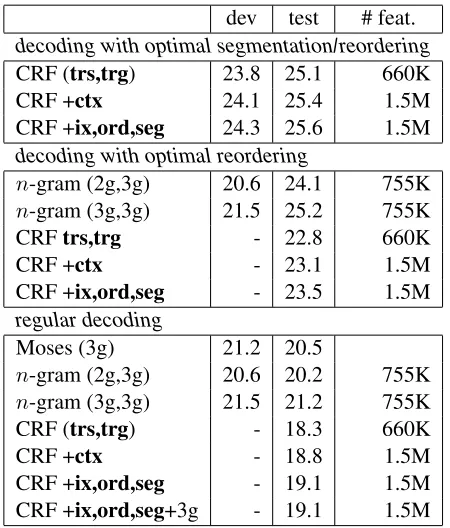
for eachf, obtained through forced alignment with the reference; we then consider the more challeng-ing case where the reorderchalleng-ing is fixed, but several segmentations are considered; then the regular de-coding task, where both segmentation and reorder-ing are unknown and where the entire space of all segmentations and reordering is searched. For each condition, we also vary (i) the set of features used and (ii) the target language model used, if any. Wherever applicable, we also report contrasts with n-gram-based systems subject to the same input and comparable resources, varying the order of the tuple language model, as well as with Moses. Results are in Table 2.
dev test # feat. decoding with optimal segmentation/reordering CRF (trs,trg) 23.8 25.1 660K
CRF +ctx 24.1 25.4 1.5M
CRF +ix,ord,seg 24.3 25.6 1.5M decoding with optimal reordering
n-gram (2g,3g) 20.6 24.1 755K n-gram (3g,3g) 21.5 25.2 755K
CRFtrs,trg - 22.8 660K
CRF +ctx - 23.1 1.5M
CRF +ix,ord,seg - 23.5 1.5M
regular decoding
Moses (3g) 21.2 20.5
n-gram (2g,3g) 20.6 20.2 755K n-gram (3g,3g) 21.5 21.2 755K
CRF (trs,trg) - 18.3 660K
CRF +ctx - 18.8 1.5M
CRF +ix,ord,seg - 19.1 1.5M
[image:7.612.315.540.306.570.2]CRF +ix,ord,seg+3g - 19.1 1.5M
Table 2: Translation performance
help choose the best target phrase.
Searching a larger space Going from the sim-pler to the more difficult conditions yields signif-icant degradations in the model, as our best score drops down from 25.6 to 23.5 (with known reorder-ing) then to 19.1 (regular decodreorder-ing). This is a clear indication that our current segmentation/reordering model is not delivering very useful scores. A similar loss is incurred by then-gram system, which loses 4 bleu points between the two conditions.
LM rescoring Our results to date with target side language models have proven inconclusive, which might explain why our best results remain between one and two BLEU points behind then-gram based system using comparable information. Note also that preliminary experiments with incorporating a large bigram during training have also failed to date to provide us with improvements over the baseline.
Summary In sum, the results accumulated during this first round of experiments tend to show that our CRF model is still underperforming the more es-tablished baseline by approximately 1 to 1.5 BLEU point, when provided with comparable resources. Sources of improvements that have been clearly identified is the scoring of reordering and segmen-tations, and the use of a target language model in training and/or decoding.
5 Related work
Discriminative learning approaches have proven successful for many NLP tasks, notably thanks to their ability to cope with flexible linguistic repre-sentations and to accommodate potentially redun-dant descriptions. This is especially appealing for machine translation, where the mapping between a source word or phrase and its target correlate(s) seems to involve an large array of factors, such as its morphology, its syntactic role, its meaning, its lexi-cal context, etc. (see eg. (Och et al., 2004; Gimpel and Smith, 2008; Chiang et al., 2009), for inspira-tion regarding potentially useful features in SMT).
Discriminative learning requires (i) a parameter-ized scoring function and (ii) a training objective. The scoring function is usually assumed to be linear and ranks candidate outputs y for input x accord-ing toθTG(x, y), whereθis the parameter vector.θ
andGdeterministically imply the input/output map-ping as x → arg maxyθTG(x, y). Given a set of training pairs{xi, yi, i = 1. . . N}, parameters are learned by optimizing some regularized loss func-tion of θ, so as to make the inferred input/output mapping faithfully replicate the observed instances. Machine translation, like most NLP tasks, does not easily lend itself to that approach, due to the complexity of the input/output objects (word or la-bel strings, parse trees, dependency structures, etc). This complexity makes inference and learning in-tractable, as both steps imply the resolution of the arg max problem over a combinatorially large space of candidates y. Structured learning tech-niques (Bakir et al., 2007), developed over the last decade, rely on decompositions of these objects into sub-parts as part of a derivation process, and use conditional independence assumptions between sub-parts to render the learning and inference problem tractable. For machine translation, this only pro-vides part of the solution, as the training data only contain pairs of word aligned sentences (f,e), but lack the explicit derivationhfromf toethat is re-quired to train the model in a fully supervised way.
The approach of (Liang et al., 2006a) circumvents the issue by assuming that the hidden derivation h
can be approximated through forced decoding. As-suming that h is in fact observed as the optimal (Viterbi) derivation h∗ from f to e given the cur-rent parameter value10, it is straightforward to re-cast the training of a phrase-based system as a stan-dard structured learning problem, thus amenable to training algorithms such as the averaged perceptron of (Collins, 2002). This approximation is however not genuine, and the choice of the most appropriate derivation seems to raises intriguing issues (Watan-abe et al., 2007; Chiang et al., 2008).
The authors of (Blunsom et al., 2008; Blunsom and Osborne, 2008) consider models for which it is computationally possible to marginalize out all pos-sible derivations of a given translation. As demon-strated in these papers, this approach is tractable even when the derivation process is a based on syn-chronous context-free grammars, rather that finite-state devices. However, the computational cost
as-10
sociated with training and inference remains very high, especially when using a target side language model, which seems to preclude the application to large-scale translation tasks11. The recent work of (Dyer and Resnik, 2010) proceeds from a similar vein: translation is however modeled as a two step process, where a set of possible source reorderings, represented as a parse forest, are associated with possible target sentences, using, as we do, a finite-state translation model. This translation model is trained discriminatively by marginalizing out the (unobserved) reordering variables; inference can be performed effectively by intersecting the input parse forest with a transducer representing translation op-tions.
A third strategy is to consider a simpler class of derivation process, which only partly describe the mapping between f and e. This is, for instance, the approach of (Bangalore et al., 2007), where a simplebag-of-wordrepresentation of the target sen-tence is computed using a battery of boolean clas-sifiers (one for each target word). In this approach, discriminative training is readily applicable, as the required supervision is overtly present in example source-target pairs (f,e); however, a complemen-tary reshaping/reordering step is necessary to turn the bag-of-word into a full-fledged translation. This work was recently revisited in (Mauser et al., 2009), where a conditional model predicting the presence of each target phrase provides a supplementary score for the standard “log-linear” model.
This line of research has been continued notably in (K¨a¨ari¨ainen, 2009), which introduces an exponen-tial model of bag of phrases (allowing some over-lap), that enables to capture localized dependencies between target words, while preserving (to some ex-tend) the efficiency of training and inference. Su-pervision is here indirectly provided by word align-ment and correlated phrase extraction processes implemented in conventional phrase-based systems (Koehn et al., 2003). If this model seems to deliver state-of-the-art performance on large-scale tasks, it does so at a very high computational cost. More-over, for lack of an internal modeling of reordering processes, this approach, like the bag-of-word
ap-11For instance, the experiments reported in (Blunsom and
Os-borne, 2008) use the English-Chinese BTEC, where the average sentence length is lesser than 10.
proach, seems only appropriate for language pairs with similar or related word ordering.
The approach developed in this paper fills a gap between the hierarchical model of (Blunsom et al., 2008) and the phrase-based model (K¨a¨ari¨ainen, 2009), with whom we share several important as-sumptions, such as the use of alignment information to provide supervision, and the resort to a an “ex-ternal”, albeit a more powerful, reordering compo-nent. Using a finite-state model enables to process reasonably large corpora, and gives some hopes as to the scalability of the whole enterprise; it also makes the integration of a target side language model much easier than in hierarchical models.
6 Discussion and future work
In this paper, we have given detailed description of an original phrase-based system implementing a dis-criminative version of then-gram model, where the translation model probabilities are computed with conditional random fields. We have showed how to implement this approach using a memory effi-cient implementation of the optimization algorithms needed for training: in our approach, training a mid-scale translation system with hundred of thousands sentence pairs and millions of features only takes a couple of hours on a standalone desktop machine. Using `1 regularization has enabled to assess the usefulness of various families of features.
We have also detailed a complete decoder im-plemented as a pipeline of finite-state transducers, which allows to efficiently combine several models, to producen-best lists and word lattices.
(Daume III, 2007)12.
One positive side effect of experimenting with new translation models is that they help reevalu-ate the performance of the whole translation system pipeline: in particular, discriminative training seems to be more sensible to alignments errors than the cor-responding n-gram system, which suggests to pay more attention to possible errors in the training data; we have also seen that the current reordering model defines a too narrow search space and delivers in-sufficiently discriminant scores: we will investigate various ways to further improve the computation and scoring of hypothetical source reorderings.
Acknowledgements
The authors wish to thank the reviewers for com-ments and suggestions. This work was achieved as part of the Quaero Programme, funded by OSEO, French State agency for innovation.
References
Cyril Allauzen, Michael Riley, Johan Schalkwyk, Wo-jciech Skut, and Mehryar Mohri. 2007. OpenFst: A general and efficient weighted finite-state trans-ducer library. In Proceedings of the Ninth Interna-tional Conference on Implementation and Application of Automata, (CIAA 2007), volume 4783 ofLecture Notes in Computer Science, pages 11–23. Springer.
http://www.openfst.org.
G¨okhan Bakir, Thomas Hofmann, Bernhard Sch¨olkopf, Alexander J.Smola, Ben Taskar, and S.V.N. Vish-wanathan. 2007. Predicting structured output. MIT Press.
Srinivas Bangalore, Patrick Haffner, and Stephan Kan-thak. 2007. Statistical machine translation through global lexical selection and sentence reconstruction. InProceedings of the 45th Annual Meeting of the Asso-ciation of Computational Linguistics, pages 152–159, Prague, Czech Republic.
Phil Blunsom and Miles Osborne. 2008. Probabilistic inference for machine translation. InProceedings of the 2008 Conference on Empirical Methods in Natu-ral Language Processing, pages 215–223, Honolulu, Hawaii.
12
In a nutshell, this proposal amounts to having three dif-ferent parameters for each feature; one parameter is trained as usual; the other two parameters are updated conditionally, depending whether the training instance comes from the in-domain or from the out-in-domain training dataset.
Phil Blunsom, Trevor Cohn, and Miles Osborne. 2008. A discriminative latent variable model for statistical machine translation. InProceedings of ACL-08: HLT, pages 200–208, Columbus, Ohio.
Peter F. Brown, John Cocke, Stephen Della Pietra, Vin-cent J. Della Pietra, Frederick Jelinek, John D. Laf-ferty, Robert L. Mercer, and Paul S. Roossin. 1990. A statistical approach to machine translation. Computa-tional Linguistics, 16(2):79–85.
Francesco Casacuberta and Enrique Vidal. 2004. Ma-chine translation with inferred stochastic finite-state transducers. Computational Linguistics, 30(3):205– 225.
David Chiang, Yuval Marton, and Philip Resnik. 2008. Online large-margin training of syntactic and struc-tural translation features. InProceedings of the 2008 Conference on Empirical Methods in Natural Lan-guage Processing, pages 224–233, Honolulu, Hawaii. D. Chiang, K. Knight, and W. Wang. 2009. 11,001 new
features for statistical machine translation. In Pro-ceedings of Human Language Technologies: The 2009 Annual Conference of the North American Chapter of the Association for Computational Linguistics, pages 218–226. Association for Computational Linguistics. David Chiang. 2005. A hierarchical phrase-based model
for statistical machine translation. InProceedings of the 43rd Annual Meeting of the Association for Com-putational Linguistics (ACL’05), pages 263–270, Ann Arbor, Michigan.
Michael Collins, Philipp Koehn, and Ivona Kucerova. 2005. Clause restructuring for statistical machine translation. InProceedings of the 43rd Annual Meet-ing of the Association for Computational LMeet-inguistics (ACL’05), pages 531–540, Ann Arbor, Michigan. Michael Collins. 2002. Discriminative training
meth-ods for hidden markov models: Theory and experi-ments with perceptron algorithms. InProceedings of the 2002 Conference on Empirical Methods in Natu-ral Language Processing, pages 1–8. Association for Computational Linguistics, July.
Josep M. Crego and Jos´e B. Mari˜no. 2007. Improving SMT by coupling reordering and decoding. Machine Translation, 20(3):199–215.
Hal Daume III. 2007. Frustratingly easy domain adapta-tion. InProceedings of the 45th Annual Meeting of the Association of Computational Linguistics, pages 256– 263, Prague, Czech Republic. Association for Compu-tational Linguistics.
surface heuristics. InProceedings of the ACL work-shop on Statistical Machine Translation, pages 31–38, New York City, NY.
Yonggang Deng and William Byrne. 2006. MTTK: An alignment toolkit for statistical machine translation. In
Proceedings of the Human Language Technology Con-ference of the NAACL, Companion Volume: Demon-strations, pages 265–268, New York City, USA. Chris Dyer and Philip Resnik. 2010. Context-free
re-ordering, finite-state translation. InHuman Language Technologies: The 2010 Annual Conference of the North American Chapter of the Association for Com-putational Linguistics, pages 858–866, Los Angeles, California. Association for Computational Linguistics. Kuzman Ganchev, Jo˜ao V. Grac¸a, and Ben Taskar. 2008. Better alignments = better translations ? In Pro-ceedings of ACL-08: HLT, pages 986–993, Columbus, Ohio.
Qin Gao and Stephan Vogel. 2008. Parallel implementa-tions of word alignment tool. InSETQA-NLP ’08. Kevin Gimpel and Noah A. Smith. 2008. Rich
source-side context for statistical machine translation. In Pro-ceedings of the Third Workshop on Statistical Machine Translation, pages 9–17, Columbus, Ohio, June. Liang Huang and David Chiang. 2007. Forest rescoring:
Faster decoding with integrated language models. In
Proceedings of the 45th Annual Meeting of the Asso-ciation of Computational Linguistics, pages 144–151, Prague, Czech Republic.
Matti K¨a¨ari¨ainen. 2009. Sinuhe – statistical machine translation using a globally trained conditional expo-nential family translation model. In Proceedings of the 2009 Conference on Empirical Methods in Natural Language Processing, pages 1027–1036, Singapore. Philipp Koehn, Franz Josef Och, and Daniel Marcu.
2003. Statistical phrase-based translation. In Proceed-ings of the Human Language Technology Conference of the North American Chapter of the Association for Computational Linguistic, pages 127–133, Edmond-ton, Canada.
Philipp Koehn, Hieu Hoang, Alexandra Birch, Chris Callison-Burch, Marcello Federico, Nicola Bertoldi, Brooke Cowan, Wade Shen, Christine Moran, Richard Zens, Chris Dyer, Ondrej Bojar, Alexandra Con-stantin, and Evan Herbst. 2007. Moses: Open source toolkit for statistical machine translation. In Proc. Annual Meeting of the Association for Computational Linguistics (ACL), demonstration session, pages 177– 180, Prague, Czech Republic.
Shankar Kumar and William Byrne. 2004. Minimum bayes-risk decoding for statistical machine translation. In Daniel Marcu Susan Dumais and Salim Roukos, editors,HLT-NAACL 2004: Main Proceedings, pages
169–176, Boston, Massachusetts, USA. Association for Computational Linguistics.
Shankar Kumar, Yonggang Deng, and William Byrne. 2006. A weighted finite state transducer transla-tion template model for statistical machine translatransla-tion.
Natural Language Engineering, 12(1):35–75.
John Lafferty, Andrew McCallum, and Fernando Pereira. 2001. Conditional random fields: probabilistic mod-els for segmenting and labeling sequence data. In
Proceedings of the International Conference on Ma-chine Learning, pages 282–289. Morgan Kaufmann, San Francisco, CA.
Thomas Lavergne, Olivier Capp, and Franois Yvon. 2010. Practical very large scale crfs. In Proceed-ings of the 48th Annual Meeting of the Association for Computational Linguistics, pages 504–513, Uppsala, Sweden.
Percy Liang, Alexandre Bouchard-Cˆot´e, Dan Klein, and Ben Taskar. 2006a. An end-to-end discriminative ap-proach to machine translation. InProceedings of the 21st International Conference on Computational Lin-guistics and 44th Annual Meeting of the Association for Computational Linguistics, pages 761–768, Syd-ney, Australia.
Percy Liang, Ben Taskar, and Dan Klein. 2006b. Align-ment by agreeAlign-ment. In Proceedings of the Human Language Technology Conference of the NAACL, Main Conference, pages 104–111, New York City, USA. Daniel Marcu and Daniel Wong. 2002. A phrase-based,
joint probability model for statistical machine trans-lation. In Proceedings of the 2002 Conference on Empirical Methods in Natural Language Processing, pages 133–139.
Jos´e B. Mari˜no, Rafael E. Banchs, Josep M. Crego, Adri`a de Gispert, Patrick Lambert, Jos´e A.R. Fonollosa, and Marta R. Costa-Juss`a. 2006. N-gram-based machine translation. Computational Linguistics, 32(4):527– 549.
Arne Mauser, Saˇsa Hasan, and Hermann Ney. 2009. Ex-tending statistical machine translation with discrimi-native and trigger-based lexicon models. In Proceed-ings of the 2009 Conference on Empirical Methods in Natural Language Processing, pages 210–218, Singa-pore.
Mehryar Mohri. 2009. Weighted automata algorithms. In Manfred Droste, Werner Kuich, and Heiko Vogler, editors, Handbook of Weighted Automata, chapter 6, pages 213–254. Springer Verlag.
Andrew Y. Ng. 2004. Feature selection, l1 vs. l2 regular-ization, and rotational invariance. InProceedings of the twenty-first international conference on Machine learning, pages 78–86.
Libin Shen, David Smith, Katherine Eng, Viren Jain, Zhen Jin, and Dragomir Radev. 2004. A smorgasbord of features for statistical machine translation. In HLT-NAACL 2004: Main Proceedings, pages 161–168, Boston, Massachusetts, USA. Association for Compu-tational Linguistics.
Kishore Papineni, Salim Roukos, Todd Ward, and Wei-Jing Zhu. 2002. BLEU: a method for automatic evaluation of machine translation. In Proceedings of the 40th Annual Meeting on Association for Computa-tional Linguistics, pages 311–318.
Martin Riedmiller and Heinrich Braun. 1993. A direct adaptive method for faster backpropagation learning: The RPROP algorithm. In Proceedings of the IEEE International Conference on Neural Networks, pages 586–591, San Francisco, USA.
Charles Sutton and Andrew McCallum. 2006. An in-troduction to conditional random fields for relational learning. In Lise Getoor and Ben Taskar, editors,
Introduction to Statistical Relational Learning, Cam-bridge, MA. The MIT Press.
Robert Tibshirani. 1996. Regression shrinkage and se-lection via the lasso. J.R.Statist.Soc.B, 58(1):267–288. Christoph Tillman. 2004. A unigram orientation model for statistical machine translation. In Susan Du-mais, Daniel Marcu, and Salim Roukos, editors, HLT-NAACL 2004: Short Papers, pages 101–104, Boston, Massachusetts, USA.
J. Turian, B. Wellington, and I.D. Melamed. 2007. Scal-able discriminative learning for natural language pars-ing and translation. InProc. Neural Information Pro-cessing Systems (NIPS), volume 19, pages 1409–1417. Taro Watanabe, Jun Suzuki, Hajime Tsukada, and Hideki Isozaki. 2007. Online large-margin training for sta-tistical machine translation. In Proceedings of the 2007 Joint Conference on Empirical Methods in Nat-ural Language Processing and Computational Natu-ral Language Learning (EMNLP-CoNLL), pages 764– 773, Prague, Czech Republic.
Joern Wuebker, Arne Mauser, and Hermann Ney. 2010. Training phrase translation models with leaving-one-out. In Proceedings of the 48th Annual Meeting of the Association for Computational Linguistics, pages 475–484, Uppsala, Sweden.