Unsupervised training of maximum-entropy models for lexical selection in
rule-based machine translation
Francis M. Tyers HSL-fakultehta,
UiT Norgga ´arktalas universitehta,ˇ
N-9018 Romsa
Felipe S´anchez-Mart´ınez Dept. Lleng. i Sist. Inform.,
Universitat d’Alacant, E-03071 Alacant
Mikel L. Forcada Dept. Lleng. i Sist. Inform.,
Universitat d’Alacant, E-03071 Alacant
Abstract
This article presents a method of training maximum-entropy models to perform lexi-cal selection in a rule-based machine trans-lation system. The training method de-scribed is unsupervised; that is, it does not require any annotated corpus. The method uses source-language monolingual corpora, the machine translation (MT) system in which the models are integrated, and a sta-tistical target-language model. Using the MT system, the sentences in the source-language corpus are translated in all possi-ble ways according to the different transla-tion equivalents in the bilingual dictransla-tionary of the system. These translations are then scored on the target-language model and the scores are normalised to provide frac-tional counts for training source-language maximum-entropy lexical-selection mod-els. We show that these models can per-form equally well, or better, than using the target-language model directly for lexical selection, at a substantially reduced compu-tational cost.
1 Introduction
Corpus-based machine translation (MT) has been the primary research direction in thefield of MT in recent years. However, rule-based MT (RBMT) systems are still being developed, and there are many successful commercial and non-commercial systems. One reason for the continued development of RBMT systems is that in order to be successful,
c
�2015 The authors. This article is licensed under a Creative Commons 3.0 licence, no derivative works, attribution, CC-BY-ND.
corpus-based MT requires parallel corpora in the order of tens of millions of words. Although for some language pairs these exist, they only exist for a fraction of the world’s languages.
An RBMT system typically consists of an analy-sis component,1a transfer component and a genera-tion component. As part of the transfer component it is necessary to make choices regarding words in the source language (SL) which may have more than one translation in the target language (TL).
Lexical selection is the task of choosing, for a given SL word, the most adequate translation in the TL among a known set of alternatives. The task is related to the task of word-sense disambiguation (Ide and V´eronis, 1998). However, it is different to word-sense disambiguation in that lexical selection is a bilingual problem, not a monolingual problem: its aim is tofind the most adequate translation, not the most adequate sense. Thus, it is not necessary to choose among a series offine-grained senses if all these senses result in the samefinal translation; however, it may sometimes be necessary to choose a different translation for the same sense, for example in a collocation.
1.1 Prior work
Dagan and Itai (1994) used the termword sense dis-ambiguationto refer to what is actually lexical se-lection in MT; they used a parser to identify syntac-tic relations such as subject–object or subject–verb. After generating all the possible translations for a given input sentence using an ambiguous bilingual dictionary, they extract the syntactic tuples from the TL and count the frequency in a previously-trained TL model of tuples. They use maximum-likelihood estimation to calculate the probability that a given
TL tuple is the translation of a given SL tuple, with an automatically determined confidence threshold. Later, Berger et al. (1996) illustrated the use of maximum-entropy classifiers on the specific prob-lem of lexical selection in IBM-style word-based statistical MT. Other authors (Melero et al., 2007) have used TL models to rank the translations re-sulting from all possible combinations of lexical selections. Nowadays, in state-of-the-art phrabased statistical MT (Koehn, 2010), lexical se-lection is taken care of by a combination of the translation model and the language model. The translation model provides probabilities of transla-tion between words or word sequences (often re-ferred to asphrases) in the source and target lan-guage. The TL model provides probabilities of word sequences in the TL. Mareˇcek et al. (2010) trained a maximum-entropy lexical selector for their dependency-grammar-based transfer system TectoMT using a bilingual corpus. More recently, Tyers et al. (2012) presented a method of lexical selection for RBMT based on rules which select or remove translations infixed-length contexts, along with a training method for learning the rules from a word-aligned parallel corpus.2
2 Method
Lexical selection in this paper considers for each word a simple SL context made up of neighbouring lemma+part-of-speech combinations. Contexts con-sidered include up to two words to the left and up to two words to the right of the word to be translated. Let the probability of a wordtbeing the trans-lation of a wordsin a SL contextcbeps(t|c). In principle, this value could be estimated directly from the available corpora for every combination of(s, t, c). This would however present two
ques-tions: (1) how should the relevant contexts be cho-sen? and (2) what should be done when (s, t, c)
is not found in the corpus? A maximum-entropy model answers both of these questions. It allows the contexts that we consider to be linguistically interesting to be defineda prioriand then integrate these seamlessly into a probabilistic model (Man-ning and Sch¨utze, 1999). In answer to the second question, a maximum-entropy model maximises the entropy subject to match the expected counts of the designed features with those found in the training
2The work by Ravi and Knight (2011) and Nuhn and Ney
(2014), who decipher word-ciphered text using monolingual corpora only may be seen as a generalised version of the prob-lem of lexical selection without parallel corpora.
data. That is, if there is no information in the train-ing data, then it assumes that all outcomes —that is, all possible translations— are equally likely. As previously mentioned, the principle of maximum entropy has been applied to the problem of lexical selection before; in particular, Berger et al. (1996) cast the problem of lexical selection in statistical MT as a classification problem. They learn a sepa-rate maximum-entropy classifier for each SL word form, using SL context to distinguish between pos-sible translations. These classifiers are then incorpo-rated into the translation model of their word-based statistical MT system. In their approach, a classifier consists of a set of binary feature functions and cor-responding weights for each feature. In both Berger et al. (1996) and our method, features are defined in the formhs
k(t, c),3wheretis a translation, and c is a SL context. One difference is that Berger et al. (1996) takes,tand cto be based on word forms, whereas in our method they are based on lemma forms. An example would be the follow-ing feature where the Spanish wordpez(‘fish’ as a living animal) is seen as the translation ofarrain (‘fish’) in the contextarrain handi ‘bigfish’ and would therefore be defined as:
harrain+handi(t, c) =
1 if
t = pez
and
handifollowsarrain
0 otherwise
(1) This feature considers a context of zero words to the left of the problem word and one word (+handi) to the right of it.
As a result of training, each of thenF features hsk(t, c) in the classifier is assigned a weight λsk.
Combining these weights of active features as in equation (2) yields the probability of a translationt for wordsin contextc.
ps(t|c) =
1
Zs(c)exp nF
�
k=1
λskhsk(t, c) (2)
In this equation,Zs(c)is a normalising constant. Thus, the most probable translationt�can be found using
t� = arg max
t∈Ts(s)
ps(t|c) = arg max t∈Ts(s)
nF
�
k=1
λskhsk(t, c),
(3)
S→ pre-lexsel →({gi}ii=1=|G|, S)→ lexsel →(g�, S)→
post-lexsel →τ(g�, S)
Figure 1:A schema of the lexical selection process: source sentenceShas|G|lexical selection pathsgi:lexselselects one of themg�, which is used to generate translationτ(g�, S).
whereTs(s)is the set of possible translations for SL words.
The approaches by Berger et al. (1996) and by Mareˇcek et al. (2010) cited above both take advan-tage of a parallel corpus to collect counts of con-texts and translations in order to train maximum-entropy models. However, parallel corpora are not available for the majority of the world’s written lan-guages. In this section we describe an unsupervised method to learn the models using only monolin-gual corpora and the components from the RBMT system in which they are used.
The input to our method consists of a col-lection of samples, G = (S, G), where S = (s1, s2, . . . s|S|) is a sequence of SL words, and
G = {g1, g2, . . . g|G|}is a set of possible
lexical-selection paths. A lexical-lexical-selection path g = (t1, t2, . . . , t|S|)is a sequence of lexical-selection
choices of those SL words, wheretiis an element of Ts(si), the set of possible translations of si.4 This is produced in thefirst stages of RBMT, just after morphological analysis, part-of-speech tag-ging, and bilingual dictionary lookup, and before any structural transfer takes place (we will call this pre-lexsel). In our model, it is after thesefirst stages that lexical selection (lexsel) occurs. After lexical selection, structural transfer and generation take place; a functionτ(gi, S)represents the result of
these last stages, which we will callpost-lexsel, and returns afinished translation of a specific lexical-selection pathgiof sentenceS. Figure 1 shows this process schematically.
As our method is unsupervised, and therefore the occurrences of specific lexical selection events
(s, t, c)cannot be counted, a TL modelPTL(·)is
used to compute a value for the fractional count for disambiguation pathgi,p(gi|S)after suitable normalisation:
p(gi|S) =
PTL(τ(gi, S))
�
gi∈GPTL(τ(gi, S))
(4)
The maximum-entropy model is trained instead using the fractional count p(gi|S) for the events
4We deal only with single-word translations in this paper.
(s, t, c) found in gi, that is, when in gi the trans-lation forsin context cis t. That is, as if event
(s, t, c)had been seen a fractional numberp(gi|S) of times. We prune(s, t, c)occurring less than a
certain number of times in the corpus, using a de-velopment corpus to guide pruning (see section 4). The method used here for lexical selection is anal-ogous to the method used by S´anchez-Mart´ınez et al. (2008) to train a hidden-Markov-model-based part-of-speech tagger in a RBMT system.
3 Experimental setting
This section describes the training and evaluation settings used in the remainder of this paper. The primary motivation behind the evaluation is that it should be automatic, meaningful, and be performed over a test set which is large enough to be repre-sentative. It should evaluate both performance on the specific subtask of lexical selection, and on the whole translation task. Evaluating lexical-selection performance is anintrinsicmodule-based evalua-tion. It measures how well the lexical selection module disambiguates the lexical-transfer output as compared to a gold-standard corpus. The lexical transfer output is the result of looking up the trans-lations of the SLlexical forms— lemmas and tags — in the bilingual dictionary.
The whole translation task evaluation is an extrin-sicevaluation, which tests how the system improves as regardsfinal translation quality in a real system.
each of the language pairs.
3.1 Apertium
Apertium is a free/open-source RBMT platform, it comprises an engine, a toolbox and data to build RBMT systems. Translation is implemented as a pipeline consisting of the following modules: mor-phological analysis, mormor-phological disambiguation, lexical transfer, lexical selection, structural transfer and morphological generation.
3.2 Language pairs
Evaluation will be performed using four Apertium (Forcada et al., 2011) language pairs. These pairs have been selected as they include languages with different morphological complexity, and different amounts of resources available — although for all pairs there is a parallel corpus available for evalua-tion (see Secevalua-tion 3.3).5
Breton–French (Tyers, 2010): Bilingual dictionar-ies were not built with polysemy in mind from the outset, but some entries were added later to start work on lexical selection.6
Macedonian–English: The Macedonian–English pair in Apertium was created specifically for the purposes of running lexical-selection ex-periments. The lexical resources for the pair were tuned to the SETimes parallel corpus (Ty-ers and Alperen, 2010). The most probable entry from automatic word alignment of this corpus using GIZA++ (Och and Ney, 2003) was checked to ensure that it was an adequate translation, and if so marked as the default.7 As a result of attempting to include all possi-ble translations, the average number of trans-lations per word is much higher than in other pairs.8
Basque–Spanish (Ginest´ı-Rosell et al., 2009): al-ternative translations were included in the bilingual dictionary.9
5The Apertium revision (version) used is given in footnotes. 6Revision 41375; https://svn.code.sf.net/p/
apertium/svn/trunk/apertium-br-fr
7Bilingual dictionaries in Apertium (Forcada et al., 2011) may
contain several translations for a given word. Dictionary writ-ers may mark aslinguistic defaultthe most general or most frequent translation among the set of possible translations.
8Revision 41476; https://svn.code.sf.net/p/
apertium/svn/trunk/apertium-mk-en
9Revision 44846; https://svn.code.sf.net/p/
apertium/svn/trunk/apertium-eu-es
English–Spanish: The English–Spanish pair was developed from a combination of the English– Catalan and Spanish–Catalan pairs, and con-tains a number of entries in the bilingual dic-tionary with more than one translation.10
3.3 Performance measures
This section describes the measures that will be used to evaluate the performance of the lexical se-lection method proposed here: a (intrinsic)lexical selection performancemeasure and an (extrinsic) machine translation performancemeasure.
3.3.1 Lexical-selection performance
This is an intrinsic module-based evaluation of the performance of the lexical-selection module. It measures how well the lexical-selection mod-ule disambiguates the output of the lexical-transfer module as compared to a gold-standard corpus. For this task, we define a metric, the lexical-selection error rate (LER), that focuses on the problem of lexical selection by restricting the evaluation to this feature; other features of the MT system, such as the transfer rules and morphological generation, are not taken into account.
The lexical-selection error rate is the fraction of times the given system chooses a translation for a word which is not the one found in an anno-tated reference. The process uses a SL sentence, S = (s1, s2, . . . , s|S|) and three functions. The
first function, Ts(si), returns all possible transla-tions of si according to the bilingual dictionary. The second function, Tt(si), returns the transla-tions ofsi selected by the lexical-selection mod-ule: Tt(si) ⊆ Ts(si); and usually |Tt(si)| = 1. If the lexical-selection module returns more than one translation, thefirst translation is selected. The functionTr(si)returns the set of reference transla-tions which are acceptable forsi in sentenceS.11 For a single sentence, we define the lexical selection error rate (LER) of that sentence as
LER =
�|S|
i=1amb(si) diff(Tr(si), Tt(si))
�|S|
i=1amb(si)
, (5)
where
amb(si) =
�
1 if|Ts(si)|>1
0 otherwise (6)
10Revision 41387; https://svn.code.sf.net/p/
apertium/svn/trunk/apertium-en-es
11Depending on how the reference is built, the set returned by
L’estiu ´es una estaci´o llarga
S el estiu ser un estaci´o llarg
Ts(si) {the} {summer} {be} {a} {station, season} {long, lengthy} Tr(si) {the} {summer} {be} {a} {season} {long}
Tt(si) {the} {summer} {be} {a} {station} {long}
amb(si) 0 0 0 0 1 1
[image:5.595.93.506.70.170.2]diff(Tr(si), Tt(si)) 0 0 0 0 1 0
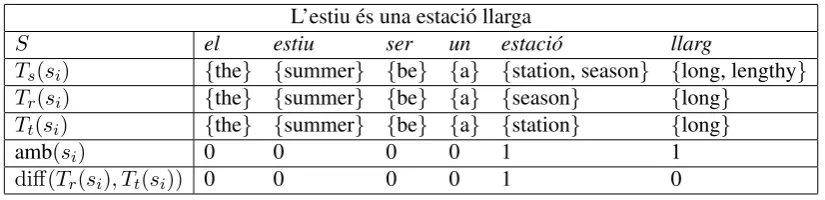
Figure 2:An example input sentence in Catalan and the three sets of English translations used for calculating the lexical-selection error rate. The source sentenceS = (s1, s2, . . . , s|S|)has two ambiguous words,estaci´oandllarg(amb(si) = 1, eq. (6)). There is one difference (diff(Tr(si), Tt(si)) = 1, eq. (7)) between the reference setTr(si)and the test setTt(si)of translations; thus, the error rate for this sentence is 50%.
tests if a word is ambiguous, and the function
diff(Tr(si), Tt(si)) =
�
1 ifTr(si)∩Tt(si) =∅
0 otherwise
(7) states that there is a difference if the intersection between the set of reference translationsTr(si)and the set of translations from the lexical selection moduleTt(si)is empty. Recall that, althoughTt(si) returns a set, this set will be a singleton, as when the lexical-selection module returns more than one translation, Apertium will select the default one if marked or thefirst one of not.12
The table in Figure 2 gives an overview of the inputs.In the description it is assumed that the refer-ence translation has been annotated by hand. How-ever, hand annotation is a time-consuming process, and was not possible. A description of how the reference was built is given in Section 3.4.
3.3.2 Machine translation performance
This is an extrinsic evaluation, which ideally would test how much the system improves as re-gards an approximate measurement offinal trans-lation quality in a real system. For this task, we use the widely-usedBLEUmetric (Papineni et al., 2002). This is not ideal for evaluating the task of a lexical selection module as the performance of the module will depend greatly on (a) the coverage of the bilingual dictionaries of the RBMT system in question, and (b) the number of reference transla-tions. It is also worth noting that successful lexical selections may not lead to successful translations due to inadequate transfer of morphological fea-tures. The BLEU metric is included only as it is commonly used to evaluate MT systems.
12In practice this does not happen as each ambiguous word has
adefaulttranslation.
3.3.3 Confidence intervals
Confidence intervals for both metrics will be cal-culated throughbootstrap resampling(Efron and Tibshirani, 1994) as described by Koehn (2004). In all cases, bootstrap resampling will be carried out for 1,000 iterations. Where thep= 0.05
confi-dence intervals overlap, we will also perform paired bootstrap resampling (Koehn, 2004).
3.4 Corpora
For creating the test corpora, providing a SL corpus for training, and a TL corpus for scoring, we used four parallel corpora:
• Ofis ar Brezhoneg(OAB): This parallel cor-pus of Breton and French has been col-lected specifically for lexical-selection experi-ments from translations produced byOfis ar Brezhoneg‘The Office of the Breton language’. The corpus has recently been made available online throughOPUS.13
• South-East European Times (SETimes): Described in Tyers and Alperen (2010), this corpus is a multilingual corpus of the Balkan languages (and English) in the news domain. The Macedonian and English part will be used.
• Open Data Euskadi(OpenData): This is a Basque–Spanish parallel corpus made from the translation memories of theHerri Ardu-ralaritzaren Euskal Erakundea‘Basque Insti-tute of Public Administration’.14
• European Parliament Proceedings
(EuroParl): Described by Koehn (2005), this is a multilingual corpus of the European Union official languages. We are using the English–Spanish data from version 7.15
There are a number of approaches to creating evaluation corpora for lexical selection in the lit-erature. Vickrey et al. (2005) use a parallel cor-pus to make annotated test and training sets for experiments in lexical selection applied to a sim-plified translation problem in statistical MT. They use word alignments fromGIZA++ (Och and Ney, 2003) to annotate SL words with their translations from the reference translation in the parallel corpus. One disadvantage of this method is that only one translation is annotated per SL word, meaning that accuracies may be lower because of missing trans-lations — this happens when the system chooses a translation which is adequate, but is not found in the reference translation. A second disadvan-tage is that the word alignments may not be 100% reliable, which decreases the accuracy of the anno-tated corpus. An alternative method is described by Zinovjeva (2000), who manually tags ambiguous words in English sentences with their translation in Swedish.
Ideally we would have had a hand-annotated eval-uation corpus, as described by Zinovjeva (2000), but as this did not exist, we decided to automati-cally annotate a test set using a process similar to that described by Vickrey et al. (2005).
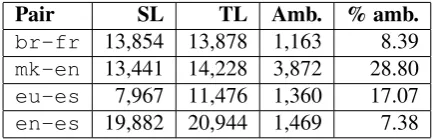
The annotation process proceeds as follows: First we word-align the corpus to extract a set of word alignments, which are correspondences between words in sentences in the source side of the parallel corpus and those in the target side. Any aligner may be used, but in this paper we useGIZA++ (Och and Ney, 2003).16We then use these alignments along with the bilingual dictionary of the MT system in question to extract only those sentences where: (a) there is at least one ambiguous word; (b) that am-biguous word is aligned to a single word in the TL; and (c) the word it is aligned to in the TL is found in the bilingual dictionary of the MT system. Sentences where there are no ambiguous words (ap-proximately 90%, see Table 1) are discarded. The source side of the extracted sentence is then passed through the lexical transfer module, which returns all the possible translations, and for each ambigu-ous word, the translation is selected which is found aligned in the reference.
After this process, we selected 1,000 sentence pairs at random for testing (test), 1,000 for
devel-16The exact configuration ofGIZA++ used is equivalent to
running the MOSEStoolkit (Koehn et al., 2007) in default configuration up to step three of training.
Pair SL TL Amb. % amb.
br-fr 13,854 13,878 1,163 8.39
mk-en 13,441 14,228 3,872 28.80
eu-es 7,967 11,476 1,360 17.07
[image:6.595.307.525.71.141.2]en-es 19,882 20,944 1,469 7.38
Table 2: Statistics about the test corpora. The columnsSL
andTLgive the number of tokens in the source and target languages respectively. The columnsamb. wordsand% am-biggives the number of word with more than one translation and the percentage of SL words which have more than one translation respectively.
opment (dev)17and left the remainder for training. Table 1 gives statistics about the size of the input corpora, and how many sentences were left after processing for testing, training and development. Table 2 gives information about the test corpora.
3.5 Reference systems
We compare our method to the following reference (or baseline) systems:
• Linguist-chosen defaults. A bilingual dictio-nary in an Apertium language pair contains correspondences between lexical forms. The dictionaries allow many lexical forms to trans-late to one lexical form. But a single lexical form may not have more than one translation without further processing. If there are many possible translations of a lexical form, then one must be marked as thedefaulttranslation.
• Oracle. The results for the oracle system are those achieved by passing the automatically annotated reference translation through the rest of the modules of the MT system. This is included to show the upper bound for the performance of the lexical-selection module.
• Target language model(TLM). One method of lexical selection is to use the existing MT system to generate all the possible translations for an input sentence, and then score these translationson-lineon a model of the TL. The highest scoring sentence is then output. This is the method used by Melero et al. (2007).
4 Results
As we are working with binary features, we use the implementation of generalised iterative scaling
17The development corpus was used for checking the value for
Pair Lines Extract. train dev test No. amb Av. amb br-fr 57,305 4,668 2,668 1,000 1,000 603 3.06
mk-en 190,493 19,747 17,747 1,000 1,000 13,134 3.06
eu-es 765,115 87,907 85,907 1,000 1,000 1,806 3.11
[image:7.595.110.489.72.141.2]en-es 1,467,708 312,162 310,162 1,000 1,000 2,082 2.28
Table 1:Statistics about the source corpora. The columnno. ambgives the number of unique tokens with more than one possible translation. The columnav. ambgives the average number of translations per ambiguous word. This is calculated by looking up each word in the corpus in the bilingual dictionary of the MT system and dividing the total number of translation by the number of words. Bothav. ambandno. ambare calculated over the whole corpus.
Pair Pruned # features
[image:7.595.105.259.213.282.2]br-fr <5 5,277 mk-en <7 205,494 eu-es <7 196,024 en-es <7 195,605
Table 3:Features in each rule set and pruning frequency.
available in theYASMET18to calculate the feature weights. After learning the feature sets and weights, we compute the evaluation measures described in Section 3.3. There is an option to remove events
(s, t, c)which occur less than a certain number of times in the training corpus. This is referred to as the feature pruning frequency threshold — features occurring less than the threshold are discarded. The value was set experimentally. Values of between two and seven were tested, and the ones which provided the best improvement on the development corpus were selected; they happen to come close to the rule-of-thumb value of five that Manning and Sch¨utze (1999, p. 596) found to be effective. Table 3 shows the number of features that have eventually been used for each language pair.
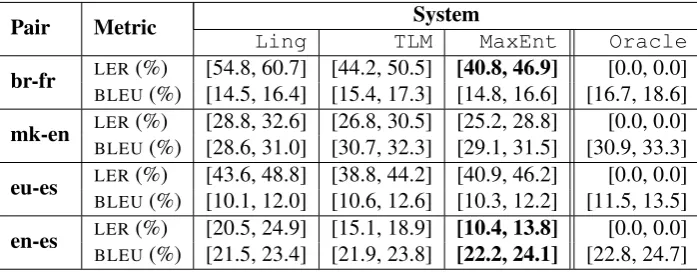
Evaluation results are presented in table 4, which compares the results of the new approach with re-spect to thedefault behaviour(the linguist-chosen defaults), with respect to theoracle(which repsents the upper bound to performance), and with re-spect to the results obtained by using the TL model online, for each of the language pairs in Apertium with respect to our two evaluation metrics. Note that the high error rate for the Breton–French pair may be as a result of having the linguistic defaults tuned to a different domain than that of the corpus. Significant improvements with respect to the
re-18http://www-i6.informatik.rwth-aachen.
de/web/Software/YASMET.html; the compilable ver-sion we used is available as part of the Apertiumlex-tools
package, http://downloads.sourceforge.net/ project/apertium/apertium-lex-tools/ apertium-lex-tools-0.1.0.tar.gz.
sults obtained using the TL model online are appar-ent with the Breton–French —the pair with the least data— and the English–Spanish language pairs. In the remaining cases, the maximum-entropy method comes close to the TL model performance in terms of similar or better BLEU and LER scores, at a much smaller computational cost.
Improvements with respect to the TL model per-formance are likely due to the effective use that the maximum-entropy model makes of information about the relevant SL contexts and their translations, through the weighting of features representing those SL contexts across the whole corpus.
5 Conclusions
Pair Metric Ling TLMSystemMaxEnt Oracle
br-fr LERBLEU(%)(%) [14.5, 16.4] [15.4, 17.3] [14.8, 16.6][54.8, 60.7] [44.2, 50.5] [40.8, 46.9] [16.7, 18.6][0.0, 0.0]
mk-en LERBLEU(%)(%) [28.6, 31.0] [30.7, 32.3] [29.1, 31.5][28.8, 32.6] [26.8, 30.5] [25.2, 28.8] [30.9, 33.3][0.0, 0.0]
eu-es LERBLEU(%)(%) [10.1, 12.0] [10.6, 12.6] [10.3, 12.2][43.6, 48.8] [38.8, 44.2] [40.9, 46.2] [11.5, 13.5][0.0, 0.0]
[image:8.595.124.473.71.207.2]en-es LERBLEU(%)(%) [21.5, 23.4] [21.9, 23.8][20.5, 24.9] [15.1, 18.9] [10.4, 13.8][22.2, 24.1] [22.8, 24.7][0.0, 0.0]
Table 4:LER and BLEU scores with 95% confidence intervals for the reference systems on the test corpora. Themax-ent
system has been trained using fractional counts. The results in bold face show statistically significant improvements for the maximum-entropy model compared to the TL model according to pair-bootstrap resampling.
Acknowledgements: We acknowledge support from the Spanish Ministry of Industry and Compet-itiveness through project Ayutra (TIC2012-32615) and from the European Commission through project Abu-Matran (FP7-PEOPLE-2012-IAPP, ref. 324414) and thank all three anonymous referees for useful comments on the paper.
References
Berger, A., Pietra, S. D., and Pietra, V. D. (1996). A maximum entropy approach to natural language processing. Compu-tational Linguistics, 22(1):39–71.
Dagan, I. and Itai, A. (1994). Word sense disambiguation using a second language monolingual corpus. Computational Linguistics, 20(4):563–596.
Efron, B. and Tibshirani, R. J. (1994).An Introduction to the Bootstrap. CRC Press.
Forcada, M. L., Ginest´ı-Rosell, M., Nordfalk, J., ORegan, J., Ortiz-Rojas, S., P´erez-Ortiz, J. A., S´anchez-Mart´ınez, F., Ram´ırez-S´anchez, G., and Tyers, F. M. (2011). Aper-tium: a free/open-source platform for rule-based machine translation.Machine Translation, 25(2):127–144. Ginest´ı-Rosell, M., Ram´ırez-S´anchez, G., Ortiz-Rojas, S.,
Ty-ers, F. M., and Forcada, M. L. (2009). Development of a free Basque to Spanish machine translation system. Proce-samiento de Lenguaje Natural, (43):185–197.
Ide, N. and V´eronis, J. (1998). Word sense disambiguation: The state of the art.Computational Linguistics, 24(1):1–41. Koehn, P. (2004). Statistical significance tests for machine translation evaluation. In Proc. of the Conference on EMNLP, pages 388–395.
Koehn, P. (2005). Europarl: A parallel corpus for statistical machine translation. InProc. of the 10th MT Summit, pages 79–86.
Koehn, P. (2010).Statistical machine translation. Cambridge University Press.
Koehn, P., Hoang, H., Birch, A., Callison-Burch, C., Federico, M., Bertoldi, N., Cowan, B., Shen, W., Moran, C., Zens, R., Dyer, C., Bojar, O., Constantin, A., and Herbst, E. (2007). Moses: Open source toolkit for statistical machine translation. InProc. of the Annual Meeting of the ACL, demonstration session.
Manning, C. D. and Sch¨utze, H. (1999).Foundations of Statis-tical Natural Language Processing. MIT Press.
Mareˇcek, D., Popel, M., andZabokrtsk´y, Z. (2010). Maxi-ˇ mum entropy translation model in dependency-based MT framework. InWMT ’10 Proc. of the Joint 5th Workshop on SMT and MetricsMATR, pages 201–206.
Melero, M., Oliver, A., Badia, T., and Su˜nol, T. (2007). Deal-ing with bilDeal-ingual divergences in MT usDeal-ing target language n-gram models. InProc. of the METIS-II Workshop, pages 19–26.
Nuhn, M. and Ney, H. (2014). Em decipherment for large vocabularies. InProceedings of the 52nd Annual Meeting of the Association for Computational Linguistics (Short Papers), pages 759–764.
Och, F. J. and Ney, H. (2003). A systematic comparison of various statistical alignment models. Computational Linguistics, 29(1):19–51.
Papineni, K., Roukos, S., Ward, T., and Zhu, W. J. (2002). ”BLEU: a method for automatic evaluation of machine
translation. InACL-2002: 40th Annual meeting of the ACL, pages 311–318.
Ravi, S. and Knight, K. (2011). Deciphering foreign language. InProceedings of the 49th Annual Meeting of the Asso-ciation for Computational Linguistics: Human Language Technologies-Volume 1, pages 12–21. Association for Com-putational Linguistics.
S´anchez-Mart´ınez, F., P´erez-Ortiz, J. A., and Forcada, M. L. (2008). Using target-language information to train part-of-speech taggers for machine translation.Machine Transla-tion, 22(1-2):29–66.
Tyers, F. M. (2010). Rule-based Breton to French machine translation. InProc. of the 14th Annual Conference of the EAMT, pages 174–181.
Tyers, F. M. and Alperen, M. S. (2010). SETimes: A parallel corpus of Balkan languages. InWorkshop on Exploitation of multilingual resources and tools for Central and (South) Eastern European Languages at the Language Resources and Evaluation Conference, pages 1–5.
Tyers, F. M., S´anchez-Mart´ınez, F., and Forcada, M. L. (2012). Flexiblefinite-state lexical selection for rule-based machine translation. InProc. of the 16th Annual Conference of the EAMT, pages 213–220, Trento, Italy.
Vickrey, D., Biewald, L., Teyssier, M., and Koller, D. (2005). Word-sense disambiguation for machine translation. In
Proc. of HLT Conference and Conference on EMNLP, pages 771–778.