Pre-reordering for machine translation using transition-based walks on
dependency parse trees
Antonio Valerio Miceli-Barone Dipartimento di Informatica
Largo B. Pontecorvo, 3 56127 Pisa, Italy
Giuseppe Attardi Dipartimento di Informatica
Largo B. Pontecorvo, 3 56127 Pisa, Italy
Abstract
We propose a pre-reordering scheme to improve the quality of machine translation by permuting the words of a source sen-tence to a target-like order. This is accom-plished as a transition-based system that walks on the dependency parse tree of the sentence and emits words in target-like or-der, driven by a classifier trained on a par-allel corpus. Our system is capable of gen-erating arbitrary permutations up to flexi-ble constraints determined by the choice of the classifier algorithm and input features.
1 Introduction
The dominant paradigm in statistical machine translation consists mainly of phrase-based sys-tem such as Moses (Koehn et.al.,2007). Differ-ent languages, however, often express the same concepts in different idiomatic word orders, and while phrase-based system can deal to some ex-tent with short-distance word swaps that are cap-tured by short segments, they typically perform poorly on long-distance (more than four or five words apart) reordering. In fact, according to (Birch et.al., 2008), the amount of reordering be-tween two languages is the most predictive feature of phrase-based translation accuracy.
A number of approaches to deal with long-distance reordering have been proposed. Since an extuasive search of the permutation space is un-feasible, these approaches typically constrain the search space by leveraging syntactical structure of natural languages.
In this work we consider approaches which in-volve reordering the words of a source sentence in a target-like order as a preprocessing step, be-fore feeding it to a phrase-based decoder which has itself been trained with a reordered training set. These methods also try to leverage syntax,
typically by applying hand-coded or automatically induced reordering rules to a constituency or de-pendency parse of the source sentence. (Gal-ley and Manning, 2008; Xu et.al., 2009; Genzel, 2010; Isozaki et.al., 2010) or by treating reorder-ing as a global optimization problem (Tromble and Eisner, 2009; Visweswariah et.al., 2011). In or-der to keep the training and execution processes tractable, these methods impose hard constrains on the class of permutations they can generate.
We propose a pre-reordering method based on a walk on the dependency parse tree of the source sentence driven by a classifier trained on a parallel corpus.
In principle, our system is capable of generat-ing arbitrary permutations of the source sentence. Practical implementations will necessarily limit the available permutations, but these constraints are not intrinsic to the model, rather they depend on the specific choice of the classifier algorithm, its hyper-parameters and input features.
2 Reordering as a walk on a dependency tree
2.1 Dependency parse trees
Let a sentence be a list of words s ≡
(w1, w2, . . . , wn)and its dependency parse tree be a rooted tree whose nodes are the words of the sentence. An edge of the tree represents a syntac-tical dependency relation between a head (parent) word and a modifier (child) word. Typical depen-dency relations includeverb-subject, verb-object,
noun-adjective, and so on.
We assume that in addition to its head hi and dependency relation typedi each word is also an-notated with a part-of-speech pi and optionally a lemmaliand a morphologymi (e.g. grammatical case, gender, number, tense).
Some definitions require dependency parse trees to beprojective, meaning that any complete
subtree must correspond to a contiguous span of words in the sentence, however, we don’t place such a requirement. In practice, languages with a substantially strict word ordering like English typ-ically have largely projective dependencies, while languages with a more free word ordering like Czech can have substantial non-projectivity.
2.2 Reordering model
Given a sentences∈Swith its dependency parse
tree and additional annotations, we incrementally construct a reordered sentence s0 by emitting its
words in a sequence of steps. We model the re-ordering process as a non-deterministic transition system which traverses the parse tree:
Let the state of the system be a tuple x ≡
(i, r, a, , . . .)containing at least the index of the current nodei (initialized at the root), the list of
emitted nodesr(initialized as empty) and the last
transition actiona(initialized asnull). Additional
information can be included in the statex, such as
the list of the lastKnodes that have been visited,
the lastKactions and a visit count for each node.
At each step we choose one of the following ac-tions:
• EM IT: emit the current node. Enabled only
if the current node hasn’t already been emit-ted
i /∈r
(i, r, a, , . . .)EM IT→ (i,(r|i), EM IT, , . . .)
• U P: move to the parent of the current node
hi6=null, ∀j a6=DOW Nj
(i, r, a, , . . .)U P→(hi, r, U P, , . . .)
• DOW Nj: move to the childj of the current
node. Enabled if the subtree ofj (including
j) contains nodes that have not been emitted yet.
hj=i, a6=U P, ∃k∈subtree(i) : k /∈r
(i, r, a, , . . .)DOW N→ j (j, r, DOW Nj, , . . .)
The pre-conditions on the UP and DOWN actions prevent them from canceling each other, ensuring that progress is made at each step. The additional precondition on DOWN actions ensures that the process always halts at a final state where all the nodes have been emitted.
LetT(s)be the set of legal traces of the transi-tion system for sentences. Each traceτ ∈ T(s) defines a permutationsτ ofsas the list of emitted nodesrof its final state.
We define the reordering problem as finding the traceτ∗that maximizes a scoring functionΦ
τ∗≡arg max
τ∈T(s)Φ (s, τ) (1) Note that since the parse tree is connected, in principle any arbitrary permutation can be gen-erated for a suitable choice of Φ, though the maximization problem (1) is NP-hard and APX-complete in the general case, by trivial reduction from the traveling salesman problem.
The intuition behind this model is to leverage the syntactical information provided by the de-pendency parse tree, as successfully done by (Xu et.al., 2009; Genzel, 2010; Isozaki et.al., 2010) without being strictly constrained by a specific type reordering rules.
2.3 Trace scores
We wish to design a scoring functionΦthat cap-tures good reorderings for machine translation and admits an efficient optimization scheme.
We chose a function that additively decomposes into local scoring functions, each depending only on a single state of the trace and the following tran-sition action
Φ (s, τ)≡ |τX|−1
t=1
φ(s, x(τ, t), xa(τ, t+ 1))
(2) We further restrict our choice to a function which is linear w.r.t. a set of elementary local fea-ture functions{fk}
φ(s, x, a)≡
|F| X
k=1
vkfk(s, x, a) (3)
where {vk} ∈ R|F| is a vector of parameters derived from a training procedure.
While in principle each feature function could depend on the whole sentence and the whole se-quence of nodes emitted so far, in practice we re-strict the dependence to a fixed neighborhood of the current node and the last few emitted nodes. This reduces the space of possible permutations.
2.4 Classifier-driven action selection
at each step of the reordering generation process, the set of enabled actions depends in general on nodes emitted at any previous step, and this pre-vents us from applying typical dynamic program-ming techniques. Therefore, we need to apply an heuristic procedure.
In our experiments, we apply a simple greedy procedure: at each step we choose an action ac-cording to the output a two-stage classifier:
1. A three-class one-vs-all logistic classifier chooses an action among EMIT, UP or DOWN based on a vector of features ex-tracted from a fixed neighborhood of the cur-rent nodei, the last emitted nodes and
addi-tional content of the state.
2. If a DOWN action was chosen, then a one-vs-one voting scheme is used to choose which child to descend to: For each pair (j, j0) : j < j0 of children ofi, a binary lo-gistic classifier assigns a vote either toj or j0. The child that receives most votes is
cho-sen. This is similar to the max-wins approach used in packages such as LIBSVM (Chang and Lin, 2011) to construct a M-class
clas-sifier fromM(M−1)/2 binary classifiers, except that we use a single binary classifier acting on a vector of features extracted from the pair of children (j, j0) and the node i, with their respective neighborhoods.
We also experimented with different classification schemes, but we found that this one yields the best performance.
Note that we are not strictly maximizing a global linear scoring function as as defined by equations (2) and (3), although this approach is closely related to that framework.
This approach is related to transition-based de-pendency parsing such as (Nivre and Scholz, 2004; Attardi, 2006) or dependency tree revi-sion(Attardi and Ciaramita, 2007).
3 Training
3.1 Dataset preparation
Following (Al-Onaizan and Papineni, 2006; Tromble and Eisner, 2009; Visweswariah et.al., 2011), we generate a source-side reference re-ordering of a parallel training corpus. For each sentence pair, we generate a bidirectional word alignment using GIZA++ (Och and Ney, 2000)
and the “grow-diag-final-and” heuristic imple-mented in Moses (Koehn et.al.,2007), then we as-sign to each source-side word a integer index cor-responding to the position of the leftmost target-side word it is aligned to (attaching unaligned words to the following aligned word) and finally we perform a stable sort of source-side words ac-cording to this index.
On language pairs where GIZA++ produces substantially accurate alignments (generally all European languages) this scheme generates a target-like reference reordering of the corpus.
In order to tune the parameters of the down-stream phrase-based translation system and to test the overall translation accuracy, we need two addi-tional small parallel corpora. We don’t need a ref-erence reordering for the tuning corpus since it is not used for training the reordering system, how-ever we generate a reference reordering for the test corpus in order to evaluate the accuracy of the re-ordering system in isolation. We obtain an align-ment of this corpus by appending it to the train-ing corpus, and processtrain-ing it with GIZA++ and the heuristic described above.
3.2 Reference traces generation and classifier training
For each source sentence s in the training set
and its reference reordering s0, we generate a
minimum-length trace τ of the reordering
transi-tion system, and for each state and actransi-tion pair in it we generate the following training examples:
• For the first-stage classifier we generate a
sin-gle training examples mapping the local fea-tures to an EMIT, UP or DOWN action label
• For the second-stage classifier, if the action is
DOW Nj, for each pair of children(k, k0) :
k < k0 of the current nodei, we generate a positive example if j = k or a negative
ex-ample ifj=k0.
Both classifiers are trained with the LIBLIN-EAR package (Fan et.al., 2008), using the L2-regularized logistic regression method. The reg-ularization parameter C is chosen by two-fold
cross-validation. In practice, subsampling of the training set might be required in order to keep memory usage and training time manageable.
3.3 Translation system training and testing
whole (non-subsampled) training corpus and the tuning corpus. For instance, if the parallel cor-pora are German-to-English, after the reorder-ing step we obtain German’-to-English corpora, where German’ is German in an English-like word order. These reordered corpora are used to train a standard phrase-based translation system. Finally, the reordering system is applied to source side of the test corpus, which is then translated with the downstream phrase-based system and the resulting translation is compared to the reference translation in order to obtain an accuracy measure. We also evaluate the ”monolingual” reordering ac-curacy of upstream reordering system by compar-ing its output on the source side of the test cor-pus to the reference reordering obtained from the alignment.
4 Experiments
We performed German-to-English and Italian-to-English reordering and translation experiments.
4.1 Data
The German-to-English corpus is Europarl v7 (Koehn, 2005). We split it in a 1,881,531 sentence pairs training set, a 2,000 sentence pairs develop-ment set (used for tuning) and a 2,000 sentence pairs test set. We also used a 3,000 sentence pairs ”challenge” set of newspaper articles provided by the WMT 2013 translation task organizers.
The Italian-to-English corpus has been assem-bled by merging Europarl v7, JRC-ACQUIS v2.2 (Steinberger et.al., 2006) and bilingual newspaper articles crawled from news websites such as Cor-riere.it and Asianews.it. It consists of a 3,075,777 sentence pairs training set, a 3,923 sentence pairs development set and a 2,000 sentence pairs test set.
The source sides of these corpora have been parsed with Desr (Attardi, 2006). For both lan-guage pairs, we trained a baseline Moses phrase-based translation system with the default configu-ration (including lexicalized reordering).
In order to keep the memory requirements and duration of classifier training manageable, we sub-sampled each training set to 40,000 sentences, while both the baseline and reordered Moses sys-tem are trained on the full training sets.
4.2 Features
After various experiments with feature selection, we settled for the following configuration for both German-to-English and Italian-to-English:
• First stage classifier: current node i
state-ful features (emitted?, left/right subtree emit-ted?, visit count), curent node lexical and syntactical features (surface formwi, lemma li, POSpi, morphologymi, DEPRELdi, and pairwise combinations between lemma, POS and DEPREL), last two actions, last two vis-ited nodes POS, DEPREL and visit count, last two emitted nodes POS and DEPREL, bi-gram and syntactical tribi-gram features for the last two emitted nodes and the current node, all lexical, syntactical and stateful features for the neighborhood of the current node (left, right, parent, parent-left, parent-right, grandparent, left-child, right-child) and pair-wise combination between syntactical fea-tures of these nodes.
• Second stage classifier: stateful features for the current node i and the the children pair
(j, j0), lexical and syntactical features for each of the children and pairwise combina-tions of these features, visit count differences and signed distances between the two chil-dren and the current node, syntactical trigram features between all combinations of the two children, the current node, the parenthi and the two last emitted nodes and the two last visited nodes, lexical and syntactical features for the two children left and right neighbors.
All features are encoded as binary one-of-n indi-cator functions.
4.3 Results
BLEU NIST German 57.35 13.2553
[image:5.595.71.236.139.215.2]Italian 68.78 15.3441
Table 1: Monolingual reordering scores
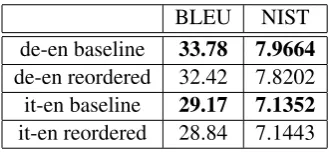
BLEU NIST de-en baseline 33.78 7.9664
de-en reordered 32.42 7.8202 it-en baseline 29.17 7.1352
it-en reordered 28.84 7.1443
Table 2: Translation scores
We applied the reordering preprocessing system to the source side of the corpora and evaluated the monolingual BLEU and NIST score of the test sets (extracted from Europarl) against their reference reordering computed from the alignment
To evaluate translation performance, we trained a Moses phrase-based system on the reordered training and tuning corpora, and evaluated the BLEU and NIST of the (Europarl) test sets. As a baseline, we also trained and evaluated Moses system on the original unreordered corpora.
We also applied our baseline and reordered German-to-English systems to the WMT2013 translation task dataset.
5 Discussion
Unfortunately we were generally unable to im-prove the translation scores over the baseline, even though our monolingual BLEU for German-to-English reordering is higher than the score re-ported by (Tromble and Eisner, 2009) for a com-parable dataset.
Accuracy on the WMT 2013 set is very low. We attribute this to the fact that it comes form a differ-ent domain than the training set.
Since classifier training set cross-validation ac-curacy is high, we speculate that the main problem lies with the training example generation process: training examples are generated only from opti-mal reordering traces. This means that once the classifiers produce an error and the system strays away from an optimal trace, it may enter in a fea-ture space that is not well-represented in the train-ing set, and thus suffer from unrecoverable per-formance degradation. Moreover, errors occurring on nodes high in the parse tree may cause incor-rect placement of whole spans of words, yielding
a poor BLEU score (although a cursory exami-nation of the reordered sentences doesn’t reveal this problem to be prevalent). Both these issues could be possibly addressed by switching from a classifier-based system to a structured predic-tion system, such as averaged structured percep-tron (Collins, 2002) or MIRA (Crammer, 2003; McDonald et.al., 2005).
Another possible cause of error is the purely greedy action selection policy. This could be ad-dressed using a search approach such as beam search.
We reserve to investigate these approaches in future work.
References
Roy Tromble and Jason Eisner. 2009. Learning linear ordering problems for better translation. In Proceed-ings of the 2009 Conference on Empirical Methods in Natural Language Processing: Volume 2 - Vol-ume 2 (EMNLP ’09), Vol. 2. Association for Com-putational Linguistics, Stroudsburg, PA, USA, 1007-1016.
G. Attardi, M. Ciaramita. 2007. Tree Revision
Learn-ing for Dependency ParsLearn-ing. InProc. of the Human
Language Technology Conference 2007.
Peng Xu, Jaeho Kang, Michael Ringgaard, and Franz Och. 2009. Using a dependency parser to improve
SMT for subject-object-verb languages. In
Proceed-ings of Human Language Technologies: The 2009 Annual Conference of the North American Chap-ter of the Association for Computational Linguistics (NAACL ’09). Association for Computational Lin-guistics, Stroudsburg, PA, USA, 245-253.
Dmitriy Genzel. 2010. Automatically learning source-side reordering rules for large scale machine
trans-lation. In Proceedings of the 23rd International
Conference on Computational Linguistics (COL-ING ’10). Association for Computational Linguis-tics, Stroudsburg, PA, USA, 376-384.
Yaser Al-Onaizan and Kishore Papineni. 2006. Dis-tortion models for statistical machine translation. In
Proceedings of the 21st International Conference on Computational Linguistics and the 44th annual meeting of the Association for Computational Lin-guistics (ACL-44). Association for Computational Linguistics, Stroudsburg, PA, USA, 529-536.
Alexandra , Miles Osborne, and Philipp Koehn. 2008.
Predicting success in machine translation. In
BLEU BLEU (11b) BLEU-cased BLEU-cased (11b) TER
de-en baseline 18.8 18.8 17.8 17.8 0.722
[image:6.595.73.464.62.107.2]de-en reordered 18.1 18.1 17.3 17.3 0.739
Table 3: WMT2013 de-en translation scores
Philipp Koehn, Hieu Hoang, Alexandra Birch, Chris Callison-Burch, Marcello Federico, Nicola Bertoldi, Brooke Cowan, Wade Shen, Christine Moran, Richard Zens, Chris Dyer, Ondˇrej Bojar, Alexandra Constantin, and Evan Herbst. 2007. Moses: open source toolkit for statistical machine translation. In
Proceedings of the 45th Annual Meeting of the ACL on Interactive Poster and Demonstration Sessions (ACL ’07).Association for Computational Linguis-tics, Stroudsburg, PA, USA, 177-180.
Hideki Isozaki, Katsuhito Sudoh, Hajime Tsukada, and Kevin Duh. 2010. Head finalization: a simple
re-ordering rule for SOV languages. In Proceedings
of the Joint Fifth Workshop on Statistical Machine Translation and MetricsMATR (WMT ’10). Asso-ciation for Computational Linguistics, Stroudsburg, PA, USA, 244-251.
Michel Galley and Christopher D. Manning. 2008. A simple and effective hierarchical phrase
reorder-ing model. In Proceedings of the Conference on
Empirical Methods in Natural Language Processing (EMNLP ’08).Association for Computational Lin-guistics, Stroudsburg, PA, USA, 848-856.
Karthik Visweswariah, Rajakrishnan Rajkumar, Ankur Gandhe, Ananthakrishnan Ramanathan, and Jiri Navratil. 2011. A word reordering model for
im-proved machine translation. In Proceedings of the
Conference on Empirical Methods in Natural Lan-guage Processing (EMNLP ’11). Association for Computational Linguistics, Stroudsburg, PA, USA, 486-496.
Giuseppe Attardi. 2006. Experiments with a
multi-language non-projective dependency parser. In
Pro-ceedings of the Tenth Conference on Computational Natural Language Learning (CoNLL-X ’06). Asso-ciation for Computational Linguistics, Stroudsburg, PA, USA, 166-170.
Joakim Nivre and Mario Scholz. 2004. Determinis-tic dependency parsing of English text. In Proceed-ings of the 20th international conference on Compu-tational Linguistics (COLING ’04).Association for Computational Linguistics, Stroudsburg, PA, USA, , Article 64 .
Franz Josef Och and Hermann Ney. 2000. Improved statistical alignment models. InProceedings of the 38th Annual Meeting on Association for Computa-tional Linguistics (ACL ’00).Association for Com-putational Linguistics, Stroudsburg, PA, USA, 440-447.
Chih-Chung Chang and Chih-Jen Lin. 2011.
LIB-SVM: A library for support vector machines. ACM
Trans. Intell. Syst. Technol. 2, 3, Article 27 (May 2011), 27 pages.
Rong-En Fan, Kai-Wei Chang, Cho-Jui Hsieh, Xiang-Rui Wang, and Chih-Jen Lin. 2008. LIBLINEAR: A Library for Large Linear Classification. J. Mach. Learn. Res.9 (June 2008), 1871-1874.
Philipp Koehn. 2005. Europarl: A Parallel Corpus for
Statistical Machine Translation. MT Summit 2005.
Ralf Steinberger, Bruno Pouliquen, Anna Widiger, Camelia Ignat, Toma Erjavec, Dan Tufis¸. 2006. The JRC-Acquis: A multilingual aligned parallel corpus
with 20+ languages. In Proceedings of the 5th
In-ternational Conference on Language Resources and Evaluation (LREC’2006).
Michael Collins. 2002. Discriminative training meth-ods for hidden Markov models: theory and
experi-ments with perceptron algorithms. InProceedings
of the ACL-02 conference on Empirical methods in natural language processing - Volume 10 (EMNLP
’02), Vol. 10. Association for Computational
Lin-guistics, Stroudsburg, PA, USA, 1-8.
Ryan McDonald, Koby Crammer, and Fernando Pereira. 2005. Online large-margin training of
de-pendency parsers. In Proceedings of the 43rd
An-nual Meeting on Association for Computational Lin-guistics (ACL ’05). Association for Computational Linguistics, Stroudsburg, PA, USA, 91-98.