D S Sharma, R Sangal and E Sherly. Proc. of the 12th Intl. Conference on Natural Language Processing, pages 316–324, Trivandrum, India. December 2015. c2015 NLP Association of India (NLPAI)
Triangulation of Reordering Tables: An Advancement Over Phrase Table
Triangulation in Pivot-Based SMT
Deepak Patil, Harshad Chavan, Pushpak Bhattacharyya Indian Institute of Technology Bombay, India
{deepakcp,harshadpc,pb}@cse.iitb.ac.in
Abstract
Triangulation in Pivot-Based Statistical Machine Translation(SMT) is a very effec-tive method for building Machine Trans-lation(MT) systems in case of scarcity of the parallel corpus. Phrase Table Triangu-lation helps in such a resource constrained setting by inducing new phrase pairs with the help of a pivot. However, it does not explore the possibility of extracting re-ordering information through the use of pivot. This paper presents a novel method for triangulation of reordering tables in Pivot Based SMT. We show that the use of a pivot can help in extracting better re-ordering information and can assist in im-proving the quality of the translation. With a detailed example, we show that triangu-lation of reordering tables also improves the lexical choices a system makes during translation. We observe a BLEU score im-provement of 1.06 for Marathi to English MT system with Hindi as a pivot, and also significant improvements in 8 other trans-lation systems by using this method.
1 Introduction
Pivot-Based Statistical Machine Transla-tion(SMT) is a crucial and a well known methodology for building Machine Transla-tion(MT) Systems for language pairs that are not so rich in terms of available resources. Low or no availability of parallel corpus for a language pair is one of the main reasons behind following a Pivot-Based approach. Pivot-Based approach makes use of a parallel corpus from source language to some language other than the target language, which is known as a “Pivot language” or simply a “Pivot”, and a parallel corpus from the pivot language to the target language. Key idea
behind using a pivot is, using one or more pivot languages to improve the quality of translation by making use of additional information that the pivot induces. This additional information is mainly in the form of a new set of phrase pairs that are extracted with the help of the pivot language. This method of extracting new phrase pairs in Pivot-Based SMT is known as the Triangulation method.
Current approaches and methods that discuss triangulation generally focus on the triangulation of the phrase tables from source language(source) to pivot language(pivot) and pivot language to tar-get language(tartar-get). This improves the translation quality because of the newly added phrase pairs, but the reordering information for these newly added phrase pairs is not present in the reorder-ing table. The focus of our work is to explore the possibility of extracting the reordering informa-tion for newly added phrase pairs by making use of the pivot language. To the best of our knowl-edge this is the first work that discusses the ap-proaches for triangulation of reordering tables and shows significant improvements.
To begin with, Section 2 discusses the work re-lated to Pivot-Based SMT and the Triangulation method. We then provide a background for our ap-proaches for reordering table triangulation in Sec-tion 3. SecSec-tion 4 discusses the mathematics in-volved in these approaches. We describe our ap-proaches viz. Table Based approach and Count Based approach in detail, in Section 5. Section 6 explains the experimental setup. Results of our experiments are shown in Section 7 along with the discussion of those results. We conclude our work in Section 8 and also point out a few directions for future work.
2 Related Work
(2006) demonstrated the use of pivot languages for extracting better word alignments when a source-target parallel corpus is either unavailable or is very small in size. Wu and Wang (2007) proposed the entire formulation for a pivot based approach and triangulation of phrase tables and showed that a pivot can be used for inducing new phrase pairs that were not extracted while building a phrase ta-ble from the training corpus. This forms a basis for a valid speculation that, pivot may also prove to be useful in extracting reordering information.
Several strategies have been proposed for the use of a pivot. Utiyama and Isahara (2007) pro-posed two strategies, a phrase translation strat-egy that is similar to the triangulation method and a sentence translation strategy that makes use of two different MT systems - one from source-pivot and other from source-pivot-target. They showed through their experiments that the phrase trans-lation strategy performs significantly better than the sentence translation strategy. Wu and Wang (2009) additionally introduced a Synthetic Method for Pivot based SMT, that synthesizes the source-target corpus from source-pivot and pivot-source-target corpora. It was found through their experiments that the Triangulation Method outperforms the Sy-thetic method as well. This encouraged us to focus our work on the triangulation approach.
Nakov and Ng (2012) showed that merging the phrase tables by giving priority to the original ta-ble that is extracted from a direct parallel cor-pus(direct table) and using additional features is a good strategy. In case of an interpolation, it refers to giving higher weight values to the translation probabilities from a direct source-pivot phrase ta-ble. Dabre et al. (2015) studied the use of more than one pivots simultaneously. They also men-tioned that the use of pivot for reordering would be an interesting problem.
The reordering model on which we focus in our work is a lexicalized reordering model dis-cussed by Koehn et al. (2005). Lexicalized re-ordering was first proposed by Tillmann (2004). Similar approach was suggested by Ohashi et al. (2005). Mirkin (2014) proposed several ways for incrementally updating the lexicalized reordering model when new training data is introduced and described a way to combine new and existing re-ordering models. To the best of our knowledge, no work has been done on triangulation of reordering tables in specific.
3 Background for Our Approaches
Our aim is to generate a source language to target language reordering table given a source language to pivot language reordering table and a pivot lan-guage to target lanlan-guage reordering table. This is called as Triangulation of Reordering tables or Re-ordering Table Triangulation. In this paper, we propose two approaches for triangulation of re-ordering tables. Both of them make use of reorder-ing tables, which have a peculiar format in Moses, a statistical machine translation system (Koehn et al., 2007). Before going forward with the descrip-tion of our approaches, we explain the concepts of reordering orientations and give a short overview of the structure of a reordering table in Moses.
3.1 Reordering Orientations: Monotone, Swap and Discontinuous
Moses implements reordering using three kinds of orientations - Monotone, Swap and Discontinu-ous (Koehn et al., 2005; Koehn, 2009). For each phrase and its corresponding translation, there are three possible orientations.
LetS1, S2be phrases in source sentence,T1, T2
be their corresponding translations in the target sentence andT1be a phrase that immediately
pre-cedes T2 in the target sentence. Then for the
phrase pair(S2, T2)the orientation is :
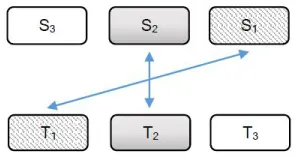
• Monotone, ifS1is a phrase that immediately
[image:2.612.349.496.466.547.2]precedesS2in the source sentence.
Figure 1: Monotone Orientation
• Swap, ifS1is a phrase that immediately
[image:2.612.350.498.625.703.2]suc-ceedsS2in the source sentence.
• Discontinuous, ifS1andS2are not adjacent
[image:3.612.116.263.73.150.2]to each other in the source sentence.
Figure 3: Discontinuous Orientation
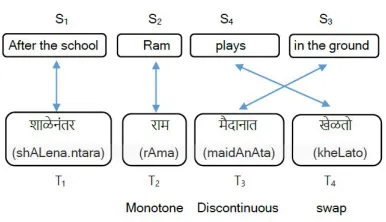
Let us consider sentences from English-Marathi language pair shown in Figure 4.
Figure 4: Example depicting all orientations
As per the definitions discussed above, the ori-entation exhibited by the phrase pair (Ram,rAm) is a monotone since, the translation of the previous phrase ofrAm i.e. ‘After the school’ is also the previous phrase of ‘Ram’. Similarly by definition, (plays,Kto) has a swap orientation and (in the ground,m{dAnAt) has a discontinuous orientation.
3.2 Structure of a Reordering Table in MOSES
As discussed in subsection 3.1, for each phrase pair, there are three reordering orientations pos-sible. A typical reordering table in Moses consists of all such phrase pairs and their respective prob-ability values for monotone, swap and discontinu-ous orientations.
Following is a sample entry from English-Marathi reordering table.
By looking|||pAEhSyAvr|||0.2 0.2 0.6 0.2 0.2 0.6
The first three values are the probability val-ues of a phrase pair (By looking, pAEhSyAvr) being a monotone, swap and discontinuous re-spectively, with respect to the previous phrase of
pAEhSyAvr(pAhilyAvara) in the target sentence. The next three values are the probability values of a phrase pair (By looking,pAEhSyAvr) being a monotone, swap and discontinuous respectively,
with respect to the next phrase ofpAEhSyAvr in the target sentence.
Reordering table is used during decoding to score the candidate translations. Scoring a partic-ular candidate translation for reordering, involves scoring each phrase with respect to its previous and next phrase. This along with the Language Model, boosts up the scores assigned to better or-dered candidate translations.
3.3 Objective of the Approach
Our objective is to determine the probability val-ues discussed in Subsection 3.2, for phrase pairs that are newly extracted by phrase table triangu-lation, given the source-pivot and pivot-target re-ordering tables.
We propose two approaches for doing this. Our first approach only assumes the availability of two reordering tables mentioned above, whereas the second approach assumes the availability of a mul-tilingual parallel corpus that is used for training, in addition to the two reordering tables.
4 Mathematical Formulation
For a language pair L1 −L2, (A, B) is a phrase
pair if phrase A from L1 translates to phrase B
from L2. We will use the notation O(A → B)
to denote the orientation of a phrase pair (A, B). The possible values of O are{M,S,D}.
Where,
M(A→B): (A, B) has a Monotone orientation S(A→B): (A, B) has a Swap orientation
D(A→B): (A, B) has a Discontinuous orientation For the discussion in this section, let X,Y and Z be the phrases from source, pivot and target lan-guages respectively which are all translations of each other. In other words, (X, Y) is phrase pair from source to pivot, (Y, Z) is a phrase pair from pivot to target and (X, Z) is a phrase pair from source to target.
Let us assume that (X, Z) is a phrase pair that was not originally present in the phrase table and was induced during the phrase table triangulation process. Then our task is to determine the proba-bility valuesP[M(X →Z)],P[S(X → Z)]and P[D(X → Z)] in order to include an entry for phrase pair (X, Z) in the reordering table.
[image:3.612.93.286.230.341.2](Y, Z) respectively.
Marginalizing over these variables we get,
P[M(X →Z)]=
P Y O(X→Y)
O(Y→Z)
P[M(X→Z), O(X→Y), O(Y→Z)]
(1) Applying the chain rule, we get,
P[M(X →Z)]=
P Y O(X→Y)
O(Y→Z)
P[M(X→Z)|O(X→Y), O(Y→Z)]. P[O(X→Y), O(Y→Z)]
(2) Since,O(X → Y)andO(Y → Z)are
indepen-dent of each other, applying this independence assumption on second term, we get
P[M(X →Z)]=
P Y O(X→Y)
O(Y→Z)
P[M(X→Z)|O(X→Y), O(Y→Z)]. P[O(X→Y)].P[O(Y→Z)]
(3)
P[O(X → Y)] and P[O(Y → Z)] are the
reordering probability values from source-pivot and pivot-target and are directly available from the reordering tables that are used for triangulation. The first term i.e.
P[M(X→Z)|O(X→Y), O(Y→Z)]
called a “Multiplicative Factor” henceforth, is a probability that for a particular orientation of
O(X →Y)andO(Y →Z), source-target
orien-tation for (X, Z) is a Monotone, in case of the cal-culation above. We worked out the mathematics for probability of (X, Z) being a Monotone. Sim-ilar calculations can be performed for determin-ing the Swap and Discontinuous probability val-ues. Therefore, similar kind of terms will exist for Swap and Discontinuous as well. The value for the Multiplicative Factor is not directly available to us. For calculating this value we propose two approaches in this paper.
5 Description of the Approaches
For calculating the Multiplicative Factor in Equa-tion 3 we can follow one of the two paths, one is called aTable Based Approachand the other is calledCount Based Approach.
5.1 Table Based Approach
This approach only assumes the availability of two reordering tables: a source language to pivot lan-guage reordering table and a pivot lanlan-guage to tar-get language reordering table. Based on all possi-ble source-pivot and pivot-target orientations, we designed an “Orientation Table” of all possible source-target orientations, which is shown in Ta-ble 1.
M S D
Monotone (M) M S, D S, D
Swap (S) S M, D M, D
Discontinuous (D) D M ,S, D M, S, D
Table 1: Orientation Table
The rows of the Orientation Table(Oi 0s) rep-resent different orientations for a source-pivot phrase pair and the columns(Oj 0s) represent dif-ferent orientation for a pivot-target phrase pair, where the pivot phrase is common. A cell which is in rowOi and columnOj lists all possible orien-tations from source-target when source-pivot ori-entation is Oi and pivot-target orientation is Oj. For example, assume that S, P, T are phrases from source, pivot and target languages respectively and are translations of each other. If the source-pivot orientation is a monotone for phrase pair (S, P) and the pivot-target orientation is swap for phrase pair (P, T), then for phrase pair (S, T) the orientation can either be a Swap or a Discontinuous. We stud-ied numerous examples from the most general sce-narios as well as from specific language pairs, in order to create this table.
We use this table for determining the Multi-plicative Factor by looking up into the appropri-ate cell of the table while doing the computation. We also assume that if there are more than one orientations in a particular cell then all of them are equally likely. We have observed that there might be some wrong translations in the training data because of which the orientations which are not present in a particular cell may also be exhib-ited by some phrases in some situations, although, such occurrences are few in number. To factor in for such discrepancies, we assume that orien-tations present in the cells of the above table are the “most probable” ones and other orientations are also possible with a very small probability.
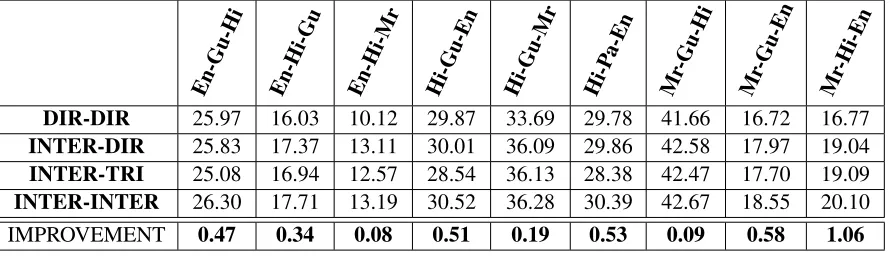
En-Gu-Hi En-Hi-Gu En-Hi-Mr Hi-Gu-En Hi-Gu-Mr Hi-P a-En
Mr-Gu-Hi Mr-Gu-En Mr-Hi-En DIR-DIR 25.97 16.03 10.12 29.87 33.69 29.78 41.66 16.72 16.77
INTER-DIR 25.83 17.37 13.11 30.01 36.09 29.86 42.58 17.97 19.04
INTER-TRI 25.08 16.94 12.57 28.54 36.13 28.38 42.47 17.70 19.09
INTER-INTER 26.30 17.71 13.19 30.52 36.28 30.39 42.67 18.55 20.10
[image:5.612.83.528.38.166.2]IMPROVEMENT 0.47 0.34 0.08 0.51 0.19 0.53 0.09 0.58 1.06
Table 2: BLEU Scores for Count Based Approach
(IMPROVEMENT row shows improvement in INTER-INTER system over INTER-DIR system)
swap, then the multiplicative factor while calculat-ing probability of (S, T) becalculat-ing a monotone i.e.
P[M(S → T)|M(S → P), S(P → T)] can be
assigned a small value, say 0.1, since monotone is not listed in the cell.
The other two orientations are assumed to be equally likely, so in this case
P[S(S →T)|M(S →P), S(P →T)] = 0.45
and
P[D(S →T)|M(S →P), S(P →T)] = 0.45
5.2 Count Based Approach
This approach assumes the availability of two reordering tables and the source-pivot-target multilingual parallel corpus that is used for training. By using the definition of probability, the Multiplicative Factor in equation (3) can be written as
P[M(S→T)|O(S →P), O(P →T)]
= count[M(S →T), O(S→P), O(P →T)]
count[O(S→P), O(P →T)]
Here the numerator is the count of the num-ber of occurrences where phrase pair (S, T) has a monotone orientation when phrase pair (S, P) has a particular orientationO1 and (P, T) has an
ori-entationO2. The denominator is the count of the
number of occurrences where phrase pair (S, P) has a particular orientationO1 and (P, T) has an
orientationO2.
Basic idea in the Count Based Approach is to extract these kind of counts from the corpus for each source-target phrase pair. For extracting these counts, say for a phrase pair (S, T), we need to look at the phrases which immediately precede or succeed phrase T in a target sentence and the position of their translations with respect to the position of phrase S in the source sentence. The
counts have to be extracted for each phrase pair and have to be stored separately in order to lookup while doing the computations for reordering table triangulation using this approach. This approach seems more intuitive since we use the parallel cor-pus for getting the count values and therefore we are likely to get more accurate values for the mul-tiplicative factor.
6 Experimental Setup
We performed several experiments with both the approaches discussed in section 5. The parallel corpus used for the experiments was a Health and Tourism domain multilingual parallel corpus (Jha, 2010) which was divided into a training corpus of 46000 sentences, a tuning corpus of 500 sentences and a test corpus of 2000 sentences. The reason behind using a small sized corpus for our experi-ments is that, often in a realistic scenario, obtain-ing a large sized multilobtain-ingual parallel corpus is dif-ficult.
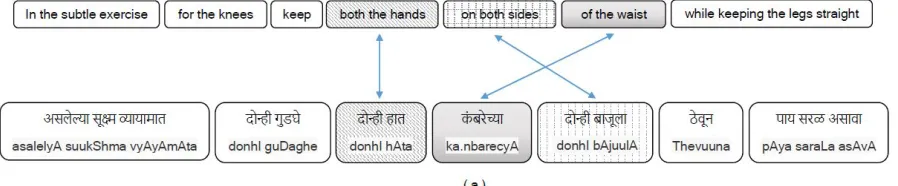
Figure 5: Sample Translation from English-Hindi-Marathi INTER-DIR MT System
tained by linear interpolation of values from Direct Phrase Table and Triangulated Phrase Table. In-terpolation of reordering tables can be performed either by linear interpolation or by Fill-up interpo-lation (Dabre et al., 2015) of Direct and Triangu-lated Reordering Tables. With this terminology in place, below is a small description of each system.
• DIR-DIR: This system uses a Direct Phrase
Table and a Direct Reordering Table.
• INTER-DIR : This system uses an Interpo-lated Phrase Table and a Direct Reordering table.
• INTER-TRI : This system uses an Interpo-lated Phrase Table and a TrianguInterpo-lated Re-ordering table.
• INTER-INTER: This system uses an
Inter-polated Phrase Table and an InterInter-polated Re-ordering table.
7 Results and Discussion
We performed experiments for both Table Based and Count Based approaches. The improvements were observed from the quantitative point of view in the BLEU scores (Papineni et al., 2002) -as well -as from the qualitative point of view - in the reordering of the translation that a system pro-duces and better lexical choice in the translation.
7.1 Improvements in BLEU Scores
For the table based approach, we found an im-provement of 0.48 in the BLEU score from 17.98 for DIR system to 18.46 for INTER-INTER system, for Marathi to English transla-tion when Gujarati is used as a pivot. Small im-provements were also observed for other systems,
like Hindi-Gujarati-English (0.4), Hindi-Punjabi-English (0.33) and Hindi-Gujarati-Marathi (0.16). The improvements in other five systems were not as significant as these. This was an expected pat-tern in the results since, the Table Based approach does not actually look at the training data while calculating the Multiplicative Factor. In this ap-proach, Multiplicative Factor is calculated based on the Orientation Table which is training data in-dependent. Therefore, the approach was expected to perform better in some situations than others.
On the other hand, the Count Based approach extracts the counts for orientations from the train-ing corpus. Thus the calculated Multiplicative Factor is more accurate as compared to the Table Based approach. So we expected the Count Based approach to outperform the Table Based and pro-duce an improvement in the BLEU score for most of the source-pivot-target language combinations. This is indeed the case and the results for Count Based approach are shown in Table 2. The im-provements vary with language combinations be-cause of the difference in the quality of the counts that are extracted for each combination.
Figure 6: Sample Translation from English-Hindi-Marathi INTER-INTER MT System
ble which mostly contains entries for only newly extracted phrase pairs. INTER-INTER systems perform better as expected, since knowledge from both, Direct and Triangulated Reordering tables is combined and used in these systems.
7.2 Qualitative Improvement in Reordering
Let us closely look at an actual translation exam-ple from the test corpus to clearly understand, how calculating reordering probability values for newly added phrase pairs helps in improving the quality of translation. It must be noted that, although the reordering information is not available for newly added phrase pairs in INTER-DIR system, they may still end up being a part of the best possible translation because of other factors involved such as Phrase Translation Probability and Language Model. For example, a newly induced phrase pair may have higher phrase translation probabil-ity than other phrase pairs, which results in that phrase being a part of the best candidate transla-tion. This phenomenon is responsible for the im-provement that is achieved by INTER-DIR system over DIR-DIR system.
Figure 5(a) shows the translation example from English-Hindi-Marathi INTER-DIR system and Figure 6(a) shows the translation example from English-Hindi-Marathi INTER-INTER sys-tem. From the phrase tables, we observed that the phrase pair (of the waist,k\brQyA) was added through triangulation of phrase tables. So, in INTER-DIR system, there are no reordering prob-ability values available for this phrase pair, but in the INTER-INTER system, the reordering table has an entry for this phrase pair with reordering probability values. Figure 6(b) shows that reorder-ing table entry for this phrase pair.
The translation produced by INTER-DIR sys-tem shown in Figure 5(a), will also be produced as a candidate translation by INTER-INTER sys-tem, but the INTER-INTER system discards it to choose the translation shown in Figure 6(a) as the best translation, since the reordering probability values for the new phrase pair play a vital role. If we look at figure 5(b), the reordering probabil-ity values for (the waist,k\br) favour discontinu-ous orientation with respect to the previdiscontinu-ous phrase and monotone orientation with respect to the next phrase. But the translation that is generated has a discontinuous orientation for the phrase k\br
with respect to both previous and next phrases. Since the generated candidate is not in accordance with the values from reordering table, the candi-date gets a relatively lesser score.
On the other hand, if we look at Figure 6(b), the reordering probability values for (of the waist,
k\brQyA) favour discontinuous orientation with respect to the previous phrase and swap orienta-tion with respect to the next phrase. The transla-tion that is generated as a candidate, shown in Fig-ure 6(a), also has discontinuous orientation with respect to the previous phrase and swap orienta-tion with respect to the next phrase, for the phrase
k\brQyA. Since the candidate is in accordance with the values from reordering table, the candi-date gets a higher score as compared to the earlier candidate. There are also other factors like trans-lation model and language model that contribute to the computation, but in this example the contri-bution by reordering probabilities is distinctly ev-ident. We can see that the inclusion of reordering information for newly added phrase pair has also inducedbetter lexical choicesin the translation.
6(a) being selected as the best translation. It can be easily observed that the translation is a better one in terms of reordering. This shows that our ap-proach works well to improve the quality of trans-lation.
Following is another example from Marathi-Hindi-English system that shows qualitative improvement in the reordering of phrases in the output translation.
Input:
Kp afkt asnhF z`ZAlA aApl vяn яA-t vAVt.
(khuupa ashakta asuunahI rugNAlA Apale vajana jAsta vATate .)
English Equivalent (Reference):
Patient thinks his / her weight to be too much even on being very weak .
Output of INTER-DIR System:
Despite weight of the patient has to be extremely weak .
Output of INTER-INTER System:
despite being very weak patient feels more your weight .
It is evident from the example that the output of INTER-INTER system is better ordered than the output of INTER-DIR system. Except for the word “your”, the meaning of the source sentence is better conveyed by the output of INTER-INTER system.
8 Conclusion and Future Work
The issue of data scarcity has been addressed ef-fectively by Phrase Table triangulation. In this paper we went a step further and proposed two new approaches for the triangulation of reorder-ing tables viz. Table Based approach and Count Based approach. We conducted experiments with both these approaches on 9 different translation systems, each using a different combination of source-pivot-target languages and found signifi-cant improvements in the BLEU scores for most of the systems. We also discussed actual translation examples that showed a qualitative improvement in the reordering of the output, thereby vindicating the fact that better reordering information can be extracted through a pivot. Examples also showed that the lexical choices made by the system
im-proved when our approach was used. We also ob-served that Count Based approach performed bet-ter than Table Based approach for most of the lan-guage combinations.
The focus of our work was on finding the re-ordering probability values for phrase pairs that are newly added to the phrase table through the use of a pivot. The question that remains is, whether a pivot can help beyond extracting these reordering values. Another interesting question is whether this approach scales well to a scenario where more than one pivots are used simultaneously. We will try to focus on these points in the future.
Acknowledgement
We would like to thank Mr. Anoop Kunchukut-tan and Mr. Rohit More from Centre For Indian Language Technology, IIT Bombay for their valu-able inputs and suggestions and for the insightful discussions on the topic.
References
Raj Dabre, Fabien Cromieres, Sadao Kurohashi, and Pushpak Bhattacharyya. 2015. Leveraging small multilingual corpora for smt using many pivot lan-guages. In Proceedings of the 2015 Conference of the North American Chapter of the Association for Computational Linguistics: Human Language Technologies, pages 1192–1202, Denver, Colorado, May–June. Association for Computational Linguis-tics.
Girish Nath Jha. 2010. The tdil program and the indian language corpora initiative (ilci). InProceedings of the Seventh Conference on International Language Resources and Evaluation (LREC 2010). European Language Resources Association (ELRA).
Philipp Koehn, Amittai Axelrod, Alexandra Birch, Chris Callison-Burch, Miles Osborne, David Talbot, and Michael White. 2005. Edinburgh system de-scription for the 2005 iwslt speech translation eval-uation. InIWSLT, pages 68–75.
Philipp Koehn, Hieu Hoang, Alexandra Birch, Chris Callison-Burch, Marcello Federico, Nicola Bertoldi, Brooke Cowan, Wade Shen, Christine Moran, Richard Zens, et al. 2007. Moses: Open source toolkit for statistical machine translation. In Pro-ceedings of the 45th annual meeting of the ACL on interactive poster and demonstration sessions, pages 177–180. Association for Computational Linguis-tics.
Philipp Koehn. 2009. Statistical machine translation. Cambridge University Press.
Shachar Mirkin. 2014. Incrementally updating the smt reordering model. InProceedings of The 28th Pa-cific Asia Conference on Language, Information and Computing (PACLIC), Phuket, Thailand.
Preslav Nakov and Hwee Tou Ng. 2012. Improv-ing statistical machine translation for a resource-poor language using related resource-rich languages.
Journal of Artificial Intelligence Research, pages 179–222.
Kazuteru Ohashi, Kazuhide Yamamoto, Kuniko Saito, and Masaaki Nagata. 2005. Nut-ntt statistical ma-chine translation system for iwslt 2005. InIWSLT, pages 118–123.
Kishore Papineni, Salim Roukos, Todd Ward, and Wei-Jing Zhu. 2002. Bleu: a method for automatic evaluation of machine translation. InProceedings of the 40th annual meeting on association for compu-tational linguistics, pages 311–318. Association for Computational Linguistics.
Christoph Tillmann. 2004. A unigram orientation model for statistical machine translation. In Pro-ceedings of HLT-NAACL 2004: Short Papers, pages 101–104. Association for Computational Linguis-tics.
Masao Utiyama and Hitoshi Isahara. 2007. A compari-son of pivot methods for phrase-based statistical ma-chine translation. InHLT-NAACL, pages 484–491. Citeseer.
Haifeng Wang, Hua Wu, and Zhanyi Liu. 2006. Word alignment for languages with scarce resources us-ing bilus-ingual corpora of other language pairs. In
Proceedings of the COLING/ACL on Main confer-ence poster sessions, pages 874–881. Association for Computational Linguistics.
Hua Wu and Haifeng Wang. 2007. Pivot language ap-proach for phrase-based statistical machine transla-tion.Machine Translation, 21(3):165–181.
Hua Wu and Haifeng Wang. 2009. Revisiting pivot language approach for machine translation. In Pro-ceedings of the Joint Conference of the 47th Annual Meeting of the ACL and the 4th International Joint Conference on Natural Language Processing of the AFNLP: Volume 1-Volume 1, pages 154–162. Asso-ciation for Computational Linguistics.